Today, rain and fog disrupt operations at Quebec City’s Jean Lesage International Airport. The conditions are at their minimum for take off and landing. But the captain of this Air Transat’s flight decides to proceed as the weather improves momentarily.
The passenger jet will take off from runway 06. But the airstrip is soaked. When the pilot applies power, we will only see water spray across the entire picture. A better choice is to focus on the A321neo as it taxis slowly.
Photography Tips
Since the sky isn’t particularly captivating due to its uniform gray colour, it becomes imperative to find something else to increase interest to the scene. The runway lights will do the trick. By including them in the foreground of the photo, they add life and frame the aircraft as it joins the runway.
I avoid photographing the plane directly from the side or from behind, as the effect is a bit static. Entering the runway at an angle offers a better alternative. Furthermore, it is not necessary to show the entire fuselage of the Airbus for a good shot.
With just a uniform gray sky, part of the aircraft, and a few runway lights, it becomes possible to produce a shot with more dynamism.
Click on the link for more aviation-related photos on my blog. There are also photo galleries for enthusiasts in the menu.
During summer 2025, several large aircraft scheduled to land at Montreal Airport had to divert to Quebec City Jean Lesage International Airport (CYQB). Numerous thunderstorms disrupted arrivals and departures at the main airports in the province of Quebec.
The extreme weather in the west gradually moved eastward. This delayed and even cancelled the departure of many planes in Quebec City.
When most of the storms finally passed over Quebec City airport in the evening, an Air Canada Boeing 777-300 ER took off from runway 24 to fly its passengers back to Montréal.
In the background, Air Transat aircraft can be observed. The Swiss Air logo can also be noticed on an Airbus A330-343. It had come from Zurich and was further diverted to Quebec City, along with an Air France Boeing 777-228 LR and a few others.
Below, we see the Boeing 777-300 ER refuelling at a time when extreme weather conditions have not yet reached the airport. Two Avjet tanker trucks are standing near the aircraft. The height of each truck is less than the internal diameter of the Boeing’s engines. For several years, this aircraft held the record for the largest engines on a civil aircraft. Now, the Boeing 777X has taken the crown.
Air Canada B777-300ER refueling at the Quebec Jean-Lesage international airport.
Photography Technique
Both photos required some compromises. Everything works if you accept being completely soaked and working with both feet in the water along a metal barrier with lightning flashing here and there. For some photos, the session lasted two hours.
I took the shots from a hole in the airport fence. My Canon EF 300 mm f/2.8L IS II USM lens was protected by a plastic bag tightly wrapped around the lens hood.
A frequency scanner provided data about air traffic. A controller informed an Air France pilot that such a situation of aircraft diversions during extreme weather had not been seen in several years.
I set my full-frame camera to produce only RAW images. Focusing was done in SERVO mode. I reduced the depth of field to optimize speed and limit the size of the photographic grain (ISO).
When selecting photos, I preferred the one showing the Boeing taking off, but where the Swiss airline’s logo is still visible. It was important to highlight the aircraft’s presence in Quebec City.
The Kingfisher is equipped with sensors that can locate objects or people up to a distance of 40 kilometers, even in low light conditions. Its range allows it to remain in flight for over 4,500 kilometers.
Photography tips
I arrive too late at Quebec City airport: the plane is already parked. However, information obtained from the pilots indicates that takeoff is scheduled within the next hour on runway 06.
Ground traffic provides excellent opportunities to photograph an aircraft while benefiting from an interesting background. The photography technique required for this first visit by the Kingfisher is really basic.
Communications with the control tower indicate when the CC-295 is starting up. It will stop just before entering runway 06. A 200mm telephoto lens would normally do the trick, provided the ISO is not too high. But today, I am trying out a recent acquisition: a Canon EF 300mm f/2.8 L IS II USM fixed telephoto lens.
In the middle of the day, a photographer deals more with the quantity of light than its quality. However, the goal here is not to capture a bouquet of flowers or a wedding, so the harsh light should be fine. The flamboyant color of the aircraft will distract attention from the lack of interest in the ambient light.
With the shutter speed reduced to 1/125 and the ISO set to 200, I wait for the moment when the Kingfisher is opposite the control tower. This will provide a high-quality background. Twenty photos later, the plane is nothing more than a memory.
All afternoon, planes land without any significant vortices. Then a CRJ9 flies overhead, leaving two beautiful swirls behind it. I place my camera between the two bars of the airport fence along Jean Gauvin Road and take a few shots.
Photography technique
I use a Canon 5DSR full-frame camera with ISO set to 200. The autofocus is set to SERVO mode. A shutter speed of 1/1000 is sufficient to follow the jet as it flies away. Cropping will then be necessary to bring the aircraft closer and position the vortices appropriately.
It is best to keep the runway lights in the frame to add more dynamism to the scene. They help to better situate the environment in which the CRJ9 is located at the moment the vortices appear.
The Dash 8-400 is also known as the DH8D or Q400 (Q standing for “quiet”). It is pictured here at the threshold of Runway 29 at Quebec City’s Jean Lesage International Airport. It is awaiting takeoff clearance.
PAL Airlines DH8D aircraft and Pascan Saab-340B at the Québec Jean-Lesage international airport.
Photography technique
I focus on the back of the aircraft. The limited depth of field blurs the rest of the image. The shutter speed is between 1/80 and 1/125, so as not to freeze the propellers. The result is a more dynamic photo.
With the plane’s back to the camera, interest is limited unless something special is happening. The frequency scanner indicates that a Pascan Saab-340 (SF32) will shortly be taking off from runway 24. With a bit of luck, I’ll be able to capture it and include it in the shot of the Q400.
A few seconds later, the aircraft enters the lens’ field of vision. The idea is to capture it while it’s still vis-a-vis the gasoline fumes from the engines. I took a few photos and kept the one with the best photographic composition.
Below is a photo of an Air Canada Rouge aircraft taking off from 24 after a heavy downpour.
An Air Canada Rouge Airbus jet takes-off from a wet runway at the Québec Jean-Lesage international airport.
This time, there’s no question of limiting the shutter speed to 1/125. The plane has no propellers, so you can choose 1/1000 without making a mistake. For greater dynamism, wait until the nose of the plane starts to lift. You can also keep a long trail of water splashes.
Finally, it’s often best to show a bit of landscape in the foreground to better situate the aircraft in its environment.
Click on the link for more aircraft photos on my blog. There are also photo galleries in the menu.
The day after Quebec’s national holiday, the Snowbirds make a few flybys over Quebec City. Although not an air show per se, their formation flights always dazzle the crowds.
The Quebec flag, the Price Building and the Snowbirds in flight in Quebec City
Photography technique.
As the flight over the city takes place at around 17:00, it’s a good idea to position yourself so as not to have to pose against the sun. Normally, a photographer located in Lévis captures excellent shots of Snowbirds passing by the Château Frontenac. But at 5:00 p.m. with the sun directly in front of you, all plane photos taken from the south shore mean uninteresting washed-out skies and far too strong contrasts. Snowbirds deserve better.
Considering the position of the sun, the citadel is the best location for a successful photo session. The light comes from behind as the aerobatic team flies over the St. Lawrence River, around the Château Frontenac and towards the Dufferin Terrace.
The Snowbirds are in flight formation near Château Frontenac in Quebec City.
Spectators know that the performance will only last about fifteen minutes. A photographer needs to prepare accordingly to maximize the chances of getting some memorable shots.
Photography theory
I use a Canon 70-200 mm f2.8L IS II USM lens to give me better leeway between the distant and close passages of the nine military jets. Coupled with a Canon 5 DSR full-frame camera, a quality zoom produces surprising results. You can crop at will without losing definition, provided the initial ISO is 200 and the shutter speed is fast enough. You don’t really need to go beyond 1/1000.
The Snowbirds in flight formation approach the Dufferin terrace in Quebec City.
With Canada Day a few days later, I now have an interesting photo of the Snowbirds and the Canadian flag.
Snowbirds in flight and the Canadian flag over the citadel of Quebec City.
The flight simulation with Microsoft Flight Simulator lets you fly over the planet like never before from the comfort of your own home. As airports around the world transmit weather observations at all times, it’s possible to import this data into the flight simulator and fly virtually in the real weather conditions reported around the globe.
This data enhances the feeling of reality for the virtual pilot, but at the same time complicates his task, as he has to take into account the presence of thunderstorms and icing, surface and upper-level winds, changes in cloud cover, visibility, pressure, and so on.
Today’s virtual pilot must also anticipate that failures of all kinds may affect the flight, especially if he or she owns a high-quality virtual aircraft. The engine(s) may fail, a structural problem may affect the aircraft’s controls and navigation equipment may cease to function. Good planning is essential, just as in real life. And since the brain doesn’t differentiate too much between the real and the virtual, there’s plenty of fun to be had.
So, I’ve decided to fly around the world as a millionaire, at my own pace, i.e., using the types of aircraft that tempt me, and flying the routes that are of particular interest. All of this will be done in real weather, with all its joys and obstacles. I’ll be publishing one of these routes on my blog from time to time.
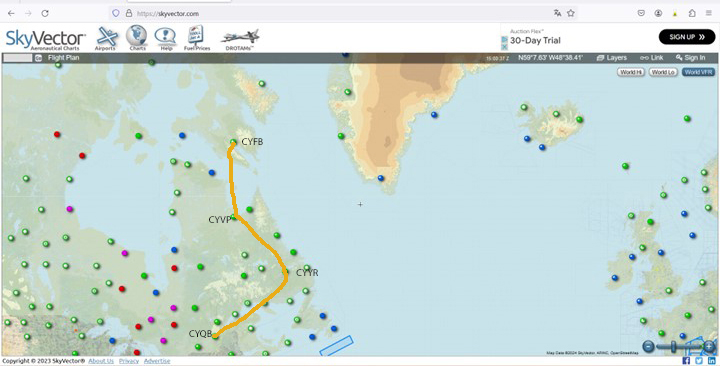
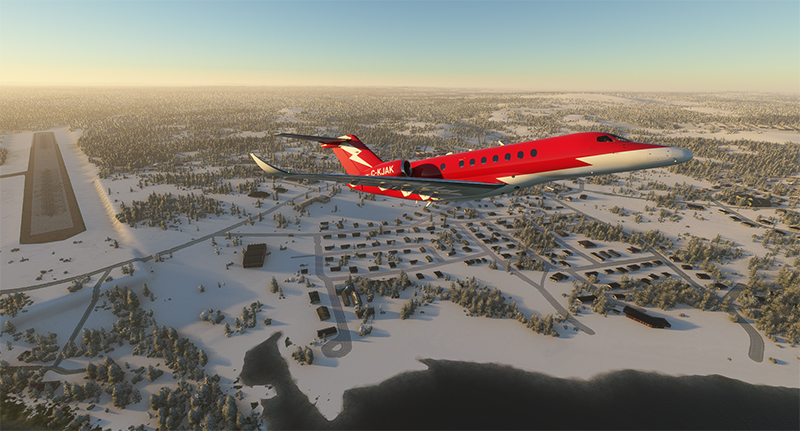
The initial route departs from Quebec’s Jean-Lesage airport (CYQB), passes through Goose Bay (CYYR), in the Canadian province of Newfoundland and Labrador, heads north to Kuujjuaq and ends in Iqaluit (CYFB).
Virtual Flight 2 will present a few photos of the Atlantic crossing from Iqaluit to Kangerlussuaq (BGSF) in Greenland, to Isafjordur (BIIS) in Iceland .
Isafjordur airport has a challenging approach. I don’t know if the Cessna Citation Longitude will be able to land there in one piece, but I intend to give it a try.
Virtual flight 1.
Virtual flights CYQB CYYR CYVP CYFB
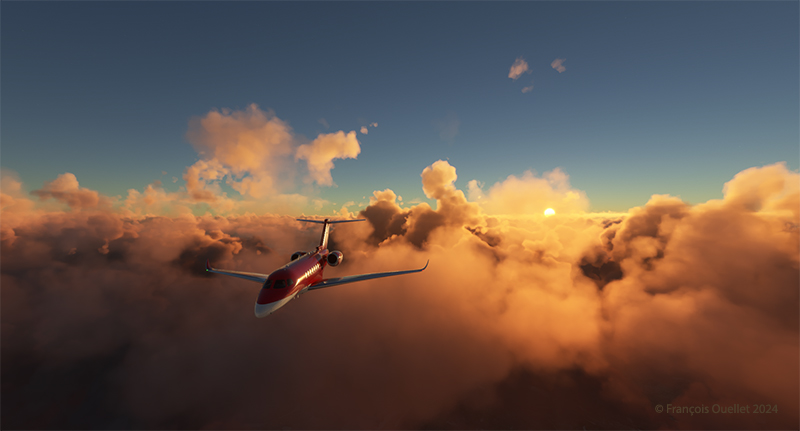
Enroute from Quebec City (CYQB) to Goose Bay (CYYR)
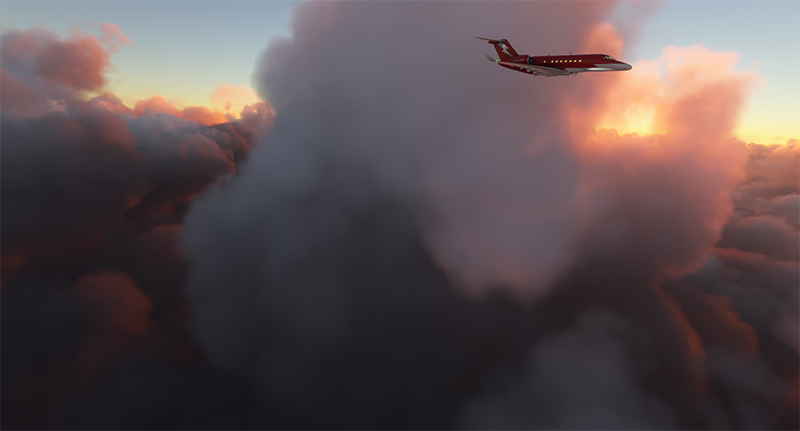
Above, the setting sun illuminates the clouds and the Cessna Citation Longitude en route from Quebec City to Goose Bay. At high altitude, the pilot sets the altimeter to the standard atmospheric pressure of 29.92 inches of mercury. Since all the other pilots are doing the same, a safe separation between the aircraft is ensured.
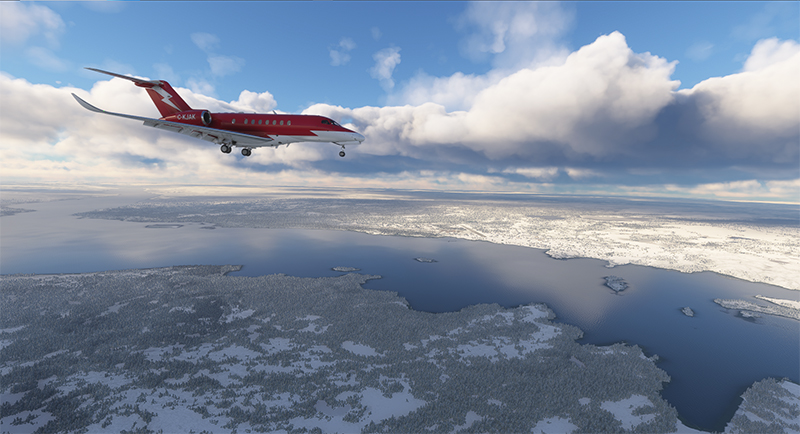
Approaching the Kuujjuaq airport (CYVP) in Quebec.
The next day, the aircraft is seen approaching Kuujjuaq (CYVP) in Nunavik. The altimeter is set to the airport’s atmospheric pressure to reflect the correct height of the runways in relation to the aircraft. Near the airport, the autopilot is disconnected, and the approach is made manually and visually. The desired speed is around 135 knots for the final.
Departing Kuujjuaq airport (CYVP) with the Cessna Citation Longitude
Above, the jet takes off from Kuujjuaq bound for Iqaluit (CYFB) on Baffin Island in Nunavut.
Enroute to Iqaluit airport (CYFB)
The setting sun illuminates the aircraft’s windows. The approach to Iqaluit has begun. The descent is gradual, so as not to cause discomfort to the virtual passengers…
On final for runway 34 of the Iqaluit airport (CYFB)
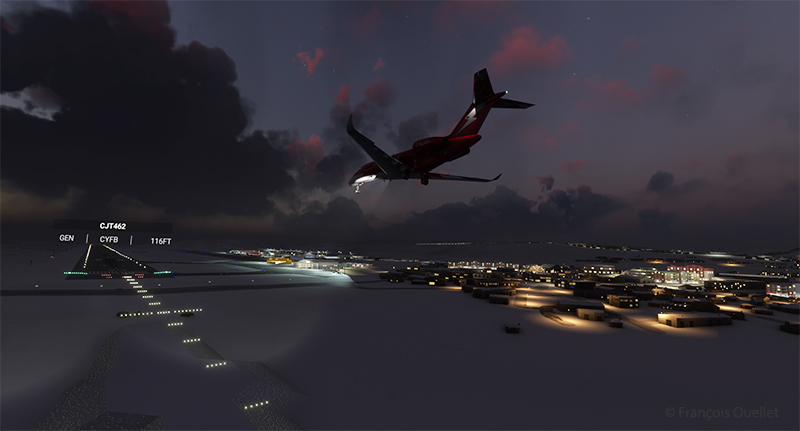
Above, the aircraft is on final for runway 34 at Iqaluit (CYFB).
The yellow Iqaluit flight service station (FSS) in Iqaluit (CYFB)
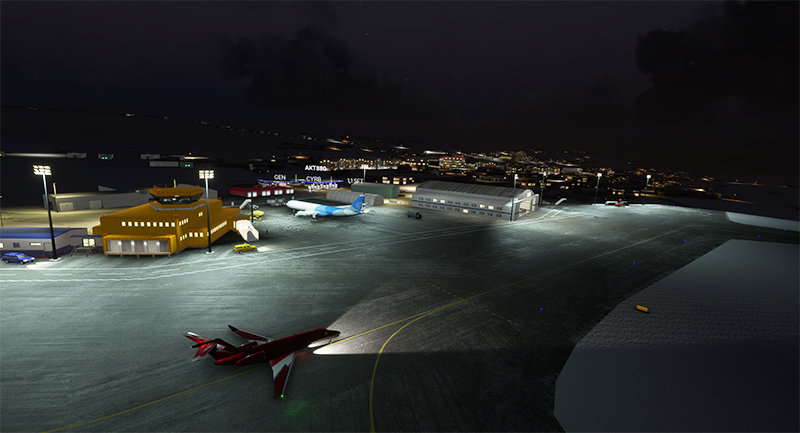
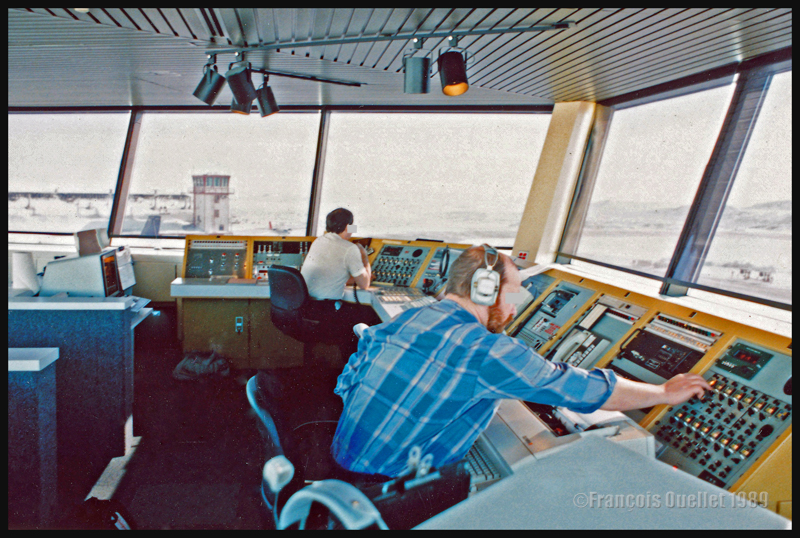
The first leg of our virtual flight around the world ends in Iqaluit, the airport where I worked for two and a half years as Flight Service Specialist (FSS) in the yellow tower on the left of the photo.
Flight service specialists at work at the Iqaluit flight service station in 1989
Above, a photo of the interior of the Flight Service Station at the time. One FSS worked on arrivals and departures at the airport, while the other handled transatlantic flights between Europe and mainly the western USA.
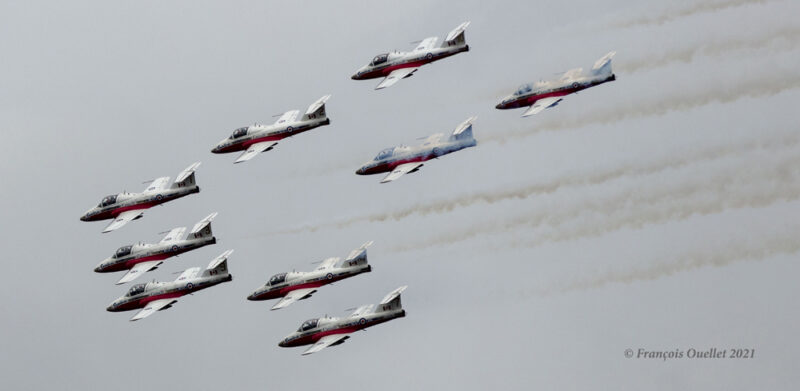
The Snowbirds passing by Québec City in June 2021.
The Snowbirds flew over Quebec City in June 2021, followed by many other jets and canadian military transport planes and helicopters. Until the last minute, a layer of low clouds and occasional showers worried event organizers.
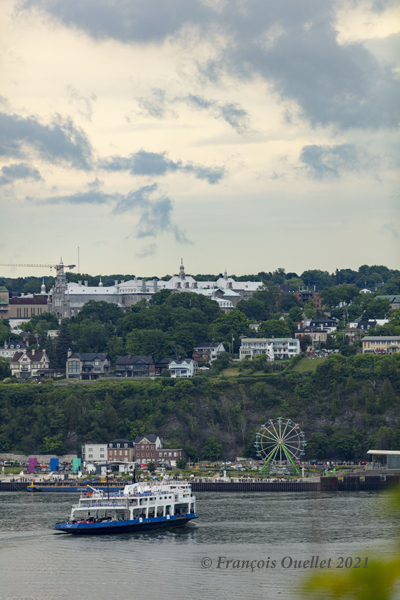
A ferry crosses the St.Lawrence Seaway in front of Lévis in June 2021.
Low clouds are visible over Lévis in the picture above taken from the Dufferin terrace in Québec City. On the St. Lawrence Seaway, the ferry bound to Lévis is approaching its destination.
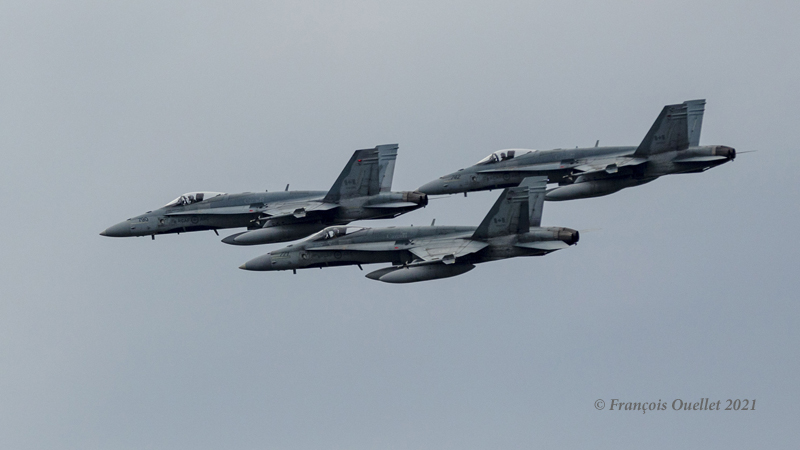
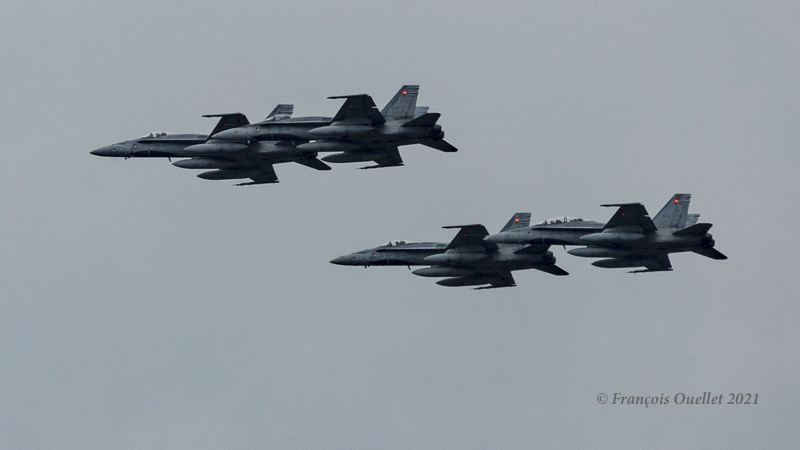
Three canadian CF-18 fly by Québec City in June 2021.
The CF-18s initially flew in a formation of three. For photography enthusiasts, the full frame camera used to capture those photos was a Canon 5DSr equipped with an EF 70-200mm f / 2.8L IS II USM telephoto lens. For the photo above, the shutter speed was set at 1/4000 and the focal length was 200mm. Given the CF-18’s fast fly-by, I opted for the AI Servo autofocus which quickly adapts to changes in the position of the objects to be photographed. Since the original image size was 50.6 megapixels, this allowed me to crop it in order to enlarge the military jets without losing quality.
Four canadian CF-18 flying by Québec City in June 2021.
Above, four CF-18s were photographed with a shutter speed of 1/5000.
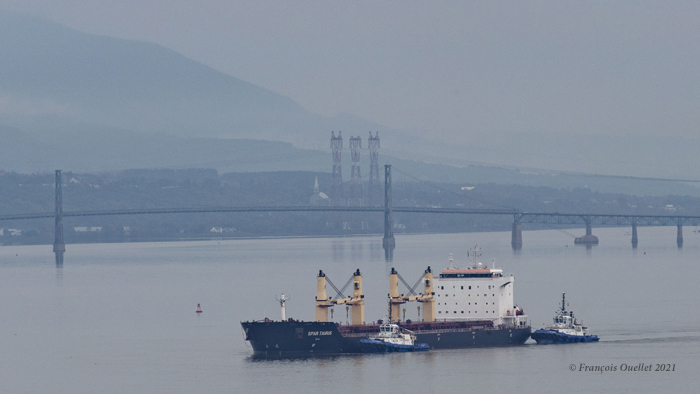
The bulk carrier Spar Taurus is arriving in the Québec City harbour in June 2021.
Between each fly-by of the various military jets, the maritime traffic continued as usual on the St. Lawrence River. Above, the Spar Taurus vessel , a bulk carrier built in 2005 and sailing under the flag of Norway, is heading towards the port of Quebec, accompanied by two Ocean company tugs. In the background, the Île d´Orléans bridge, which will be redone in a few years.
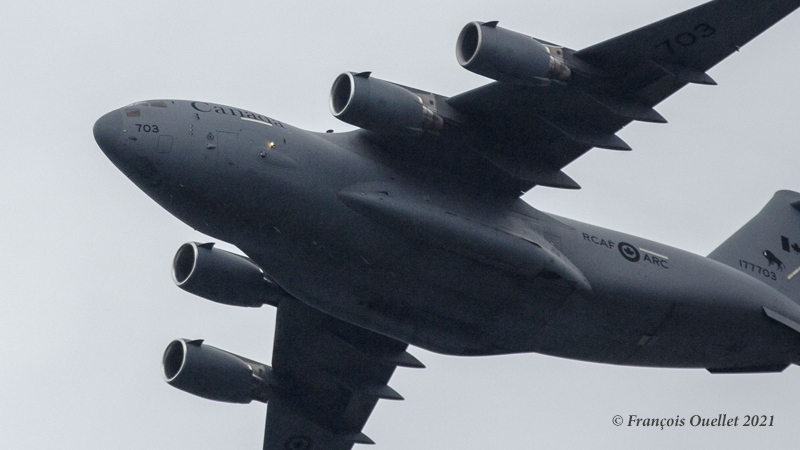
A canadian C-17 Globemaster III flies over the Dufferin terrace in Québec City in June 2021.
A C-17 Globemaster III, military transport aircraft built by McDonnell Douglas, flies over the Dufferin Terrace. Canada owns five of these aircrafts.
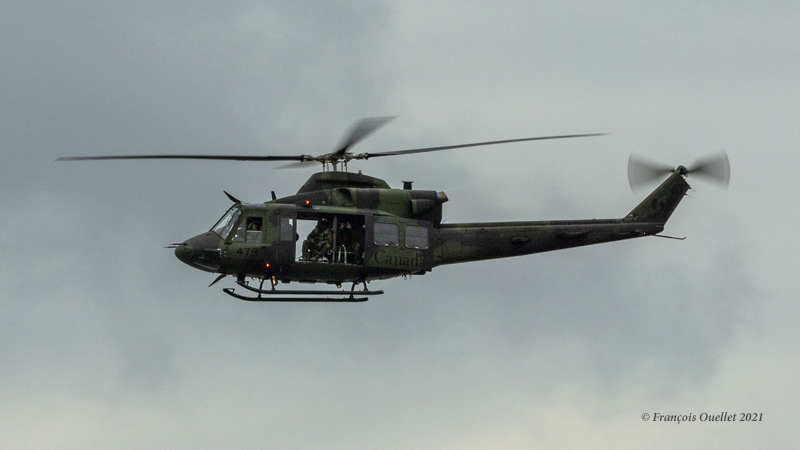
A canadian Bell CH-146 Griffon at Québec in June 2021
Above, a Canadian Bell CH-146 Griffon military helicopter , slowly flies near the Château Frontenac. A soldier seated behind takes a picture of the crowd gathered on the Dufferin Terrace. To photograph a helicopter, the shutter speed must be drastically reduced, so that the movement of the blades can be observed. For the photo above, I opted for 1/250, but I could have gone down to 1/125 without too much risk of the helicopter being out of focus.
There were other aircrafts that flew over the seaway, such as the CP-140 Aurora and the Lockheed C-130J Super Hercules, but the photos were not of sufficient quality to be published on the web.
Click on the link for other pictures of Québec City in Summer on my blog.
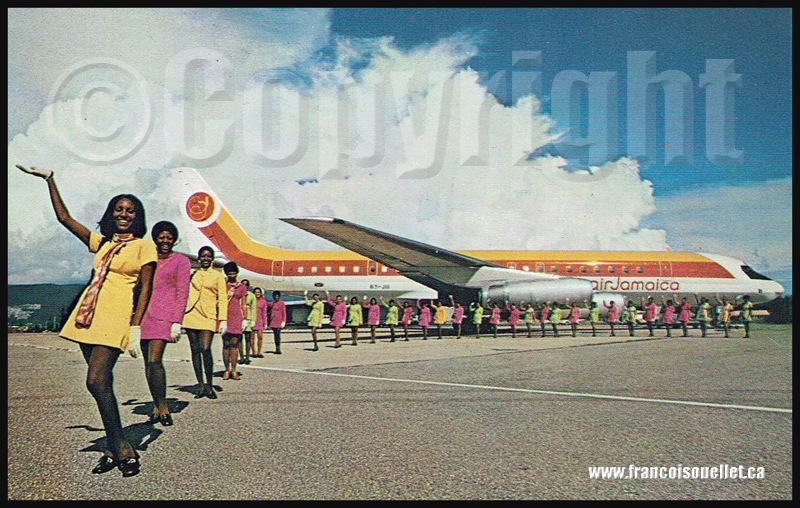
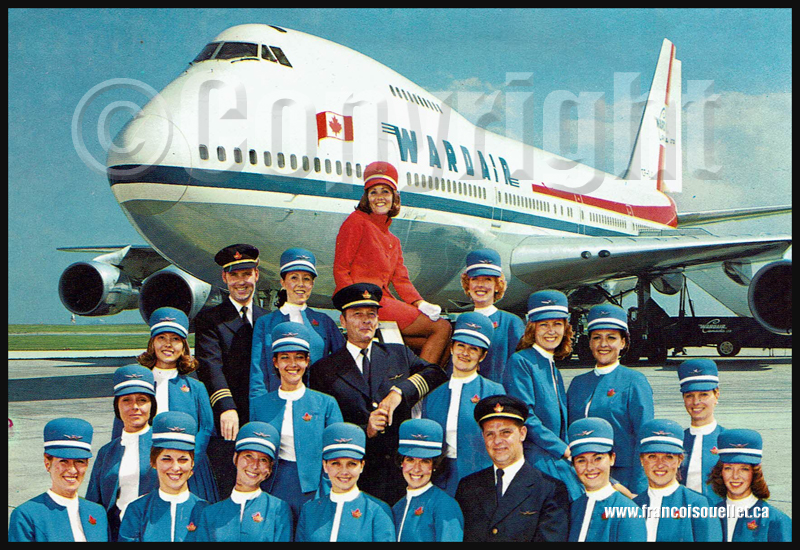
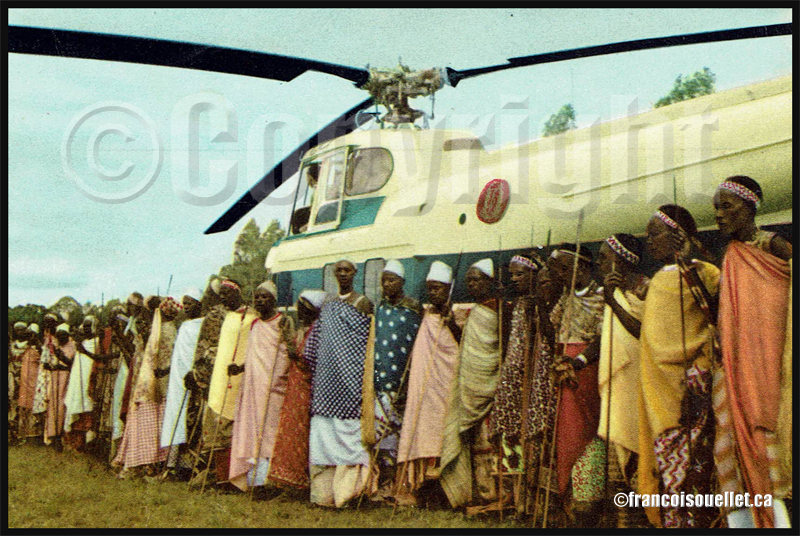
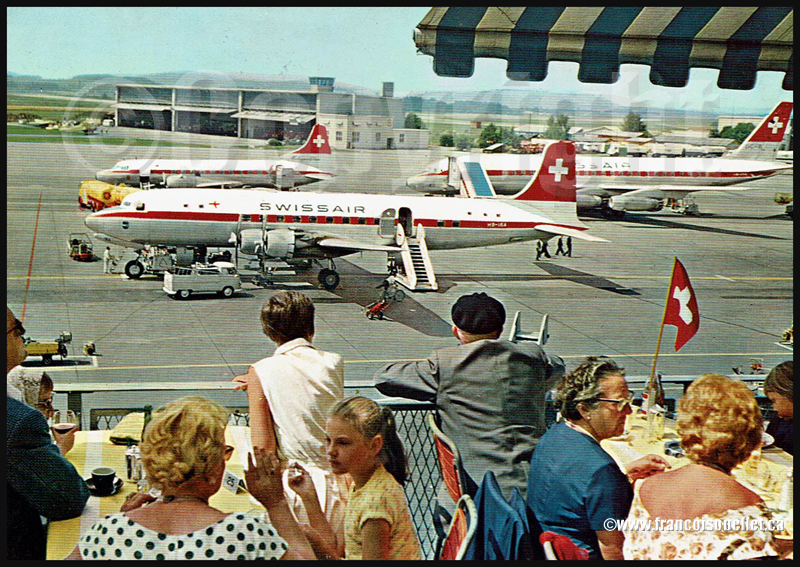
A few years ago, I started a collection of postcards related toaviation that include people, so as to show not only the different cultures but also the fashion and sometimes the habits of people during the last decades. Postcards can be as much a photo as a commercial design.
The collection, still in development, covers all continents. Below are some samples; the other cards can be found in the section “People in aviation postcards” of my website.
Ladies and Air Jamaica DC-8 Super 62 on aviation postcardWardair B-747 and crew on aviation postcard King’s journey in Congo on aviation postcardAriana Afghan’s DC-10 on aviation postcardSwissair aircrafts and people in Switzerland on aviation postcardRoyal Flying Doctor Service of Australia on aviation postcard
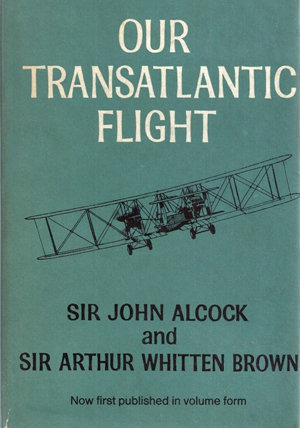
Our transatlantic flight, by Sir John Alcock and Sir Arthur Whitten Brown
Newfoundland
Before 1949, Newfoundland was called Dominion of Newfoundland and was part of the British Commonwealth . In 1949, it became a Canadian province.
The first non-stop flight eastward across the Atlantic.
The book « Our transatlantic flight » tells the story of the historic flight that was made in 1919, just after the First World War, from Newfoundland to Ireland. There was a 10,000 £ prize offered by Lord Northcliffe from Great Britain for whoever would succeed on the first non-stop flight eastward across the Atlantic.
A triumph for British aviation
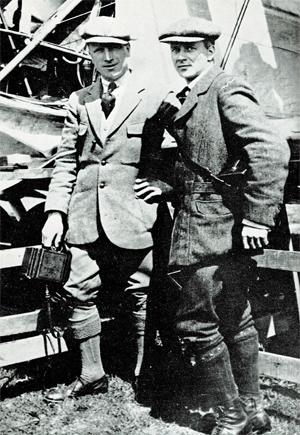
Sir John Alcock and Sir Arthur Whitten Brown , respectively pilot and navigator, wrote the story of their successful flight in this book which was published in 1969. The followings are pilot quotes from the book : « For the first time in the history of aviation the Atlantic had been crossed in direct, non-stop flight in the record time of 15 hours, 57 minutes. » (p.13) « The flight was a triumph for British aviation; the pilot and navigator were both British, the aircraft was a Vickers-Vimy and the twin engines were made by Rolls-Royce. » (p.13)
Sir John Alcock and Sir Arthur Whitten Brown
As with all great human achievements, a very good flight planning and some luck was needed to make this flight a success. If there was an engine failure during the flight, even if the planning was excellent, there was only one outcome : downward.
In order to make the flight, Alcock and Brown boarded a ship from England bound to Halifax. They then headed to Port aux Basques and finally arrived in St.John’s. There, they joined a small group of British aviators who had arrived a few days before and who were also preparing for the competition. « The evenings were mostly spent in playing cards with the other competitors at the Cochrane Hotel, or in visits to the neighbouring film theatres. St.John’s itself showed us every kindness. » (p.60)
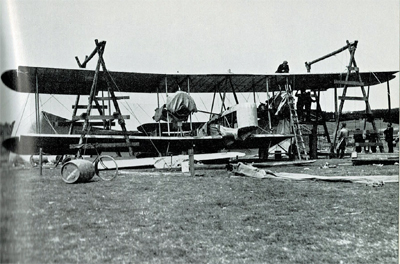
Maritime transport was used to carry the Vickers-Vimy biplane to Newfoundland on May 4th. It was assembled in Newfoundland. « The reporters representing the Daily Mail, the New York Times, and the New York World were often of assistance when extra manpower was required. » (p.61).
While the aircraft was being built, there were more and more visiters coming to the site. Brown says : « Although we remained unworried so long as the crowd contented itself with just watching, we had to guard against petty damage. The testing of the fabric’s firmness with the point of an umbrella was a favourite pastime of the spectators […]. » (p.61)
The Vickers-Vimy is being reassembled at Quidi Vidi in Newfoundland.
It was difficult to find a field that could be improvised into an aerodrome : « Newfoundland is a hospitable place, but its best friends cannot claim that it is ideal for aviation. The whole of the island has no ground that might be made into a first-class aerodrome. The district around St.John’s is especially difficult. Some of the country is wooded, but for the most part it shows a rolling, switchback surface, across which aeroplanes cannot taxi with any degree of smoothness. The soil is soft and dotted with boulders, as only a light layer covers the rock stratum. Another handicap is the prevalence of thick fogs, which roll westward from the sea. » (p.59)
They flight tested the airplane on June 9th at Quidi Vidi. During the short flight, the crew could see icebergs near the coast. They did a second trial on June 12th and found that the transmitter constantly caused problems. But, at least, the engines seemed to be reliable…
The departure
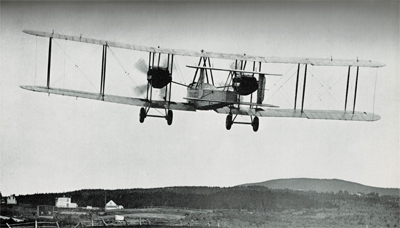
The two men left Newfoundland on June 14th 1919. In order to fight the cold air in flight, they wore electrically heated clothing. A battery located between two seats provided for the necessary energy.
The Vickers-Vimy departs from Newfoundland in 1919
The short take-off was very difficult due to the wind and the rough surface of the aerodrome. Brown writes : « Several times I held my breath, from fear that our under-carriage would hit a roof or a tree-top. I am convinced that only Alcock’s clever piloting saved us from such an early disaster. » (p.73)
It took them 8 minutes to reach 1000 ft. Barely one hour after departure and once over the ocean, the generator broke and the flight crew was cut off from all means of communication.
As the airplane consumed petrol, the centre of gravity changed and since there was no trim on the machine, the pilot had to exert a permanent backward pressure on the joystick.
Flying in clouds, fog and turbulence.
During the flight with much clouds and fog, Brown, having almost no navigation aid, had real problems to estimate the aircraft’s position and limit the flying errors. He had to wait for a higher altitude and for the night to come to improve his calculations : « I waited impatiently for the first sight of the moon, the Pole Star and other old friends of every navigator. » (p.84). The fog and clouds were so thick that at times they « cut off from view parts of the Vickers-Vimy. » (p.95)
Without proper instruments to fly in clouds, they were relying on a « revolution-counter » to establish the climbing or the falling rate. That is pretty scary. « A sudden increase in revolutions would indicate that the plane was diving; a sudden loss of revs would show that she was climbing dangerously steeply. » (p.176)
But that was not enough. They also had to deal with turbulence that rocked the plane while they could not see anything outside. They became desoriented : « The airspeed indicator failed to register, and bad bumps prevented me from holding to our course. From side to side rocked the machine, and it was hard to know in what position we really were. A spin was the inevitable result. From an altitude of 4,000 feet we twirled rapidly downward.[…]. « Apart from the changing levels marked by aneroid, only the fact that our bodies were pressed tightly against the seats indicated that we were falling. How and at what angle we were falling, we knew not. Alcock tried to centralise the controls, but failed because we had lost all sense of what was central. I searched in every direction for an external sign, and saw nothing but opaque nebulousness. » (p.88)
« It was a tense moment for us, and when at last we emerged from the fog we were close down over the water at an extremely dangerous angle. The white-capped waves were rolling along too close to be comfortable, but a quick glimpse of the horizon enabled me to regain control of the machine. » (p.40).
De-icing a gauge installed outside of the cockpit.
Snow and sleet were falling. They didn’t realize how lucky they were to continue flying in such a weather. Nowadays, there are many ways to dislodge ice from a wing while the aircraft is in flight. Here is what Brown says about their situation : « […] The top sides of the plane were covered completely by a crusting of frozen sleet. The sleet imbedded itself in the hinges of the ailerons and jammed them, so that for about an hour the machine had scarcely any lateral control. Fortunately, the Vickers-Vimy possesses plenty of inherent lateral stability; and, as the rudder controls were never clogged by sleet, we were able to hold to the right direction. » (p.95)
After twelve hours of flying, the glass of a gauge outside the cockpit became obscured by clotted snow. Brown had to deal with it, while Alcock was flying. « The only way to reach it was by climbing out of the cockpit and kneeling on top of the fuselage, while holding a strut for the maintenance of balance. […] The violent rush of air, which tended to push me backward, was another discomfort. […] Until the storm ended, a repetition of this performance, at fairly frequent intervals, continued to be necessary. » (p.94)
In order to save themselves, they executed a descent from 11,000 to 1000 feet and in the warmer air the ailerons started to operate again. As they continued their descent below 1000 feet over the ocean, they were still surrounded by fog. They had to do some serious low altitude flying : « Alcock was feeling his way downward gently and alertly, not knowing whether the cloud extended to the ocean, nor at what moment the machine’s undercarriage might touch the waves. He had loosened his safety belt, and was ready to abandon ship if we hit the water […]. » (p.96)
The arrival.
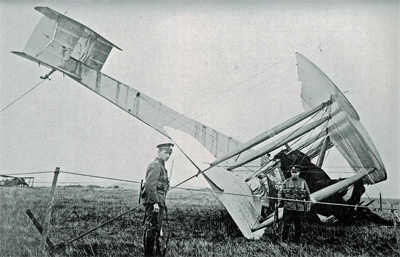
They saw Ireland at 8.15 am on June 15th and crossed the coast ten minutes later. They did not expect a very challenging landing as the field looked solid enough to support an aircraft. They landed at 8 :40 am at Clifden on top of what happened to be a bog; the aircraft rolled on its nose and suffered serious material damages. The first non-stop transatlantic flight ended in a crash. Both both crewmen were alive and well, although they were dealing with fatigue…
The transatlantic flight ends up in Ireland in a soft field
Initially, nobody in Ireland believed that the plane arrived from North America. But when they saw mail-bags from Newfoundland, there were « cheers and painful hand-shakes » (p.102).
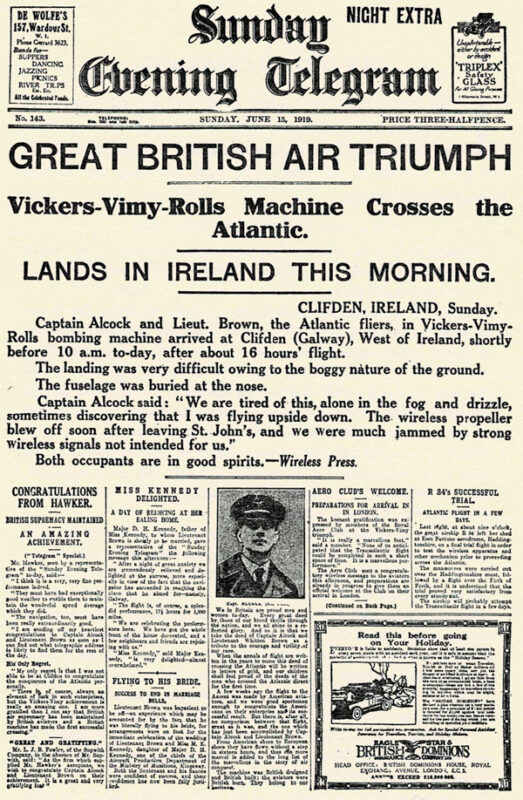
First page of the Sunday Evening Telegraph in 1919.
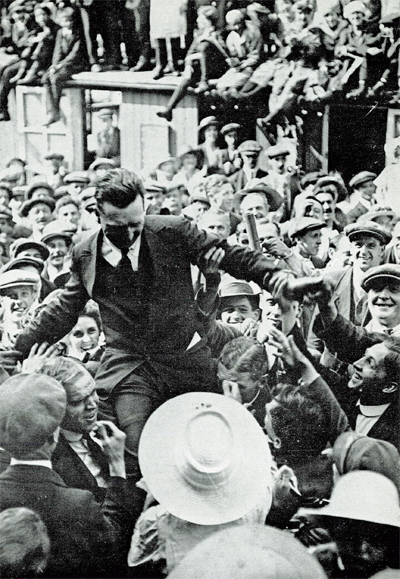
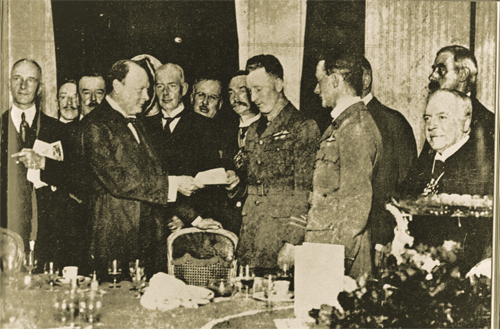
They were cheered by the crowds in Ireland and England and received their prize from Winston Churchill.
John Alcock chaired by the crowd
Winston Churchill is presenting the Daily Mail Check to the two pilots.
Their record stood unchallenged for eight years until Lindbergh’s flight in 1927.
The future of transatlantic flight.
Towards the end of the book, the authors risk a prediction on the future of transatlantic flight. But aviation made such a progress in a very short time that, inevitably, their thoughts on the subject was obsolete in a matter of a few years. Here are some examples :
« Nothwithstanding that the first two flights across the Atlantic were made respectively by a flying boat and an aeroplane, it is evident that the future of transatlantic flight belongs to the airship. » (p.121)
« […] The heavy type of aeroplane necessary to carry an economical load for long distances would not be capable of much more than 85 to 90 miles an hour. The difference between this and the present airship speed of 60 miles an hour would be reduced by the fact that an aeroplane must land at intermediate stations for fuel replenishment. » (p.123)
« It is undesirable to fly at great heights owing to the low temperature; but with suitable provision for heating there is no reason why flying at 10,000 feet should not be common. » (p.136)
The Air Age.
There is a short section in the book on the « Air Age ». I chose two small excerpts on Germany and Canada :
On Germany’s excellent Zeppelins : « The new type of Zeppelin – the Bodensee – is so efficient that no weather conditions, except a strong cross-hangar wind, prevents it from making its daily flight of 390 miles between Friedrichshafen and Staalsen, thirteen miles from Berlin. » (p.140)
On Canada’s use of aeroplanes : « Canada has found a highly successful use for aeroplanes in prospecting the Labrador timber country. A group of machines returned from an exploration with valuable photographs and maps of hundreds of thousands of pound’s worth of forest land. Aerial fire patrols, also, are sent out over forests.» (p.142) and « Already, the Canadian Northwest Mounted Police [today the RCMP] have captured criminals by means of aeroplane patrols. » (p.146)
Conclusion
The Manchester Guardian stated, on June 16th 1919 : « […] As far as can be foreseen, the future of air transport over the Atlantic is not for the aeroplane. It may be used many times for personal feats of daring. But to make the aeroplane safe enough for business use on such sea routes we should have to have all the cyclones of the Atlantic marked on the chart, and their progress marked in from hour to hour. »(p.169)
Title : Our Transatlantic Flight
Authors : Sir John Alcock and Sir Arthur Whitten Brown