A F-18 in flight over the Musée de la défense aérienne in Bagotville
In September 2025, Canadian military personnel flew to Estonia to participate in Operation Reassurance. Canada wants to offer support to NATO in this region of the world. The first exercise, Cobra Warrior 25-2, is scheduled to take place in Great Britain for six weeks, followed by Tarrasis 25 in Estonia.
Eighteen months of preparation were required to develop this operation. Some landings will take place on a highway to increase the level of realism and difficulty for the pilots.
Two F-18 training in Bagotville, Québec
As luck would have it, we happened to be passing through Bagotville on the day everything was getting underway. Positioned at the end of the runway, we were able to watch numerous aircraft take off, including an Eastern Airlines Boeing 777-200 chartered to carry approximately 160 Canadian military personnel. A Boeing C-17 and eight F-18s will also cross the Atlantic to take part in the mission. Aircraft from Trenton and Winnipeg will also participate in the maneuvers, including a CC-150 Polaris, a CC-130H Hercules, and a CC-130J Hercules.
Canadian Boeing C-17 departing Bagotville for Estonia.
Eastern B777-200 on the departure at Bagotville, Canada, heading to Estonia.
At the same time as these departures were taking place, F-18s and Top Aces A-4 Skyhawks were coming in for landing after combat exercises in the Saguenay region.
During summer 2025, several large aircraft scheduled to land at Montreal Airport had to divert to Quebec City Jean Lesage International Airport (CYQB). Numerous thunderstorms disrupted arrivals and departures at the main airports in the province of Quebec.
The extreme weather in the west gradually moved eastward. This delayed and even cancelled the departure of many planes in Quebec City.
When most of the storms finally passed over Quebec City airport in the evening, an Air Canada Boeing 777-300 ER took off from runway 24 to fly its passengers back to Montréal.
In the background, Air Transat aircraft can be observed. The Swiss Air logo can also be noticed on an Airbus A330-343. It had come from Zurich and was further diverted to Quebec City, along with an Air France Boeing 777-228 LR and a few others.
Below, we see the Boeing 777-300 ER refuelling at a time when extreme weather conditions have not yet reached the airport. Two Avjet tanker trucks are standing near the aircraft. The height of each truck is less than the internal diameter of the Boeing’s engines. For several years, this aircraft held the record for the largest engines on a civil aircraft. Now, the Boeing 777X has taken the crown.
Air Canada B777-300ER refueling at the Quebec Jean-Lesage international airport.
Photography Technique
Both photos required some compromises. Everything works if you accept being completely soaked and working with both feet in the water along a metal barrier with lightning flashing here and there. For some photos, the session lasted two hours.
I took the shots from a hole in the airport fence. My Canon EF 300 mm f/2.8L IS II USM lens was protected by a plastic bag tightly wrapped around the lens hood.
A frequency scanner provided data about air traffic. A controller informed an Air France pilot that such a situation of aircraft diversions during extreme weather had not been seen in several years.
I set my full-frame camera to produce only RAW images. Focusing was done in SERVO mode. I reduced the depth of field to optimize speed and limit the size of the photographic grain (ISO).
When selecting photos, I preferred the one showing the Boeing taking off, but where the Swiss airline’s logo is still visible. It was important to highlight the aircraft’s presence in Quebec City.
The Kingfisher is equipped with sensors that can locate objects or people up to a distance of 40 kilometers, even in low light conditions. Its range allows it to remain in flight for over 4,500 kilometers.
Photography tips
I arrive too late at Quebec City airport: the plane is already parked. However, information obtained from the pilots indicates that takeoff is scheduled within the next hour on runway 06.
Ground traffic provides excellent opportunities to photograph an aircraft while benefiting from an interesting background. The photography technique required for this first visit by the Kingfisher is really basic.
Communications with the control tower indicate when the CC-295 is starting up. It will stop just before entering runway 06. A 200mm telephoto lens would normally do the trick, provided the ISO is not too high. But today, I am trying out a recent acquisition: a Canon EF 300mm f/2.8 L IS II USM fixed telephoto lens.
In the middle of the day, a photographer deals more with the quantity of light than its quality. However, the goal here is not to capture a bouquet of flowers or a wedding, so the harsh light should be fine. The flamboyant color of the aircraft will distract attention from the lack of interest in the ambient light.
With the shutter speed reduced to 1/125 and the ISO set to 200, I wait for the moment when the Kingfisher is opposite the control tower. This will provide a high-quality background. Twenty photos later, the plane is nothing more than a memory.
The Dash 8-400 is also known as the DH8D or Q400 (Q standing for “quiet”). It is pictured here at the threshold of Runway 29 at Quebec City’s Jean Lesage International Airport. It is awaiting takeoff clearance.
PAL Airlines DH8D aircraft and Pascan Saab-340B at the Québec Jean-Lesage international airport.
Photography technique
I focus on the back of the aircraft. The limited depth of field blurs the rest of the image. The shutter speed is between 1/80 and 1/125, so as not to freeze the propellers. The result is a more dynamic photo.
With the plane’s back to the camera, interest is limited unless something special is happening. The frequency scanner indicates that a Pascan Saab-340 (SF32) will shortly be taking off from runway 24. With a bit of luck, I’ll be able to capture it and include it in the shot of the Q400.
A few seconds later, the aircraft enters the lens’ field of vision. The idea is to capture it while it’s still vis-a-vis the gasoline fumes from the engines. I took a few photos and kept the one with the best photographic composition.
Below is a photo of an Air Canada Rouge aircraft taking off from 24 after a heavy downpour.
An Air Canada Rouge Airbus jet takes-off from a wet runway at the Québec Jean-Lesage international airport.
This time, there’s no question of limiting the shutter speed to 1/125. The plane has no propellers, so you can choose 1/1000 without making a mistake. For greater dynamism, wait until the nose of the plane starts to lift. You can also keep a long trail of water splashes.
Finally, it’s often best to show a bit of landscape in the foreground to better situate the aircraft in its environment.
Click on the link for more aircraft photos on my blog. There are also photo galleries in the menu.
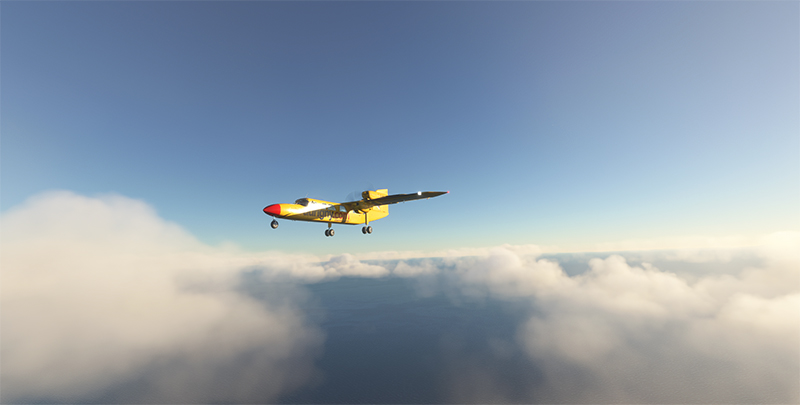
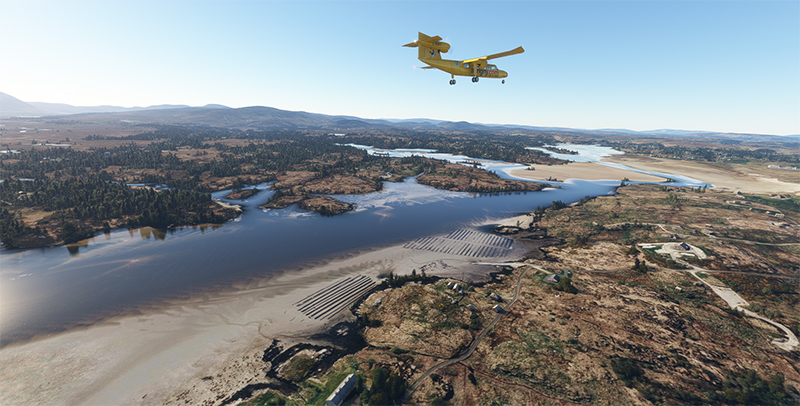
The flight simulation world tour continues with a Britten Norman BN2A Trislander MK III. The initial version of the aircraft is not particularly reliable. There have been engine failures, fatigue cracks in the structure, cowlings opening unexpectedly, etc. Nevertheless, we’re going to try our luck with this aircraft today.
BN2A Trislander airborne from the Barra beach airfield with MSFS
With a three-engine aircraft, pilots don’t take into account the distance to shore in case of engine failure. But if we were flying a single-engine aircraft, we’d have to head for Tiree Island at the highest possible altitude, then turn off towards Donegal.
Virtual BN2A Trislander MK III enroute to Donegal airport (EIDL) in the Republic of Ireland with MSFS
In all realistic virtual flights, a program injects weather data received from airports via the Internet directly into the flight simulator.
For the past few days, the weather in Ireland and Scotland has been nothing but fine. I was expecting rain and low clouds, but it’s been just the opposite.
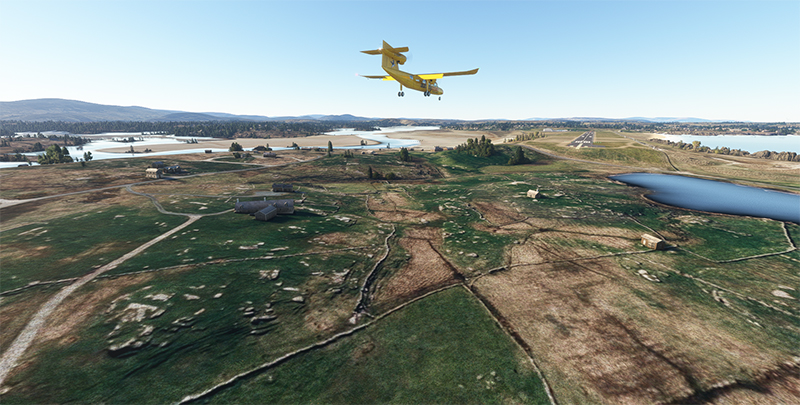
So, for the time being, the fine weather is making it easier to plan flights over a very large area. Below you can see the rockier landscape around Donegal airport.
BN2A Trislander descending towards Donegal in Republic of Ireland with MSFS
The Trislander is now on final for runway 21 at Donegal. Light winds make the approach easy. No part of the aircraft has been lost on the way!
The Britten Norman Trislander is on final for Donegal airport (EIDL) in flight simulation
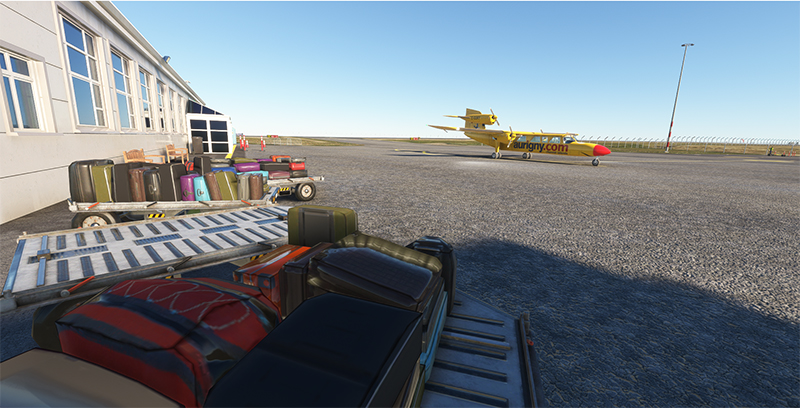
The airport staff have already brought out the suitcases for the next flight. Way too much luggage! They must have mistaken the Trislander for a Boeing 737. Aviation rules are strict. I don’t know if the passengers bring back too much shells or beer bottles with them, but some of the suitcases won’t be leaving today!
BN2A arrived at Donegal (EIDL) with Microsoft Flight Simulator
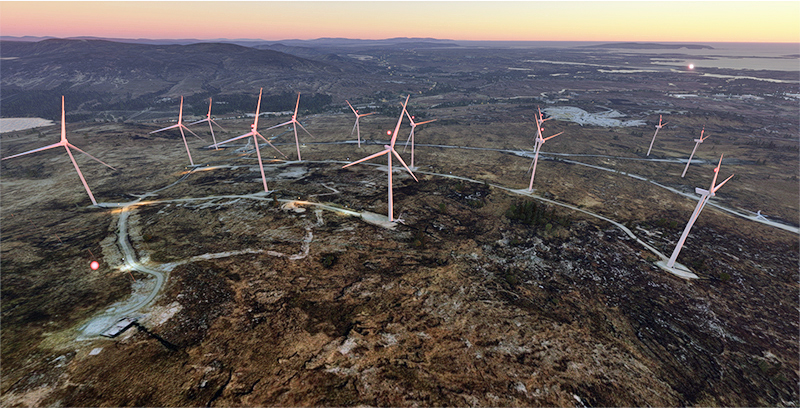
In the evening, a virtual drone flies over the area to observe the cliffs and numerous wind turbines.
Virtual landscape around the Donegal region in the Republic of Ireland with MSFS 2020 flight simulator.
Virtual scenery in the evening in the Donegal region of the Republic of Ireland with MSFS 2020.
Leg 18 of the world tour will take place between Donegal Airport and the Isle of Man, using a Nardi FN-333 Riviera and Microsoft Flight Simulator 2020.
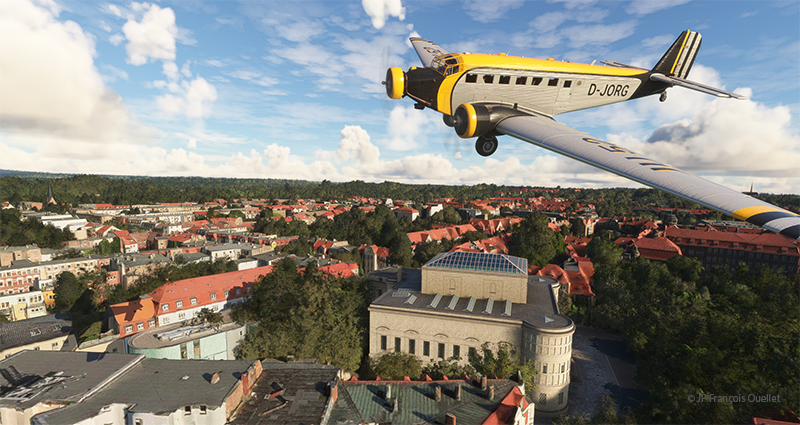
Leg 10 of this round-the-world flight simulation trip takes place between Poland and Germany. Two very different aircraft will be used to complete the journey during this day of VFR flying: an old Junkers Ju 52/3m and a modern business helicopter, the Airbus H160.
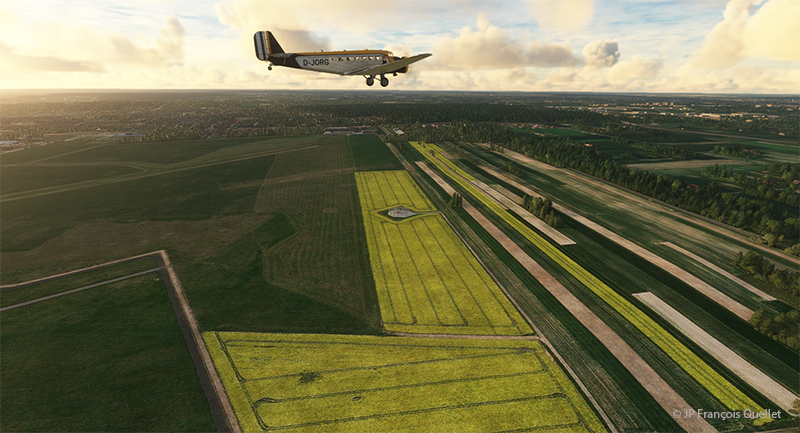
Junkers JU 52 airborne from the Lublin airport (EPLB) in Poland.
Departure is from Lublin airport (EPLB) in Poland. The Junkers Ju 52/3m takes off without a hitch over a short distance. The big three-engine tailwheel is as predictable as the Cessna C-170B I used in real life to cross Canada in 1981. Above, one can see the cultivated fields of Poland.
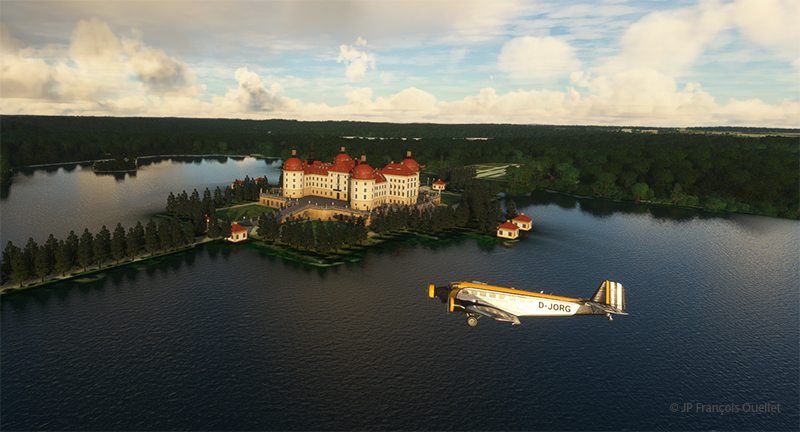
Junkers JU 52 and the Moritzburg Castle in Germany in flight simulation
It’s shaping up to be a beautiful morning, weather-wise. The first leg of the trip takes us over Moritzburg Castle (Schloss Moritzburg), northwest of Dresden. Built in 1542, it was originally the hunting lodge of the Duke of Saxony.
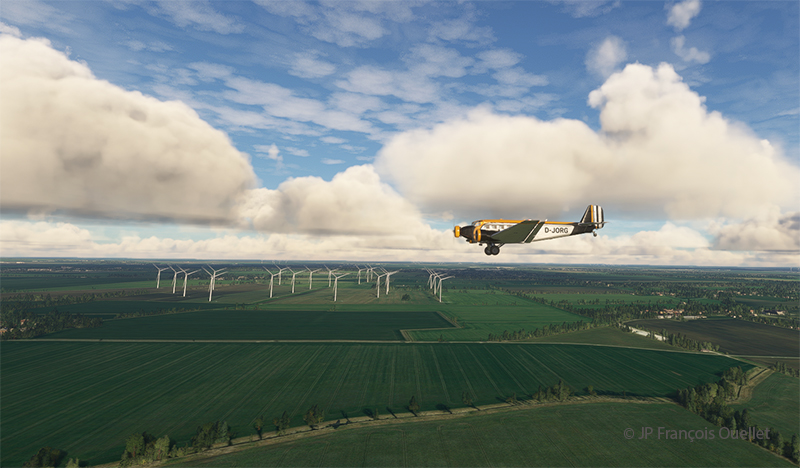
Junkers JU 52 enroute to the Landesmuseum für Vorgeschichte Halle in Germany
On the way to Halle is a large wind farm. Germany, like Europe, is rapidly developing its green energy. Russia’s recent attitude to Europe’s natural gas supply has drastically changed energy planning in neighboring countries.
A Junkers JU 52 flying over the State Museum of Prehistory Halle in Germany in flight simulation
Above, in the center of the photo, is a partial view of the National Museum of Prehistory in Halle (Landesmuseum für Vorgeschichte Halle), not far from Leipzig. It is one of Central Europe’s leading archaeological museums.
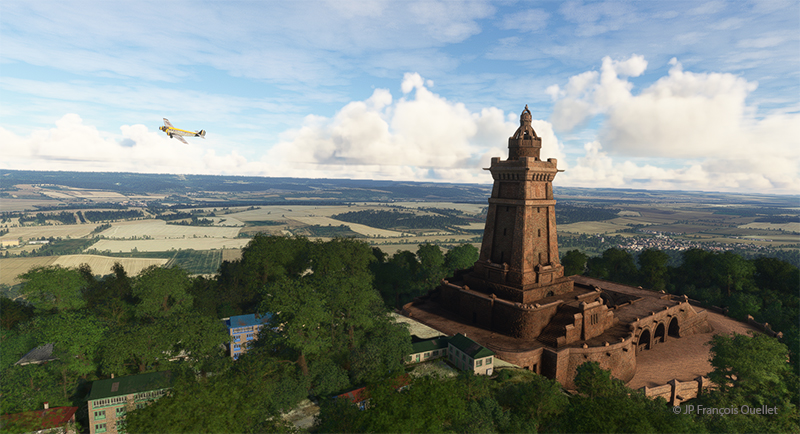
Fly-by of the Kyffhaüser-Denkmal in Germany by a Junkers Ju 52 in flight simulation
Before reaching Calden airport to change aircraft, we gaze at the Kyffhaüser monument (Kyffhaüser Denkmal). Once in Calden, we jump into a modern Airbus-built H160 helicopter and head for Göttingen, more precisely over the Münchhausenstrasse.
We’ve obtained permission to fly over this thoroughfare at very low altitude, just long enough to say hello to an old acquaintance. This dubious authorization will probably cost Germany’s Minister of Transport his job.
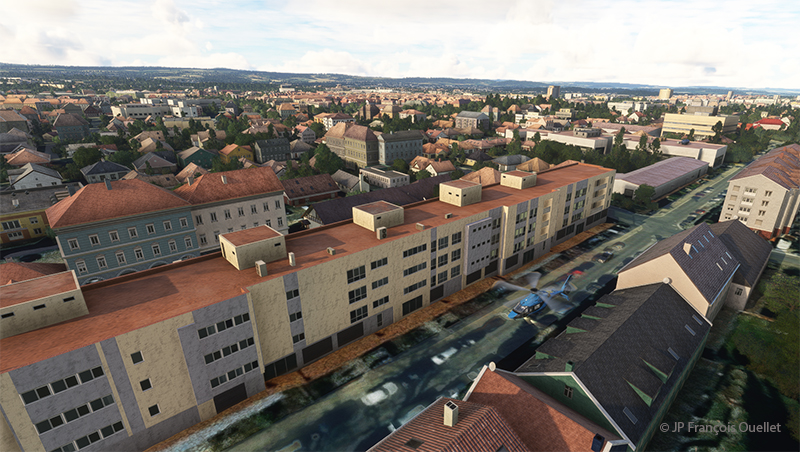
Streets of Göttingen, Germany, in flight simulation
A flyover of this Göttingen street is necessary to verify the extent of the traffic.
Helicopter descending on Münchhausenstrasse, Göttingen, Germany, in flight simulation.
The descent is gradual between the buildings. We hover just above the cars. Pedestrians seem to wave at us, but we may misinterpret the gesture. Our friend is at the window and takes the time to stop his reading of an excellent comic strip to wave at us. We then continue on our way to Padderborn Lippstadt Airport (EDLP), our destination for today.
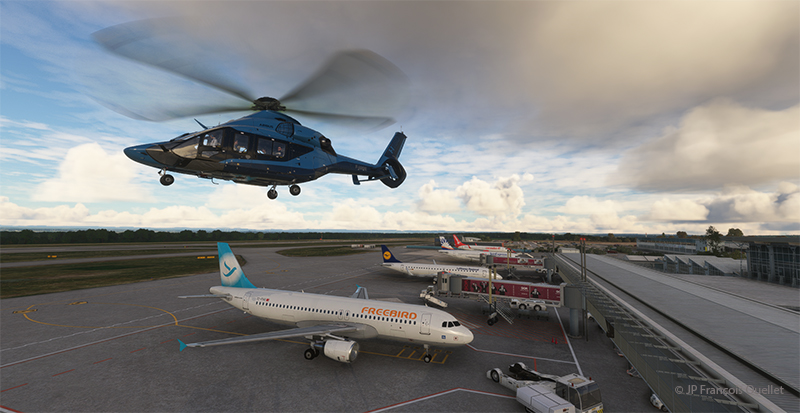
Helicopter H160 landing at the Padderborn Lippstadt (EDLP) in Germany in flight simulation.
Still, there’s a fair amount of activity at the airport. Immediately after landing, we’ll start planning leg 11 of this round-the-world flight simulation and real weather trip.
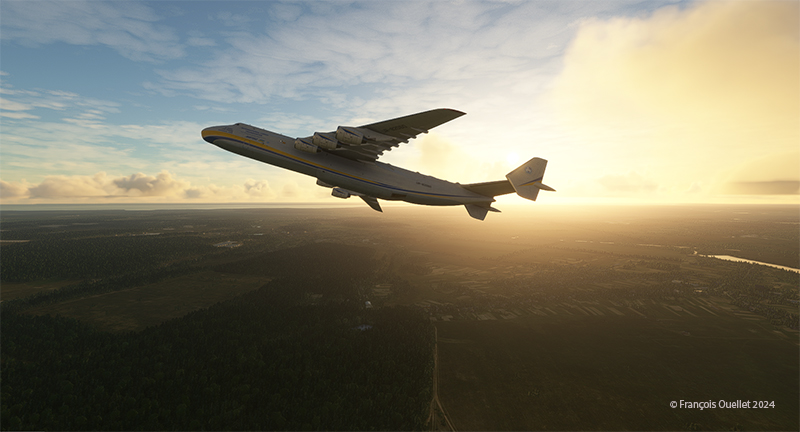
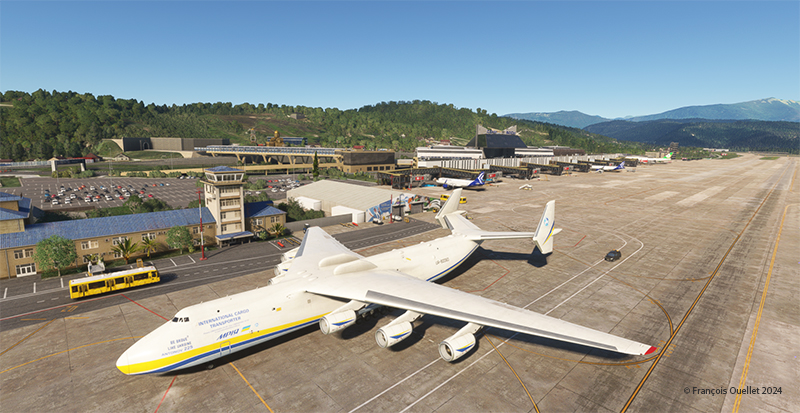
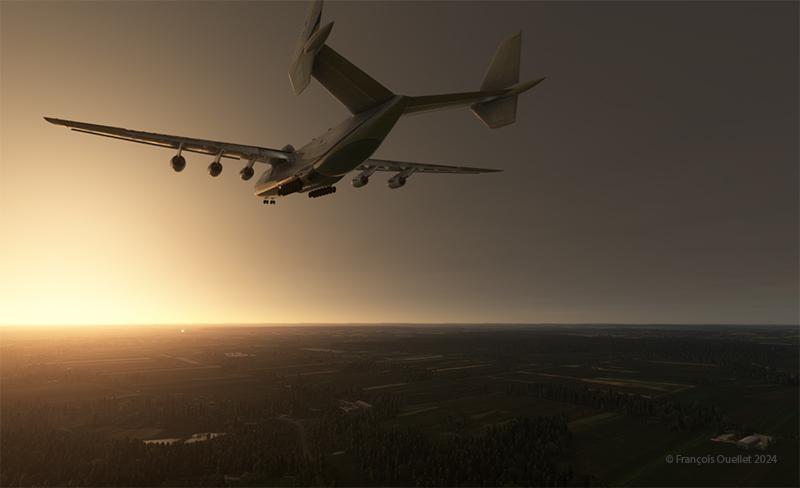
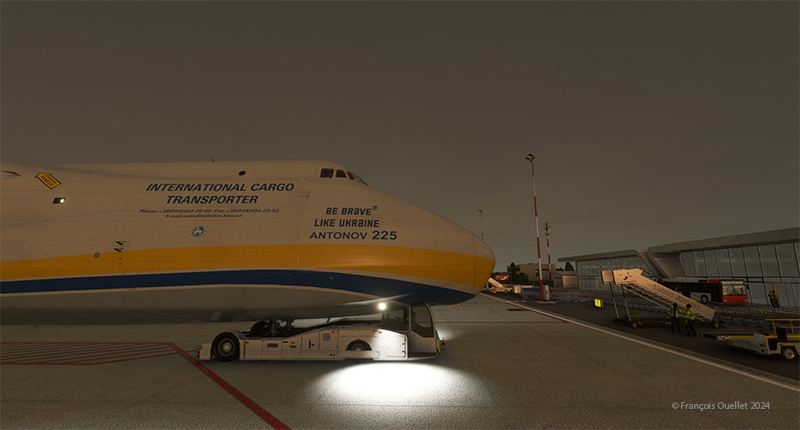
The Antonov 225 taking-off from the Antonov airport (UKKM) in Ukraine heading to Sochi, Russia.
Today, the Antonov 225 is reborn for another leg of this world tour of flight simulation. In reality, this aircraft was destroyed by Russia during its invasion of Ukraine. At the time of writing, war is still raging between the two nations. But in virtual mode, we have more latitude to alter the course of events and simulate peace.
So, we leave Ukraine’s Antonov airport (UKKM), fly over Crimea and then stop off in Sochi, Russia (airport code USSR). Our destination is Lublin airport (EPLB) in Poland.
The weather is looking good, with clear skies for the arrival in Sochi. The scenery around Sochi is splendid, and it’s best to land in good weather.
Take-off is a breeze, but the Antonov 225’s heaviness takes some getting used to. The weight of the aircraft means that every time the pilot makes a maneuver with the flight controls, initially nothing happens. Then, the aircraft slowly begins to obey. So, you have to expect delays and anticipate the outcome of maneuvers.
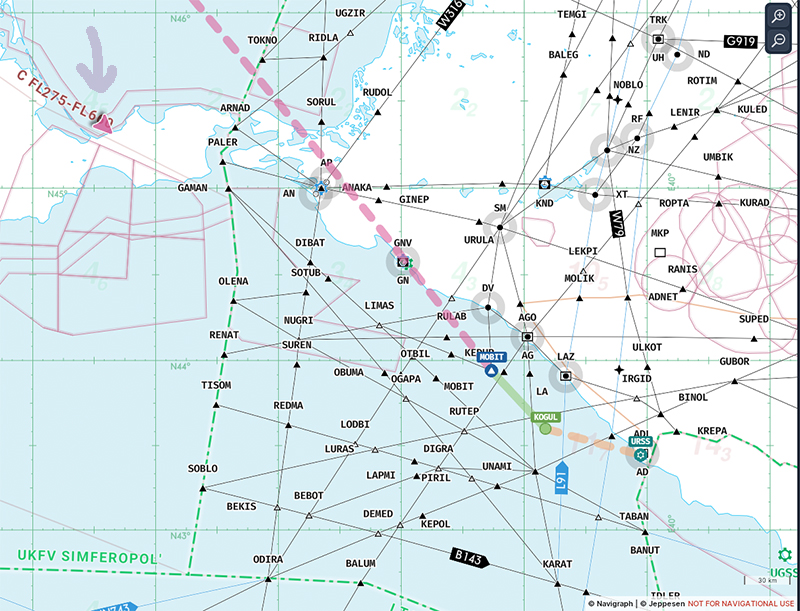
Navigraph is used for navigation. Of course, I plan to deviate from the initial route to fly over Crimea and then on to Sochi.
The pink triangle indicates the position of the Antonov 225 entering Crimea on its flight to Sochi in Russia and then Poland.
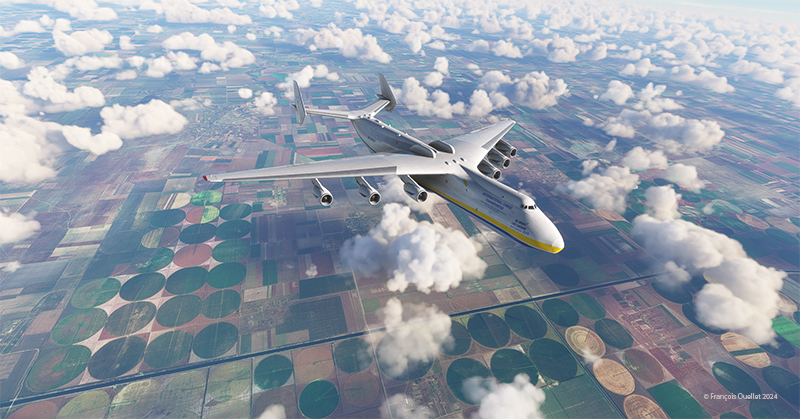
Below, the ploughed fields of the Ukraine. Ukraine is considered the breadbasket of the world.
The Antonov 225 over the cultivated fields of Ukraine.
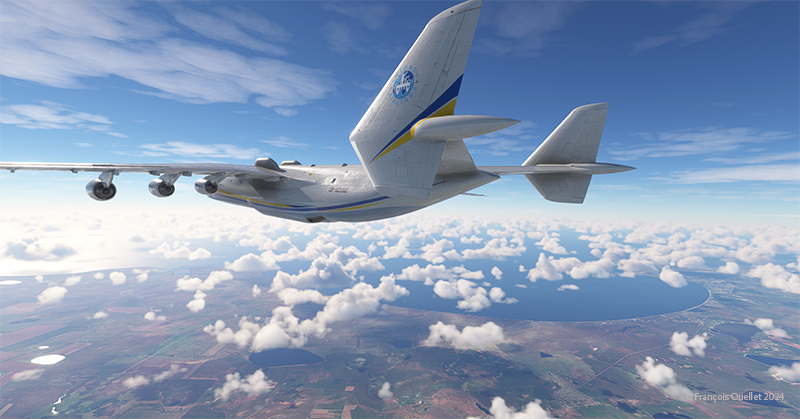
Crimea is a beautiful region from the air, but fiercely contested on the ground. A pilot would say that today, it’s more turbulent down there than up.
The Antonov 225 entering Crimea on its flight to Russia then Poland
A few minutes later, the flight over the Sea of Azov begins in the direction of Sochi.
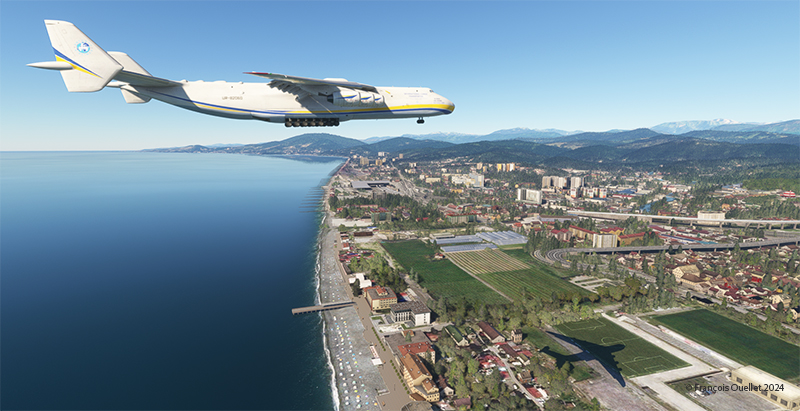
The approach is spectacular, with the surrounding mountains. As with all large aircraft, the Antonov has to be stabilized well in advance to avoid overcorrecting on final.
Antonov 225 on long final for runway 06 in Sochi (USSR), Russia.
The cargo plane stops in an extremely short distance for such a heavy aircraft. When the thrust is reversed on six engines, there’s no need to set the brakes to maximum, especially in Sochi. We make a short stopover.
Antonov 225 parked for a short stopover at Sochi (USSR), Russia.
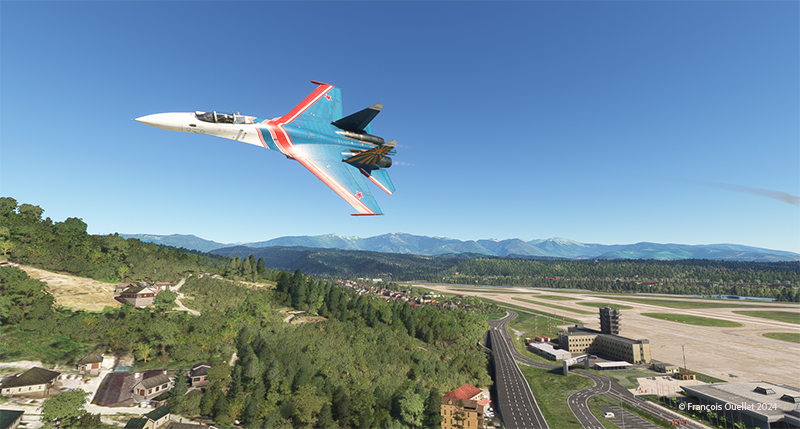
Just after our arrival, a Russian Sukhoi 27 military jet makes a low pass near the tower. The fighter jet was created at the time in response to the construction of the American F-15.
A Sukhoi Su-27 makes a low pass at the Sochi Airport (USSR), Russia.
The flight resumes in the late afternoon. Below, the Antonov 225 is on final approach to runway 25 at Lublin airport in Poland.
Antonov 225 on final for rwy 25 at Lublin airport, Poland
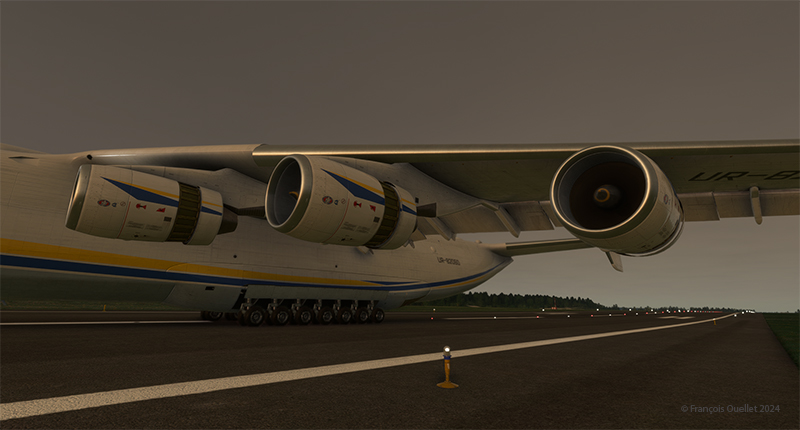
The thrust reversers allow the aircraft to exit onto the taxiway in the middle of the runway.
Antonov 225 with thrust reversers after landing at Lublin (EPLB) airport in Poland.
We get a little help with parking.
Antonov 225 with some help for the parking at Lublin airport, Poland
The next stage of this round-the-world flight simulation will be with a smaller aircraft, heading for Germany. A flight over Göttingen is planned with a helicopter (D-JORG). The trip will end at Paderborn Lippstadt Airport (EDLP).
Airborne from the Ivalo virtual airport (EFIV) in northern Finland.
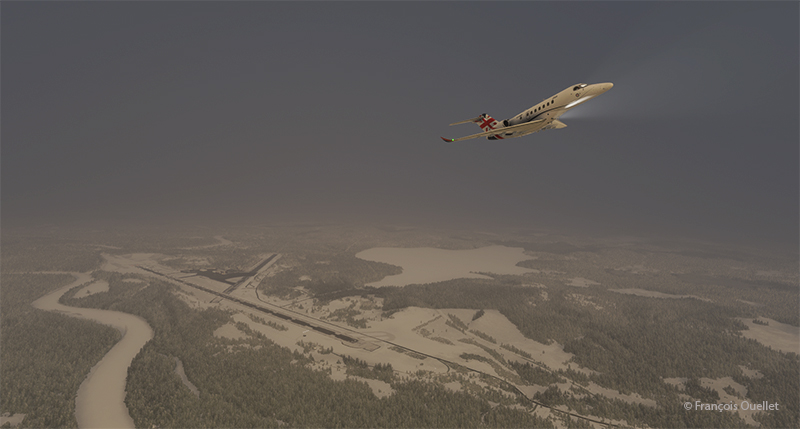
The fifth leg of this world tour in flight simulation continues with a journey from Ivalo airport (EFIV) in Finland to Molde airport (ENML) in southern Norway. It’s hard to see daylight through the cloud cover as we take off.
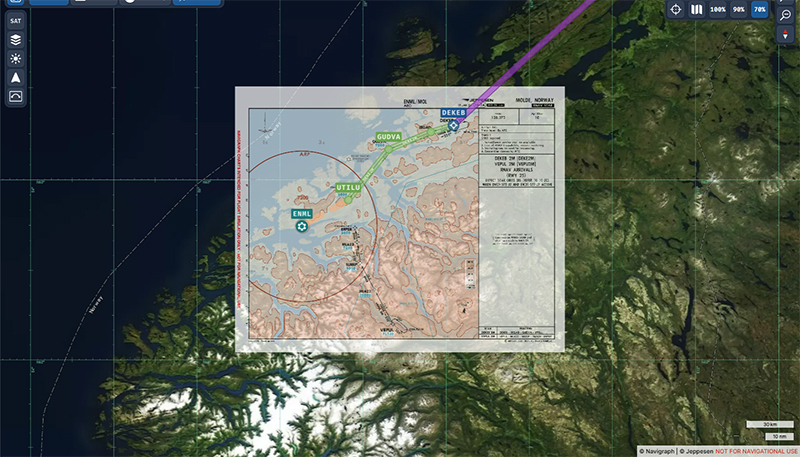
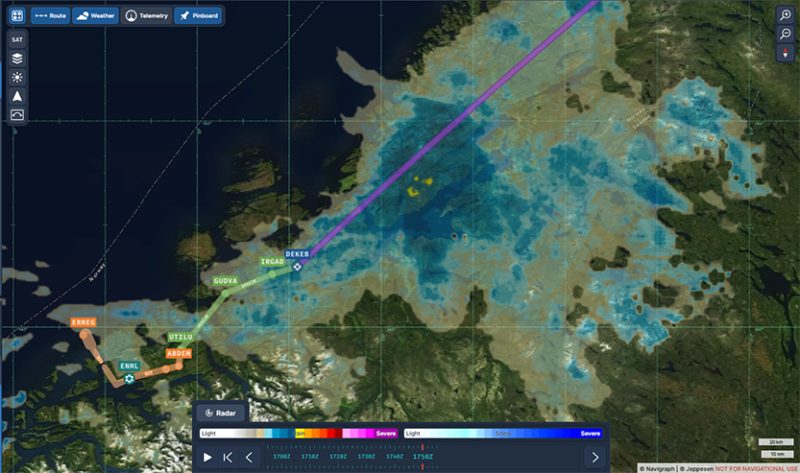
In anticipation of this and subsequent flights, I subscribed to Navigraph to make the experience even more immersive. The map below shows the choices for arrival procedures at Molde airport. In green are the reporting points for the arrival and in orange those for the approach. The aircraft follows these points automatically, thanks to the on-board computer.
Navigraph informations for the arrival in Molde (ENML)
I’m only just getting to grips with Navigraph and am still going through a trial-and-error process when it comes to using the data. But I’m making progress…
Heading towards the Molde (ENML) airport in Norway with MFS2020.
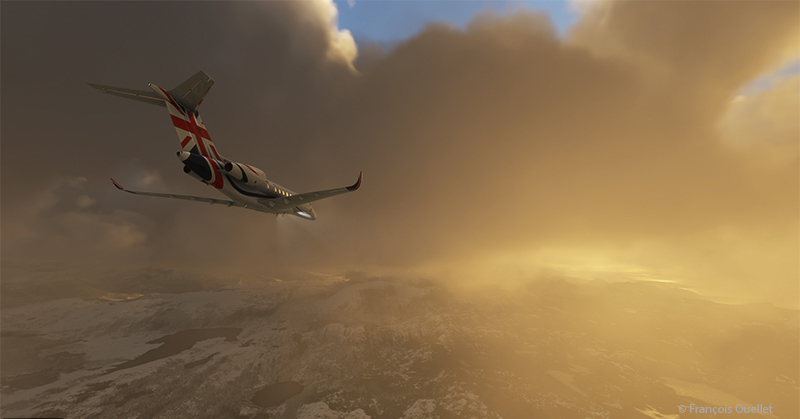
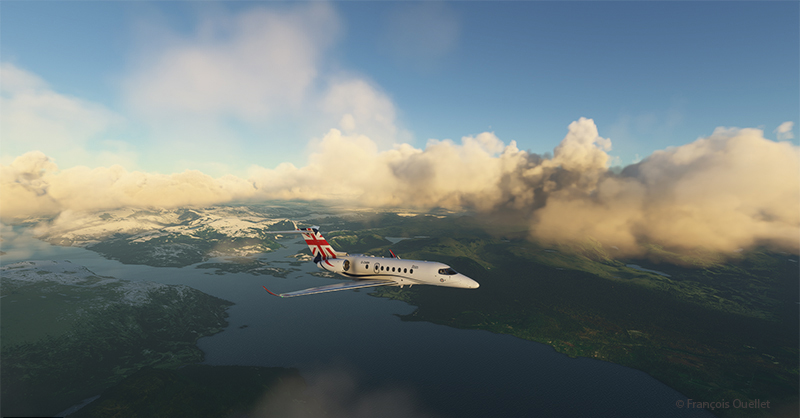
Once through the cloud layer, the aircraft finally reaches flight level FL380 (38,000 feet).
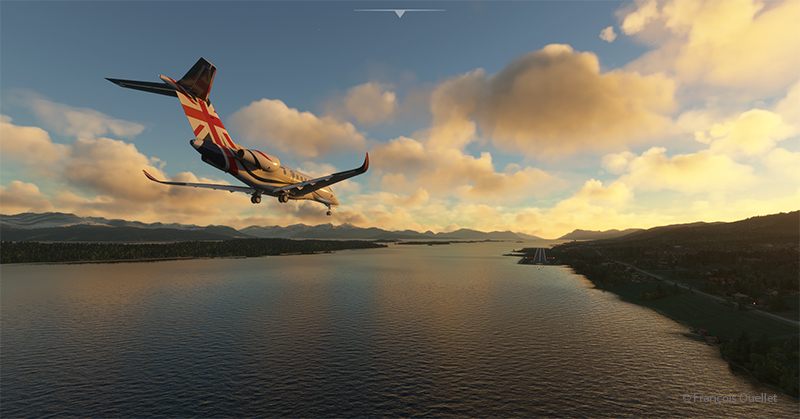
The runway at Molde airport is 2221 metres (7287 feet) long, and lies on the shore of Moldefjorden. It’s perfect for the Cessna Citation Longitude, but there are mountains on the approach.
Navigraph map superposed on the geography on approach for the Molde airport (ENML)
The data provided by Navigraph helps the pilot to use the correct altitude limits to maintain a safe height above the terrain at all times. You can also track the aircraft’s progress along the chosen route. Several types of maps are also available to help prepare take-offs and landings. When required, maps can be overlaid with the Navigraph system, while maintaining the aircraft’s planned route over the local geography.
Cessna Citation Longitude descending towards the Molde airport (ENML) airport in Norway in flight simulation.
We start the descent to Molde airport. The cloud cover is relatively thin and visibility is not a problem.
Descending for Molde airport (ENML) in Norway with Microsoft Flight Simulator.
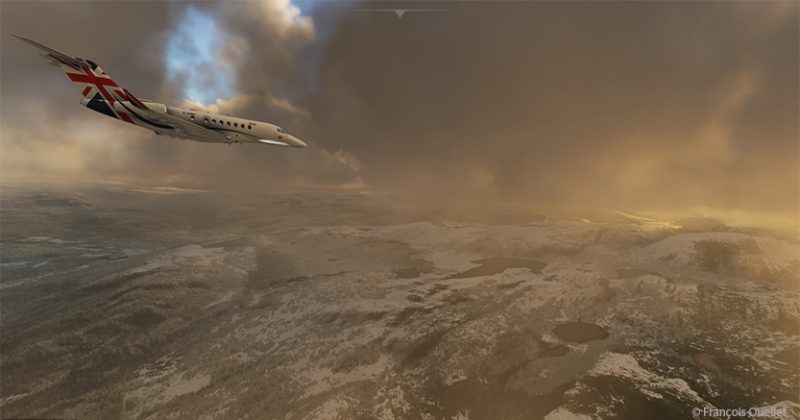
The setting sun makes for beautiful scenes on the descent to Molde.
Approaching the virtual Molde airport (ENML) with the Cessna Citation Longitude
Once out of the clouds and in ideal weather, the autopilot is disconnected and the approach is made visually.
On final for runway 25 at the Molde virtual airport (ENML) in flight simulation.
Winds oriented almost in line with runway 25 facilitate the approach.
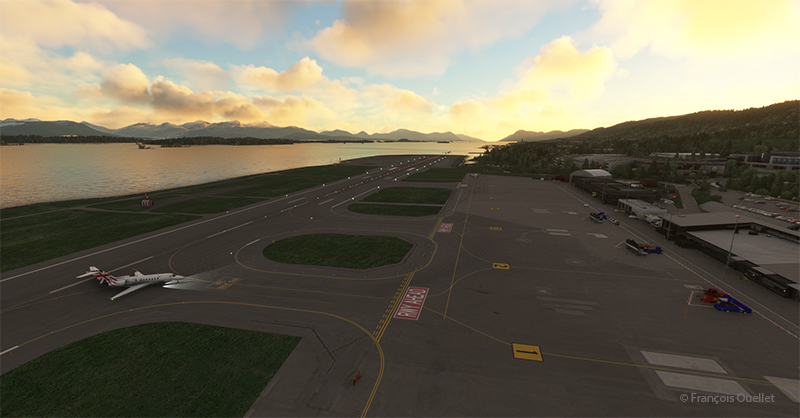
Exiting runway 25 at the Molde airport (ENML) in Norway.
The Cessna Citation leaves runway 25 and parks for a few days in Molde, a Norwegian town renowned for its beautiful mountains and numerous parks and rose gardens. This town was saved from famine in 1740 by the presence of herrings. The town’s coat of arms features a whale hunting herrings in a barrel as a reminder of this period. Thanks to its position along the fjords and the foehn effect, winters in Molde are relatively mild (and very mild compared to Canada).
Soon the sixth leg of the flight will take place, from Molde to Sandane (ENSD), a Norwegian airport surrounded by beautiful mountains.
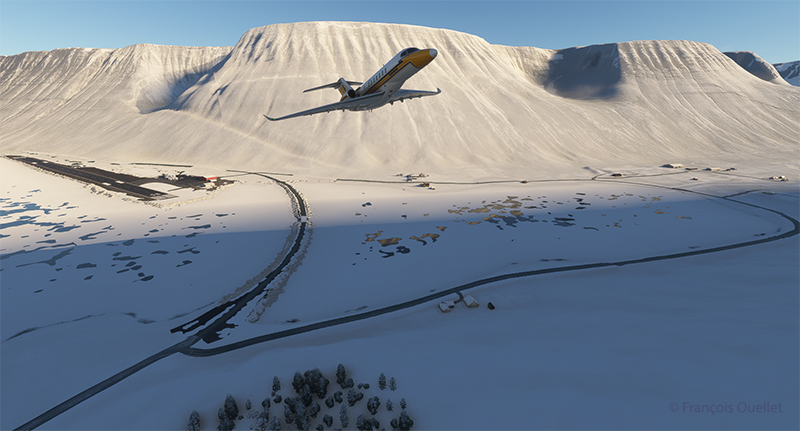
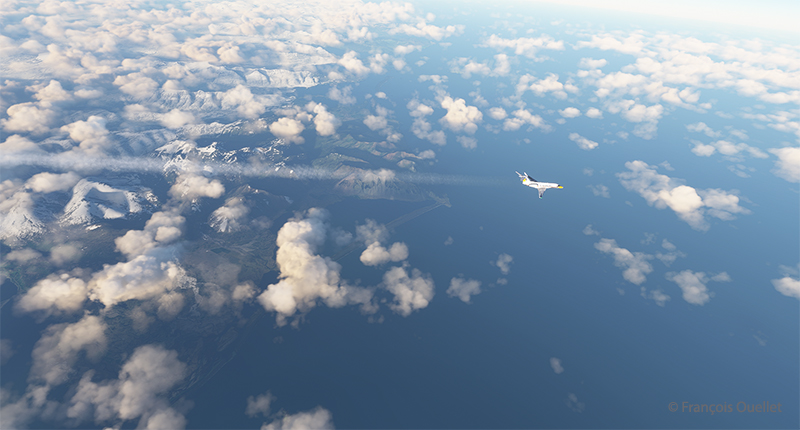
Airborne from the Isafjordur airport (BIIS) In Iceland with Microsoft Flight Simulator.
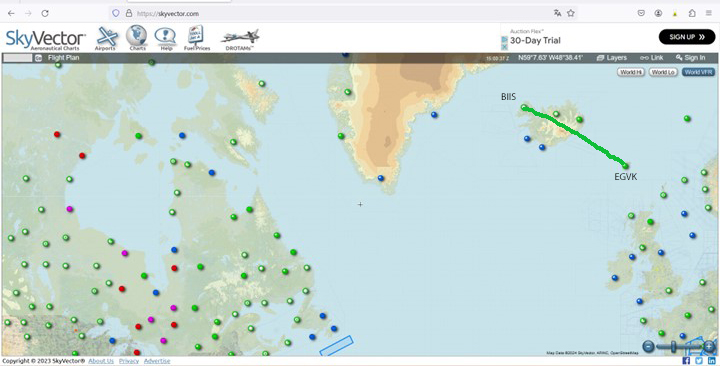
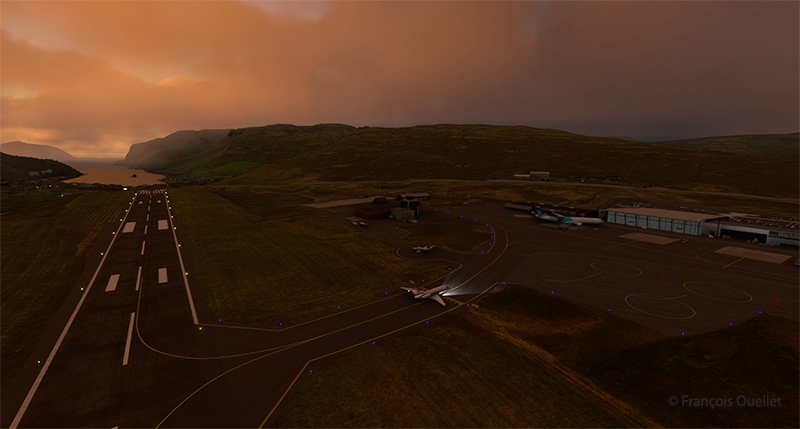
The third leg of the round-the-world flight simulation begins with a departure from Isafjordur (BIIS) in Iceland and ends at Vagar airport (EKVG) in the Faroe Islands, an autonomous archipelago belonging to the Kingdom of Denmark.
The departure from Isafjordur faces a mountain. You can see the shadows on the ground. But as visibility is perfect, this is no problem at all, as long as the rate of climb is sufficient.
Virtual flight BIIS EGVK
The Cessna Citation Longitude is airborne from the Isafjordur airport (BIIS) in Iceland with Microsoft Flight Simulator.
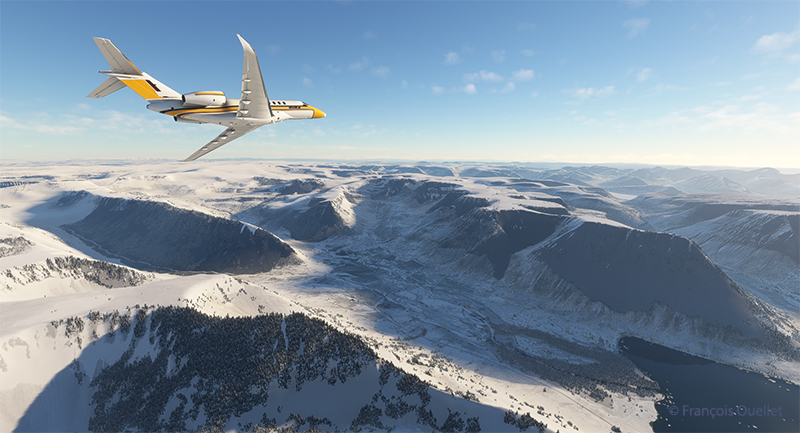
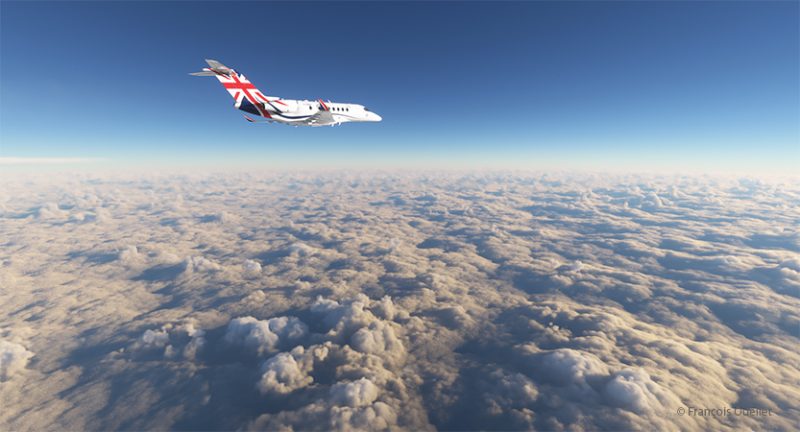
A left turn over the superb Icelandic landscape establishes the Cessna Citation Longitude on course for the Faroe Islands. The FMS ensures that the aircraft will stay on course. But it’s important to remain vigilant: there’s a lot of other equipment that can cause surprises along the way.
The Cessna Citation is climbing slowly over Iceland.
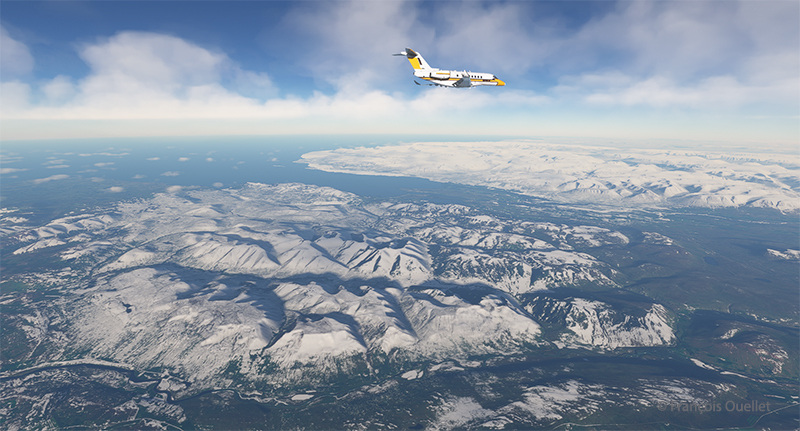
The climb continues over a magnificent landscape. There’s no turbulence today; if there were, the flight simulator would make sure the plane was harder to control, even for the autopilot. I set the virtual flight to observe real air traffic during the flight, but the route between Iceland and the Faroe Islands is off the most popular routes, so it’s normal not to encounter too many aircrafts.
The Cessna Citation Longitude is heading to the Vagar airport (EKVG) in Feroe Islands
We are now established at our cruising altitude, leaving Iceland’s eastern border to fly over the Atlantic Ocean.
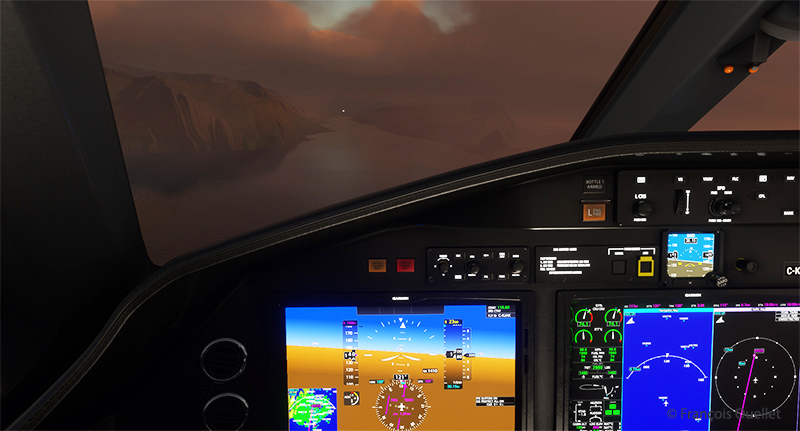
Visual approach for runway 12 at the Vagar airport (EKVG) Feroe Islands
We disconnect the autopilot to give us a free hand on the visual approach to Vagar (EKVG) airport. A small white dot, the lights of runway 12, can be seen straight ahead in the distance. The landing gear is down, as are the flaps, and the speed has stabilized at around 140 knots for the moment.
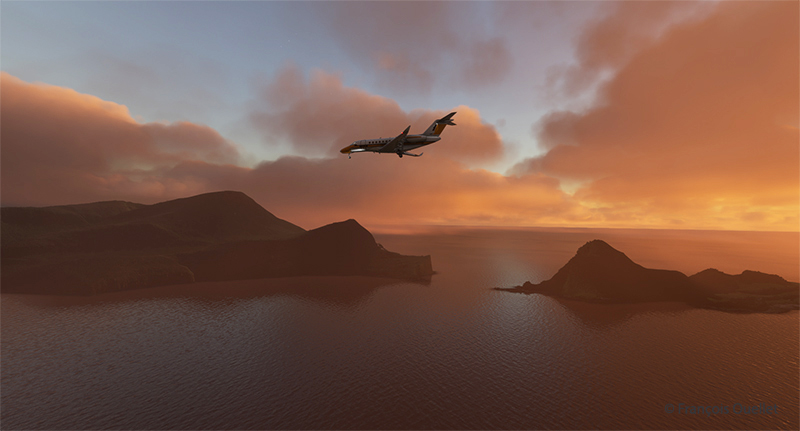
The Cessna Citation is on long final for runway 12 of the Vagar airport (EKVG) Faroe Islands
It’s an ideal time to arrive in the Faroe Islands, with the setting sun coloring all the surrounding clouds.
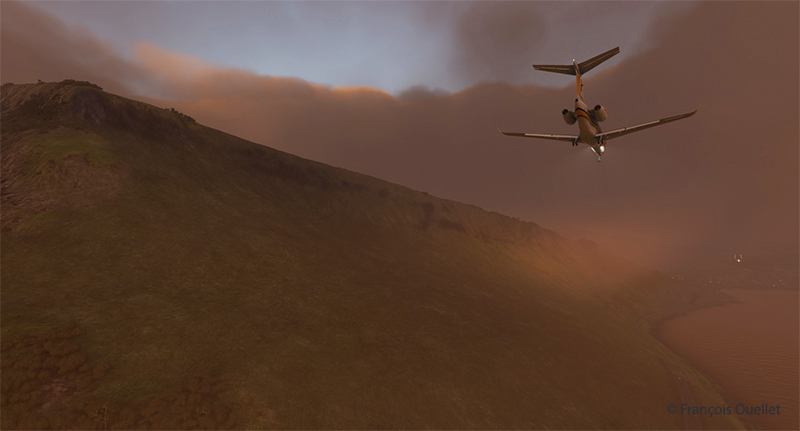
The Citation Longitude on visual approach to runway 12 at the Vagar airport (EKVG)
Runway 12 is visible on the far right in the photo above. The uneven cloud cover sometimes blocks the view of the airport for a few seconds, but the wind quickly blows the clouds away, preventing a missed approach. Virtual weather ensures a constant renewal of weather conditions.
The Cessna Citation exits runway 12 at the Vagar airport (EKVG) in Faroe Islands with Microsoft Flight Simulator
Landing is trouble-free, as the Vagar runway is long enough (5902 x 98 feet) to accommodate such a private jet.
Some 53,000 people lived in the Faroe Islands as of 2021. One of the most popular activities is bird and plant watching. To make it easier for residents and tourists to get around, tunnels have been built between some of the archipelago’s 18 islands.
The fourth leg of the round-the-world virtual flight will take place between Vagar and Ivalo (EFIV) in Finland. This is Finland’s northernmost airport.
The flight simulation with Microsoft Flight Simulator lets you fly over the planet like never before from the comfort of your own home. As airports around the world transmit weather observations at all times, it’s possible to import this data into the flight simulator and fly virtually in the real weather conditions reported around the globe.
This data enhances the feeling of reality for the virtual pilot, but at the same time complicates his task, as he has to take into account the presence of thunderstorms and icing, surface and upper-level winds, changes in cloud cover, visibility, pressure, and so on.
Today’s virtual pilot must also anticipate that failures of all kinds may affect the flight, especially if he or she owns a high-quality virtual aircraft. The engine(s) may fail, a structural problem may affect the aircraft’s controls and navigation equipment may cease to function. Good planning is essential, just as in real life. And since the brain doesn’t differentiate too much between the real and the virtual, there’s plenty of fun to be had.
So, I’ve decided to fly around the world as a millionaire, at my own pace, i.e., using the types of aircraft that tempt me, and flying the routes that are of particular interest. All of this will be done in real weather, with all its joys and obstacles. I’ll be publishing one of these routes on my blog from time to time.
The initial route departs from Quebec’s Jean-Lesage airport (CYQB), passes through Goose Bay (CYYR), in the Canadian province of Newfoundland and Labrador, heads north to Kuujjuaq and ends in Iqaluit (CYFB).
Virtual Flight 2 will present a few photos of the Atlantic crossing from Iqaluit to Kangerlussuaq (BGSF) in Greenland, to Isafjordur (BIIS) in Iceland .
Isafjordur airport has a challenging approach. I don’t know if the Cessna Citation Longitude will be able to land there in one piece, but I intend to give it a try.
Virtual flight 1.
Virtual flights CYQB CYYR CYVP CYFB
Enroute from Quebec City (CYQB) to Goose Bay (CYYR)
Above, the setting sun illuminates the clouds and the Cessna Citation Longitude en route from Quebec City to Goose Bay. At high altitude, the pilot sets the altimeter to the standard atmospheric pressure of 29.92 inches of mercury. Since all the other pilots are doing the same, a safe separation between the aircraft is ensured.
Approaching the Kuujjuaq airport (CYVP) in Quebec.
The next day, the aircraft is seen approaching Kuujjuaq (CYVP) in Nunavik. The altimeter is set to the airport’s atmospheric pressure to reflect the correct height of the runways in relation to the aircraft. Near the airport, the autopilot is disconnected, and the approach is made manually and visually. The desired speed is around 135 knots for the final.
Departing Kuujjuaq airport (CYVP) with the Cessna Citation Longitude
Above, the jet takes off from Kuujjuaq bound for Iqaluit (CYFB) on Baffin Island in Nunavut.
Enroute to Iqaluit airport (CYFB)
The setting sun illuminates the aircraft’s windows. The approach to Iqaluit has begun. The descent is gradual, so as not to cause discomfort to the virtual passengers…
On final for runway 34 of the Iqaluit airport (CYFB)
Above, the aircraft is on final for runway 34 at Iqaluit (CYFB).
The yellow Iqaluit flight service station (FSS) in Iqaluit (CYFB)
The first leg of our virtual flight around the world ends in Iqaluit, the airport where I worked for two and a half years as Flight Service Specialist (FSS) in the yellow tower on the left of the photo.
Flight service specialists at work at the Iqaluit flight service station in 1989
Above, a photo of the interior of the Flight Service Station at the time. One FSS worked on arrivals and departures at the airport, while the other handled transatlantic flights between Europe and mainly the western USA.