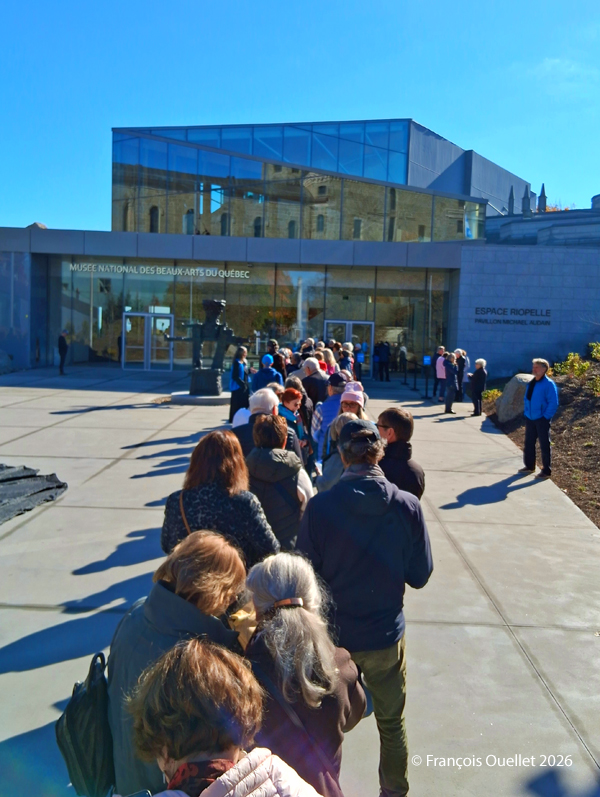
The Espace Riopelle-Pavillon Michael Audain opened its doors to the general public on October 22, 2026. It houses the world’s largest collection of public works by Canadian artist Jean-Paul Riopelle. The high-quality works on display reflect painter Jean-Paul Riopelle’s artistic exploration throughout his life.
The crowd at the opening of Espace Riopelle at the Pavillon Michael Audain in 2026
By naming the pavilion after the prominent patron Michael Audain, the MNBAQ (Musée national des beaux-arts du Québec) recognizes the contribution of the Audain Foundation, located in British Columbia, Canada.
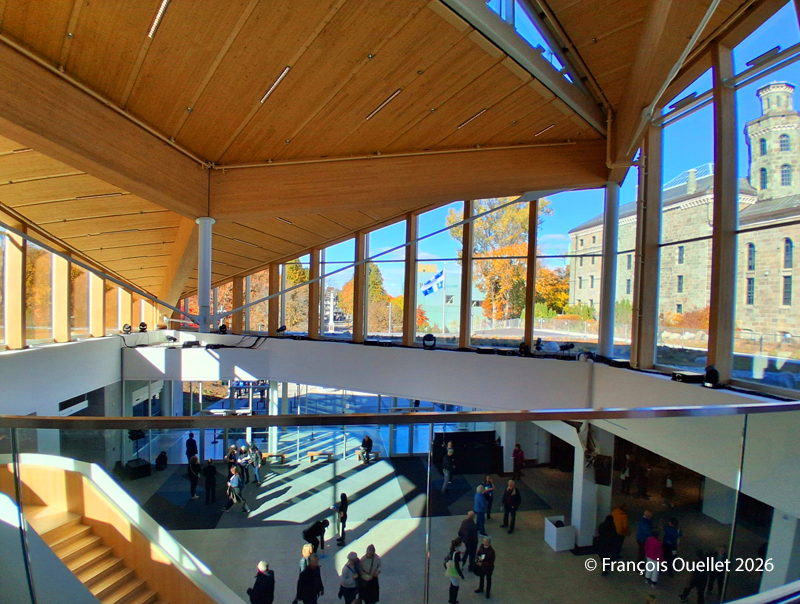
Inside Espace Riopelle – Pavillon Michael Audain during the first day of the opening to the public in Quebec City.
In fact, Michael Audain and his wife, Yoshiko Karasawa, donated dozens of works by Jean-Paul Riopelle and also helped fund the building. Added to these are other bequests from donors such as Pierre Lassonde. This brings the total number of donated works to more than sixty.
Espace Riopelle – Pavillon Michael Audain at the Musée National des Beaux-Arts du Québec during the first day opened to the public in 2026.
We had booked our tickets back in August so we could visit the Espace Riopelle—Pavillon Michael Audain on its first day open to the public. And there was quite a crowd!
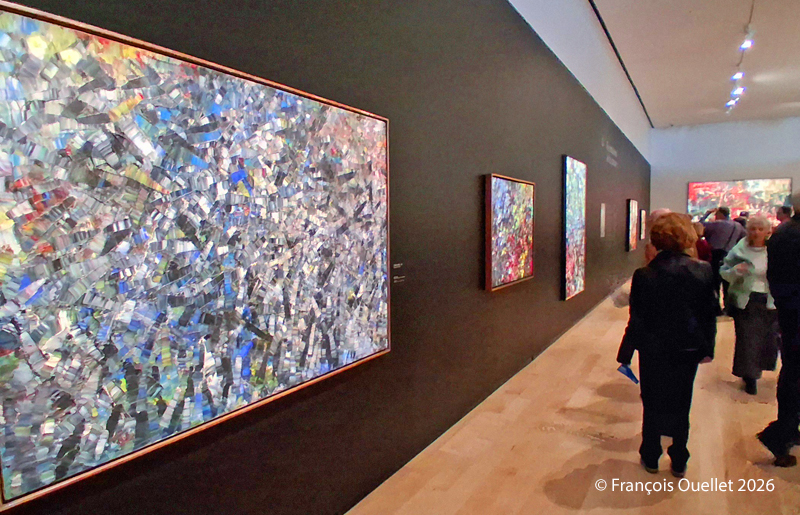
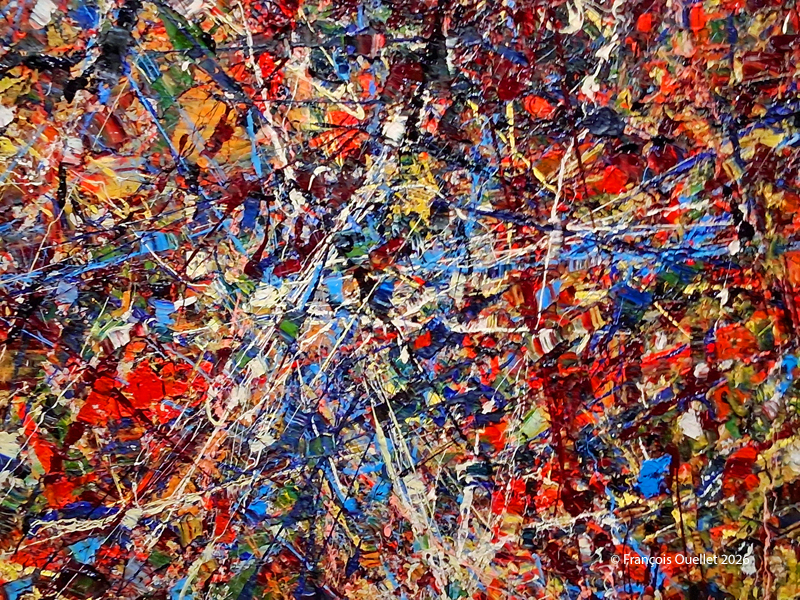
Painting by Quebec artist Jean-Paul Riopelle at the MNBAQ, Espace Riopelle – Pavillon Michael Audain.
What a treasure this place is—a place many are already calling the Riopelle Museum. It is the only building in North America designed specifically to showcase the works of a single artist.
But people don’t come during the first few days just to quietly admire Riopelle’s paintings, drawings, and sculptures. The initial visit is mainly about exploring the space. How did the architects at the Montreal firm FABG conceive this pavilion? This first visit sets the stage for all the others—the ones that will follow once the media buzz has died down a bit.
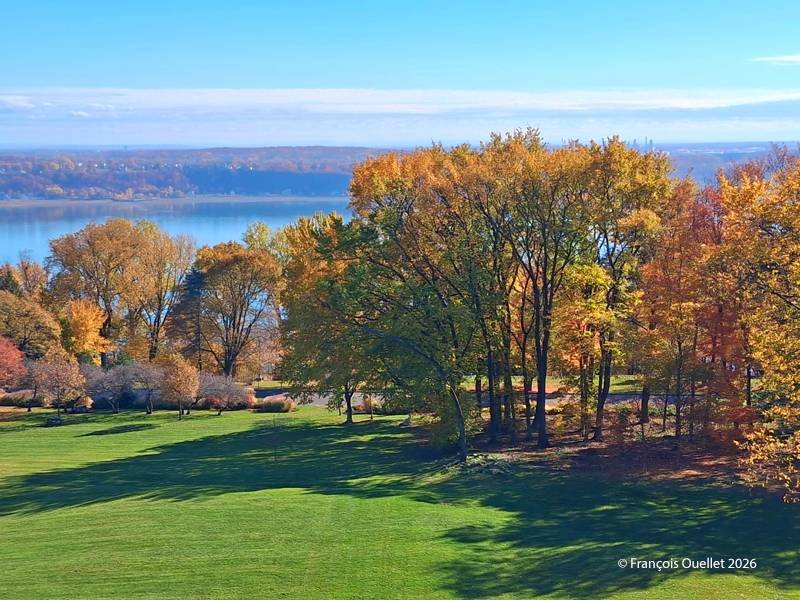
View of the Plains of Abraham from Espace Riopelle – Pavillon Michael Audain in Quebec City.
From the top of the Espace Riopelle—Pavillon Michael Audain, visitors can enjoy a terrace. From there, they can take in the natural surroundings and the St. Lawrence River. Jean-Paul Riopelle had similar views while creating his works on L’Isle-aux-Grues and Île aux Oies.
This new building is yet another gem to be added to the MNBAQ’s collection of pavilions, following the recently opened Pavillon Lassonde.
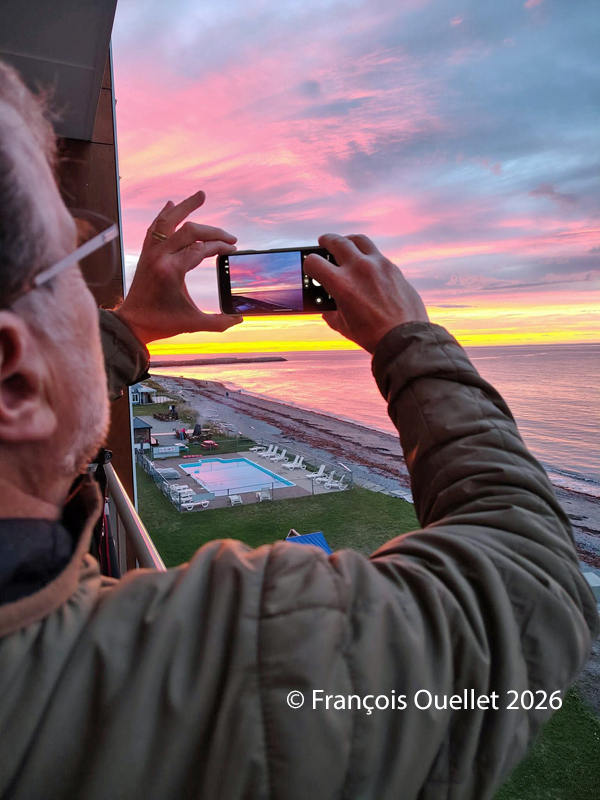
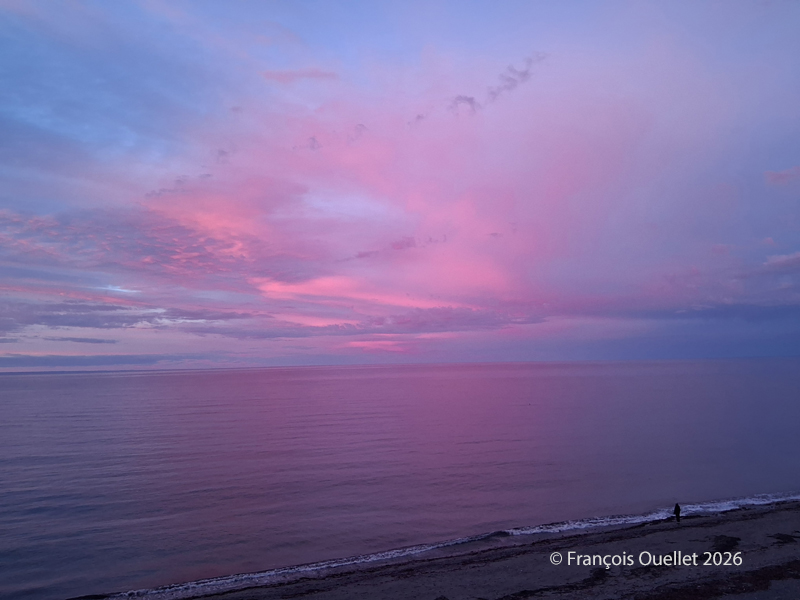
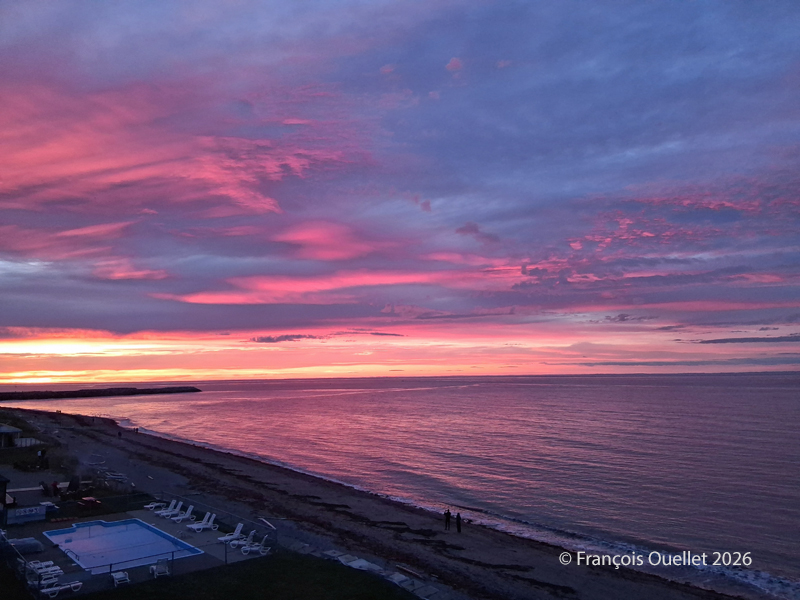
While on vacation in Matane for a few days, we took the opportunity to snap a few photos of the magnificent sunsets that are the hallmark of the area.
Sunset in Matane, Quebec, 2026
You never know what to expect, because in the evening the sky often clouds over or clears up in a matter of minutes. You have to be ready to capture the most beautiful colors, which last only a very short time—sometimes just a few seconds.
Sunset in Matane in September 2026
The entire region along the St. Lawrence River between Matane and Quebec City offers spectacular sunsets. The Kamouraska region sometimes features colors so intense that it’s hard to post them on social media without people thinking the photos have been edited and oversaturated.
Beginning of the bike ride between Saint-Roch-des-Aulnaies and Rivière Ouelle
Since cycling tourism is very popular, I’d like to suggest a beautiful bike ride between Saint-Roch-des-Aulnaies and Rivière-Ouelle in the Bas-Saint-Laurent region. This round-trip route, which is about 43 kilometers long, takes you along the St. Lawrence River and offers a few spots where you can stop to enjoy the view.
There is free parking very close to the highway exit, though it’s slightly off the main road. You’ll find it fairly easily. Very early on in the bike ride, you’ll see a small side path that leads to the St. Lawrence River. (Photo below)
Two ladies discussing at the halte de la Pointe Rouge near the Grande-Anse bike path.
On the Grande-Anse bike path, cyclists ride completely protected from cars. On one side is Highway 20, and on the other are trees and the St. Lawrence River.
On the Chemin des Berges between Saint-Roch-des-Aulnaies and Rivière Ouelle
The Chemin des Berges trail, which starts in Saint-Roch-des-Aulnaies, is a gravel path.
Bike path between Saint-Roch-des-Aulnaies and Rivière Ouelle
As you approach Rivière-Ouelle, you’ll ride a very short distance on Route 132, and then, after the Rivière-Ouelle bridge, turn left onto a paved secondary road with little traffic. This road leads cyclists to Rivière-Ouelle Beach.
Second section of the bike ride between Saint-Roch-des-Aulnaies and Rivière Ouelle
At the end of the trail, you have direct access to the beach for at least one kilometer. There are a few benches and even a picnic table.
Stopover at Rivière Ouelle during a bike ride in Québec in 2026
Then it’s time to head back to Saint-Roch-des-Aulnaies. The total distance of the hike is about 43 kilometers. It’s an easy hike, as it has only one hill and the distance is reasonable.
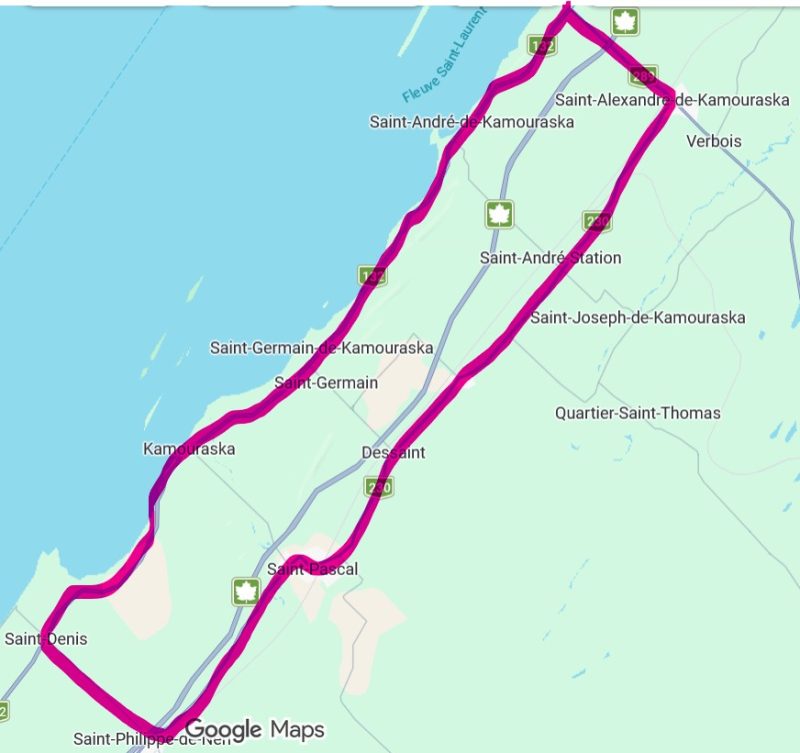
Map of a 77 km bike ride in the Kamouraska region.
This intermediate-level, 77-kilometer bike route in the Bas-Saint-Laurent runs entirely on paved roads, unlike Vélo Québec’s Églantiers loop (55 km), which includes a 14-kilometer gravel section. The cycling tour follows a sort of elongated rectangle running parallel to the St. Lawrence River.
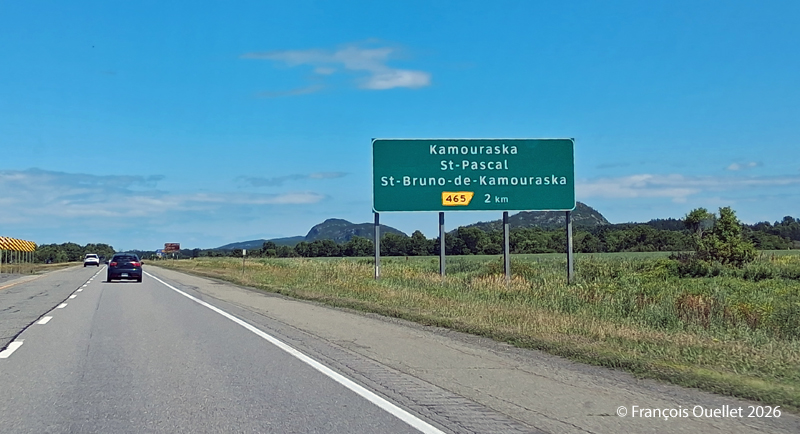
Exit for St-Pascal and Kamouraska
To get there by car, take the St-Pascal exit and head toward Kamouraska. Parking at the village church is free.
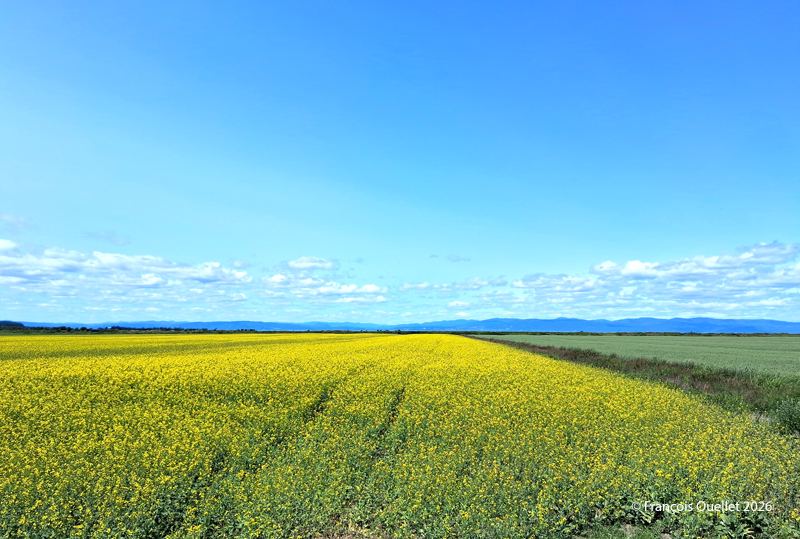
The bike route begins heading southwest, first along Route 132 toward Saint-Denis-De La Bouteillerie. Cyclists are treated to beautiful views along the way, whether of ancestral houses, flower-filled or plowed fields, farms, monadnocks, the river, or the mountains in the distance. When I was there, a massive drone controlled from the roadside was spraying crops.
Once you reach Saint-Denis-De La Bouteillerie, turn left onto Route 287 and continue toward Saint-Philippe-de-Néri. Eventually, you’ll pass under Highway 20 and reach Route 230. There, turn left again and ride along Route 230 to Saint-Alexandre-de-Kamouraska. Generally speaking, the route heads northeast.
Kamouraska fields, Summer 2026.
In Saint-Alexandre-de-Kamouraska, a left turn brings you onto Route 289, which you follow until you reach Route 132, near the river. Along the way, a long downhill stretch allows for a bit of a break and allows to reach a speed of 60 km/h. For reference, by the time you turn onto Route 289, you’ll have already covered about 50 kilometers.
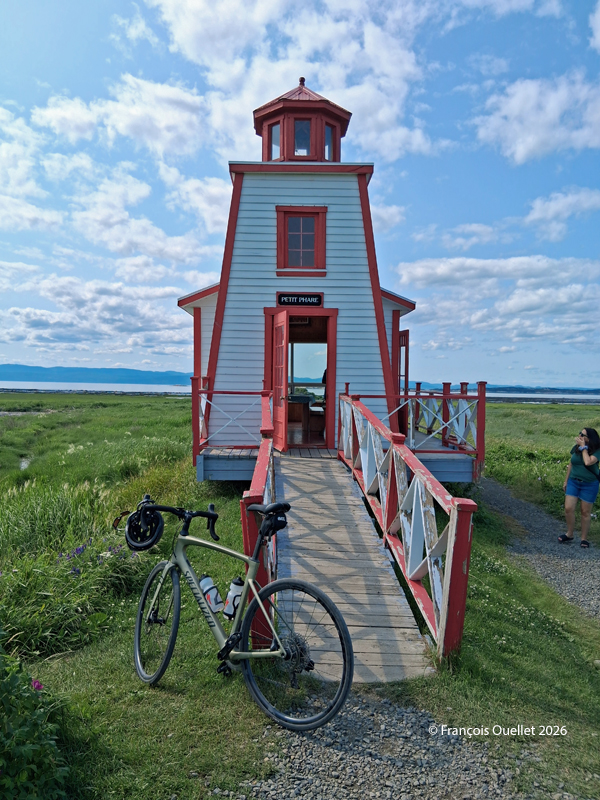
Once you reach Route 132, turn left to ride along the river and head back toward Kamouraska. At this point, there are between 15 and 20 kilometers left to go. A possible stopover is the small lighthouse in Saint-André de Kamouraska.
Small lighthouse of Saint-André de Kamouraska
Throughout this hike, there are several opportunities to take a shortcut inland to reach Kamouraska more quickly. This can be helpful if you’re tired, injured, or for any other reasons.
Once you’re back in the village of Kamouraska, there are a few interesting spots worth visiting to grab a bite, pick up some unique souvenirs, and even take a walk near the beach.
Alpha Jets from the Patrouille de France flying by Quebec City July 2026
In July 2026, the Patrouille de France arrives from the United States and makes a stopover in Montreal and Quebec City for the last time with its Alpha Jet twin-engine jets. These aircraft will be replaced by Pilatus PC-21s starting in 2030.
Photographing the flyover of Quebec City requires choosing between a close-up of the Alpha Jets—aircraft we will never see again—or a wide-angle shot showing the contrails in the colors of France as the pilots fly over the Quebec Bridge.
The Alpha Jets are moving quickly over the St. Lawrence River. The photographer cannot change lenses to capture both a close-up and a super-wide-angle shot in a single pass. He must choose…
A telephoto lens is ideal for capturing the details of aircraft as they fly by. The Canon EF 70-200 mm f/2.8L IS II USM will do the trick. Set to ISO 200 and mounted on a Canon 5DSR full-frame camera, it allows for significant cropping without any loss of quality when zooming in. The excellent light conditions allow for a fast shutter speed.
But every choice involves a trade-off. So, I have to forgo a high-quality super-wide-angle shot taken from the base of the bridge. It would have shown the entire metal structure along with the planes flying by. But the planes would have been too small to be identified.
The Quebec Bridge cannot be overlooked, as it is the world’s largest cantilever structure. Furthermore, the structure—which is over a century old—collapsed twice during its construction.
The Patrouille de France flying over the Québec bridge in 2026
The telephoto lens will allow for a decent photo of the Patrouille de France and the Quebec Bridge in the distance, but nothing more. Viewers will have to settle for a scene full of compromises where neither the planes nor the bridge are clearly visible. However, it did allow for some impressive close-ups of the Alpha Jets, as shown in the first photo.
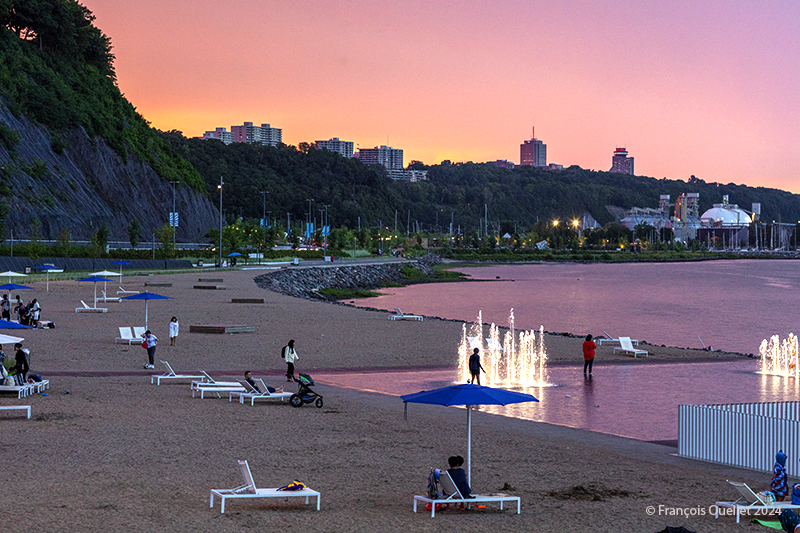
An evening after the rain at the Station de la plage, Québec 2024
The information below applies to those interested in stand-up paddleboarding in Quebec City, from the “station de la voile” towards the “station de la plage” and the surrounding area.
Before setting out, check the general weather forecast.
Those with some aviation knowledge should check the CYQB TAF (Terminal Area Forecast) for wind estimates.
Also check the tide table (Lauzon) to see if the tide is rising or falling.
Wearing a personal flotation device (PFD) is mandatory. A wetsuit is strongly recommended, as the water in the St. Lawrence remains cold, even in summer. Here’s a useful rule for deciding what to wear: the water temperature plus the air temperature, compared to 37 °C. If the result is less than 37, a wetsuit is preferable. If the water is 10 °C or colder, regardless of the air temperature, a waterproof layer is essential.
For water temperature near Quebec City, click on “water temperature.”
Buoys measure the temperature. Another possible site for the winds: Windy.
Wetsuits come in various thicknesses (2, 3, or 5 mm for slightly colder conditions).
The wetsuit should fit snugly against the body to prevent air pockets from forming between the skin and the material. If you’re in saltwater, you can apply lotion to your skin under the wetsuit (since water seeps through the wetsuit and can irritate the skin).
Hypothermia: the human body can withstand a maximum of fifteen minutes in water at 5 °C.
Station de la Plage and showers in Quebec City.
The “rule of 12” is taken into account when launching a paddleboard on the river. Each hour corresponds to a more or less rapid rise or fall in water flow. On the St. Lawrence River near Quebec City, the tidal range is three metres. A tidal cycle lasts about 6 hours. During the first hour (1/12) = 1/12 of three metres = .25 metres. The tide changes by .25 metres during the first hour. The second hour (2/12) = .50 metres. The third and fourth hours: 3/12 each. Therefore, during the third and fourth hours, the tide varies by 0.75 metres each hour. The fifth hour: 2/12. Sixth hour: 1/12.
From the “station de la voile”: if the tide is falling and winds are blowing from the S, SW, W, or NW, there are two obstacles when heading west. There is a headwind component, and the person paddles against the current. Check whether the wind strength allows you to launch the board and head west first, especially if the tide is falling.
The safer approach is to exert effort at the start of the trip and coast on the return.
If you decide to head west with an incoming tide, the trip out will be very easy, but you’ll have to paddle hard on the way back.
To gauge the effort required, you can choose a reference point along the Champlain Promenade and note how far the board drifts when you’re not paddling. Then, compare that to your progress when paddling normally. For example, during a trip westward with an ebb tide (water flowing back to the sea) and winds from 250 degrees at 10 knots, I paddled for over an hour just to reach the first stone pier near the “station de la plage”. This included using the double paddle.
At the ends of the stone jetties extending into the river at the sailing and beach stations, waves come from all directions.
Kneeling on the board, you can catch higher waves and have more power to paddle.
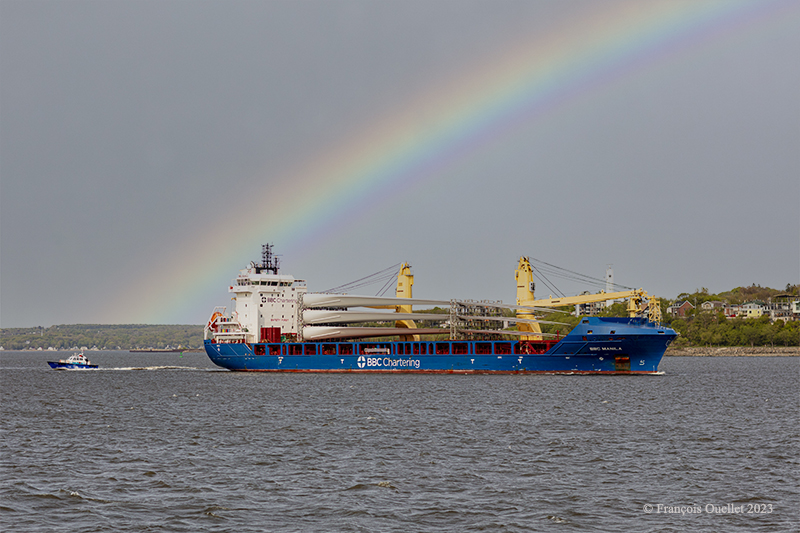
The BBC Manila carries wind turbine blades on the St.Lawrence Seaway near Quebec City.
The river has short, long, and very long waves that mix. You may dip a few feet in the through and rise back up on the ridge when the wave is large. There are also times when you’re pushed sideways. Keep an eye on the shore to see which way you’re being carried.
To maintain your balance, keep your eyes on the horizon at all times. Alternate between twenty-minute sessions standing up and then kneeling to rest. If necessary, set up a board seat and use a double paddle while seated for a change.
You must not stray too far from the shore to avoid becoming a victim of sailboats or jet skis travelling at high speeds in areas that require more cautious navigation.
When a large ship passes offshore, two-foot waves arrive a few minutes later, gently lift you up, then continue on and crash against the banks on either side of the river. They return to the paddleboarder much later and are much weaker.
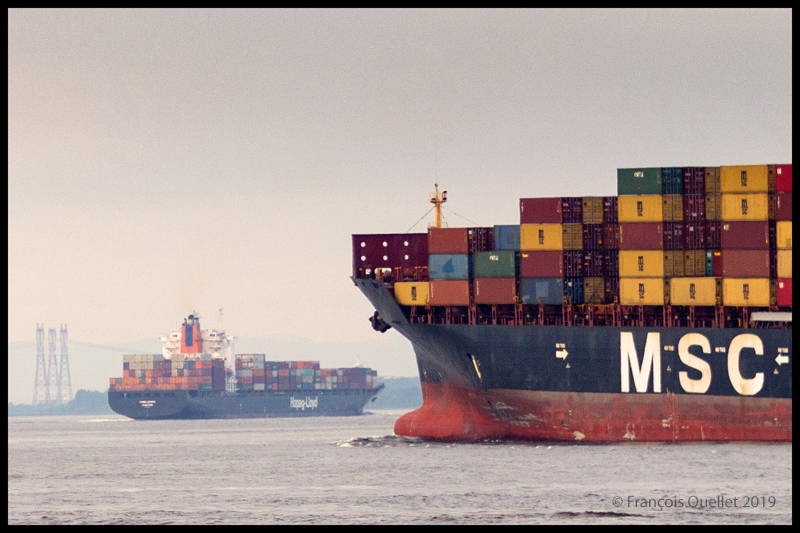
The container ship Hapag_Lloyd Quebec Express and the container ship MSC Paola are sailing around Île d’Orléans near Quebec City.
Take this opportunity to relax. Since this is a water sport, it’s normal to end up in the water from time to time.
There’s a beach near the “station de la voile.” It has few sharp rocks. However, keep an eye out and avoid going there when the tide is at its highest.
Have fun!
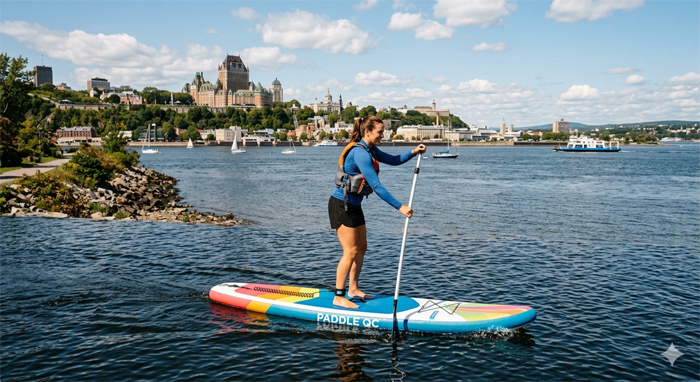
A paddleboarder on the St. Lawrence River, as imagined by AI.
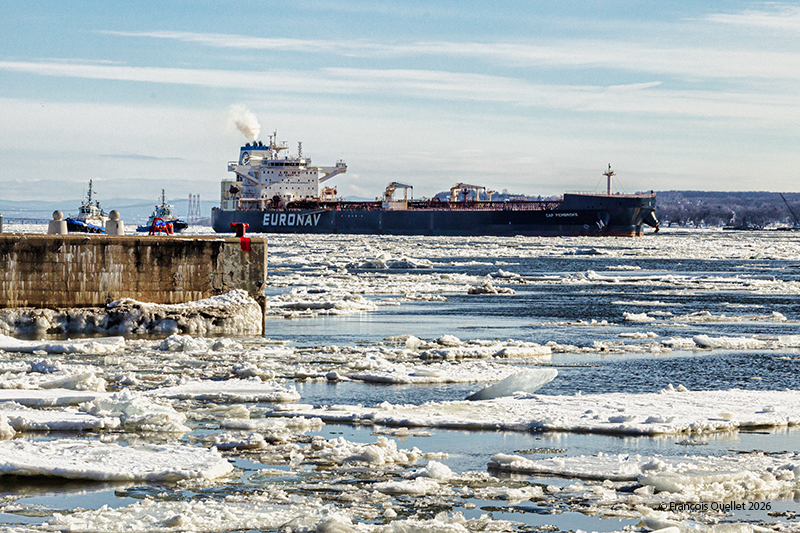
Oil tanker Cap Pembroke near Quebec City April 2026
Sailing from Ingleside (US YIG) in the Gulf of Mexico, the Greek-flagged oil tanker Cap Pembroke is heading toward the Valero Energy facilities in Lévis (CA QUE). The crew leaves the Gulf of Mexico in T-shirts and arrives in the icy waters of the St. Lawrence River a few days later.
The tanker can be seen as it rounds Île d’Orléans at high tide, assisted by two tugboats from the Ocean Group.
At very low speeds, the steering efficiency of a ship like the Cap Pembroke is greatly reduced. Measuring 277 meters long and 48 meters wide, it relies on tugboats to avoid obstacles and navigate the tides and winds of the river near Quebec City.
Federal Trident sailing through the ice in front of Quebec City 2026
Days with temperatures of -25 °C and below are becoming increasingly rare in Quebec City. With the wind chill factor, the temperature today feels like -36 °C. This is a golden opportunity to try to capture the sea smoke on the St. Lawrence River.
Photography technique
Sea mist between Île d’Orléans and Quebec City, winter 2026
Night photography in these weather conditions remains difficult. The low light requires a tripod, which itself vibrates in the gusty wind. This means increasing the ISO and decreasing the depth of field to achieve a faster shutter speed, which slightly reduces image quality. In addition, using a 300 mm telephoto lens increases the risk of blurry photos. Photography is all about compromise!
Canadian Coastguard icebreaker Des Groseillers at work near Quebec City winter 2026
Above is a photo of the Canadian Coast Guard icebreaker Des Groseillers at work. It is not surprising to see this type of vessel in the area, as the Seaway must remain ice-free in its centre to allow ships to navigate year-round. And this year, there is ice!
Canadian Coast Guard Amundsen icebreaker on the St.Lawrence river near Quebec City 2026
The freezing weather of winter 2025-2026 in Quebec requires frequent interventions by the Canadian Coast Guard to open passages on the St. Lawrence River. In the photo above, the icebreaker Amundsen, clears the way in front of Quebec City.
This ship occasionally works in the Canadian Arctic on research projects. It also ensures a Canadian presence in Canada’s northernmost territories.
Note the helicopter parked at the rear of the ship. Other larger icebreakers are under construction at various shipyards across the country, including the one in Lévis. Some of them are intended to strengthen Canadian territorial sovereignty in the Arctic.
Ferries at work in the ice in front of Quebec City winter 2026
Ferries make their way through the ice in January 2026. They ensure the crossing for pedestrians and vehicles between Quebec City and Lévis.
Ship moving through the ice on a winter night in front of Quebec City
For this nighttime photograph, I used a Canon EF 85mm f/1.2L II USM lens. It requires very little light and allows the photographer to take a picture of the Ocean tugboat and the merchant navy ship as they pass in front of Quebec City. I took the photo from the Dufferin Terrace and cropped it to enlarge the image.
Leaving Tadoussac, the road continues along the Côte-Nord (North Shore) and we pass through Forestville to reach Baie-Comeau and take the ferry to Matane, on the south shore of the St. Lawrence River.
We arrive in Matane at dusk, just in time to set up the camera equipment on the beach. There’s no way I can take the photo above from the ferry, because a long exposure requires absolute stillness. I want to capture this beautiful September moon rising above the houses.
I miss a few shots by relying on autofocus. I quickly change my photography technique. Liveview (Live View) mode and manual focus will improve the sharpness.
Fishing boat at dusk in Matane, Quebec 2025
The next day, a boat leaves Matane just before nightfall for a fishing expedition off the St. Lawrence River. The relative calm of the waters offers interesting reflections. The low light and distance of the boat require the use of a high-quality lens, in this case the Canon EF 300mm f/2.8L IS II USM.
On the way back from Matane to Quebec City, a stop at Bic National Park allows us to take a few photos, including this fishing boat returning to port. The sailors’ departure time varies constantly depending on the river tides.
Fishing boat in the Parc national du Bic, Québec 2025
Another location well known for its beauty is the municipality of Sainte-Luce-sur-Mer. Below, the colorful houses along the beach attract the attention of tourists and contribute to the area’s reputation. I preferred to capture an overall effect by including vegetation in the foreground. The few small low cumulus clouds also add to the dynamic of the scene.
The village of Sainte-Luce-sur-Mer and its colorful houses.
One last photo shows the sunset in Berthier-sur-Mer. This area, along with the Kamouraska and Notre-Dame-du-Portage regions, regularly offers exceptional panoramas when the sun sets. So much so that some photos can look like they’ve been retouched.
I saw reds and purples so pronounced that it became obvious that the photographer would have been accused of oversaturating his shots.
Sunset at Berthier-sur-Mer en 2024.
After an excellent meal at the beach restaurant in Berthier-sur-Mer, we finally reach our final destination, the beautiful city of Quebec City.