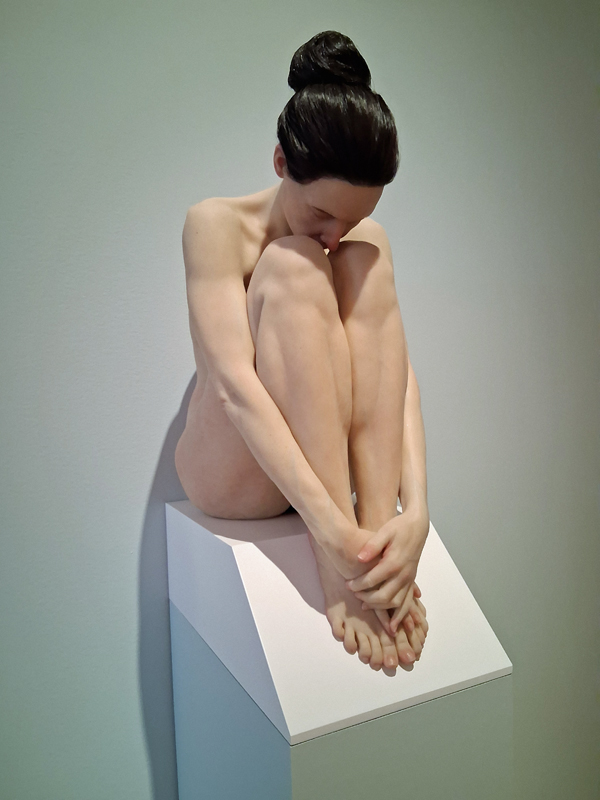
Femme assise, an hyperrealist sculpture by Sam Jinks at the MNBAQ in 2026.
The exhibition “Hyperrealism: This Is Not a Body,” on view in Quebec City at the Musée national des beaux-arts du Québec (MNBAQ), runs through November 15, 2026. It is sure to become a major tourist attraction for the upcoming summer in Quebec City.
Some forty sculptures are on display for the public to view, including works by well-known artists such as Ron Mueck and Maurizio Cattelan.
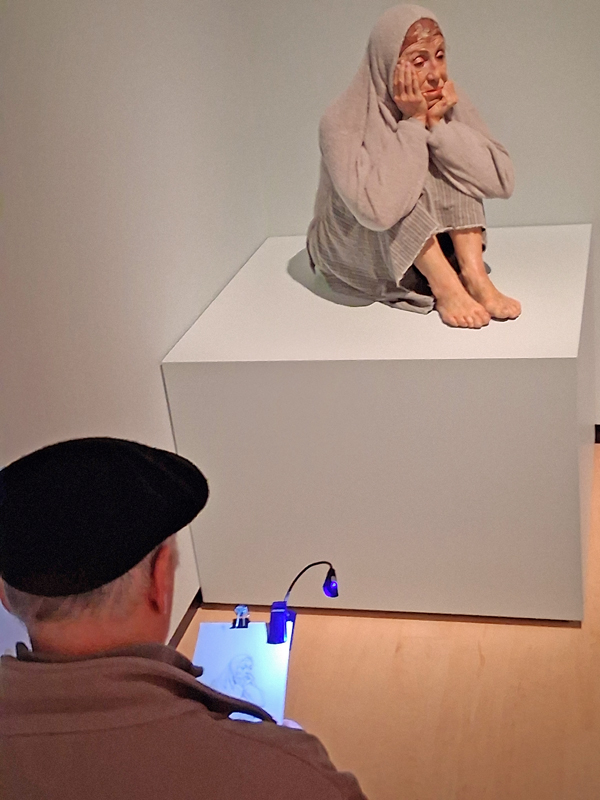
An artist draws one of Marc Sijan’s scuptures at thev MNBAQ.
Above, a man who is clearly very talented took the time to pull out his sketchbook and draw a sketch of the sculpture “Mise au coin” by Marc Sijan.
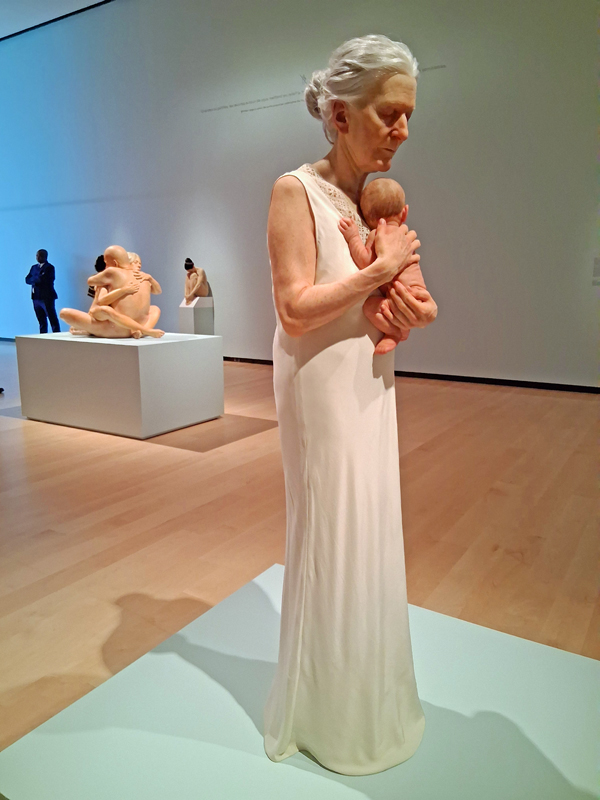
Femme et enfant, a creation by Sam Jinks at the MNBAQ in 2026.
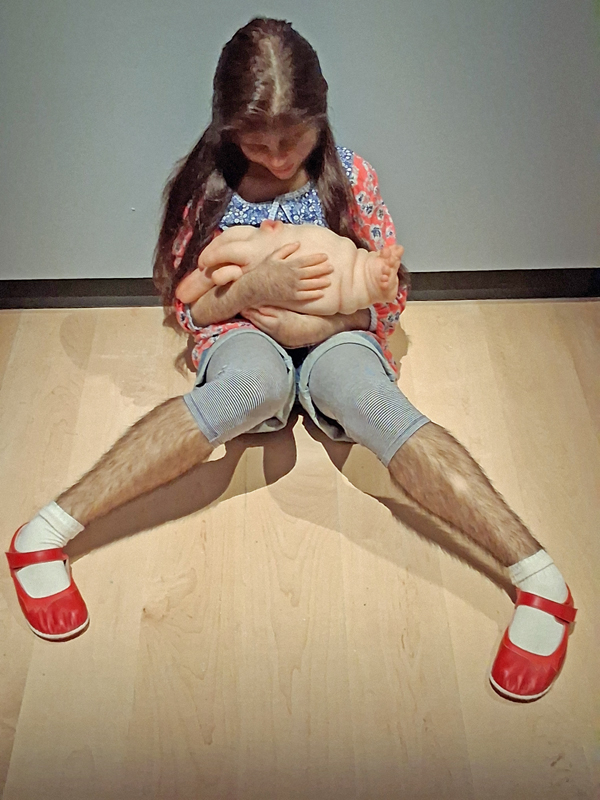
Visitors experience a whole range of emotions. There’s something for everyone, from the simplest to the strangest, as in the photo below, where a young person (“The Comforter,” by Patricia Piccinini) is holding something—it’s hard to say exactly what—in her arms.
A work by Patricia Picinini that has everyone talking at the MNBAQ.
Ferry Baie Sainte-Catherine Tadoussac in the province of Québec, 2025
The ideal time to visit Tadoussac, the fjord, and the surrounding area is in May and June until Saint-Jean-Baptiste Day, then immediately after Labor Day.
If travellers decide to go there during the summer anyway, they will see tourists everywhere.
View from Hotel Tadoussac in the province of Québec, 2025
If you can, book one or two nights at the Tadoussac Hotel, preferably with a room overlooking the river. In the morning, the space will be much brighter than a room facing the backyard. The hotel has undergone extensive renovations, which will continue discreetly in 2025.
The hotel is close to everything, and you can explore many local attractions without having to use your car. The docks are also a ten-minute walk away when it’s time to take a whale-watching cruise.
Beluga whale sculpture in front of the interpretation center in Tadoussac, Quebec 2025
Numerous chairs on the grounds in front of the hotel Tadoussac allow guests to enjoy magnificent views of the surrounding landscape and the St. Lawrence River. The hotel restaurant is decent and features a beautiful glass roof. However, don’t expect the same level of culinary experience as Chez Truchon in La Malbaie.
As for the tourist attraction of booking a cruise on the St. Lawrence River to watch humpback whales and beluga whales on the AML Grand Fleuve, I would advise you to pay the extra fee that gives you exclusive access to the upper deck of the boat. You will be much more comfortable there and able to take pictures of the marine mammals than if you find yourself crammed in with dozens of other curious people on the main deck.
Fin whale in the St. Lawrence river near Tadoussac, Québec 2025
However, I don’t think it’s worth paying extra to sit in the VIP lounge and have a glass of wine. If alcohol is your priority, skip the cruise and stop at one of the bars along the beach instead. You’ll save a lot of money.
Another tip: a cell phone won’t be very userul for taking pictures. In general, belugas and whales are not close enough to the ships for cell phones to capture them clearly. If you want to bring back a high-quality digital souvenir, bring a decent camera with a telephoto lens that can crop images without too much degradation.
Cloud formations near Tadoussac and the Saguenay River 2025
I can’t stress this enough: even if it’s warm or cool in Tadoussac when you set out on the river, the temperature will drop significantly once you’re out on the open water, sometimes by as much as 10 degrees Celsius. A hat and several layers of clothing will allow you to truly enjoy the experience and stay outside the cabin throughout the trip. Those who are less well-dressed focus on protecting themselves from the cold, stay inside the cabin, and see practically nothing.
In September 2025, another edition of Vintage Weekend took place in Quebec City. This year, more than 200 vintage cars were on display on Saint-Paul Street and on the grounds adjacent to Espace Quatre Cent in Quebec City’s Old Port.
Stéphane Lavallée’s 1959 Corvette at Quebec City’s Vintage Weekend
As usual, restaurant owners had their hands full serving the many curious visitors who came to admire the cars. In addition, they had to contend with the presence of travelers who had recently disembarked from the three cruise ships moored in the harbor. The next photo shows the energetic team at Bistro St-Malo hard at work feeding passersby.
The restaurateur of Bistro St-Malo at work on St-Paul Street at Weekend Vintage 2025
This year, musicians from Calgary entertained the crowd with songs from the 1950s. The audience was delighted by the excellent quality of the performance, both in terms of singing and music. The same can be said of the dancers, who took us back in time with a few hits from that era.
Retro dancing on St. Paul Street at the Quebec Vintage Weekend in 2025
Below, cars occupy the space surrounding La Vivrière, a fountain sculpture commemorating the founding of the Food and Agriculture Organization of the United Nations (FAO).
Gary Lynch’s Hudson Hornet Hollywood 7x at Quebec City’s Vintage Weekend
Burger Heaven Lights on for Service at the Weekend Vintage in Quebec City
Paul Forest’s 1955 Chevrolet Bel Air with modified color
1952 Oldsmobile Super 88 Holiday and Michel Savard at Quebec City’s Vintage Weekend
Above, Michel Savard poses proudly next to his 1952 Oldsmobile Super 88 Holiday. As for André Guillemette, he had original parts shipped from Great Britain to do justice to his 1962 Jaguar Mark II, which can be seen below.
André Guillemette’s 1962 Jaguar Mark II at Quebec City’s 2025 Vintage Weekend
Reflections in Michel Métivier’s 1967 Pontiac GTO at Quebec City’s Vintage Weekend
A final photo shows St. Paul Street with Charles Boisseau’s 1965 Corvette Stingray.
Charles Boisseau’s 1965 Corvette Stingray at Quebec City’s Vintage Weekend
Montreal city view from Mount Royal in the evening in HDR.
This photo of Montreal in the evening during the blue hour is actually three photos superimposed with different apertures (HDR photography). In the absence of a tripod, I placed the camera on the rampart at the top of Mont-Royal. This allowed me to use a very low ISO and a nice depth of field.
Mount Royal is a major tourist attraction. The many visitors crowd along the rampart and compete for a selfie. Getting through the three HDR exposures without being hit by a curious onlooker is a miracle. As soon as my camera moves the slightest bit, I have to take all three photos again. And that evening, Mount Royal was crowded! But luck eventually smiles on us.
Sculpture of a winged demon on a Montreal building.
In Montreal, you can expect many styles of sculpture to grace the facades of buildings. The red-eyed demon above has an strong effect on the pedestrian! Good thing it’s not in front of a restaurant…
Rabagliati artwork on a Montreal building.
On the Plateau Mont-Royal, there’s a space reserved for a creation by Michel Rabagliati, the Quebec author renowned for his Paul series of comic strips. He also produces graphic novels, of which “Rose à l’île” is a good example. The winter scene on the building contrasts with the warm summer day in Montreal at the time of our visit.
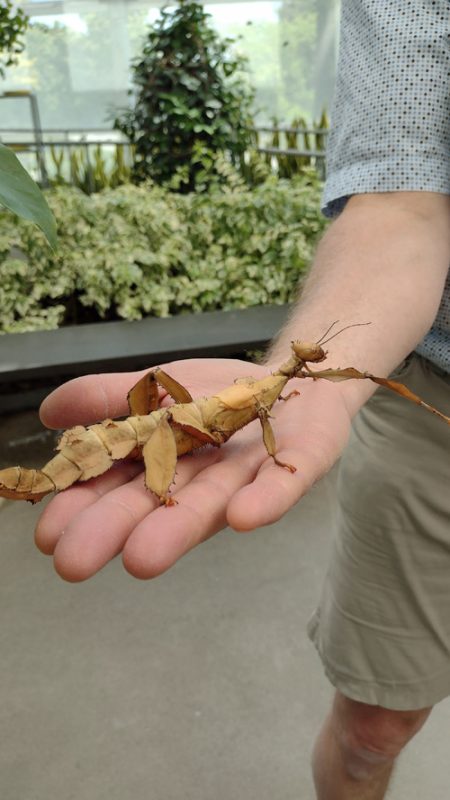
A “Giant prickly stick insect” is on my hand at the Montreal insectarium.
What a wonderful experience this week at the Montreal Insectarium! While we were visiting one of the pavilions, an attendant offered to hold a Extatosoma tiaratum, also known as tiara snail, scorpion stick or Australian walking stick.
The insect gets its scorpion-like reputation from the fact that it curls its tail in the same way as a scorpion when it feels in danger. But it doesn’t sting. You can then put your hand upside down and it will grab you effortlessly. This is its natural position under a branch.
As someone who rarely carries his cell phone around with me, I was delighted to have the opportunity to take a photo of him that day!
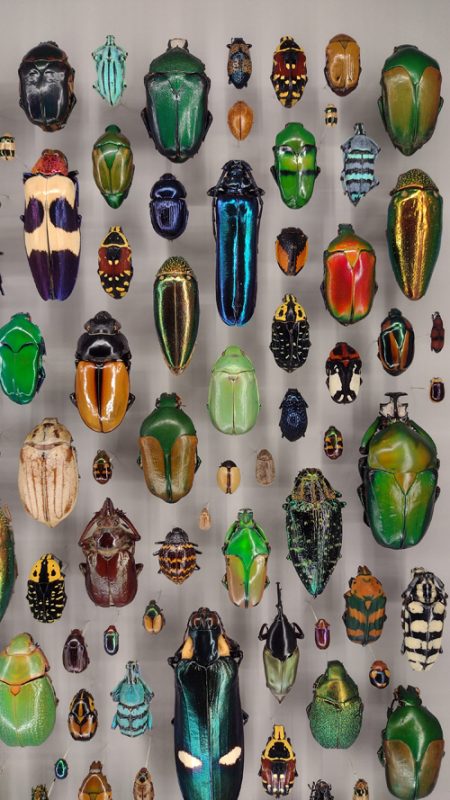
Part of the insect collection at the Montreal insectarium.
The diversity of shapes and colours of insects in the environment is astounding. Nature never ceases to amaze.
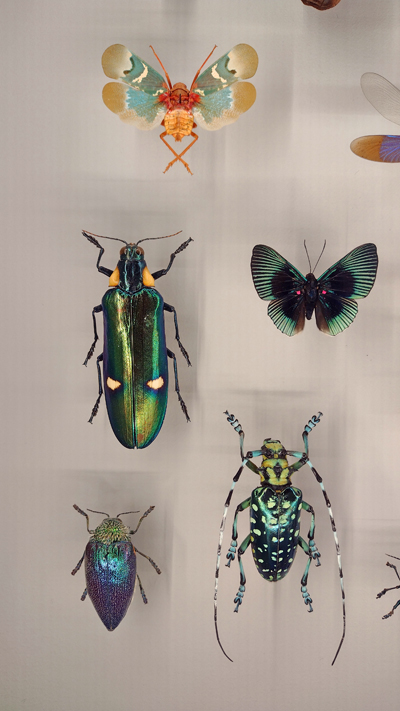
Superb specimens at the Montreal insectarium.
In addition to the central pavilion, home to a large number of colourful insects, visitors can also take a stroll through the butterfly aviary. The butterflies wander around the visitors, but it is forbidden to touch them.
Among Quebec’s tourist attractions, the Montreal insectarium is well worth a visit.
Click on the link for more articles and photos on the environment in my blog.
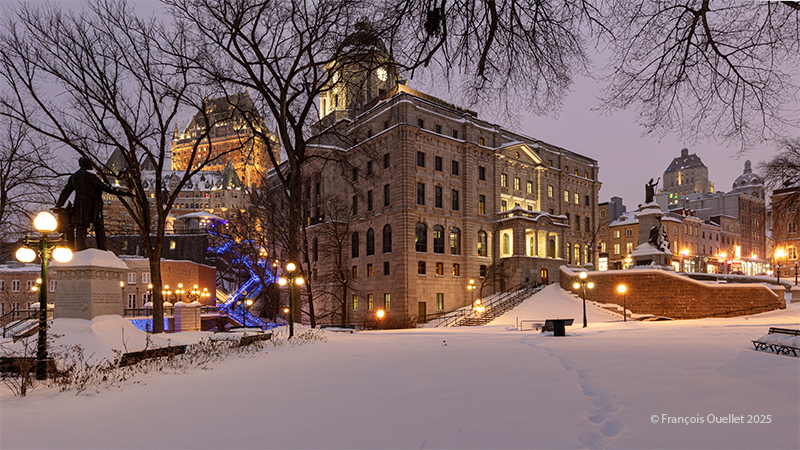
Old Quebec in winter seen from Parc Montmorency in 2025
It’s time for another winter outing in Old Quebec. The night photography session will be devoted to architecture.
The temperature is about -14 C and the winds are blowing at 15 km/h. Without gloves in order to manipulate the little buttons on the camera, the skin feels -22 C. A regular break is essential to thaw out the fingers!
I took the photo from Parc Montmorency, just up the côte de la Montagne. This historic site is a major tourist attraction in Quebec City. Louis Hébert, Canada‘s first farmer, cultivated the land here on his arrival in New France. It’s important to understand, however, that the natives knew about farming and cultivated the soil long before the arrival of the French settlers.
On the left is a sculpture of Sir Georges-Étienne Cartier, one of the Fathers of Confederation. The Château Frontenac and Price Building are also visible in the distance. In the foreground is a building that has changed function many times. It was originally the first Episcopal Palace.
Photography technique
For this shot, I planted my tripod in 40 centimetres of snow. I used a Canon 5 DSr camera equipped with a Canon EF 11-24 mm F/4L USM ultra wide-angle zoom lens. I could have set the ISO to 200 thanks to the stability of the tripod, but the wind demanded a faster result due to possible vibrations. ISO and shutter speed are therefore dictated by ambient weather conditions rather than low light.
Taken in the evening, the shot features five photos with different apertures. This allows us to deal with the great difference in luminosity between the foreground and the city of Lévis in the distance.
The clouds and snow help to reflect the city’s glow during the night. Even so, I’ve enhanced the light in the background to make the buildings more easily visible.
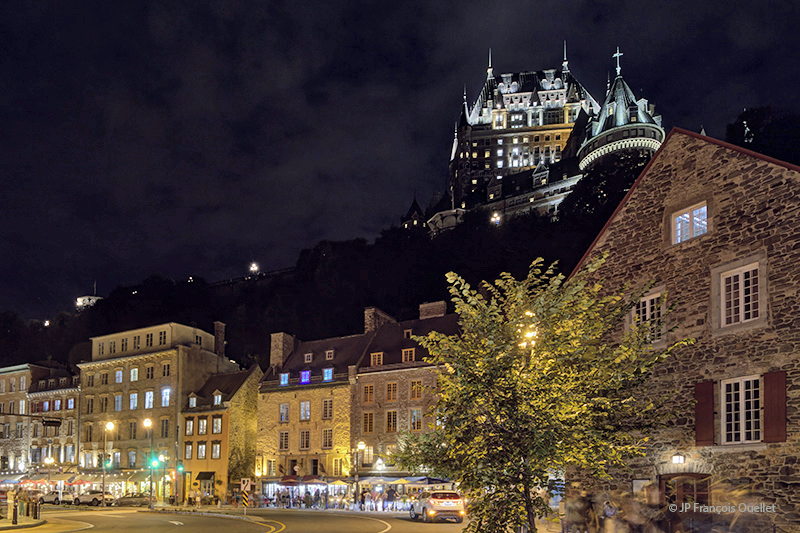
Scène de Québec et du Château Frontenac la nuit. Photo par François Ouellet
Photographing a tourist attraction like the Château Frontenac at night, with all its lights, is a good challenge for both the Canon 5 DSr camera and the photographer. Here are a few photographic tips to help you repeat the experience:
1) For a special effect, you might as well go all out and capture the château, including all the lights in the buildings near the Petit-Champlain district.
2) Photographic composition is based on the rule of thirds. You don’t always have to respect the fundamental theory, but this time it works well.
3) The viewer first notices the brightest structures, all of which have a similar luminosity. He then detects the castle on the cape.
4) The contrast is deliberate. The castle is not depicted in all its architectural splendour, but as a few lines lit up in the night.
5) The observer no longer needs to see all the forms of the castle to recognize it. It’s the most photographed castle in the world. The brain quickly analyzes the visible shapes and completes the building in a fraction of a second.
6) Being photographed from this angle and in this light gives a more mysterious aspect to this hotel overlooking the smaller buildings.
7) HDR photography solves some of the lighting problems. I superimposed five photos to obtain the final result.
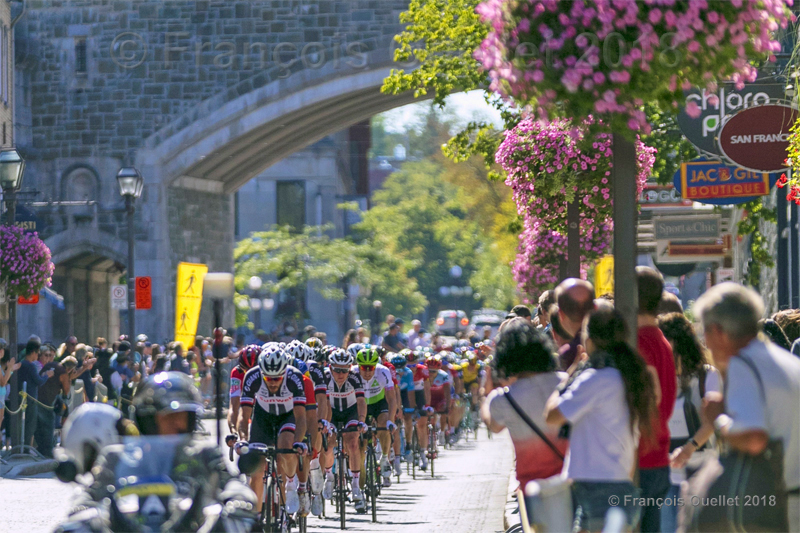
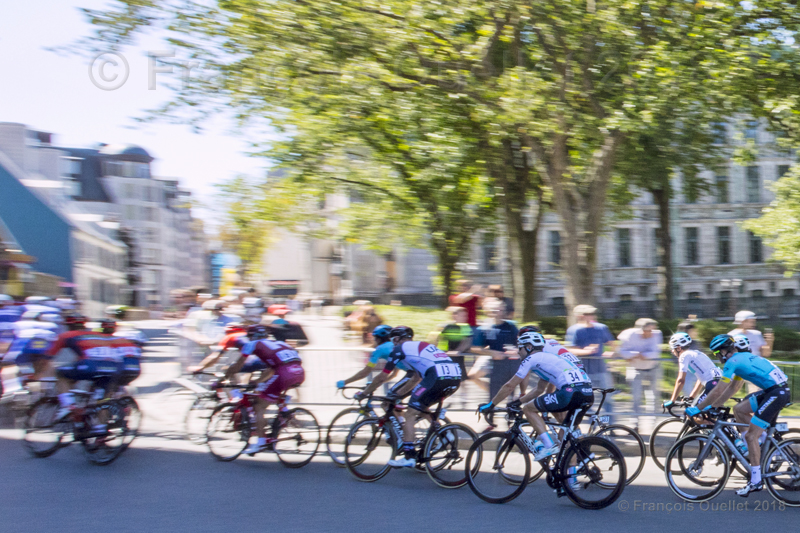
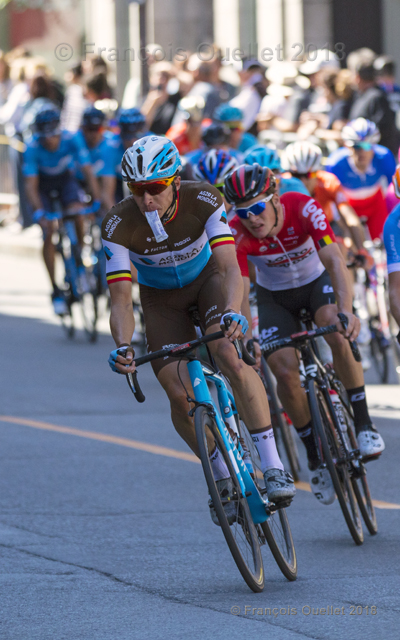
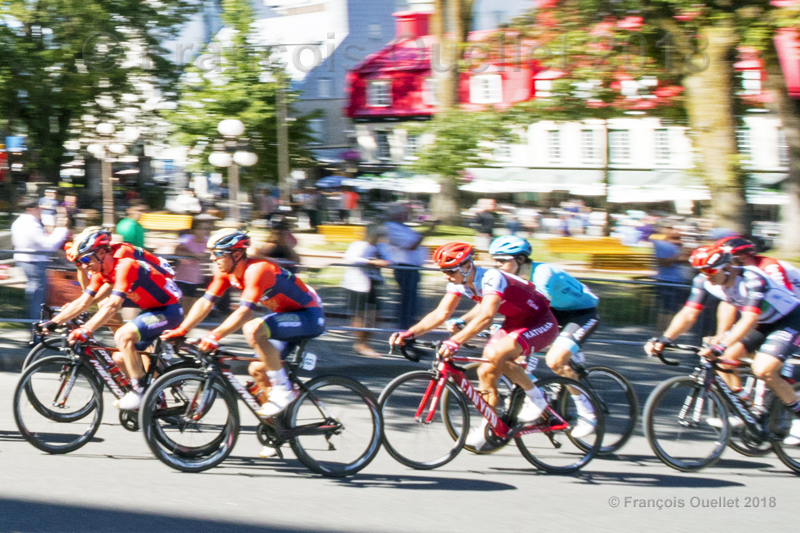
The 2018 Grand Prix Cycliste de Québec took place on September 7th on a beautiful day. The cyclists had to repeat a 12,6 km pattern across Old Quebec and the Battlefields Park sixteen times, which amounted to 201,6 km.
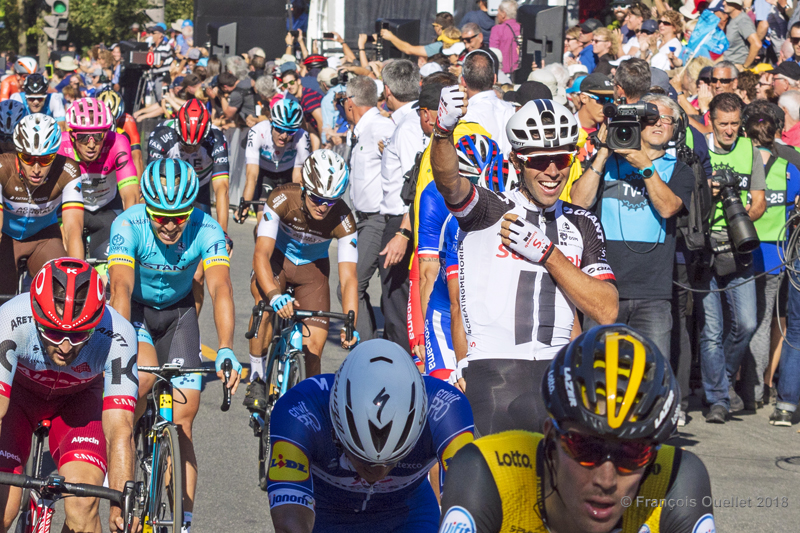
The circuit’s height difference from start to finish was 186 meters, for a total difference of 2976 meters. It is the Australian Michael Matthews who won the race during the final sprint.
Here are a few photos that I took with a Canon 5DSR camera. I used a Canon 14mm 2.8L ultra wide angle lens and a Canon 70-200 2.8L IS II USM telephoto lens.
The Grand Prix Cycliste Québec 2018. The cyclists are passing under the St. Jean Gate.
The Grand Prix Cycliste Québec 2018. Turning on St-Louis street.
The Grand Prix Cycliste Québec 2018. Turning on Côte de la Fabrique.
The Grand Prix Cycliste Québec 2018. The cyclists are passing under the St. Louis Gate.
The Grand Prix Cycliste Québec 2018, in front of Place d’Armes.
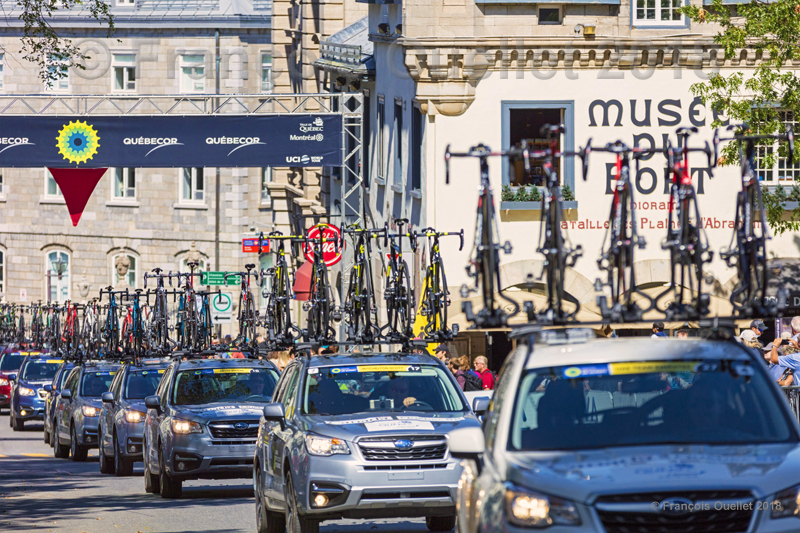
The Grand Prix Cycliste Québec 2018. The car from each team is never far behind the racers.
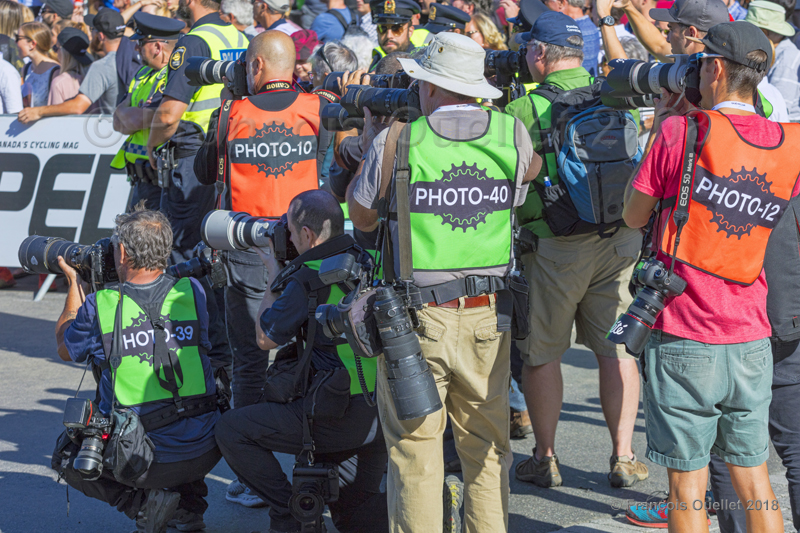
A few official photographers at the UCI World Tour Quebec 2018.
The Grand Prix Cycliste Québec 2018. The winner, Michael Matthews, from the Sunweb team, raises his fist.
Pour d’autres photos de la ville de Québec, cliquez sur les
liens suivants de mon blogue :
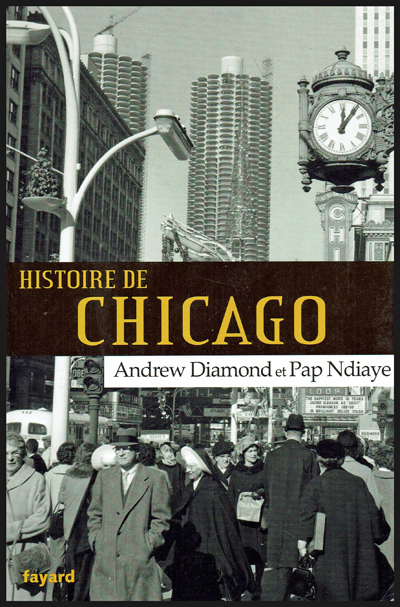
The 2016 televised political debates on CNN between Hillary Clinton and Donald Trump put forward the topic of racism in the United States. Chicago was specifically mentioned as it detains the national record for violent deaths. The book “Histoire de Chicago” allows, among other subjects, to better understand what feeds social inequalities between Blacks and Whites since the creation of Chicago.
The reader understands that it is not the cultural deficiencies that are at the base of the problems but an institutionalized racism and the economic choices of the different municipal administrations.
The city grew set against a background in which the color of a person’s skin determined the type of work that he or she was allowed to occupy. Eventually, even urban planning was designed so that Blacks and Whites would be separated: the artificial walls created by the construction of the Dan Ryan Expressway or the Dearborn Park are in themselves good examples.
In 2016, the polls show a strong support for the Unites States republican candidate Donald Trump. Trump knows Chicago very well and he had his “Trump Tower” built there.
The republican candidate takes over in his political platform some of the elements that have made the popularity and success of the Daley family who ruled over Chicago for decades: the exploitation of fear between ethnical groups to build and maintain a political power, the idea of building a wall and the use of torture as a simplistic solution to complex problems.
This populism attracts a certain class of American electors who are easily scared by the differences between people and cultures.
The book “Histoire de Chicago” is very much a reflection of what is happening today and the authors do no fear to raise delicate political subjects.
Cover of the book “Histoire de Chicago” by Andrew Diamond and Pap Ndiaye
Chicago
Chicago became a territory of the United States with the Treaty of Paris in 1783. Subsequently, natives progressively lost their lands through different manoeuvers, among them the signature of contracts while they were drunk. Around 1830, when the Indians were definitely gone, the speculative fever started.
Railways
Starting around 1860, Chicago organized itself to become the main hub for the most important railway companies of the United States. The city grew very quickly. Passengers, livestock, cereals and other merchandise had to transit through Chicago. The city depended on the train to grow, and the railway companies depended on Chicago to be profitable.
The rapid growth of Chicago’s population was essentially the driver of migration from Europe (Irish, Germans, Polish and Italians). The evolving and often violent relationships between Chicago’s ethnic groups is well explained in the book.
Retail stores
Just before 1900, the Chicago population witnessed the creation of the first retail stores in which a customer could order through a catalogue and use credit. New categories of employees and managers were added to the working population and helped shape the middle class.
Black immigration in Chicago
Around 1910, there was an important increase in the Black immigration coming from southern United States. Chicago was an abolitionist city. This does not mean that it was favoring racial equality but that it was against slavery. In fact, Chicago progressively became the most segregated city in the United States.
Blacks were massively arriving from southern United States, not only for economic reasons but also to get away from the slavery, racial violence and segregation that was the norm in multiple states. Although far from ideal, the situation in Chicago was better than in the south of the country.
The First World War considerably reduced the number of immigrants coming from Europe. This created a serious problem for a city that was benefiting from numerous military contracts and needed a very high number of employees in its manufacturing companies. This also favored the “great migration”, which is to say “the spectacular intensification of the Afro-American migration towards the North-East and Middle West major urban centers […]” (p.143)
Chicago’s slaughterhouses
Chicago was renowned for the very high number of its slaughterhouses, in particular its pork slaughterhouses. The smell and pollution created by this activity was terrible. Chemical laboratories allowed for the commercial use of all parts of an animal. The writer Georges Duhamel wrote in his book that in Chicago “nothing leaves the slaughterhouse but the squeal” (p.63).
Black workers did not have the right to work in the Chicago steel industry and had to limit themselves to slaughterhouses where they were hired as manual workers. They had no access to qualified jobs.
The Second World War
During the Second World War, Chicago was competing with other major American cities to obtain huge military contracts. The city did not manage its efforts to show it supported the American government. Chicago eventually received billions of dollars for the construction of tanks, tractors, torpedoes, bombs and aircrafts (among them the B-29 bomber aircraft).
To compensate for the lack of manpower, since a lot of men enrolled as volunteers and had gone to war, women massively entered the workforce. Employers saw an opportunity to maximize their profits by reducing the salaries of working women, which corresponded only to 65% of the men’s salary for the same work. This represents the way women were thanked for their effort and collaboration.
Transformation of the Chicago economy
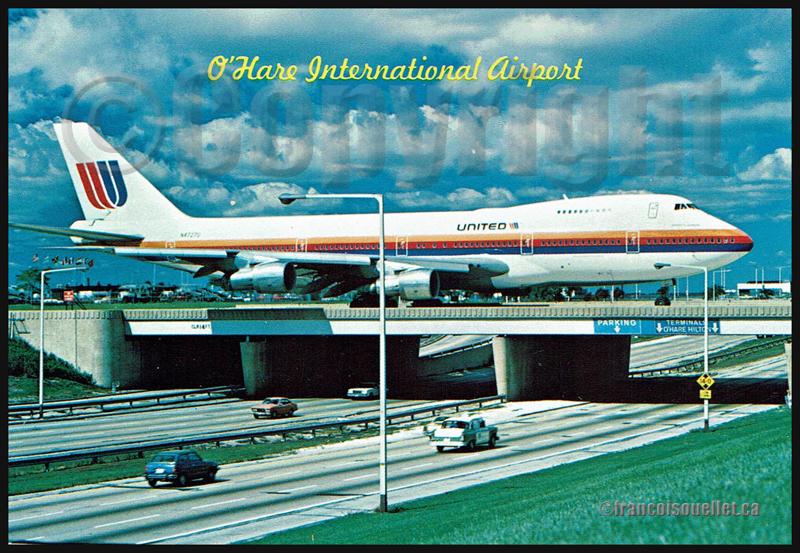
A United Airlines Boeing B747 is taxiing over the expressway at the Chicago O’Hare international airport (on aviation postcard)
Chicago experienced a profound transformation during the ‘70 s. The closure of the slaughterhouses in 1971, and the diminishing demand for steel mills products signalled the end of the industrial era. It was followed by an opening on the international and the development of a new economy based on specialized services like finance, real estate, insurance, marketing, publicity and legal services.
The Chicago mayor, Richard M. Daley, fostered the establishment of a new socio-professional class of creators in the city (design, arts, music, etc.) by considering it like another “ethnic group” who needed privileged space to express itself.
The development of housing estates and complexes during the ‘60s and ‘70 s
During the ‘60s and ‘70s, the Chicago landscape was profoundly modified. Huge housing estates and complexes were built (Magnificent Mile, Sandburgh Village, Marina City, Lake Point Tower, Dearborn Park) where the White population lived, in the north part of the city. The Chicago Tribune said of Dearborn Park that it was “a fortress reserved for Whites and aimed at protecting the financial district against the Blacks”.
The Daley administration had to fight against urban sprawling and consequently favored the construction of skyscrapers to maintain the presence of Whites in the central area while receiving more property taxes. Two stock exchange institutions were created, the Chicago Board of Trade (CBOT) and the Chicago Mercantile Exchange (CME). The creation of those two institutions as well as of the complexes did not do anything to change the dynamic between the Whites and the Blacks.
The racial segregation
Although Martin Luther King was a dominant figure in the fight for the civil rights of the Blacks in the United States, the authors underline that the black population of Chicago had not waited for a leader to promote their rights as they had already started to mobilize themselves years before.
Martin Luther King’s ideas on the integration of Blacks did not receive the support of everyone in the black community, especially the Chicago black politicians who benefited from a special treatment from the Daley machine, which favored the status quo.
Chicago’s mayor Richard M. Daley experienced much success. To stay in power, the Daley Machine “rested squarely on the continued separation and competition between communities”. (p.322-323) The separation between Blacks and Whites was planned and maintained. There was and there are still two Chicagos.
A highway, the Dan Ryan Expressway, was even positioned in such a way that it would create an artificial wall between the Daley’ s district, Bridgeport and the Black Belt: “This was the most massive obstacle that the city could build, other than a wall, to separate the white South Side from the Black Belt” (p.259).
The Daley Machine
We cannot talk about Chicago without underlining the importance of the Daley family and its political machine: “Through an authoritarian control of the “machine”, Richard J. Daley and his son Richard M. Daley, each one in his own style, dominated the Chicago political scene for forty-three years, between 1955 and 2011.
During that period which saw the development and the subsequent decline of modern civil rights, the ghettoization of huge parts of the West Side and South Side, a massive immigration wave from Latin America and the transformation of the city from an industrial giant to a world-class global services economy center, Chicago barely knew one legitimate municipal election or one real debate at the municipal council” (p.16)
There was rampant corruption and secret budgets in the Daley administration. In total opaqueness, the City Hall diverted the funds reserved to disadvantaged neighbourhood and distributed it to the privileged ones.
“[…] While important businessmen, Mafiosi and others who had links with the Daley machine were getting richer, Blacks and Latinos in need were shot in the street or tortured in the precinct’s’ back rooms” (p.394)
Law firms and entrepreneurs gave huge sums of money in exchange for important contracts. The Daley Machine was never short of money.
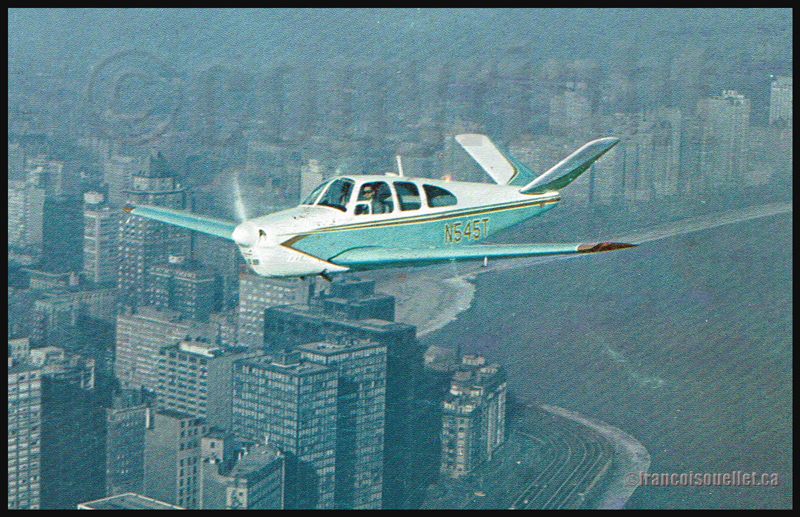
Beechcraft N35 Bonanza N545T in flight during the years when the Daley family was reigning over Chicago (on aviation postcard)
Racial tensions and repression policies under Mayor Daley
“By the 1930s, Chicago had become, according to the historian Frank Donner “the national capital for police repression” (p.321)
The black migration that took place during the 1940s and 1950s scared the Chicago population that felt besieged. This increased racial tensions that were already present and maintained. It was easier to accept more policemen than social housing.
The muscled tactics of Mayor Daley were the most obvious during the 1968 Democrat Convention, when policemen and 7000 National Guard soldiers “went down hard on the [crowd of 10,000 young protesters] in an explosion of mindless violence” (p.315)
The exploitation of racial fears was quite successful. Daley was defending his policies by saying that “ most people are more worried about a black uproar than of a mayor that orders the use of lethal force to put an end to it and they recognized themselves far less in pacific protesters than in policemen that hit them with truncheons” (p.319).
Media propaganda and the Daley Machine’s police were efficient in convincing the Blacks to respect the established order. Torture was common in the zone 2’s precinct, in the South Side, between 1972 and 1991.
The expected arrival of a new black mayor, Harold Washington, during the 1980’s, increased the fear that everything would change in Chicago. Everything was done to undermine Washington’s candidacy, but he eventually won helped by the black vote.
There were several left-wing political movements which all had their own objectives and were unable to unite under the same progressist banner. This provided the necessary margin of manoeuver to the Daley Machine, who worked in cooperation with the federal authorities to organize the state repression.
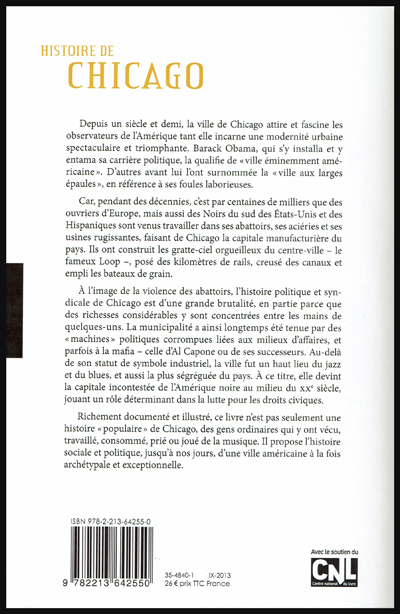
Back cover of the book “Histoire de Chicago”
Social problems in disadvantaged neighbourhoods
During the 1995 heat wave, 739 persons died in Chicago. The social precarity helped increase the number of deaths, but it was easier to determine that the victims were responsible of their fate.
The Blacks and Latinos believed, and still do, that the problems related to their school system and neighbourhoods come from some cultural deficiencies, but in trying to understand the real nature of their problems, they overlook the ongoing racism and economic choices of the different city administrations since the creation of the city.
“The 1980 census showed that ten out of sixteen of the poorest neighbourhoods in United States were in Chicago, in the Black Belt, of course”(p.334)
In 2002, Chicago was the American murder capital, with 647 victims. In 2008-2009, the city held the record of students killed in public schools which were gang related.
Today, there are two Chicagos
Today, Chicago benefits from well-defined ethnic neighbourhoods that attract tourists in search of diversity. However, the sustained racial segregation policies have isolated the black neighbourhoods and in 2016 Chicago still has the sad reputation of being the murder capital of the United States.
“The Chicago situation looks more and more like a science-fiction scenario. While part of the city has an economic capacity that sets it among the five first in the world, the other part is frozen in an austerity situation that could very well become irreversible” (p.443)