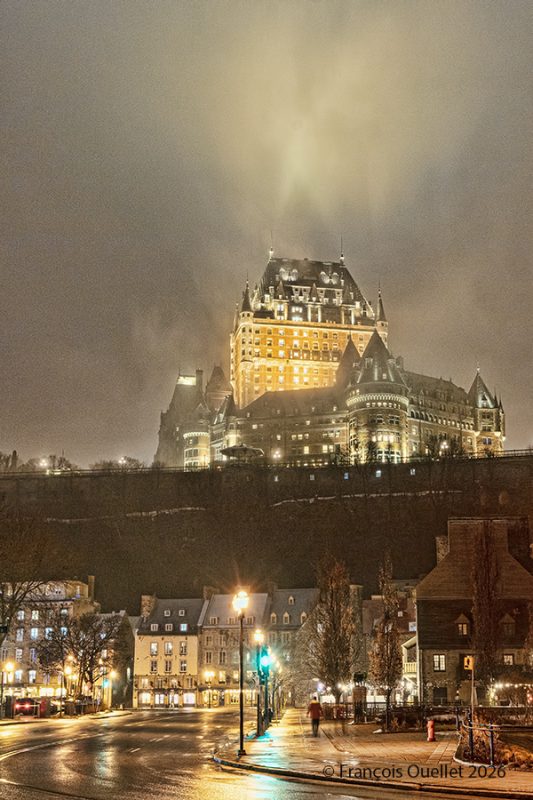
The Château Frontenac in the evening with low clouds during Spring 2026
In Quebec City, we had several consecutive days of rain in April while there was still snow on the ground. The warm rain melts the snow quickly, saturating the air with moisture and leading to fog and low-hanging clouds. Night photography enthusiasts know that this is an opportunity not to be missed for capturing special effects.
In the photo above, you can see low-hanging clouds above the Château Frontenac in Old Quebec. Fortunately, the central tower remains clearly visible. This is the perfect moment to capture the light reflecting off the clouds and onto the street.
Photographic Composition
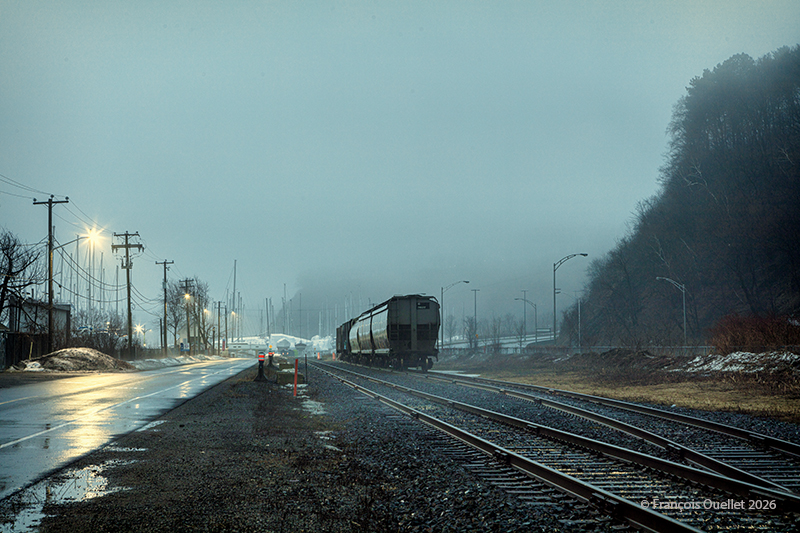
Train in foggy weather in Quebec City during Spring 2026.
Tonight, the wind is blowing less strongly near Gilmour Hill than in the Port of Québec. A persistent fog covers this section of Champlain Boulevard.
For the composition, I use the stationary railcar as the focal point between the lit road on the left and the headland on the right. It serves as a link for an imaginary diagonal line that cuts the image in half, running from the lower left corner to the upper right corner of the frame.
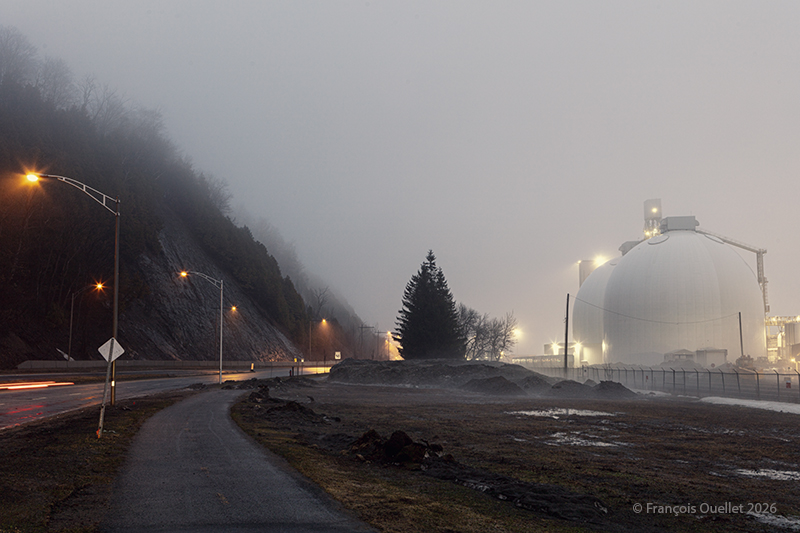
The Boulevard Champlain in Quebec City in fog, April 2026
The fog softens and unifies the elements of the scene above. The photographic composition takes into account the path that guides the eye toward the center of the photo. There, a strategically placed fir tree prevents the gaze from wandering off toward the horizon. On either side of the image are two contrasting elements, differing in height, color, and state (nature vs. industry).
HDR picture of the Château Frontenac at Christmas 2025 from Côte de la Montagne in Quebec City.
During the holiday season, the Château Frontenac is decked out in red and green. For an interesting effect, try taking a picture of the castle’s main tower from Côte de la Montagne. To do this, you have to point the camera upward, but all the lines that are normally vertical become slanted.
Photographic Technique
To correct this effect and restore the architectural lines to near verticality, some computer work is necessary. In a few minutes, after cropping and changing the photographic plane, the photo regains the natural appearance that the eye observes when climbing Côte de la Montagne.
HDR photo of the Château Frontenac and surroundings in winter in Quebec City.
The photo above shows another beautiful view of the Château Frontenac. In the middle of the tourist season, passersby in Old Quebec are plentiful in front of the camera lens. Long exposure times mean that several “ghosts” will appear to be moving around when taking nighttime photographs.
How can you avoid these “ghosts” as much as possible? Timing is important. Once the blue hour has passed, complete darkness provides uniform lighting. This allows you to choose a moment when no one is passing by the camera when taking each shot to achieve the HDR effect. Five shots with different apertures will give you the desired HDR result. I use a tripod and a Canon EF 11-24mm f/4L USM wide-angle lens mounted on a Canon 5DSR full-frame camera.
There is only one person very close to the camera lens during the entire session. I remove her from the HDR photo. Since she was working with a tripod, she moved very little during my five shots, which allowed the correction tool in the digital processing software to teleport her to a parallel universe.
Château Frontenac during Christmas time in Quebec City
The photo above shows a section of the German Christmas market in Quebec City in front of the Château Frontenac. As usual, there was a large crowd that day in Old Quebec but I waited for the pedestrians to disperse a little before taking the picture. The blue hour is approaching…
Below, the huge Christmas tree installed at Place Royale occupies the foreground of this photo of Notre-Dame-des-Victoires Church in Old Quebec. This year, anonymous donors have made it possible for the interior of the church to be festively illuminated for the 2025 holiday season.
The Notre-Dame-des-Victoires church in Old Quebec during Christmas time in 2025.
Click on the link for more photos of Quebec City on my blog.
Now that we know the winner, here are seven photos of Julian Alaphilippe, the Tudor team, Marion Rousse (the winner’s partner), Tadej Pogacar and Pavel Sivakov.
The Tudor team and Alaphilippe on côte de la Montagne at the GPC Québec 2025
The 216-kilometer race took place between https://www.quebec-cite.com/en/old-quebec-city Old Quebec, the Plains of Abraham, the Montcalm neighborhood, and Champlain Boulevard. Above, cyclists climb Côte de la Montagne, which has an average gradient of 9% over 600 meters, but with a steep section reaching 13%.
Below, a photo of the main peloton with the Château Frontenac in the background.
View of the Château Frontenac during the GPC Québec 2025
Near the Château Frontenac, I take the opportunity to snap a photo of Tadej Pogacar and Julian Alaphilippe, two of the most famous names in the race.
Pogacar and Alaphilippe the winner of the GPC Québec race 2025
The Tudor cyclist team opens the way for Alaphilippe at the GPC Québec 2025
On Rue Saint-Louis, the young Swiss Tudor team worked to save Julian Alaphilippe’s efforts. Below, Julian Alaphilippe after his victory. In the background are Tadej Pogacar and Pavel Sivakov of the UAE team. The latter finished two seconds behind Alaphilippe, while Alberto Bettiol of the XDS Astana Team took third place, four seconds behind.
Pogacar was well positioned, but at the end of the race, the group he was riding with refused to take turns at the front. So, he decided to slow down and watch someone else win.
Alaphilippe, Pogacar and Sivakov after the Grand Prix cycliste de Québec 2025
Marion Rousse, former French champion and actual director of the Women’s Tour de France, was working as an analyst at the GPC in Quebec City. She left her post for a few minutes to congratulate her partner, Julian Alaphilippe. She can be seen in the photo below walking towards the Tudor team.
Marion Rousse arrives to congratulate Julian Alaphilippe at the GP cycliste de Québec 2025
It was once again an exciting race, held for the fourteenth consecutive year under sunny skies and ideal temperatures. Every year, more and more cycling enthusiasts come to watch this UCI World Tour race. The same is true for the race in Montreal.
Here is the link for all the results of the Quebec City race.
The day after Quebec’s national holiday, the Snowbirds make a few flybys over Quebec City. Although not an air show per se, their formation flights always dazzle the crowds.
The Quebec flag, the Price Building and the Snowbirds in flight in Quebec City
Photography technique.
As the flight over the city takes place at around 17:00, it’s a good idea to position yourself so as not to have to pose against the sun. Normally, a photographer located in Lévis captures excellent shots of Snowbirds passing by the Château Frontenac. But at 5:00 p.m. with the sun directly in front of you, all plane photos taken from the south shore mean uninteresting washed-out skies and far too strong contrasts. Snowbirds deserve better.
Considering the position of the sun, the citadel is the best location for a successful photo session. The light comes from behind as the aerobatic team flies over the St. Lawrence River, around the Château Frontenac and towards the Dufferin Terrace.
The Snowbirds are in flight formation near Château Frontenac in Quebec City.
Spectators know that the performance will only last about fifteen minutes. A photographer needs to prepare accordingly to maximize the chances of getting some memorable shots.
Photography theory
I use a Canon 70-200 mm f2.8L IS II USM lens to give me better leeway between the distant and close passages of the nine military jets. Coupled with a Canon 5 DSR full-frame camera, a quality zoom produces surprising results. You can crop at will without losing definition, provided the initial ISO is 200 and the shutter speed is fast enough. You don’t really need to go beyond 1/1000.
The Snowbirds in flight formation approach the Dufferin terrace in Quebec City.
With Canada Day a few days later, I now have an interesting photo of the Snowbirds and the Canadian flag.
Snowbirds in flight and the Canadian flag over the citadel of Quebec City.
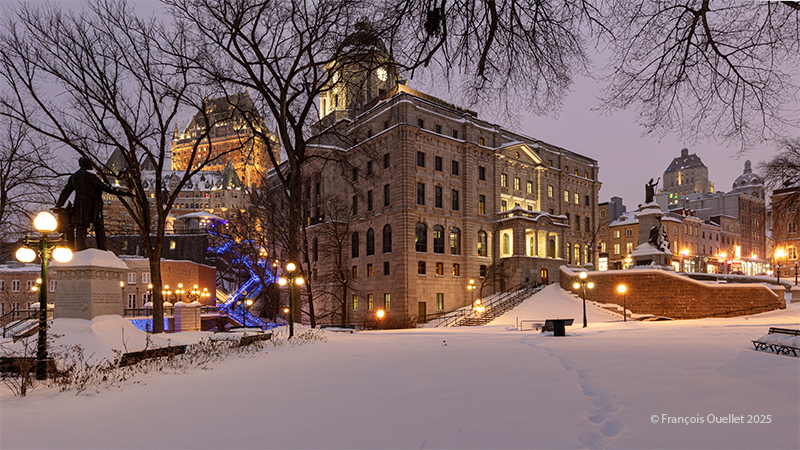
Old Quebec in winter seen from Parc Montmorency in 2025
It’s time for another winter outing in Old Quebec. The night photography session will be devoted to architecture.
The temperature is about -14 C and the winds are blowing at 15 km/h. Without gloves in order to manipulate the little buttons on the camera, the skin feels -22 C. A regular break is essential to thaw out the fingers!
I took the photo from Parc Montmorency, just up the côte de la Montagne. This historic site is a major tourist attraction in Quebec City. Louis Hébert, Canada‘s first farmer, cultivated the land here on his arrival in New France. It’s important to understand, however, that the natives knew about farming and cultivated the soil long before the arrival of the French settlers.
On the left is a sculpture of Sir Georges-Étienne Cartier, one of the Fathers of Confederation. The Château Frontenac and Price Building are also visible in the distance. In the foreground is a building that has changed function many times. It was originally the first Episcopal Palace.
Photography technique
For this shot, I planted my tripod in 40 centimetres of snow. I used a Canon 5 DSr camera equipped with a Canon EF 11-24 mm F/4L USM ultra wide-angle zoom lens. I could have set the ISO to 200 thanks to the stability of the tripod, but the wind demanded a faster result due to possible vibrations. ISO and shutter speed are therefore dictated by ambient weather conditions rather than low light.
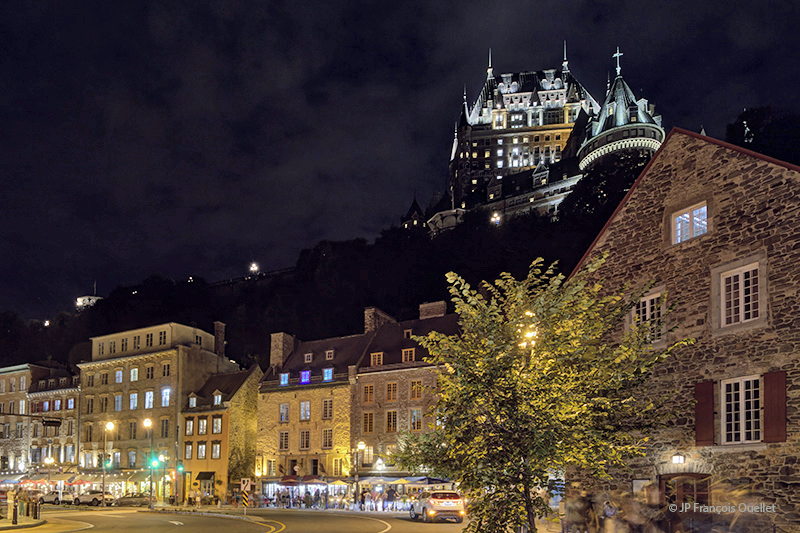
Scène de Québec et du Château Frontenac la nuit. Photo par François Ouellet
Photographing a tourist attraction like the Château Frontenac at night, with all its lights, is a good challenge for both the Canon 5 DSr camera and the photographer. Here are a few photographic tips to help you repeat the experience:
1) For a special effect, you might as well go all out and capture the château, including all the lights in the buildings near the Petit-Champlain district.
2) Photographic composition is based on the rule of thirds. You don’t always have to respect the fundamental theory, but this time it works well.
3) The viewer first notices the brightest structures, all of which have a similar luminosity. He then detects the castle on the cape.
4) The contrast is deliberate. The castle is not depicted in all its architectural splendour, but as a few lines lit up in the night.
5) The observer no longer needs to see all the forms of the castle to recognize it. It’s the most photographed castle in the world. The brain quickly analyzes the visible shapes and completes the building in a fraction of a second.
6) Being photographed from this angle and in this light gives a more mysterious aspect to this hotel overlooking the smaller buildings.
7) HDR photography solves some of the lighting problems. I superimposed five photos to obtain the final result.
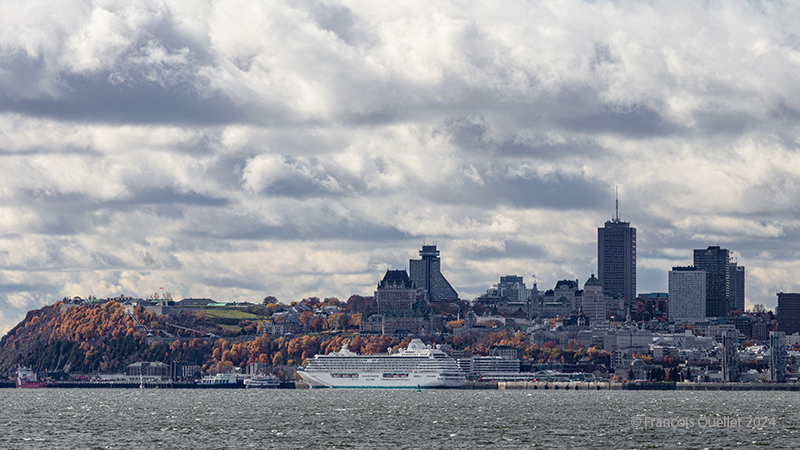
Above, a photo of the Château Frontenac in autumn with a cruise ship that has just docked at the Port of Québec. The photo was taken from Île d’Orléans. Also visible in the center of the photo is the Concorde Hotel’s revolving restaurant, “Ciel! Resto-bar”.
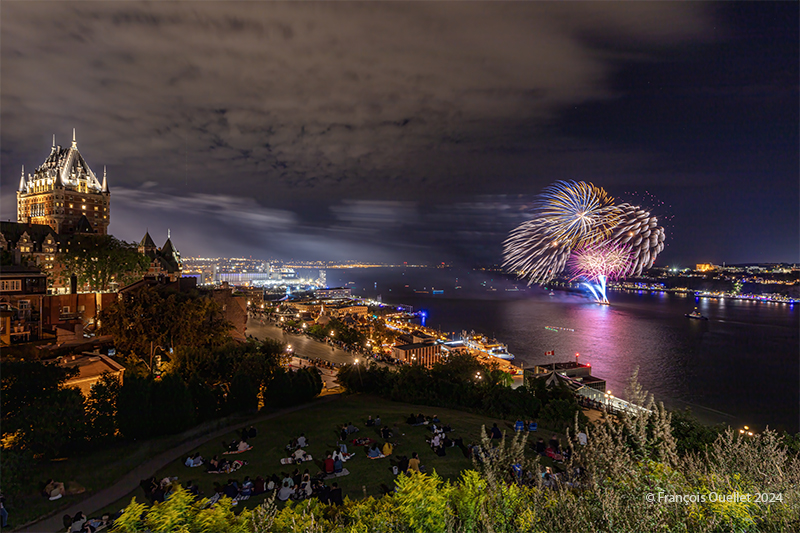
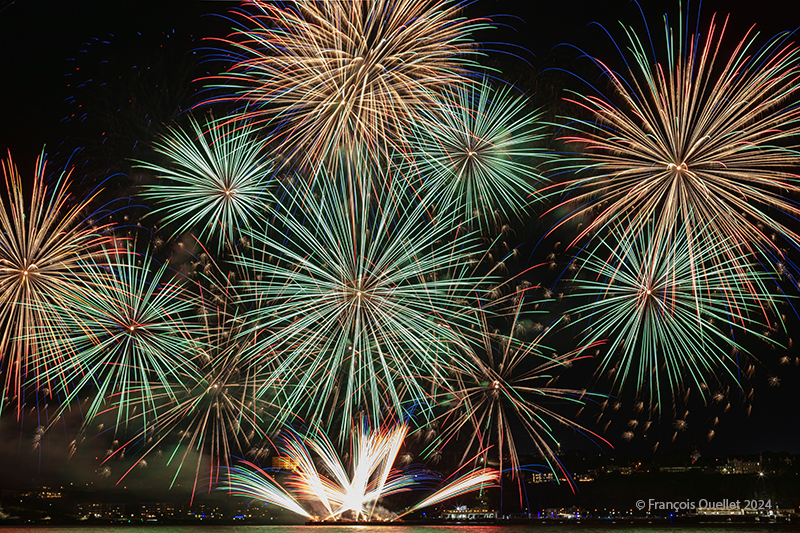
This year, the Grands Feux Loto-Québec are lit from a barge in the middle of the St. Lawrence River, between Lévis and Quebec City. A tugboat from the Ocean Group company secures the barge with a cable for the duration of the event.
I took the above shot with a Canon 5DSr full-frame camera equipped with a remote shutter release and a tripod-mounted Canon EF 11-24 mm F/4L lens. The super-wide-angle lens can capture both the Château Frontenac and the lights and city of Lévis across the river.
The BULB mode lets you set your own exposure time and take creative initiatives. The brilliant path from launch to explosion is captured in a single photo.
As soon as the bursts begin, you try a five-second exposure and observe the result. Then adjust by stretching the exposure time until good effects are achieved.
One mistake to avoid is leaving the shutter open for too long. When this happens, flashes of light build up on top of each other, and all you see in the final photo is blurry, glowing white.
Working with a RAW file offers much greater flexibility than with a JPEG file when processing the image on the computer.
ISO 200 seems the best option here for several reasons: even if the activity takes place in full darkness, we want to avoid significant digital noise. A low ISO will also lengthen the exposure time and allow us to capture beautiful streaks at the moment of the explosions.
What’s more, the lights will illuminate the scene, reducing exposure time to a reasonable length. Finally, a layer of altocumulus cloud above the Château Frontenac serves today as an artificial light reflector in the photo above.
Grands Feux Loto-Québec, August 2024
A depth of field between 8 and 13 ensures sufficiently accurate light at a reasonable distance.
Whether to focus manually or automatically remains a matter of taste. It should be noted that darkness can cause problems for autofocus. However, trial and error can sometimes produce interesting effects.
If you’re using manual focus, use the camera’s backlit screen to magnify the scene as much as possible and adjust the focus as required. You then return to the normal size display for the duration of the fireworks, taking care not to inadvertently touch the focus adjustment ring when changing the zoom.
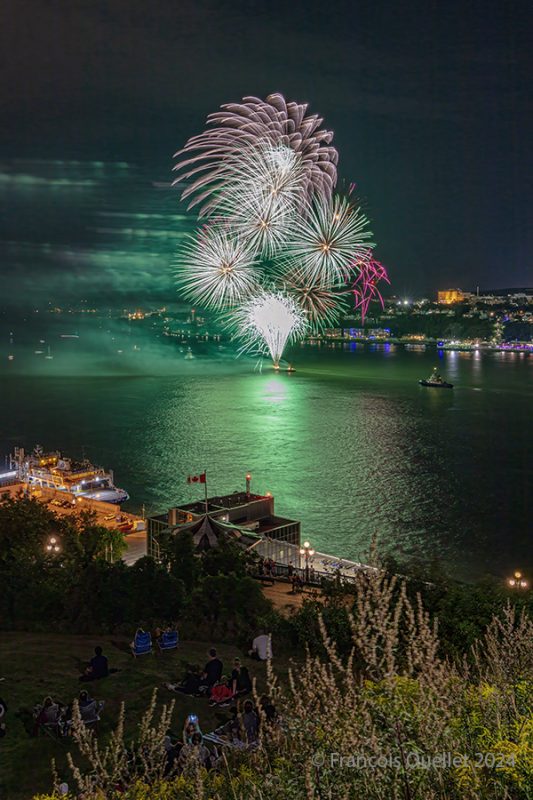
Fireworks at the Grands Feux Loto-Québec 2024
Consider using a heavy tripod. In windy conditions, it will better resist vibrations during long exposures.
A final word of advice: fireworks attract a lot of people, some of whom are content with a fairly limited personal space, if they have one at all. Protecting your photographic area becomes an important objective, to avoid the tripod getting snagged or someone moving in front of you when enthusiasm takes over. So, arrive well in advance to choose the best location for you to work in, while protecting your work area.
For example, for the photos above, I had set up between a ramp fixed on a steep slope in front of me and a bush at the rear. No one could stand in front of me and no one could pass behind me because of the bush. I thus had only the sides to worry about. It sounds like an unnecessary concern, but these days everyone is filming fireworks and continually repositioning themselves without regard to their neighbors. Make life easier for yourself by making the necessary arrangements before the show.
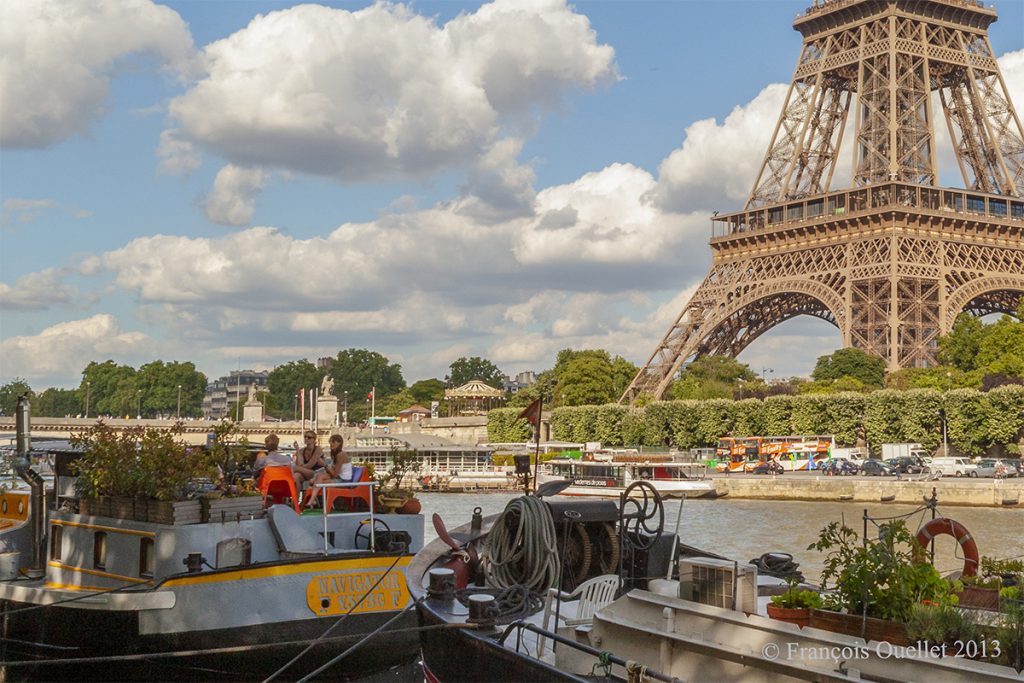
Ten years ago this year, I took this photo of Parisian life in relaxation mode. I wasn’t interested in the main subject that we find on every postcard, but in the normal parallel life of citizens living close to such a well-known tourist attraction.
In the photo above, these Parisians are taking it easy on their barge moored along the Seine, in the shadow of the Eiffel Tower.
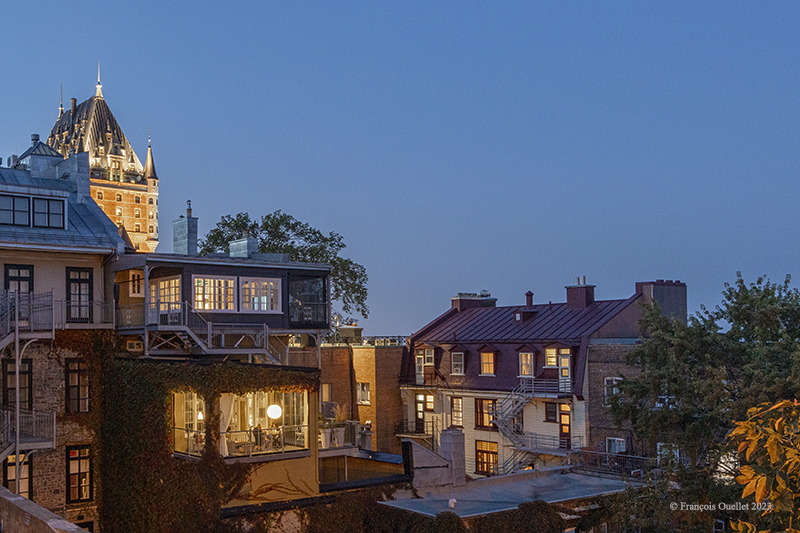
A relax evening for local citizens living near the Château Frontenac.
The same is true for Quebec City residents living near the Château Frontenac. They find a way to reserve a little peace and quiet for themselves, away from the tourists, quietly seated on their verandas at the end of the day.