Canadian Coast Guard Amundsen icebreaker on the St.Lawrence river near Quebec City 2026
The freezing weather of winter 2025-2026 in Quebec requires frequent interventions by the Canadian Coast Guard to open passages on the St. Lawrence River. In the photo above, the icebreaker Amundsen, clears the way in front of Quebec City.
This ship occasionally works in the Canadian Arctic on research projects. It also ensures a Canadian presence in Canada’s northernmost territories.
Note the helicopter parked at the rear of the ship. Other larger icebreakers are under construction at various shipyards across the country, including the one in Lévis. Some of them are intended to strengthen Canadian territorial sovereignty in the Arctic.
Ferries at work in the ice in front of Quebec City winter 2026
Ferries make their way through the ice in January 2026. They ensure the crossing for pedestrians and vehicles between Quebec City and Lévis.
Ship moving through the ice on a winter night in front of Quebec City
For this nighttime photograph, I used a Canon EF 85mm f/1.2L II USM lens. It requires very little light and allows the photographer to take a picture of the Ocean tugboat and the merchant navy ship as they pass in front of Quebec City. I took the photo from the Dufferin Terrace and cropped it to enlarge the image.
A F-18 in flight over the Musée de la défense aérienne in Bagotville
In September 2025, Canadian military personnel flew to Estonia to participate in Operation Reassurance. Canada wants to offer support to NATO in this region of the world. The first exercise, Cobra Warrior 25-2, is scheduled to take place in Great Britain for six weeks, followed by Tarrasis 25 in Estonia.
Eighteen months of preparation were required to develop this operation. Some landings will take place on a highway to increase the level of realism and difficulty for the pilots.
Two F-18 training in Bagotville, Québec
As luck would have it, we happened to be passing through Bagotville on the day everything was getting underway. Positioned at the end of the runway, we were able to watch numerous aircraft take off, including an Eastern Airlines Boeing 777-200 chartered to carry approximately 160 Canadian military personnel. A Boeing C-17 and eight F-18s will also cross the Atlantic to take part in the mission. Aircraft from Trenton and Winnipeg will also participate in the maneuvers, including a CC-150 Polaris, a CC-130H Hercules, and a CC-130J Hercules.
Canadian Boeing C-17 departing Bagotville for Estonia.
Eastern B777-200 on the departure at Bagotville, Canada, heading to Estonia.
At the same time as these departures were taking place, F-18s and Top Aces A-4 Skyhawks were coming in for landing after combat exercises in the Saguenay region.
Now that we know the winner, here are seven photos of Julian Alaphilippe, the Tudor team, Marion Rousse (the winner’s partner), Tadej Pogacar and Pavel Sivakov.
The Tudor team and Alaphilippe on côte de la Montagne at the GPC Québec 2025
The 216-kilometer race took place between https://www.quebec-cite.com/en/old-quebec-city Old Quebec, the Plains of Abraham, the Montcalm neighborhood, and Champlain Boulevard. Above, cyclists climb Côte de la Montagne, which has an average gradient of 9% over 600 meters, but with a steep section reaching 13%.
Below, a photo of the main peloton with the Château Frontenac in the background.
View of the Château Frontenac during the GPC Québec 2025
Near the Château Frontenac, I take the opportunity to snap a photo of Tadej Pogacar and Julian Alaphilippe, two of the most famous names in the race.
Pogacar and Alaphilippe the winner of the GPC Québec race 2025
The Tudor cyclist team opens the way for Alaphilippe at the GPC Québec 2025
On Rue Saint-Louis, the young Swiss Tudor team worked to save Julian Alaphilippe’s efforts. Below, Julian Alaphilippe after his victory. In the background are Tadej Pogacar and Pavel Sivakov of the UAE team. The latter finished two seconds behind Alaphilippe, while Alberto Bettiol of the XDS Astana Team took third place, four seconds behind.
Pogacar was well positioned, but at the end of the race, the group he was riding with refused to take turns at the front. So, he decided to slow down and watch someone else win.
Alaphilippe, Pogacar and Sivakov after the Grand Prix cycliste de Québec 2025
Marion Rousse, former French champion and actual director of the Women’s Tour de France, was working as an analyst at the GPC in Quebec City. She left her post for a few minutes to congratulate her partner, Julian Alaphilippe. She can be seen in the photo below walking towards the Tudor team.
Marion Rousse arrives to congratulate Julian Alaphilippe at the GP cycliste de Québec 2025
It was once again an exciting race, held for the fourteenth consecutive year under sunny skies and ideal temperatures. Every year, more and more cycling enthusiasts come to watch this UCI World Tour race. The same is true for the race in Montreal.
Here is the link for all the results of the Quebec City race.
The Kingfisher is equipped with sensors that can locate objects or people up to a distance of 40 kilometers, even in low light conditions. Its range allows it to remain in flight for over 4,500 kilometers.
Photography tips
I arrive too late at Quebec City airport: the plane is already parked. However, information obtained from the pilots indicates that takeoff is scheduled within the next hour on runway 06.
Ground traffic provides excellent opportunities to photograph an aircraft while benefiting from an interesting background. The photography technique required for this first visit by the Kingfisher is really basic.
Communications with the control tower indicate when the CC-295 is starting up. It will stop just before entering runway 06. A 200mm telephoto lens would normally do the trick, provided the ISO is not too high. But today, I am trying out a recent acquisition: a Canon EF 300mm f/2.8 L IS II USM fixed telephoto lens.
In the middle of the day, a photographer deals more with the quantity of light than its quality. However, the goal here is not to capture a bouquet of flowers or a wedding, so the harsh light should be fine. The flamboyant color of the aircraft will distract attention from the lack of interest in the ambient light.
With the shutter speed reduced to 1/125 and the ISO set to 200, I wait for the moment when the Kingfisher is opposite the control tower. This will provide a high-quality background. Twenty photos later, the plane is nothing more than a memory.
Today’s flight around the planet takes place between the virtual airports of London City (EGLC) in England and Rotterdam-The Hague (EHDR) in the Netherlands. The weather looks good, apart from a few large TCUs here and there along the route. The crew imports the Simbrief flight plan into Navigraph to facilitate navigation between the two countries.
Daher TBM930 airborne from the London City virtual airport (EGLC) in United Kingdom
For a fast and comfortable journey, we choose the high-performance Daher TBM930 in Canadian colors. Microsoft has truly designed a marvel of a virtual aircraft.
Virtual TBM930 over United Kingdom heading to the Rotterdam airport (EHDR), Netherlands
The operating ceiling is 31,000 feet and the maximum range of the TBM930 is around 1,730 nm. With a cruising speed of 330 knots, we cross the English Channel in no time. As you would expect, there is a lot of shipping traffic between the North Sea and the English Channel.
TBM930 turboprop aircraft over water and approaching Netherlands
We are now above the Netherlands. The programmed route reads as follows: EGLC runway 09 DEP ODUK1H ODUKU M84 TOVGU M84 CLN P44 RATLO M197 REDFA MASOS. We have selected the REDF3R arrival and the RNAV runway 24 approach.
Working Title Simulations Daher TBM930 over Netherlands approaching the Rotterdam virtual airport (EHDR) with Microsoft Flight Simulator
Below, the cockpit photo shows the interior of the TBM930 and the route followed for the approach. We are descending rapidly to reach the recommended altitude of 2,000 feet a little further on for arrival.
Cockpit of the Daher TBM930 as it approaches runway 24 for the Rotterdam (EHDR) in flight simulation MSFS
There are strong winds today and mechanical turbulence throughout the journey to Rotterdam.
TBM930 approaching rwy 24 for the Rotterdam virtual airport (EHDR) with Microsoft Flight Simulator MSFS
The autopilot keeps the single-engine turboprop slightly to the right of the centerline of runway 24 during the long final approach to counter strong crosswinds. The VNAV function does a very good job of maintaining the correct altitude during descent.
MSFS Daher TBM930 on final for rwy 24 Rotterdam airport in flight simulation
During the short final approach, we disconnect the autopilot. Surface winds are blowing at 320/14 knots. Moments later, we land the virtual aircraft without breaking anything. A short taxi brings us to a parking spot where staff are waiting for us.
Canadian Daher TBM930 arriving at the virtual Rotterdam The Hague airport (EHDR) with Microsoft Flight Simulator
Flying virtually with the TBM930 is a treat. It is one of the best virtual aircraft currently available on the market for use with the Microsoft Flight Simulator (MSFS) flight simulator. What’s more, virtual pilots don’t have to pay extra for this aircraft, as it comes with the MSFS software.
The next leg of this simulated flight around the world takes place between Rotterdam and Paris-Le Bourget Airport (LFPB) in France. Customers have chartered an old MD-11 in KLM colors for a historic flight to the Air and Space Museum in Le Bourget.
Of the 55 aircraft of this model built in the 1980s, only 26 remain in service worldwide. The Antonov 124 can carry a load 17% greater than that of the C-5A Galaxy.
I took the first photo in close-up to emphasize the enormity of the aircraft compared to a human. Note also the “Be brave like Kharkiv” logo on the nose of the aircraft, in reference to the war between Ukraine and Russia.
Antonov AN 124-100M departing the Québec Jean-Lesage international airport (CYQB) for Harrisburg (KMDT) in the United States.
Tips in photography
The aircraft took off from runway 24 bound for Harrisburg (KMDT) in Pennsylvania. As the runway was wet, a photographer positioned at the threshold of runway 24 to observe the takeoff would have seen only water being lifted by the engines.
The thresholds of runways 06 and 29 were therefore an excellent choice. Runway 29 provided a nice side-on shot with no visual contaminants. Curiously, while many photography enthusiasts were massed near the thresholds of 06 and 24, I was alone near 29. This made it possible to get a shot from an original angle.
As the cargo plane was quite a distance from my position, I used a Canon 70-200mm f2.8L IS II USM telephoto lens. An acceptable shutter speed to avoid motion blur meant sacrificing depth of field.
The full-frame sensor’s 50.6 megapixels then made it possible to crop the subject sufficiently without compromising photo quality.
Photography technique
A good photography session goes hand in hand with proper planning. Listen to ground frequency 121.9, control tower 118.65 and terminal 127.85 to improve your chances of success.
A cell phone allows you to use the Flightradar24 application (for scheduled arrivals and departures and current trajectories). Flightaware is also an excellent choice. The cell phone can also be used to find out if there are any road closures around the airport that would prevent us from getting to our desired destination. It also provides information on current weather conditions and forecasts. In Canada, the AWWS site is a mine of information for aviation enthusiasts.
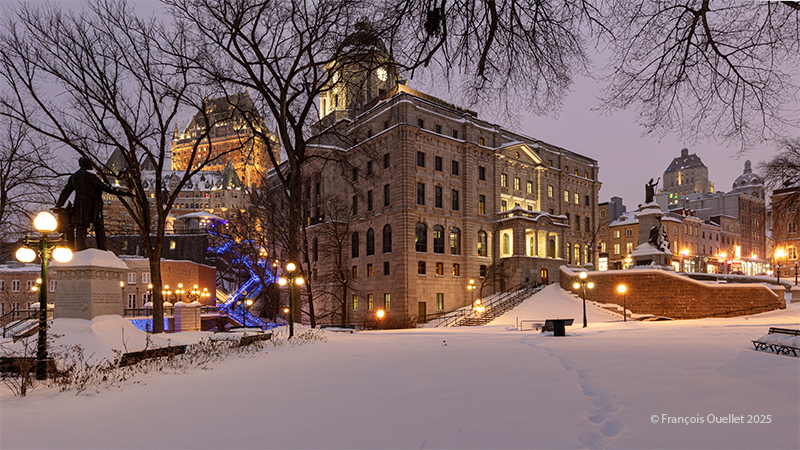
Old Quebec in winter seen from Parc Montmorency in 2025
It’s time for another winter outing in Old Quebec. The night photography session will be devoted to architecture.
The temperature is about -14 C and the winds are blowing at 15 km/h. Without gloves in order to manipulate the little buttons on the camera, the skin feels -22 C. A regular break is essential to thaw out the fingers!
I took the photo from Parc Montmorency, just up the côte de la Montagne. This historic site is a major tourist attraction in Quebec City. Louis Hébert, Canada‘s first farmer, cultivated the land here on his arrival in New France. It’s important to understand, however, that the natives knew about farming and cultivated the soil long before the arrival of the French settlers.
On the left is a sculpture of Sir Georges-Étienne Cartier, one of the Fathers of Confederation. The Château Frontenac and Price Building are also visible in the distance. In the foreground is a building that has changed function many times. It was originally the first Episcopal Palace.
Photography technique
For this shot, I planted my tripod in 40 centimetres of snow. I used a Canon 5 DSr camera equipped with a Canon EF 11-24 mm F/4L USM ultra wide-angle zoom lens. I could have set the ISO to 200 thanks to the stability of the tripod, but the wind demanded a faster result due to possible vibrations. ISO and shutter speed are therefore dictated by ambient weather conditions rather than low light.
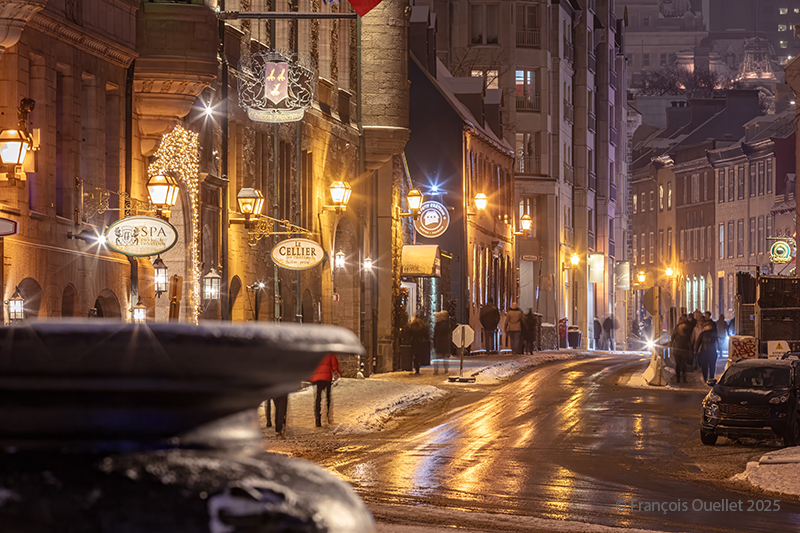
Beautiful Old Quebec night reflections on Saint-Louis Street. Photo by François Ouellet, 2025.
Another perfect evening to photograph Old Quebec in winter! I consider myself very lucky to have daily access to this magical place. It is as you know a UNESCO jewel and one of Canada’s major tourist attractions.
Photography theory and technique
It’s all there: calm winds, light snow, acceptable temperature, low cloud ceiling. Here is a great opportunity to improve one’s photography technique. What’s more, Quebec City finds itself between two busy tourist periods. This means fewer blurred people during night photography.
The snow melts immediately upon reaching Saint-Louis Street. It creates multiple reflections, ideal for special effects.
The quality of the lighting is superb, even in the middle of the nighttime. The city’s glow mirrors off cloud bases and precipitation. This in turn illuminates the old buildings.
Now it’s a question of locating an unusual angle to capture rue Saint-Louis. I’m trying to avoid the over-rehearsed postcard frame!
The viewer’s eye must remain focused on the street and the architecture. It must travel towards the background to discover a section of the National Assembly structures in the distance. The photographic composition is easily achieved.
In order to reach the objective, the viewer’s attention must be captured. A nice object can serve as foreground. It can also remain partially hidden. The vase installed on the Monument Samuel-de-Champlain will be good enough. We’re not really interested in it, but it serves as an entrance to the scene.
Those are simple but efficient photographic tips for winter photography in Old Quebec!
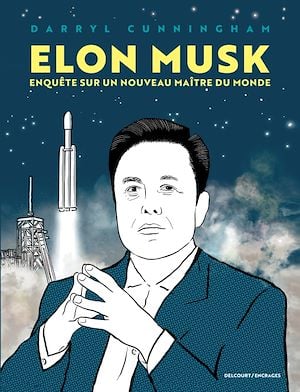
French graphic novel on Elon Musk by author Darryl Cunningham, Delcourt/Ancrages edition.
The Musk family
I appreciate real-life stories, and especially investigations that study human behaviour. Reading this graphic novel in French about Elon Musk, one grasps the character’s high level of initiative. He likes risking a lot when creating a new company. This characteristic is also present in the family genealogy, starting with the grandfather. However, they clearly act without concern for social norms.
Elon’s main desire is to use his talent and creativity to influence the course of the world, particularly when it comes to the Internet, renewable energies and space. As well as mentioning Musk’s successes, the graphic novel also highlights the grey areas that are too often overlooked.
Considering that mankind will one day colonize space, Elon Musk looked to buy a rocket, but they were all too expensive. So he created Spacex and a team of Spacex scientists invented a rocket named Falcon 1, which the company succeeded in launching into orbit after six years’ work. In 2011, Spacex built the world’s first reusable rocket. A year later, the Falcon 9 equipped with a Dragon capsule refuelled the International Space Station (ISS). In light of this success, the government reinjected another $440 million into Spacex for development. I write “another $440 million” because this was not the government’s initial investment in the firm.
Companies narrowly saved
As we read the book, we realize how many times Musk’s businesses have come close to disaster, only to be narrowly saved by perseverance, lots of luck, top-level government relations and whimsical promises.
Just think of Tesla and Spacex, two endangered companies that were spared from bankruptcy by a sudden injection of public money in the form of a $1.6 billion contract from NASA. This was preceded and followed by substantial loans from the US government: “Without the support of American taxpayers, Musk’s fortune would not exist.”
The book also mentions a possible fraud, as the SEC (Securities and Exchange Commission) filed a complaint for misleading tweets about Tesla. These tweets were said to have pushed up the share price by 6%. A settlement was reached a week later between Musk and the SEC. On this subject, Musk neither admits nor denies the allegations. “Musk and Tesla had to pay a fine of $20 million each and Musk had to step down as Chairman of Tesla’s Board of Directors for three years while remaining CEO.”
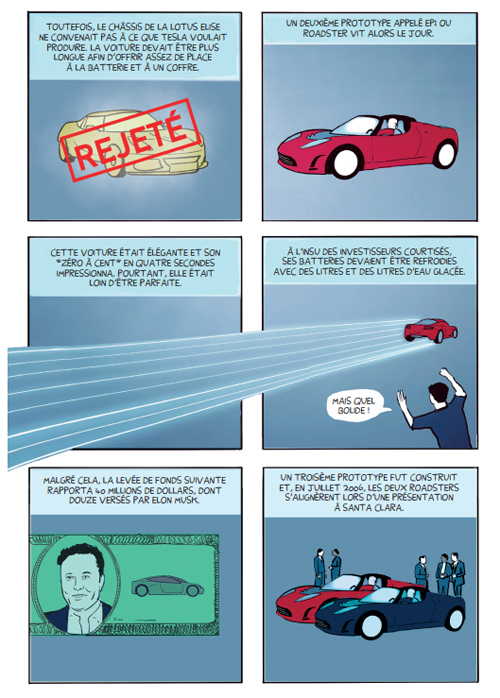
A page from the French graphic novel: Elon Musk: enquête sur un nouveau maître du monde.
Whimsical Promises or Unfounded Announcements
Musk has talent when it comes to touting his products. But the author specifies this: “There’s no denying that Musk is determined, intractable and possesses a real gift for self-promotion. That said, he’s not an inventor, let alone a scientist.”
The book lists a number of whimsical promises, while pointing out that the media help Musk by passing on information that is not systematically verifiable or proven. The result is that the average reader is left with the impression that Elon Musk developed Spacex and Tesla all by himself: “The legend of the self-made billionaire will always be more seductive than the banal reality”.
As an example of whimsical promises, Musk announces that all battery recharging will be free for the Tesla Model S. This is nothing but hot air. He also declares that a Tesla will drive autonomously between Los Angeles and New York in 2017. At the time of writing, no such promise has materialized.
He also made other daring statements in 2016 when he founded Neuralink. This company has been criticized because the research it funds is poorly controlled. According to the book, it generates unnecessary animal suffering. In 2024, Elon Musk reveals that “his company has successfully implanted a device capable of ‘reading thoughts’ in an individual’s brain […]”. He gives no details of the location of the operation or the results.
Musk also makes unfounded statements about vaccination and the virulence of Covid-19. While he declares that this virus has a very low mortality rate and that he will not be vaccinated, the WHO announces in 2023 that the planet is at over three million deaths. He changes his mind and gets vaccinated. But what effect have his words had on recalcitrant Americans?
Elon Musk, Twitter and X
“Since its takeover by Musk, Twitter (or rather ‘X’) has been a tool for promoting the interests, prejudices and conspiracy theories of the right-wing parties of the American political class. This bias has brought a tidal wave of racism, anti-Semitism, climate skepticism, LGBTQ+ hate and medical fake news to the site.”
Elon Musk and Long-Termism
Long-termism and the colonization of various planets are themes dear to Elon Musk. Here’s what the book has to say about it: “Long-termism is an extremely dangerous ideology. It’s a secular religion built around the worship of ‘future value’ whose ethos absolves you from worrying about threats like climate change and global poverty, while making you a good person because you care about the future of humanity as a race that has conquered other planets.”
“No one should have the discretionary power that Elon Musk enjoys, because he hasn’t earned it and he doesn’t owe it to himself alone. He doesn’t understand how much his success owes to privilege and luck. As a result, he thinks he’s much smarter than he really is.”
Elon Musk and US President Donald Trump
If the attitude and decisions that characterize Elon Musk in entrepreneurship are transposed to the state, they could undermine the American president’s aspirations regarding his vision of American politics and the actions to be taken in the face of future challenges.
For example, Musk is known for avoiding confrontation with the Chinese president, as China is Tesla’s second-largest market. But Trump didn’t hesitate in his first term to impose substantial tariffs on China. Musk has also “directly interfered in Ukraine’s fight against Russian invasion”. The strategic interests of the two individuals could diverge significantly at times.
But it must also be considered that the actions of the two men could come into phase, which would mean far more rapid and far-reaching upheavals than anticipated.
One thing is certain: the Trump/Musk duo’s solutions to America’s problems will surprise observers of the political and economic scene. The Musk family has never been concerned about the dust they kick up when it comes to pushing their ideas forward. And Trump’s reductive analysis of the cause of America’s problems will do nothing to reassure the various national and international players. This can be seen in his current comments on Greenland, the Panama Canal and Canada.
The countries targeted by this duo’s initiatives will have to expect anything, and use their creativity, fighting spirit and composure to impose respect and restraint.
Leg 10 of this round-the-world flight simulation trip takes place between Poland and Germany. Two very different aircraft will be used to complete the journey during this day of VFR flying: an old Junkers Ju 52/3m and a modern business helicopter, the Airbus H160.
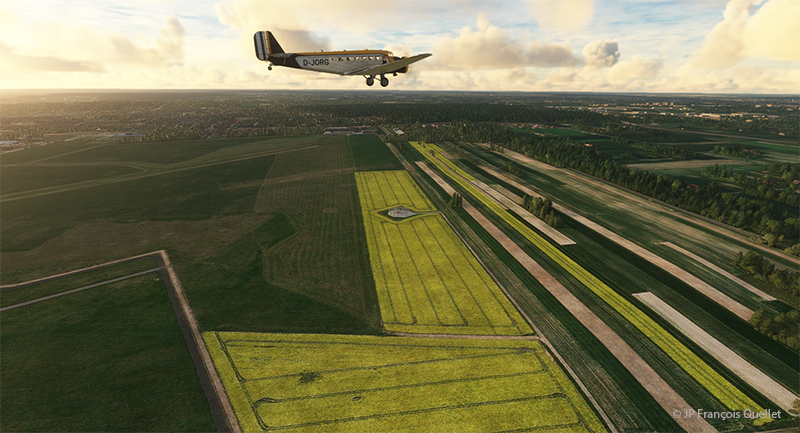
Junkers JU 52 airborne from the Lublin airport (EPLB) in Poland.
Departure is from Lublin airport (EPLB) in Poland. The Junkers Ju 52/3m takes off without a hitch over a short distance. The big three-engine tailwheel is as predictable as the Cessna C-170B I used in real life to cross Canada in 1981. Above, one can see the cultivated fields of Poland.
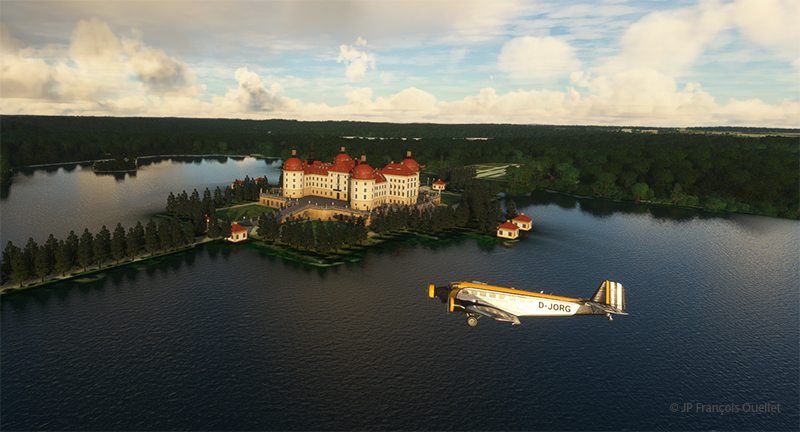
Junkers JU 52 and the Moritzburg Castle in Germany in flight simulation
It’s shaping up to be a beautiful morning, weather-wise. The first leg of the trip takes us over Moritzburg Castle (Schloss Moritzburg), northwest of Dresden. Built in 1542, it was originally the hunting lodge of the Duke of Saxony.
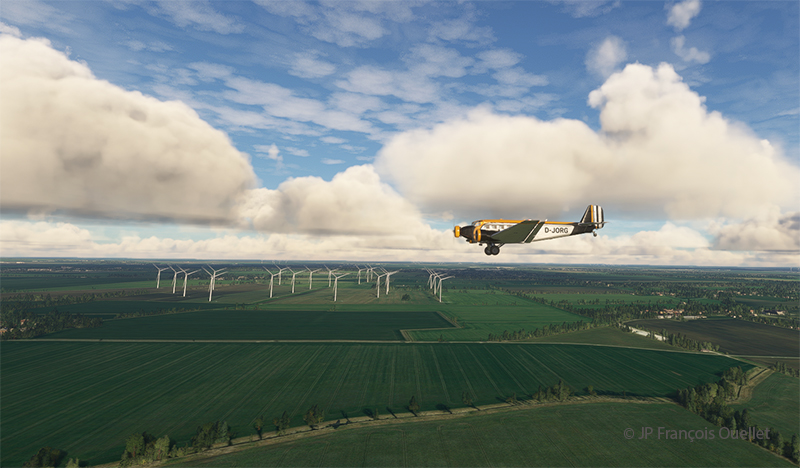
Junkers JU 52 enroute to the Landesmuseum für Vorgeschichte Halle in Germany
On the way to Halle is a large wind farm. Germany, like Europe, is rapidly developing its green energy. Russia’s recent attitude to Europe’s natural gas supply has drastically changed energy planning in neighboring countries.
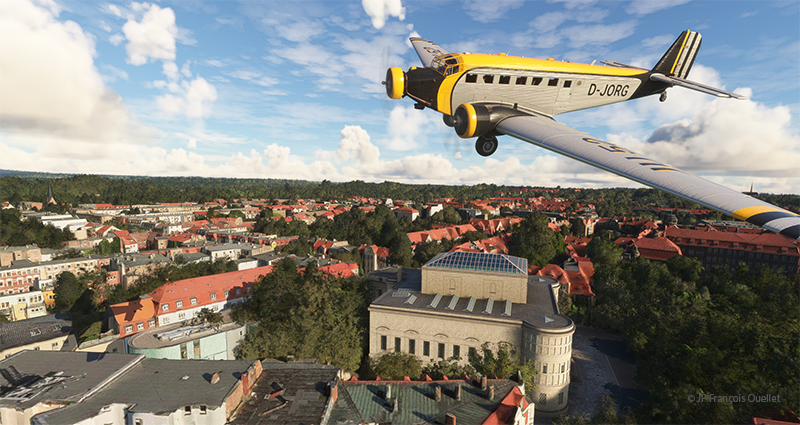
A Junkers JU 52 flying over the State Museum of Prehistory Halle in Germany in flight simulation
Above, in the center of the photo, is a partial view of the National Museum of Prehistory in Halle (Landesmuseum für Vorgeschichte Halle), not far from Leipzig. It is one of Central Europe’s leading archaeological museums.
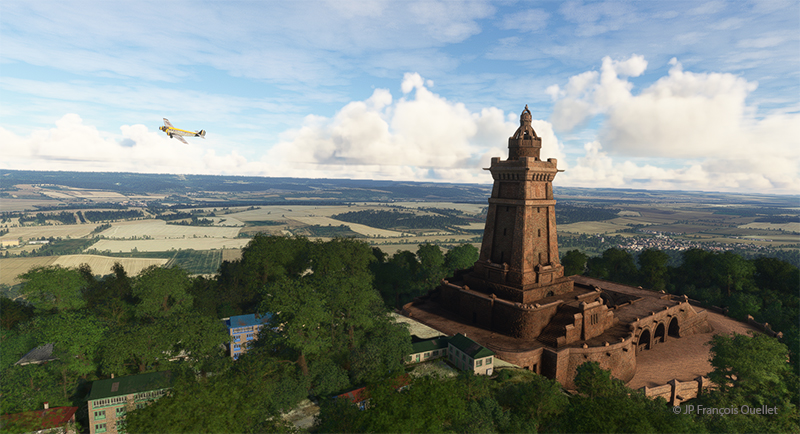
Fly-by of the Kyffhaüser-Denkmal in Germany by a Junkers Ju 52 in flight simulation
Before reaching Calden airport to change aircraft, we gaze at the Kyffhaüser monument (Kyffhaüser Denkmal). Once in Calden, we jump into a modern Airbus-built H160 helicopter and head for Göttingen, more precisely over the Münchhausenstrasse.
We’ve obtained permission to fly over this thoroughfare at very low altitude, just long enough to say hello to an old acquaintance. This dubious authorization will probably cost Germany’s Minister of Transport his job.
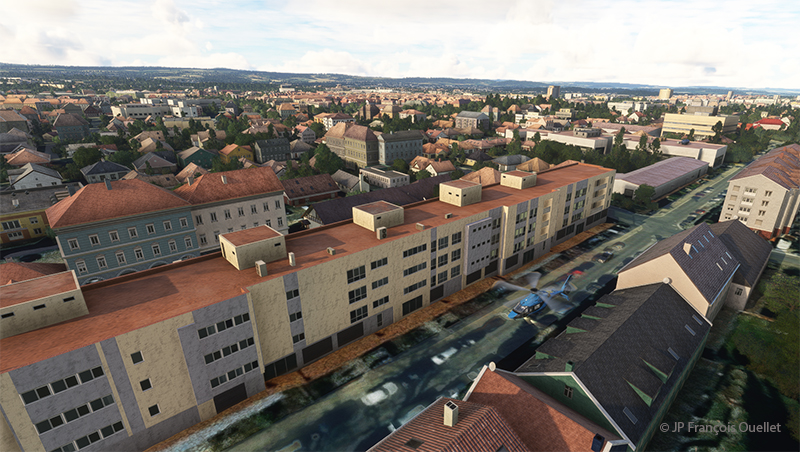
Streets of Göttingen, Germany, in flight simulation
A flyover of this Göttingen street is necessary to verify the extent of the traffic.
Helicopter descending on Münchhausenstrasse, Göttingen, Germany, in flight simulation.
The descent is gradual between the buildings. We hover just above the cars. Pedestrians seem to wave at us, but we may misinterpret the gesture. Our friend is at the window and takes the time to stop his reading of an excellent comic strip to wave at us. We then continue on our way to Padderborn Lippstadt Airport (EDLP), our destination for today.
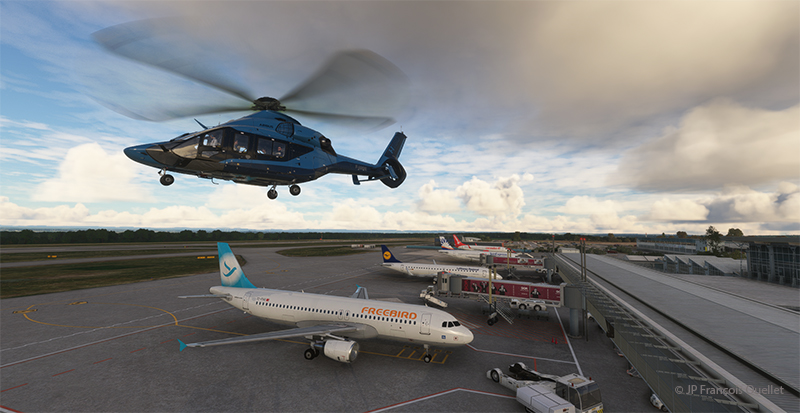
Helicopter H160 landing at the Padderborn Lippstadt (EDLP) in Germany in flight simulation.
Still, there’s a fair amount of activity at the airport. Immediately after landing, we’ll start planning leg 11 of this round-the-world flight simulation and real weather trip.