Categories
Aviation photography

Operation Reassurance: Canada in Estonia.

A F-18 in flight over the Musée de la défense aérienne in Bagotville

In September 2025, Canadian military personnel flew to Estonia to participate in Operation Reassurance. Canada wants to offer support to NATO in this region of the world. The first exercise, Cobra Warrior 25-2, is scheduled to take place in Great Britain for six weeks, followed by Tarrasis 25 in Estonia.

Eighteen months of preparation were required to develop this operation. Some landings will take place on a highway to increase the level of realism and difficulty for the pilots.

Two F-18 training in Bagotville, Québec

As luck would have it, we happened to be passing through Bagotville on the day everything was getting underway. Positioned at the end of the runway, we were able to watch numerous aircraft take off, including an Eastern Airlines Boeing 777-200 chartered to carry approximately 160 Canadian military personnel. A Boeing C-17 and eight F-18s will also cross the Atlantic to take part in the mission. Aircraft from Trenton and Winnipeg will also participate in the maneuvers, including a CC-150 Polaris, a CC-130H Hercules, and a CC-130J Hercules.

Canadian Boeing C-17 departing Bagotville for Estonia.
Eastern B777-200 on the departure at Bagotville, Canada, heading to Estonia.

At the same time as these departures were taking place, F-18s and Top Aces A-4 Skyhawks were coming in for landing after combat exercises in the Saguenay region.

Top Aces A-4 Skyhawk in Bagotville, Québec.
A F-18 on final in Bagotville

Some of the photos were taken using a Canon EF 300mm f/2.8L IS II USM fixed telephoto lens.  

Click on the link for more aviation-related photos on my blog.

Categories
Aviation photography

Aviation Photography: Air Transat A321neo in Quebec City

Air Transat Airbus A321neo in Québec City

Today, rain and fog disrupt operations at Quebec City’s Jean Lesage International Airport. The conditions are at their minimum for take off and landing. But the captain of this Air Transat’s flight decides to proceed as the weather improves momentarily.

The passenger jet will take off from runway 06. But the airstrip is soaked. When the pilot applies power, we will only see water spray across the entire picture. A better choice is to focus on the A321neo as it taxis slowly.

Photography Tips

Since the sky isn’t particularly captivating due to its uniform gray colour, it becomes imperative to find something else to increase interest to the scene. The runway lights will do the trick. By including them in the foreground of the photo, they add life and frame the aircraft as it joins the runway.

I avoid photographing the plane directly from the side or from behind, as the effect is a bit static. Entering the runway at an angle offers a better alternative. Furthermore, it is not necessary to show the entire fuselage of the Airbus for a good shot.

With just a uniform gray sky, part of the aircraft, and a few runway lights, it becomes possible to produce a shot with more dynamism.

Click on the link for more aviation-related photos on my blog. There are also photo galleries for enthusiasts in the menu.

Categories
Aviation photography

Aviation photography and extreme weather conditions in Quebec.

Air Canada 777-300ER airborne from Québec airport

During summer 2025, several large aircraft scheduled to land at Montreal Airport had to divert to Quebec City Jean Lesage International Airport (CYQB). Numerous thunderstorms disrupted arrivals and departures at the main airports in the province of Quebec.

The extreme weather in the west gradually moved eastward. This delayed and even cancelled the departure of many planes in Quebec City.

When most of the storms finally passed over Quebec City airport in the evening, an Air Canada Boeing 777-300 ER took off from runway 24 to fly its passengers back to Montréal.

In the background, Air Transat aircraft can be observed. The Swiss Air logo can also be noticed on an Airbus A330-343. It had come from Zurich and was further diverted to Quebec City, along with an Air France Boeing 777-228 LR and a few others.

Below, we see the Boeing 777-300 ER refuelling at a time when extreme weather conditions have not yet reached the airport. Two Avjet tanker trucks are standing near the aircraft. The height of each truck is less than the internal diameter of the Boeing’s engines. For several years, this aircraft held the record for the largest engines on a civil aircraft. Now, the Boeing 777X has taken the crown.

Air Canada B777-300ER refueling at the Quebec Jean-Lesage international airport.

Photography Technique

Both photos required some compromises. Everything works if you accept being completely soaked and working with both feet in the water along a metal barrier with lightning flashing here and there. For some photos, the session lasted two hours.

I took the shots from a hole in the airport fence. My Canon EF 300 mm f/2.8L IS II USM lens was protected by a plastic bag tightly wrapped around the lens hood.

A frequency scanner provided data about air traffic. A controller informed an Air France pilot that such a situation of aircraft diversions during extreme weather had not been seen in several years.

I set my full-frame camera to produce only RAW images. Focusing was done in SERVO mode. I reduced the depth of field to optimize speed and limit the size of the photographic grain (ISO).

When selecting photos, I preferred the one showing the Boeing taking off, but where the Swiss airline’s logo is still visible. It was important to highlight the aircraft’s presence in Quebec City.

Click on the link for more aviation-related photos on my blog. There is also a drop-down menu with several photo galleries dedicated to aircraft.

Categories
Aviation photography

The first visit of the Canadian CC-295 Kingfisher to Quebec City.

First visit of the Canadian search and rescue Kingfisher aircraft at Quebec Jean-Lesage intl airport

In July 2025, Quebec City Jean Lesage International Airport (CYQB) welcomed its first visit from the Canadian CC-295 Kingfisher. This is the Canadian Forces’ new search and rescue aircraft. Sixteen units of the aircraft have been ordered.

The Kingfisher is equipped with sensors that can locate objects or people up to a distance of 40 kilometers, even in low light conditions. Its range allows it to remain in flight for over 4,500 kilometers.

Photography tips

I arrive too late at Quebec City airport: the plane is already parked. However, information obtained from the pilots indicates that takeoff is scheduled within the next hour on runway 06.

Ground traffic provides excellent opportunities to photograph an aircraft while benefiting from an interesting background. The photography technique required for this first visit by the Kingfisher is really basic.

Communications with the control tower indicate when the CC-295 is starting up. It will stop just before entering runway 06. A 200mm telephoto lens would normally do the trick, provided the ISO is not too high. But today, I am trying out a recent acquisition: a Canon EF 300mm f/2.8 L IS II USM fixed telephoto lens.

In the middle of the day, a photographer deals more with the quantity of light than its quality. However, the goal here is not to capture a bouquet of flowers or a wedding, so the harsh light should be fine. The flamboyant color of the aircraft will distract attention from the lack of interest in the ambient light.

With the shutter speed reduced to 1/125 and the ISO set to 200, I wait for the moment when the Kingfisher is opposite the control tower. This will provide a high-quality background. Twenty photos later, the plane is nothing more than a memory.

Click on the link for more aviation-related photos on my blog.

Categories
Aviation photography

Aviation photography: Vortices behind an Air Canada CRJ9

Vortex behind an Air Canada CRJ9 Québec Jean-Lesage international airport (CYQB)

This Bombardier Canadair Regional Jet 900 (CRJ9) flown by Air Canada is coming in for a short final approach to runway 06 at Quebec City Jean Lesage International Airport (CYQB). It is raining lightly and weather conditions require instrument flight rules (IFR).

All afternoon, planes land without any significant vortices. Then a CRJ9 flies overhead, leaving two beautiful swirls behind it. I place my camera between the two bars of the airport fence along Jean Gauvin Road and take a few shots.

Photography technique

I use a Canon 5DSR full-frame camera with ISO set to 200. The autofocus is set to SERVO mode. A shutter speed of 1/1000 is sufficient to follow the jet as it flies away. Cropping will then be necessary to bring the aircraft closer and position the vortices appropriately.

It is best to keep the runway lights in the frame to add more dynamism to the scene. They help to better situate the environment in which the CRJ9 is located at the moment the vortices appear.

Click on the links for more photos of aircrafts and galleries on my blog.
Categories
Aviation photography

Aviation photography: PAL Airlines Dash 8-400 in Quebec City.

The Dash 8-400 is also known as the DH8D or Q400 (Q standing for “quiet”). It is pictured here at the threshold of Runway 29 at Quebec City’s Jean Lesage International Airport. It is awaiting takeoff clearance.

PAL Airlines DH8D aircraft and Pascan Saab-340B at the Québec Jean-Lesage international airport.

Photography technique

I focus on the back of the aircraft. The limited depth of field blurs the rest of the image. The shutter speed is between 1/80 and 1/125, so as not to freeze the propellers. The result is a more dynamic photo.

With the plane’s back to the camera, interest is limited unless something special is happening. The frequency scanner indicates that a Pascan Saab-340 (SF32) will shortly be taking off from runway 24. With a bit of luck, I’ll be able to capture it and include it in the shot of the Q400.

A few seconds later, the aircraft enters the lens’ field of vision. The idea is to capture it while it’s still vis-a-vis the gasoline fumes from the engines. I took a few photos and kept the one with the best photographic composition.

Below is a photo of an Air Canada Rouge aircraft taking off from 24 after a heavy downpour.

An Air Canada Rouge Airbus jet takes-off from a wet runway at the Québec Jean-Lesage international airport.

This time, there’s no question of limiting the shutter speed to 1/125. The plane has no propellers, so you can choose 1/1000 without making a mistake. For greater dynamism, wait until the nose of the plane starts to lift. You can also keep a long trail of water splashes.

Finally, it’s often best to show a bit of landscape in the foreground to better situate the aircraft in its environment.

Click on the link for more aircraft photos on my blog. There are also photo galleries in the menu.
Categories
Aviation photography

Aviation photography: The Fantastic Snowbirds visit Quebec City.

Snowbirds in formation over Quebec City

The day after Quebec’s national holiday, the Snowbirds make a few flybys over Quebec City. Although not an air show per se, their formation flights always dazzle the crowds.

The Quebec flag, the Price Building and the Snowbirds in flight in Quebec City

Photography technique.

As the flight over the city takes place at around 17:00, it’s a good idea to position yourself so as not to have to pose against the sun. Normally, a photographer located in Lévis captures excellent shots of Snowbirds passing by the Château Frontenac. But at 5:00 p.m. with the sun directly in front of you, all plane photos taken from the south shore mean uninteresting washed-out skies and far too strong contrasts. Snowbirds deserve better.

Considering the position of the sun, the citadel is the best location for a successful photo session. The light comes from behind as the aerobatic team flies over the St. Lawrence River, around the Château Frontenac and towards the Dufferin Terrace.

The Snowbirds are in flight formation near Château Frontenac in Quebec City.

Spectators know that the performance will only last about fifteen minutes. A photographer needs to prepare accordingly to maximize the chances of getting some memorable shots.

Photography theory

I use a Canon 70-200 mm f2.8L IS II USM lens to give me better leeway between the distant and close passages of the nine military jets. Coupled with a Canon 5 DSR full-frame camera, a quality zoom produces surprising results. You can crop at will without losing definition, provided the initial ISO is 200 and the shutter speed is fast enough. You don’t really need to go beyond 1/1000.

The Snowbirds in flight formation approach the Dufferin terrace in Quebec City.

With Canada Day a few days later, I now have an interesting photo of the Snowbirds and the Canadian flag.

Snowbirds in flight and the Canadian flag over the citadel of Quebec City.

Click on the link for more aviation-related photos on my blog.

Categories
Aviation photography

Photography and aviation: the Antonov An 124-100M in Quebec City.

Antonov An 124-100M on the ground at the Québec Jean-Lesage international airport (CYQB)

We were treated to a pleasant surprise this week at Quebec City’s Jean Lesage International Airport (CYQB). An Antonov An 124-100M cargo plane scheduled to land in Montreal had to change its destination. The reason was the Montreal Formula 1 Grand Prix.

Of the 55 aircraft of this model built in the 1980s, only 26 remain in service worldwide. The Antonov 124 can carry a load 17% greater than that of the C-5A Galaxy.

I took the first photo in close-up to emphasize the enormity of the aircraft compared to a human. Note also the “Be brave like Kharkiv” logo on the nose of the aircraft, in reference to the war between Ukraine and Russia.

Antonov AN 124-100M departing the Québec Jean-Lesage international airport (CYQB) for Harrisburg (KMDT) in the United States.

Tips in photography

The aircraft took off from runway 24 bound for Harrisburg (KMDT) in Pennsylvania. As the runway was wet, a photographer positioned at the threshold of runway 24 to observe the takeoff would have seen only water being lifted by the engines.

The thresholds of runways 06 and 29 were therefore an excellent choice. Runway 29 provided a nice side-on shot with no visual contaminants. Curiously, while many photography enthusiasts were massed near the thresholds of 06 and 24, I was alone near 29. This made it possible to get a shot from an original angle.

As the cargo plane was quite a distance from my position, I used a Canon 70-200mm f2.8L IS II USM telephoto lens. An acceptable shutter speed to avoid motion blur meant sacrificing depth of field.

The full-frame sensor’s 50.6 megapixels then made it possible to crop the subject sufficiently without compromising photo quality.

Photography technique

A good photography session goes hand in hand with proper planning. Listen to ground frequency 121.9, control tower 118.65 and terminal 127.85 to improve your chances of success.

A cell phone allows you to use the Flightradar24 application (for scheduled arrivals and departures and current trajectories). Flightaware  is also an excellent choice. The cell phone can also be used to find out if there are any road closures around the airport that would prevent us from getting to our desired destination. It also provides information on current weather conditions and forecasts. In Canada, the AWWS site is a mine of information for aviation enthusiasts.

Click on the link for more aircraft photos and technical advices on my blog.

Categories
Aviation photography

The RCAF flies by Québec City

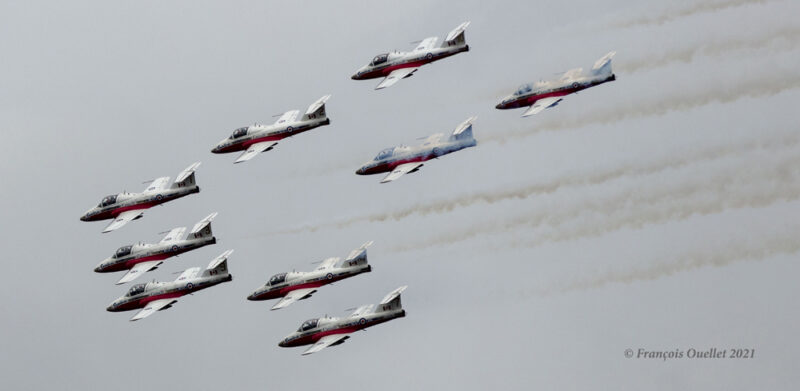
The Snowbirds passing by Québec City in June 2021.

The Snowbirds flew over Quebec City in June 2021, followed by many other jets and canadian military transport planes and helicopters. Until the last minute, a layer of low clouds and occasional showers worried event organizers.

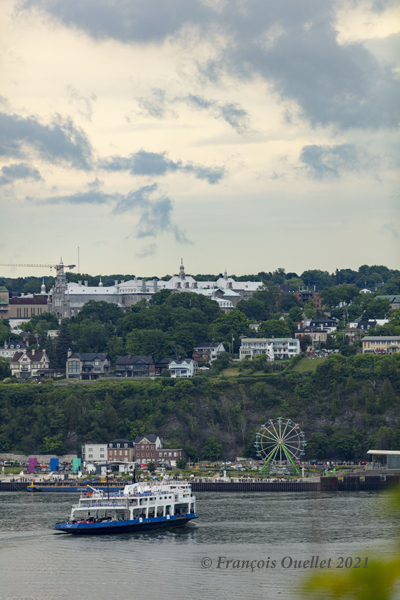
A ferry crosses the St.Lawrence Seaway in front of Lévis in June 2021.

Low clouds are visible over Lévis in the picture above taken from the Dufferin terrace in Québec City. On the St. Lawrence Seaway, the ferry bound to Lévis is approaching its destination.

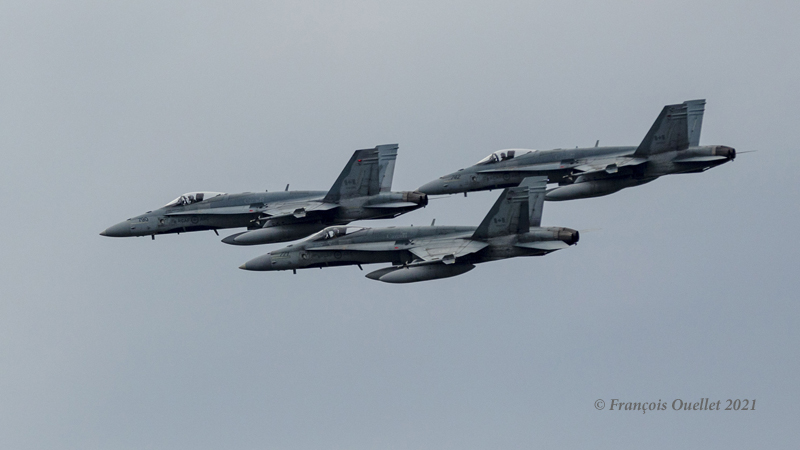
Three canadian CF-18 fly by Québec City in June 2021.

The CF-18s initially flew in a formation of three. For photography enthusiasts, the full frame camera used to capture those photos was a Canon 5DSr equipped with an EF 70-200mm f / 2.8L IS II USM telephoto lens. For the photo above, the shutter speed was set at 1/4000 and the focal length was 200mm. Given the CF-18’s fast fly-by, I opted for the AI ​​Servo autofocus which quickly adapts to changes in the position of the objects to be photographed. Since the original image size was 50.6 megapixels, this allowed me to crop it in order to enlarge the military jets without losing quality.

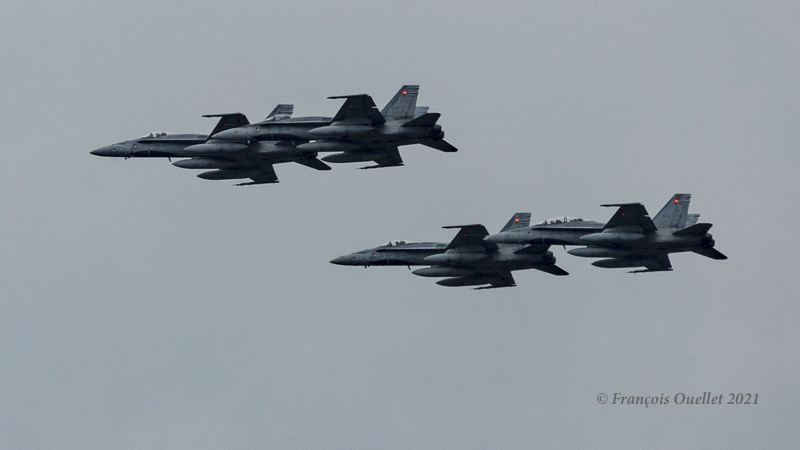
Four canadian CF-18 flying by Québec City in June 2021.

Above, four CF-18s were photographed with a shutter speed of 1/5000.

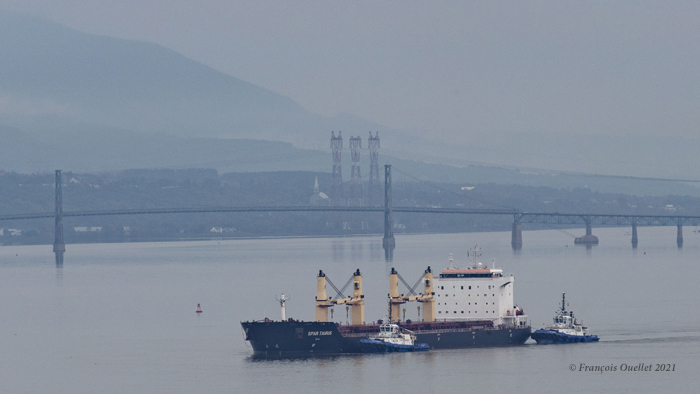
The bulk carrier Spar Taurus is arriving in the Québec City harbour in June 2021.

Between each fly-by of the various military jets, the maritime traffic continued as usual on the St. Lawrence River. Above, the Spar Taurus vessel , a bulk carrier built in 2005 and sailing under the flag of Norway, is heading towards the port of Quebec, accompanied by two Ocean company tugs. In the background, the Île d´Orléans bridge, which will be redone in a few years.

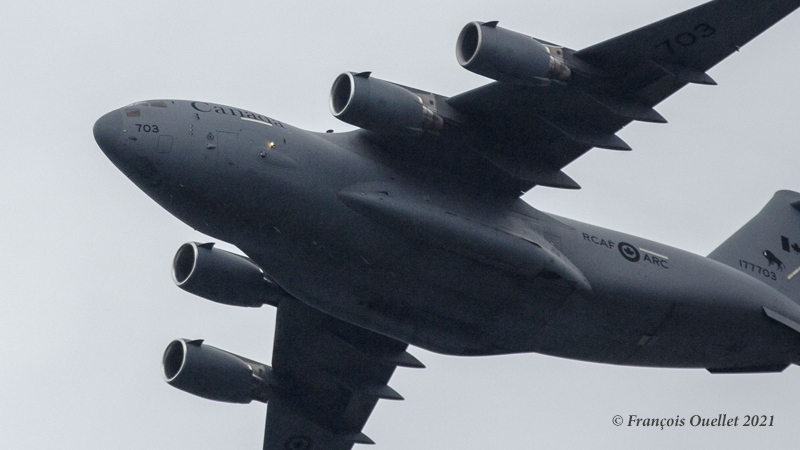
A canadian C-17 Globemaster III flies over the Dufferin terrace in Québec City in June 2021.

A C-17 Globemaster III, military transport aircraft built by McDonnell Douglas, flies over the Dufferin Terrace. Canada owns five of these aircrafts.

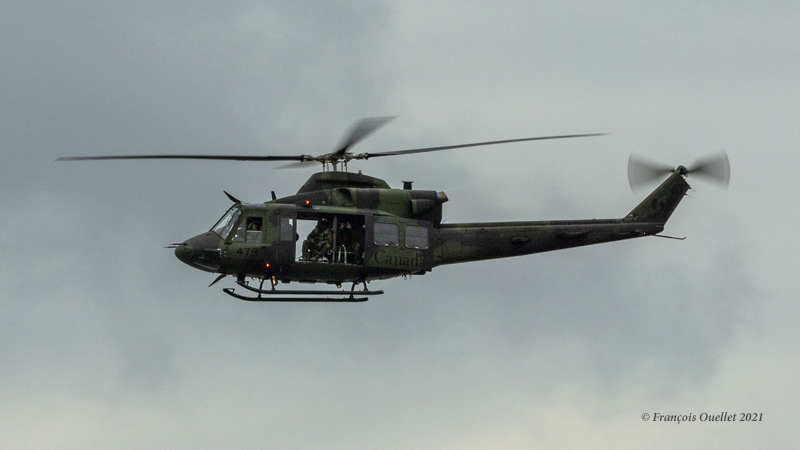
A canadian Bell CH-146 Griffon at Québec in June 2021

Above, a Canadian Bell CH-146 Griffon military helicopter , slowly flies near the Château Frontenac. A soldier seated behind takes a picture of the crowd gathered on the Dufferin Terrace. To photograph a helicopter, the shutter speed must be drastically reduced, so that the movement of the blades can be observed. For the photo above, I opted for 1/250, but I could have gone down to 1/125 without too much risk of the helicopter being out of focus.

There were other aircrafts that flew over the seaway, such as the CP-140 Aurora and the Lockheed C-130J Super Hercules, but the photos were not of sufficient quality to be published on the web.

Click on the link for other pictures of Québec City in Summer on my blog.

Categories
Aviation photography

Covid-19 : The Antonov 225 lands in Mirabel, Québec.

On Friday May 1st 2020, Quebec received a shipment of medical equipment destined to the people fighting COVID-19. An Antonov 225 was carrying the goods. The flight was organized thanks to a joint collaboration between Nolinor, Momentum Solutions and Antonov Airlines.

Departing from Tianjin, China, the plane made a stopover in Anchorage, Alaska, before continuing its flight over Canada towards the province of Quebec.

The Antonov 225 carrying medical supplies for Canada makes a stopover in Anchorage, Alaska.

The arrival of the Antonov 225 in Anchorage was announced in advance by the media, which allowed a large crowd to stand near the airport and monitor the approach of the aircraft. The following link allows you to view the approach and arrival: KTUU Video Antonov 225

At 5:35 on the KTUU video, we can see a Fedex MD-11F. It is worth mentioning, because this was a very impressive plane at the time of its conception, but companies are progressively getting rid of it due to the age and fuel costs associated with its operation.  Today, the aircraft is only used for the transport of goods. The production of aircrafts of this size, with three engines, was stopped years ago. There is a good chance that the Antonov 225 will continue to fly long after the MD-11F has made its last flight. (Edit: The Russians destroyed the Antonov 225 during the invasion of Ukraine)

After taking off from Anchorage in the morning of May 1st, the Antonov 225 arrived in Mirabel, Quebec, in the evening of the same day at around 8:22 p.m. The aircraft’s flight path (ADB3381) could be followed on Flightradar24 at the time of its approach for Mirabel (CYMX).

The Antonov 225 ADB3381 on final for Mirabel airport in Canada on May 1st 2020.

We can see on the Flightradar24 screen capture that a helicopter (C-GSTV) is positioned to film the arrival of the world’s biggest aircraft. It is an AS 350 BA from TVA, a French-language news media in Quebec.

The Québec TVA news helicopter C-GSTV.

Source : FlightAware.

The Antonov 225 arrives in Mirabel from Anchorage on May 1st 2020.

Photo taken by Martin Chevalier

YQBspotting has posted a very interesting video of the Antonov 225 arriving with its cargo of medical equipment in Mirabel, Quebec.

Andy St-André, from TVA, posted a video of the unloading of medical equipment on his Twitter account. 

The photo below shows the unloading operation. The employees wore protective equipment against the coronavirus.

Unloading the Antonov 225 at Mirabel airport in Québec during the COVID-19 crisis.

Photo : Joël Lemay/Agence QMI.

Several challenges were encountered for this flight to be a success: the language barrier, the verification of equipment quality (contaminated material is not of a big help), the airport operation’s requirements from China, customs limited hours of operation, maximum daily time in service for the Antonov 225 crew, international competition for slot times and orders, initiatives from some countries to acquire shipments not intended for them, etc. But finally, after hard work, Quebec finally received the precious cargo.

The last video from YQBspotting shows the Antonov 225’s departure. 

Click on the link for more articles on aviation photography on my blog.