Categories
Aviation photography Photos of Canada

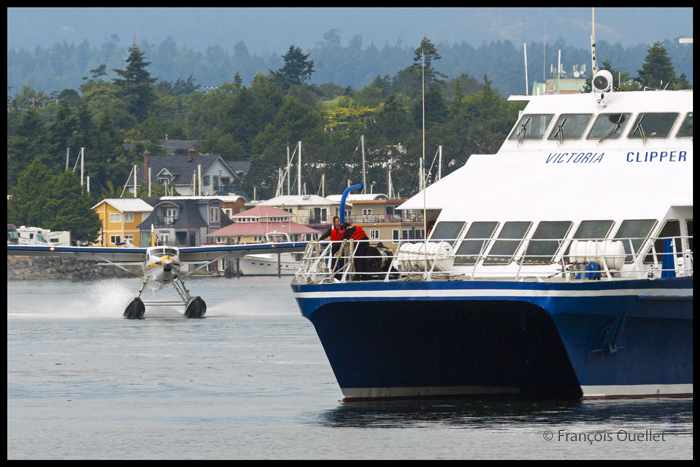
Timing is everything in Victoria Harbour.

A Harbour Air floatplane is rapidly approaching the Victoria Clipper in the Victoria harbour.

Arriving and departing floatplanes in Victoria Harbour must deal daily with ships that cross their path on landing and take-off. The staff on the Victoria Clipper is so used to this kind of traffic that it does not look in the direction of the incoming aircraft!

Click on the link for other pictures of British-Columbia on my blog.

Categories
Aviation photography

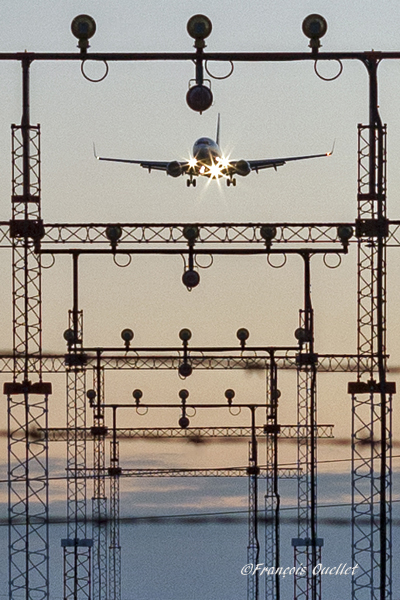
A Boeing 737 800 on final for the Toronto international airport.

A Boeing 737-800 is on final for runway 05 at the Toronto international airport.

The picture above shows a Boeing 737 800 on approach for runway 05 at the Toronto international airport. I used the precision approach equipment at the threshold of runway 05 to frame the aircraft on approach. A few trials were required to ensure that an aircraft of that size would not seem to be touching the antennas with its wings. At the same time, the rapidly moving Boeing had to stay in focus.

The picture was taken in February by -20C. The ambiant light is always softer at this time of the year. For this hand held photo, I used a Canon EF 50mm f/1.4 USM lens.

Click on the link for other aircraft photos on my blog.

Categories
Aviation photography

Japan Air Force One at the G7 summit in Quebec City

The Government of Japan's Boeing 747-400, with the Japanese Prime Minister on board, leaves Quebec City after the G7 summit in 2018.
The Government of Japan’s Boeing 747-400, with the Japanese Prime Minister on board, leaves Quebec City after the G7 summit in 2018.

The picture above shows the Japan Air Force Boeing 747-400 (B744) leaving Quebec City after the G7 2018 summit.

Below is a video of the training made by the pilots to get accustomed to the Quebec Jean-Lesage international airport.The runways at the CYQB airport are only 150 feet wide.

Click on the link for other aviation pictures on my blog.

Categories
Aviation photography

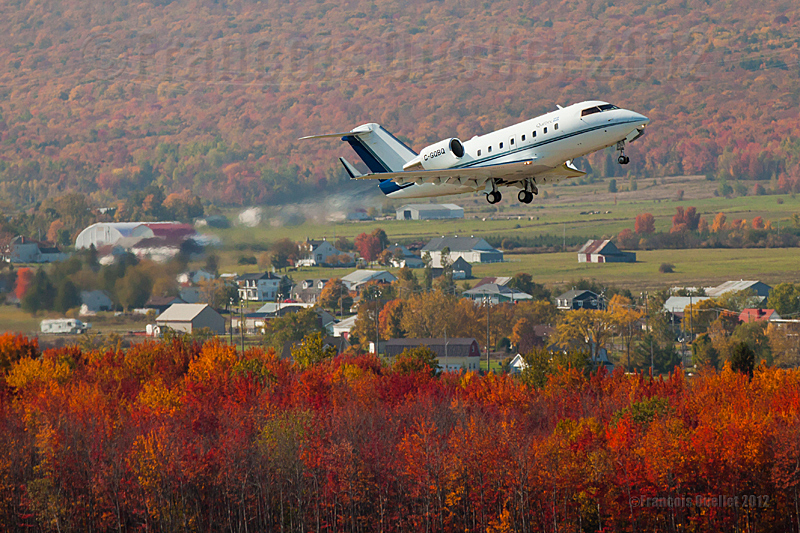
The Government of Quebec Challenger 600 C-GQBQ

Government of Quebec Challenger CL-600 C-GQBQ airborne from the Québec Jean-Lesage international airport

I return in the past with this photo of the Governement of Quebec Challenger 600 C-GQBQ. It is seen here after the take-off from the Quebec Jean-Lesage international airport. The picture was taken during fall 2012 with a Canon 5D MKII full frame camera, from the stairway surrounding the Quebec control tower.

With regards to photographic composition, the rule of thirds can be detected in the two wooden zones in the background, one at the top and the other at the bottom of the photo. The aircraft’s position in the frame happens to also meet the same rule of thirds.

I used the spectacular colors of fall to add some interest to the scene.

Click on the link for other aviation photos on my blog.

Categories
Aviation photography

Aviation photography: the Harbour Air DHC-2 Beaver floatplane

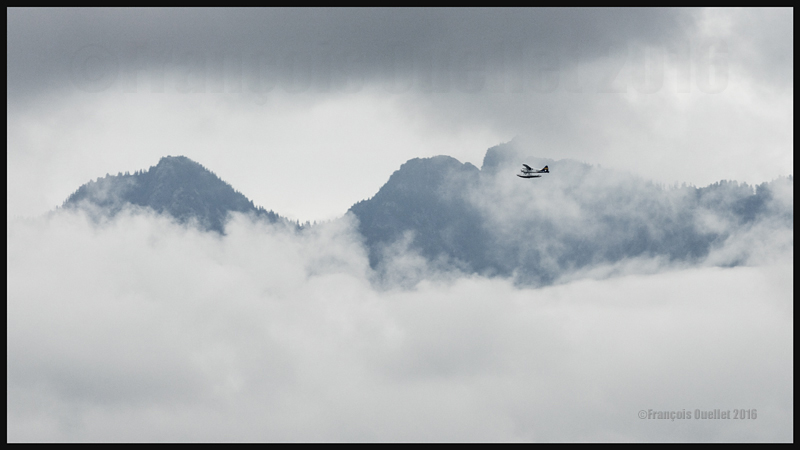
An Harbour Air DHC-2 Beaver floatplane is just airborne from Vancouver

The photo above portrays a Beaver floatplane belonging to Harbour Air. It is seen here a few minutes after its take-off from the Vancouver Harbour floatplane base in British Columbia. The picture was taken with a Canon 5DSR full-frame camera equipped with a Canon 70-200 f2.8L IS II USM telephoto lens.

The aircraft, quite small in the photo, could have been enlarged using the Canon 5DSR’ s 50 megapixel full-frame sensor. The image would still have been of excellent quality but I would have lost the effect I was initially looking for.

As opposed to what seems obvious at first sight, the scenery was not captured sitting in another plane but from the ground, while I was standing near the Harbour Air seaplane base. The morning’s constant precipitation saturated the air with moisture and helped create a low level cloud base.

An image editing software was then used to crop the scene. I used a non standard photo format to show the kind of flight the pilot was dealing with, between two cloud layers and with a mountain range on his right. It seems to me that a photographer does not have to feel obliged to follow an arbitrary format if the latter has a negative impact on the intended result.

Cliquez sur le lien pour d’autres photos d’avions sur mon blogue.

Categories
Aviation photography

Aviation photography: the sunset colors on a Bombardier Q-400

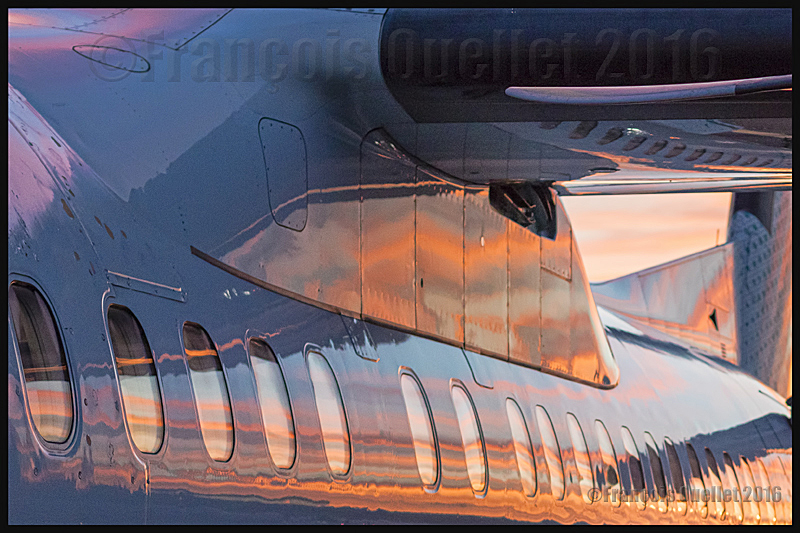
Sunset colors reflecting on an Air Canada Bombardier Q-400 in Toronto

The Air Canada Terminal installations at the Toronto Lester B. Pearson international airport are such that a voyager intending to do a flight from Toronto to Quebec has to walk outside the building to catch his plane. This has some advantages, especially when it is an evening flight and there is, at the time of boarding, a superb sunset.

But to directly photograph the sunset colors without any filter or tripod, while hand holding the camera, is a recipe for disaster. And a photographer cannot stay immobile for very long in that restricted area where security agents and passengers walking towards the DHC-8-400 demand that everyone move with the flow.

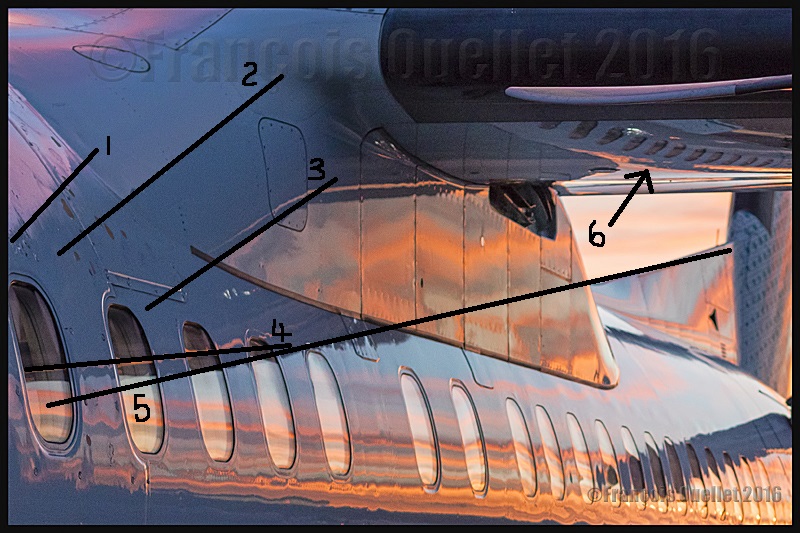
A practical method that offers very good results is to indirectly photograph the beautiful sunset colors by using the aircraft as a reflector.

First, it is better to use a camera lens that requires very little light. This will limit the grain size while allowing a shutter speed that is high enough to avoid a blurred picture. The scenery was thus captured with a Canon 5DSR full-frame camera equipped with a Canon EF 50mm f/1.4 USM lens.

Secondly, the photographer must crop the photography using an image editing software so that all useless details are absent from the final shot. There are two objectives: 1) it is obviously necessary to keep the aircraft parts that will best show the sunset colors and 2) do the best possible use of the elements presenting graphic interests for the viewer.

If I had kept only several oversized windows in order to show the superb sunset colours, there would have been only clear bright colours, without contrasts. That would have given an uninteresting photo. The advantages of protecting the shadowy top of the aircraft are that it adds a strong luminosity contrast, allows the inclusion of the Q-400 diagonal lines (1-2-3-4-5) and a reflection of the reflections themselves (6) under the aircraft’s wing. All this is highlighted in the photo below.

Photography theory: diagonal lines on a Bombardier Q-400 photo

Click on the link for more aviation photos on my blog.

Categories
Aviation photography

Aviation photography: sunset on Vancouver Harbour

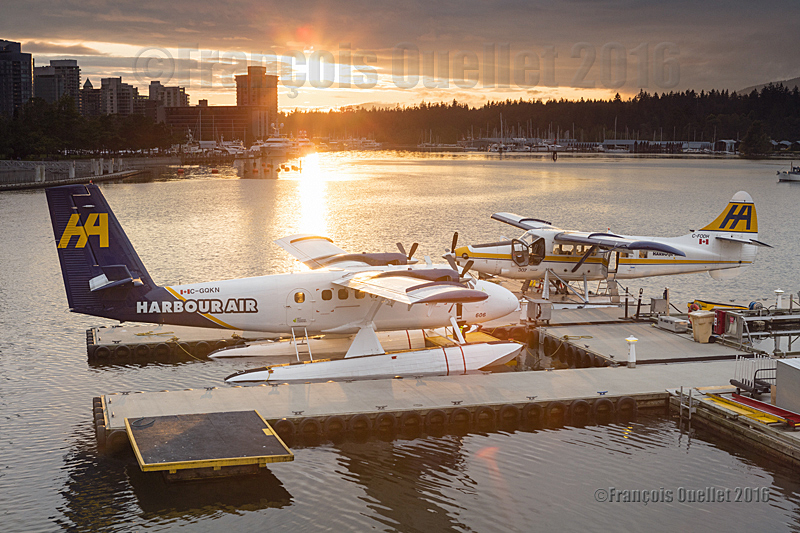
Harbour Air Twin Otter floatplane C-GQKN and Turbo Otter floatplane C-FODH in the sunset in the Port of Vancouver during summer 2016

The picture above has been taken with a Canon 5DSR full-frame camera in the Port of Vancouver, in British Columbia, during summer 2016. Following a very busy day of take-offs and landings, everything is now peaceful. The Harbour Air Twin Otter floatplane C-GQKN and Turbo Otter floatplane C-FODH are now parked for the night.

Pictures taken at dusk or dawn benefit from a unique light. Nonetheless, taking pictures of aircrafts against the light, with the last sunrays still visible, requires a special attention with regards to blown out highlights.

When contrasts are too important, it is possible to correct the situation by taking several pictures with different exposures and merging them using an image editing software like Photomatix (HDR photography). This is done in a few minutes only. Nonetheless, with floatplane aircrafts that are still slightly moving even when tied for the night, there is an increased risk of a blurred picture. The best way to proceed is to use a ND grad filter and to place it exactly where the light is the strongest. Naturally, there will still be some blown out highlights.

This being said, you still have a good margin of manoeuver, since there is no problem in showing a limited amount of over-exposed highlights in the brighter part of the sunrays, as there is not much details to lose there anyway. While purists would argue otherwise and spend hours in front of their computer trying to correct everything, you are making the best of another day of photographic exploration.

If the picture was taken using RAW files (or RAW with JPEG), it is possible to improve the scene even more by correcting some aspects like the contrasts, the brightness, the colours, the saturation and ambient light, etc. This also requires very limited time in front of the computer once you understand the basic principles of an image editing software.

Click on the link for more aviation photos on my blog.

Categories
Aviation photography

Aviation photography: when rain helps the photographer

Harbour Air Twin Otter floatplane C-GQKN on final for Vancouver Harbour, in British-Columbia, during Summer 2016. Photo taken with a Canon 5DSR full frame camera.

It looked like it would be an average day for a photography session at the Vancouver Harbour. The sky was quite ordinary, which means totally cloudless. But around noon, a new and more humid air mass made its way in British Columbia and rapidly the blue sky was replaced by clouds and precipitations. At the same time, the high intensity light that was prevailing around noon suddenly took more acceptable levels for photography.

Pilots of different bush floatplanes like the Twin Otter (DHC-6), Turbo Otter (DHC-3T) and Beaver (DHC-2) had to deal with the sudden weather deterioration in order to complete the daily planned flights. But one man’s loss is another man’s gain. For aviation photography, low clouds and light intensity meant that the pictures would be more interesting.

The photo above was taken with a Canon 5DSR full-frame DSLR camera equipped with a Canon 70-200 f2.8L IS II USM telephoto lens. In order to capture the moving propellers, I had to set a low shutter speed. The scene was then cropped to avoid visual distractions. The 50.6 megapixels full-frame sensor of the Canon 5DSR facilitates cropping when it is required.

In the foreground, there is a Harbour Air Twin Otter floatplane (C-GQKN) approaching to land in the Vancouver Harbour. In the background, far away and in the superior right corner of the photo, the pilot of a Turbo Otter floatplane also deals with worsening weather while ensuring that he maintains a visual contact with high ground obstacles surrounding the harbour.

Click on the following link for aviation photography on my blog.
Categories
Aviation photography

Aviation photography: a Twin Otter floatplane lands in Vancouver Harbour

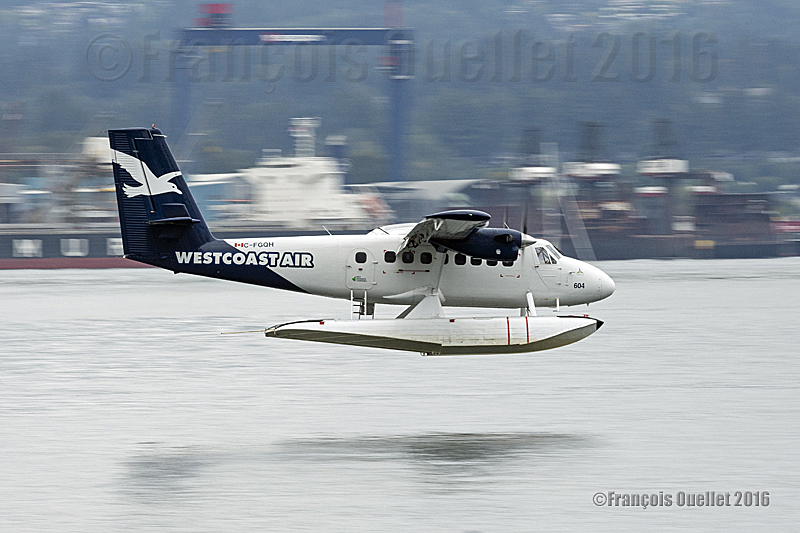
Westcoast Air Twin Otter floatplane C-FGQH arriving in Vancouver Harbour, in British-Columbia, during Summer 2016. The photo was taken with a Canon 5DSR camera.

The picture above was taken in British Columbia, during summer 2016, with a Canon 5DSR full-frame camera equipped with a Canon 70-200 f2.8L IS II USM telephoto lens.

A Westcoast Air (C-FGQH) Twin Otter floatplane (DHC-6) was about to land in the Vancouver Harbour. It is obvious that adjusting the shutter speed to 1/1200 would have given enough speed to obtain a clear image. But this would have taken away any movement sensation by freezing the propellers and background.

The shutter speed had to be slow enough to allow the rotation of propellers. It is clear that an aircraft’s propeller rotates more slowly on final for landing than during take-off. So the camera had to be adjusted for a shutter speed varying between 1/40 and 1/125.

A slower shutter speed increases the risk of getting a blurred photo, especially when the photograph must move with the camera to obtain the desired effect of movement. The fact that a telephoto lens is used also increases the possibility of a blurred picture. It is thus imperative to activate the stabilizer and horizontal panning function of the telephoto lens.

To obtain a background without any precise details, the camera is panning and follows exactly the aircraft’s movement. This requires a progressive acceleration of the panning, according to the aircraft’s position from the photographer.

When the Twin Otter gets closer, things get a bit more complicated as everything speeds up. It is necessary to already have positioned the feet in the appropriate direction in order to avoid a major switch in the body’s posture. The slightest useless or brisk movement would immediately be visible on the photo.

With a bit of practice, a photographer will achieve success by respecting the following elements: a shutter speed between 1/40 and 1/125, an appropriate position of the feet, no brisk movement while pivoting and a progressive acceleration of the body’s rotation aligned with the aircraft’s speed. A slower shutter speed will enhance the aircraft movement. But expect more blurred pictures when working with speeds between 1/40 and 1/60.

A last detail: as soon as the aircraft’s floats touch the water, the deceleration starts. The photographer’s pivoting speed must immediately slow down otherwise the photo will be blurred.

Click on the link for other aviation photos on my blog.

Categories
Aviation photography

Viking’s Twin Otter Series 400 in Victoria, British Columbia

Twin Otter Series 400 parked in Victoria, British-Columbia, in 2016

Knowing I would spend some time in Victoria in 2016, I planned a visit of the Viking Air Ltd installations, the Canadian company who now builds the famous Twin Otter Series 400. This company is unknown from a majority of Canadians since its production is essentially exported. Out of one hundred aircrafts produced so far, only two were bought by a Canadian company. Viking also offers maintenance service for the Twin Otter Series 100 to 300 in activity around the world.

In the foreground, a Twin Otter Series 400 built by Viking in Victoria, British-Columbia. In the background, a CL-215 water bomber recently acquired by Viking. It will possibly be modified into the more powerful CL-415 version .

In the beginning of 2016, Bombardier and Viking sealed a commercial deal that now makes Viking the new owner of the patents and designs for the CL-215 and CL-415 water bombers. Viking not only services the existing Twin Otters but is evaluating the possibility of restarting the production of the CL-415 water bombers. All is resting on the demand. But with more extreme meteorological conditions fueling a growing number of major forest fires, one can expect that within the next few years Viking will reactivate the production.

In Victoria, a Twin Otter Series 400 on floats built by Viking has been bought by Reignwood Air. It is ready for delivery to China (2016).

With the on-going regulatory changes actually taking place in China, Viking is confident to see an increase in its orders for the Twin Otter Series 400 on floats. The company will receive, at their Victoria installations in 2016, the first flight simulator essentially dedicated to training pilots on the Twin Otter on floats.

A Viking's Twin Otter Series 400 in Victoria ready for delivery to Russia
A Viking’s Twin Otter Series 400 in Victoria ready for delivery to Russia

For now, Russia is Viking’s most important customer despite the ups and downs linked to the political crisis between that country and Ukraine combined with a ruble devaluation that have forced a slowdown in the production of aircrafts destined to Russian companies. With the recent stabilization in the political situation, Viking has been able to hire back numerous workers which now brings the count to at least 350 employees, if my memory does not fail me.

Turbo Otter DHC-3T C-GVTO in Victoria, Canada, in 2016

Nowadays, most Canadians ignore that a Canadian company has restarted the production of the Twin Otters and is evaluating the possibility of also relaunching the production of the CL-415 water bombers. In the meantime, some CL-215s recently acquired by Viking will possibly be transformed into the more powerful CL-415 version. The only thing now missing for Viking is an important order from a Canadian company: that would make its name as well-known as Bombardier or De Havilland.

For other articles on aviation and photography, click on the following link: Aviation photography