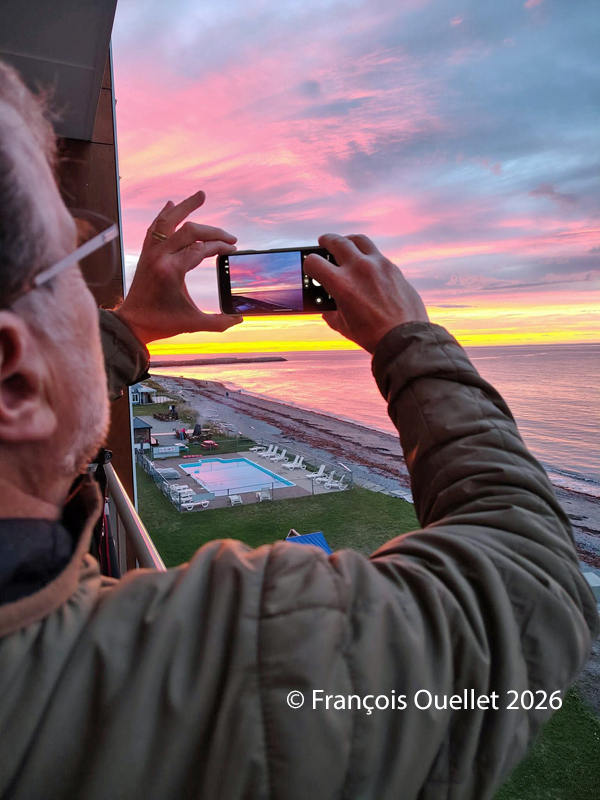
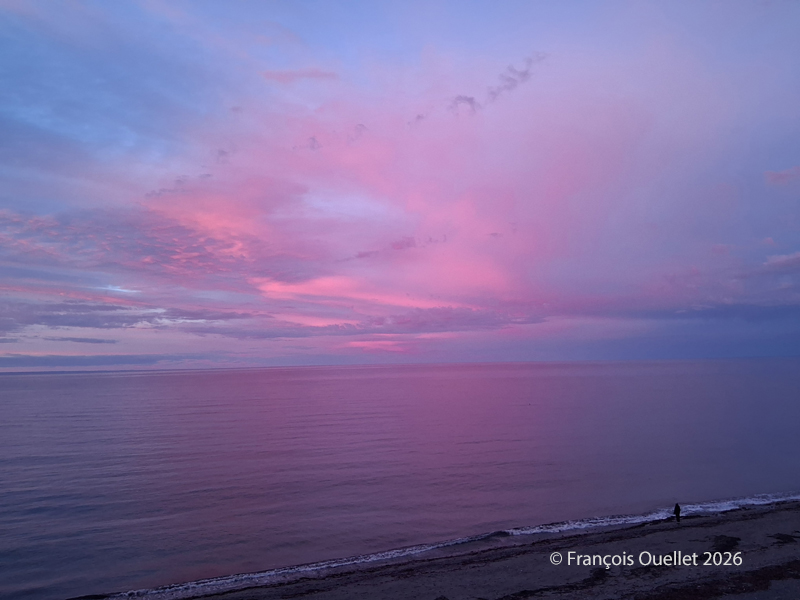
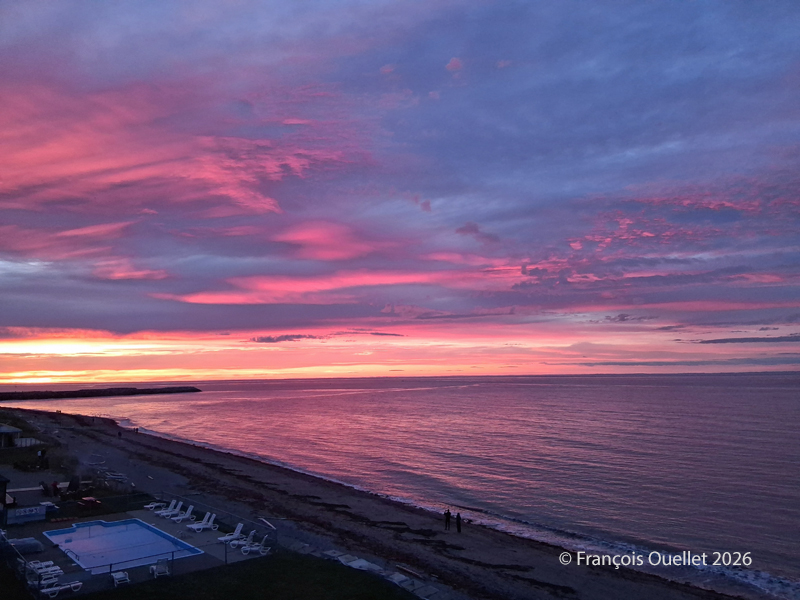
While on vacation in Matane for a few days, we took the opportunity to snap a few photos of the magnificent sunsets that are the hallmark of the area.
Sunset in Matane, Quebec, 2026
You never know what to expect, because in the evening the sky often clouds over or clears up in a matter of minutes. You have to be ready to capture the most beautiful colors, which last only a very short time—sometimes just a few seconds.
Sunset in Matane in September 2026
The entire region along the St. Lawrence River between Matane and Quebec City offers spectacular sunsets. The Kamouraska region sometimes features colors so intense that it’s hard to post them on social media without people thinking the photos have been edited and oversaturated.
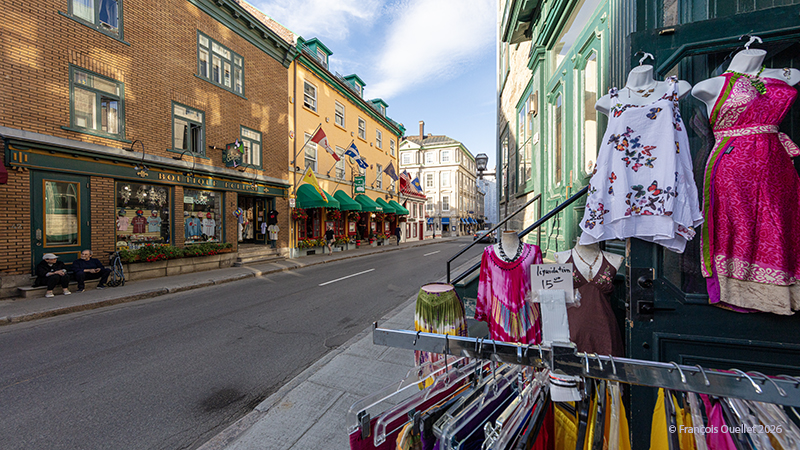
Here’s a photo of Saint-Louis Street in Old Quebec before the massive influx of tourists. Nothing blocks the view of the buildings across the street.
Photography Technique
Today, the area is beautifully lit, and the few clouds add dynamism to the sky. Rather than capturing the scene around noon, it’s better to wait until dinnertime. The light remains bright, and the sun’s angle at that hour creates some nice shadows.
I’m taking advantage of a clothing sale to add some life to the photo. By framing the shot with a Canon EF 11–24 mm f/4L USM zoom lens, I can include the little multicoloured dresses in the image. We use whatever we can to improve the final result of the photographic composition.
Canon’s high-performance zoom lens allows me to capture numerous buildings while preserving all the vertical lines, without distortion.
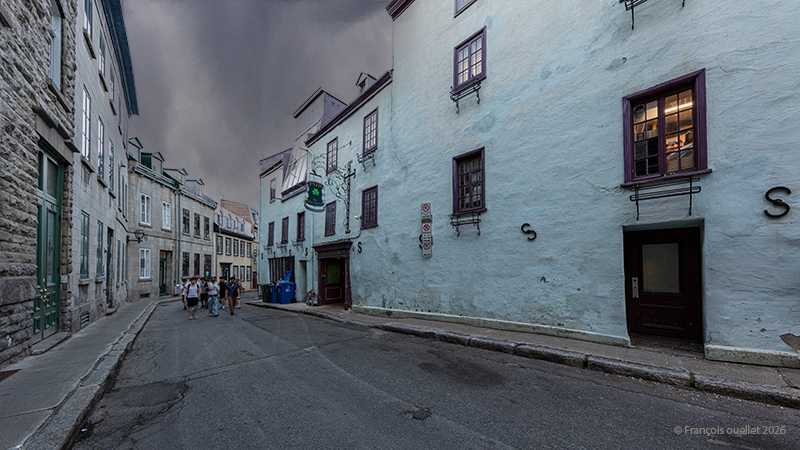
Old Quebec buildings and virga.
Above is an alley in Old Quebec, near Saint-Louis Street, but in a different context. This is a composite photo, meaning the sky is not the original one. I had some fun using digital editing software to search for clouds with precipitation that doesn’t reach the ground (virga).
The final result creates an interesting atmosphere, though it’s a bit gloomier than the first shot. The pronounced bluish tint on the building on the right comes from adjusting the vibrance. I moved the slider a little further to the right than usual.
So, we have two very different photos: an unaltered, authentic view of Rue Saint-Louis, and a composite alleyway.
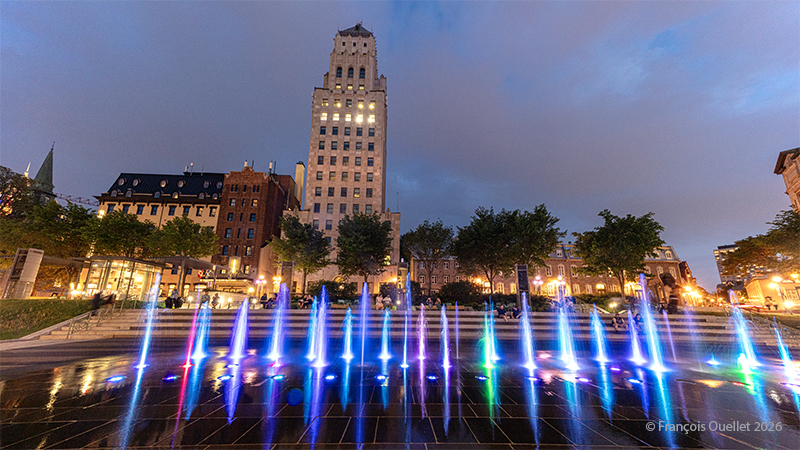
Here are a few photography tips for taking a decent photo of the Price Building, the only skyscraper in Old Quebec, with the multicoloured fountain at Quebec City Hall.
Ideally, you should use an ultra-wide-angle lens. In the picture above, I’m using the Canon EF 11–24 mm F/4L USM zoom lens. At 11 mm, it frames the Price Building and the fountain without cutting anything out.
It’s best to photograph the scene during the blue hour. At this time, the cloud formations that are still visible create a more vibrant sky. The colours of the water jets also stand out better. Of course, a tripod and a camera shutter release cable are necessary.
The height and colour of the water jets vary constantly. It takes several attempts to get the jets high enough and achieve the desired colour. This way, you’ll capture large reflections on the tiles that ultimately create long, straight lines of colour.
It’s well known that fountains attract children… and parents. The main challenge when taking photos comes from the number of people making selfies and standing still in the water jets. It’s during those rare moments when no one enters the frame that you capture the scenery.
Shooting in RAW format allows you to enhance the data recorded by the camera later on. I use a fairly low ISO and a shutter speed between 1/60 and 1/125. A slower shutter speed also produces good results and alters the texture of the water jets. The depth of field is around 9.0.
Michel Rabagliati never disappoints me. I thoroughly enjoyed reading his latest book, *Y a d’la joie*. The author starts off strong with a few drawings that speak volumes about the influence of the media today. Then he lets us into his life by taking us on a tour of his neighborhood in Montreal. I particularly enjoy the true stories, as they possess an intensity I don’t find in works of fiction.
Here’s a quick aside: while reading Mr. Rabagliati’s book, I was passing through Montreal and took a few photos, including one of the city with the lilacs in bloom.
Lilacs in bloom in Montreal in the spring of 2026
And since the Montreal Canadiens were playing a game that evening that would later eliminate the Buffalo Sabres, it was a must to capture the city’s buildings lit up in red, white, and blue.
Buildings in Montreal decked out in the Montreal Canadiens’ colors during the 2026 playoffs
Now back to the book. The author presents us with an uncensored Montreal—the one you don’t see on postcards. He rightly rails against the idiots who deface the beautiful murals in his neighborhood and elsewhere in the city. Fortunately, there are still buildings where the artwork remains intact, as shown in the two photos below.
Mural on a building in Montreal 2026
Joker mural in Montreal
Mr. Rabagliati introduces us to the businesses in his neighborhood, the people who work there, and those he deals with on a regular basis. He stops by to say hello to his daughter and reminisces about the good times. I love the book’s slow pace and its human touch. His style and words remind me of the Icelandic author Auður Ava Ólafsdóttir.
In short, a superb book that lets us catch our breath a little and reconnect with life bit by bit. If you’d like to see the author in his daily life, you’ll enjoy “Y a d’la joie.”
Snow blower at work on Île d’Orléans in the winter of 2026
On Île d’Orléans, snow blowers don’t stop clearing snow when a vehicle approaches from the opposite direction. They blow the snow across the road with enough force that you can quickly pass under the spray without getting too much debris on your car.
House on Île d’Orléans with Mont St. Anne in the background
The sun hits the trees sideways in the late afternoon on Île d’Orléans. From the Sainte-Famille parish, you can capture the island’s houses with an interesting backdrop: the ski slopes of Mont St-Anne.
Protest in Quebec City against Iran’s mullahs
Even in freezing temperatures, citizens of Iranian origin are demonstrating in Old Quebec against the dictatorial regime of the mullahs in Iran. All this at a time when an American fleet is positioning itself for a military intervention in Iran.
Leaving Tadoussac, the road continues along the Côte-Nord (North Shore) and we pass through Forestville to reach Baie-Comeau and take the ferry to Matane, on the south shore of the St. Lawrence River.
We arrive in Matane at dusk, just in time to set up the camera equipment on the beach. There’s no way I can take the photo above from the ferry, because a long exposure requires absolute stillness. I want to capture this beautiful September moon rising above the houses.
I miss a few shots by relying on autofocus. I quickly change my photography technique. Liveview (Live View) mode and manual focus will improve the sharpness.
Fishing boat at dusk in Matane, Quebec 2025
The next day, a boat leaves Matane just before nightfall for a fishing expedition off the St. Lawrence River. The relative calm of the waters offers interesting reflections. The low light and distance of the boat require the use of a high-quality lens, in this case the Canon EF 300mm f/2.8L IS II USM.
On the way back from Matane to Quebec City, a stop at Bic National Park allows us to take a few photos, including this fishing boat returning to port. The sailors’ departure time varies constantly depending on the river tides.
Fishing boat in the Parc national du Bic, Québec 2025
Another location well known for its beauty is the municipality of Sainte-Luce-sur-Mer. Below, the colorful houses along the beach attract the attention of tourists and contribute to the area’s reputation. I preferred to capture an overall effect by including vegetation in the foreground. The few small low cumulus clouds also add to the dynamic of the scene.
The village of Sainte-Luce-sur-Mer and its colorful houses.
One last photo shows the sunset in Berthier-sur-Mer. This area, along with the Kamouraska and Notre-Dame-du-Portage regions, regularly offers exceptional panoramas when the sun sets. So much so that some photos can look like they’ve been retouched.
I saw reds and purples so pronounced that it became obvious that the photographer would have been accused of oversaturating his shots.
Sunset at Berthier-sur-Mer en 2024.
After an excellent meal at the beach restaurant in Berthier-sur-Mer, we finally reach our final destination, the beautiful city of Quebec City.
Ferry Baie Sainte-Catherine Tadoussac in the province of Québec, 2025
The ideal time to visit Tadoussac, the fjord, and the surrounding area is in May and June until Saint-Jean-Baptiste Day, then immediately after Labor Day.
If travellers decide to go there during the summer anyway, they will see tourists everywhere.
View from Hotel Tadoussac in the province of Québec, 2025
If you can, book one or two nights at the Tadoussac Hotel, preferably with a room overlooking the river. In the morning, the space will be much brighter than a room facing the backyard. The hotel has undergone extensive renovations, which will continue discreetly in 2025.
The hotel is close to everything, and you can explore many local attractions without having to use your car. The docks are also a ten-minute walk away when it’s time to take a whale-watching cruise.
Beluga whale sculpture in front of the interpretation center in Tadoussac, Quebec 2025
Numerous chairs on the grounds in front of the hotel Tadoussac allow guests to enjoy magnificent views of the surrounding landscape and the St. Lawrence River. The hotel restaurant is decent and features a beautiful glass roof. However, don’t expect the same level of culinary experience as Chez Truchon in La Malbaie.
As for the tourist attraction of booking a cruise on the St. Lawrence River to watch humpback whales and beluga whales on the AML Grand Fleuve, I would advise you to pay the extra fee that gives you exclusive access to the upper deck of the boat. You will be much more comfortable there and able to take pictures of the marine mammals than if you find yourself crammed in with dozens of other curious people on the main deck.
Fin whale in the St. Lawrence river near Tadoussac, Québec 2025
However, I don’t think it’s worth paying extra to sit in the VIP lounge and have a glass of wine. If alcohol is your priority, skip the cruise and stop at one of the bars along the beach instead. You’ll save a lot of money.
Another tip: a cell phone won’t be very userul for taking pictures. In general, belugas and whales are not close enough to the ships for cell phones to capture them clearly. If you want to bring back a high-quality digital souvenir, bring a decent camera with a telephoto lens that can crop images without too much degradation.
Cloud formations near Tadoussac and the Saguenay River 2025
I can’t stress this enough: even if it’s warm or cool in Tadoussac when you set out on the river, the temperature will drop significantly once you’re out on the open water, sometimes by as much as 10 degrees Celsius. A hat and several layers of clothing will allow you to truly enjoy the experience and stay outside the cabin throughout the trip. Those who are less well-dressed focus on protecting themselves from the cold, stay inside the cabin, and see practically nothing.
KLM MD-11 airborne from Rotterdam The Hague virtual airport in Microsoft Flight Simulation
After Holland, France is stage 22 of the flight simulation tour of the world. The first airport of interest will be Paris-Le Bourget (LFPB), more specifically the Musée de l’Air et de l’Espace du Bourget. Since this is a historical visit, we choose the aircraft accordingly.
So, departing from Rotterdam, passengers board an MD-11 in KLM colors. The last flight of KLM’s MD-11 passenger aircraft in the real world took place in 2014, departing from Montreal to Amsterdam.
Today, several MD-11s are still flying, but only in cargo versions. Airlines are progressively replacing them by more modern aircrafts.
TFDI produced this high-quality virtual aircraft. An updated version has further improved the aircraft. It can be seen below flying at 13,000 feet.
A KLM MD-11 climbs for FL210 towards Paris-Le Bourget (LFPB) with MSFS
Below, the MD-11 reaches flight level FL210. The virtual weather based on METAR reports from Rotterdam and Paris indicates no serious problems for the approach and landing.
Virtual TFDI KLM MD-11 about to reach FL210 enroute to (LFPB) Paris Le Bourget airport
For this flight, the MD-11 is carrying only about 100 passengers. The runway at Le Bourget offers plenty of room for maneuvering when landing such an aircraft. Thirty-five degrees of flaps will therefore be sufficient for the final approach to runway 25.
The approach axis is unusual in that it is offset by 26 degrees from the center of the runway. As Jean-Pierre Otelli so aptly puts it in his book, ” Piloter en sécurité ” : “If the localizer were in line with the runway, the final approaches at Le Bourget would pass 1,000 feet above Terminal 1 at Roissy” […]. Aircraft landing on 25 must make a final 26-degree turn after following the localizer.”
Le Bourget is not the only airport where a serious turn is necessary on final approach. We obviously remember the Hong Kong Checker Board Approach for runway 13 at the former Kai Tak Airport in Hong Kong. At that airport, the final turn was not 26 degrees, but 47 degrees.
Finally, we can also mention Ronald Reagan Airport, where the approach for runway 19 requires a final turn of 36 degrees to avoid the area surrounding the White House.
KLM MD-11 on final for the virtual airport Paris Le Bourget (LFPB) with Microsoft Flight Simulator
The MD-11 taxis down the runway after a smooth landing. After switching off the autopilot for the final approach, an alarm sounds in the cockpit. Even after the plane has touched down, no matter what I do to silence the alarm, nothing works. I still have several hours of study ahead of me to master this aircraft.
Virtual KLM MD-11 taxiing on rwy 27 Paris Le Bourget airport after landing with MSFS
The MD-11 taxis to a makeshift parking area near the museum after crossing the disused runway.
A KLM MD-11 de KLM arrives at the Paris Le Bourget (LFPB) airport with Microsoft Flight Simulator
Le Musée de l’Air et de l’Espace du Bourget (The Air and Space Museum in Le Bourget).
Virtual Musée de l’Air et de l’Espace du Bourget with Microsoft Flight Simulator MSFS
The next stage of our flight around the world with Microsoft Flight Simulator will also take place in France. The current weather conditions will once again dictate the choice of aircraft and destination.
After visiting the La Malbaie region, the Saguenay Fjord, Bagotville, and La Baie, all of which were featured in my previous blog post, we continue our journey to Saint-Gédéon, along the Lac-Saint-Jean, Alma, and then back to La Baie at nightfall.
Lac-Saint-Jean, September 2025
Lac-Saint-Jean has a circumference of 263 kilometers and covers an area of 1,003 square kilometers. When we were there, the wind was blowing moderately, and it’s easy to imagine the swells that boaters must face in the middle of this immense expanse of water. Some sources cite waves up to 4 meters high during extreme weather conditions.
Hay bales near St-Gédéon, Lac Saint-Jean 2025
In September, farmers store hay bales. Around 6 p.m. in the Saint-Gédéon region near Lac-Saint-Jean, the sun hits the field from the side, beautifully illuminating the hay still outside. An excellent opportunity for landscape photography.
Just before nightfall and our departure for Alma, we take a few shots of the wind turbines near the lake. The photographic composition requires a vertical frame.
Wind turbines at dusk in Lac-Saint-Jean, Quebec 2025
In Alma, we take the opportunity to eat at the restaurant owned by Mario Tremblay, a star hockey player for the Montreal Canadiens who is now retired. It was well worth the stop! I took a photo of the restaurant entrance where you can see the hockey player in action!
Entrance to Mario Tremblay’s restaurant in Alma
The journey continues in the next article, where we stop in Tadoussac for a whale watching cruise.
Sailboat anchored in the Saguenay Fjord in the province of Québec
Heading up the west coast of Saguenay from Saint-Siméon, you pass through Sagard (home to the Desmarais family’s huge estate and castle) and L’Anse-Saint-Jean. In L’Anse-Saint-Jean, you can book a shuttle for a few hours’ round trip on the Saguenay. This allows you to see Cap Trinité and stop off at Sainte-Rose-du-Nord.
I took the picture above from Baie Éternité. The cliffs rise up to 400 metres. A sailboat has chosen to anchor there for a while.
The Saguenay River at low tide near La Baie, Québec 2025
Just before La Baie, you can walk on the beach at low tide. There are several interesting opportunities for landscape photography, including a lighthouse, mountains, the town at night, and even cruise ships sailing up the Saguenay River in the fall.
Downtown in La Baie, province of Québec 2025
To achieve the above effect in La Baie, I had to remove a few poles and advertisements using digital processing software. The pseudo-HDR method enhances the impact of the clouds by defining them more clearly.
Seals resting on rocks in the Saguenay fjord, Québec 2025
This last photo shows seals resting on the rocks along the Saguenay Fjord. The captain of the ferry was able to approach the cliffs safely because of the great depth of the fjord at this point.