In September 2025, another edition of Vintage Weekend took place in Quebec City. This year, more than 200 vintage cars were on display on Saint-Paul Street and on the grounds adjacent to Espace Quatre Cent in Quebec City’s Old Port.
Stéphane Lavallée’s 1959 Corvette at Quebec City’s Vintage Weekend
As usual, restaurant owners had their hands full serving the many curious visitors who came to admire the cars. In addition, they had to contend with the presence of travelers who had recently disembarked from the three cruise ships moored in the harbor. The next photo shows the energetic team at Bistro St-Malo hard at work feeding passersby.
The restaurateur of Bistro St-Malo at work on St-Paul Street at Weekend Vintage 2025
This year, musicians from Calgary entertained the crowd with songs from the 1950s. The audience was delighted by the excellent quality of the performance, both in terms of singing and music. The same can be said of the dancers, who took us back in time with a few hits from that era.
Retro dancing on St. Paul Street at the Quebec Vintage Weekend in 2025
Below, cars occupy the space surrounding La Vivrière, a fountain sculpture commemorating the founding of the Food and Agriculture Organization of the United Nations (FAO).
Gary Lynch’s Hudson Hornet Hollywood 7x at Quebec City’s Vintage Weekend
Burger Heaven Lights on for Service at the Weekend Vintage in Quebec City
Paul Forest’s 1955 Chevrolet Bel Air with modified color
1952 Oldsmobile Super 88 Holiday and Michel Savard at Quebec City’s Vintage Weekend
Above, Michel Savard poses proudly next to his 1952 Oldsmobile Super 88 Holiday. As for André Guillemette, he had original parts shipped from Great Britain to do justice to his 1962 Jaguar Mark II, which can be seen below.
André Guillemette’s 1962 Jaguar Mark II at Quebec City’s 2025 Vintage Weekend
Reflections in Michel Métivier’s 1967 Pontiac GTO at Quebec City’s Vintage Weekend
A final photo shows St. Paul Street with Charles Boisseau’s 1965 Corvette Stingray.
Charles Boisseau’s 1965 Corvette Stingray at Quebec City’s Vintage Weekend
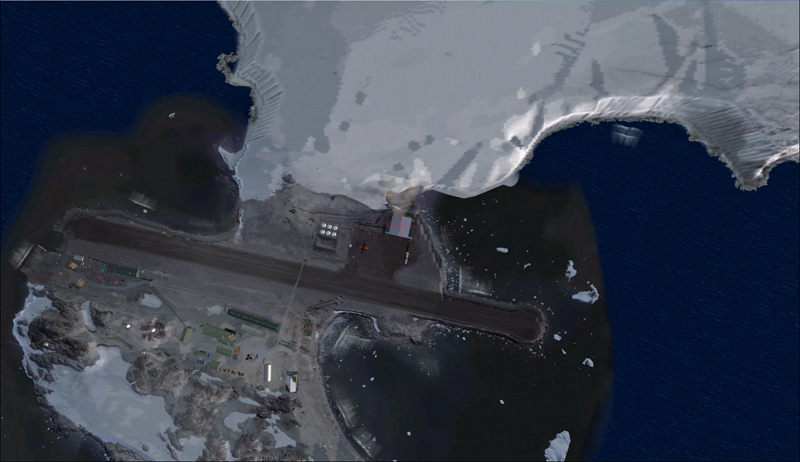
Aerial view of the Rothera research station in Antarctica.
For this flight, you will need the Antarctica X flight simulation software made by Aerosoft.
The maintenance of BAS Twin Otters and their Dash-7 is done in Calgary, Canada, and head to Antarctica during the austral summer, between October and March. So if you want to try a flight simulation with a Twin Otter or a Dash-7 from Chile to Antarctica, pick one of those months as it is more realistic.
Since it would be a bit long to make all the virtual flights from Canada to Antarctica, I chose to do the last three legs to see what the landscape looks like.
A Twin Otter is normally approved for a maximum take-off weight of 12,500 pounds. But with skis weighing 800 pounds and additional fuel required to fly longer legs, BAS (British Antarctic Survey) has arranged to have their Twin Otters approved at 14,000 pounds. Even at this weight, the aircraft could still operate on one engine.
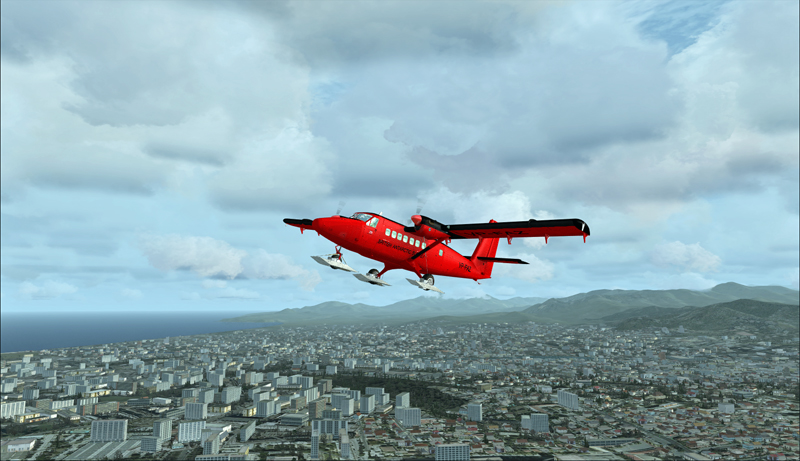
First, the aircraft departs La Florida airport (SCSE) in Chile, after a mandatory fuel stop before its next destination, the El Tepual de Puerto Montt airport (SCTE), also in Chile.
Airborne from La Florida, Chile, after refueling.
This virtual flight with the Twin Otter last about 4:25 hours (696 nm) with a heading of 185 degrees.
In flight towards El Tepual de Puerto Montt, Chile.
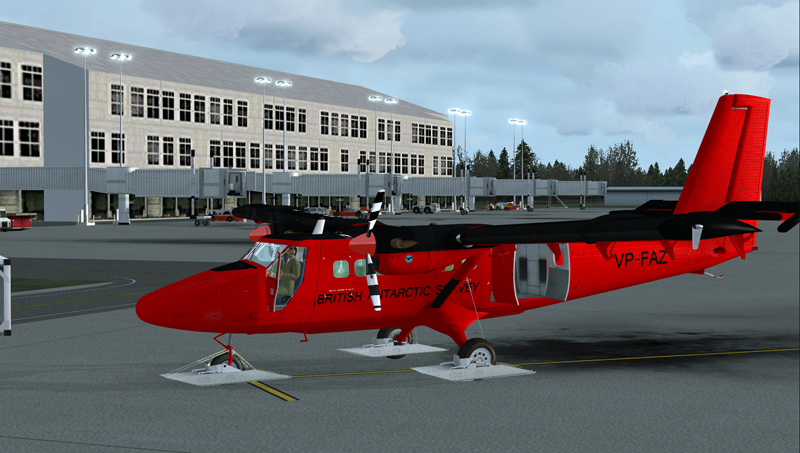
For the screen captures, FTX Global, FTX Vector and Pilot’s FS Global 2010 were installed. Orbx has also reworked the original El Tepual de Puerto Montt airport to include some people, aircrafts and new buildings. It makes for a more interesting destination.
Twin Otter on final approach for El Tepual de Puerto Montt, Chile.
Ready for refueling at the El Tepual de Puerto Montt, Chile.
The next flight is from the El Tepual de Puerto Montt airport (SCTE) to Punta Arenas (SCCI), both in Chile.
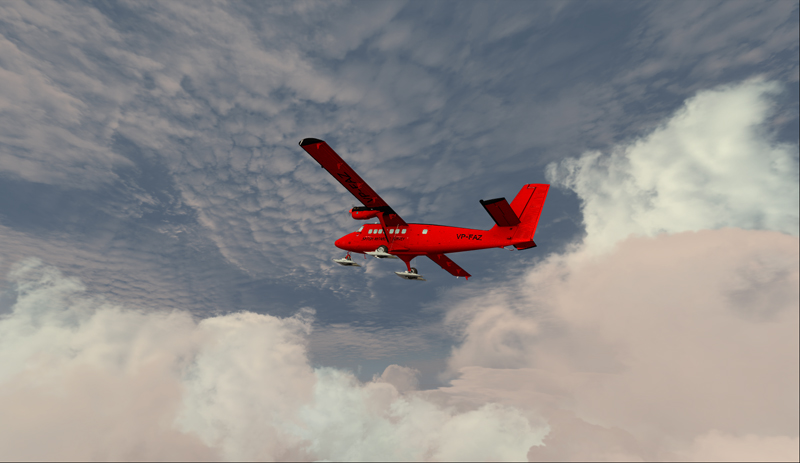
Twin Otter aircraft airborne and heading to Punta Arenas, Chile.
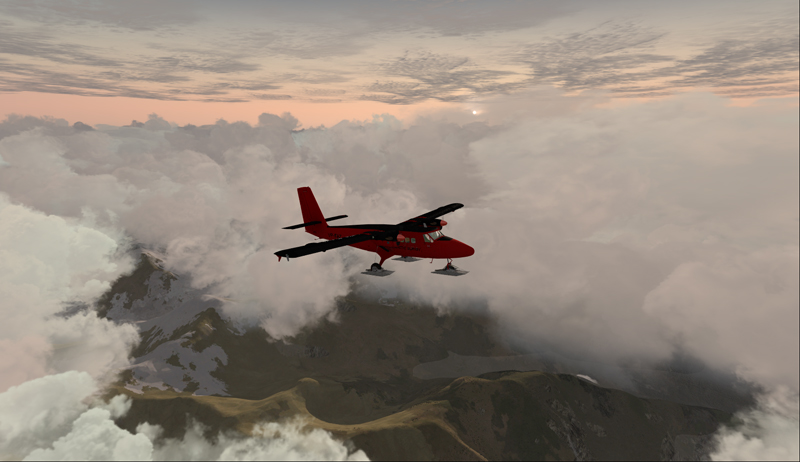
This flight, made low across the Andes, absolutely requires good weather. You will have to climb to 17,000 feet to make the direct route between the airports.
Twin Otter over the Andes climbing for17,000 feet
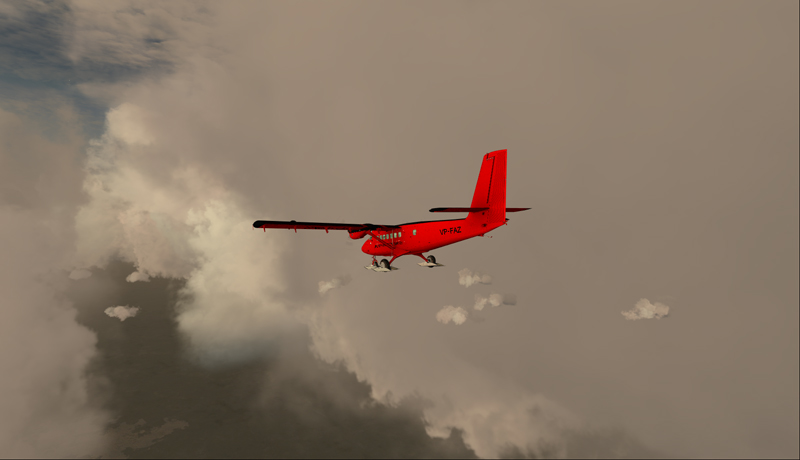
There are often spectacular views available to the virtual pilot. Yes, the BAS Twin Otter is flown by only one pilot, but there is always somebody else accompanying him.
Don’t forget to lean the mixture during the climb. Also use some additional oxygen (!!) if you don’t want to start singing and flying in circles after a while. Again, pay attention to the mixture during the descent, considering that you will be losing close to 17,000 feet.
Refueling at Punta Arenas, Chile.
The Punta Arenas airport, straight from FSX, is not an interesting airport to look at. It is a very bare airport, with just a single building and a VOR.
But since the BAS pilot do that mandatory leg just before heading to Antarctica, I chose not to change the route. The general direction for the flight to Punta Arenas was 164 degrees and the duration approximately 4:28 hours. You can obviously accelerate the process once the aircraft is established at its flying altitude.
The last flight is from Punta Arenas, Chile, to Rothera, Antarctica.
Twin Otter aircraft heading for the Rothera airport in Antarctica.
The Twin Otter will take between six and seven hours on an average heading of 162 degrees to cover the distance between Punta Arenas (SCCI) and Rothera (EGAR).
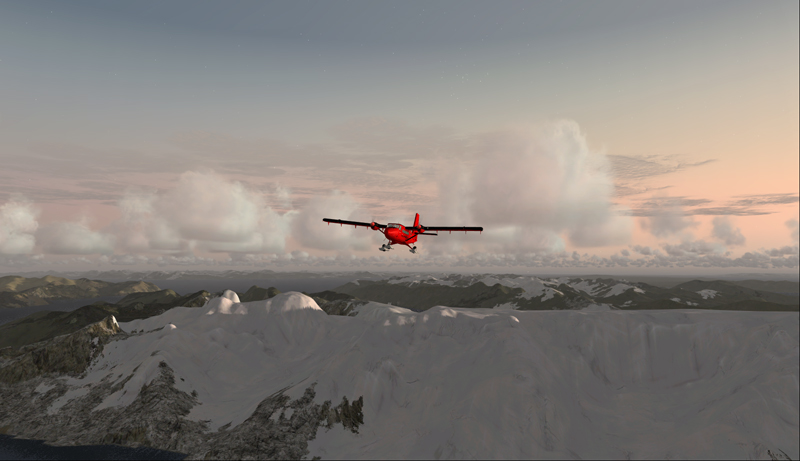
Over the snowy mountains of Chile towards Rothera, Antarctica
Carrying extra fuel on the flight towards Rothera, Antarctica.
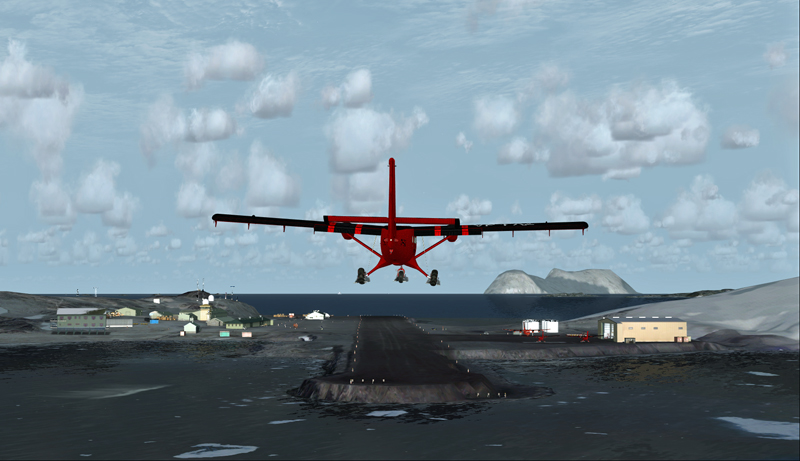
The runway at Rothera is made of gravel and is 2953 feet long. That is plenty for the Twin Otter and the DASH-7. Before you make the flight, go into the aerosoft/Antarctica X file in your flight simulator and click on the “LOD 8.5” option (the default is at LOD 4.5). It will give you much better details when you are approaching Antarctica.
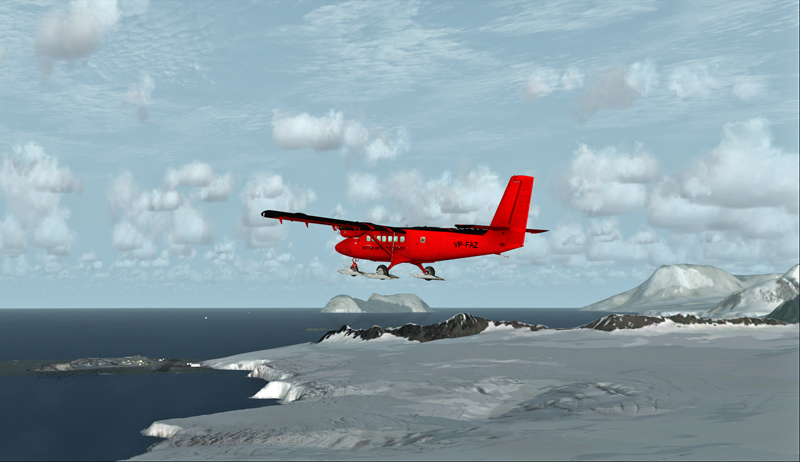
The antarctic Rothera research station is in sight
Twin Otter aircraft on final at Rothera, Antarctica.
The Airliner World magazine had an excellent article on the BAS operations in Antarctica in its March 2017 edition. It included plenty of interesting pictures and detailed explanations on what is expected from pilots and personnel working for BAS. I compared the Rothera virtual airport with the real one through the available pictures in Airliner World and was pleasantly surprised with the level of accuracy of the details.
A British Antarctic Survey Twin Otter aircraft is landing on the Rothera runway, Antarctica
The BAS always prepares itself for the worst: “[It] carries parts valued at around $5m, including a replacement engine for each aircraft, spare props and undercarriage components”.
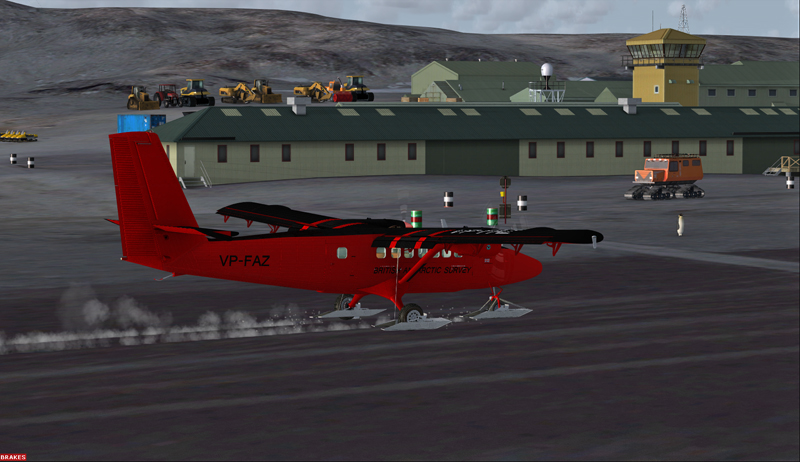
Twin Otter aircraft after a landing on the Rothera runway, Antarctica
“A new development for the Air Unit has been its work with the RAF, using C-130 Hercules transports to airdrop supplies into the field. They fly from Punta Arenas and drop fuel to support our science programmes on the Ronne Ice Shelf. […] It is all part of their training system and the accuracy they drop to is very impressive. They might drop 250 drums, think how many Twin Otter trips that would have been for us (48 or more than 400 flying hours)”.
The main hangar in Rothera, Antarctica.
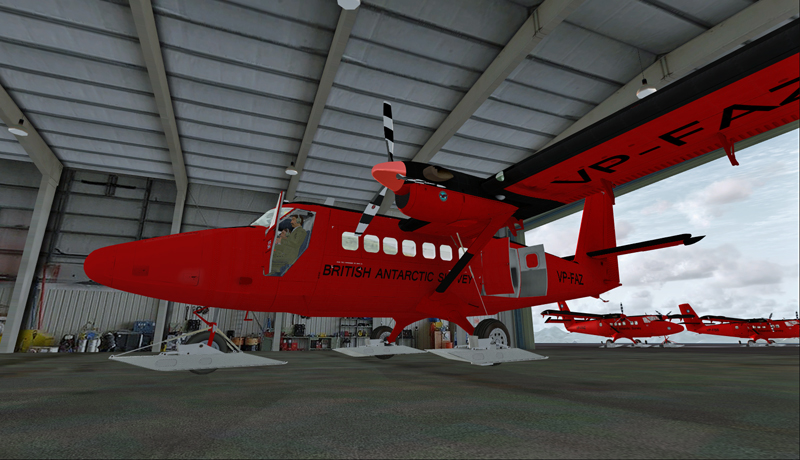
Aerosoft has made an excellent job in replicating the buildings in Rothera, BAS’s main research station in Antarctica. The biggest hangar can accommodate three Twin Otters and a Dash-7 altogether.
Inside the main hangar at the Rothera research station, Antarctica.
When your flight is over, do not forget to change the settings back to LOD 4.5 for Antarctica in your aerosoft/Antarctica X files.