Categories
Graphic novels and comics

History of Russia: the graphic novel Tsar Bomba.

The graphic novel “Tsar Bomba” recounts, through the testimony of Andrei Sakharov, the competition between the major powers to create the most devastating atomic weapon.

The author Fabien Grolleau states that he does not wish to use his book for propaganda purposes, and I must say that I quite agree. Although the book focuses mainly on the USSR’s nuclear tests, it also provides information about France and the United States. When recounting the various stories that unfolded throughout the development of “Tsar Bomba,” it is essential to at least provide the reader with the context of the USSR at the time. We are dealing with a totalitarian regime that eliminates its own citizens, even if they have done nothing wrong. I saw the results of Stalin’s purges in the book “Les alpinistes de Staline.”

The graphic novel Tsar Bomba (in French)

Soviet scientists worked in what was known as “the Facility.” They did not know exactly where it was located, due to military secrecy. They did also ignore for how long they would work in these nuclear research laboratories. And it is clear that, given the context of the time, no scientist dared to openly criticize the Kremlin. But Sakharov was an exception.

Realizing the significance of his research, Andrei Sakharov began to “denounce Stalin’s crimes, the dangers of thermonuclear war, current and future ecological threats, and above all, the lack of democracy in his country! This was unheard of in the Soviet Union.” He had now become a dissident.

Below is a graph showing the difference in intensity between an atomic bomb created in 1945 and the Tsar Bomba of 1961.

Comparison of the strength of nuclear bombs

The Germany-Japan alliance during World War II upset the balance of power and pushed the United States to invent an unthinkable weapon to end the hostilities. The nuclear age began with the Manhattan Project and Hiroshima. The major powers recognized the devastating effect of atomic weapons and embarked on an arms race to establish a policy of nuclear deterrence. No single country could be allowed to possess the bomb! Humanity now had to come to terms with the idea that the balance of terror-maintained peace.

The author highlights the impact of radiation on residents living in areas surrounding nuclear test sites. Whether due to shifting winds, stronger-than-expected nuclear reactions, or a lack of transparency towards villagers, many citizens die as a result of these supposedly “controlled” tests. National security and territorial sovereignty take precedence over all other considerations.

On a Personal Note

A new race is now consuming all the energy of researchers working for the major powers: artificial intelligence. We hear about the ethical use of these technological advances, but this is more smoke and mirrors than anything else.

All that matters now for a major power is to ensure that it is ahead of the others. An article from the January/February edition of Foreign Affairs magazine mentioned that the country that has a real lead over its competitors in artificial intelligence will control the world. In this context, I do not believe that a major power will agree to limit itself and slow down its research because of an ethical issue.

In conclusion, here is a quote from Albert Einstein that appears in the graphic novel: “I don’t know how World War III will be fought, but I know how World War IV will be fought: with sticks and stones.”

Click on the link for more graphic novels and comics on my blog.

Title: Tsar Bomba (in French)

Authors: Fabien Grolleau and Cyril Elophe

Edition: Glénat, 2025

ISBN: 978-2-344-05319-5/001

Categories
Flight Simulation

Explore the Planet in Flight Simulation (22)

KLM MD-11 airborne from Rotterdam The Hague virtual airport in Microsoft Flight Simulation

After Holland, France is stage 22 of the flight simulation tour of the world. The first airport of interest will be Paris-Le Bourget (LFPB), more specifically the Musée de l’Air et de l’Espace du Bourget. Since this is a historical visit, we choose the aircraft accordingly.

So, departing from Rotterdam, passengers board an MD-11 in KLM colors. The last flight of KLM’s MD-11 passenger aircraft in the real world took place in 2014, departing from Montreal to Amsterdam.

Today, several MD-11s are still flying, but only in cargo versions. Airlines are progressively replacing them by more modern aircrafts.

TFDI produced this high-quality virtual aircraft. An updated version has further improved the aircraft. It can be seen below flying at 13,000 feet.

A KLM MD-11 climbs for FL210 towards Paris-Le Bourget (LFPB) with MSFS

Below, the MD-11 reaches flight level FL210. The virtual weather based on METAR reports from Rotterdam and Paris indicates no serious problems for the approach and landing.

Virtual TFDI KLM MD-11 about to reach FL210 enroute to (LFPB) Paris Le Bourget airport

For this flight, the MD-11 is carrying only about 100 passengers. The runway at Le Bourget offers plenty of room for maneuvering when landing such an aircraft. Thirty-five degrees of flaps will therefore be sufficient for the final approach to runway 25.

The approach axis is unusual in that it is offset by 26 degrees from the center of the runway. As Jean-Pierre Otelli so aptly puts it in his book, ” Piloter en sécurité ”  : “If the localizer were in line with the runway, the final approaches at Le Bourget would pass 1,000 feet above Terminal 1 at Roissy” […]. Aircraft landing on 25 must make a final 26-degree turn after following the localizer.”

Le Bourget is not the only airport where a serious turn is necessary on final approach. We obviously remember the Hong Kong Checker Board Approach for runway 13 at the former Kai Tak Airport in Hong Kong. At that airport, the final turn was not 26 degrees, but 47 degrees.

Finally, we can also mention Ronald Reagan Airport, where the approach for runway 19 requires a final turn of 36 degrees to avoid the area surrounding the White House.

KLM MD-11 on final for the virtual airport Paris Le Bourget (LFPB) with Microsoft Flight Simulator

The MD-11 taxis down the runway after a smooth landing. After switching off the autopilot for the final approach, an alarm sounds in the cockpit. Even after the plane has touched down, no matter what I do to silence the alarm, nothing works. I still have several hours of study ahead of me to master this aircraft.

Virtual KLM MD-11 taxiing on rwy 27 Paris Le Bourget airport after landing with MSFS

The MD-11 taxis to a makeshift parking area near the museum after crossing the disused runway.

A KLM MD-11 de KLM arrives at the Paris Le Bourget (LFPB) airport with Microsoft Flight Simulator

Le Musée de l’Air et de l’Espace du Bourget (The Air and Space Museum in Le Bourget).

Virtual Musée de l'Air et de l'Espace du Bourget with Microsoft Flight Simulator MSFS
Virtual Musée de l’Air et de l’Espace du Bourget with Microsoft Flight Simulator MSFS

The next stage of our flight around the world with Microsoft Flight Simulator will also take place in France. The current weather conditions will once again dictate the choice of aircraft and destination.

Click on the link for photos and previous flights around the world in flight simulation on my blog.

Categories
Graphic novels and comics

WWII Comic book: Les derniers corsaires.

Comic book "Les derniers corsaires"
Comic book “Les derniers corsaires”

The Quebec comic book “Les derniers corsaires” tells what appears to be true stories, although it is difficult for me to verify every detail in the book. There may also be some inventions on the part of the authors.

The events are said to have taken place during World War II aboard various British submarines, including the Thorn. Their officers learn on the job and sometimes narrowly avoid making critical mistakes.

For example, Lieutenant Woolf of the Royal Navy wants to quickly defeat the Germans, despite his relative inexperience and flawed strategies. His desire to rack up trophies and earn the rank of captain puts the submarine in danger. In a naval battle, haste is a poor advisor.

This officer redeems himself in a big way as he learns to use all the tools at his disposal to improve his risk management and make brilliant and courageous decisions. Sailors who were previously hesitant to follow him now support him to the death if necessary.

The story is surprising in its intensity and the amount of information it contains. It gives a better understanding of some of the qualities and knowledge required to gain an advantage over an opponent while avoiding costly mistakes. The comic book is a page-turner. You want to know everything, even though that’s obviously not possible.

The content of the correspondence between Captain Woolf and his brother provides a powerful conclusion to this comic book. While researching the content of the comic book, the authors discovered a website (www.walterwoolf.letters.org) which was blocked three days later. The correspondence downloaded during this short period of time reveals interesting information.

Thus, as the war was about to end in favour of the Allies, the SS based in the North Atlantic intended to launch a bacteriological war. They transported Hagen’s bacillus (possibly Hansen’s bacillus) to France by sea on the sailing ship Göteborg.

Although the mission failed and the bacillus did not reach its destination, its discovery on the sailboat raises several questions that have yet to be answered. The crew set off for a desolate spot in Greenland to await nature’s verdict. Were those who discovered the bacillus infected? Where did the entire crew disappear?

The authors write: “In 2001, Denmark declared part of Greenland’s west coast and hinterland a military exclusion zone, which remained in place until 2009. It can be assumed that intensive research is being carried out there.”

This is a well-crafted comic book that will leave no one indifferent.

Title: Les derniers corsaires (The Last Corsairs)

Authors: Jocelyn Houde and Marc Richard

Publisher: La Pastèque, 2012

ISBN: 978-2-923841-14-4

Click on the link for more comic books and graphic novels on my blog.

Categories
Photos of Quebec

Tudor, Alaphilippe and the Grand Prix cycliste de Québec 2025.

Cyclists on côte de la Montagne at the Grand Prix cycliste de Québec 2025

Julian Alaphilippe of the Swiss cycling team Tudor is the winner of the Grand Prix cycliste de Québec 2025

Now that we know the winner, here are seven photos of Julian Alaphilippe, the Tudor team, Marion Rousse (the winner’s partner), Tadej Pogacar and Pavel Sivakov.

The Tudor team and Alaphilippe on côte de la Montagne at the GPC Québec 2025

The 216-kilometer race took place between https://www.quebec-cite.com/en/old-quebec-city Old Quebec, the Plains of Abraham, the Montcalm neighborhood, and Champlain Boulevard. Above, cyclists climb Côte de la Montagne, which has an average gradient of 9% over 600 meters, but with a steep section reaching 13%.

Below, a photo of the main peloton with the Château Frontenac in the background.

View of the Château Frontenac during the GPC Québec 2025

Near the Château Frontenac, I take the opportunity to snap a photo of Tadej Pogacar and Julian Alaphilippe, two of the most famous names in the race.

Pogacar and Alaphilippe the winner of the GPC Québec race 2025
The Tudor cyclist team opens the way for Alaphilippe at the GPC Québec 2025

On Rue Saint-Louis, the young Swiss Tudor team worked to save Julian Alaphilippe’s efforts. Below, Julian Alaphilippe after his victory. In the background are Tadej Pogacar and Pavel Sivakov of the UAE team. The latter finished two seconds behind Alaphilippe, while Alberto Bettiol of the XDS Astana Team took third place, four seconds behind.

Pogacar was well positioned, but at the end of the race, the group he was riding with refused to take turns at the front. So, he decided to slow down and watch someone else win.

Alaphilippe, Pogacar and Sivakov after the Grand Prix cycliste de Québec 2025

Marion Rousse, former French champion and actual director of the Women’s Tour de France, was working as an analyst at the GPC in Quebec City. She left her post for a few minutes to congratulate her partner, Julian Alaphilippe. She can be seen in the photo below walking towards the Tudor team.

Marion Rousse arrives to congratulate Julian Alaphilippe at the GP cycliste de Québec 2025

It was once again an exciting race, held for the fourteenth consecutive year under sunny skies and ideal temperatures. Every year, more and more cycling enthusiasts come to watch this UCI World Tour race. The same is true for the race in Montreal.

Here is the link for all the results of the Quebec City race.

Click on the link for more photos of the province of Québec on my blog.
Categories
Aviation photography

Aviation photography and extreme weather conditions in Quebec.

Air Canada 777-300ER airborne from Québec airport

During summer 2025, several large aircraft scheduled to land at Montreal Airport had to divert to Quebec City Jean Lesage International Airport (CYQB). Numerous thunderstorms disrupted arrivals and departures at the main airports in the province of Quebec.

The extreme weather in the west gradually moved eastward. This delayed and even cancelled the departure of many planes in Quebec City.

When most of the storms finally passed over Quebec City airport in the evening, an Air Canada Boeing 777-300 ER took off from runway 24 to fly its passengers back to Montréal.

In the background, Air Transat aircraft can be observed. The Swiss Air logo can also be noticed on an Airbus A330-343. It had come from Zurich and was further diverted to Quebec City, along with an Air France Boeing 777-228 LR and a few others.

Below, we see the Boeing 777-300 ER refuelling at a time when extreme weather conditions have not yet reached the airport. Two Avjet tanker trucks are standing near the aircraft. The height of each truck is less than the internal diameter of the Boeing’s engines. For several years, this aircraft held the record for the largest engines on a civil aircraft. Now, the Boeing 777X has taken the crown.

Air Canada B777-300ER refueling at the Quebec Jean-Lesage international airport.

Photography Technique

Both photos required some compromises. Everything works if you accept being completely soaked and working with both feet in the water along a metal barrier with lightning flashing here and there. For some photos, the session lasted two hours.

I took the shots from a hole in the airport fence. My Canon EF 300 mm f/2.8L IS II USM lens was protected by a plastic bag tightly wrapped around the lens hood.

A frequency scanner provided data about air traffic. A controller informed an Air France pilot that such a situation of aircraft diversions during extreme weather had not been seen in several years.

I set my full-frame camera to produce only RAW images. Focusing was done in SERVO mode. I reduced the depth of field to optimize speed and limit the size of the photographic grain (ISO).

When selecting photos, I preferred the one showing the Boeing taking off, but where the Swiss airline’s logo is still visible. It was important to highlight the aircraft’s presence in Quebec City.

Click on the link for more aviation-related photos on my blog. There is also a drop-down menu with several photo galleries dedicated to aircraft.
Categories
Graphic novels and comics

Salvator Mundi, a questionable painting sold for $450 million.

The comic book "Salvator Mundi: la folle histoire du tableau le plus cher du monde"
The comic book “Salvator Mundi: la folle histoire du tableau le plus cher du monde”

The comic book “Salvator Mundi: la folle histoire du tableau le plus cher du monde” tells how a painting originally purchased for $1,500 was retouched and resold for $450 million.

We know that renowned paintings attract a wealthy and discreet clientele. What is less well known, however, is how interest in a work is generated.

An art lover discovers a painting that seems promising. He has it retouched by a professional art restorer. He does not want any photos of the work in progress. People must quickly be convinced that it is a work by the famous Italian master Leonardo da Vinci.

The desire of the wealthiest people to obtain a rare painting by Leonardo da Vinci outweighs critical reasoning. Haste is a poor advisor, especially in the murky world of art. Every dealer has an interest in not revealing details that could jeopardize an interesting transaction.

The work, purchased for $1,500 a few years ago, is resold to the Russian oligarch Dmitri Rybolovlev for tens of millions of dollars. The painting becomes the playground of experts with diverging interests. The new owner disposes of his recent acquisition when he realizes that doubts persist about the authenticity of the artist.

Christie’s wins the contract to auction the painting. The famous auction house exhibits the painting in a category that surprises art professionals, alienates connoisseurs, and encourages emotional buying.      

Prices skyrocket thanks to a battle between two stubborn buyers. MBS (Mohammed bin Salman of Saudi Arabia) wins the bid for $400 million plus fees. A great deal, but one in which the owner realizes a little too late that he has very possibly purchased a painting by one of Da Vinci’s students.

This purchase urgently needs to be “cleansed.” What follows are shady dealings, political pressure on President Macron, the threat of cancellation of arms contracts from France, and an attempt to use the Louvre’s reputation to “certify” a painting that is increasingly doubted to be by Leonardo.

I won’t tell you how the story ends. I’ll just add that the graphic presentation and storyline keep the reader’s attention throughout. This true story is a lesson for all art lovers, wealthy or not.

Click on the link for more comics and graphic novels on my blog.
Title : Salvator Mundi : la folle histoire du tableau le plus cher du monde.

Authors : Éric Laberge, Antoine Vitkine, Sébastien Borgeaud

Edition : Futuropolis

© 2025

ISBN : 978-2-7548-3405-6

Categories
Flight Simulation

Explore the world in flight simulation (21)

Today’s flight around the planet takes place between the virtual airports of London City (EGLC) in England and Rotterdam-The Hague (EHDR) in the Netherlands. The weather looks good, apart from a few large TCUs here and there along the route. The crew imports the Simbrief flight plan into Navigraph to facilitate navigation between the two countries.

Daher TBM930 airborne from the London City virtual airport (EGLC) in United Kingdom

For a fast and comfortable journey, we choose the high-performance Daher TBM930 in Canadian colors. Microsoft has truly designed a marvel of a virtual aircraft.

Virtual TBM930 over United Kingdom heading to the Rotterdam airport (EHDR), Netherlands

The operating ceiling is 31,000 feet and the maximum range of the TBM930 is around 1,730 nm. With a cruising speed of 330 knots, we cross the English Channel in no time. As you would expect, there is a lot of shipping traffic between the North Sea and the English Channel.

TBM930 turboprop aircraft over water and approaching Netherlands

We are now above the Netherlands. The programmed route reads as follows: EGLC runway 09 DEP ODUK1H ODUKU M84 TOVGU M84 CLN P44 RATLO M197 REDFA MASOS. We have selected the REDF3R arrival and the RNAV runway 24 approach.

Working Title Simulations Daher TBM930 over Netherlands approaching the Rotterdam virtual airport (EHDR) with Microsoft Flight Simulator

Below, the cockpit photo shows the interior of the TBM930 and the route followed for the approach. We are descending rapidly to reach the recommended altitude of 2,000 feet a little further on for arrival.

Cockpit of the Daher TBM930 as it approaches runway 24 for the Rotterdam (EHDR) in flight simulation MSFS

There are strong winds today and mechanical turbulence throughout the journey to Rotterdam.

TBM930 approaching rwy 24 for the Rotterdam virtual airport (EHDR) with Microsoft Flight Simulator MSFS

The autopilot keeps the single-engine turboprop slightly to the right of the centerline of runway 24 during the long final approach to counter strong crosswinds. The VNAV function does a very good job of maintaining the correct altitude during descent.

MSFS Daher TBM930 on final for rwy 24 Rotterdam airport in flight simulation

During the short final approach, we disconnect the autopilot. Surface winds are blowing at 320/14 knots. Moments later, we land the virtual aircraft without breaking anything. A short taxi brings us to a parking spot where staff are waiting for us.

Canadian Daher TBM930 arriving at the virtual Rotterdam The Hague airport (EHDR) with Microsoft Flight Simulator

Flying virtually with the TBM930 is a treat. It is one of the best virtual aircraft currently available on the market for use with the Microsoft Flight Simulator (MSFS) flight simulator. What’s more, virtual pilots don’t have to pay extra for this aircraft, as it comes with the MSFS software.

The next leg of this simulated flight around the world takes place between Rotterdam and Paris-Le Bourget Airport (LFPB) in France. Customers have chartered an old MD-11 in KLM colors for a historic flight to the Air and Space Museum in Le Bourget.

Click on the link for the previous stages of this flight simulation tour of the planet in my blog.

Categories
Graphic novels and comics

Author Guy Delisle’s superb new graphic novel

The new graphic novel from Guy Delisle: Pour une fraction de seconde.

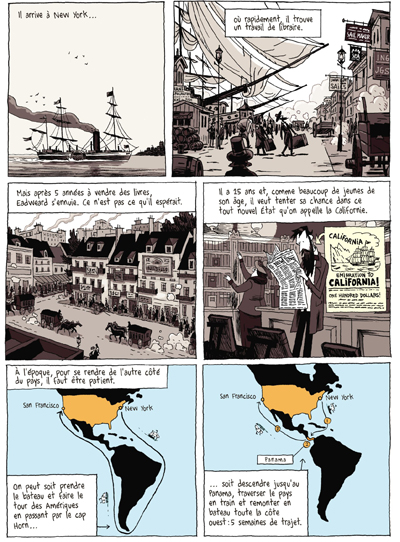
Guy Delisle clearly hits the nail on the head with his new graphic novel “Pour une fraction de seconde – La vie mouvementée d’Eadweard Muybridge”. The book introduces us to a colorful character, famous for having advanced photography by leaps and bounds through the study of animal movement. These innovations consequently led to the development of cinema.

Guy Delisle’s drawings and script work perfectly. This time, the teaching of the story clearly takes over, but without ever boring the reader – on the contrary. A subject that could have turned out to be dry becomes fun and full of surprises. This book is a little more serious than the author’s usual offerings, but in a relaxed, well-presented form.

When someone stands out in an astonishing way in a field, we often hear the expression: “He was born to do that”. This is certainly not the case with Muybridge. And yet, he succeeds where many fail or lack the tenacity and character to face adversity.

Before achieving fame for his success in photography, the main character took many paths, some of them seemingly contradictory. He started out as a bookseller and became entrepreneur, genius inventor, assassin, businessman, writer and lecturer. He traveled extensively to further his projects. That took him to England, the United States, France, Germany and Italy.

A page from Guy Delisle's new graphic novel "Pour une fraction de seconde"
A page from Guy Delisle’s new graphic novel “Pour une fraction de seconde”

As a result of Guy Delisle’s reputation as a cartoonist in Quebec and France, he knows he can choose any subject he is passionate about without risking to lose his public. There is undoubtedly a lot of research in his new book. In a way, he’s doing us all a favor, as we learn a bit of history while we’re entertained.

Along the way, you’ll meet the likes of Tesla, Edison and the Lumière brothers, and discover who was behind the name “Stanford” at the famous American university.

Happy reading!

Title: Pour une fraction de seconde — La vie mouvementée d’Eadweard Muybridge

Author: Guy Delisle

Publisher: © 2024 Éditions Delcourt

ISBN: 978-2-413-08585-0

Click on the link for other graphic novels and comics on my blog

Categories
Photos of Canada Photos of Quebec

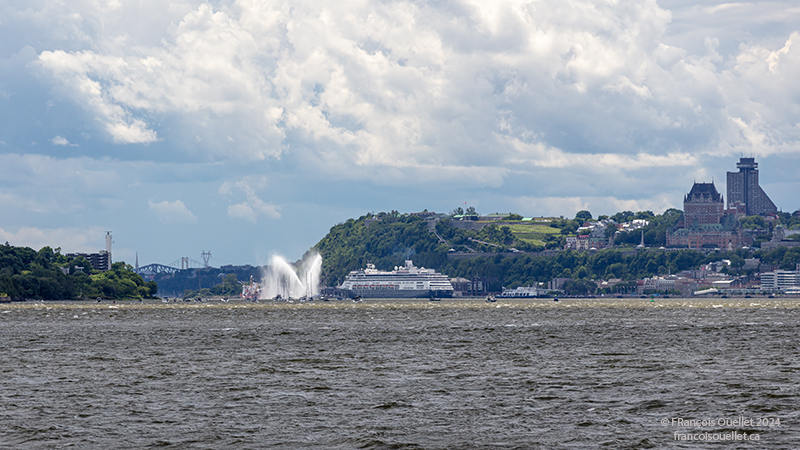
Transat Québec Saint-Malo 2024 and the sailboat La Boulangère Bio.

Transat Québec Saint-Malo 2024 and the Château Frontenac

Above, a view of Cap Diamant and the Château Frontenac as the Transat Québec Saint-Malo 2024 gets underway. You can see the water jets and the Volendam, a cruise ship anchored at the Port of Quebec.

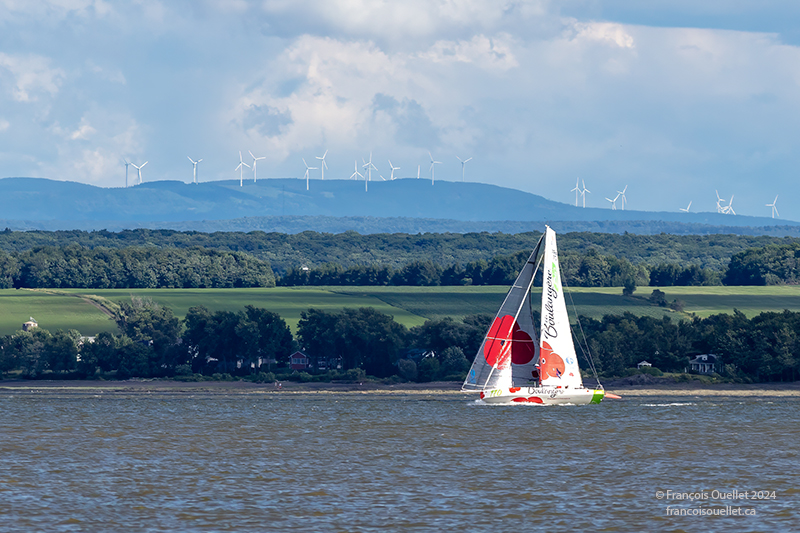
La Boulangère Bio sailboat on the St.Lawrence River during the Transat Québec St-Malo en 2024

The photo above shows the sailboat La Boulangère Bio on the St. Lawrence River off Île d’Orléans. Skipper Amélie Grassi is originally from France, more specifically La Rochelle. She achieves excellent results in most of the races she takes part in.

In the background is the 150 MW Massif du Sud wind farm, which supplies electricity to Hydro-Québec.

Click on the links for more photos of Quebec City and Île d’Orléans in Summer and for photos of the province of Quebec on my blog.

Categories
Photos of Canada Photos of Quebec

Transat Quebec Saint-Malo 2024 and the Atlas Ocean Racing yacht.

The Atlas Ocean Racing sailboat during the Transat Québec St-Malo 2024

This photo shows the Atlas Ocean Racing sailboat during the Transat Quebec Saint-Malo as it passes near Île d’Orléans near Quebec City. Skipper Gilles Barbot is a French Canadian of Breton origin who now lives in Montreal. All crew members are Canadian, from the province of Quebec.

The Transat Québec Saint-Malo 2024 observed from Île d'Orléans.
The Transat Québec Saint-Malo 2024 observed from Île d’Orléans.

Curious onlookers set up here and there along the south shore of Île d’Orléans to watch the sailboats that left Quebec City an hour ago.

Rotor clouds and lenticular clouds over the St.Lawrence River during the Transat Québec Saint-Malo 2024.

Off Île d’Orléans, lenticular clouds and a small rotor cloud are visible. They are formed by strong wind aloft that is crossing the mountain range north of the St. Lawrence River.

P.S. After many days of racing, the results are now known. It is the Atlas Ocean Racing‘s team that arrived first in St-Malo, France.

Click on the link for more photos of Quebec City and Île d’Orléans in Summer as well as photos of the province of Quebec on my blog.