Categories
Flight Simulation

Explore the world in flight simulation (21)

Today’s flight around the planet takes place between the virtual airports of London City (EGLC) in England and Rotterdam-The Hague (EHDR) in the Netherlands. The weather looks good, apart from a few large TCUs here and there along the route. The crew imports the Simbrief flight plan into Navigraph to facilitate navigation between the two countries.

Daher TBM930 airborne from the London City virtual airport (EGLC) in United Kingdom

For a fast and comfortable journey, we choose the high-performance Daher TBM930 in Canadian colors. Microsoft has truly designed a marvel of a virtual aircraft.

Virtual TBM930 over United Kingdom heading to the Rotterdam airport (EHDR), Netherlands

The operating ceiling is 31,000 feet and the maximum range of the TBM930 is around 1,730 nm. With a cruising speed of 330 knots, we cross the English Channel in no time. As you would expect, there is a lot of shipping traffic between the North Sea and the English Channel.

TBM930 turboprop aircraft over water and approaching Netherlands

We are now above the Netherlands. The programmed route reads as follows: EGLC runway 09 DEP ODUK1H ODUKU M84 TOVGU M84 CLN P44 RATLO M197 REDFA MASOS. We have selected the REDF3R arrival and the RNAV runway 24 approach.

Working Title Simulations Daher TBM930 over Netherlands approaching the Rotterdam virtual airport (EHDR) with Microsoft Flight Simulator

Below, the cockpit photo shows the interior of the TBM930 and the route followed for the approach. We are descending rapidly to reach the recommended altitude of 2,000 feet a little further on for arrival.

Cockpit of the Daher TBM930 as it approaches runway 24 for the Rotterdam (EHDR) in flight simulation MSFS

There are strong winds today and mechanical turbulence throughout the journey to Rotterdam.

TBM930 approaching rwy 24 for the Rotterdam virtual airport (EHDR) with Microsoft Flight Simulator MSFS

The autopilot keeps the single-engine turboprop slightly to the right of the centerline of runway 24 during the long final approach to counter strong crosswinds. The VNAV function does a very good job of maintaining the correct altitude during descent.

MSFS Daher TBM930 on final for rwy 24 Rotterdam airport in flight simulation

During the short final approach, we disconnect the autopilot. Surface winds are blowing at 320/14 knots. Moments later, we land the virtual aircraft without breaking anything. A short taxi brings us to a parking spot where staff are waiting for us.

Canadian Daher TBM930 arriving at the virtual Rotterdam The Hague airport (EHDR) with Microsoft Flight Simulator

Flying virtually with the TBM930 is a treat. It is one of the best virtual aircraft currently available on the market for use with the Microsoft Flight Simulator (MSFS) flight simulator. What’s more, virtual pilots don’t have to pay extra for this aircraft, as it comes with the MSFS software.

The next leg of this simulated flight around the world takes place between Rotterdam and Paris-Le Bourget Airport (LFPB) in France. Customers have chartered an old MD-11 in KLM colors for a historic flight to the Air and Space Museum in Le Bourget.

Click on the link for the previous stages of this flight simulation tour of the planet in my blog.
Categories
Flight Simulation

Explore the planet in flight simulation (15)

Through the videos on Youtube, I see that a runway called Out Skerries (EG78 or OUK) in the Shetland Islands attracts interest for its challenging landing. It is only 1195 feet long.

The tiny airstrip will therefore be the destination for leg #15 of our round-the-world flight simulation tour with the MSFS flight simulator.

To increase the fun, we choose a twin-engine aircraft, which is heavier and requires a longer breaking distance.

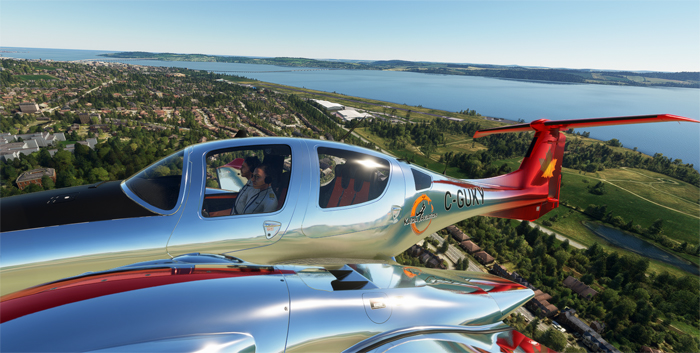
We take off from Dundee (EGPN) with a virtual Diamond DA-62 and arrive at dusk. It’s probably a bit tight for a short, unlit runway, but we’ll give it a go.

DA-62 aircraft taking off from Dundee airport, Scotland, with Microsoft Flight Simulator

The stall speed of the DA-62 in landing configuration is 68 knots, which will help us to succeed in our undertaking. We take a 018-degree northerly course to reach the islands from Dundee. Ground speed is around 155 knots for this 250 nautical mile journey.

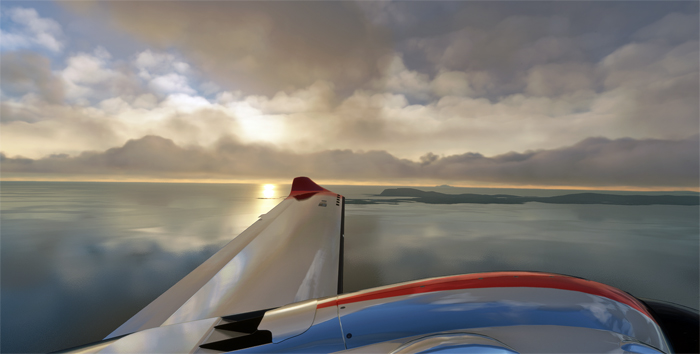
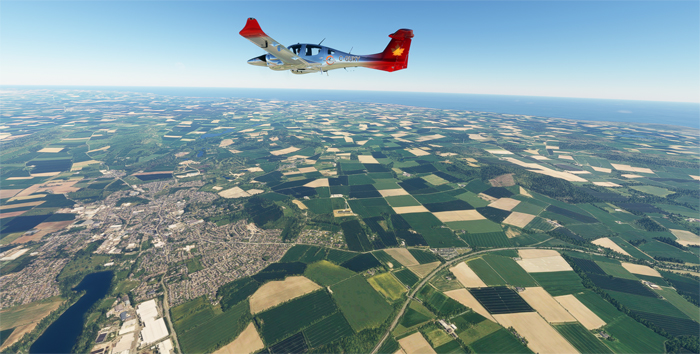
Virtual DA-62 over Scotland enroute to the Shetland Islands
DA-62 aircraft near Fair Isle in the Shetland Islands with Microsoft Flight Simulator

We have to fly off Fair Isle on the way to our destination. I learn from some research that Fair Isle knitwear remains one of Shetland’s most famous products. I imagine that fish products are also very popular.

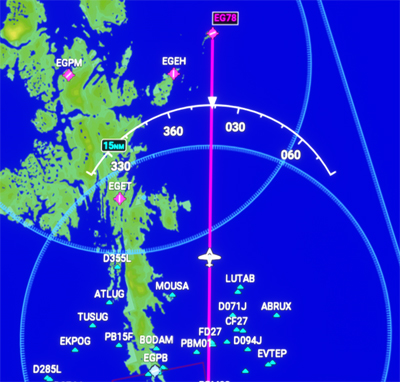
Flight trajectory towards Out Skerries (EG78) on the Shetland Islands, Scotland
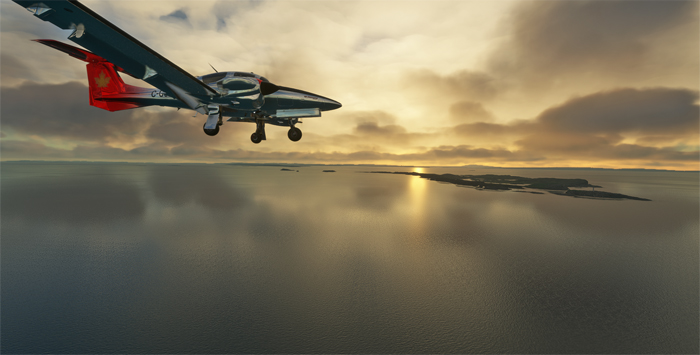
Approaching Out Skerries (EG78) airport in Scotland with the DA62 virtual aircraft

Here we are, approaching Out Skerries. The absence of runway lights makes the operation tricky.

The surrounding hills block the pilot’s view at low altitude, and what is considered a landing strip is not visible until fairly late in the approach. There are no other aids to help locate the facilities.  

The omnipresent winds complicate the task, as does the turn on approach. One of the runway thresholds ends in a cliff ready to receive ill-prepared aviators.

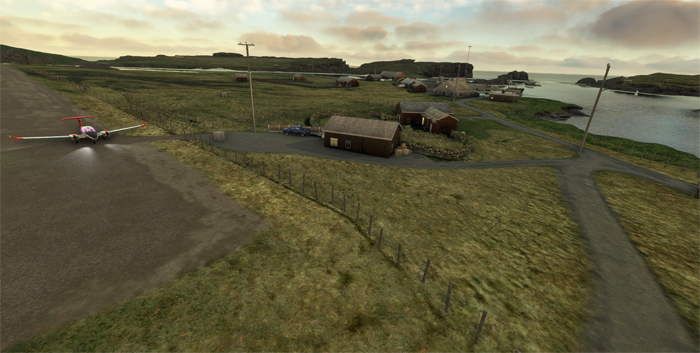
After landing at Out Skerries airport (EG78) with Microsoft Flight Simulator

We see the runway threshold at the last moment. Since the DA-62 weighs more than a single-engine model, the aircraft requires a longer braking distance.

Ground contact is harder than usual, but without bouncing. If there’s a bounce, the pilot has to climb back up and repeat the approach.

You really have to glue the aircraft to the ground at the runway threshold, immediately raise the flaps while pulling back on the stick to maximize braking efficiency. In real life, we’d add that braking must be performed without locking the wheels.

I classify this exercise as a challenging virtual flight.

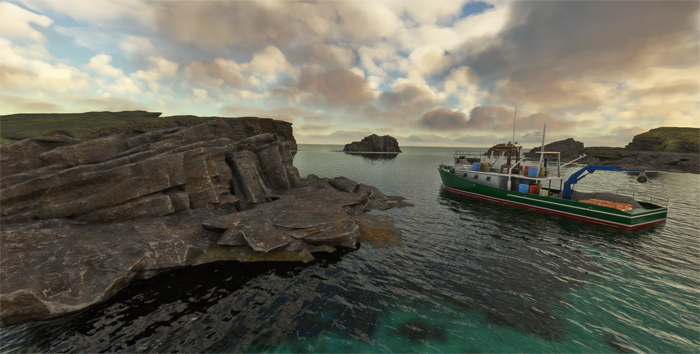
Fishing boat around the Shetland Islands with Microsoft Flight Simulator

Once the flight is over, the crew visits the surroundings. Many fishing boats come and go around the islands.

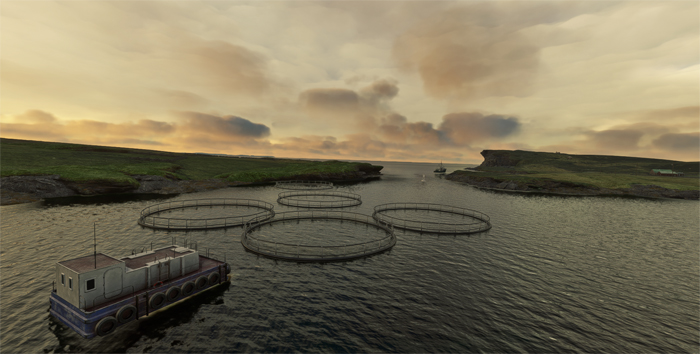
Mussel farming around the Shetland islands in Scotland, with Microsoft Flight Simulator.

We can even see mussel farming facilities.

On our next flight, we head for Barra Airfield (EGPR). It’s located in Scotland’s Outer Hebrides and is the only airport in the world “where scheduled services land on a beach”. We’ll be sure to check the tide before take-off…

Click on the link for more stages of this flight simulation world tour on my blog.