Categories
Photos of Canada Photos of Quebec

A quick outing in foggy weather in Quebec City

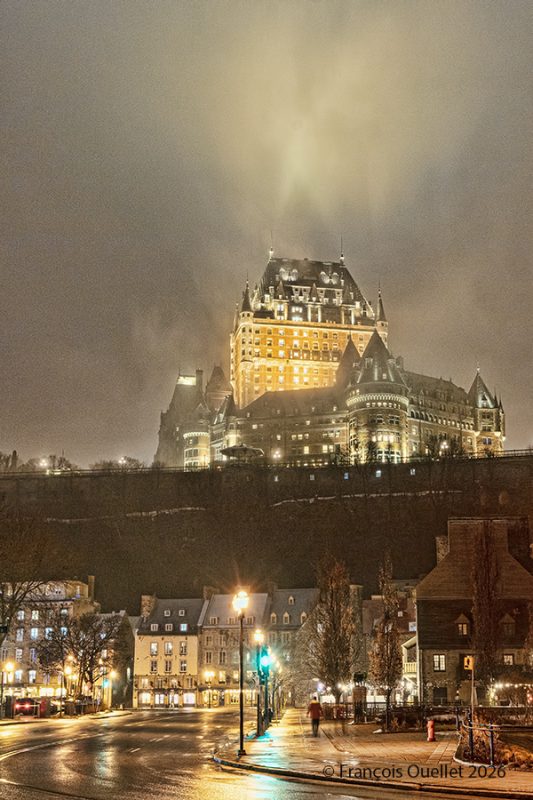
The Château Frontenac in the evening with low clouds during Spring 2026

In Quebec City, we had several consecutive days of rain in April while there was still snow on the ground. The warm rain melts the snow quickly, saturating the air with moisture and leading to fog and low-hanging clouds. Night photography enthusiasts know that this is an opportunity not to be missed for capturing special effects.

In the photo above, you can see low-hanging clouds above the Château Frontenac in Old Quebec. Fortunately, the central tower remains clearly visible. This is the perfect moment to capture the light reflecting off the clouds and onto the street.

Photographic Composition

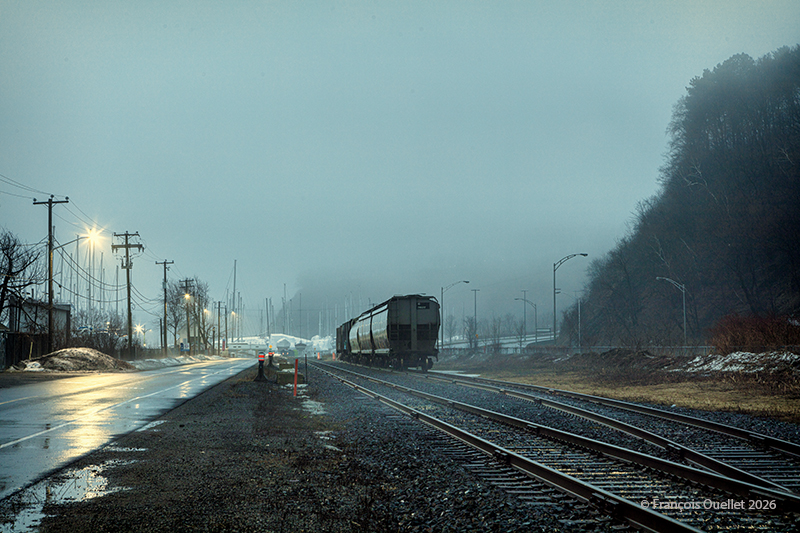
Train in foggy weather in Quebec City during Spring 2026.

Tonight, the wind is blowing less strongly near Gilmour Hill than in the Port of Québec. A persistent fog covers this section of Champlain Boulevard.

For the composition, I use the stationary railcar as the focal point between the lit road on the left and the headland on the right. It serves as a link for an imaginary diagonal line that cuts the image in half, running from the lower left corner to the upper right corner of the frame.

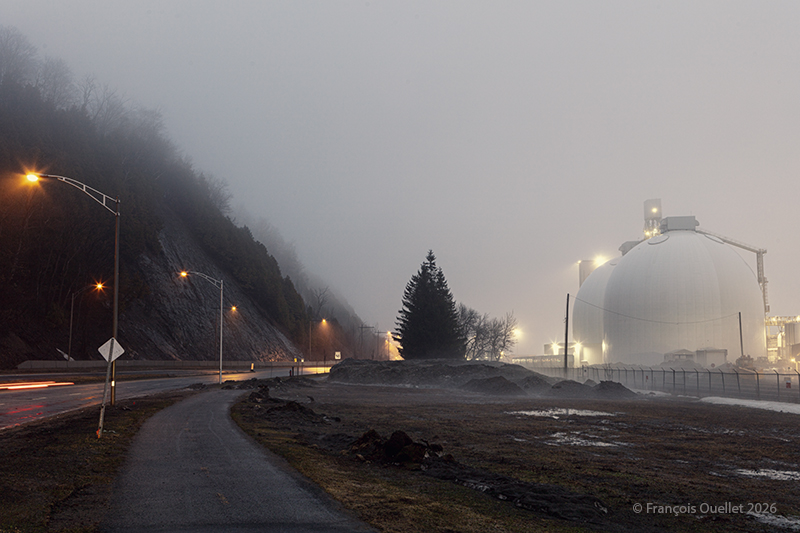
The Boulevard Champlain in Quebec City in fog, April 2026

The fog softens and unifies the elements of the scene above. The photographic composition takes into account the path that guides the eye toward the center of the photo. There, a strategically placed fir tree prevents the gaze from wandering off toward the horizon. On either side of the image are two contrasting elements, differing in height, color, and state (nature vs. industry).

Click the link for more photos of Quebec City on my blog.
Categories
Photos of Quebec

A beautiful trip to Lac-Saint-Jean and Alma.

After visiting the La Malbaie region, the Saguenay Fjord, Bagotville, and La Baie, all of which were featured in my previous blog post, we continue our journey to Saint-Gédéon, along the Lac-Saint-Jean, Alma,  and then back to La Baie at nightfall.

Lac-Saint-Jean, September 2025

Lac-Saint-Jean has a circumference of 263 kilometers and covers an area of 1,003 square kilometers. When we were there, the wind was blowing moderately, and it’s easy to imagine the swells that boaters must face in the middle of this immense expanse of water. Some sources cite waves up to 4 meters high during extreme weather conditions.

Hay bales near St-Gédéon, Lac Saint-Jean 2025

In September, farmers store hay bales. Around 6 p.m. in the Saint-Gédéon region near Lac-Saint-Jean, the sun hits the field from the side, beautifully illuminating the hay still outside. An excellent opportunity for landscape photography.

Just before nightfall and our departure for Alma, we take a few shots of the wind turbines near the lake. The photographic composition requires a vertical frame.

Wind turbines at dusk in Lac-Saint-Jean, Quebec 2025

On the way to Alma, we stop at Boulangerie Fromagerie Médard, a must-visit spot, to treat ourselves!

In Alma, we take the opportunity to eat at the restaurant owned by Mario Tremblay, a star hockey player for the Montreal Canadiens who is now retired. It was well worth the stop! I took a photo of the restaurant entrance where you can see the hockey player in action!

Entrance to Mario Tremblay's restaurant in Alma
Entrance to Mario Tremblay’s restaurant in Alma

The journey continues in the next article, where we stop in Tadoussac for a whale watching cruise.

Click on the link for more photos of Quebec on my blog.

Categories
Aviation photography

Aviation photography: PAL Airlines Dash 8-400 in Quebec City.

The Dash 8-400 is also known as the DH8D or Q400 (Q standing for “quiet”). It is pictured here at the threshold of Runway 29 at Quebec City’s Jean Lesage International Airport. It is awaiting takeoff clearance.

PAL Airlines DH8D aircraft and Pascan Saab-340B at the Québec Jean-Lesage international airport.

Photography technique

I focus on the back of the aircraft. The limited depth of field blurs the rest of the image. The shutter speed is between 1/80 and 1/125, so as not to freeze the propellers. The result is a more dynamic photo.

With the plane’s back to the camera, interest is limited unless something special is happening. The frequency scanner indicates that a Pascan Saab-340 (SF32) will shortly be taking off from runway 24. With a bit of luck, I’ll be able to capture it and include it in the shot of the Q400.

A few seconds later, the aircraft enters the lens’ field of vision. The idea is to capture it while it’s still vis-a-vis the gasoline fumes from the engines. I took a few photos and kept the one with the best photographic composition.

Below is a photo of an Air Canada Rouge aircraft taking off from 24 after a heavy downpour.

An Air Canada Rouge Airbus jet takes-off from a wet runway at the Québec Jean-Lesage international airport.

This time, there’s no question of limiting the shutter speed to 1/125. The plane has no propellers, so you can choose 1/1000 without making a mistake. For greater dynamism, wait until the nose of the plane starts to lift. You can also keep a long trail of water splashes.

Finally, it’s often best to show a bit of landscape in the foreground to better situate the aircraft in its environment.

Click on the link for more aircraft photos on my blog. There are also photo galleries in the menu.

Categories
Photos du Québec Photos of Canada

Reflections on Saint-Louis Street in Quebec City in winter.

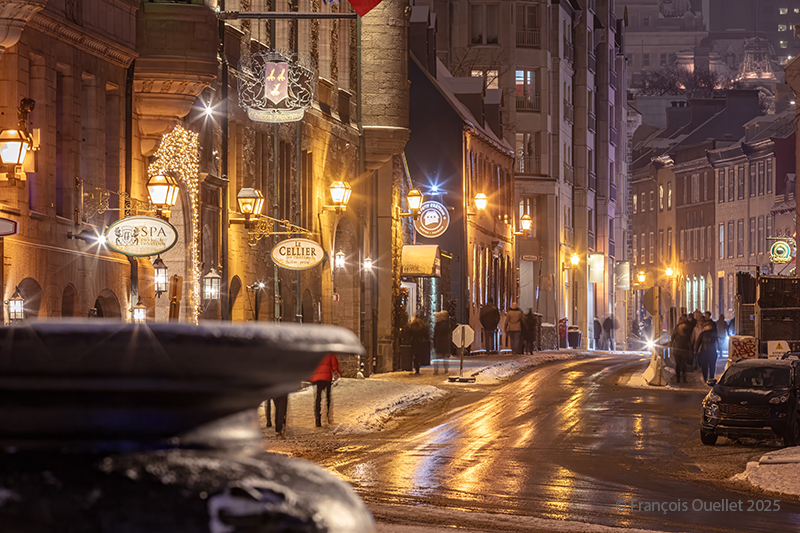
Beautiful Old Quebec night reflections on Saint-Louis Street. Photo by François Ouellet, 2025.

Another perfect evening to photograph Old Quebec in winter! I consider myself very lucky to have daily access to this magical place. It is as you know a UNESCO jewel and one of Canada’s major tourist attractions.

Photography theory and technique

It’s all there: calm winds, light snow, acceptable temperature, low cloud ceiling. Here is a great opportunity to improve one’s photography technique. What’s more, Quebec City finds itself between two busy tourist periods. This means fewer blurred people during night photography.

The snow melts immediately upon reaching Saint-Louis Street. It creates multiple reflections, ideal for special effects.

The quality of the lighting is superb, even in the middle of the nighttime. The city’s glow mirrors off cloud bases and precipitation. This in turn illuminates the old buildings.

Now it’s a question of locating an unusual angle to capture rue Saint-Louis. I’m trying to avoid the over-rehearsed postcard frame!

The viewer’s eye must remain focused on the street and the architecture. It must travel towards the background to discover a section of the National Assembly structures in the distance. The photographic composition is easily achieved.

In order to reach the objective, the viewer’s attention must be captured. A nice object can serve as foreground. It can also remain partially hidden. The vase installed on the Monument Samuel-de-Champlain will be good enough. We’re not really interested in it, but it serves as an entrance to the scene.

Those are simple but efficient photographic tips for winter photography in Old Quebec!

Click on the link for more winter photos of Quebec City and Île d’Orléans on my blog.

Categories
Photos du Québec

Photo of Quebec City and Château Frontenac by night.

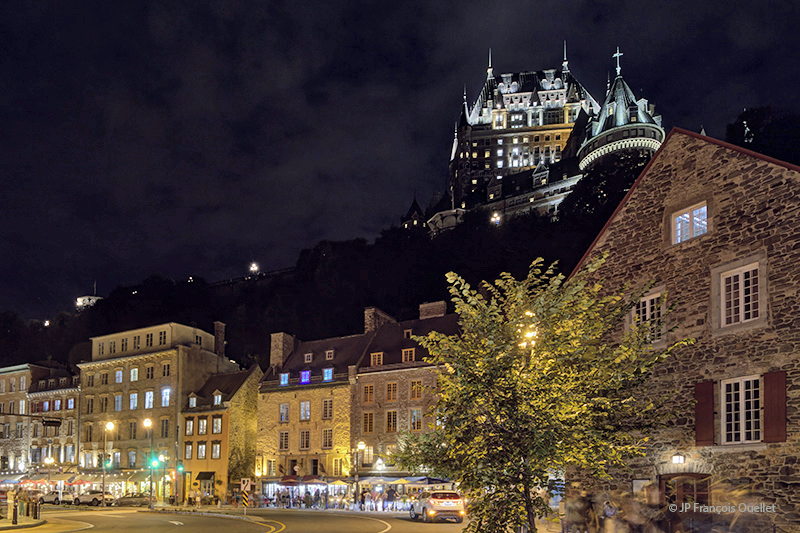
Scène de Québec et du Château Frontenac la nuit. Photo par François Ouellet

Photographing a tourist attraction like the Château Frontenac at night, with all its lights, is a good challenge for both the Canon 5 DSr camera and the photographer. Here are a few photographic tips to help you repeat the experience:

1) For a special effect, you might as well go all out and capture the château, including all the lights in the buildings near the Petit-Champlain district.

2) Photographic composition is based on the rule of thirds. You don’t always have to respect the fundamental theory, but this time it works well.

3) The viewer first notices the brightest structures, all of which have a similar luminosity. He then detects the castle on the cape.

4) The contrast is deliberate. The castle is not depicted in all its architectural splendour, but as a few lines lit up in the night.

5) The observer no longer needs to see all the forms of the castle to recognize it. It’s the most photographed castle in the world. The brain quickly analyzes the visible shapes and completes the building in a fraction of a second.

6) Being photographed from this angle and in this light gives a more mysterious aspect to this hotel overlooking the smaller buildings.

7) HDR photography solves some of the lighting problems. I superimposed five photos to obtain the final result.

Click on the link for more autumn photos of Quebec City and Île d’Orléans on my blog.

Categories
Photos of Quebec

Buildings and streets of Old Quebec 2024.

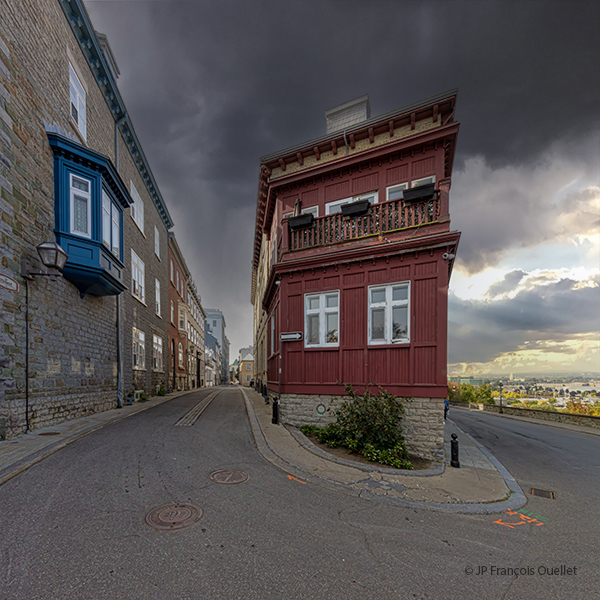
Streets and buildings of Old Quebec. Picture by François Ouellet

Here’s a scene from Quebec City, specifically Old Quebec, captured in autumn. I rarely use the square format to present a photo, but this time it suited the photographic composition perfectly. Digital processing enhanced the effect of the clouds and lessened the impact of the setting sun in the west.

Click on the link for more autumn photos of Quebec City and Île d’Orléans on my blog.

Categories
Photos of Canada Photos of Quebec

Old Quebec in photos (2)

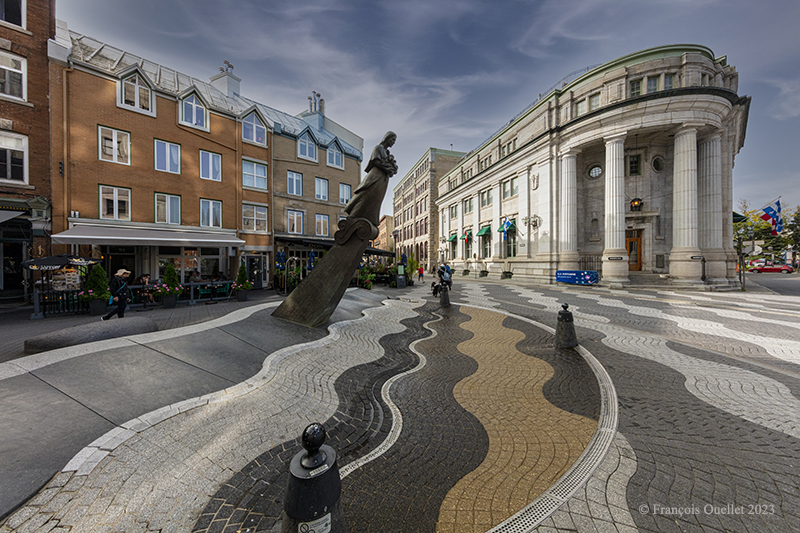
Old Quebec heading to St-Paul street.

Old meets new in this photo of Old Quebec. On the right, the headquarters of the Norplex group, real estate developer. This is the former Canadian Bank of Commerce building, designed in 1914 by architect V. D. Horsburgh. The rounded shape is reminiscent of the Bank of England’s Tivoli.

In the foreground, the sculpture-fountain La Vivrière, a more modern creation inaugurated in 1995 on Place de la FAO to mark the fiftieth anniversary of the founding of the FAO in Quebec City in 1945, under the aegis of Lester B. Pearson.

In terms of photographic composition, the sculpted waves in the foreground gradually direct the viewer’s eye towards the main building at the top right of the photo. The rounded columns are only straight thanks to the use of Canon’s ultra-wide-angle EF 11-24mm F/4L lens.

Quiet evening in Old Quebec during Summer 2024

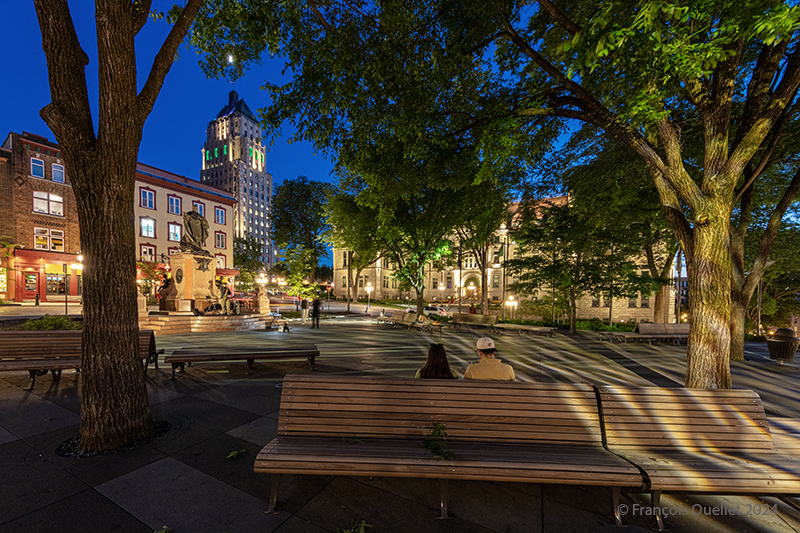
Above, a view of the newly restored Place de l’Hôtel-de-Ville. In the distance, the tower of the Price building. Rotating spotlights create moving shadows for the couple in the foreground.  

Old Quebec buildings seen from Côte de la Montagne, 2024.

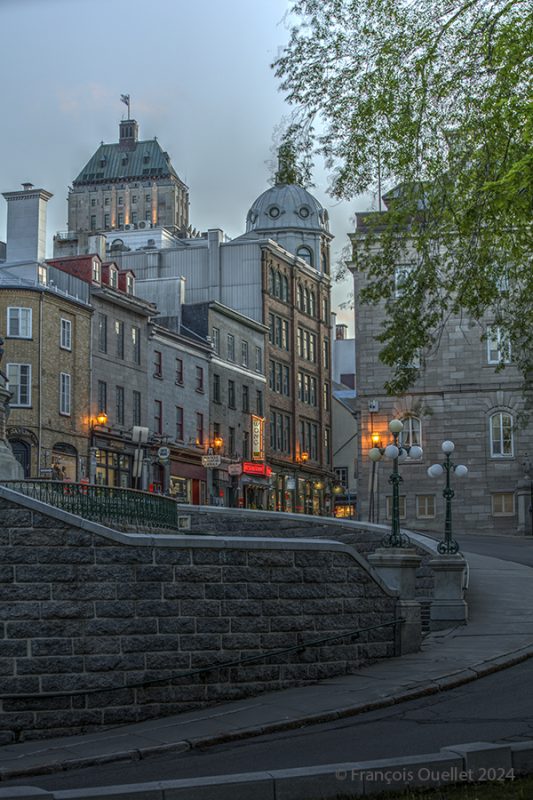
Above, a five-shot HDR photo of buildings in Old Quebec. In the foreground, a wall stands at the intersection of Port Dauphin and Côte-de-la-Montagne streets. In the middle ground, we see the shops and buildings on rue De Buade. In the background, the Price Building, the only skyscraper permitted in Old Quebec.

Click on the link for more photos of Quebec City and Île d’Orléans in summer on my blog.

Categories
Photos of Canada Photos of Quebec

The “rue du Trésor” in Old Quebec.

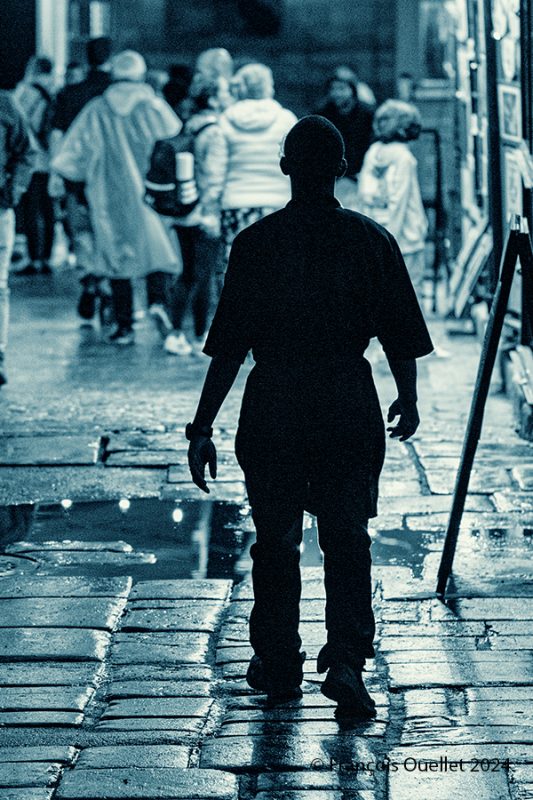
Being watched in rue du Trésor, Old Quebec 2024

On an evening when isolated showers were continually changing the atmosphere in Quebec City, I visited the old part of the town, especially “rue du Trésor”. Today’s article features four photos of the same street captured from different angles. About three hours separates the shots.

Above, passers-by seem to be followed by an individual. I’ve maximized the effect of tension by taking advantage of a moment when the tourists in the background are in the light and the lone walker remains in shadow. To accentuate the discomfort, I opted for a cold tone and undersaturation in post-processing.

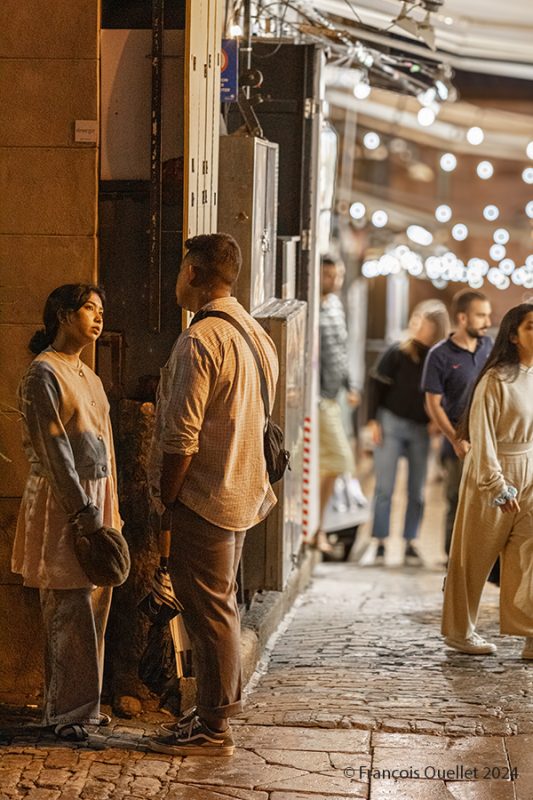
Below, two young people chat quietly at the entrance to rue du Trésor, while pedestrians go about their business. The tiles have had time to dry out a little since the last shower.

Conversation near rue du Trésor, Old Quebec 2024

The photo is legal in Quebec because it’s not just about the two persons in the foreground. There’s a street setting where other passers-by are also present. This is always a factor to consider when publishing for non-commercial use. If the couple is alone in the scene and it’s a close-up, I can capture the scene, but under Quebec law, I don’t publish. For added precaution, it is sometimes better to wait a while between the moment the photo is taken and its distribution. Finally, I make sure that people are not portrayed in such a way as to damage their reputation. So, there are always multiple factors to consider before a photo is taken and distributed.

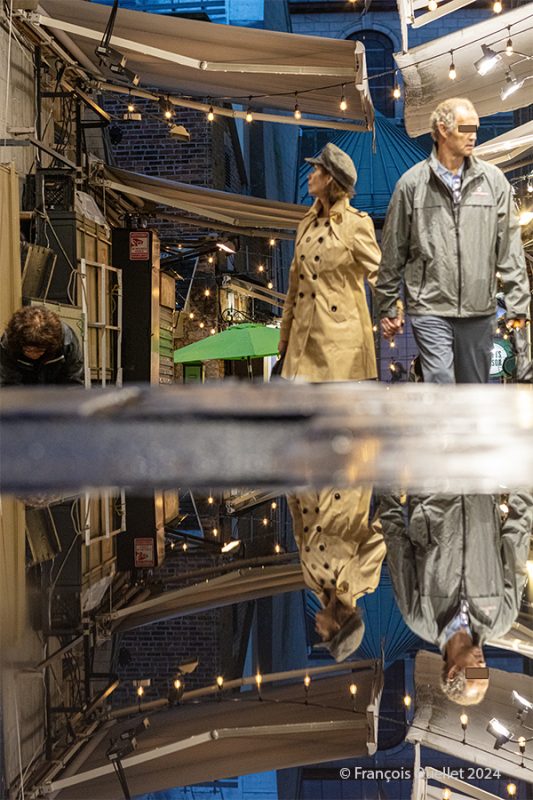
Reflections after the rain in the rue du Trésor, Old Quebec 2024

Above, a couple takes a walk immediately after a rain shower. I set up the camera a few inches off the ground, in front of a puddle to get a reflection.

The goal of the picture is the water reflection but, since I want to publish the photo, I have to think about the persons. The couple becomes possibly the main subject for some viewers. Using added precaution, I put an artificial obstacle in front of the man’s eyes to make him less recognizable. As for the woman, her head turned to one side makes identification impossible.

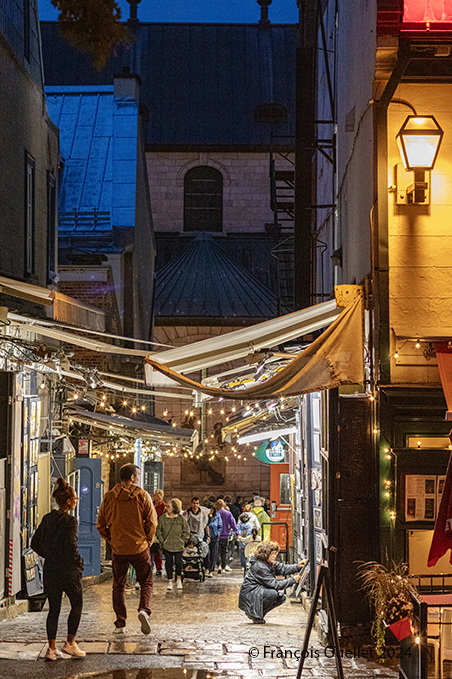
Below is a view of the Rue du Trésor during the “blue hour,” after the showers. The last tourists take the opportunity to choose a piece of art before the shopkeepers leave.

Rue du Trésor in evening in Old Quebec, 2024

Click on the link for reference books about photography in Canada and Quebec on my blog. Also use the following link for more photos of Quebec City and Île d’Orléans in summer on my blog.

Categories
Photos of Canada Photos of Quebec

The umbrellas of Old Quebec.

Series of colorful umbrellas in Old Quebec, 2024

Umbrellas cover part of Rue du Cul-de-Sac in Quebec City. Most tourists are unaware of this installation when they set foot in the Petit Champlain   area. Surprised, they whip out their cell phones and capture the moment as best they can. Since they’re just passing through, most don’t have the luxury of choosing the most appropriate light for their multiple shots.

The situation is different for someone who has easy and frequent access to the location. They can wait for the “blue hour” on a fine summer evening, and at the same time capture the golden hue of the lights in front of the many restaurants lining the alleyway.

The main challenge in taking the above shot, however, is the sharp contrasts in light.

For example, the tourists in the foreground are standing in the half-light, but the viewer still wants to see the details. Just above the people, the lighting contrasts sharply with the shaded area at the bottom of the photo. It’s hard for the camera to decide which brightness to prefer.

To top it all off, the soft blue light of late evening illuminates the umbrellas from above, while the restaurant lights illuminate the installation from below.

Image processing software is used to optimize the information contained in the RAW file of the photo, helping to highlight the different areas of brightness in the scene while avoiding areas that are too light or too dark.

Click on the link for more photos of Quebec City and Île d’Orléans in Summer on my blog.

Categories
Photos of Quebec

McWilliam Street in Old Quebec at night.

Corner of Saint-Stanilas and Saint-Jean streets in Old Québec in the evening Summer 2024.

The photo above shows an evening view of the intersection between rue Saint-Stanislas and rue Saint-Jean in Old Quebec. For several months a year, a section of rue Saint-Jean is reserved for pedestrians only. This attracts many tourists. Just behind this popular street is McWilliam Street, with a radically different feel, especially late at night.

The McWilliam street behind the Cochon Dingue restaurant in Québec City.

To produce an HDR effect of the location, I plan to stack five photos. I set up the tripod and begin the session. Just as I’m about to finish, a door suddenly opens. A man steps out and lights a cigarette.

I need to capture this very brief moment when the individual is just a stealthy shadow in motion with the intense fluorescent lighting in the background. In this rather dark alleyway, this could generate an interesting effect.

The smoker asks me what I’m doing. It’s an employee on break working for the popular Cochon Dingue restaurant on Rue St-Jean. What a contrast between the modern façade and the back of the same building on McWilliam Street.

At home, HDR processing begins. But it’s impossible to use all five shots together as planned initially. The software combines a closed and an open door at the same time. The result is a kind of butchered wicket door, with almost no light filtering through.

I abandon the idea of an HDR montage and fall back on the single photo where the man is standing in front of the door. I wasn’t counting on this presence, but it adds a touch of humanity to a scene that’s still not very inviting.

Life often presents photography enthusiasts with unexpected opportunities. It’s all about being flexible and capturing the moment, even if it’s not part of the initial planning. Click on the link for more photos of Quebec City and Île d’Orléans in Summer on my blog.