HDR picture of the Château Frontenac at Christmas 2025 from Côte de la Montagne in Quebec City.
During the holiday season, the Château Frontenac is decked out in red and green. For an interesting effect, try taking a picture of the castle’s main tower from Côte de la Montagne. To do this, you have to point the camera upward, but all the lines that are normally vertical become slanted.
Photographic Technique
To correct this effect and restore the architectural lines to near verticality, some computer work is necessary. In a few minutes, after cropping and changing the photographic plane, the photo regains the natural appearance that the eye observes when climbing Côte de la Montagne.
HDR photo of the Château Frontenac and surroundings in winter in Quebec City.
The photo above shows another beautiful view of the Château Frontenac. In the middle of the tourist season, passersby in Old Quebec are plentiful in front of the camera lens. Long exposure times mean that several “ghosts” will appear to be moving around when taking nighttime photographs.
How can you avoid these “ghosts” as much as possible? Timing is important. Once the blue hour has passed, complete darkness provides uniform lighting. This allows you to choose a moment when no one is passing by the camera when taking each shot to achieve the HDR effect. Five shots with different apertures will give you the desired HDR result. I use a tripod and a Canon EF 11-24mm f/4L USM wide-angle lens mounted on a Canon 5DSR full-frame camera.
There is only one person very close to the camera lens during the entire session. I remove her from the HDR photo. Since she was working with a tripod, she moved very little during my five shots, which allowed the correction tool in the digital processing software to teleport her to a parallel universe.
During summer 2025, several large aircraft scheduled to land at Montreal Airport had to divert to Quebec City Jean Lesage International Airport (CYQB). Numerous thunderstorms disrupted arrivals and departures at the main airports in the province of Quebec.
The extreme weather in the west gradually moved eastward. This delayed and even cancelled the departure of many planes in Quebec City.
When most of the storms finally passed over Quebec City airport in the evening, an Air Canada Boeing 777-300 ER took off from runway 24 to fly its passengers back to Montréal.
In the background, Air Transat aircraft can be observed. The Swiss Air logo can also be noticed on an Airbus A330-343. It had come from Zurich and was further diverted to Quebec City, along with an Air France Boeing 777-228 LR and a few others.
Below, we see the Boeing 777-300 ER refuelling at a time when extreme weather conditions have not yet reached the airport. Two Avjet tanker trucks are standing near the aircraft. The height of each truck is less than the internal diameter of the Boeing’s engines. For several years, this aircraft held the record for the largest engines on a civil aircraft. Now, the Boeing 777X has taken the crown.
Air Canada B777-300ER refueling at the Quebec Jean-Lesage international airport.
Photography Technique
Both photos required some compromises. Everything works if you accept being completely soaked and working with both feet in the water along a metal barrier with lightning flashing here and there. For some photos, the session lasted two hours.
I took the shots from a hole in the airport fence. My Canon EF 300 mm f/2.8L IS II USM lens was protected by a plastic bag tightly wrapped around the lens hood.
A frequency scanner provided data about air traffic. A controller informed an Air France pilot that such a situation of aircraft diversions during extreme weather had not been seen in several years.
I set my full-frame camera to produce only RAW images. Focusing was done in SERVO mode. I reduced the depth of field to optimize speed and limit the size of the photographic grain (ISO).
When selecting photos, I preferred the one showing the Boeing taking off, but where the Swiss airline’s logo is still visible. It was important to highlight the aircraft’s presence in Quebec City.
All afternoon, planes land without any significant vortices. Then a CRJ9 flies overhead, leaving two beautiful swirls behind it. I place my camera between the two bars of the airport fence along Jean Gauvin Road and take a few shots.
Photography technique
I use a Canon 5DSR full-frame camera with ISO set to 200. The autofocus is set to SERVO mode. A shutter speed of 1/1000 is sufficient to follow the jet as it flies away. Cropping will then be necessary to bring the aircraft closer and position the vortices appropriately.
It is best to keep the runway lights in the frame to add more dynamism to the scene. They help to better situate the environment in which the CRJ9 is located at the moment the vortices appear.
The day after Quebec’s national holiday, the Snowbirds make a few flybys over Quebec City. Although not an air show per se, their formation flights always dazzle the crowds.
The Quebec flag, the Price Building and the Snowbirds in flight in Quebec City
Photography technique.
As the flight over the city takes place at around 17:00, it’s a good idea to position yourself so as not to have to pose against the sun. Normally, a photographer located in Lévis captures excellent shots of Snowbirds passing by the Château Frontenac. But at 5:00 p.m. with the sun directly in front of you, all plane photos taken from the south shore mean uninteresting washed-out skies and far too strong contrasts. Snowbirds deserve better.
Considering the position of the sun, the citadel is the best location for a successful photo session. The light comes from behind as the aerobatic team flies over the St. Lawrence River, around the Château Frontenac and towards the Dufferin Terrace.
The Snowbirds are in flight formation near Château Frontenac in Quebec City.
Spectators know that the performance will only last about fifteen minutes. A photographer needs to prepare accordingly to maximize the chances of getting some memorable shots.
Photography theory
I use a Canon 70-200 mm f2.8L IS II USM lens to give me better leeway between the distant and close passages of the nine military jets. Coupled with a Canon 5 DSR full-frame camera, a quality zoom produces surprising results. You can crop at will without losing definition, provided the initial ISO is 200 and the shutter speed is fast enough. You don’t really need to go beyond 1/1000.
The Snowbirds in flight formation approach the Dufferin terrace in Quebec City.
With Canada Day a few days later, I now have an interesting photo of the Snowbirds and the Canadian flag.
Snowbirds in flight and the Canadian flag over the citadel of Quebec City.
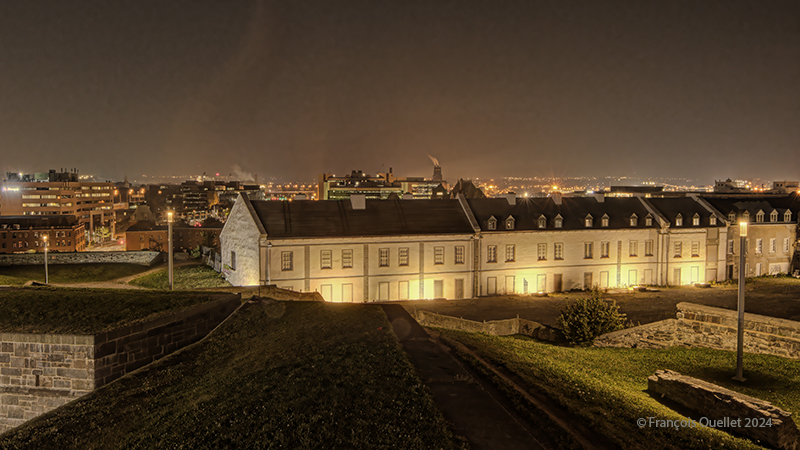
The HDR photo of the Dauphine Redoubt above comprises seven pictures with different apertures. The Photomatix software stacks them one on top of the other to create a single shot. This allows the darker regions to stand out, while controlling the lighter areas as much as possible.
For a successful effect, the following factors need to be taken into account: type of camera (ideally full frame), use of an appropriate wide-angle lens, focus, time of day, cloud types, tripod, extension cable, camera mirror vibrations, wind, visibility, photographic grain, depth of field, moving obstacles in front of the camera and photographic composition.
I use a Canon 5 DSr with a Canon EF 11–24 mm F/4L super-wide-angle lens. Focusing with the camera’s backlit screen improves accuracy. It is better to avoid nighttime and take advantage of the blue hour. The clouds don’t prevent the capture of a distant background, and allow the city lights to be reflected in the sky.
I opt for a sturdy tripod. Its extra weight cancels out minor jolts and supports fairly heavy photographic equipment. The extension cable prevents the photographer from touching the camera when taking seven photos.
For mirror-equipped cameras like the Canon 5 DSr, it is important to activate the mirror lock function. This means that vibrations caused by the mirror rotation will have two seconds to fade before the actual picture is taken. A light wind also reduces the chance of vibrations.
Moderate visibility allows better graduation of colours and reflections. Tonight, the mist plays its part well. By using a tripod, I greatly limit the photographic grain. ISO is therefore set at 200. Depth of field is not a problem, as the tripod will prevent movement caused by long exposure.
As many people visit the site in the evening, I try to take each of the seven photos between two crosswalks. This isn’t always possible, but Photomatix can remove “ghosts” when compiling the shots. There is, however, a limit to this function.
The final point concerns photographic composition. The photo above is divided into three roughly equal horizontal zones. Oblique lines on either side at the bottom of the photo direct the eye towards the centre of the image. The five lights of the Dauphine Redoubt and those of the city capture the attention. All the shots have visible details and are not lost in the darkness. For better balance, the composition ignores another imposing building at the right of the scene.
These are just some of the precautions taken when capturing the scene in HDR night photography.
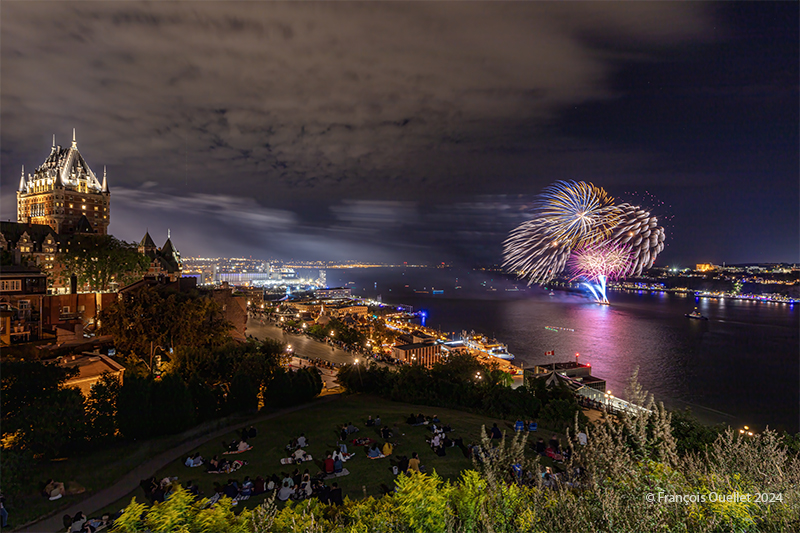
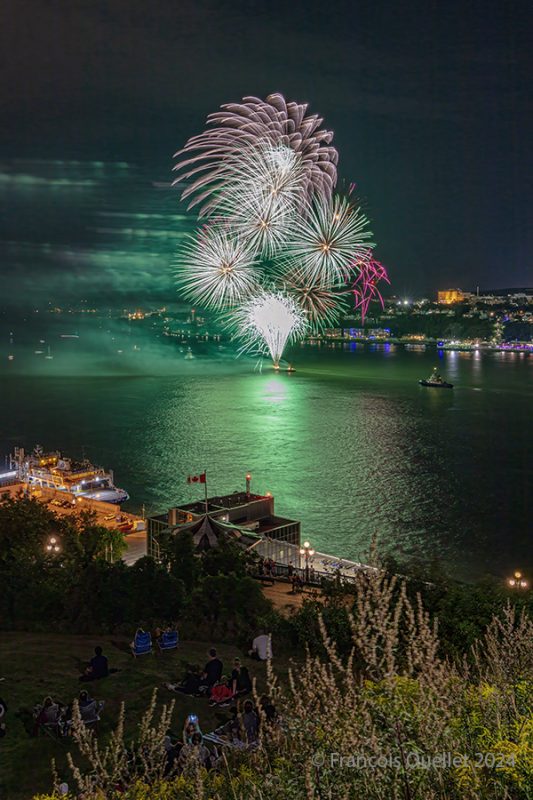
This year, the Grands Feux Loto-Québec are lit from a barge in the middle of the St. Lawrence River, between Lévis and Quebec City. A tugboat from the Ocean Group company secures the barge with a cable for the duration of the event.
I took the above shot with a Canon 5DSr full-frame camera equipped with a remote shutter release and a tripod-mounted Canon EF 11-24 mm F/4L lens. The super-wide-angle lens can capture both the Château Frontenac and the lights and city of Lévis across the river.
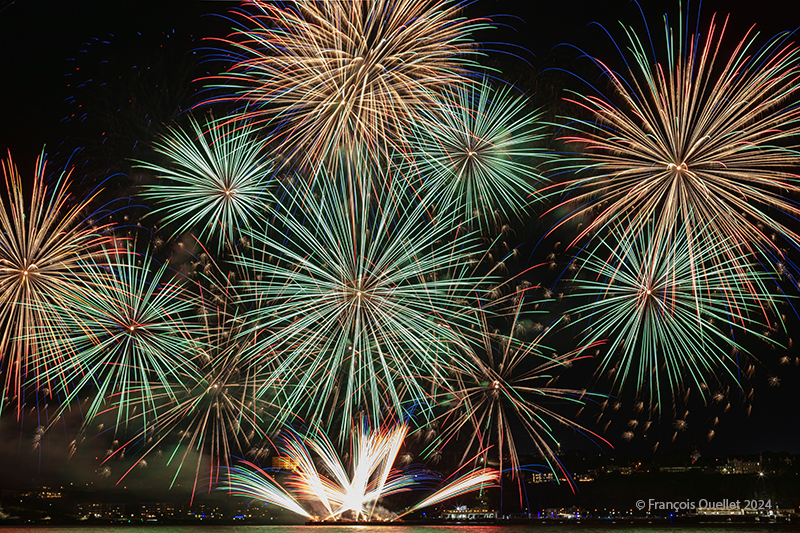
The BULB mode lets you set your own exposure time and take creative initiatives. The brilliant path from launch to explosion is captured in a single photo.
As soon as the bursts begin, you try a five-second exposure and observe the result. Then adjust by stretching the exposure time until good effects are achieved.
One mistake to avoid is leaving the shutter open for too long. When this happens, flashes of light build up on top of each other, and all you see in the final photo is blurry, glowing white.
Working with a RAW file offers much greater flexibility than with a JPEG file when processing the image on the computer.
ISO 200 seems the best option here for several reasons: even if the activity takes place in full darkness, we want to avoid significant digital noise. A low ISO will also lengthen the exposure time and allow us to capture beautiful streaks at the moment of the explosions.
What’s more, the lights will illuminate the scene, reducing exposure time to a reasonable length. Finally, a layer of altocumulus cloud above the Château Frontenac serves today as an artificial light reflector in the photo above.
Grands Feux Loto-Québec, August 2024
A depth of field between 8 and 13 ensures sufficiently accurate light at a reasonable distance.
Whether to focus manually or automatically remains a matter of taste. It should be noted that darkness can cause problems for autofocus. However, trial and error can sometimes produce interesting effects.
If you’re using manual focus, use the camera’s backlit screen to magnify the scene as much as possible and adjust the focus as required. You then return to the normal size display for the duration of the fireworks, taking care not to inadvertently touch the focus adjustment ring when changing the zoom.
Fireworks at the Grands Feux Loto-Québec 2024
Consider using a heavy tripod. In windy conditions, it will better resist vibrations during long exposures.
A final word of advice: fireworks attract a lot of people, some of whom are content with a fairly limited personal space, if they have one at all. Protecting your photographic area becomes an important objective, to avoid the tripod getting snagged or someone moving in front of you when enthusiasm takes over. So, arrive well in advance to choose the best location for you to work in, while protecting your work area.
For example, for the photos above, I had set up between a ramp fixed on a steep slope in front of me and a bush at the rear. No one could stand in front of me and no one could pass behind me because of the bush. I thus had only the sides to worry about. It sounds like an unnecessary concern, but these days everyone is filming fireworks and continually repositioning themselves without regard to their neighbors. Make life easier for yourself by making the necessary arrangements before the show.
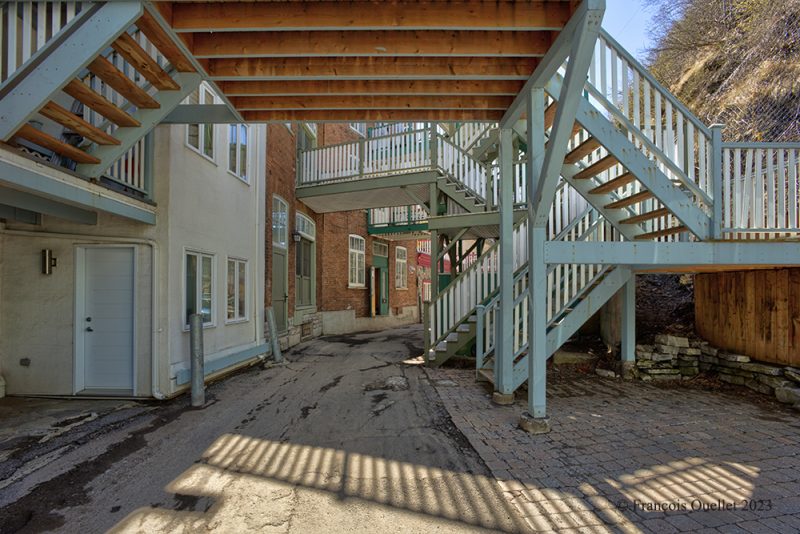
Photographers make little use of the intense midday light when it comes to achieving an interesting effect. However, as in this HDR photo of the stairs of an Old Quebec street above, bright light can be used to create shadow effects with horizontal, vertical and oblique lines.
Quebec City HDR Spring 2023
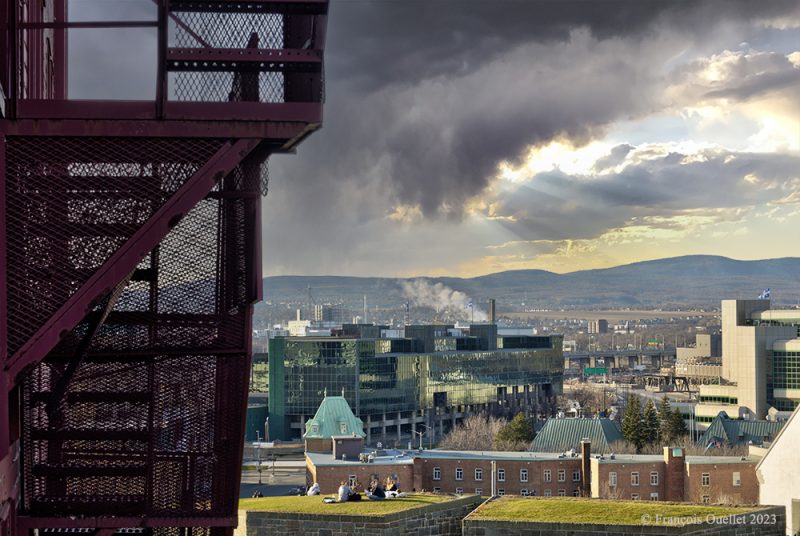
Above, another staircase with lines running in all directions. But it plays only a partial role in this HDR photo, the rest being taken up by the scene in the distance. I was looking for a double effect of chiaroscuro and atmosphere. The foreground, dark and cold, contrasts with a brighter background with an uncertain sky. On the right-hand side of the photo, the tension eases and the blue sky and sun appear.
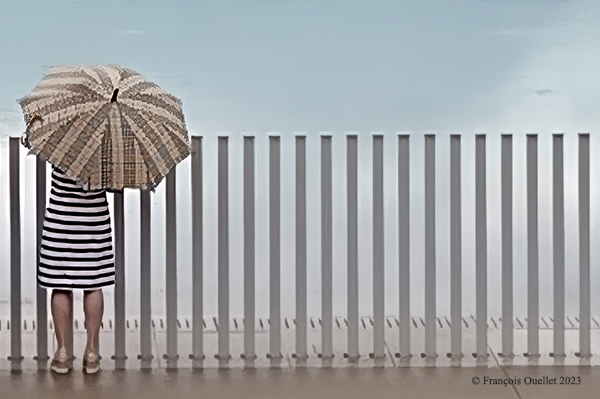
Street photography at the “station de la Plage” 2023
This image is what is known as “street photography“. Chance has placed this person in the right place with the right dress and the right umbrella. She is wearing a horizontally lined dress and holding an obliquely lined umbrella in front of the vertically lined fence of the “station de la Plage” in Quebec City. The gray sky avoids distractions and focuses attention on the main subject.
For this last photo, I didn’t have my full-frame camera, but a cell phone. The file was of inferior quality, so I had to improve the focus using photographic software with artificial intelligence capability.
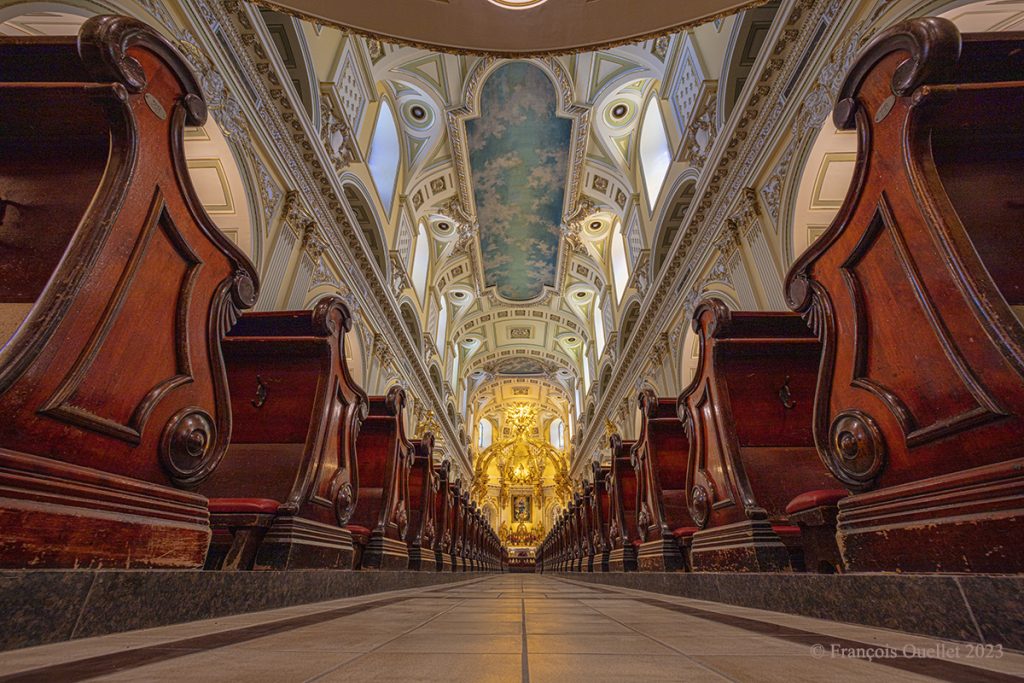
The visit being improvised, I did not have a tripod. So, I put the full frame cameraCanon 5DSr directly on the ground. However, the lens was pointing straight ahead, preventing me from capturing the architecture and colors of the vault. I put my wallet and the lens cap on the floor to provide support for the camera to point towards the ceiling. Considering the circumstances, the result could have been worse.
Two months earlier, this 2007 Canon 14mm lens broke and could not focus automatically or manually anymore. I had sent it to Canon in Toronto. The company had written back that the lens was beyond repair and that I would unfortunately have to get a new one, at an estimated cost of $2700.
With nothing left to lose, I took the chance to have it repaired in Quebec City in a small workshop that repairs just about everything. The technician only needed a few hours of work on the lens and I received a bill for $200 plus taxes.
It was explained to me that the big camera companies do not repair equipment that is fifteen years old or more: they declare it “irreparable” when a few hours are all it takes for an experienced and competent technician to do the job.
The breakdown came just in time as the technician retired within a few weeks…
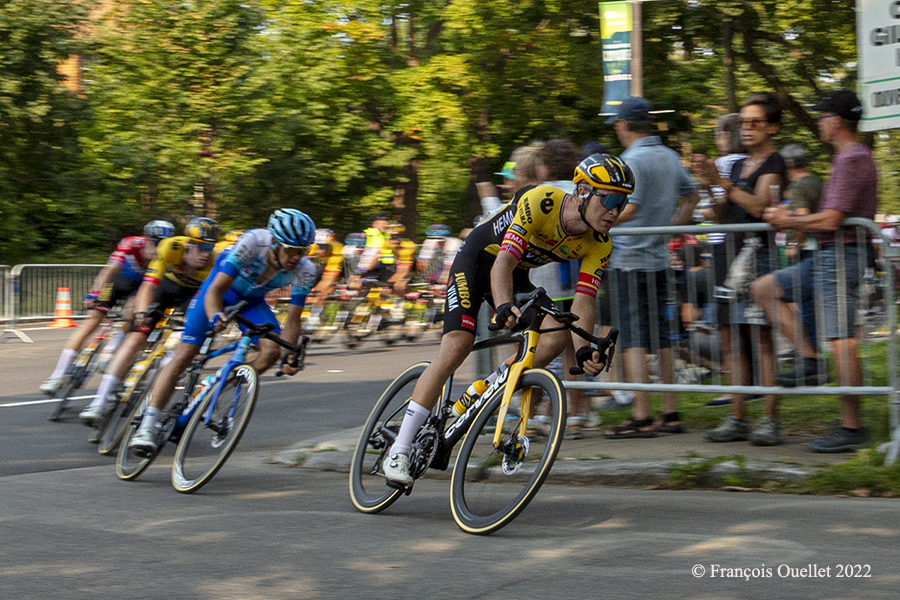
Cyclists turning for côte Gilmour in Quebec City in 2022
An interesting vantage point to photograph the Grand Prix Cycliste de Québec is at the intersection of Grande-Allée and the avenue leading to the famous Gilmour hill. The cyclists are riding at high speed and must brake hard before making a sharp left turn to begin the descent to the portion that will take them along the St. Lawrence River. There are no obstructions for the photographer at this point.
2022 Quebec City Grand Prix Cycliste
To capture the effect of the cyclists’ movement, the shutter speed must not be set too fast, preferably between 1/125 and 1/160. Otherwise, everything looks immobile, even the wheel spokes.
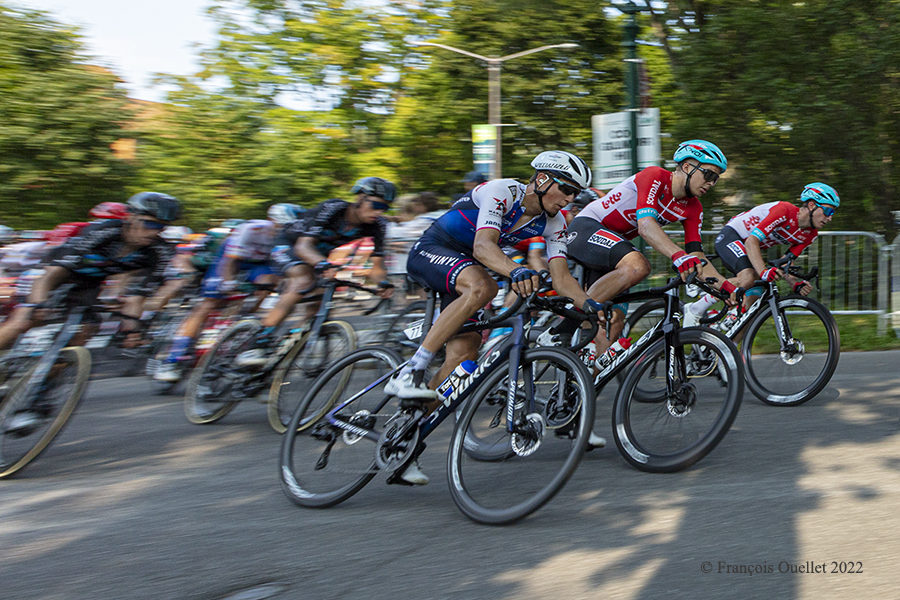
Quebec City Grand Prix Cycliste in 2022
Positioning yourself immediately after the curve allows you to capture a long line of bicycles. You can focus on the cyclists on the right in the viewfinder and leave the line of cyclists around the curve out of focus. To do this, make sure that the chosen aperture will blur the background. It is also important to follow the movement of the cyclists with the camera. If you stand still, all the riders will be out of focus, as the shutter speed is too slow for the high speed of these riders.
Cyclists racing on Grande-Allée in Quebec City 2022
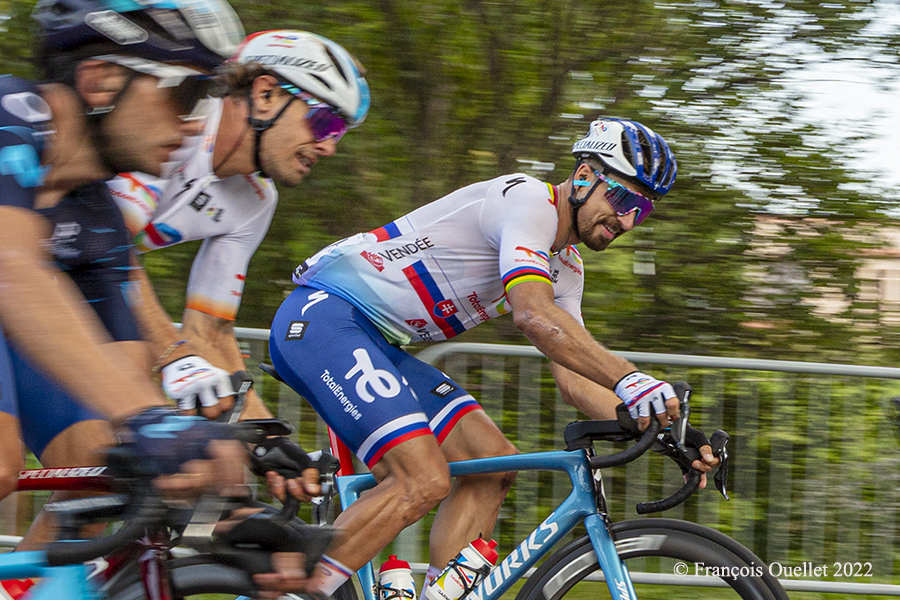
An occasional close-up obtained through cropping allows us to see details that we would otherwise miss. In the case of the photo above, it is clear that not only is the rider in the front relaxed, but he has also recently crashed, with his right arm still in recovery. Sometimes we also see the result of deformities in the knees of cyclists following numerous surgeries.
Quebec City Grand Prix Cycliste 2022
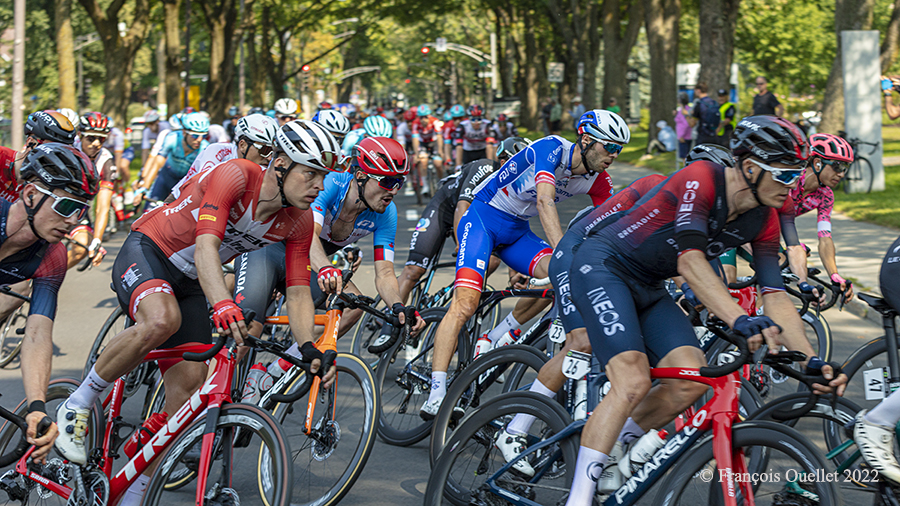
The cyclists want to maintain their position in this tightly packed group that must maneuver in a small space. With a telephoto lens, one can see the facial expressions change as they approach the turn for the Gilmour hill. Note the concentration on the faces of the cyclists in the foreground…
Grand Prix Cycliste in Quebec City in 2022
Following moving cyclists with a camera remains a difficult art to master. Several pictures are taken before a successful one is achieved. Fortunately, film photography is behind us and we don’t worry as much about missed shots. The important thing is to have fun and try to get a little better with each photo session!
Motorcycle policemen lead the convoy bringing the Pope to Old Quebec in 2022.
If you don’t have privileged access, the main difficulty in photographing the arrival of Pope Francis in Old Quebec in 2022 lies in the vague and sometimes contradictory information offered to journalists in an obvious effort to protect the itinerary of the head of state.
You also have to deal with the strong police presence and the barriers that open and close according to the mood of the moment, blocking bicycles and pedestrians long before the Pope has crossed the Saint-Louis gate. As a photographer, you don’t want to find yourself suddenly stuck in a place of no interest.
Other aspects to consider are purely photographic, such as the ambient light and the distance from the subject at the time of the photo, which will influence the choice of equipment carried.
The official convoy arrives on Saint-Louis Street. It is important to know that in the afternoon, the sun crosses directly the axis of the Saint-Louis Street in its slow descent towards the west. If you position yourself along this street to take the picture, there is no physical obstacle, but you photograph against the light a convoy which passes at full speed. The camera sensor does not appreciate backlighting, because it has difficulty evaluating which light takes precedence. The choice of a straight line on Saint-Louis Street is therefore not very interesting.
The crowd greets Pope Francis on his arrival in Old Quebec in 2022.
The Pope’s driver sits on the left (at least in Canada). The Pope will therefore be on the right, whether forward or backward. If one stands in the Place d’Armes, one gives priority to the driver rather than to the Pontiff.
As the sun travels progressively from the axis of St. Louis Street to the west, the tall trees of the Place d’Armes will create a natural veil blocking the effects of backlighting. This will increase the chances of successful photos.
On St. Louis Street, the convoy is moving quickly in a long straight line. The chances of getting a good picture decrease. When the security cars reach the end of Saint-Louis, they have to brake because of a sharp curve near the Château Frontenac. If you position yourself immediately after the curve, the chances of getting an acceptable picture increase greatly.
As for photographic equipment, a camera lens that requires little light will help optimize shutter speed and depth of field, especially in the late afternoon. The Canon EF 85mm f/1.2L II USM lens offers more flexibility.
A camera with a full-frame sensor will also allow the cropping necessary to magnify the photo without loss of quality. For the photos included in this article, the camera used was a Canon 5DSR.
The riskiest technique which therefore requires a little more experience is to take the picture of the head of state in his car in focus while leaving the outside blurred, to show that the car is moving fast. You follow the car with the camera’s viewer. The closer it gets to you, there is an obvious feeling of acceleration. It is thus necessary to increase the rotation of your body to adjust to the car’s relative speed change. The autofocus does its job as the vehicle approaches.
There is only a fraction of a second where you get a completely clear view of the head of state. A second too early and you only see a portion of the face with a piece of the car, a second too late and you get a three-quarter rear view. A continuous shooting mode becomes absolutely necessary.
Pope Francis arrives in Old Quebec on his trip to Canada in 2022.
An adequate shutter speed captures the face of the head of state accurately and keeps the background blurred. A shutter speed that is too fast makes the whole scene clear and sharp, and the photo loses its dynamism. Too slow a speed and the face lacks definition. There is only one chance to get it right.
So, those were a few ideas to remember if you want to photograph important events in Old Quebec. A prior knowledge of the terrain and of the sun’s position at specific times remains essential if you want to increase your chances of success.