Categories
Aviation photography

Aviation photography: Quebec’s CL- 415s heading towards Fort McMurray, Alberta

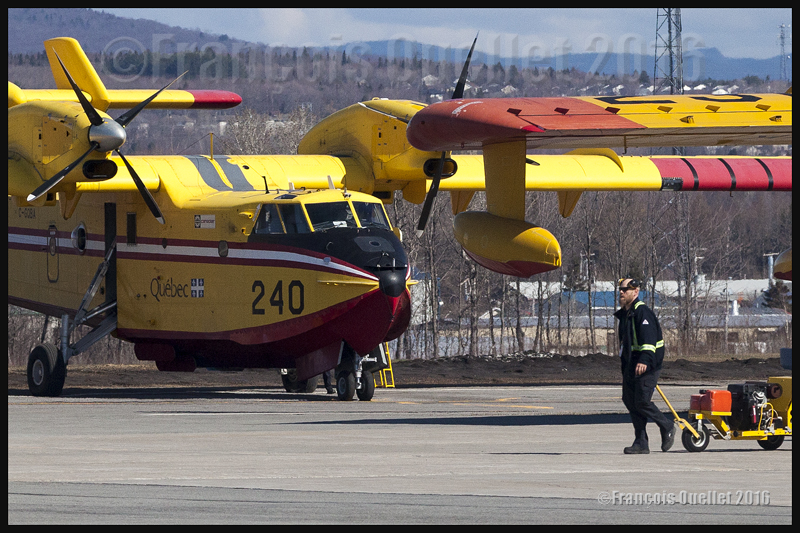
A Bombardier CL-415 water bomber, property of the Government of Quebec, is being prepared for its flight towards Fort McMurray, May 2016

Quebec’s CL-415s helping out in Fort McMurray

On May 5th, 2016, according to what had been announced by the Government of Quebec, four CL-415s took off from the Quebec Jean-Lesage international airport (CYQB) heading to Fort McMurray, Alberta, to help in the fight against widespread forest fires in that province. It is the worst natural disaster that Canada has known in its history.

Preparing flight crews and aircrafts for such a long cross-country trip naturally demands much coordination from the SOPFEU (Society for the protection of forests against fires). Once they will have landed at the Fort McMurray airport, the pilots of those CL-415s will be under the direct command of the Albertan authorities in charge of fighting the wildfires, since the latter are best positioned to know exactly what the local needs are.

I figure that the flight service specialists (FSS) of the Nav Canada flight information center (FIC) in Edmonton must have quite busy days with the increased aerial activity associated with the numerous fires…
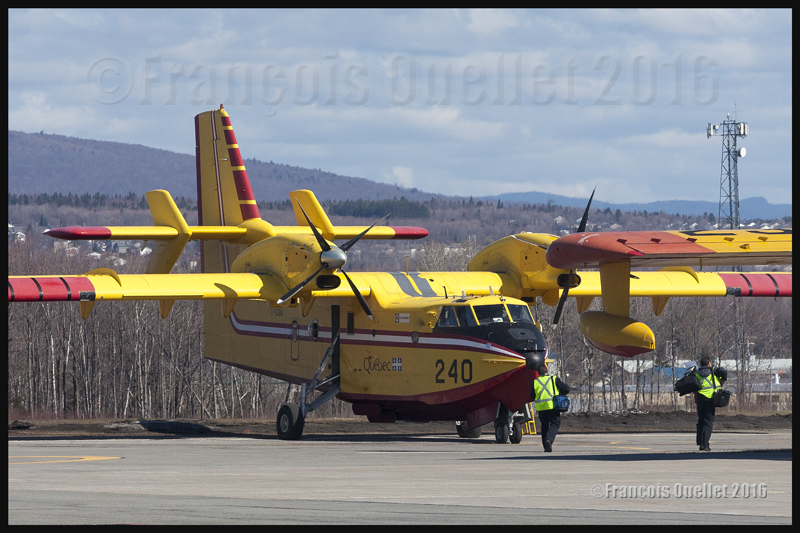
Crew members are walking towards the Government of Quebec CL-415; they will soon be airborne and heading to Fort McMurray in Alberta, to fight the forest fires (2016)

The picture above shows crew members heading towards their assigned aircraft. Once they start working in the Fort McMurray region, they will not only have to directly fight the forest fires but also head to sectors that have not yet been touched by fire and water the area thoroughly to prevent new wildfires.
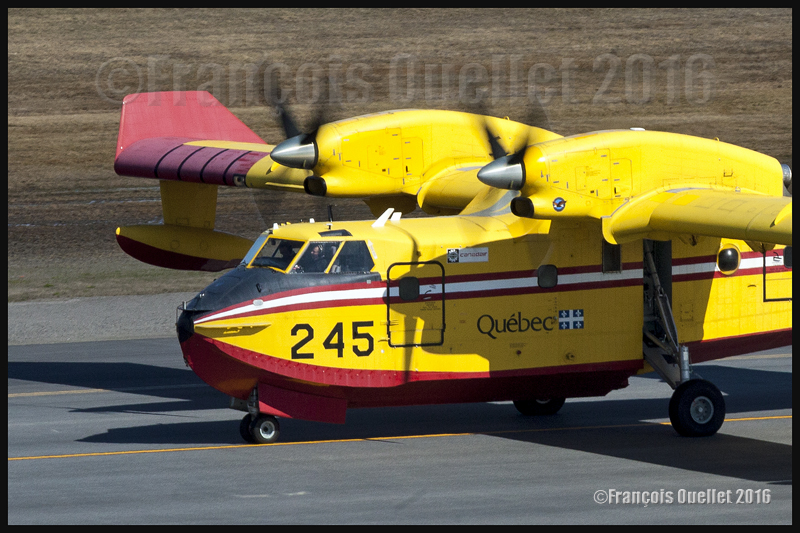
A Government of Quebec CL-415 number 245 is taxiing at the Quebec Jean-Lesage international airport to take-off towards Fort McMurray, in Alberta, to help fight the out of control forest fires in that province during May 2016.

Taking pictures of propeller-driven aircrafts
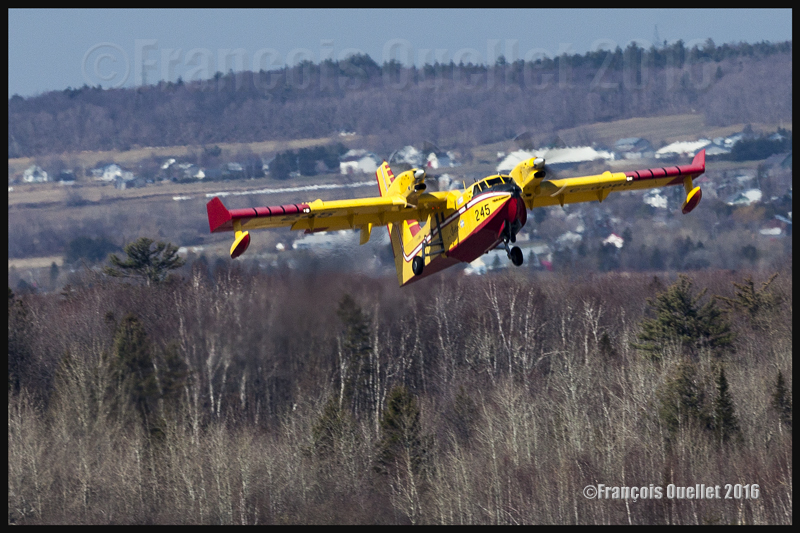
A Bombardier CL-415 water bomber takes off from the Quebec Jean-Lesage international airport heading to Fort McMurray, in Alberta, to help fight the forest fires (2016)

It is a bit touchy to photograph propeller-driven aircrafts while making sure that there is a sensation of movement. In a natural reflex to want to avoid blurred pictures, the photographer uses a shutter speed that corresponds to the focal used for the shot. In the case of the picture above, the focal was 400mm. But if a shutter speed of 1/400 had been used, the propellers would have been totally immobilized and the aircraft would have looked like its climbing while not using its engines.

It was necessary to reduce the speed to 1/160, thus increasing the risk of obtaining a blurred picture. In order to get both image sharpness and moving propellers visual effect, the photographer has to follow exactly the movement of the aircraft with the camera so that it looks totally immobile in the viewfinder. This asks for a bit of practice but allows for more realistic photos.

The CL-415 in a black and white photo

Black and white photo of a Bombardier CL-415 (C-GQBG) flying over Quebec City in 2015

The government of Canada helping out Alberta’s citizens

The government of Canada, under Justin Trudeau, has promised to match the amounts of money offered by all Canadians to the Red Cross society toward helping the Fort McMurray population.

Obviously, its contribution will not stop there (in fact, far from it), but the message is for the whole Canadian population to contribute generously to support the efforts of the Red Cross. It is already estimated that the material damages will reach at least nine billion dollars and that numerous years will be required to rebuild everything. The Liberal Party of Canada had built its political campaign around the need to invest for the renewal of infrastructures. With the Fort McMurray fires, there will be plenty of new unplanned expenses ahead.

More than 1,400 firemen are fighting the wildfires. So few, there has been very few lives lost, although “very few” is always too much. The crisis is, according to everyone, well managed by the government of Alberta.

At the time of writing, there was still no rain forecasted for days to come and the drought was also extending to the southern half of Saskatchewan and part of Manitoba. The winds were expected to increase, which would mean that even more resources would be needed in the near future to bring those wildfires under control.

It seems to me that the government of many Canadian provinces would benefit in acquiring new water bombers like the CL-415 to give them an increased margin of manoeuver that would allow them to react more quickly, if we take into account the tendency for the ever growing number and size of forest fires. In the picture below, the government of Quebec CL-415 number 247 is just airborne from Quebec to Fort McMurray.

A Bombardier CL-415 C-GQBK airborne from the Quebec Jean-Lesage international airport heading to Fort McMurray, Alberta, in May 2016

The CL-215s will not head to Fort McMurray

While several CL-415s are leaving for Alberta, few water bombers, like the two Canadair CL-215s shown below, stay at the Quebec Jean-Lesage international airport in case of forest fires in the province and also to be used for the seasonal rehearsal needed for every pilot before they are dispatched across the province of Quebec.
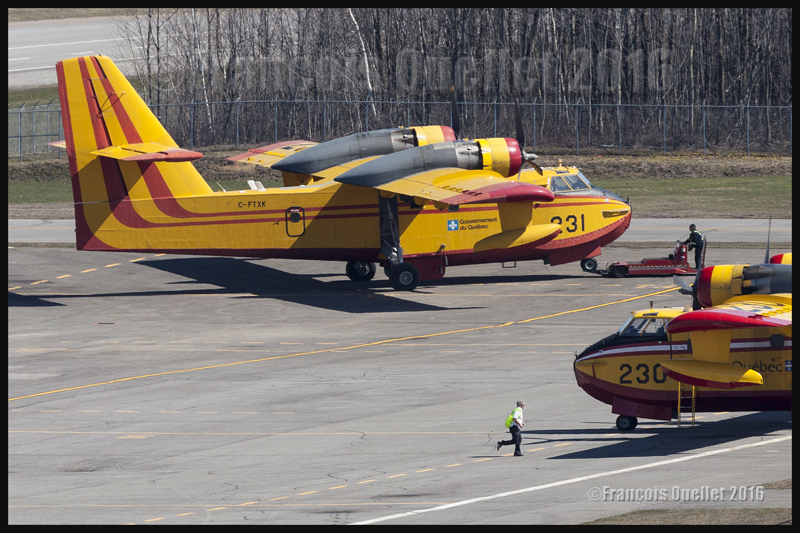
Two Canadair CL-215 water bombers parked at the Quebec Jean-Lesage international airport in May 2016.

Global warming

Some people can say that global warming is not responsible for the increasing number of extended wildfires. They might be right, but I prefer to adopt a wider view than only what is going on in Alberta. Heat transfer between the north and south are now more extreme in order to equalize the temperatures around the globe. All means to reduce the difference in temperatures between the equator and the poles are at work and this causes increasing problems to particular regions.
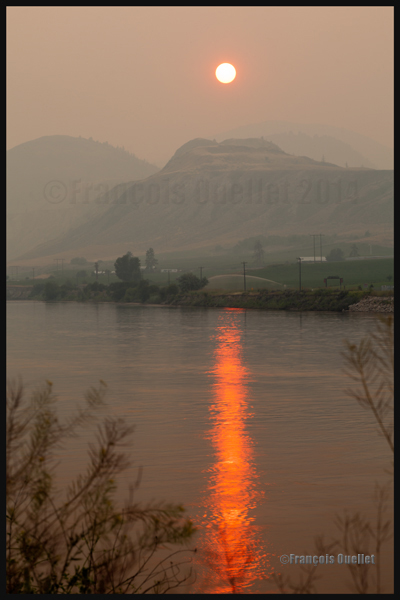
The Kamloops region in British-Columbia, when numerous forest fires were raging 2014.

A powerful El Nino phenomenon, repetitive Omega blocks, the air circulation in different cells (Hadley, Ferrell, polar, Walker) all participate in the heat exchange. At a more reduced scale, we also regularly hear of cold and warm fronts in the meteorological forecasts.

It is certainly not local warm fronts that are responsible for the fact that a thinner layer of permafrost is unable to ensure the stability of Arctic runways anymore. Nor are fronts responsible for the fact that houses on stilts do not have a stable foundation anymore. Many heat records have been established these past years in northern Canada. There will certainly be large amounts of money to spend to rebuild the Nordic infrastructures.

Brush fires as soon as April in Alberta

This year, as soon as April, there were widespread brush fires in a region as north as Fort McMurray in Alberta because winter has not brought much snow to humidify the land during Spring. I thus wondered what would happen once in July. Albertans did not need to wait that long to get the answer.
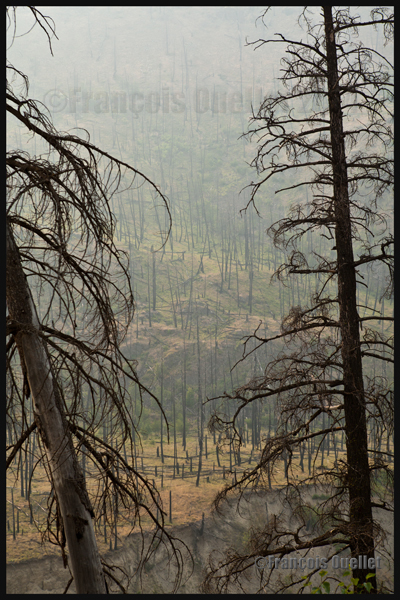
Western Canada forest after a fire (2014)

The modelization of climatic changes indicates that, in the Fort McMurray region, the forest fire season is already fifteen days longer that it used to be. More heat might favor more droughts. But an increase in temperature also favors the development of thunderstorms and with them comes lighting that will start up new fires.

One thing is sure: insurance companies will not lose time with the different theories on global warming. The reinsurers (those who insure the insurance companies) have the obligation to limit their losses to stay afloat and premiums will quickly increase to answer to the thousands of claims following an increasing number of natural disasters.

Photos of the local air traffic in Quebec, just after the CL-415s departed to Fort McMurray
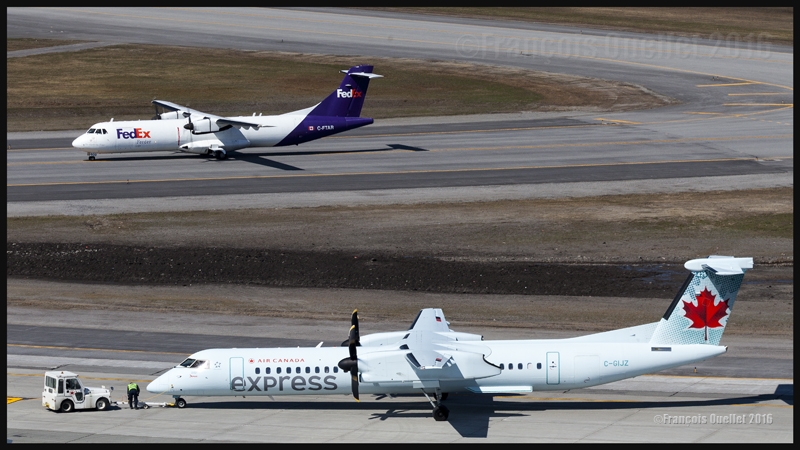
FedEx ATR 72-202F C-FTAR and Air Canada Express Bombardier DHC-8-Q-402NG (C-GIJZ) at the Quebec Jean-Lesage international airport in May 2016

At the Quebec airport, between the take offs of the four Bombardier CL-415 towards Fort McMurray, I was able to take few pictures of the local air traffic. In the photo above, it is possible to see a FedEx ATR 72 (C-FTAR) taxiing toward the ramp after a landing runway 06. An Air Canada Express Bombardier DHC-8-402 (Q-400) (C-GIJZ) was also being towed for is imminent departure.

ATAC’s Hawker Hunter N339AX

Being in luck, I was able to capture a Hawker Hunter (N339AX) belonging to the American company  ATAC, just airborne from Quebec. As for any military jet, it is difficult to ignore them on take-off: the reactor’s noise is there to remind you of their presence…

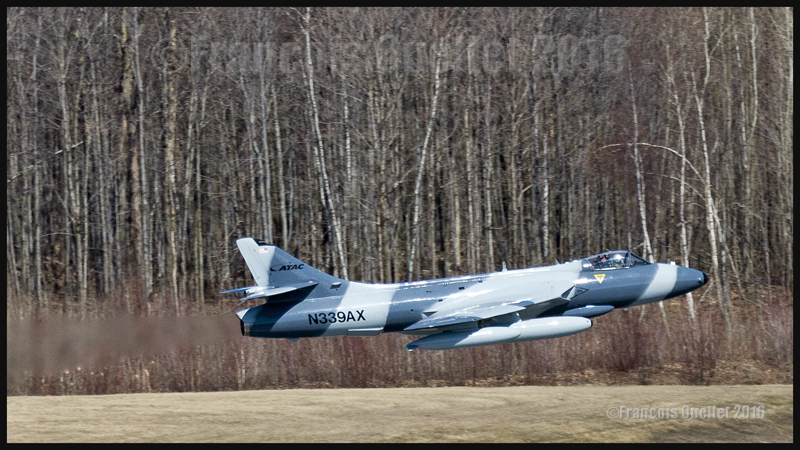
A Hawker Hunter belonging to the american company ATAC is airborne from the Quebec Jean-Lesage international airport (CYQB), May 2016
A Hawker Hunter, from the american company ATAC, is airborne from the Quebec Jean-Lesage international airport (CYQB) in May 2016

The pictures above have been taken with a Canon 5D MKII camera, equipped with a telephoto lens Canon 70-200 f2.8L IS II USM with a polarizing filter and a Canon Extender EF 2X III which brought the focal length to 400 mm. Even then, more cropping was necessary to enlarge the aircraft since I was quite far away from the runway.

Wishing to ensure that the image was sharp (a blurred picture is more probable with a 400 mm focal length while the photographer attempts to follow a fast flying jet), I adjusted the shutter speed to 1/1600 and made sure that the automatic focus was set on AI servo.

I now realized that a slower speed could have worked a bit better since it would have allowed showing a blurred forest in the background while keeping the aircraft sharp. But it is not often that you have the opportunity to see a Hawker Hunter in flight these days and I played safe with the shutter speed. The ideal shot will be for another day…

CL-415s and CL-215s together in Quebec (2012 photo)

CL-415 and CL-215 water bombers belonging to the Gouvernment of Quebec. Quebec Jean-Lesage international airport (CYQB) 2012

A last picture, taken few years ago, during autumn 2012, shows numerous water bombers CL-415 and CL-215 parked at the Quebec Jean-Lesage international airport (CYQB). During the off- season, the water bombers are brought back to Quebec City from the different bases were they have been in operation during summertime.

For other articles on aviation and photography, click on the following link: Aviation photography
Categories
Photos of Europe

Photography in Europe: Gruyères and the Moléson in Switzerland

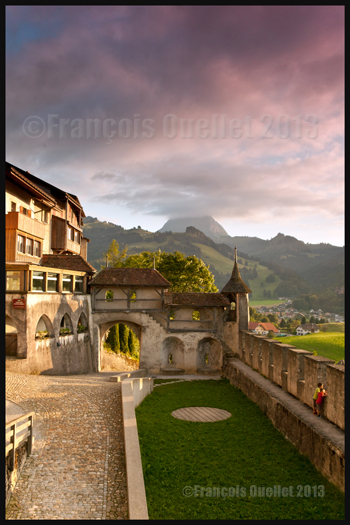
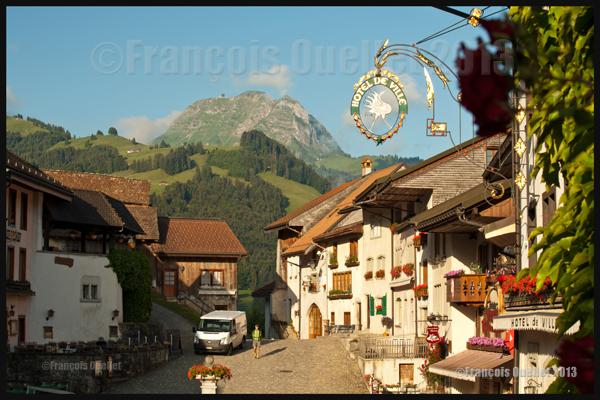
Gruyères and the Moleson in the background, Switzerland 2013

The city of Gruyères is located in the Prealps, in the Friburg County in Switzerland. It is a very charming small medieval town where cars are forbidden (the white van shown in the picture above is only used for morning delivery). In the city, one can visit the Gruyères Castle (Château de Gruyères), the H.R.Giger Museum (creator of the “Alien” in the movie Alien), the Tibet Museum, a cheese factory and boutiques. There are also some restaurants.

In the picture above, shot with a Canon 5D MKII, it is possible to see the Moléson in the background, a mountain that rises only 512 metres above the surrounding terrain but is still at more than 2000 meters above sea level. It is a tourist attraction that should not be neglected since it is very well equipped for all types of visitors, with a funicular and cable car. The visitors also have access to very interesting walking paths, for all ages and experiences.

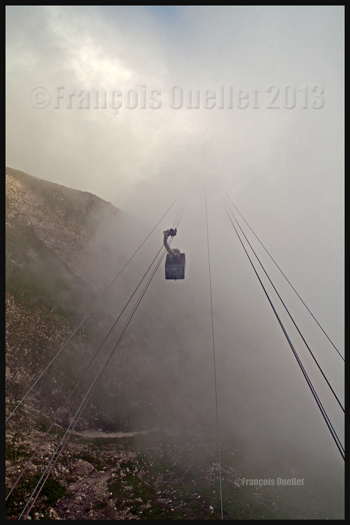
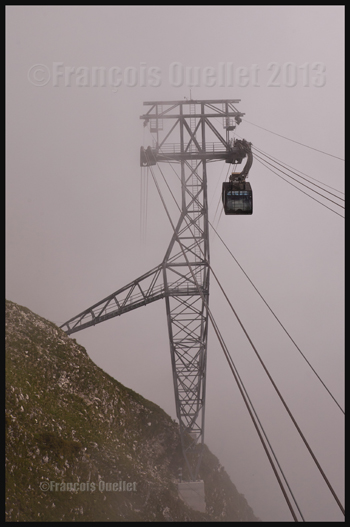
Moleson cable car, in the Gruyeres region, Switzerland 2013

When you use a cable car and do not see where it is leading due to the presence of clouds, you have to trust human engineering. But we are in Switzerland, so it should be all right!

The Moleson cable car, Switzerland 2013

The Moléson summit offers superb views. The small cumuliform clouds visible in the morning around the mountain progressively lift up due to daytime heating and eventually become beautiful cumulus clouds that add life to any pictures.

Moleson summit in the clouds, Switzerland 2013

Once on top of the Moléson, it is possible to use a modern metal stairway to gain even more height and access a platform allowing an unobstructed panoramic view. The picture above was taken with a Canon EF 16-35mm f2.8L II USM wide-angle zoom lens equipped with a polarizing filter.

Metal stairs leading to an observation post on top of the Moleson, Gruyeres region, Switzerland 2013

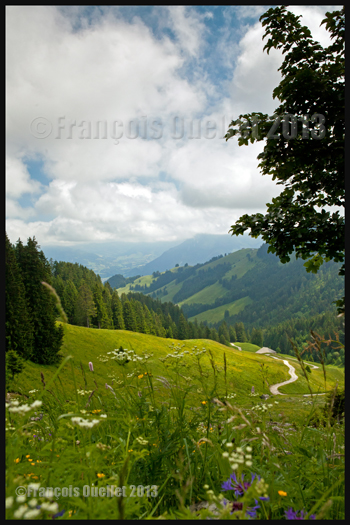
When ready to go down the mountain, the visitor has two choices: travel with the cable car and funicular he used when coming up, or slowly walk along an easily accessible path through beautiful green landscapes. The more experienced trekkers might decide to walk along the crests of surrounding mountains. We chose to walk on paths covered with flowers.

Path on the Moleson, Switzerland 2013

Back to Gruyères, a visit of the Château de Gruyères and both museums is a must, as well as a tour of the cheese factory. You might want to spend some time in the boutiques too and try the local restaurants. It is also the moment to take a few pictures…

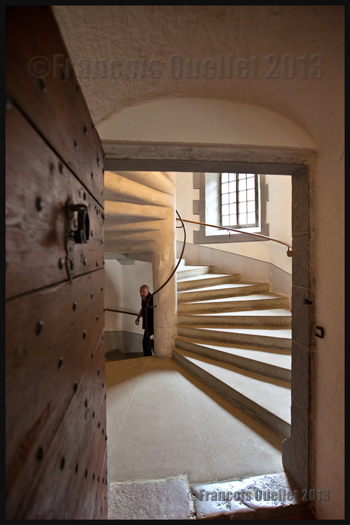
Inside the Gruyeres medieval city, Switzerland, 2013

The old architecture of the buildings in Gruyères as well as the neighbouring countryside allow for very interesting photographic compositions. A well-known photography technique consists in using an opening in a building and using it as a second frame (a frame within a frame). I made sure that the background was clear enough to improve the visual effect. An aperture around 16 allowed for an appropriate depth-of-field.

Spiraling stairs in the Gruyeres Castle, Switzerland 2013

The picture above shows a spiraling staircase inside the Château de Gruyères. I can barely imagine what the results would have been if I had had access to the new Canon 11-24mm wide-angle lens. But nonetheless, the Canon EF 16-35mm f2.8L II USM zoom lens did a good job.

The beauty of the full frame sensor mounted on the Canon 5D MKII DSLR is that a wide-angle shot taken at a 16mm focal will stay at 16mm while with a smaller sensor, like the APS-C, the photographer is facing a conversion factor of 1.5 or 1.6X, which transforms the 16-35mm wide-angle into a 24-52mm, in the best of cases. The APS-C sensor is interesting when used with a telephoto lens but a bit less when comes the time to take wide-angle shots.

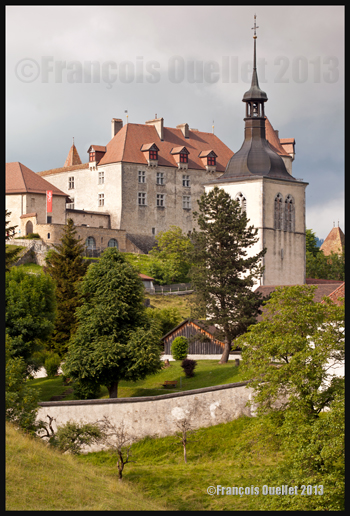
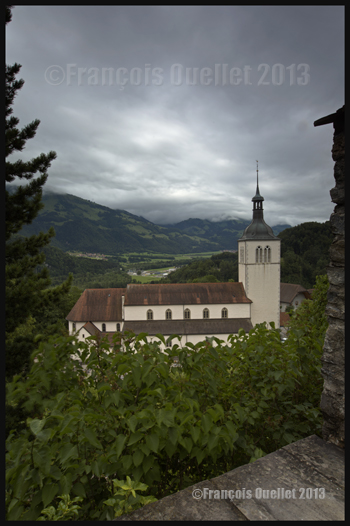
The picture below presents the Château de Gruyères seen from a neighbouring field.

Gruyeres old architecture, Switzerland 2013

As the sun was setting down, I tried a shot from inside the castle. It was interesting to see the two little boys standing up alongside the wall and admiring the sunset. At the same time, it was possible to see the Moléson in the distance, its summit hidden in the clouds.

Due to the strong light contrasts, it was necessary to use a Hi-Tech ND graduated filter installed on my Canon 16-35mm wide-angle zoom lens. The Digital SLR Photography magazine, in one of its recent editions, made a comparison between ND grad filters and indicated that the Hi-Tech filter had a slight magenta coloration instead of a neutral grey. I think it is easily visible in the picture below. The photo could have been corrected with Photoshop but I thought of keeping it as it was since the scenery looked somewhat unreal already.

View from the Gruyeres Castle and the Moleson, Switzerland 2013

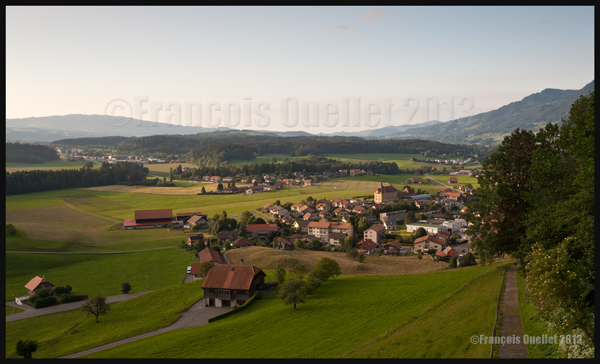
Once the sun was below the horizon, the more subtle colours gave a totally new look to the countryside. On the picture below, it is possible to see on the right a small path that a visitor can take to head down to the nearby village.

Gruyeres region in the sunset, Switzerland 2013

All the sceneries are not that easy to capture and it is sometimes necessary to use HDR photography to extend the dynamic range and take care of extreme light contrasts. The photo below needed five different exposures that were subsequently processed with the Photomatix image editing software. Useless to say, it was necessary to use the mirror lock-up function, a tripod and a remote control release.

View from the Gruyères Castle, Switzerland, in HDR 2013

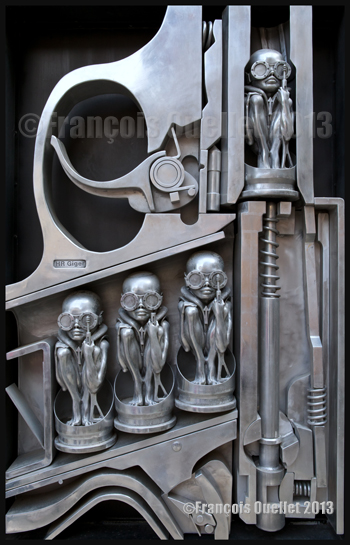
Here is, as the final picture, an idea of what is waiting for you at the H.R. Giger Museum. If there is a strange but very interesting museum, it is this one.

Artwork in front of the H R Giger Museum, Gruyeres, Switzerland 2013

Other pictures of Europe and around the world will be posted in the coming months…

Categories
Photos of Canada

Photography: wildlife in Alberta and British Columbia, Canada

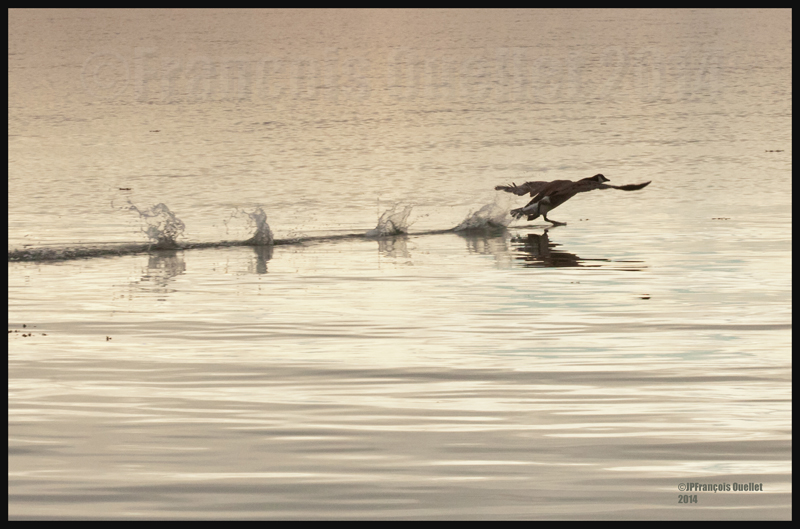
A Canada goose about to take off from Oak Bay, Victoria, British-Columbia in 2014

Obviously, the Canon 5D MKII is not the ideal camera for sport photography, but it still can offer very good results with its full frame sensor. You don’t get a high number of frames per second, but you get the benefit of a bigger image than one produced with an APS-C sensor. I was thus able to capture the full take-off run of this Canada goose in Victoria, British Columbia, while leaving enough space on the right side of the frame, which was essential for a balanced photographic composition.

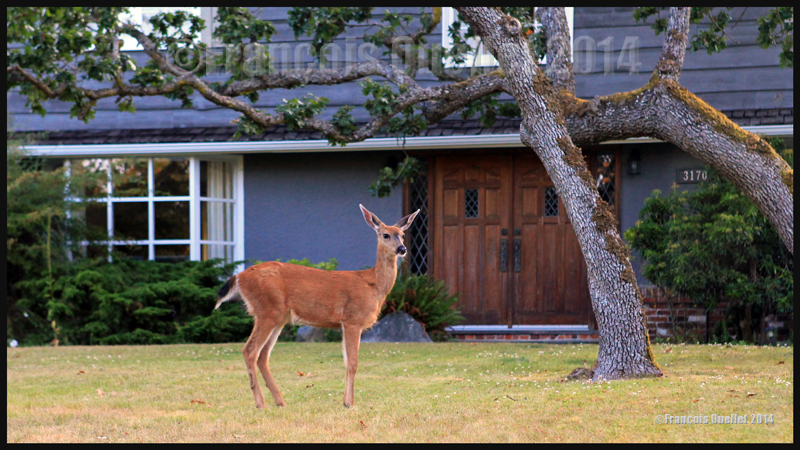
Deer on a private property in Uplands, Victoria, British-Columbia in 2014

Deer move freely in Victoria’s Uplands sector and you can easily find them on private property lots. Since they are so numerous and have no natural enemies, the city has imposed new regulations to control their ever growing number. The picture above was taken from my vehicle: it was only necessary to slow down and proceed quickly to capture the animal while it was looking at the car.

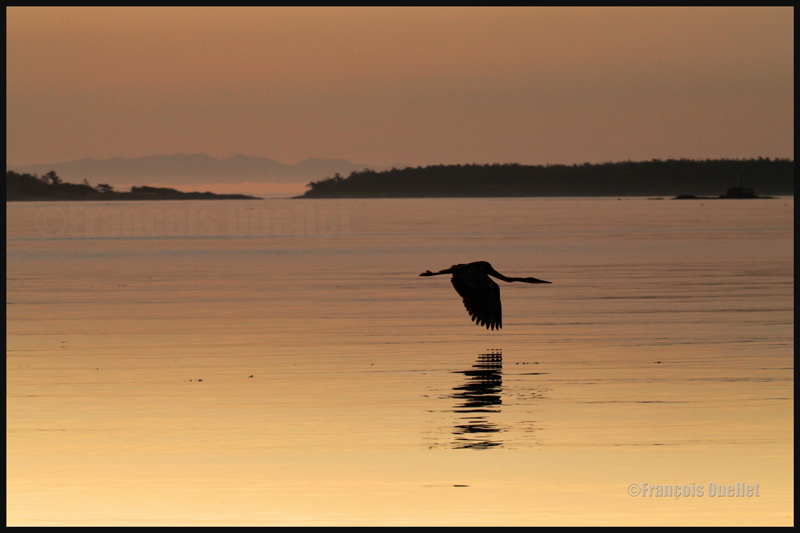
Heron in flight in Oak Bay, Victoria, British-Columbia 2012

There are numerous herons in Victoria’s Oak Bay sector. This picture was taken very early in the morning, while there was a mixture of mist and low clouds and the rising sun was still blocked by some low clouds. The wind was calm. A graduated filter was nonetheless necessary to tone down the contrasts caused by a horizontal light.

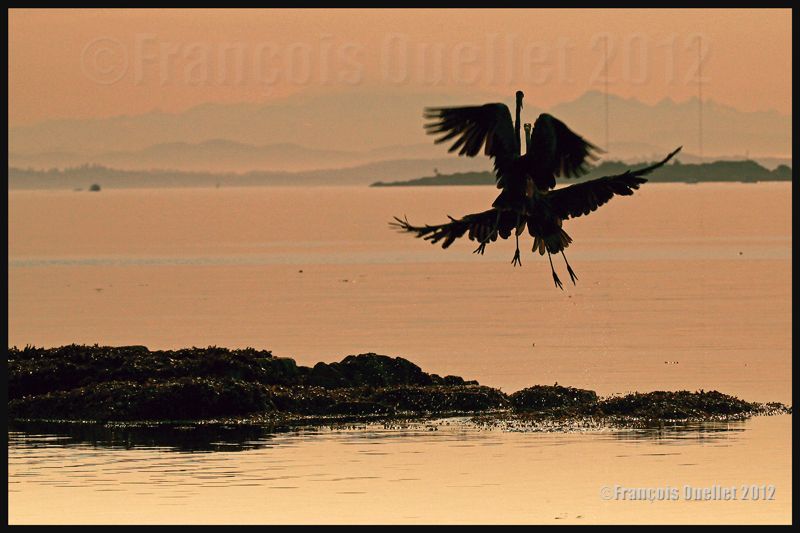
Fighting herons in Oak Bay, Victoria, British-Columbia in 2012

Every bird has to fight for its own territory and those two herons are no exception.

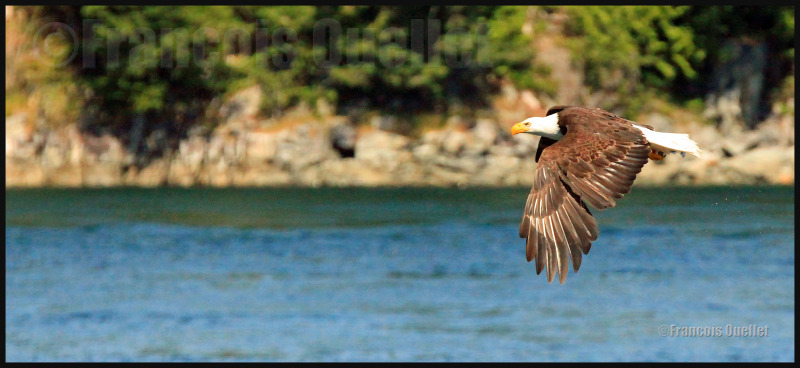
Eagle observed in the Campbell River region, British-Columbia, Canada. Summer 2012.

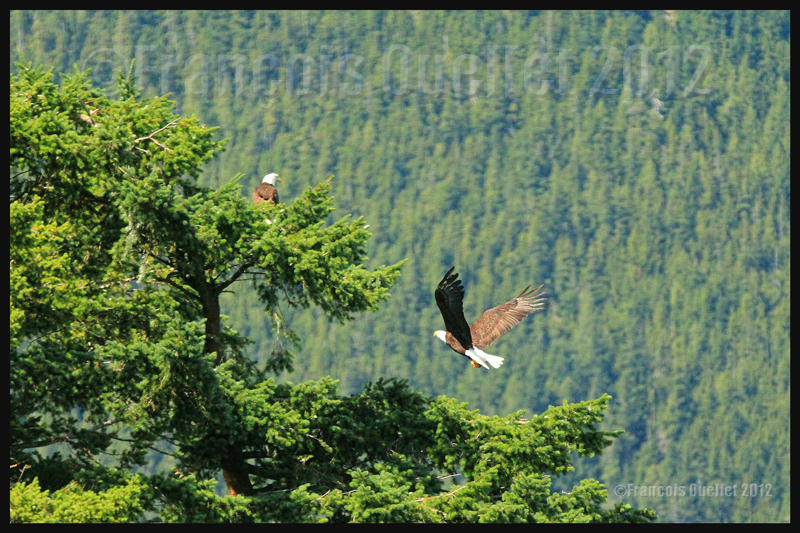
While taking a little scenic cruise in British-Columbia’s Campbell River area, we were able to see numerous eagles diving to catch fishes then climbing back up in high trees to deliver the catch of the day. Pictures were hard to take since the captain had to keep the boat at a good distance from the eagles to respect their hunting territory. Moreover, it was windy and the boat was constantly moving.

Two eagles near Campbell River, British-Columbia, Canada in 2012

The two pictures of eagles were taken with a Canon 5D MKII equipped with a Canon 70-200 f2.8L IS II USM telephoto lens. An extender (2X) was also added to increase the focal distance to 400mm. Even then, I had to crop quite a lot to bring the birds to an acceptable distance, which increased the digital noise. A quality APS-C equipped camera (like the Canon 7D MKII) would have been very useful here (10 frames per second and a reduced amount of cropping, if you are ready to compromise on the size of the image).

A full frame camera like the Canon 5DSr would have also been appropriate, with its 50.6 MP resolution, as long as a high shutter speed is selected. Due to all those pixels crammed on a regular full frame sensor (not a medium format), the slightest camera movement is recorded. But if you succeed in totally freezing a long distance shot, the exceptional resolution of the Canon 5DSr would allow you to greatly increase the size of the bird while protecting the sharpness of the image, especially now that the low pass filter has been neutralized in the model R.

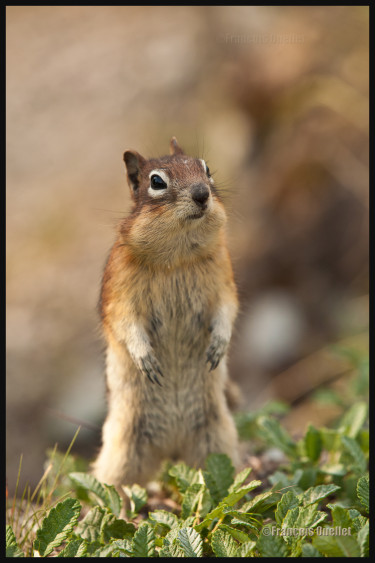
Chipmunk near highway 93 towards Jasper, Alberta

On the car ride between Lake Louise and Jasper, we had to stop on numerous occasions to take pictures in the fantastic Jasper National Park. At one point, a little chipmunk, familiar with rest areas, paid us a visit hoping to add something new to his diet. The picture’s depth-of-field has deliberately been adjusted to make sure the chipmunk would be easily visible, since both animal and background had the same colours.

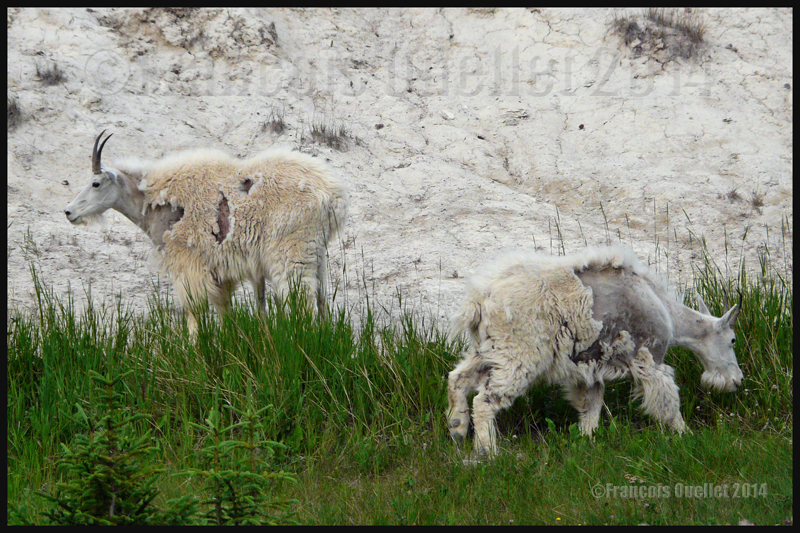
Mountain goats in the Jasper National Park, Alberta, Canada in 2014

It was hot, very hot, during summer 2014 in the Jasper National Park. The car’s thermometer was recording 38C between Lake Louise and Jasper. Numerous forest fires were raging. So much so that we had to delay our trip towards Jasper by 24 hours since Highway 93 had been closed by authorities. Mountain goats nonetheless had to endure part of their winter fur in that very high heat…

Canadian bighorns near Kamloops, Alberta, Canada in 2014

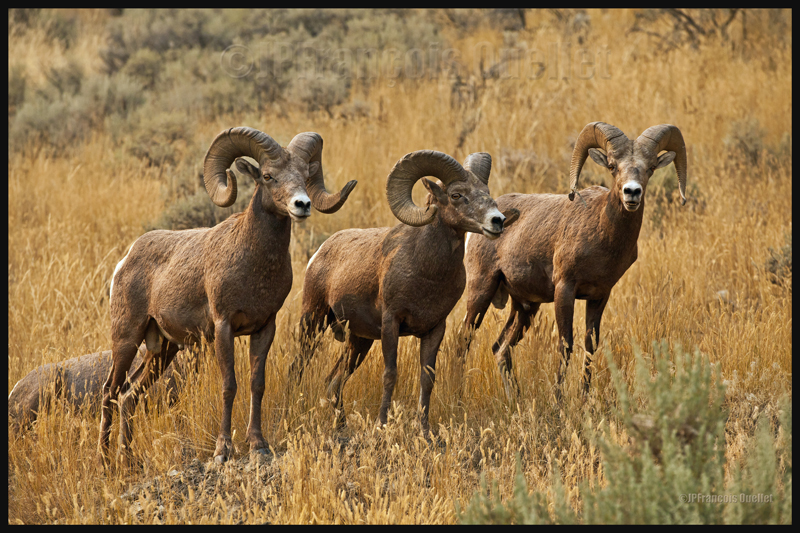
Near Kamloops, in Alberta, we were able to observe about twenty Canadian bighorns coming down from the surrounding mountains to help themselves from the cultivated lands in the valley. The picture above was taken with a Canon 70-200 f2.8L IS II USM telephoto lens, almost without cropping, the bighorns being close enough.

Brown bear near the Yellowhead Highway, Alberta, Canada in 2014

The picture above was taken alongside the Yellowhead Highway in Alberta. We saw the bear in a field and when he detected our presence, he changed direction and started moving toward us. Here, everything is about moderation and although I love photography, comes a time when a bear is big enough in the viewfinder to indicate that it is time to retreat…

Other pictures on Western Canada will be available in the coming months…

For more articles in the category « Photos of Canada », click on the following link : Photos of Canada