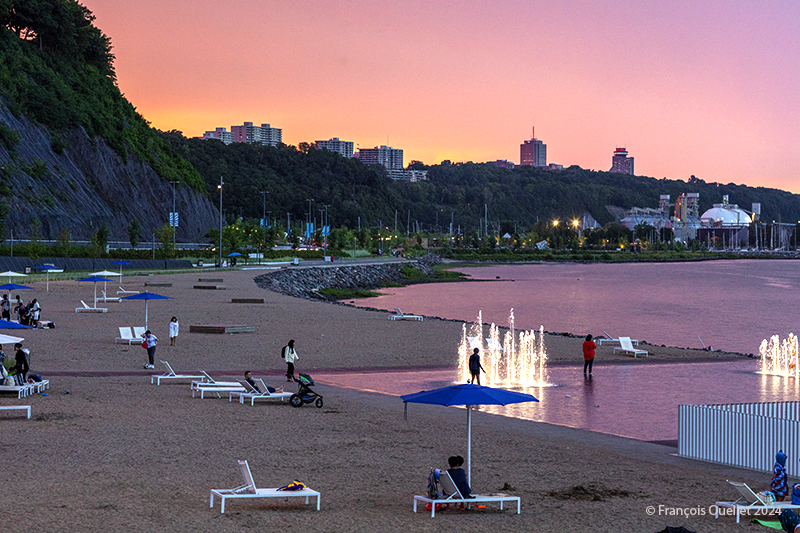
An evening after the rain at the Station de la plage, Québec 2024
The information below applies to those interested in stand-up paddleboarding in Quebec City, from the “station de la voile” towards the “station de la plage” and the surrounding area.
Before setting out, check the general weather forecast.
Those with some aviation knowledge should check the CYQB TAF (Terminal Area Forecast) for wind estimates.
Also check the tide table (Lauzon) to see if the tide is rising or falling.
Wearing a personal flotation device (PFD) is mandatory. A wetsuit is strongly recommended, as the water in the St. Lawrence remains cold, even in summer. Here’s a useful rule for deciding what to wear: the water temperature plus the air temperature, compared to 37 °C. If the result is less than 37, a wetsuit is preferable. If the water is 10 °C or colder, regardless of the air temperature, a waterproof layer is essential.
For water temperature near Quebec City, click on “water temperature.”
Buoys measure the temperature. Another possible site for the winds: Windy.
Wetsuits come in various thicknesses (2, 3, or 5 mm for slightly colder conditions).
The wetsuit should fit snugly against the body to prevent air pockets from forming between the skin and the material. If you’re in saltwater, you can apply lotion to your skin under the wetsuit (since water seeps through the wetsuit and can irritate the skin).
Hypothermia: the human body can withstand a maximum of fifteen minutes in water at 5 °C.
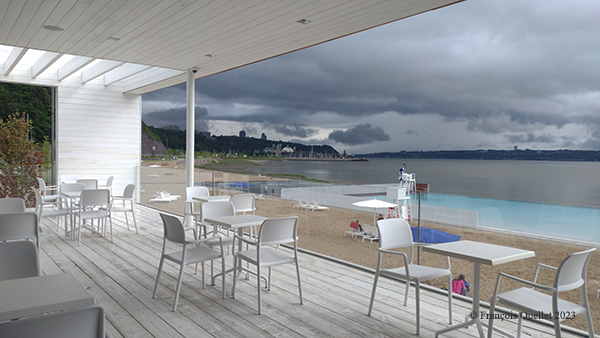
Station de la Plage and showers in Quebec City.
The “rule of 12” is taken into account when launching a paddleboard on the river. Each hour corresponds to a more or less rapid rise or fall in water flow. On the St. Lawrence River near Quebec City, the tidal range is three metres. A tidal cycle lasts about 6 hours. During the first hour (1/12) = 1/12 of three metres = .25 metres. The tide changes by .25 metres during the first hour. The second hour (2/12) = .50 metres. The third and fourth hours: 3/12 each. Therefore, during the third and fourth hours, the tide varies by 0.75 metres each hour. The fifth hour: 2/12. Sixth hour: 1/12.
From the “station de la voile”: if the tide is falling and winds are blowing from the S, SW, W, or NW, there are two obstacles when heading west. There is a headwind component, and the person paddles against the current. Check whether the wind strength allows you to launch the board and head west first, especially if the tide is falling.
The safer approach is to exert effort at the start of the trip and coast on the return.
If you decide to head west with an incoming tide, the trip out will be very easy, but you’ll have to paddle hard on the way back.
To gauge the effort required, you can choose a reference point along the Champlain Promenade and note how far the board drifts when you’re not paddling. Then, compare that to your progress when paddling normally. For example, during a trip westward with an ebb tide (water flowing back to the sea) and winds from 250 degrees at 10 knots, I paddled for over an hour just to reach the first stone pier near the “station de la plage”. This included using the double paddle.
At the ends of the stone jetties extending into the river at the sailing and beach stations, waves come from all directions.
Kneeling on the board, you can catch higher waves and have more power to paddle.
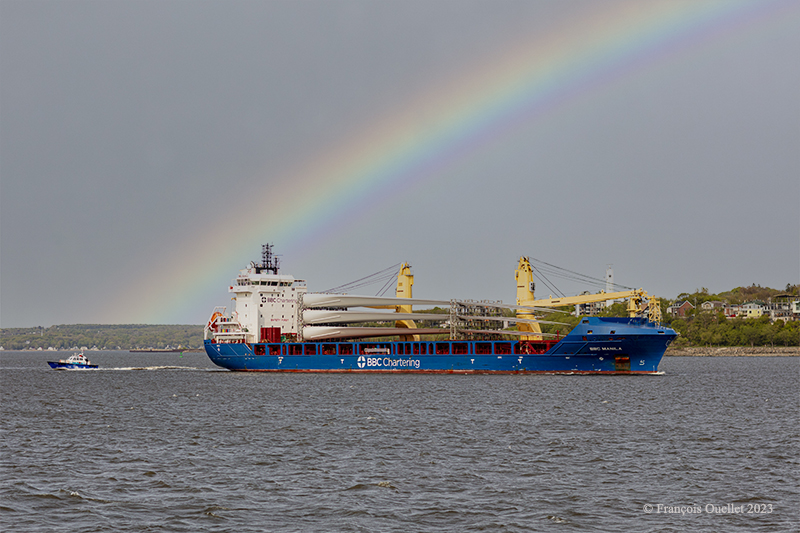
The BBC Manila carries wind turbine blades on the St.Lawrence Seaway near Quebec City.
The river has short, long, and very long waves that mix. You may dip a few feet in the through and rise back up on the ridge when the wave is large. There are also times when you’re pushed sideways. Keep an eye on the shore to see which way you’re being carried.
To maintain your balance, keep your eyes on the horizon at all times. Alternate between twenty-minute sessions standing up and then kneeling to rest. If necessary, set up a board seat and use a double paddle while seated for a change.
You must not stray too far from the shore to avoid becoming a victim of sailboats or jet skis travelling at high speeds in areas that require more cautious navigation.
When a large ship passes offshore, two-foot waves arrive a few minutes later, gently lift you up, then continue on and crash against the banks on either side of the river. They return to the paddleboarder much later and are much weaker.
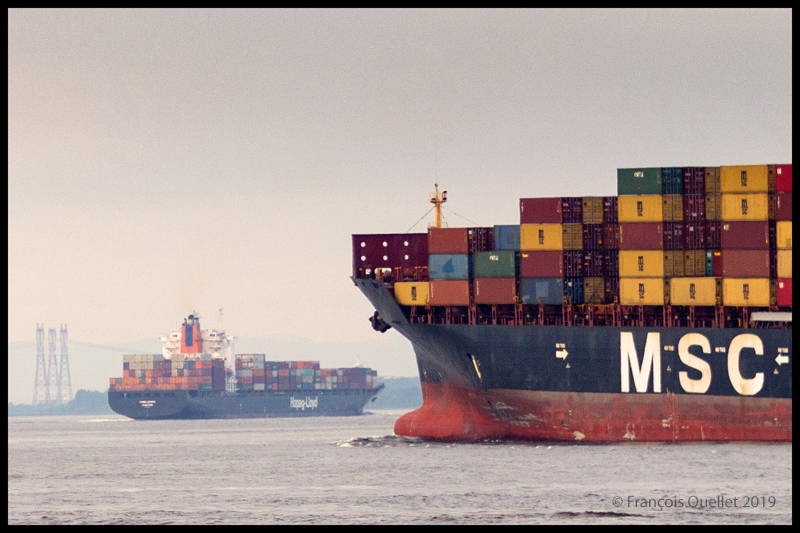
The container ship Hapag_Lloyd Quebec Express and the container ship MSC Paola are sailing around Île d’Orléans near Quebec City.
Take this opportunity to relax. Since this is a water sport, it’s normal to end up in the water from time to time.
There’s a beach near the “station de la voile.” It has few sharp rocks. However, keep an eye out and avoid going there when the tide is at its highest.
Have fun!
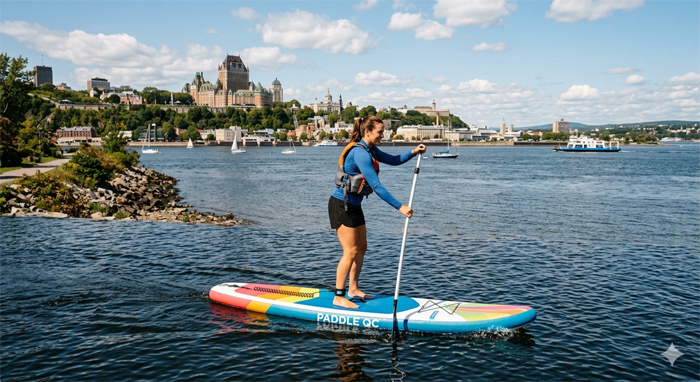
A paddleboarder on the St. Lawrence River, as imagined by AI.
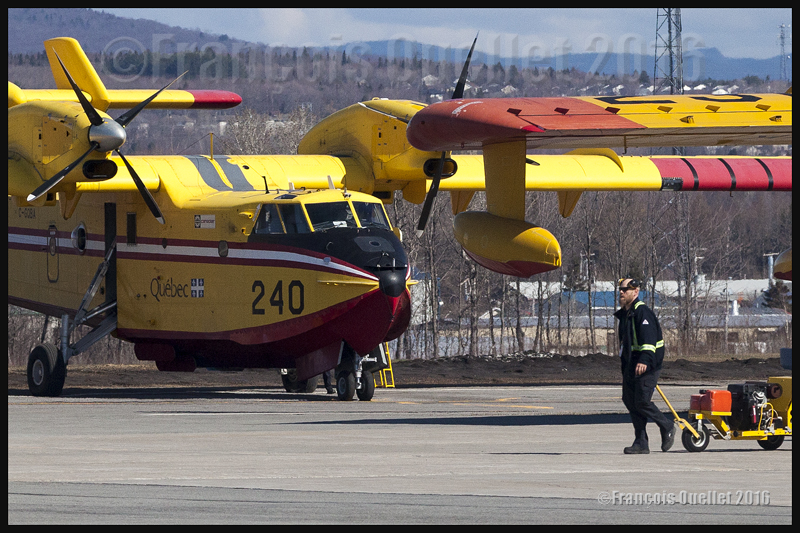
A Bombardier CL-415 water bomber, property of the Government of Quebec, is being prepared for its flight towards Fort McMurray, May 2016
Quebec’s CL-415s helping out in Fort McMurray
On May 5th, 2016, according to what had been announced by the Government of Quebec, four CL-415s took off from the Quebec Jean-Lesage international airport (CYQB) heading to Fort McMurray, Alberta, to help in the fight against widespread forest fires in that province. It is the worst natural disaster that Canada has known in its history.
Preparing flight crews and aircrafts for such a long cross-country trip naturally demands much coordination from the SOPFEU (Society for the protection of forests against fires). Once they will have landed at the Fort McMurray airport, the pilots of those CL-415s will be under the direct command of the Albertan authorities in charge of fighting the wildfires, since the latter are best positioned to know exactly what the local needs are.
I figure that the flight service specialists (FSS) of the Nav Canada flight information center (FIC) in Edmonton must have quite busy days with the increased aerial activity associated with the numerous fires…
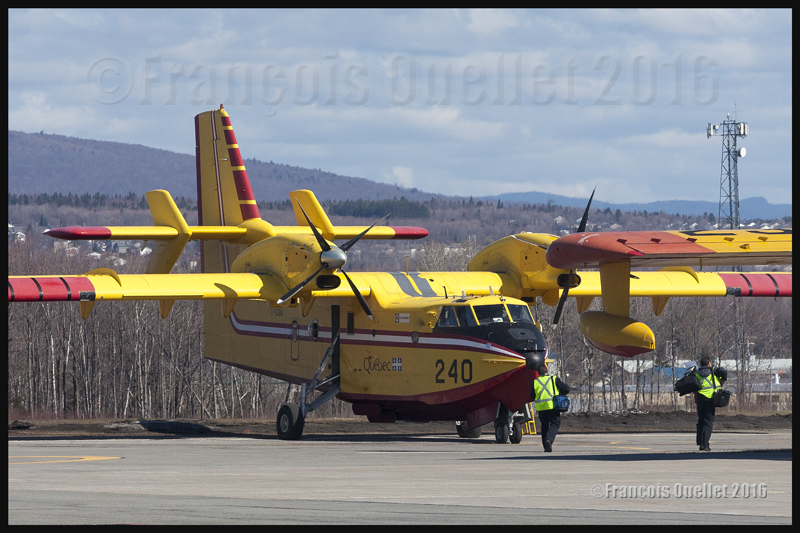
Crew members are walking towards the Government of Quebec CL-415; they will soon be airborne and heading to Fort McMurray in Alberta, to fight the forest fires (2016)
The picture above shows crew members heading towards their assigned aircraft. Once they start working in the Fort McMurray region, they will not only have to directly fight the forest fires but also head to sectors that have not yet been touched by fire and water the area thoroughly to prevent new wildfires.
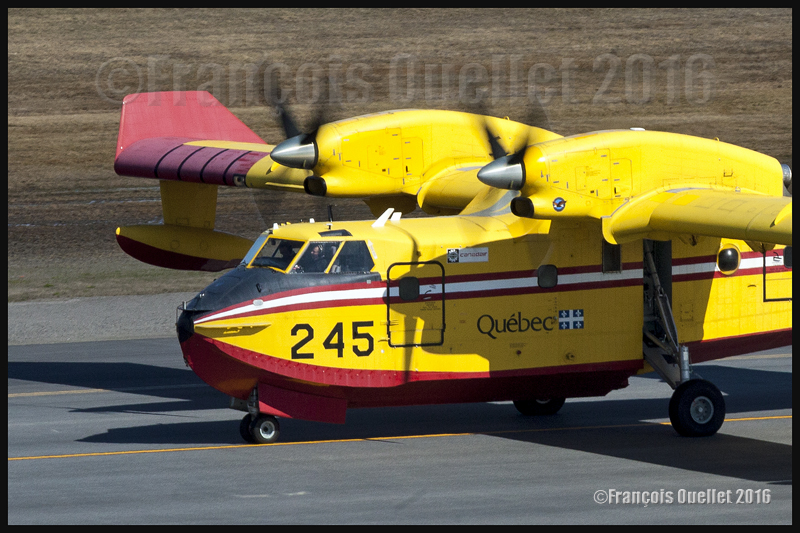
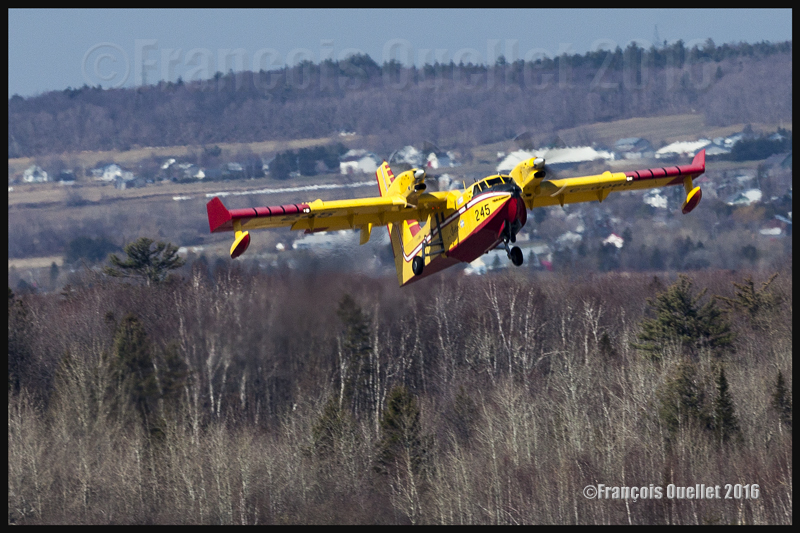
A Government of Quebec CL-415 number 245 is taxiing at the Quebec Jean-Lesage international airport to take-off towards Fort McMurray, in Alberta, to help fight the out of control forest fires in that province during May 2016.
Taking pictures of propeller-driven aircrafts
A Bombardier CL-415 water bomber takes off from the Quebec Jean-Lesage international airport heading to Fort McMurray, in Alberta, to help fight the forest fires (2016)
It is a bit touchy to photograph propeller-driven aircrafts while making sure that there is a sensation of movement. In a natural reflex to want to avoid blurred pictures, the photographer uses a shutter speed that corresponds to the focal used for the shot. In the case of the picture above, the focal was 400mm. But if a shutter speed of 1/400 had been used, the propellers would have been totally immobilized and the aircraft would have looked like its climbing while not using its engines.
It was necessary to reduce the speed to 1/160, thus increasing the risk of obtaining a blurred picture. In order to get both image sharpness and moving propellers visual effect, the photographer has to follow exactly the movement of the aircraft with the camera so that it looks totally immobile in the viewfinder. This asks for a bit of practice but allows for more realistic photos.
The CL-415 in a black and white photo
Black and white photo of a Bombardier CL-415 (C-GQBG) flying over Quebec City in 2015
The government of Canada helping out Alberta’s citizens
The government of Canada, under Justin Trudeau, has promised to match the amounts of money offered by all Canadians to the Red Cross society toward helping the Fort McMurray population.
Obviously, its contribution will not stop there (in fact, far from it), but the message is for the whole Canadian population to contribute generously to support the efforts of the Red Cross. It is already estimated that the material damages will reach at least nine billion dollars and that numerous years will be required to rebuild everything. The Liberal Party of Canada had built its political campaign around the need to invest for the renewal of infrastructures. With the Fort McMurray fires, there will be plenty of new unplanned expenses ahead.
More than 1,400 firemen are fighting the wildfires. So few, there has been very few lives lost, although “very few” is always too much. The crisis is, according to everyone, well managed by the government of Alberta.
At the time of writing, there was still no rain forecasted for days to come and the drought was also extending to the southern half of Saskatchewan and part of Manitoba. The winds were expected to increase, which would mean that even more resources would be needed in the near future to bring those wildfires under control.
It seems to me that the government of many Canadian provinces would benefit in acquiring new water bombers like the CL-415 to give them an increased margin of manoeuver that would allow them to react more quickly, if we take into account the tendency for the ever growing number and size of forest fires. In the picture below, the government of Quebec CL-415 number 247 is just airborne from Quebec to Fort McMurray.
A Bombardier CL-415 C-GQBK airborne from the Quebec Jean-Lesage international airport heading to Fort McMurray, Alberta, in May 2016
The CL-215s will not head to Fort McMurray
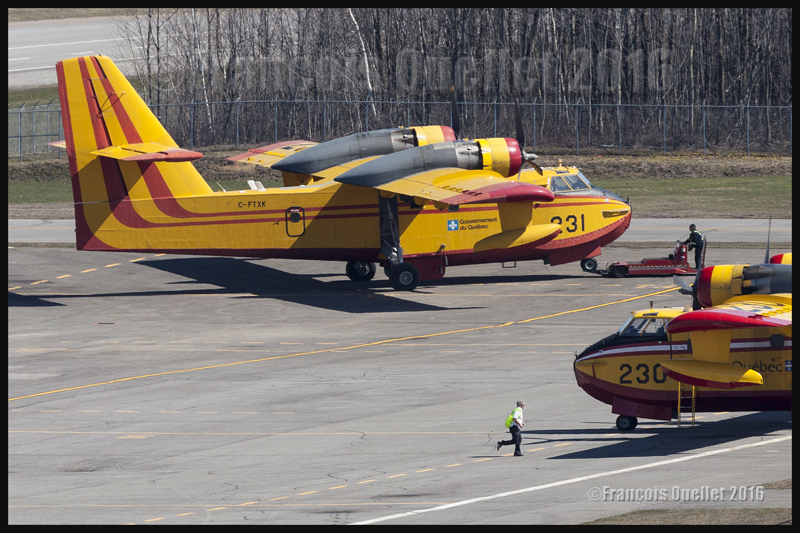
While several CL-415s are leaving for Alberta, few water bombers, like the two Canadair CL-215s shown below, stay at the Quebec Jean-Lesage international airport in case of forest fires in the province and also to be used for the seasonal rehearsal needed for every pilot before they are dispatched across the province of Quebec.
Two Canadair CL-215 water bombers parked at the Quebec Jean-Lesage international airport in May 2016.
Global warming
Some people can say that global warming is not responsible for the increasing number of extended wildfires. They might be right, but I prefer to adopt a wider view than only what is going on in Alberta. Heat transfer between the north and south are now more extreme in order to equalize the temperatures around the globe. All means to reduce the difference in temperatures between the equator and the poles are at work and this causes increasing problems to particular regions.
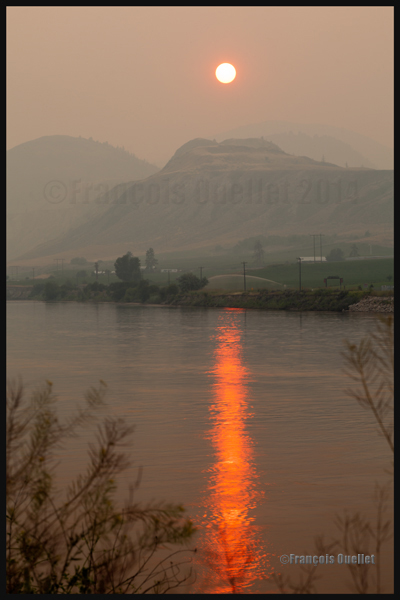
The Kamloops region in British-Columbia, when numerous forest fires were raging 2014.
A powerful El Nino phenomenon, repetitive Omega blocks, the air circulation in different cells (Hadley, Ferrell, polar, Walker) all participate in the heat exchange. At a more reduced scale, we also regularly hear of cold and warm fronts in the meteorological forecasts.
It is certainly not local warm fronts that are responsible for the fact that a thinner layer of permafrost is unable to ensure the stability of Arctic runways anymore. Nor are fronts responsible for the fact that houses on stilts do not have a stable foundation anymore. Many heat records have been established these past years in northern Canada. There will certainly be large amounts of money to spend to rebuild the Nordic infrastructures.
Brush fires as soon as April in Alberta
This year, as soon as April, there were widespread brush fires in a region as north as Fort McMurray in Alberta because winter has not brought much snow to humidify the land during Spring. I thus wondered what would happen once in July. Albertans did not need to wait that long to get the answer.
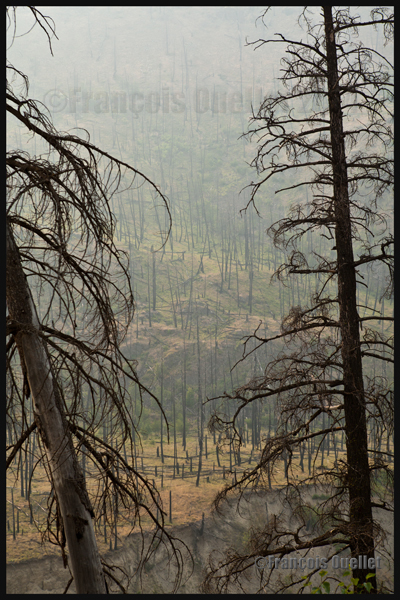
Western Canada forest after a fire (2014)
The modelization of climatic changes indicates that, in the Fort McMurray region, the forest fire season is already fifteen days longer that it used to be. More heat might favor more droughts. But an increase in temperature also favors the development of thunderstorms and with them comes lighting that will start up new fires.
One thing is sure: insurance companies will not lose time with the different theories on global warming. The reinsurers (those who insure the insurance companies) have the obligation to limit their losses to stay afloat and premiums will quickly increase to answer to the thousands of claims following an increasing number of natural disasters.
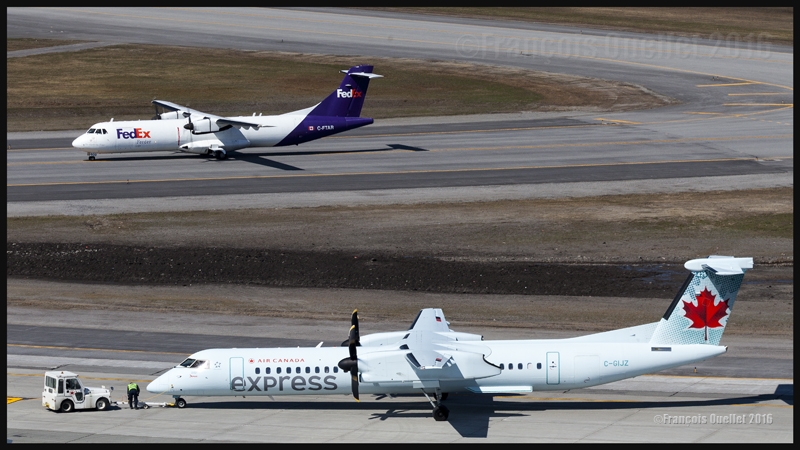
Photos of the local air traffic in Quebec, just after the CL-415s departed to Fort McMurray
FedEx ATR 72-202F C-FTAR and Air Canada Express Bombardier DHC-8-Q-402NG (C-GIJZ) at the Quebec Jean-Lesage international airport in May 2016
At the Quebec airport, between the take offs of the four Bombardier CL-415 towards Fort McMurray, I was able to take few pictures of the local air traffic. In the photo above, it is possible to see a FedEx ATR 72 (C-FTAR) taxiing toward the ramp after a landing runway 06. An Air Canada Express Bombardier DHC-8-402 (Q-400) (C-GIJZ) was also being towed for is imminent departure.
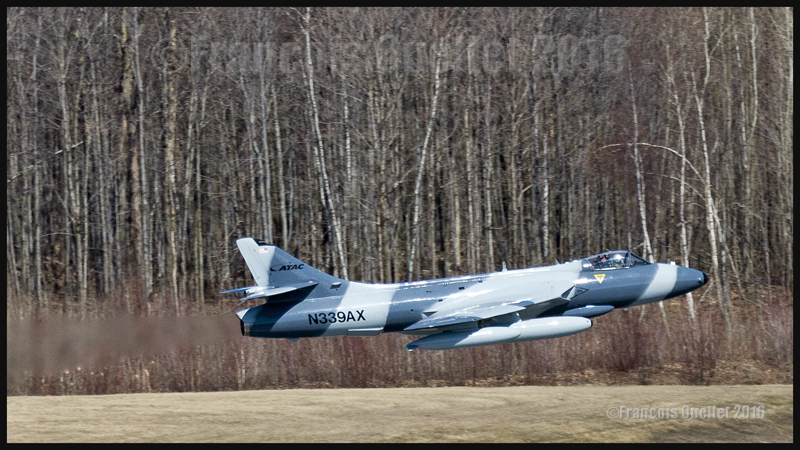
ATAC’s Hawker Hunter N339AX
Being in luck, I was able to capture a Hawker Hunter (N339AX) belonging to the American company ATAC, just airborne from Quebec. As for any military jet, it is difficult to ignore them on take-off: the reactor’s noise is there to remind you of their presence…
A Hawker Hunter belonging to the american company ATAC is airborne from the Quebec Jean-Lesage international airport (CYQB), May 2016
A Hawker Hunter, from the american company ATAC, is airborne from the Quebec Jean-Lesage international airport (CYQB) in May 2016
The pictures above have been taken with a Canon 5D MKII camera, equipped with a telephoto lens Canon 70-200 f2.8L IS II USM with a polarizing filter and a Canon Extender EF 2X III which brought the focal length to 400 mm. Even then, more cropping was necessary to enlarge the aircraft since I was quite far away from the runway.
Wishing to ensure that the image was sharp (a blurred picture is more probable with a 400 mm focal length while the photographer attempts to follow a fast flying jet), I adjusted the shutter speed to 1/1600 and made sure that the automatic focus was set on AI servo.
I now realized that a slower speed could have worked a bit better since it would have allowed showing a blurred forest in the background while keeping the aircraft sharp. But it is not often that you have the opportunity to see a Hawker Hunter in flight these days and I played safe with the shutter speed. The ideal shot will be for another day…
CL-415s and CL-215s together in Quebec (2012 photo)
CL-415 and CL-215 water bombers belonging to the Gouvernment of Quebec. Quebec Jean-Lesage international airport (CYQB) 2012
A last picture, taken few years ago, during autumn 2012, shows numerous water bombers CL-415 and CL-215 parked at the Quebec Jean-Lesage international airport (CYQB). During the off- season, the water bombers are brought back to Quebec City from the different bases were they have been in operation during summertime.
For other articles on aviation and photography, click on the following link: Aviation photography