Categories
Photos of Quebec Ship photography

Ready for some stand-up paddleboarding on the St. Lawrence?

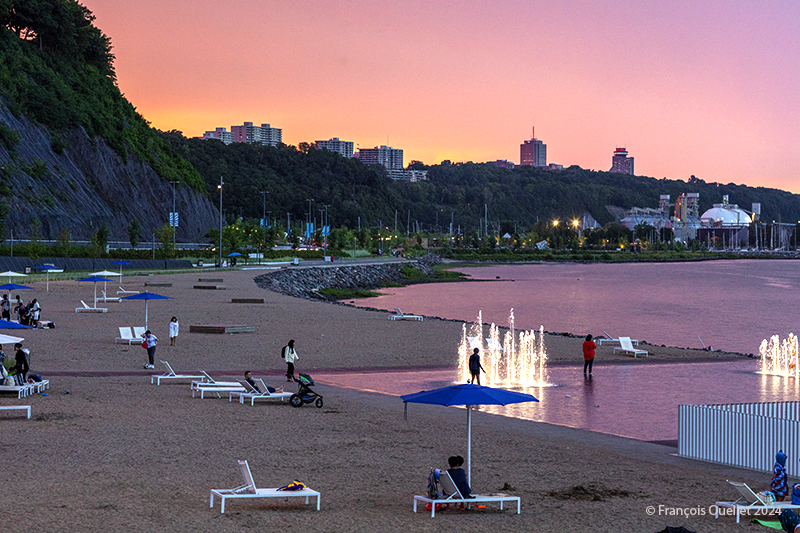
An evening after the rain at the Station de la plage, Québec 2024

The information below applies to those interested in stand-up paddleboarding in Quebec City, from the “station de la voile” towards the “station de la plage” and the surrounding area.

Before setting out, check the general weather forecast.

Those with some aviation knowledge should check the CYQB TAF (Terminal Area Forecast) for wind estimates.

Also check the tide table (Lauzon) to see if the tide is rising or falling.

Wearing a personal flotation device (PFD) is mandatory. A wetsuit is strongly recommended, as the water in the St. Lawrence remains cold, even in summer. Here’s a useful rule for deciding what to wear: the water temperature plus the air temperature, compared to 37 °C. If the result is less than 37, a wetsuit is preferable. If the water is 10 °C or colder, regardless of the air temperature, a waterproof layer is essential.

For water temperature near Quebec City, click on “water temperature.”

Buoys measure the temperature. Another possible site for the winds: Windy.

Wetsuits come in various thicknesses (2, 3, or 5 mm for slightly colder conditions).

The wetsuit should fit snugly against the body to prevent air pockets from forming between the skin and the material. If you’re in saltwater, you can apply lotion to your skin under the wetsuit (since water seeps through the wetsuit and can irritate the skin).

Hypothermia: the human body can withstand a maximum of fifteen minutes in water at 5 °C.
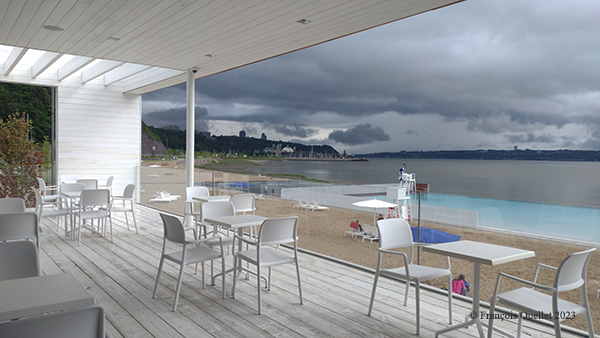
Station de la Plage and showers in Quebec City.

The “rule of 12” is taken into account when launching a paddleboard on the river. Each hour corresponds to a more or less rapid rise or fall in water flow. On the St. Lawrence River near Quebec City, the tidal range is three metres. A tidal cycle lasts about 6 hours. During the first hour (1/12) = 1/12 of three metres = .25 metres. The tide changes by .25 metres during the first hour. The second hour (2/12) = .50 metres. The third and fourth hours: 3/12 each. Therefore, during the third and fourth hours, the tide varies by 0.75 metres each hour. The fifth hour: 2/12. Sixth hour: 1/12.

From the “station de la voile”: if the tide is falling and winds are blowing from the S, SW, W, or NW, there are two obstacles when heading west. There is a headwind component, and the person paddles against the current. Check whether the wind strength allows you to launch the board and head west first, especially if the tide is falling.

The safer approach is to exert effort at the start of the trip and coast on the return.

If you decide to head west with an incoming tide, the trip out will be very easy, but you’ll have to paddle hard on the way back.

To gauge the effort required, you can choose a reference point along the Champlain Promenade and note how far the board drifts when you’re not paddling. Then, compare that to your progress when paddling normally. For example, during a trip westward with an ebb tide (water flowing back to the sea) and winds from 250 degrees at 10 knots, I paddled for over an hour just to reach the first stone pier near the “station de la plage”. This included using the double paddle.

At the ends of the stone jetties extending into the river at the sailing and beach stations, waves come from all directions.

Kneeling on the board, you can catch higher waves and have more power to paddle.
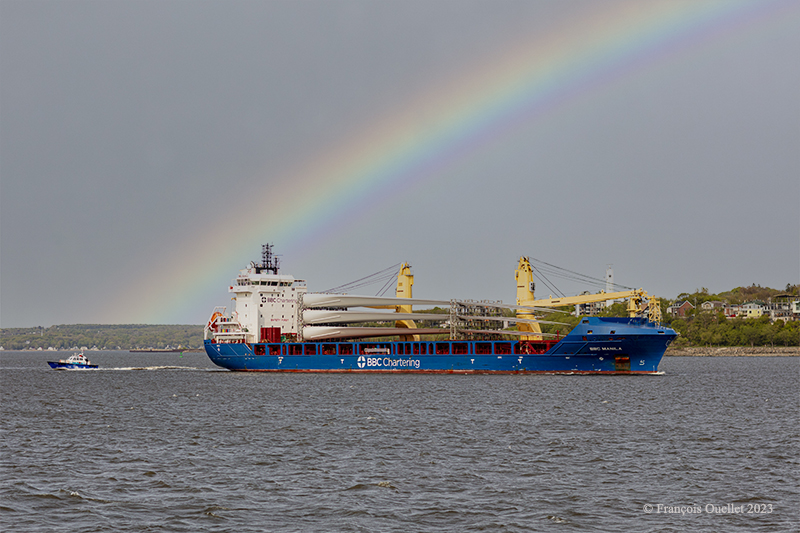
The BBC Manila carries wind turbine blades on the St.Lawrence Seaway near Quebec City.

The river has short, long, and very long waves that mix. You may dip a few feet in the through and rise back up on the ridge when the wave is large. There are also times when you’re pushed sideways. Keep an eye on the shore to see which way you’re being carried.

To maintain your balance, keep your eyes on the horizon at all times. Alternate between twenty-minute sessions standing up and then kneeling to rest. If necessary, set up a board seat and use a double paddle while seated for a change.

You must not stray too far from the shore to avoid becoming a victim of sailboats or jet skis travelling at high speeds in areas that require more cautious navigation.

When a large ship passes offshore, two-foot waves arrive a few minutes later, gently lift you up, then continue on and crash against the banks on either side of the river. They return to the paddleboarder much later and are much weaker.
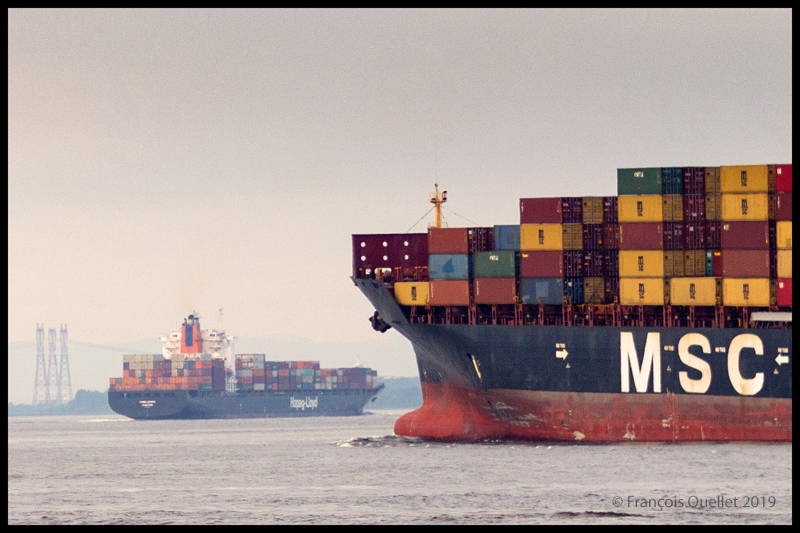
The container ship Hapag_Lloyd Quebec Express and the container ship MSC Paola are sailing around Île d'Orléans near Quebec City.
The container ship Hapag_Lloyd Quebec Express and the container ship MSC Paola are sailing around Île d’Orléans near Quebec City.

Take this opportunity to relax. Since this is a water sport, it’s normal to end up in the water from time to time.

There’s a beach near the “station de la voile.” It has few sharp rocks. However, keep an eye out and avoid going there when the tide is at its highest.

Have fun!
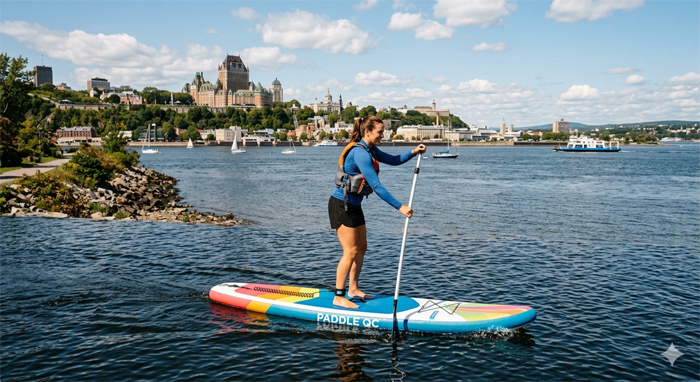
A paddleboarder on the St. Lawrence River, as imagined by AI.

A paddleboarder on the St. Lawrence River, as imagined by AI.

Click the link to see more photos of Quebec City on my blog.
Categories
Photos of Quebec

Sea kayaking on Île d’Orléans

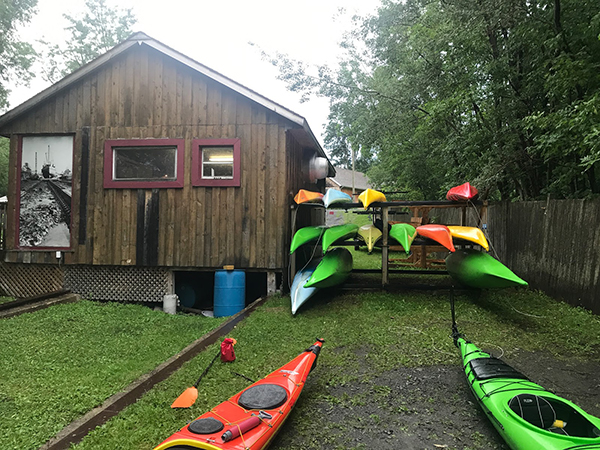
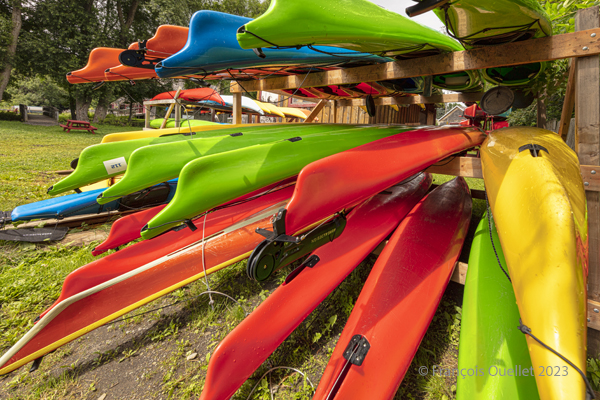
Sea kayaks at Saint-Laurent-de-l'Île d'Orléans 2023
Sea kayaks at Saint-Laurent-de-l’Île d’Orléans 2023

On Sunday, September 24, 2023, the company Quatre Natures   organized a certified level 1 sea kayaking course the St. Lawrence River, starting from Île d’Orléans. As registration was done well in advance, we had to be a bit lucky during the activity, as it would take place as much in good weather as in bad.

So, I take a chance. Fortunately, an incredible day awaits the six students: full sun and twenty degrees Celsius. How should we dress for the circumstances? We know that the human body temperature is 37 degrees Celsius. The kayaker adds up the water and air temperatures and compares the total to the temperature of the human body. With the river that day at 18 degrees and the air around 20 degrees, this gives a total of 38. As this figure is slightly higher than normal body temperature, we can wear normal clothing for water activities, rather than a wetsuit.

The morning is used to cover theory. No one sets foot in the water. The instructor discusses what the kayaker must have on board, the relative quality of different equipment, preparation, communications and radio frequencies, safety and hypothermia prevention, and so on.

Sea kayaking activity at l'île d'Orléans (photo Vadym Kravchenko)
Sea kayaking activity at l’île d’Orléans (photo Vadym Kravchenko)

After lunch, the kayaks are placed on the lawn and the vocabulary related to each part of the kayak is learned. The student then settles into the kayak and learns how to adjust the footbraces, hold the paddle, install the spray skirt, and so on. The boats are then brought to shore and kayaking begins.

First, we learn the basic maneuvers. How to embark and disembark, the trajectory the paddle should follow in the water depending on whether you want to go forward, backward or turn. We discuss the correct position of the body, arms and wrists on the paddle, and the importance of rotating the pelvis to force the paddle properly. We quickly realize the influence of side winds on the kayak, especially when it has no centerboard or rudder.

The river is considered level 2 for kayaking. The current is strong, and we have to deal with three-metre tides. The wind around the island is also stronger than in Quebec City. Level 1 kayakers are encouraged to seek out Level 1 locations to gain experience, and never to set off alone at this stage of their learning process.

During the exercises, you can see the container ships and the various pleasure boats offshore. The larger vessels generate waves that take between five and ten minutes to reach the shore. When these approach, the instructor warns novice kayakers to turn to face the wave, so as to limit the effects on the boat.

The container ship Hapag_Lloyd Quebec Express and the container ship MSC Paola are sailing around Île d'Orléans near Quebec City.
The container ship Hapag_Lloyd Quebec Express and the container ship MSC Paola are sailing around Île d’Orléans near Quebec City.
The BBC Manila carries wind turbine blades on the St.Lawrence Seaway near Quebec City.

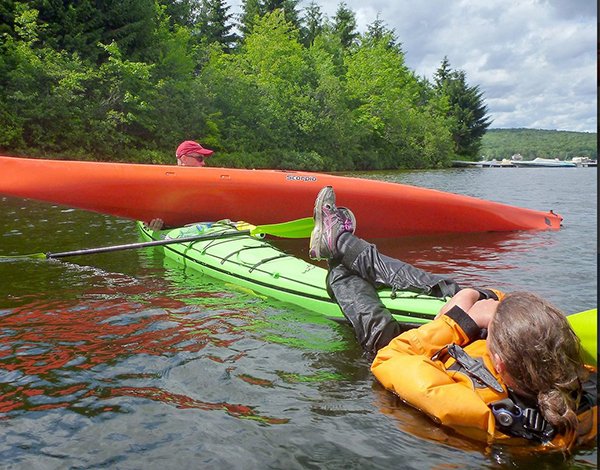
Then come the emergency maneuvers: what’s the procedure for getting out of a kayak that’s just capsized? How do you help someone who has capsized?

I didn’t have time to get to this stage of the course. I capsized before. I don’t remember how I managed to extricate myself from the kayak and get back to the surface, but we’re not talking about an approved method here. The brain immediately detects the danger and organizes itself so that the body gets out of the kayak and the head doesn’t stay underwater for too long.

In the minutes that follow, the instructor teaches us how to perform the classic exit from a capsized kayak. We work in pairs. At Level 1, there’s no question of using the paddle to force the kayak to turn.

To obtain KDM 1 certification, everyone must lean sideways so that the kayak tips over. Once submerged, the student leans forward, unhooks the spray skirt attached to the kayak, and slowly taps the kayak’s hull three times to signal that he is in control of what he is doing. The instructor wants to avoid unpredictable reactions. We then push ourself out of the kayak by placing our hands at hip height on the coaming. As soon as we are out of the water, it’s imperative that we hold on to our kayak, thanks to the lifeline. It only takes a few seconds. Here and there, you can hear a little coughing as the student surfaces, but nothing more. A good sip of St. Lawrence River boosts the immune system.

Next comes the recovery of the person in the water. As we work as a team, the kayaker in difficulty clings to the front of our kayak and stays there until we catch up with his or her kayak, lift it onto our boat, empty it of water, turn it over and position it correctly.

Sea kayaking course level 1 with Quatre Natures (photo Quatre Natures)

The person clinging to the kayak then releases his or her grip, and depending on the method taught, climbs back into the boat while the latter is being held securely. The important thing here is to keep the center of gravity as low as possible. If the person doesn’t hurry and proceed step by step, the operation is a success every time. 

A few more exercises follow, and it’s back to the beach on Île d’Orléans a few hours later. Once all participants have dried off and put on their warm clothes, the course concludes with a few weather notions, including the need to consult weather forecasts and radars, and to return quickly to shore when storm cells are present.

We also cover tide calculation (rule of 12) and how to attach a kayak to a car roof. How many attachment points? What equipment is available to make the job easier? Where should harnesses go to avoid breaking the kayak? Etc.

The KDM 1 certificate is awarded approximately eight to nine hours after the start of the course, depending on the instructor’s assessment. I noticed that on the way home, in the heat of the car, I really didn’t feel like rushing on the road. But you quickly come back to reality when you see how fast the cars are coming up behind you.

In short, a full day to remember!

Sea kayaking on the St.Lawrence Seaway near Rivière-du-Loup

Click on the link for Autumn photos of Quebec City and Île d’Orléans on my blog.