Categories
Photos of Quebec

Old Quebec, photographed with Canon’s ultra-wide-angle lens.

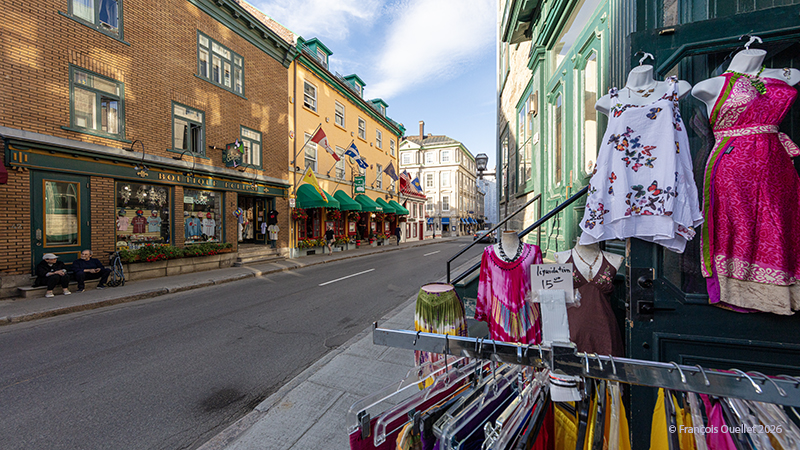
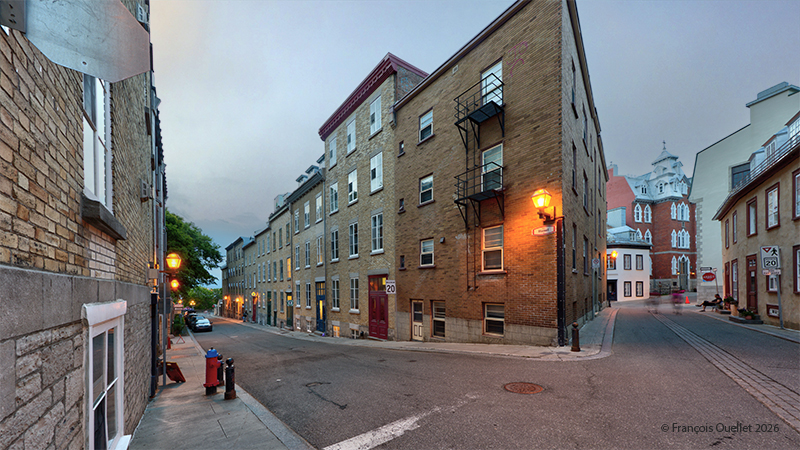
St. Louis Street in Old Quebec in June 2026.

Here’s a photo of Saint-Louis Street in Old Quebec before the massive influx of tourists. Nothing blocks the view of the buildings across the street.

Photography Technique

Today, the area is beautifully lit, and the few clouds add dynamism to the sky. Rather than capturing the scene around noon, it’s better to wait until dinnertime. The light remains bright, and the sun’s angle at that hour creates some nice shadows.

I’m taking advantage of a clothing sale to add some life to the photo. By framing the shot with a Canon EF 11–24 mm f/4L USM zoom lens, I can include the little multicoloured dresses in the image. We use whatever we can to improve the final result of the photographic composition.

Canon’s high-performance zoom lens allows me to capture numerous buildings while preserving all the vertical lines, without distortion.
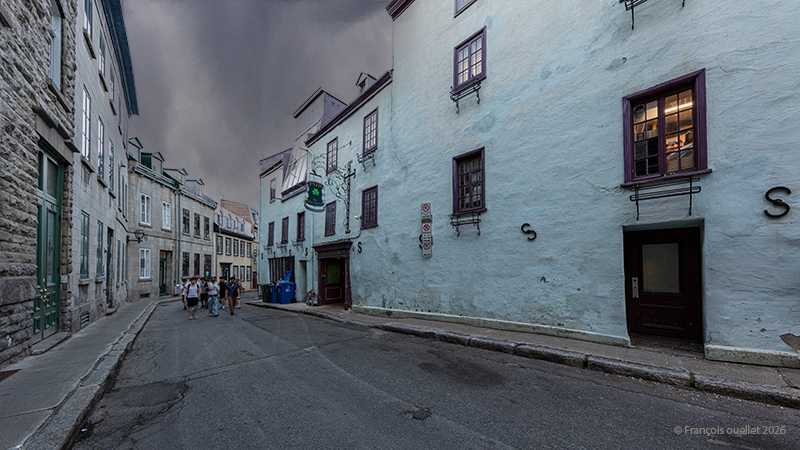
Old Quebec buildings and virga.

Above is an alley in Old Quebec, near Saint-Louis Street, but in a different context. This is a composite photo, meaning the sky is not the original one. I had some fun using digital editing software to search for clouds with precipitation that doesn’t reach the ground (virga).

The final result creates an interesting atmosphere, though it’s a bit gloomier than the first shot. The pronounced bluish tint on the building on the right comes from adjusting the vibrance. I moved the slider a little further to the right than usual.

So, we have two very different photos: an unaltered, authentic view of Rue Saint-Louis, and a composite alleyway.

Click the link for more photos of Quebec City on my blog.
Categories
Photos of Quebec

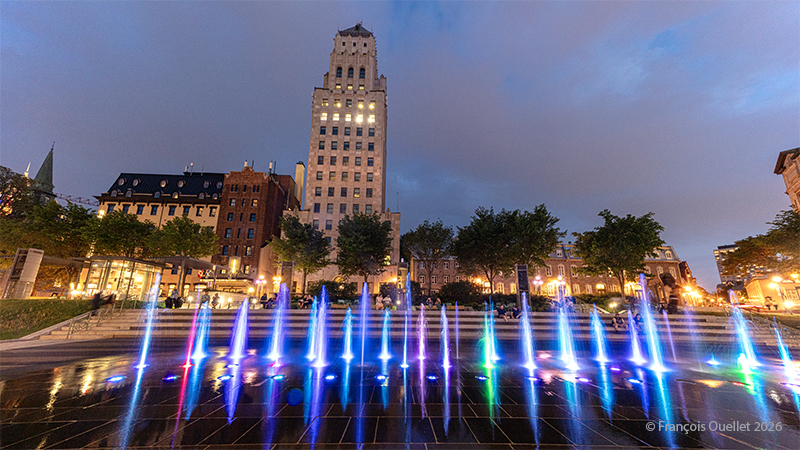
The Price Building and the fountain at Quebec City Hall.

City Hall Fountain and Price Building 2026

Photography Tips

Here are a few photography tips for taking a decent photo of the Price Building, the only skyscraper in Old Quebec, with the multicoloured fountain at Quebec City Hall.

Ideally, you should use an ultra-wide-angle lens. In the picture above, I’m using the Canon EF 11–24 mm F/4L USM zoom lens. At 11 mm, it frames the Price Building and the fountain without cutting anything out.

It’s best to photograph the scene during the blue hour. At this time, the cloud formations that are still visible create a more vibrant sky. The colours of the water jets also stand out better. Of course, a tripod and a camera shutter release cable are necessary.

The height and colour of the water jets vary constantly. It takes several attempts to get the jets high enough and achieve the desired colour. This way, you’ll capture large reflections on the tiles that ultimately create long, straight lines of colour.

It’s well known that fountains attract children… and parents. The main challenge when taking photos comes from the number of people making selfies and standing still in the water jets. It’s during those rare moments when no one enters the frame that you capture the scenery.

Shooting in RAW format allows you to enhance the data recorded by the camera later on. I use a fairly low ISO and a shutter speed between 1/60 and 1/125. A slower shutter speed also produces good results and alters the texture of the water jets. The depth of field is around 9.0.

Click the link for more photos of Quebec City on my blog.
Categories
Photos of Quebec

Old Quebec photographed with the Canon EF 11-24 mm f/4L USM lens.

Old Quebec in the evening during Spring 2026.

The narrow, winding streets combined with the tall houses of Old Quebec are captured beautifully with the Canon EF 11-24 mm F/4L USM ultra-wide-angle lens. It is the widest zoom lens Canon has ever produced.

It has the appearance of a “fisheye” lens, but it doesn’t distort vertical lines, even at 11 mm. This results in more realistic-looking buildings when that’s the desired effect.

Photography Tips

The photo above requires waiting until the end of the day for better light. Position the tripod so that it captures two alleys at the same time. The rule of thirds helps place the main building for a superior photographic composition. This rule of thirds, like other rules for that matter, is always just a suggestion.

The houses at the end of the alley on the right add colour and variety. They also create a visual barrier that draws the eye back to the foreground.

A remote shutter release connected to the camera minimizes camera shake. Five photos taken at different apertures achieve the desired HDR effect.

Of course, fleeting shadows—“ghosts” are often unavoidable in a city with many tourist attractions. This occurs when people move while the camera takes five photos spaced a few seconds apart. The Photomatix software offers the option to reduce the number of these ghosting effects, but you shouldn’t overuse this feature, as it can compromise the picture’s quality.

Verify in Photoshop or a similar digital editing software if the buildings are straight. Shooting in RAW rather than JPEG allows for additional adjustments to achieve a superior final result.

Click the link to see more photos of Quebec City on my blog.

Categories
Photos of Quebec

HDR Photography of the Château Frontenac at Christmas

HDR picture of the Château Frontenac at Christmas 2025 from Côte de la Montagne in Quebec City.

During the holiday season, the Château Frontenac is decked out in red and green. For an interesting effect, try taking a picture of the castle’s main tower from Côte de la Montagne. To do this, you have to point the camera upward, but all the lines that are normally vertical become slanted.

Photographic Technique

To correct this effect and restore the architectural lines to near verticality, some computer work is necessary. In a few minutes, after cropping and changing the photographic plane, the photo regains the natural appearance that the eye observes when climbing Côte de la Montagne.

HDR photo of the Château Frontenac and surroundings in winter in Quebec City.

The photo above shows another beautiful view of the Château Frontenac. In the middle of the tourist season, passersby in Old Quebec are plentiful in front of the camera lens. Long exposure times mean that several “ghosts” will appear to be moving around when taking nighttime photographs.

How can you avoid these “ghosts” as much as possible? Timing is important. Once the blue hour has passed, complete darkness provides uniform lighting. This allows you to choose a moment when no one is passing by the camera when taking each shot to achieve the HDR effect. Five shots with different apertures will give you the desired HDR result. I use a tripod and a Canon EF 11-24mm f/4L USM wide-angle lens mounted on a Canon 5DSR full-frame camera.

There is only one person very close to the camera lens during the entire session. I remove her from the HDR photo. Since she was working with a tripod, she moved very little during my five shots, which allowed the correction tool in the digital processing software to teleport her to a parallel universe.

Click on the link for more photos of Quebec City on my blog.

Categories
Photos of Quebec

Christmas decorations and atmosphere in Old Quebec.

Christmas time near rue Saint Paul in Old Quebec

While visiting Old Quebec, I took the opportunity to practice my night photography. The photo above shows some Christmas decorations at the intersection of Saint-Paul Street and Saint-Pierre Street. This is HDR photography, as I stacked five photos of 50.6 megapixels each.

Christmas decorations on rue Saint-Pierre in Old Quebec

For the photo above, I am a little cramped in the old Rue Saint-Pierre. It was only with the help of a Canon EF 11-24 mm F/4L USM super wide-angle lens mounted on a tripod that I was able to take this shot. There is only one shot, because the HDR effect would not produce anything interesting, accumulating the lights on the illuminated sign to such an extent that everything would become diffuse.

The format is not standard, but that only matters to photographers who are unable to break free from the theoretical rules of photography.

Click on the link for more photos of Quebec on my blog.

Categories
Photos of Quebec

Château Frontenac and the winter wonderland of Old Quebec

Old Quebec in winter seen from Parc Montmorency in 2025

It’s time for another winter outing in Old Quebec. The night photography session will be devoted to architecture.

The temperature is about -14 C and the winds are blowing at 15 km/h. Without gloves in order to manipulate the little buttons on the camera, the skin feels -22 C. A regular break is essential to thaw out the fingers!

I took the photo from Parc Montmorency, just up the côte de la Montagne. This historic site is a major tourist attraction in Quebec City. Louis Hébert, Canada‘s first farmer, cultivated the land here on his arrival in New France. It’s important to understand, however, that the natives knew about farming and cultivated the soil long before the arrival of the French settlers.

On the left is a sculpture of Sir Georges-Étienne Cartier, one of the Fathers of Confederation. The Château Frontenac and Price Building are also visible in the distance. In the foreground is a building that has changed function many times. It was originally the first Episcopal Palace.

Photography technique

For this shot, I planted my tripod in 40 centimetres of snow. I used a Canon 5 DSr camera equipped with a Canon EF 11-24 mm F/4L USM ultra wide-angle  zoom lens. I could have set the ISO to 200 thanks to the stability of the tripod, but the wind demanded a faster result due to possible vibrations. ISO and shutter speed are therefore dictated by ambient weather conditions rather than low light.

Click on the link for more photos of Quebec City and Île d’Orléans in winter on my blog.