Today, rain and fog disrupt operations at Quebec City’s Jean Lesage International Airport. The conditions are at their minimum for take off and landing. But the captain of this Air Transat’s flight decides to proceed as the weather improves momentarily.
The passenger jet will take off from runway 06. But the airstrip is soaked. When the pilot applies power, we will only see water spray across the entire picture. A better choice is to focus on the A321neo as it taxis slowly.
Photography Tips
Since the sky isn’t particularly captivating due to its uniform gray colour, it becomes imperative to find something else to increase interest to the scene. The runway lights will do the trick. By including them in the foreground of the photo, they add life and frame the aircraft as it joins the runway.
I avoid photographing the plane directly from the side or from behind, as the effect is a bit static. Entering the runway at an angle offers a better alternative. Furthermore, it is not necessary to show the entire fuselage of the Airbus for a good shot.
With just a uniform gray sky, part of the aircraft, and a few runway lights, it becomes possible to produce a shot with more dynamism.
Click on the link for more aviation-related photos on my blog. There are also photo galleries for enthusiasts in the menu.
In September 2025, another edition of Vintage Weekend took place in Quebec City. This year, more than 200 vintage cars were on display on Saint-Paul Street and on the grounds adjacent to Espace Quatre Cent in Quebec City’s Old Port.
Stéphane Lavallée’s 1959 Corvette at Quebec City’s Vintage Weekend
As usual, restaurant owners had their hands full serving the many curious visitors who came to admire the cars. In addition, they had to contend with the presence of travelers who had recently disembarked from the three cruise ships moored in the harbor. The next photo shows the energetic team at Bistro St-Malo hard at work feeding passersby.
The restaurateur of Bistro St-Malo at work on St-Paul Street at Weekend Vintage 2025
This year, musicians from Calgary entertained the crowd with songs from the 1950s. The audience was delighted by the excellent quality of the performance, both in terms of singing and music. The same can be said of the dancers, who took us back in time with a few hits from that era.
Retro dancing on St. Paul Street at the Quebec Vintage Weekend in 2025
Below, cars occupy the space surrounding La Vivrière, a fountain sculpture commemorating the founding of the Food and Agriculture Organization of the United Nations (FAO).
Gary Lynch’s Hudson Hornet Hollywood 7x at Quebec City’s Vintage Weekend
Burger Heaven Lights on for Service at the Weekend Vintage in Quebec City
Paul Forest’s 1955 Chevrolet Bel Air with modified color
1952 Oldsmobile Super 88 Holiday and Michel Savard at Quebec City’s Vintage Weekend
Above, Michel Savard poses proudly next to his 1952 Oldsmobile Super 88 Holiday. As for André Guillemette, he had original parts shipped from Great Britain to do justice to his 1962 Jaguar Mark II, which can be seen below.
André Guillemette’s 1962 Jaguar Mark II at Quebec City’s 2025 Vintage Weekend
Reflections in Michel Métivier’s 1967 Pontiac GTO at Quebec City’s Vintage Weekend
A final photo shows St. Paul Street with Charles Boisseau’s 1965 Corvette Stingray.
Charles Boisseau’s 1965 Corvette Stingray at Quebec City’s Vintage Weekend
During summer 2025, several large aircraft scheduled to land at Montreal Airport had to divert to Quebec City Jean Lesage International Airport (CYQB). Numerous thunderstorms disrupted arrivals and departures at the main airports in the province of Quebec.
The extreme weather in the west gradually moved eastward. This delayed and even cancelled the departure of many planes in Quebec City.
When most of the storms finally passed over Quebec City airport in the evening, an Air Canada Boeing 777-300 ER took off from runway 24 to fly its passengers back to Montréal.
In the background, Air Transat aircraft can be observed. The Swiss Air logo can also be noticed on an Airbus A330-343. It had come from Zurich and was further diverted to Quebec City, along with an Air France Boeing 777-228 LR and a few others.
Below, we see the Boeing 777-300 ER refuelling at a time when extreme weather conditions have not yet reached the airport. Two Avjet tanker trucks are standing near the aircraft. The height of each truck is less than the internal diameter of the Boeing’s engines. For several years, this aircraft held the record for the largest engines on a civil aircraft. Now, the Boeing 777X has taken the crown.
Air Canada B777-300ER refueling at the Quebec Jean-Lesage international airport.
Photography Technique
Both photos required some compromises. Everything works if you accept being completely soaked and working with both feet in the water along a metal barrier with lightning flashing here and there. For some photos, the session lasted two hours.
I took the shots from a hole in the airport fence. My Canon EF 300 mm f/2.8L IS II USM lens was protected by a plastic bag tightly wrapped around the lens hood.
A frequency scanner provided data about air traffic. A controller informed an Air France pilot that such a situation of aircraft diversions during extreme weather had not been seen in several years.
I set my full-frame camera to produce only RAW images. Focusing was done in SERVO mode. I reduced the depth of field to optimize speed and limit the size of the photographic grain (ISO).
When selecting photos, I preferred the one showing the Boeing taking off, but where the Swiss airline’s logo is still visible. It was important to highlight the aircraft’s presence in Quebec City.
The Kingfisher is equipped with sensors that can locate objects or people up to a distance of 40 kilometers, even in low light conditions. Its range allows it to remain in flight for over 4,500 kilometers.
Photography tips
I arrive too late at Quebec City airport: the plane is already parked. However, information obtained from the pilots indicates that takeoff is scheduled within the next hour on runway 06.
Ground traffic provides excellent opportunities to photograph an aircraft while benefiting from an interesting background. The photography technique required for this first visit by the Kingfisher is really basic.
Communications with the control tower indicate when the CC-295 is starting up. It will stop just before entering runway 06. A 200mm telephoto lens would normally do the trick, provided the ISO is not too high. But today, I am trying out a recent acquisition: a Canon EF 300mm f/2.8 L IS II USM fixed telephoto lens.
In the middle of the day, a photographer deals more with the quantity of light than its quality. However, the goal here is not to capture a bouquet of flowers or a wedding, so the harsh light should be fine. The flamboyant color of the aircraft will distract attention from the lack of interest in the ambient light.
With the shutter speed reduced to 1/125 and the ISO set to 200, I wait for the moment when the Kingfisher is opposite the control tower. This will provide a high-quality background. Twenty photos later, the plane is nothing more than a memory.
Today’s flight around the planet takes place between the virtual airports of London City (EGLC) in England and Rotterdam-The Hague (EHDR) in the Netherlands. The weather looks good, apart from a few large TCUs here and there along the route. The crew imports the Simbrief flight plan into Navigraph to facilitate navigation between the two countries.
Daher TBM930 airborne from the London City virtual airport (EGLC) in United Kingdom
For a fast and comfortable journey, we choose the high-performance Daher TBM930 in Canadian colors. Microsoft has truly designed a marvel of a virtual aircraft.
Virtual TBM930 over United Kingdom heading to the Rotterdam airport (EHDR), Netherlands
The operating ceiling is 31,000 feet and the maximum range of the TBM930 is around 1,730 nm. With a cruising speed of 330 knots, we cross the English Channel in no time. As you would expect, there is a lot of shipping traffic between the North Sea and the English Channel.
TBM930 turboprop aircraft over water and approaching Netherlands
We are now above the Netherlands. The programmed route reads as follows: EGLC runway 09 DEP ODUK1H ODUKU M84 TOVGU M84 CLN P44 RATLO M197 REDFA MASOS. We have selected the REDF3R arrival and the RNAV runway 24 approach.
Working Title Simulations Daher TBM930 over Netherlands approaching the Rotterdam virtual airport (EHDR) with Microsoft Flight Simulator
Below, the cockpit photo shows the interior of the TBM930 and the route followed for the approach. We are descending rapidly to reach the recommended altitude of 2,000 feet a little further on for arrival.
Cockpit of the Daher TBM930 as it approaches runway 24 for the Rotterdam (EHDR) in flight simulation MSFS
There are strong winds today and mechanical turbulence throughout the journey to Rotterdam.
TBM930 approaching rwy 24 for the Rotterdam virtual airport (EHDR) with Microsoft Flight Simulator MSFS
The autopilot keeps the single-engine turboprop slightly to the right of the centerline of runway 24 during the long final approach to counter strong crosswinds. The VNAV function does a very good job of maintaining the correct altitude during descent.
MSFS Daher TBM930 on final for rwy 24 Rotterdam airport in flight simulation
During the short final approach, we disconnect the autopilot. Surface winds are blowing at 320/14 knots. Moments later, we land the virtual aircraft without breaking anything. A short taxi brings us to a parking spot where staff are waiting for us.
Canadian Daher TBM930 arriving at the virtual Rotterdam The Hague airport (EHDR) with Microsoft Flight Simulator
Flying virtually with the TBM930 is a treat. It is one of the best virtual aircraft currently available on the market for use with the Microsoft Flight Simulator (MSFS) flight simulator. What’s more, virtual pilots don’t have to pay extra for this aircraft, as it comes with the MSFS software.
The next leg of this simulated flight around the world takes place between Rotterdam and Paris-Le Bourget Airport (LFPB) in France. Customers have chartered an old MD-11 in KLM colors for a historic flight to the Air and Space Museum in Le Bourget.
Montreal city view from Mount Royal in the evening in HDR.
This photo of Montreal in the evening during the blue hour is actually three photos superimposed with different apertures (HDR photography). In the absence of a tripod, I placed the camera on the rampart at the top of Mont-Royal. This allowed me to use a very low ISO and a nice depth of field.
Mount Royal is a major tourist attraction. The many visitors crowd along the rampart and compete for a selfie. Getting through the three HDR exposures without being hit by a curious onlooker is a miracle. As soon as my camera moves the slightest bit, I have to take all three photos again. And that evening, Mount Royal was crowded! But luck eventually smiles on us.
Sculpture of a winged demon on a Montreal building.
In Montreal, you can expect many styles of sculpture to grace the facades of buildings. The red-eyed demon above has an strong effect on the pedestrian! Good thing it’s not in front of a restaurant…
Rabagliati artwork on a Montreal building.
On the Plateau Mont-Royal, there’s a space reserved for a creation by Michel Rabagliati, the Quebec author renowned for his Paul series of comic strips. He also produces graphic novels, of which “Rose à l’île” is a good example. The winter scene on the building contrasts with the warm summer day in Montreal at the time of our visit.
A “Giant prickly stick insect” is on my hand at the Montreal insectarium.
What a wonderful experience this week at the Montreal Insectarium! While we were visiting one of the pavilions, an attendant offered to hold a Extatosoma tiaratum, also known as tiara snail, scorpion stick or Australian walking stick.
The insect gets its scorpion-like reputation from the fact that it curls its tail in the same way as a scorpion when it feels in danger. But it doesn’t sting. You can then put your hand upside down and it will grab you effortlessly. This is its natural position under a branch.
As someone who rarely carries his cell phone around with me, I was delighted to have the opportunity to take a photo of him that day!
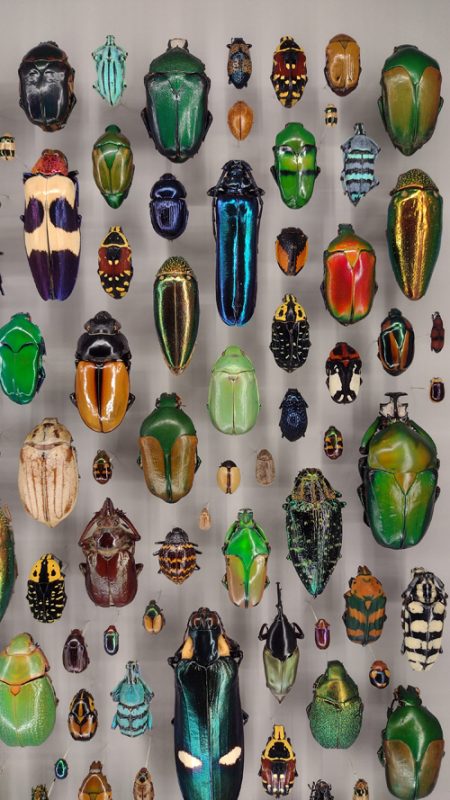
Part of the insect collection at the Montreal insectarium.
The diversity of shapes and colours of insects in the environment is astounding. Nature never ceases to amaze.
Superb specimens at the Montreal insectarium.
In addition to the central pavilion, home to a large number of colourful insects, visitors can also take a stroll through the butterfly aviary. The butterflies wander around the visitors, but it is forbidden to touch them.
Among Quebec’s tourist attractions, the Montreal insectarium is well worth a visit.
Click on the link for more articles and photos on the environment in my blog.
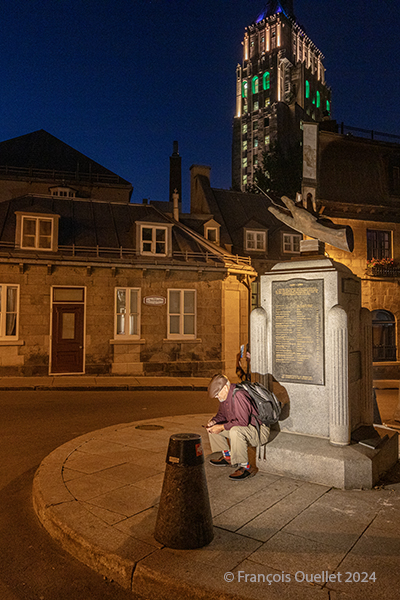
A pedestrian takes a break in Old Quebec, with the Price building in the background.
A pedestrian rests in the evening in the shadow of the Price building in Old Quebec. Many residents and tourists alike appreciate the safety of the Old Town. Accompanied or unaccompanied, even the elderly feel at ease here late in the evening.
The Price building is the only skyscraper allowed in Old Quebec. During my photography sessions in this area, I enjoy finding different vantage points and special lighting to feature this unique building. At the time I captured the scene, there was still a bit of blue in the sky. This color blends delicately with the surrounding orange-yellow.
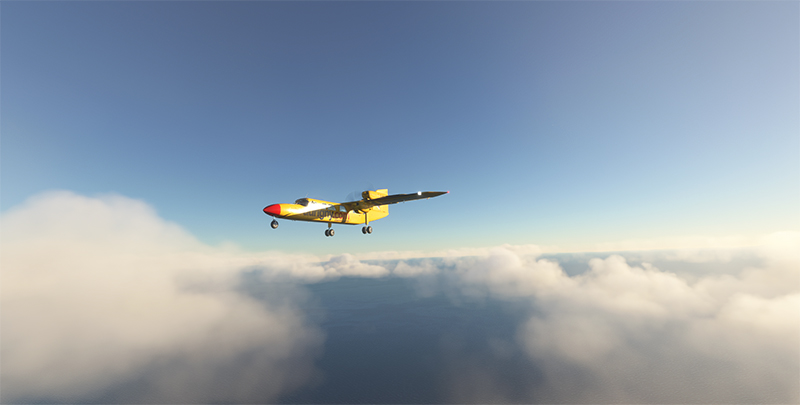
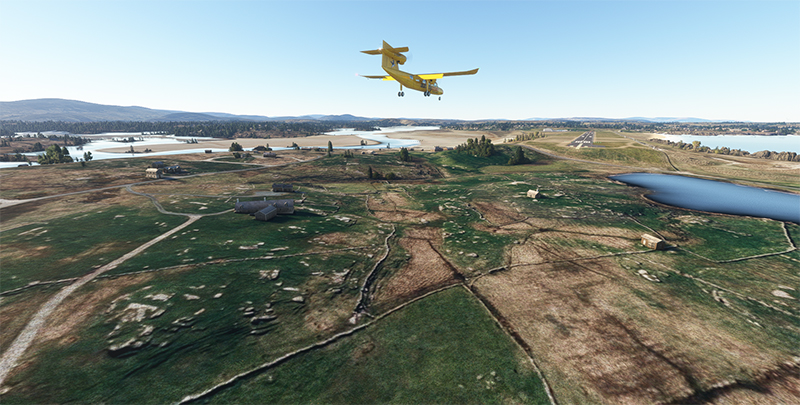
The flight simulation world tour continues with a Britten Norman BN2A Trislander MK III. The initial version of the aircraft is not particularly reliable. There have been engine failures, fatigue cracks in the structure, cowlings opening unexpectedly, etc. Nevertheless, we’re going to try our luck with this aircraft today.
BN2A Trislander airborne from the Barra beach airfield with MSFS
With a three-engine aircraft, pilots don’t take into account the distance to shore in case of engine failure. But if we were flying a single-engine aircraft, we’d have to head for Tiree Island at the highest possible altitude, then turn off towards Donegal.
Virtual BN2A Trislander MK III enroute to Donegal airport (EIDL) in the Republic of Ireland with MSFS
In all realistic virtual flights, a program injects weather data received from airports via the Internet directly into the flight simulator.
For the past few days, the weather in Ireland and Scotland has been nothing but fine. I was expecting rain and low clouds, but it’s been just the opposite.
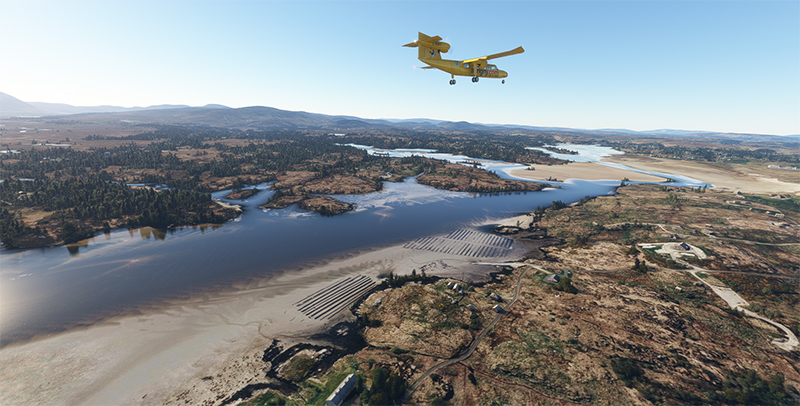
So, for the time being, the fine weather is making it easier to plan flights over a very large area. Below you can see the rockier landscape around Donegal airport.
BN2A Trislander descending towards Donegal in Republic of Ireland with MSFS
The Trislander is now on final for runway 21 at Donegal. Light winds make the approach easy. No part of the aircraft has been lost on the way!
The Britten Norman Trislander is on final for Donegal airport (EIDL) in flight simulation
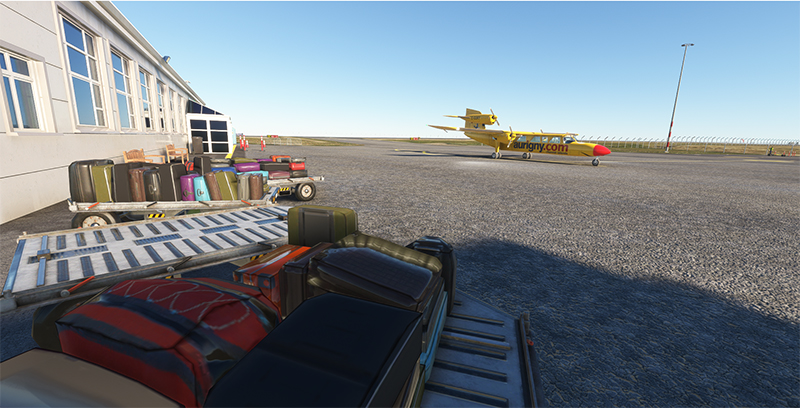
The airport staff have already brought out the suitcases for the next flight. Way too much luggage! They must have mistaken the Trislander for a Boeing 737. Aviation rules are strict. I don’t know if the passengers bring back too much shells or beer bottles with them, but some of the suitcases won’t be leaving today!
BN2A arrived at Donegal (EIDL) with Microsoft Flight Simulator
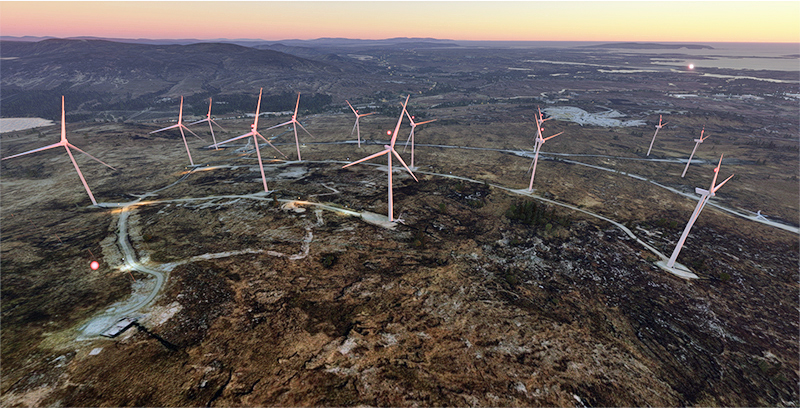
In the evening, a virtual drone flies over the area to observe the cliffs and numerous wind turbines.
Virtual landscape around the Donegal region in the Republic of Ireland with MSFS 2020 flight simulator.
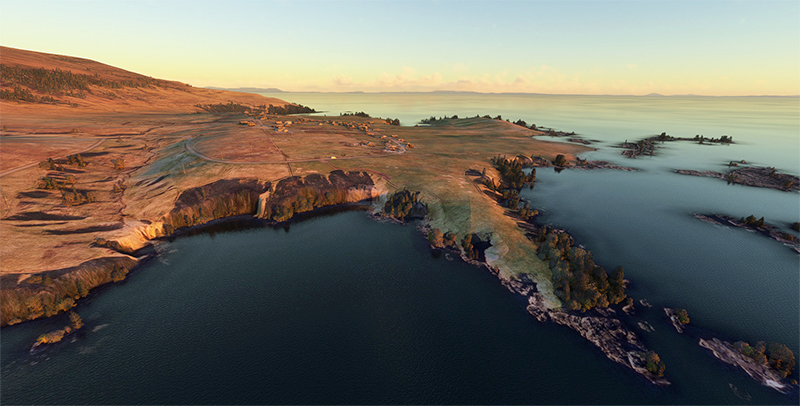
Virtual scenery in the evening in the Donegal region of the Republic of Ireland with MSFS 2020.
Leg 18 of the world tour will take place between Donegal Airport and the Isle of Man, using a Nardi FN-333 Riviera and Microsoft Flight Simulator 2020.
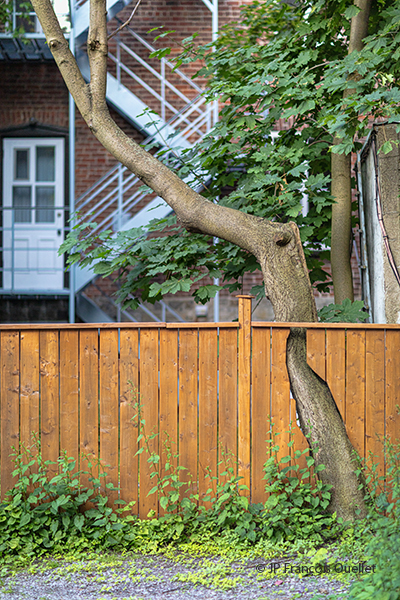
The photo above is a good example of appropriate human behavior and an original way of avoiding the eternal fence squabbles between neighbors.
Why argue about a tree that’s too close to the property line? Two Quebec City neighbors decided to work together and trim the fence to facilitate the growth of a tree that has been growing over the years.
It’s a minimal effort that preserves good relations between neighbors while taking care of the environment. Intelligence is the ability to adapt!
Click on the link for more articles on environment in my blog.