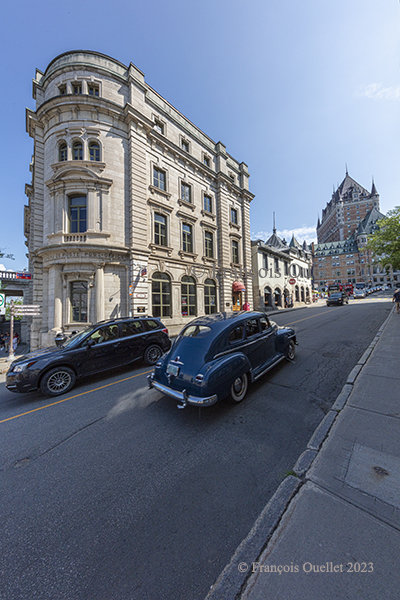
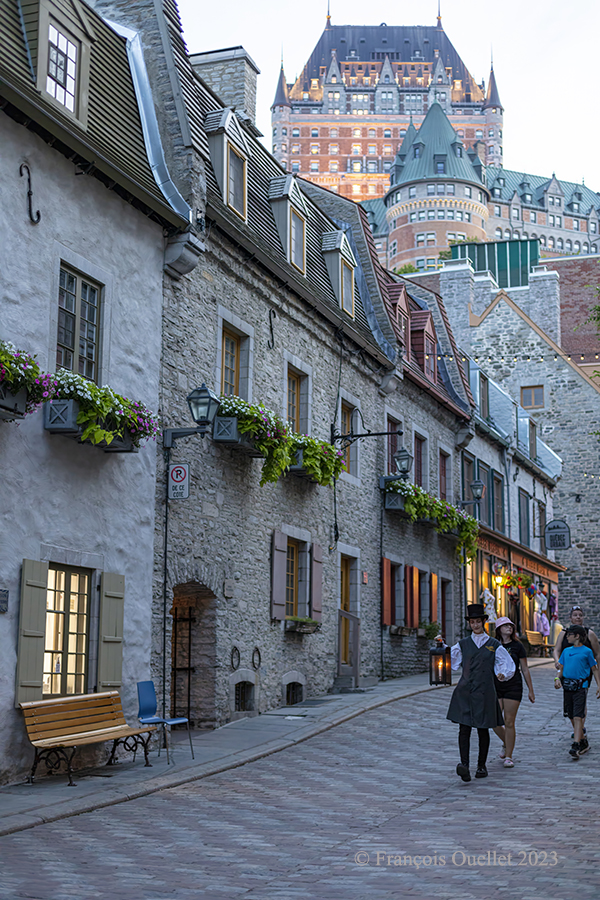
An Old Quebec view with the Château Frontenac in the distance using a Canon 11-24mm zoom lens.
Luck plays a significant role in the acquisition of an original shot. To put chance on our side, we need to go on photo expeditions frequently, whatever the weather, and seize opportunities when they arise.
For this outing in Old Quebec, I thought I’d use a Canon 11–24mm f/4L USM super-wide-angle zoom lens. It allows you to get very close to a tall building and obtain vertical lines without the top of the structure disappearing.
Indeed, many high-performance zooms require the utilization of image-processing software to produce an almost perfect vertical effect. But doing so cuts off the top of the edifice.
So, I was looking for a different perspective to shoot the Château Frontenac. I saw it more in the background, as a point of arrival for the eye, rather than taking up all the space. Even as a small edifice in a photo, you recognize it before any other structure.
To do this, I chose an architecturally interesting building as my starting element. It reminded me vaguely of the Flatiron Building in New York. Naturally, it’s not as high and offers that rounded effect when captured in wide-angle format.
I’ve observed a lot of representations of Old Quebec so far. However, I don’t recall previously noticing the street and the old edifices in this way. Usually, the building in the foreground is partially visible.
Lost in the analysis of the ideal angle, I heard a strange engine sound. On my left, a vintage car was moving slowly and would pass in front of the Canon 5DSr lens in a few seconds.
I quickly lifted the camera and placed it in the right spot. The auto was already gaining speed and I had to seize the opportunity. This vintage car blended perfectly into the scene. Only the slightly more contemporary station wagon indicates a more recent picture.
Modernity and the past still come together in harmony in a developer-protected Old Quebec. To capture interesting pictures, you need to get out into the old town frequently.
Some companies organize themed guided tours of Old Quebec at dusk in summer. The guides dress up in costume and regularly follow the same routes. With a little patience, a lantern-wielding person can be included in a photo, as well as the old stone houses and the Château Frontenac. This adds another interesting detail to the scene.
The picture above presented several challenges, some of which have been solved. Ideally, the HDR method would have provided a better control of luminosity, but the hostess holding the lantern would have disappeared in the process carried out by the Photomatix software. This person played an important role in the scene, so I decided to take just one shot, but in RAW format to optimize the sky light correction in post-processing.
I wanted to use the smallest aperture possible to get a precise focus from the foreground to the Château Frontenac. But due to the lack of adequate light and the movement of people towards the camera, I had to maintain a sufficient shutter speed, even at ISO 6400. Unfortunately, the aperture suffered a little.
So, this is a photo full of compromises, where you do the best you can with the situation and the photographic equipment available.
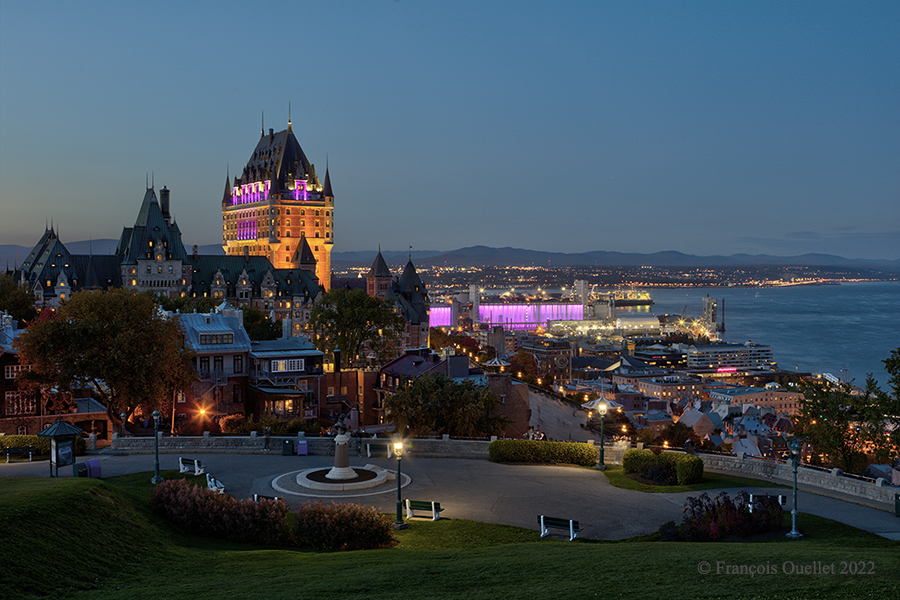
HDR photo of the Château Frontenac and surroundings at dusk 2022
Here is a view at dusk of the Château Frontenac and the surroundings of Old Québec. Even before taking a first shot, you can anticipate that the illuminated tower of the castle will distort the reading of the camera sensor, because it is much brighter than the surroundings.
To correct this frequent error in advance, it is best to look for an HDR (High Dynamic Range) effect by taking five photos with complementary apertures which will then be compiled in an appropriate software.
The most important challenge for this night photography photo was however to avoid taking pictures of too many tourists walking in the foreground. When they are in five close-up photos, people form what are called “ghost images“. You see them in duplicate or triplicate, half decomposed. They are useful when comes the time to add special effects, but this is not the case in the scene above.
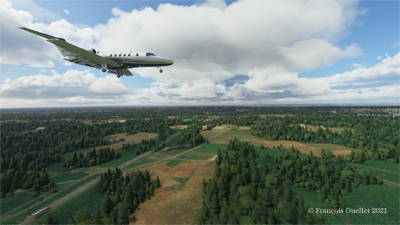
Approaching the Narita international airport, in Japan, with Microsoft Flight Simulator 2020.
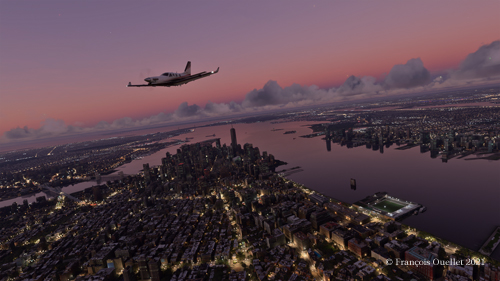
The Microsoft Flight Simulator 2020 is an extremely interesting product. Microsoft is taking advantage of the satellite imagery offered by Bing, which allows the flight simulation enthusiast to fly over the world almost like in the real life. With the addition of live weather and air traffic in real time, the immersion is incredible.
Flying over New York in the evening with Microsoft Flight Simulator 2020.
To download the game’s 128 gigabytes using my current internet plan, it took fourteen hours. I still remember when I bought a hard drive that could hold 30 megabytes of data: it was a computer revolution!
Of course, the game requires an adaptation. We are far from the old FSX platform. It goes without saying that you need a high-performance computer. But a new and very positive aspect of this simulator is that you can now use an X-Box controller as an in-flight camera, with the addition of a rudder and a steering wheel for more reality. This camera offers incredible possibilities and the additional X-Box controller becomes essential.
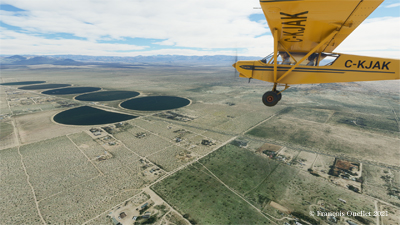
The Zlin Savage Cub flying over the United States using Microsoft Flight Simulator 2020.
As with anything new, there are some glitches. Personally, I have been using the CH company products for flight simulation for many years and the new MSFS 2020 has had problems recognizing the functions of CH products. Many virtual flight enthousiasts have had the same problems. So here are the links below that allowed a neophyte like me to solve the problems.
A first video of interest is also available. Its author uses a slightly different method, but it is super easy to understand and allows you to acquire additional knowledge if you want to map your CH rudder and control column correctly.
A second video gives you access to the CH company products. There you will find the links that allow you to print a representation of your CH flight controls. This will allow you to find which number is associated with a specific command control. You can then remap the controls to your taste and keep a record of all the modifications you made.
Here are two other practical links for answers to various questions about X-Box and other subjects and CH products.
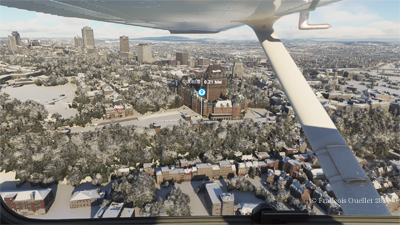
Aerial view of Quebec City using Microsoft Flight Simulator 2020.
In the screenshot above, you might recognize Quebec City, with the restaurant Le Concorde in the distance on the left, followed by the Edifice Marie-Guyart, a part of the Plains of Abraham, the Château Frontenac, the Price building and the lower town.
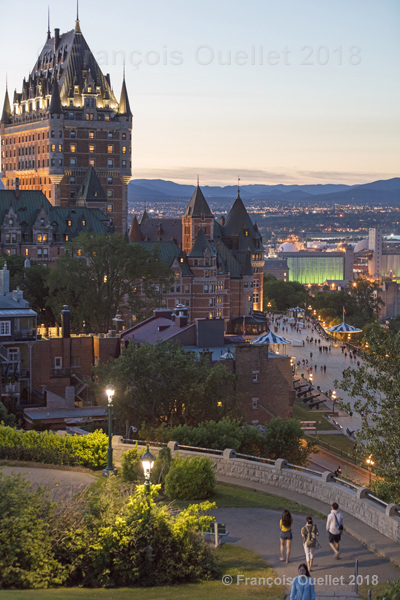
This picture of the Château Frontenac and Dufferin Terrace was taken during the Quebec Summer Festival 2018. From where I stood, near the Citadel, I could hear the crowd present on the Plains of Abraham during Patrice Michaud’s performance.
The picture was taken with a full frame Canon 5DSR camera equipped with a Canon EF70-200mm f/2.8L IS II USM. The focal length was set at 70mm. As the sun was setting, an ISO set at 200 would have caused the moving persons to be blurred. It was thus necessary to set the ISO at 4000.
Working without a graduated filter to attenuate the background light, I had to correct the exposure at +1, otherwise the middle ground would have been too dark and it was the main subject of the picture. I then slightly reduced the clear tones of the sky with Photoshop for a more balanced result.
The focus was done manually while the camera was installed on a tripod. The aperture was limited to 4.5 to limit the exposure time so that a compromise could be found between an acceptable depth of field and the moving people. This allowed for a shutter speed of only 1/15 sec, even in a relatively low light.
For other pictures of Quebec City, click on the following
links of my blog :
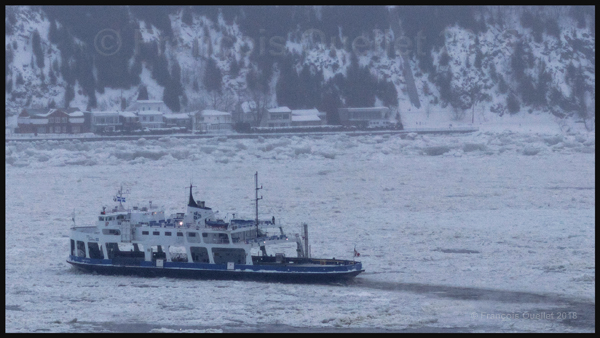
So far, this winter has been especially cold in Quebec City. There have been several weeks where the temperature stayed below -20 C. The STQ ferries, property of the Government of Quebec, must navigate the ice covered St. Lawrence Seaway between Lévis and Quebec City.
Government of Quebec ferry in the icy St. Lawrence Seaway between Lévis and Quebec. Winter 2018.
The ferries Alphonse-Desjardins and Lomer-Gouin, carrying cars and passengers between the two cities, must sometimes completely cancel the service. On three occasions so far, a ferry stayed stuck while trying to cross the ice covered seaway. The passengers had to wait patiently up to four hours for a crossing that normally takes ten minutes.
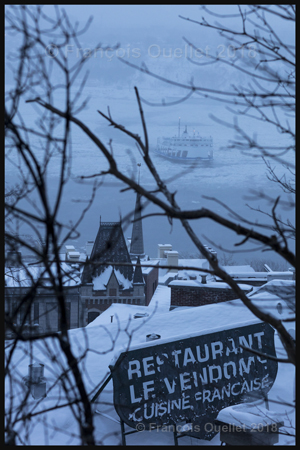
The picture below was taken from Old Quebec. In the foreground stands the “Le Vendôme” restaurant, which has been for sale for years now. In the distance, a ferry makes its way through ice towards Quebec City.
Ferry approaching Quebec during the winter in 2018
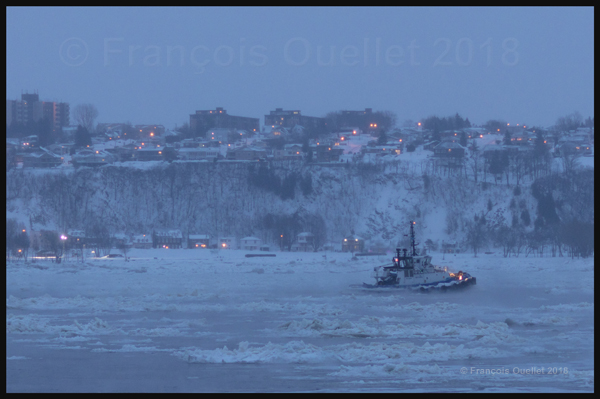
Ocean’s tugboats are also working on the seaway, regardless of the temperature. The picture below shows one of those tugboats enroute to the Jean-Gaulin refinery to help an oil tanker.
Ocean’s tugboat on the St. Lawrence Seaway near Quebec City. Winter 2018, by -20 C.
The pictures in this article were taken on January 7th 2018 with a Canon 5DSR equipped with a Canon EF 85 mm f/1.2L II USM. The temperature was -18 C.
The next day, a man who had fallen in the icy waters of the St. Lawrence Seaway was luckily spotted by one of the passengers who was standing on the Lomer-Gouin ferry heading to Quebec City. The man suffering from severe hypothermia was saved by the Government of Quebec STQ staff (Société des traversiers). Here is the link to TVA news (in French): Une personne tombe dans le fleuve Saint-Laurent à Québec.
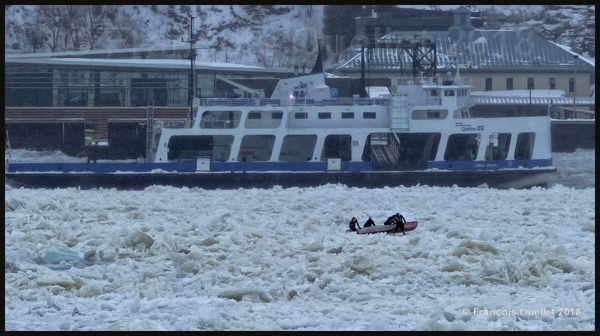
The cold temperature and winds did not stop the Château Frontenac canoeists from training on the icy seaway in preparation for the Quebec Carnival competition. This year, the race will be held on February 4th. The Association des coureurs en canots à glace du Québec (Ice canoeists Association of Quebec) recently faced a tragedy went they lost one of their members in a training session during very harsh weather conditions.
Château Frontenac ice canoe team at work by -18 C on the St. Lawrence Seaway between Lévis and Quebec.
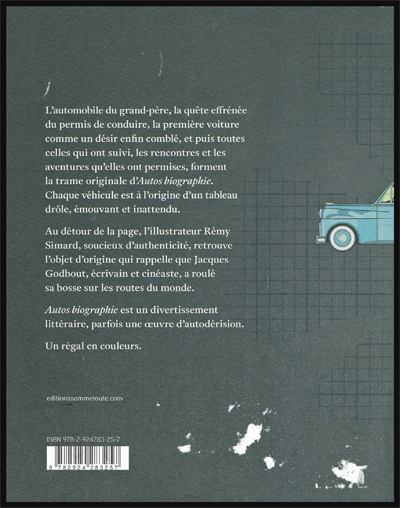
Front cover of the book Autos Biographie by Jacques Godbout
Jacques Godbout has found a very interesting way to present his autobiography. The cars that he once owned or rented , even those who he attempted to drive without success, become the link that the reader follows to travel around the world, always learning something new about the author’s life.
This is a refreshing book, filled with humor, where the author presents his family and many other people with whom he studied or worked, including Robert Bourassa, a former Prime Minister of Quebec.
Back cover of the book Autos Biographie by Jacques Godbout
As a citizen of Quebec City, I was surprised to learn that it is the rounded shape of the St-Laurent bar, inside Château Frontenac, that inspired Jacques Godbout and three of his friends (Paul Buissonneau, Gilles Carle and Jacques Languirand) when they were asked to sketch the beautiful Montreal Expo 67’s pavillion “L’homme dans la cité” (Man in the Community).
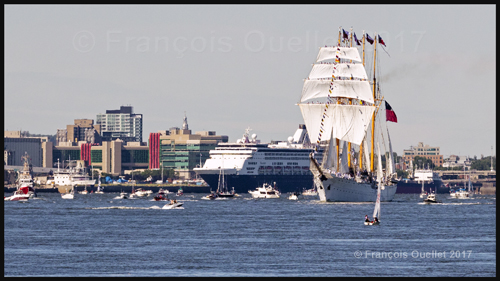
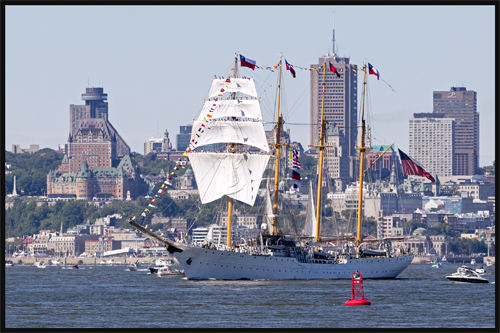
The chilean vessel Esmeralda and its crew during the Tall Ships Regatta 2017 in Quebec City.
In July 2017, the four masted Chilean sailboat Esmeralda arrived in Quebec City for the Tall Ships Regatta 2017. The arrival was quite spectacular, as the whole crew sang together for several minutes for the people standing along the pier.
In order to avoid any distraction, the full frame picture has been taken in the portrait mode and the cropping was tight enough to bring forward the crew members standing up high away on the masts.
The picture below offers another point of view of the sailboat masts but this time the importance is given to the colored chairs directly installed in water, allowing the tourists to cool down during a particularly hot summer day. The wide angle lens used for the shot was a Canon 14mm f/2.8L. Two diagonal lines created by the pool in the foreground progressively meet with each other in the distance, in front of the sailboat.
The vessel Esmeralda during the Tall Ships Regatta 2017 in Quebec City.
When the Tall Ships Regatta 2017 ended, several small boats approached the Esmeralda and other sailboats to slowly travel with them from Quebec City until they cleared île d’Orléans. In the picture below, you can see the cruise ship Maasdam, which has been repositioned to a new pier in the Port of Quebec in order to accomodate the sailboats.
The ship Maasdam and the vessel Esmeralda during the Tall Ships Regatta 2017 in Quebec City.
In the picture below, the sailboat Esmeralda his heading towards the north of île d’Orléans as the final parade is completed. On the left, you can see the Château Frontenac and, directly behind, the Hotel Le Concorde Québec, with in its upper ring a revolving restaurant offering a superb view of Quebec City. The hand held photo was taken from île d’Orléans with a Canon EF 70-200mm f/2.8L IS II USM telephoto lens. This lens is equipped with an integrated stabilizer.
It would nonetheless have been quite difficult to succeed with such an important cropping without the performance of the 50.6 megapixel full frame sensor used in the Canon 5DSR. Considering the great distance over water that is present between the camera and the sailboat, it is possible that you notice a mirage effect, even with the small picture presented here.
The vessel Esmeralda in Quebec City during the Tall Ships Regatta 2017. In the background, the Château Frontenac and the hotel Le Concorde.
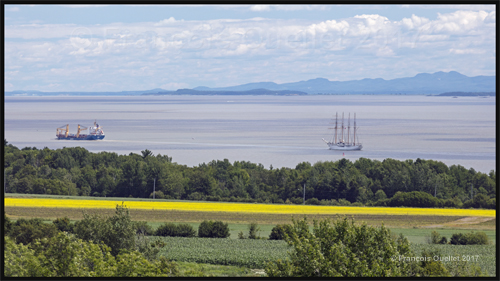
I thought the crew would use all of the sailboat’s sails once passed île d’Orléans, but it was not the case. The picture below was taken from the top of a wooden tower installed at the north east extremity of île d’Orléans, while the Esmeralda is still navigating using its engine.
Even without the sails, the photographic composition benefited from a yellow field, a merchant ship and a lively horizon line showing the Appalachian mountains. No tripods were used for the shot as the wooden tower was constantly moving. The telephoto lens used was a Canon EF 70-200mm f/2.8L IS II USM and a slight cropping was necessary.
An approximative rule of thirds is behind the composition of the photo : you can imagine three fictive horizontal lines dividing the frame. The sailboat also finds itself on one of the rule of thirds vertical line on the right.
The vessel Esmeralda, from Chile, sailing on the St. Lawrence Seaway after its departure from the Tall Ships Regatta 2017 in Quebec.
For other pictures of ships on my blog, click on the following link : Ship photography.
The Quebec Islamic community has just lost six of its members. I want to offer them my sincere condolances as a Quebecer from Quebec City and as a Canadian.
It is hard for me to realize that in my city, which is so beautiful and peaceful, such a tragedy can happen. But all the citizens who have lived the same tragedy in their city tell themselves the same thing. Talk about it to the French or the Berliners. Quebec is not different.
The Quebec City mayor, Régis Labeaume, was recently mentioning how good the statistics were in Quebec when it came to violent acts : there had been only one homicide in twenty-one months. And now, in full Quebec Carnival period, at a time where the City invites its citizens and tourists to get out and be together enjoying the winter season, one Quebecer attacks his peaceful compatriots.
The word « terrorism »
I do not know why exactly but it seems that the Sainte-Foy, January 29th 2017 murders that have just been commited will be classified as a « terrorist » act. Possibly because it targeted a specific community that has a different religion than the shooter. Or because the act is aimed at terrorizing people. Or both.
The word « terrorism » is popular. In United States, the Donald Trump government has just closed its boundaries to selected countries, in case a potential « terrorist » would arrive in USA.
It is easy to forget that there are American citizens already living in United States that are even more dangerous, those who kill tens of thousands of Americans yearly with all kinds of guns that they have the right to possess according to a Constitution that did not anticipate the consequences.
In spite of the blooshed that includes tens of children in schools, it is not « terrorism » so there are no drastic actions taken. Politicians talk and hesitate for weeks after a tragedy and then everything comes back to normal. The « terrorist » murder has obviously a much stronger social impact than any other murder. And it allows to disregard the widespread « laisser-faire » when it comes to the right of everybody in United States to acquire almost whatever he desires when it comes to guns and to use them at will. But if you come from Irak, now that’s dangerous!
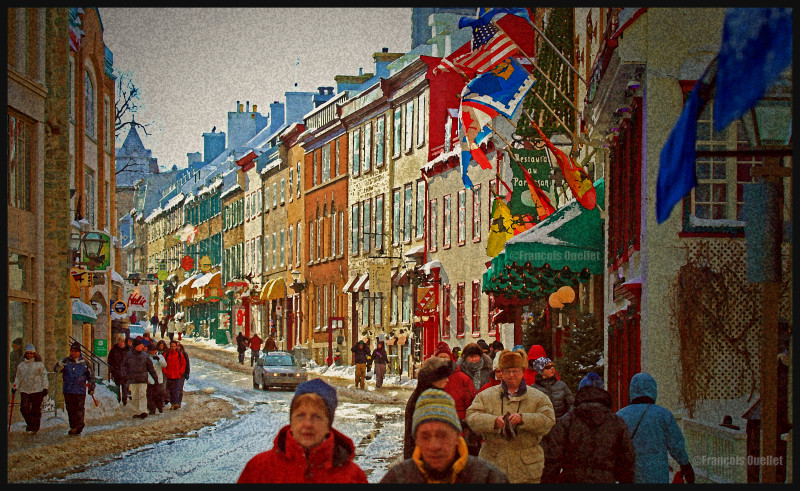
A few nice Quebec City photos
I take the opportunity to post a few nice pictures of Quebec City, as I did for France after the terrorist acts. They have been taken with a Canon 5DSR. This is another way of saying to local citizens and tourists that Québec, as for Paris, Nice or Berlin, is a beautiful city, normally very peaceful and filled with happy people. And that we are not going to be told how to behave or think by the most violent and often mentally fragile individuals of our societies.
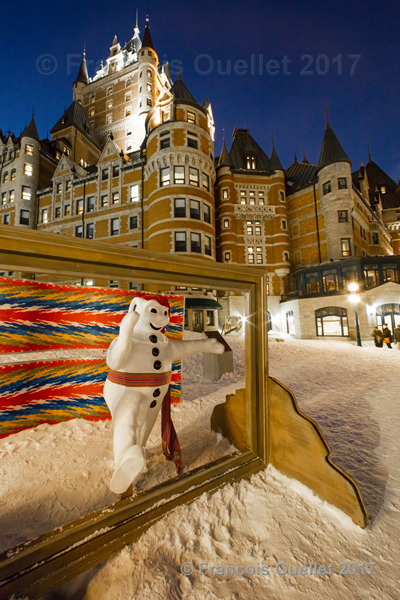
Bonhomme Carnaval and Château Frontenac, Québec 2017
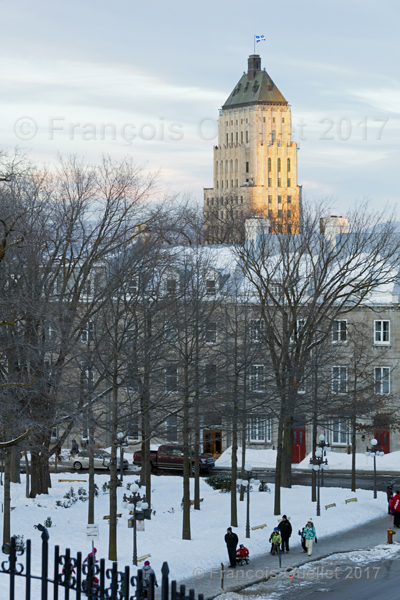
The Price building, Québec 2017
Dufferin Terrace slide, Québec 2017
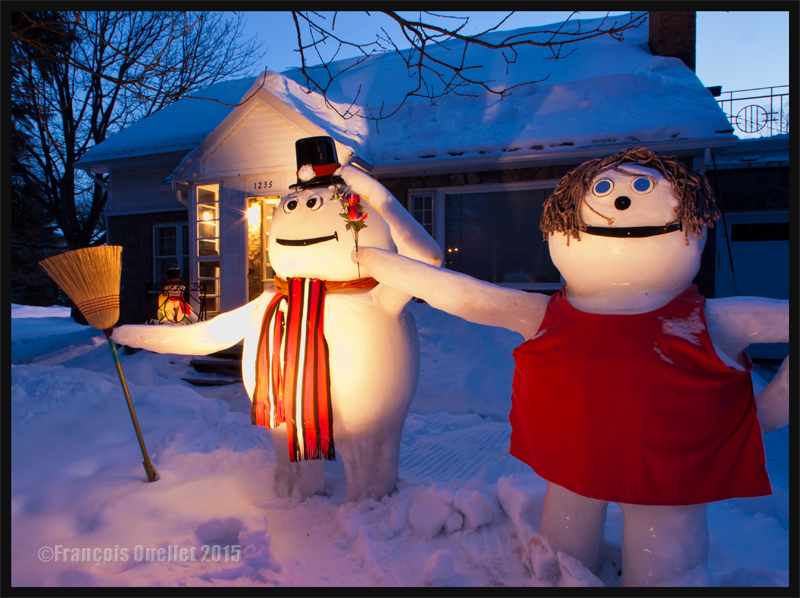
Snow, ice and wood creation made by a Sillery citizen in Quebec City in 2015.
Here are a few recent photos taken during the month of May 2016 using a Canon 5DSR camera equipped with a Canon 70-200 f2.8L IS II USM telephoto lens. I was on île d’Orléans for the photo session, near the Horatio Walker promenade in Sainte-Pétronille.
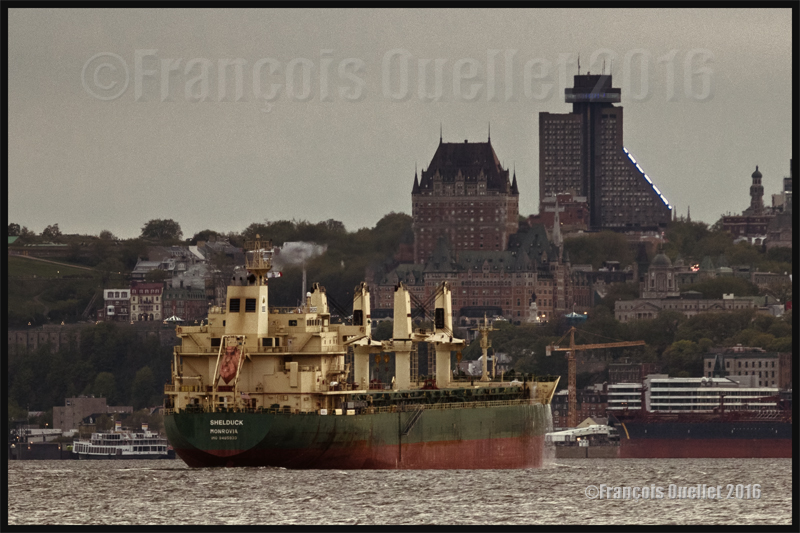
The vessel Shelduck (Monrovia) in front of Quebec City in 2016. The photo was taken with a Canon 5DSR
The picture above shows the vessel Shelduck flying the Liberian flag. It just crossed the narrow channel between île d’Orléans and Levis. This ship, built in 2012, is a bulk carrier. In the background it is possible to see Quebec City, with the Château Frontenac and the Hotel Le Concorde Quebec.
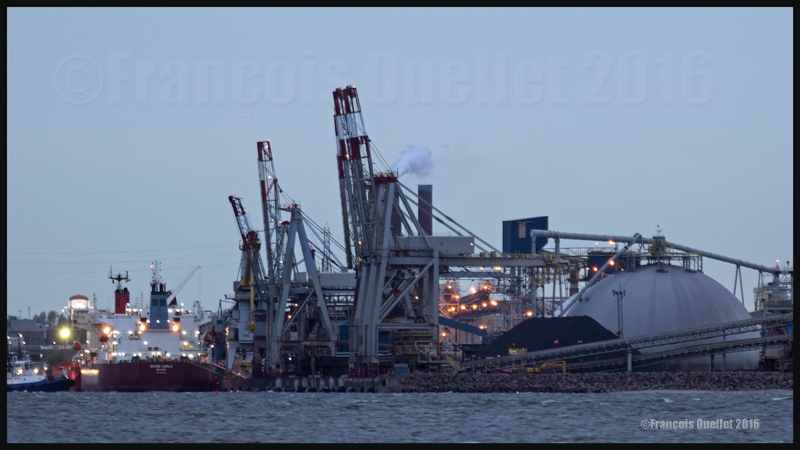
The photo below shows the Silver Carla (Majuro), a tanker used to carry oil and chemical products. It is moored at the Quebec harbour installations. The ship was built in 2014 and sails using the Marshall Islands flag of convenience.
The vessel Silver Carla (Majuro) and some of the Quebec harbour installations in May 2016
In the picture below, the tanker Cap Jean, property of Euronav, is approaching île d’Orléans. This tanker was initially supposed to be named St. Jean but the name’s religious connotation could have caused problems in some parts of world. The name Cap Jean was thus chosen.
The vessel Cap Jean, property of Euronav, in front of Quebec City in 2016
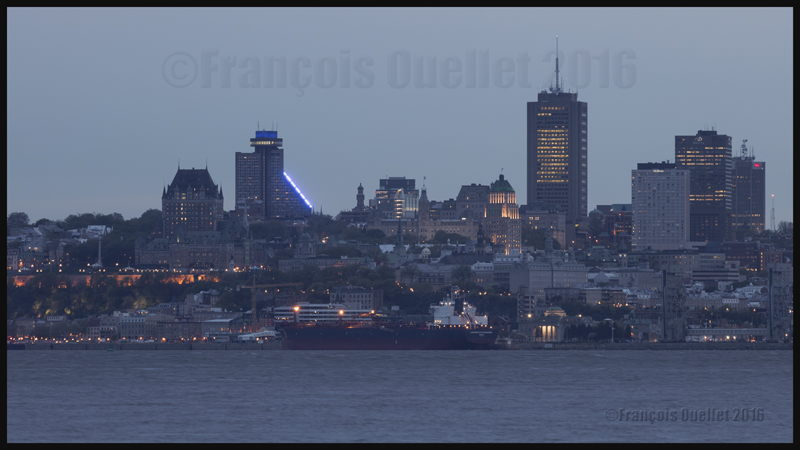
The photo below, also taken from île d’Orléans, offers an interesting view of Quebec City just before nightime. The Hotel Le Concorde Quebec’s new lighting system is visible in the distance. In the foreground, you can see the ship Laurentia Desgagnés.
The vessel Laurentia Desgagnés moored in front of Quebec City during a May 2016 evening.
Below, the ship Nilufer Sultan is heading towards Quebec harbour. Built in 2008, this oil tanker also uses the Marshall Islands flag of convenience.
The vessel Nilufer Sultan in front of Quebec City in 2016. Also visible are the Château Frontenac and the Hôtel Le Concorde Quebec.
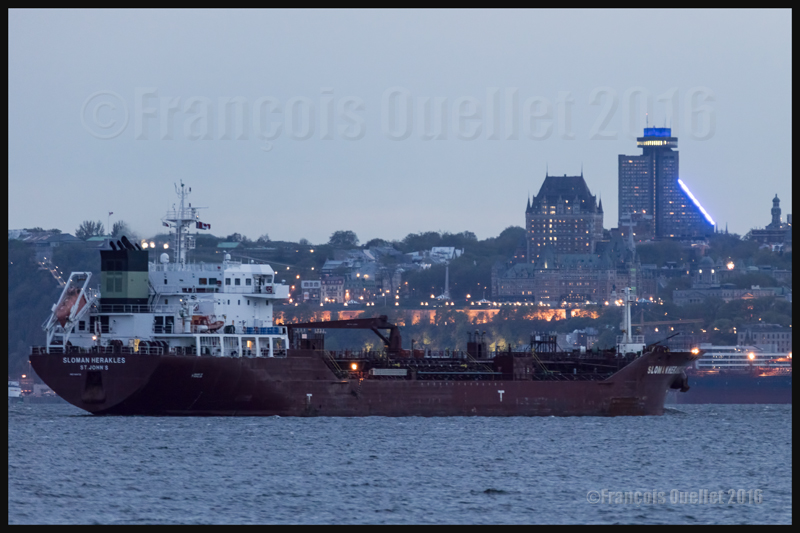
The photo below shows the tanker Sloman Herakles, normally based in St. John’s, Canada. It sails under the Antigua and Barbuda flag and is heading to Sarnia, Ontario.
The vessel Sloman Herakles (St. John’s) in front of Quebec City in 2016
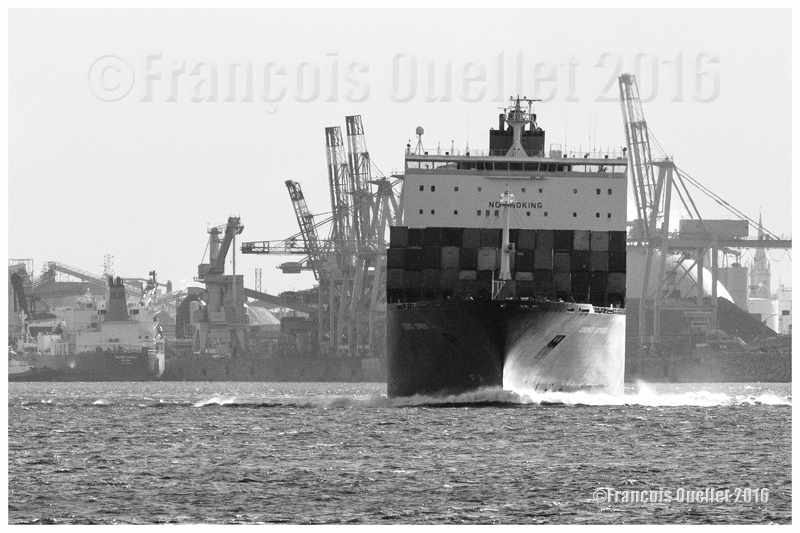
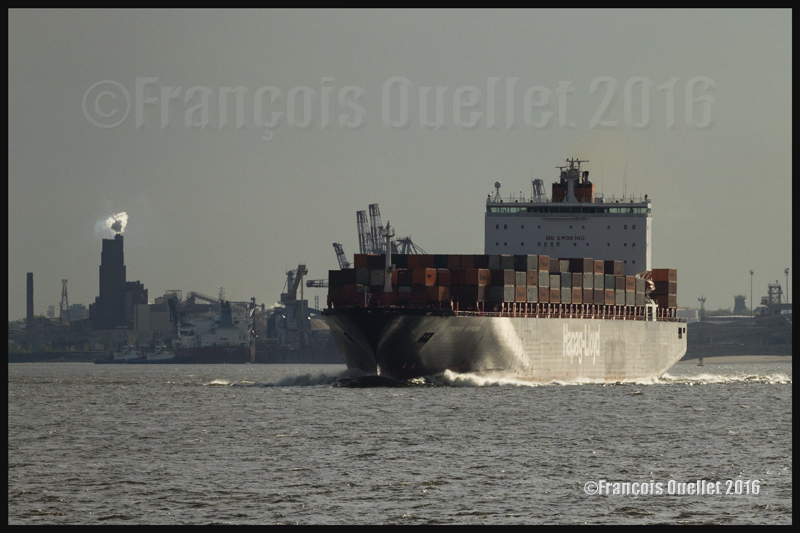
The two photos below show the container ship Toronto Express, property of the Hapag Lloyd Company. I chose to transform the first picture in black and white since the ship did not contrast enough with the background in the colored picture. It is actually slightly inclined since it is turning towards the right while approaching île d’Orléans. On the next picture, we can see in the background the smoking chimney of the Papiers White Birch Company, formerly called Daïshowa and later Stadacona.
Black and white photo of Hapag Lloyd’s Toronto Express in front of the Quebec harbour installations in May 2016
The Vessel Hapag Lloyd Toronto Express near the Quebec City Harbour in 2016. Photo taken with a Canon 5DSR full-frame camera
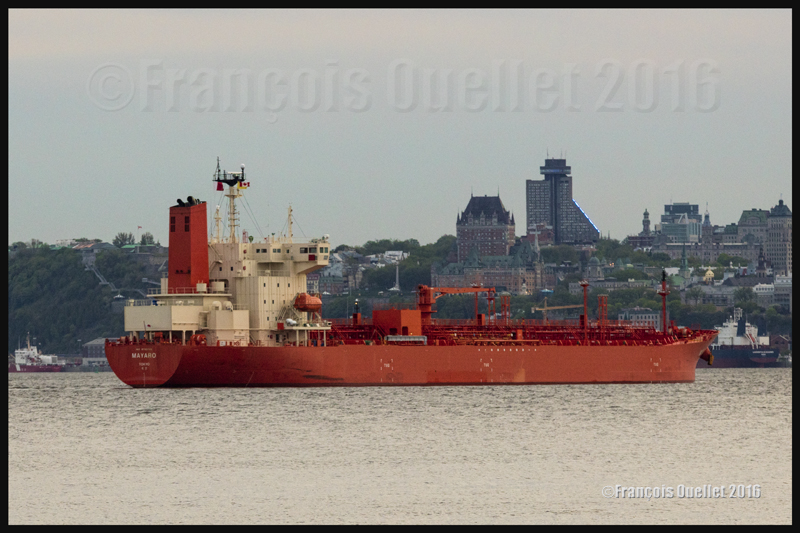
Below is the chemical tanker Mayaro (Japan) arriving near Quebec City in May 2016.
The vessel Mayaro (Tokyo) and Quebec Château Frontenac in the background. The picture was taken in 2016 with a Canon 5DSR
Taking pictures in the evening
Trying to take pictures of moving ships in the evening, using the smallest possible ISO, forces a photographer to use a tripod, a remote trigger and the camera’s mirror lock-up function to reduce vibrations. Ideally, it is best to find a spot where the tripod will be protected from the wind while ensuring that the camera’s strap is not moving at all. There is no need to use a polarizing filter at this time of the day: that would only be detrimental to the photo.
The Canon 5DSR DSLR full frame camera allows the photographer to take a picture in two steps, reducing even more the possibility of secondary vibrations. First, the mirror is lifted up. Then, two seconds later, the photo is finally taken. For a sharper image, it is best to use the Liveview function with a 16X enlargement and do a manual focus adjustment.
Risks associated with photography!
On île d’Orléans, many visitors use the surroundings banks to let their dog roam freely. This can cause a problem as the animal sometimes perceives the photographer and his photographic equipment as a potential threat to a master that it must protect… You will have been advised!
For other ship photos posted on my website, click on the following link: