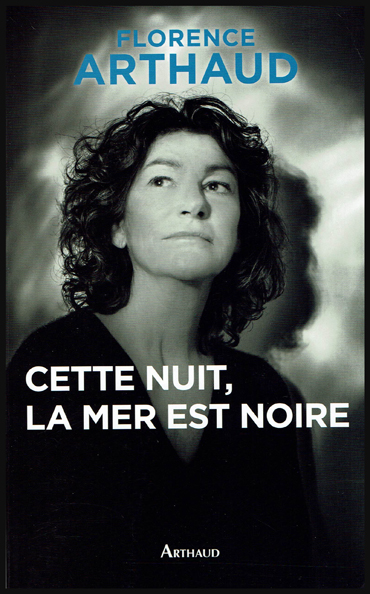
Front cover of the Florence Arthaud’s book: “Cette nuit, la mer est noire”.
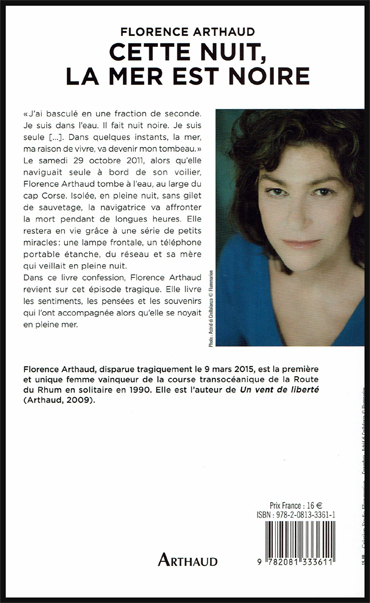
Florence Arthaud is the only woman to have won the Route du Rhum transatlantic single-handed yacht race, one of the most prestigious races in the world. She achieved her feat in 1990.
In 2011, as she was navigating alone aboard her sailboat, Florence fell into the water, off the Cap Corse coast. She shares her thoughts with us as she is convinced that in few hours, exhausted, she will lose her life at sea.
The book starts like this: “I went overboard in a fraction of a second. I am in the water. It is night, and pitch black outside. I am alone […]. In a few moments, the sea, my reason for living, will become my grave”.
Back cover of the book: “Cette nuit, la mer est noire”.
Here are few other translated quotes to give you an idea of the intensity of the story:
“I must move my legs to avoid drowning. Swim, swim. Fight against that fear that would like to paralyze me. I will die, that is for sure, but when? In how much time? To which miracle can I hang to? I try not to think”.
“I am fifteen miles off the coast; not a sign of life around me. The fear I am feeling has nothing to do with the one I encounter when I am racing”.
“The only thing now missing would be sharks. I chase away this childish fear of my spirit”.
But due to several little miracles, Florence will finally be saved.
An excellent book about the human will to survive.
Note: Florence Arthaud died four years later in an airplane crash.
Click on the link for other books on the theme “Tragedy at sea” on my blog.
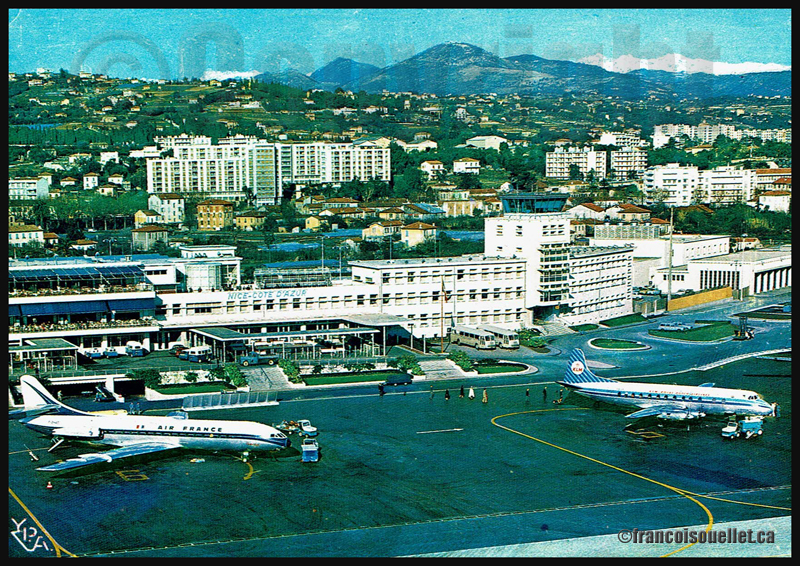
Nice – Côte d’Azur airport in France in 1965 on an aviation postcard
Here is a photo of an aviation postcard representing the Nice – Côte d’Azur airport in 1965. It is part of a collection that you can view on the present web site, under the link :
Its title is : « Au soleil de la Côte d’Azur, Nice – vue aérienne de l’aéroport » which translates into « Under the Côte d’Azur, Nice sun – aerial view of the airport ». It is a postcard that was mailed on September 19th 1965. You can see two aircrafts belonging respectively to Air France (Caravelle) and KLM. It was a time where security at airports was minimal and when people did not expect that at any moment an unstable person would transform into a terrorist and attack innocents in public places, like what happened two days ago in Nice.
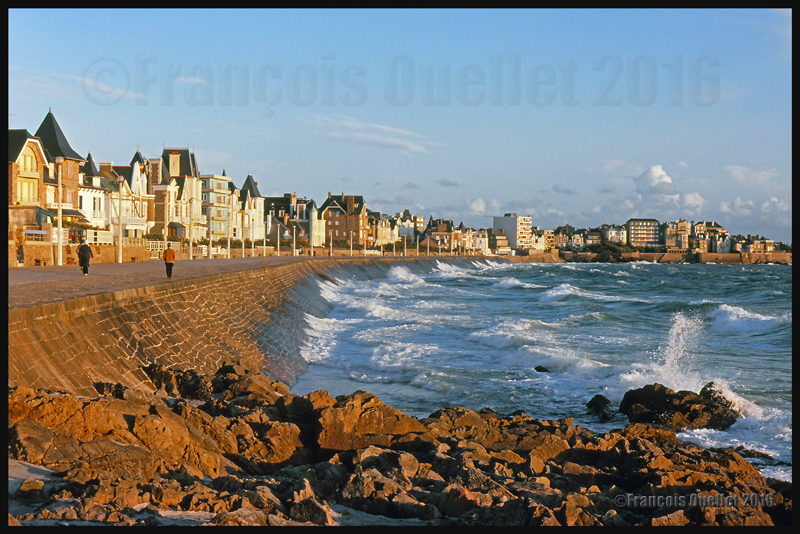
The author writes : « […] Nous quittons Nice ce soir pour St-Malo et nous y resterons quelques jours » which translates into « […] We are leaving Nice tonight heading to St-Malo where we will spend few days ». Having been to St-Malo myself in 1978, I take the opportunity to post a photo of that region dating from that period, just to show the beauty of France and encourage people to continue to travel in that country and continue to benefit from its diversified countryside.
St-Malo, France, en 1978
We returned in France in 2013 and some of the pictures that were taken during that time are posted in the present website, under the link :
One day after the November 13th 2015 deadly attacks, here are few pictures showing the beauty of France. The terrorists have proven nothing and accomplished nothing.
There are seven very interesting articles, in the non-fiction category, in this anthology. Published between 2009 and 2013 in publications like The New Yorker, Vanity Fair, Esquire, Men’s Journal or Q2U.S, they allow the reader to catch-up on events that happened around the planet.
Those stories received a lot of attention from the medias since they covered popular topics like a mid-air collision between two jets, a jewel heist by the Pink Panthers, a botched covered operation by Mossad, wild animals freed by their owner near a small American city, the son of a wealthy American who suddenly leaves United States for Lybia to fight against Khadafi. The reader can also learn more about Apollo Robbins, the king of pickpockets and, finally, comes the weird story of a film making that started in 2006 in Ukraine and is still not ready today.
Le diable à 37,000 pieds (The Devil at 37,000 feet)
This story presents all the elements that contributed to create a mid-air collision: a new crew recently trained on an aircraft loaded with a modern technology that makes flight management more complicated than anything else; air traffic controllers letting their expectations impear their judgment; tired and under pressure careless pilots; passengers disturbing the flying crew by visiting the cockpit on multiple occasions.
It is paradoxal to realize that the extreme precision offered by modern flight navigation equipment also increases the possibility that two aircrafts hit each other in flight.
Pink Panthers
A popular name that sends the reader back to the movies where Peter Sellers played a distracted police inspector. But the article is about the real thing: What circumstances favored the creation and international development of the multiple groups of thiefs that came to be known as the Pink Panthers.
The different Pink Panthers groups have robbed more than 152 jewelry stores since 2002 and pocketed around 250 million dollars. The reader learns that most Pink Panthers members come from the Balkan region and that they operate from Italy, France, Belgium, the Netherlands, Denmark and Switzerland.
The author uses the opportunity to explain how the Milosevic’s gangster regime was put in place in Serbia, a State transformed into a criminal business: “In March 2001, soon after the fall of Milosevic, we discovered, in a safe rented by municipal civil servants from a Belgrade bank, more than 660 kilos of a 93% pure heroin, valued at approximately 100 million dollars on the street”.
Montenegro is also associated with significant banditry and the author tells us about a meeting he had in that region with a former Pink Panthers. In order for criminal groups to survive and develop, there is an essential collaboration with politicians and the border services staff.
Opération Dubaï (Dubaï Operation)
In January 2010, a Mossad team lands in Dubaï with the intention of killing Mahmoud al-mabhouh. The agents are part of an ultra-secret section called “Césarée”. Although they reached their goal, the mission was somewhat a failure since it was possible to determine very rapidly who were the killers, which embarrassed Israël.
The article recounts the general progress of the operation in Dubaï and enhances the important mistakes that eventually damaged the Mossad’s reputation for efficiency.
Here are some of those mistakes:
1. Agents are sitting for hours in a hotel lobby, thus attracting the staff’s attention.
2. Two members of the team head towards the hotel washrooms, where they change their appearance by using a wig and sunglasses, all this while their physical transformation is filmed by an hotel camera positioned near the toilet’s door.
3. The man in charge of planning the covert operation has a huge ego and does not tolerate criticism or a difference of opinion.
4. Carelessness is shown when the team members are equipped with Payoneer prepaid calling cards. Those cards are mostly used in United States and the Payoneer’s director, Yuval Tal, is a veteran of the Israel’s Defence Force elite commando. While they were at it, why not give a Mossad colored business card directly?
5. The person in charge of the operation greatly underestimates the capacity and will of Dubaï’s police force to find the culprits behind Mahmoud al-mabhouh’s death.
6. Every phone call made by the team transit through the same system located in Austria.
An increase in the number of operations lead by Mossad certainly contributed to the non-compliance with respect to the security protocol. Meir Dagan eventually had to step down and the relations between the Mossad and other occidental intelligence services were impacted.
La désertion des animaux du zoo (Animals)
This is a very interesting account of an incident that made the news around the world. At the end of 2011, in Zanesville, Ohio, the owner of about fifty wild animals killed himself, not without having precedently opened the cages of all the wild animals he was keeping on his private property.
The story allows us to share a bit of the emotions lived by the inhabitants living close to the private zoo. We witness the quick reaction and organization needed to face the lions, tigers and bears that are now free to go where they want in the fields near Zanesville. It’s a very well written story.
Vacances de printemps arabe (Arab Spring Break)
This is the story of a rich American who abandons his wealthy neighborhood to go fight against Khadafi in Lybia. This type of story, told with a humoristic approach, was possibly quite amusing in 2012. But with the departure of numerous young kids gone to join ISIS during the past few years, the tone used in the article is now kind of awkward.
Le roi des pickpockets (A Pickpocket’s Tale)
The article is about the life of Apollo Robbins, a now internationally famous pickpocket that has appeared on multiple TV programs around the world, among them National Geographic’s “Brain Games”.
Un tournage pris dans l’engrenage (The Movie Set That Ate Itself)
Through the account of a movie director’s eccentric behaviour in Kharkov, Ukraine, the reader is made aware of the exaggerated control that a human can impose on other persons. It also shows the easiness with which people are ready to accept a totalitarian control in their life. All this while the movie itself is about the dictatorship lived in Russia, more precisely in Moscow, during the fifties and sixties.
Islamic State, Daesh and ISIS: three names that represent the same terrorist group
In order to avoid any confusion, the author, Alexandre Adler, immediately makes clear that three names represent the same group: Islamic State, Daesh and ISIS. He explains what the ultimate goal of ISIS is: to establish a Caliphate on the Levant, a territory that spreads from Mediterranean to the Persian Gulf and that includes Lebanon, Syria, Iraq and Palestine.
The concept of “caliphate” and the reasons behind the desire to re-establish it are explained clearly.
Changes in the balance of power between Sunnis and Shiites
ISIS uses decomposing zones to settle. The group feeds on very high tensions created by increased inequality between two groups: Sunnis and Shiites. The Sunnis, a more conservative religious group, has lost a lot of influence following Saddam Hussein’s death. Today, there is an effort to ensure that the leaders in charge of Iraq take into consideration the interests of both groups.
Radical movements look for dissatisfied people
Sunnis are aware of the increasing strength of the Shiite axis: Beirut, Damascus, under Bachar Assad, Bagdad under Maniki, and Iran, who is inhabited by a vast majority of Shiites. Acting on the new imbalance of powers, ISIS has managed to recruit military officers as well as dissatisfied Sunnis and Arab tribe’s chiefs.
The author insists on the fact that radical movements basically dig in the dissatisfied crowd, the left aside individuals. He gives another example of a situation that is almost certain to create dissatisfaction: colonization.
Dividing a territory without taking into account the human factor
Colonization modifies the balance of power within a population. The author being French, he writes about the way France intervened in Sahara, dividing the territory without taking into account the human factor. As new boundaries were being drawn, the Touareg tribe was suddenly divided in three. This tribe refusing to obey to a new authority, in this case the Malian government, tensions built up and increased with time, since no acceptable compromise could be found.
From Libya, dictator Gaddafi understood that he could take advantage of the situation. He started supporting the Touareg resistance movement. After Gaddafi was killed, the Touareg looked for support by getting closer to jihadists. Progressively, a historically autonomous tribe became a friendly land for jihadists.
Between Al Qaeda and ISIS, Boko Haram chooses ISIS
The author explains that in Nigeria, Boko Haram was born of internal tensions between the north side of the country, which holds the political power, and the south where the population benefits from revenues generated by vast petroleum resources. In 2014, Boko Haram chose to fight along ISIS. Why? ISIS, contrary to Al Qaeda, wants a total war against the Shiites. Boko Haram picked the most radical movement.
Appearance and disappearance of the caliphal power
The caliphal power establishes a theological and political continuity of the State created in 622 by the Prophet in Medina. The author explains the reasons for the multiple appearances and disappearances of that caliphal power since the year 622. The last change was brought in 1923, when Mustapha Kemal abolished the caliphate.
Which religious group represents the real Islam?
Tensions exist between Sunnis and Shiites about the caliphate and the group which really represents the real Islam. This division dates from centuries ago. Shiites consider that Ali, the fourth successor of the Prophet, was victim of a plot at a time when he was attempting to achieve a moral and state straightening of Islam. Shiites consider that they are the real Islam beholders. They have been defending that point of view for centuries, even through Sunnis persecutions against them.
Shiites are against an early reestablishment of the caliphate
The author explains the profound differences of opinion as for the philosophic, theological and political views between both groups. Because of those reasons, Shiites are against an early reestablishment of the caliphate, which leads the most radical Sunnis, and through them ISIS, to lead a total war against them.
The Sunni axis is represented by Saudi Arabia and Egypt, although there is a degree of rivalry between those two countries.
Saudi Arabia’s fear
Saudis fear the birth of a powerful Shiite political movement on their territory. They estimate that there would be a risk to lose the control on oil installations, which constitute the base of Saudi Arabia’s economic wealth. The author writes that Saudis are financing “[my translation] all the anti-Shiites movement in the Arab world, including the Sunni jihad in Iraq”.
The return of Iran
The return of Iran, a Shiite power, on the world stage, adds to an already complex equation. The reader is told that there are natural tensions between Persian Iran and the Arab world. But there is something else: Iran, as well as few other countries in the region, is now supporting more moderate policies: “[my translation] Iran is radically changing its orientation and now prepares his return on the world stage as a more open country, pluralist, supporting a Shiite democracy. Although this is not a perfect democracy, the country is now living its perestroika”.
A fight between extremism and moderation
The adoption of more moderate positions is far from pleasing an extremist political group like ISIS. The 2013 americano-iranian agreement on nuclear talks, and the continued progress made in 2015, corresponds to a net increase in terrorist acts committed by ISIS.
Atrocities against humanity set in an historical context
The Medias constantly report on the atrocities perpetrated by ISIS. According to the author, all that media attention gives a false impression on the real strength of Islamic State: ISIS would now be down to committing those terrible acts against humanity due to its relative weakness.
The author links ISIS actions with war crimes and atrocities perpetrated by other regimes throughout decades. He situates those actions at a time that always corresponds to a last attempt to survive before being completely defeated and replaced by modern and moderate political parties.
A little reserve
The only reserve I have on the book concerns the passage where the author repeats, without nuances and like other well-known Medias, that Ben Laden is responsible for the New York 9/11 attacks. This version of facts has always been strongly debated, the disagreements starting within hours after the attack. And, contrary to popular belief, it was not brought forward only by what we call the “conspirationists”. But everyone knows that the more you repeat something, the more it becomes a reality, an undisputable truth. Noam Chomsky and other renowned authors have covered this aspect at length.
Title: Le Califat du sang Author: Alexandre Adler Edition: Grasset&Fasquelle, 2014. ISBN : 978-2-246-85457-9
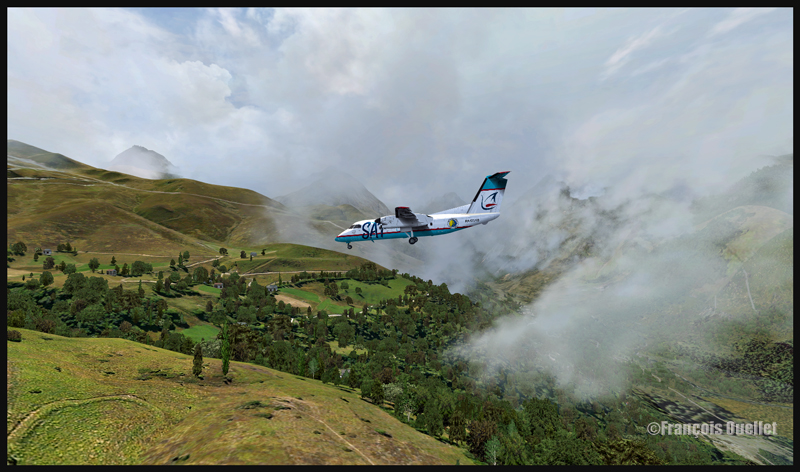
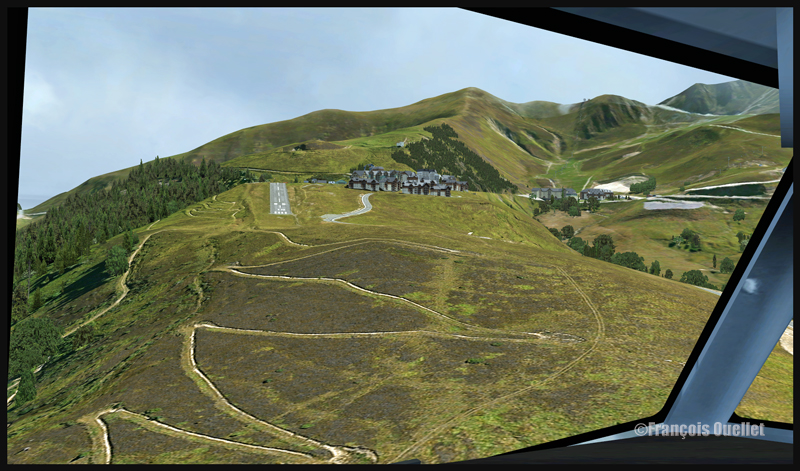
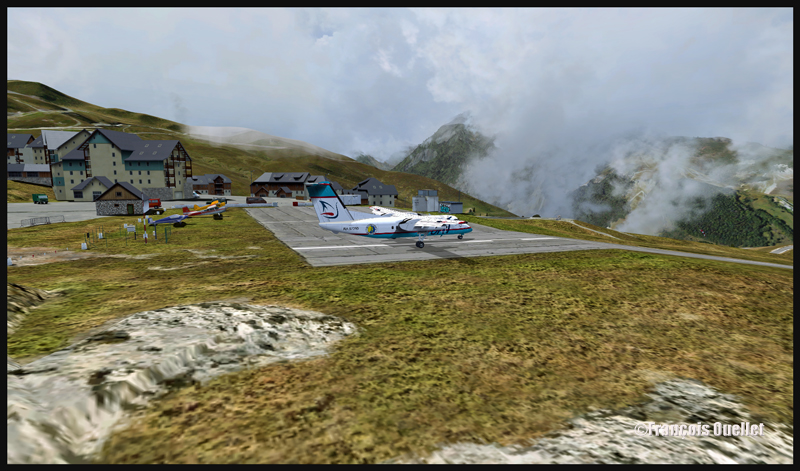
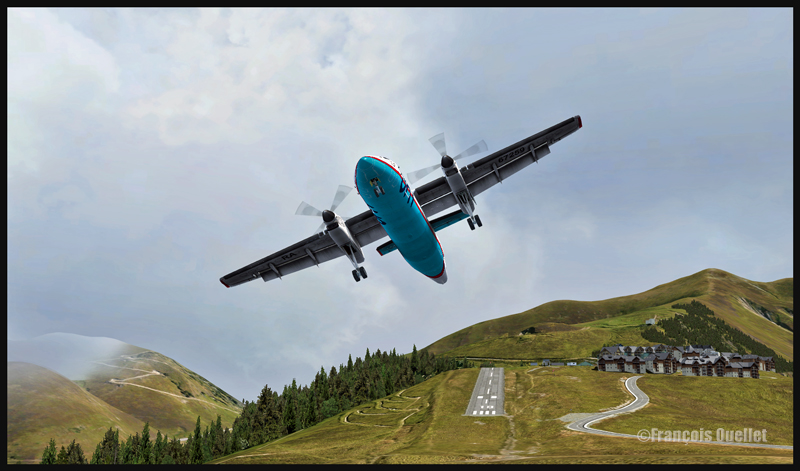
A Sat Airlines aircraft is on final for the Peyresourde mountain airfield
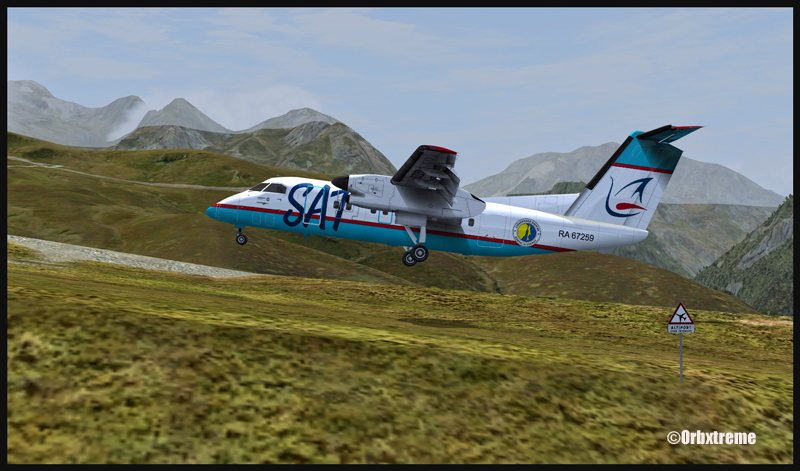
Flight simulation allows the use of all company liveries and types of aircraft. In the present case, a DHC-8-227Q from Sat Airlines, with the Sakhalin Energy logo, has mysteriously found itself inbound for the Peyresourde mountain airfield.
A Sat Airlines aircraft is on final for the Peyresourde mountain airfield
A Sat Airlines aircraft is on short final for Peyresourde mountain airfield
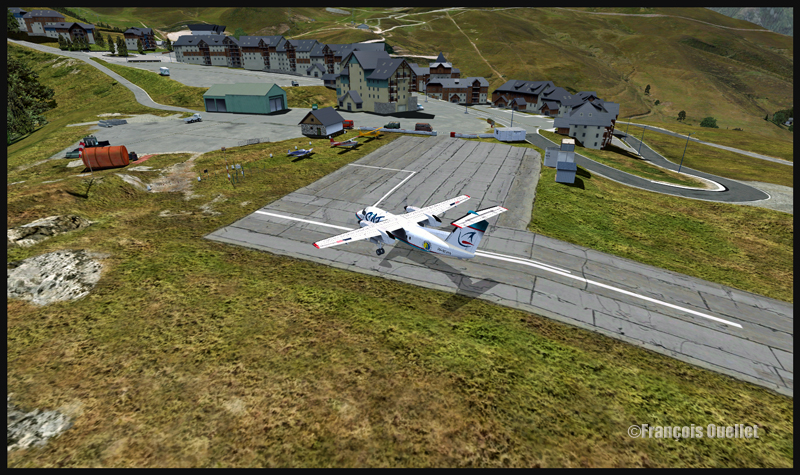
Peyresourde Balestas is located in the Pyrenees, at an altitude of 1580 meters. Its runway is only 335 meters long and has a 15 degree slope. The beginning of the James Bond movie “Tomorrow never dies” has been filmed there. The runway is long enough to accommodate the DHC-8-227Q as the plane’s excellent braking capacity is even improved by the sloped runway. If you touch early enough, you won’t even have to apply full braking power.
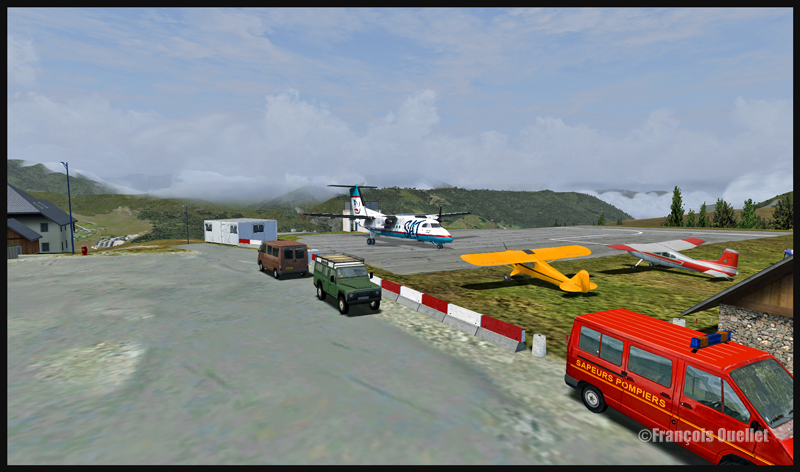
Sat Airlines Sakhalin Energy and the Peyresourde mountain airfield (fsx)
A Dash 7, with its superb ability to operate from any kind of field, would also fit in there, providing the amount of fuel and cargo is well calculated. Because what lands must also takeoff.
Peyresourde Balestas and the DHC-8-202Q Sat Airlines Sakhalin Energy (fsx)
The Peyresourde Balestas mountain airfield is made by LLH Créations, from France. The company has already produced four mountain airfields located in the French Alps. This is the first one in the Pyrenees.
Virtualcol FS Software created the Dash-8 used for this flight. For a very reasonable price, that company offers, in one bundle, an astonishing amount of liveries and all the types of DHC-8. Their product is detailed enough and really takes lower end computers into account when it comes to FPS (frames per second). Don’t expect the same realism as with the Q400 from Majestic Software though: Majestic’s Q400 is on a category by itself in the sim world and the price is adjusted accordingly.
The fun will not be over after you land. You will find that the takeoff is quite spectacular. Apply the brakes, full power and the necessary amount of flaps and let it go! You’ll see that the runway’s end is coming quickly and that you’re building speed like you never believed possible with a Dash 8!
The Peyresourde Balestas airport and a DHC-8-202Q aircraft owned by Sat Airlines Sakhalin Energy
A DHC-8-202Q owned by Sat Airlines Sakhalin Energy is leaving the Peyresourde Balestas runway
Your passengers will certainly remember that mountain airfield. So will you!
If you want more ideas of flights that would test your nerves, just head to the “challenging virtual flight” section of this website.
For more articles on flight simulation on my web site, click on the following link : Flight simulation
1. A picture you would never have thought possible, because of extreme contrasts between brightness and darkness, is now accessible to you through HDR.
2. For a good HDR picture, you need at least 1) an interesting subject 2) an appropriate setting or background 3) the appropriate light and 4) a wide range in contrasts. That seems basic, but HDR will not save a picture that was not thought through.
3. You need a software like Photomatix, to transform several pictures taken at different exposures into one HDR picture. But this is only the first step. You will also need another editing software to improve the general result after Photomatix has been used.
4. A tripod is required to help Photomatix align the pictures and create the HDR effect.
5. As with your normal pictures, it is always better to try to use the lowest ISO as possible.
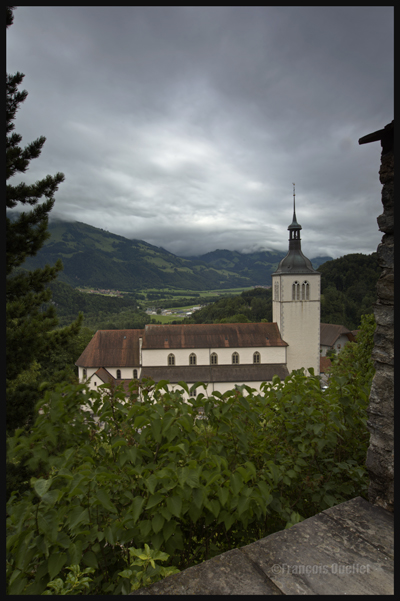
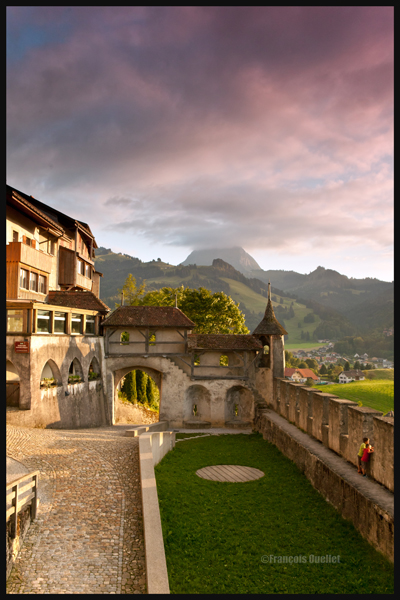
Gruyères, Switzerland, 2013.
6. It is safer to work with manual focus. This way, none of your shots will have been influenced by external objects without you noticing. It will always be the exact same focus throughout the HDR photo session. With automatic focus, you generally notice your blurred pictures when you’re back home and then it is too late (it will often happen under low light conditions).
7. The greater the contrast, the more exposures you need to take (up to nine) in order to match the dynamic range of your eyes.
8. The idea is to take each exposure at a different exposure setting. If you need seven exposures, an example of settings would be: -1, -2/3, -1/3, 0, +1/3, +2/3, +1. You might decide that three exposures only are necessary and go for -2, 0, +2 or -1, 0, +1. The choice is yours but you must take only the required number of exposures to avoid including too much noise in your shots.
Canon, 16-35mm, HDR format.
9. Throughout your HDR exposures of a specific scene, always keep the same aperture.
10. A scene is rarely perfectly balanced with light and shadows. If there are many shadow areas in the photo you want to take, then take more exposures over the recommended settings to ensure that you caught the whole dynamic range of the scene.
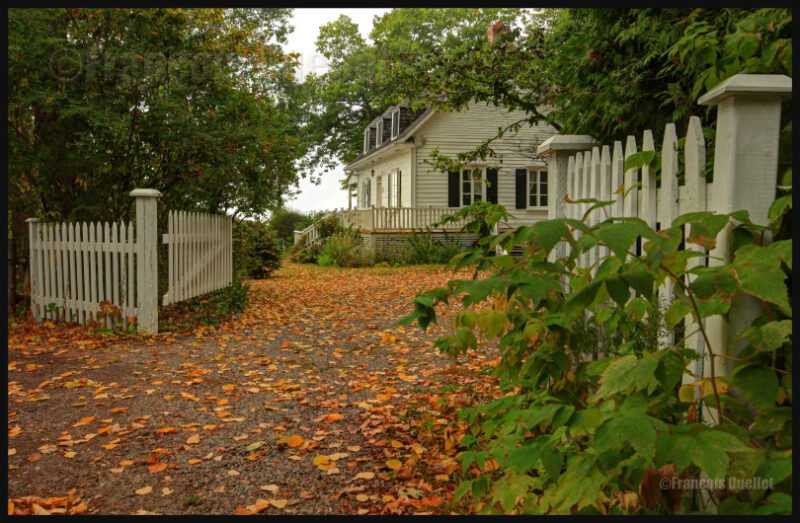
A house in Sainte-Pétronille, on Île d’Orléans, autumn 2012. HDR picture.
11. Inversely, if your scene has lots of highlight areas, take more exposures under the recommended settings.
12. Setting your camera to “automatic bracketing” is preferable because all the pictures are taken quickly thus avoiding to show any blurred picture in the final HDR picture. But if you want to show the movement of water in a creek, you don’t need bracketing: just take few shots with different time of exposure (in number of seconds). Just don’t overdo it otherwise it will give place to an uninteresting undefined white surface.
13. Check your LCD monitor so that none of the highlights are blown out. There would be a loss of details. For the same reason, you must avoid to block the shadows.
14. Always work with RAW files, it gives you better results. The RAW file already provides you with more f/stops then the JPEG file, and this before the transformation in HDR has even started).
15. Of all the lenses I’m using, the wide angle lens is my preferred one with it comes to HDR photography.
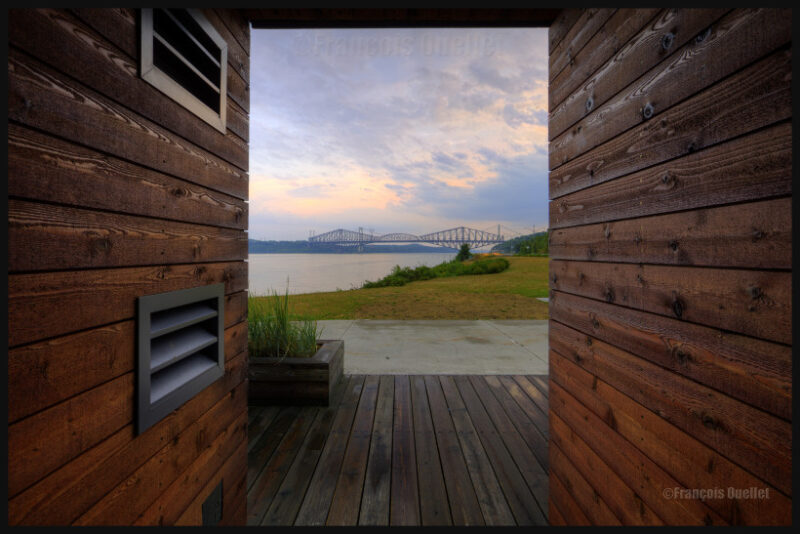
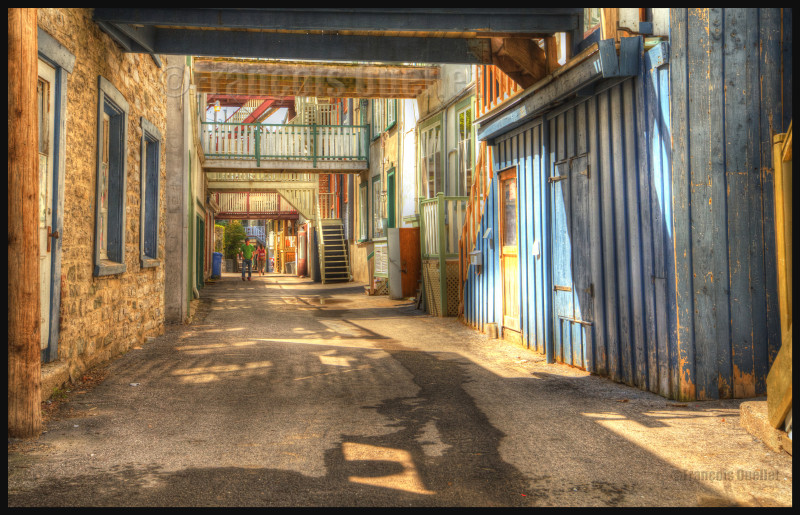
Spring light in the lower town of Quebec City
16. To improve the composition or enhance the general impact, crop the picture.
17. Not all pictures are appropriate for HDR transformation. If you want a dramatic silhouette as the final result, for example, HDR will not be appropriate. It will reveal too many details in the shadows and you will lose the high contrast effect that you were looking for. With practice, you will recognize where HDR is the most effective.
18. Whether you want a realistic picture or not, you can obtain surprising results with the combined effects of softwares like Photomatix, Topaz, Photoshop, Nik Software, Lightroom, Lucis Pro and so on. It’s only a matter of taking your time to experiment.
19. If you have only one picture on hand, like a shot you took years ago, and you would like to give it an HDR effect, you can use a software likeTopaz Adjust. There is an HDR effect section in that software that allows you to get a wide range of effects. But this is not going to be nearly as good as the real HDR resulting out of many pictures. The final editing step is, most of the time, done using Photoshop.
20. An unpretentious book about HDR is “Rick Sammon’s HDR Photography Secrets for Digital Photographers”. It is simple, colorful, well written and loaded with practical informations.
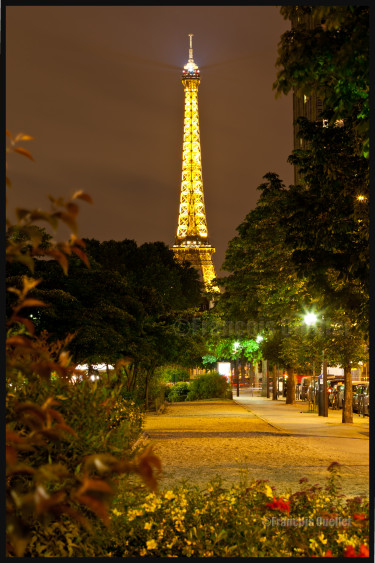
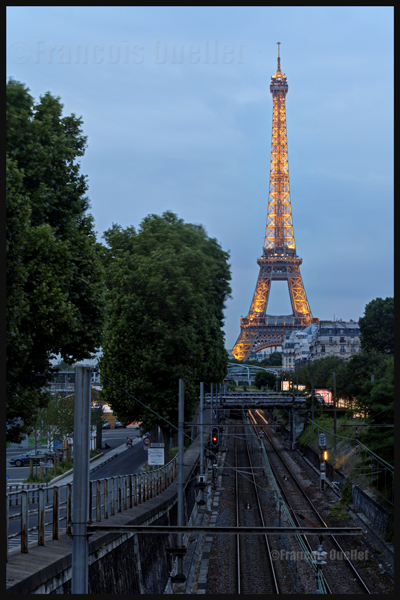
Eiffel Tower at night with HDR effect
Note: All the photos were taken with a Canon 5D MKII
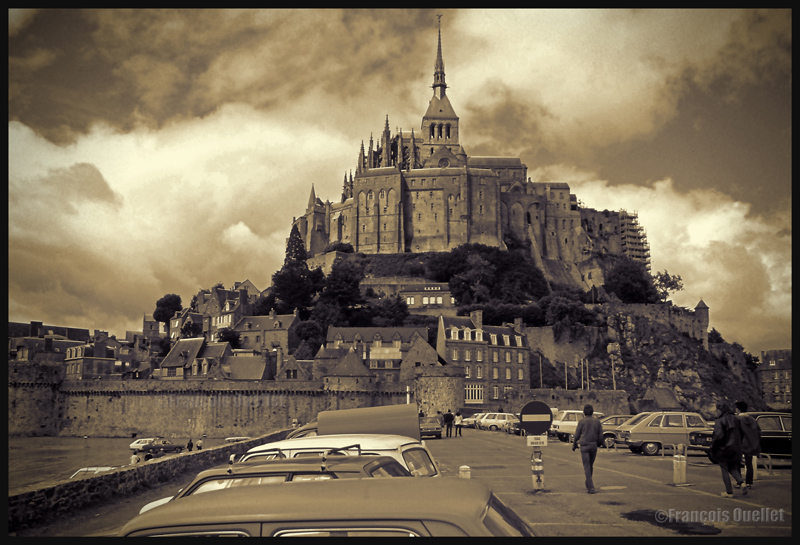
Cumuliform clouds add energy to any photo. Even photos in black and white benefit from them largely, whether it is for a normal or an HDR photo.
Cumuliform clouds add dynamism to this Abbaye du Mont St-Michel scenery. France (1978)
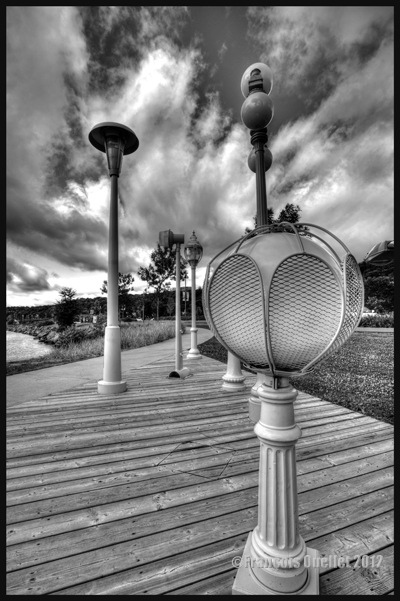
Black and white HDR picture of lamp posts installed along the St-Lawrence, Quebec City 2012.
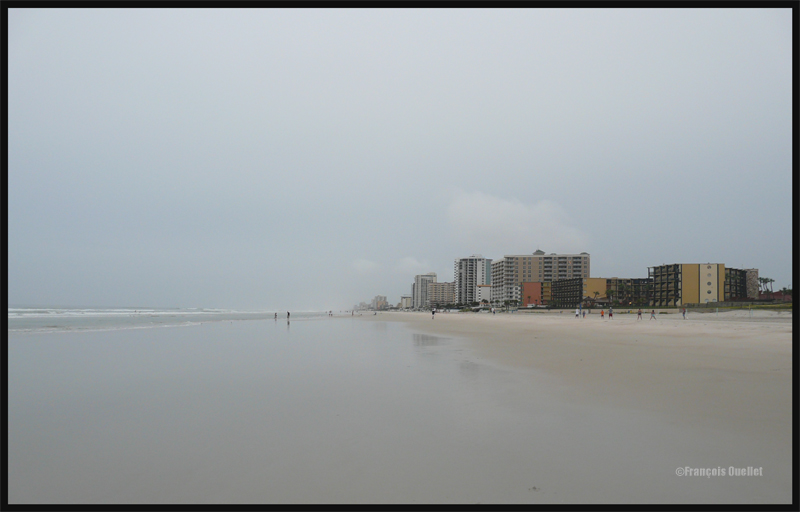
The stratiform clouds add to the tranquillity and the stability of a photo.
Daytona Beach under stratus clouds in 2011. The end of the afternoon allows the fresh air from the sea to move over the heated land, which helps create few cumulus fractus, visible near the buildings.
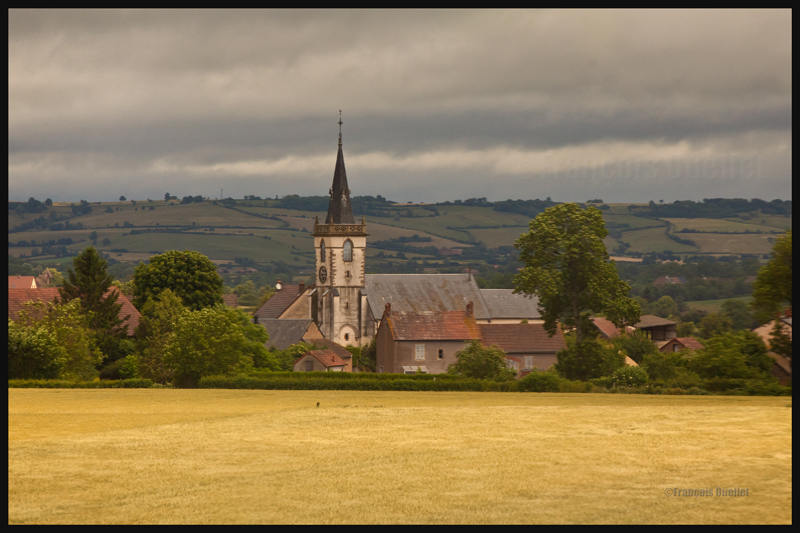
Clouds including a stratiform and cumuliform components (stratocumulus) produce an effect that is more energizing than the simple stratus, while avoiding the explosion of energy of the cumuliform clouds.
A stratocumulus adds to this otherwise peaceful scenery captured on board the Lyria train between Paris and Geneva in 2013.
The cold front
The approach of a cold front enhances the possibility of interesting photos. If it is a fast moving cold front of moist and unstable air, the photos will probably be more spectacular, as some thunderstorms will be associated with the system. A dew point of more than 15 C indicates the presence of a lot of water vapor which can be transformed into precipitation, thus releasing a lot of energy. When these conditions are combined with a really strong contrast between the new air mass which approaches and the one which goes away, the produced meteorological phenomena will certainly be intense.
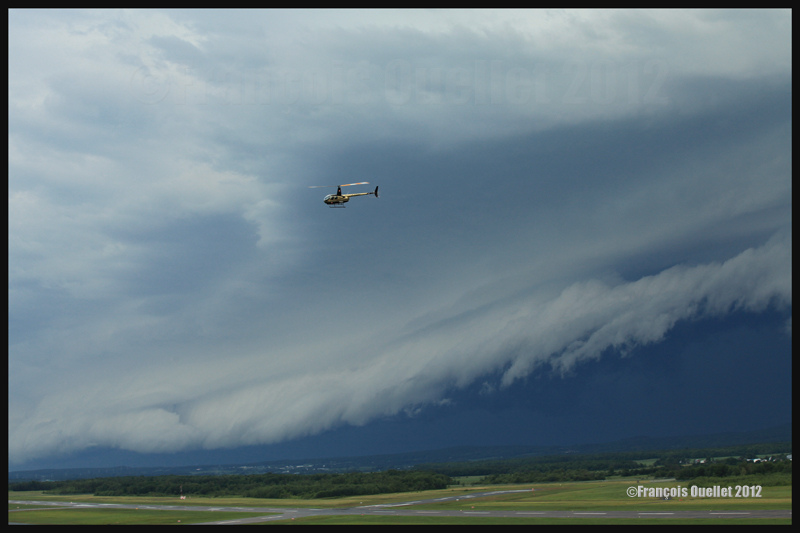
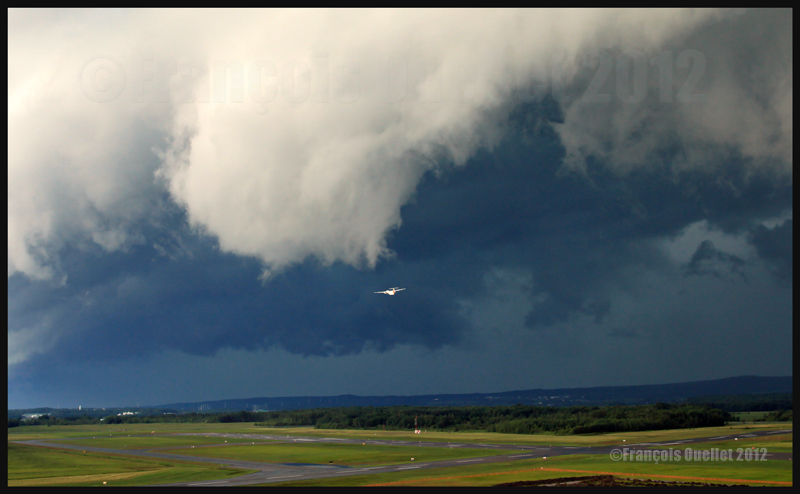
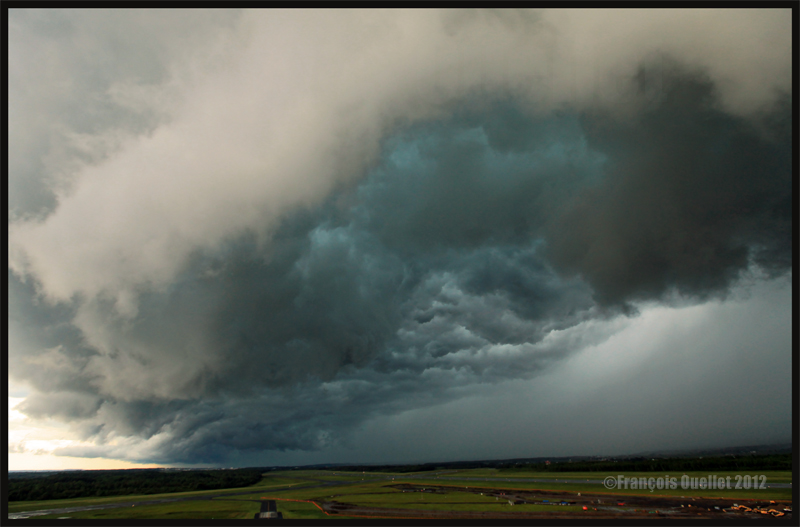
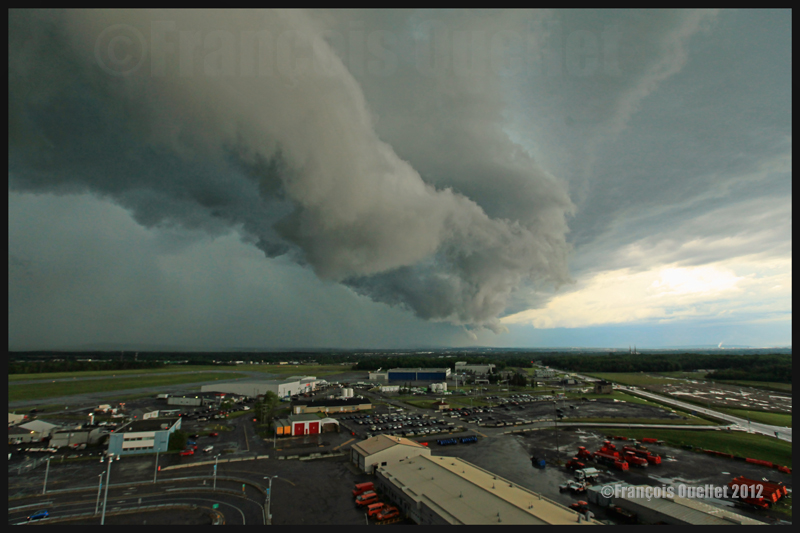
In the photos below, the meteorological system approaching the Quebec Jean-Lesage international airport also had to cross a small mountain range.
A roll arcus cloud in development ahead of a thunderstorm approaching the Quebec Jean-Lesage airport in 2012.
A roll arcus cloud in development ahead of a thunderstorm approaching the Quebec Jean-Lesage airport in 2012.
View under a developing arcus cloud at the Quebec Jean-Lesage international airport (2012)
An arcus cloud ahead of a thunderstorm approaching the Quebec Jean-Lesage airport in 2012
A roll arcus cloud ahead of a thunderstorm heading for Quebec City in 2012
The morning fog
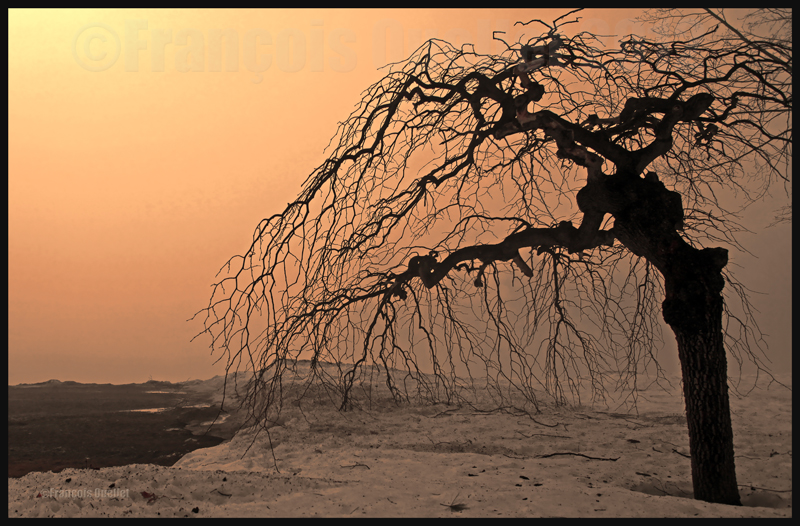
The morning fog offers many opportunities for interesting photos. You can choose an isolated tree and capture the combined effects of the morning sun and fog. Or you may choose a cluster of trees, for a completely different effect. Both photos below were taken in Domaine Cataraqui, Quebec City.
Trees in fog at Domaine Cataraqui, Quebec City 2009
Sun and fog provide for a special atmosphere at the Domaine Cataraqui, Quebec City 2009
A morning fog resulting from a cold cloudless night will persist for hours if there is no wind. The cold morning air, motionless over a slightly hotter stretch of water, creates a fog that will finally disappear just before noon, when the atmosphere has been heated enough. If there had been an overcast sky during the night, chances are that the air over the water would have remained at a higher temperature, preventing the formation of fog.
The opportunities for more interesting photos arise when you witness the first holes in the fog layer.
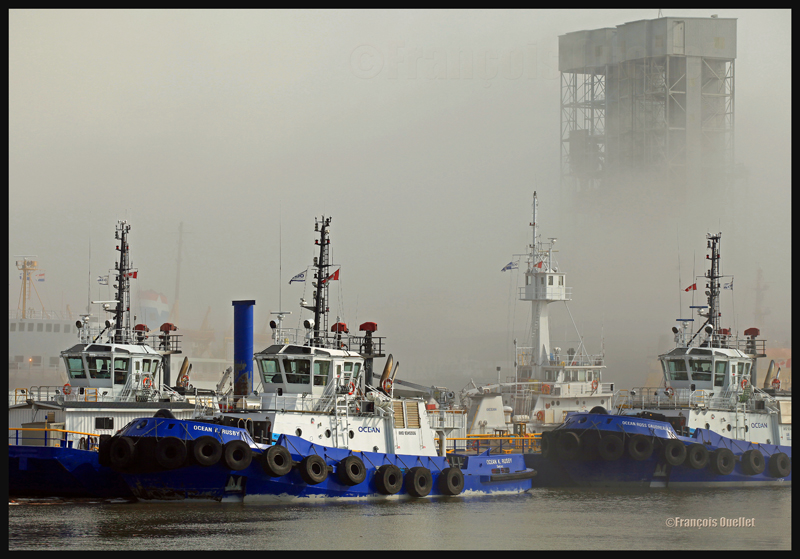
The Ocean tugboats during a dense fog in the Bassin Louise in Quebec (2012).
We can take into account the season to estimate the speed of the diurnal reheating of the lower atmosphere. A morning fog will need more time to dissipate from late autumn to early spring: that leaves more time for the photographer to prepare. The forecasts can announce the disappearance of fog while it will not be the case if, over your sector, there is an invading layer of stratocumulus preventing the morning sun from reaching the ground.
To determine if the fog is going to dissipate as expected or will remain and possibly intensify, watch the difference between the temperature and the dew point on the hourly meteorological observations issued by weather stations near your place of residence. If the temperature and dew point spread increases, the fog is going to lift. If the difference between those two decreases, the fog is going to persist and possibly intensify.
The mist
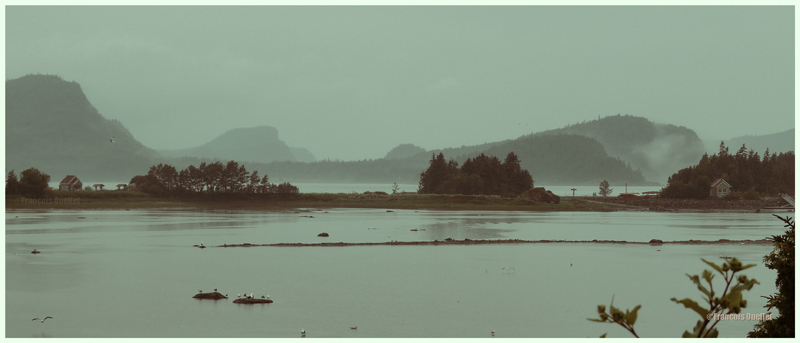
The mist can be qualified as such when the visibility is superior to ½ mile, but do not exceed 6 miles for an observer on the ground. If the visibility is of ½ mile or less, it is called fog. This photo of the Bic National Park, near Rimouski, shows the interesting effect that the mist adds to a beautiful landscape.
Mist in the Bic National Park, Province of Quebec (2009)
Hot and unstable air in winter
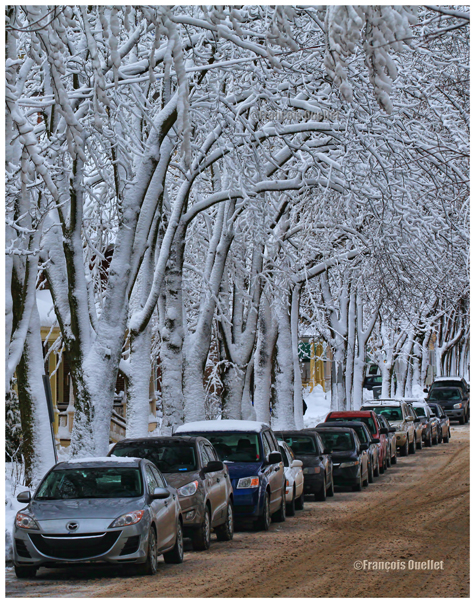
When there is a warm and unstable air advection (about 0 degrees) while winter has already settled, there are good opportunities for photos. A moderately developed cumulus produces significant snow showers and this snow sticks on all the surrounding objects. All that snow would have begun to melt on contact of objects if the latter had had a temperature superior to zero degree. But, the winter being already settled, the snow persists. It gives enough time to capture some souvenirs.
A Quebec City street after a snow shower
The local effects
A photographer might benefit from learning about the meteorological local effects influencing the regions he intends to visit. The local effects are often simple to understand and they repeat themselves regularly, according to wind and season changes. The knowledge of these effects allows the photographer to be ready and position himself even before the phenomenon occurs. It limits the comments like: “If I had known that it would occur, I would have settled down here one hour earlier!“
The local terrain as well as large size bodies of water produce predictable meteorological phenomenon that can be used by a well prepared photographer. It can consist of persistent fog, repetitive snowstorms over a small sector, strong winds, cumuliform clouds alongside the mountain summits, etc. By being positioned at the right place, at the right time, the desired photo can be realized.
A change in the wind direction
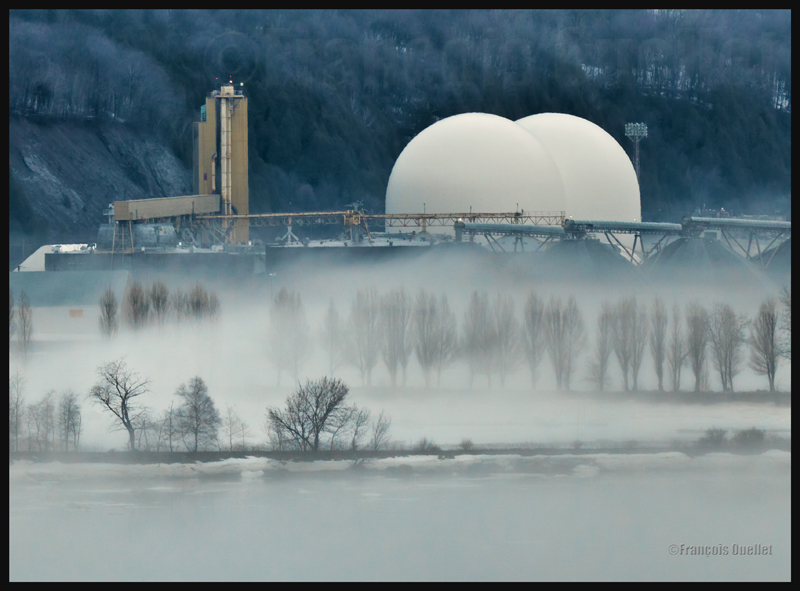
A change in the wind direction suddenly increases the opportunities of interesting photos. It might announce the approach of a cold front, a warm front, a sea or land breeze, etc. In the photo below, a bit of fresher air suddenly began crossing the St-Lawrence seaway at the end of the day, thanks to the approach of a weak cold front. The water was still relatively warm and the moisture which was present over the surface became visible due to the cool air supply. The conditions were now ideal for a short-term thin fog, as long as the wind speed would not increase. Just in time for a photo.
The new wood pellets silos in Anse au Foulon in Quebec City en 2014
Familiarization with weather radars
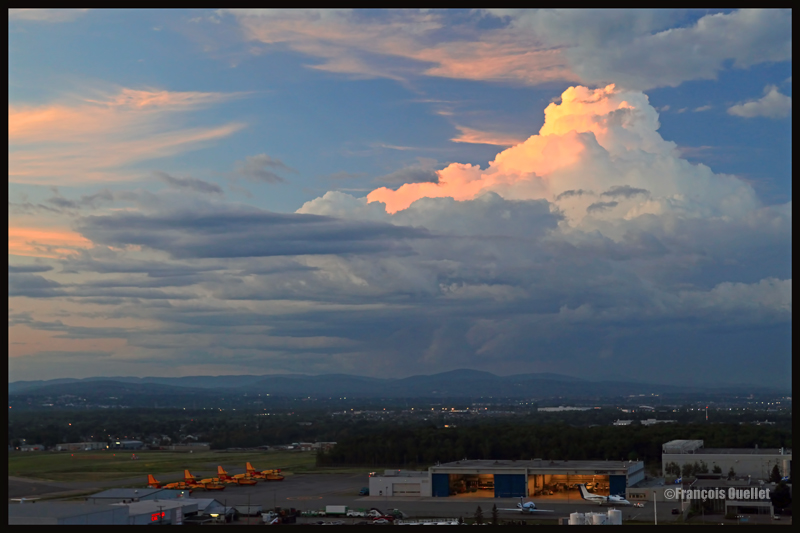
It can be useful to get acquainted with weather radars which, for the needs of photography, remain simple to interpret. Multiple echoes of small dimension with a steep gradient of various colors indicate precipitation resulting from cumuliform clouds. The showers associated with these clouds are often moderated or strong and will be the result of approaching towering cumulus or cumulonimbus (thunderstorms). A towering cumulus presents a dark base and a white summit to the photographer. At sunset, their vertical development can be used to emphasize the last rays of light.
The side of a towering cumulus (TCU) is benefiting from the remaining sunlight over Quebec
Large echo areas of similar colors of low intensity indicate a relatively stable air generally producing steady light rain or drizzle. This should be understood as a possibility of increased humidity limiting the visibility through mist or fog.
Hoar frost
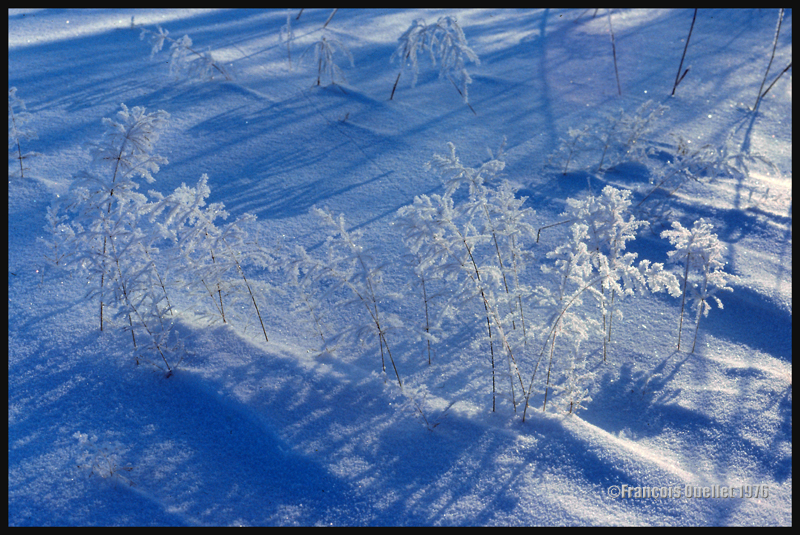
Hoar frost is a short-term phenomenon. It is thus necessary to capture the scene before the sun melts everything. The photo below shows some small twigs on which hoar frost has settled. It was taken at the beginning of the seventies. Although the quality of the photo is not exceptional, the meteorological phenomenon is well demonstrated.
A combination of snow and hoar frost observed on a Quebec field in 1976.
Forest fires
Wishing to make photos of western Canada during summer 2014, I came up against a season where hundreds of forest fires were raging. The smoke was covering some parts of Alberta and British Columbia. Some fires were important enough to require the closure of the sole highway connecting Lake Louise to Jasper. I thus decided to include the effects of those fires in the holiday souvenirs.
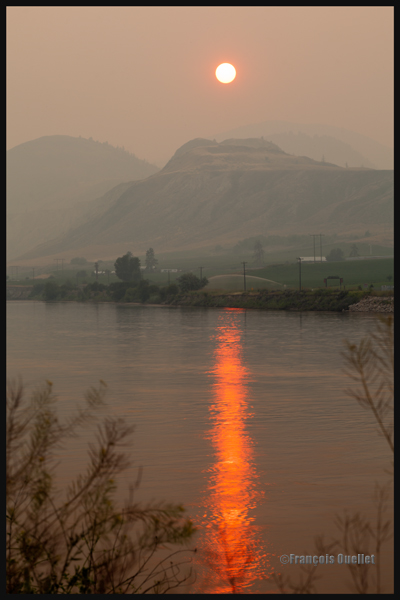
A visibility reduced in forest fire smoke allows a photographer to obtain, without special editing, sunsets with interesting colors.
Sunset and smoke from forest fires in Kamloops in 2014
The smoke also produces an effect similar as fog, but a fog which would be impossible to obtain at the end of a summer afternoon while the sun shines and there is a 38 degrees Celsius temperature.
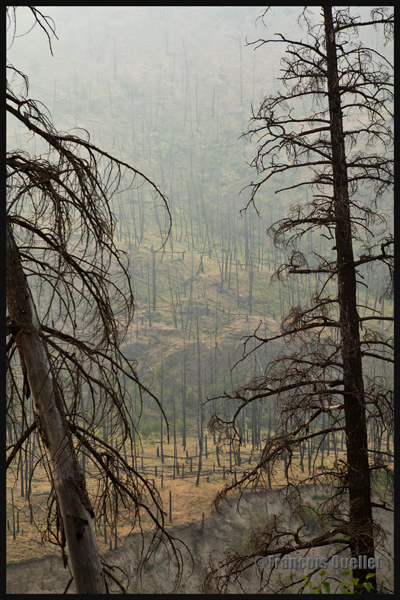
An area near Kamloops, Canada, that was touched by forest fires in 2014
At dusk, the residual smoke is visible near tree tops while the setting sun strikes the mountain side. The effect is of two horizontal lines of complementary colors, blue and orange.
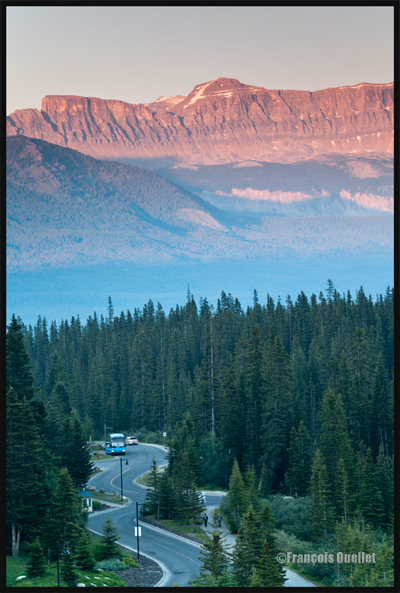
Forest fire smoke and sunset combined in Lake Louise, Alberta en 2014
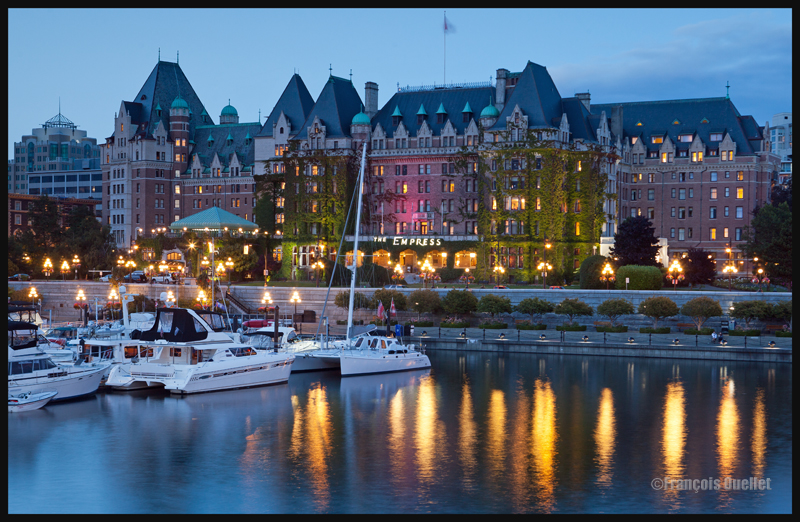
Empress Hotel at dusk, Victoria Harbor, Canada 2014
1. Ensure you bring : tripod, remote cable, flashlight and timer.
2. Use of RAW (.TIFF) is highly recommended. There is a greater potential for corrections afterward, if something is not according to your taste.
3. Noise reduction activated on the camera.
4. If the winds are calm: ISO between 50 and 200.
5. If there are strong winds: ISO 400 might be useful to avoid a blurred picture caused by the continual small vibrations of the tripod due to a long exposure. That is why a heavy tripod is always preferable.
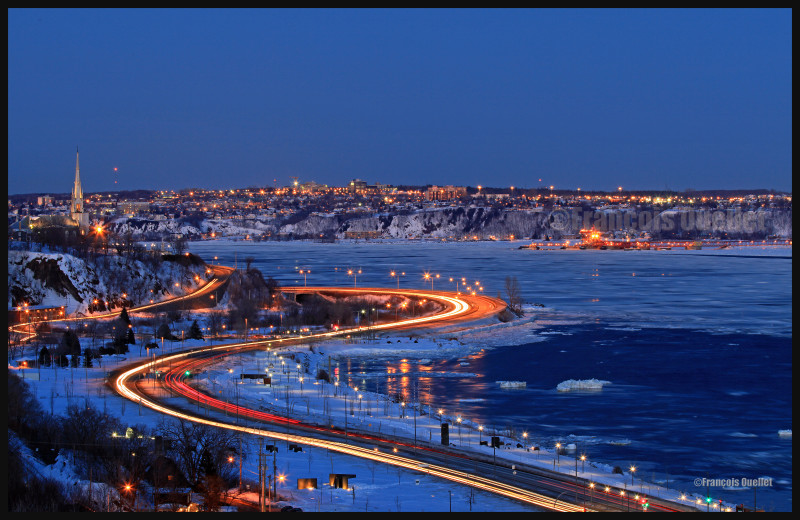
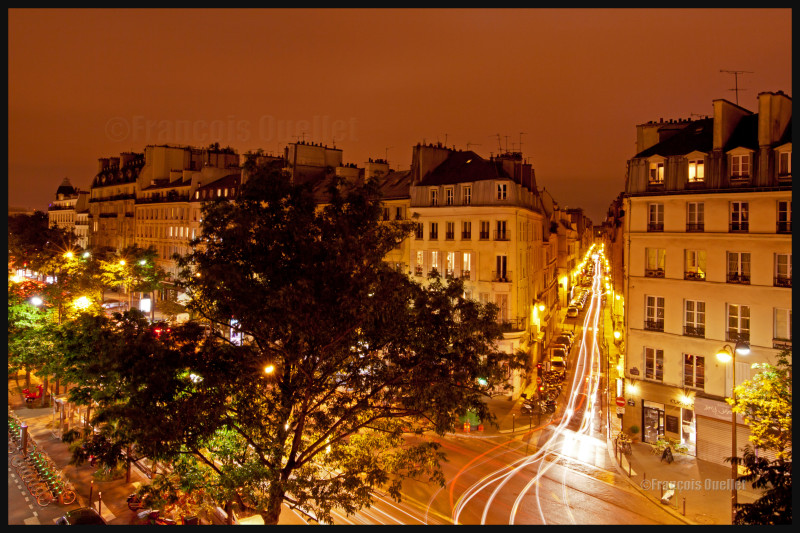
Trailing lights on boulevard Champlain, Quebec City
6. If you wish to take a picture of people moving at a normal pace, and you have access to quality lenses, it will often be necessary to use ISO 800 to get a clear shot. This setting could allow the shutter speed to be adjusted at about 1/200 which is plenty to obtain a picture that is not blurred; that is unless you are not using a long focal like 200mm or more.
7. For people shots, it is better to have your back to the remaining light on the horizon, unless your goal is to capture a silhouette.
8. For extended exposure, use the autofocus “one shot” setting until it stops working due to insufficient light. Then use manual focus. Or use manual focus all along, with Liveview, if you prefer it that way, for extra precision.
9. Mirror lock-up function must be activated to avoid vibrations caused by the shutter action.
10. Use a remote cable when taking the picture to avoid useless vibrations.
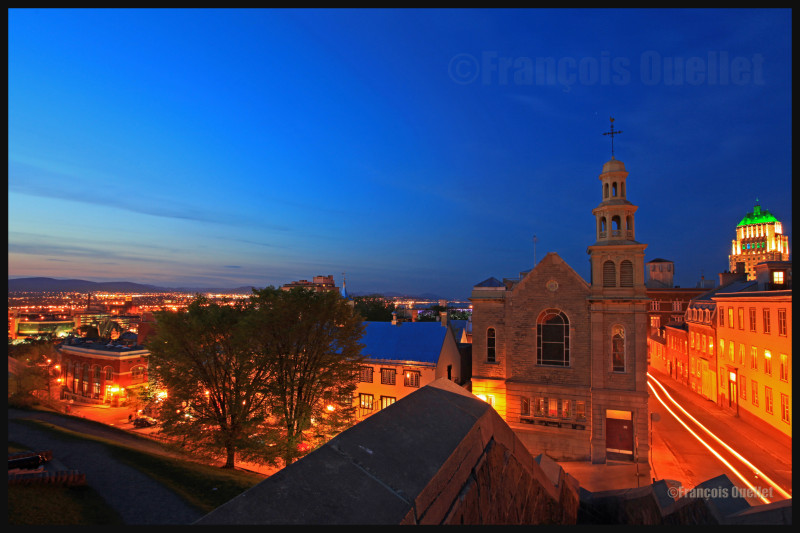
Old Québec at dusk.
11. If you wish, you might think of selecting a specific AF point to ensure a better focus if there is a small area that matters the most to you in the picture.
12. Do not use the FULL AUTO mode during night photography.
13. The three most important modes are 1. Aperture (taking care of slightly overexposing for surrounding lights) 2. Speed 3. Manual. There is one more reason to overexpose a bit if you work with the RAW format: there is more data information in light than in shadow, so once the picture is taken you have access to more data to play with to adjust the dark sections of the picture.
14. If you expect an exposure longer than 30 seconds, use BULB mode.
15. Night pictures are best taken using the camera bracketing funtion (-1,0,+1) and this, every two minutes.
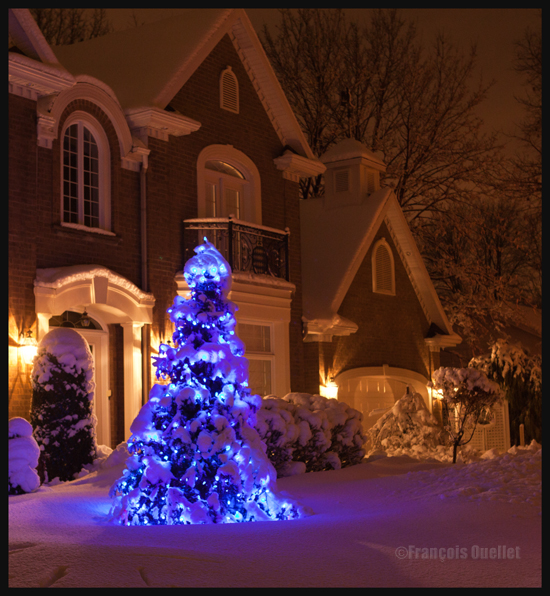
A Christmas tree in Sillery
16. The best period for night shots is 15 minutes after sunset, until official night time, which you can find on the internet. As this period is quite short, it is important that you know in advance what is of interest to you and where you will position yourself when comes the time for the picture.
17. Total darkness is not what is the most favourable in night photography. But you can certainly obtain interesting results using black and white.
18. Beware of surrounding light reflection in your lens.
19. Histogram has to be reviewed to ensure that there is no serious overexposure.
20. It is preferable to choose an aperture between F11 and F16 for maximum sharpness as well as an adequate depth-of-field.
21. If shooting a subject against the remaining light over the horizon, there might be quite a contrast in lighting between where you stand and where your subject is positioned. You might think of using grad filters (3-6-9-10) to help correct this huge light difference, or you can transform the standard photo session into an HDR one. Or both! There are also filters specifically designed for sunrise and sunset periods that can improve your shots.
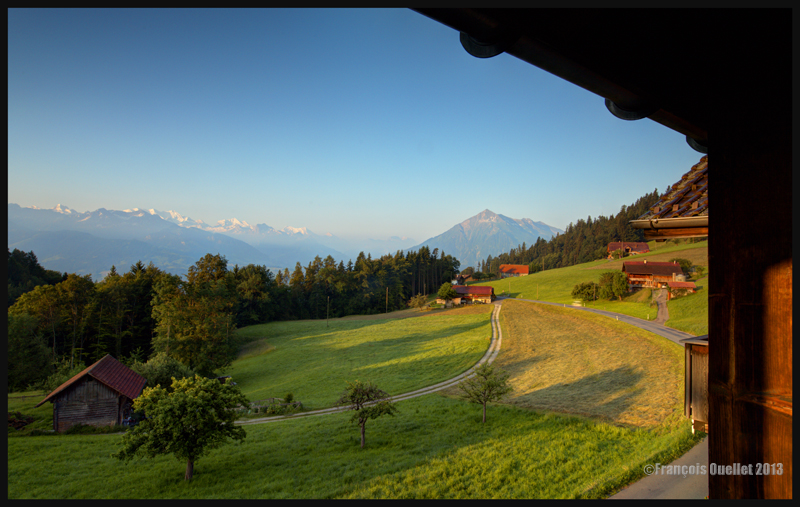
View from our hotel room in Schwanden, Switzerland 2013
Here are some of the pictures recently added to the Europe photo gallery. Schwanden, in Switzerland, was a superb discovery as the hotel was in the countryside but at a very reasonable distance from a big city like Bernes. This is an HDR picture, as the contrasts were just too important between the shadows under the balcony and the natural light of the sky. The Schwanden picture represents in fact five shots each taken with a different exposure. Photomatix is the software used to mix together all the pictures. Have a good visit in the photo galleries!