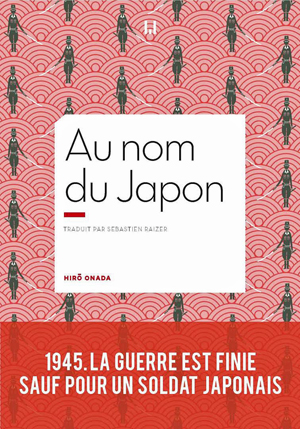
Even though World War II is over and the armistice was signed in 1945, four Japanese soldiers continue to hide on Lubang Island in the Philippines, awaiting official orders from their superior to surrender. They have been forgotten there in the jungle and continue to survive as best they can, dodging the patrols that have gone looking for them to tell them the war is over. They continue to accumulate information on the island for the intelligence services, hoping to be useful when a possible Japanese landing takes place that will drive the Americans out of the island. Years pass and there will be only one Japanese soldier left, Hiro Onada, who will finally surrender in 1974, thirty years later!
The bookis a lesson in survival in a hostile environment. The discipline and resourcefulness that are required to survive and ensure their safety is extremely impressive. Onada, even as he gradually sank into an alternate reality, shows a remarkable tenacity.
Here is a passage that shows the reality of the jungle. I translated it as best as I could: “[…] There are also a lot of bees on the island. Huge swarms fly in the bushy areas at the foot of the mountains. I saw some that were thirty meters wide and a hundred long, flying here and there with unpredictable changes of direction. If we encountered one of these swarms, the only thing to do was to go back to the woods or, if we did not have time, to cover our heads with the canvas of our tent or our clothes and lie down on the ground. If we made the slightest move, they would attack. We had to breathe as gently as possible, until the swarm had passed. “(P.216)
In 1957, bombardments in the neighborhood reassured them that the war continued. But these were military exercises by the Philippine Air Force, not an American attack.
Onada et Qanon
As the years pass, there will be countless opportunities for those soldiers to realize that the war is over. They even had access, for a while, to a radio. It did not matter: whatever was read, heard or discovered by chance was, according to them, only the fruit of disinformation from the enemy.
On reading this real life story, it is possible to make a connection between Onada’s testimony and a follower of Qanon: both cannot accept defeat and believe in an almost divine mission. As Onada himself put it so well: “At that time, Kozuka and I had developed so many fixed ideas that we were unable to understand everything that differed from them. If something did not fit our vision, we interpreted it to give it the meaning we wanted “(p.192).
When a person is gradually made to believe in an alternate reality and decides to cling to it for their mental or physical health, or both, the same conclusion remains: regardless of the evidence, the rhetoric or the new realities that will be presented, that person will continue to persist with his line of thinking. It will take some dramatic event in his life for him to decide to change course and come back to a more objective reality.
Have a good read!
Click on the link for more books on war in my blog.
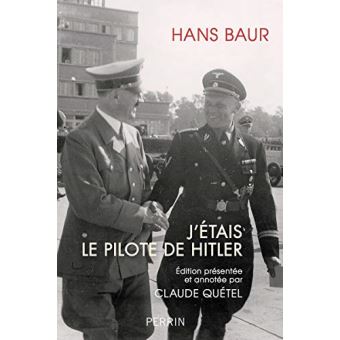
The book “J’étais le pilote de Hitler” tells a true story that was originally published in 1957. The 2020 French edition, presented and annotated by Claude Quétel, improves our understanding of Hans Baur, one of the founders of Lufthansa in 1926, Hitler‘s personal pilot, but also a high-ranking Nazi SS officer and a close friend of the Führer.
The information offered by Hans Baur is of great interest. Early in Hans Baur’s career, the pilots doing what he did were called aviation pioneers. At the time, planes contained virtually no air navigation instruments that could assist a pilot flying in difficult weather conditions. The Alps are tricky to fly through in good weather, so it gets a lot more challenging in bad weather and in a poorly equipped plane. If we add the freezing conditions, engine failures, cabins that are not heated and that are not equipped with devices providing supplemental oxygen to pilots, then there are flightsthat would be considered something like an “exploit”. This aspect of the book is therefore very interesting.
I also liked all of Hans Baur’s anecdotes about Hitler’s demands on him. Being a pilot for the Führer was no small task. Hitler had very high expectations regarding the performance and the punctuality of his personal pilot, and the latter certainly demonstrated extraordinary abilities to satisfy his superior.
Where we have to be wary is that we are still dealing with an SS pilot, who was a member of the Nazi organization before Hitler took power. We have to question his personal values and what he voluntarily neglected in his book. The regular massacres carried out during Barbarossa Operation in Russia, or the elimination of six million Jews, are not discussed, as the SS pilot maintains he was never involved in politics. He carried passengers without asking questions, but he had chosen Nazism as a political movement. When you are invited to Hitler’s table on a daily basis and are therefore part of his inner circle, it is clear that the Nazi represented by Hans Baur is speaking about more than piloting.
The experience in Russian prisons is described as inhuman by Hans Baur, who has been there ten years. He talks about the transport of German prisoners in cattle cars, very bad food, etc. But I couldn’t help but wonder what planet he lived on to denounce his condition as a prisoner while ignoring the treatment the Germans imposed on the Russians and all the people who were deported and massacred. The Einsatzgruppen were not altar boys. Moreover, Claude Quétel also questioned this remark from Hans Baur, adding that “although very harsh, the living and working conditions in the Soviet camps have nothing to do – as we sometimes read – with those of the German concentration camps.”(p.381).
There are also some inaccuracies and sometimes falsehoods that Claude Quétel does not hesitate to point out. Sometimes these are trivial errors resulting from poor memory. However, other important facts are downright inaccurate. As in this passage where Baur says that Hitler decided to attack Russia four weeks before the start of the war, which is not true. The conquest of the East and of more living space is specifically enunciated in Mein Kampfand is spoken of in a book written while Hitler was in prison in 1923 following a failed coup.
Conclusion
The book « J’étais le pilote de Hitler » is a very interesting book, one more about Nazi Germany. The history of Germany is fascinating and complex, from the time of the Holy Roman Empire to the present day. But it seems that it will always be the twelve years of the Nazi period that will achieve more success in bookstores.
Have a good read!
Click on the link for other books on war in my blog.
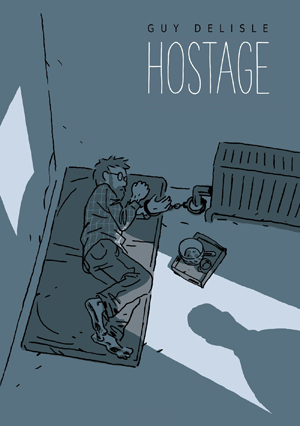
Guy Delisle took fifteen years to write this graphic novel. He tells the story of the kidnapping for ransom (K&R) in 1997 of a French citizen, Christophe André, while he was working for a medical NGO in the Caucasus region.
Faithful to his habits, this author born in Quebec City offers us a fascinating and humane narrative. A work that looks at a real life story often adds tension, when properly put together. This is what happens with the work of Guy Delisle. Hostage is a 428-page graphic novel that can be read in one sitting. As it often happens in dramatic events, humans discover an unsuspected character and strengths that enable them to cope with abuse, loneliness and stress.
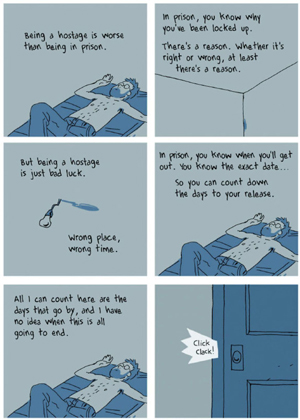
Hostage by Guy Delisle interior page
The pace and the quality of the drawings and the script make it easy for the reader to dive into the story and imagine themselves in the place of the captive. Would the decisions made by the hostage also have been made by the reader? Would he have used other means to deal with his captivity?
I discourage the reader from trying to discover the conclusion of this story before starting to read the book. Resist this temptation, the read is worth the effort!
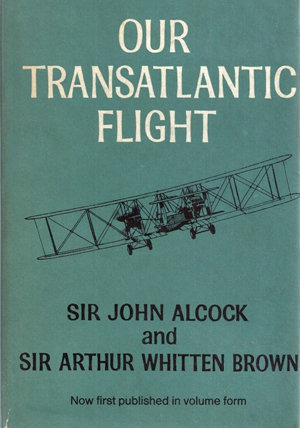
Our transatlantic flight, by Sir John Alcock and Sir Arthur Whitten Brown
Newfoundland
Before 1949, Newfoundland was called Dominion of Newfoundland and was part of the British Commonwealth . In 1949, it became a Canadian province.
The first non-stop flight eastward across the Atlantic.
The book « Our transatlantic flight » tells the story of the historic flight that was made in 1919, just after the First World War, from Newfoundland to Ireland. There was a 10,000 £ prize offered by Lord Northcliffe from Great Britain for whoever would succeed on the first non-stop flight eastward across the Atlantic.
A triumph for British aviation
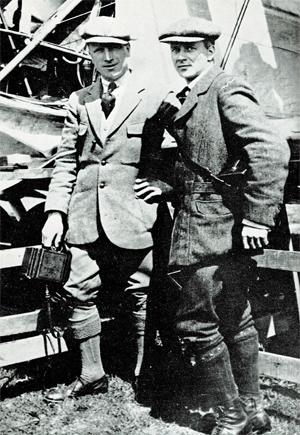
Sir John Alcock and Sir Arthur Whitten Brown , respectively pilot and navigator, wrote the story of their successful flight in this book which was published in 1969. The followings are pilot quotes from the book : « For the first time in the history of aviation the Atlantic had been crossed in direct, non-stop flight in the record time of 15 hours, 57 minutes. » (p.13) « The flight was a triumph for British aviation; the pilot and navigator were both British, the aircraft was a Vickers-Vimy and the twin engines were made by Rolls-Royce. » (p.13)
Sir John Alcock and Sir Arthur Whitten Brown
As with all great human achievements, a very good flight planning and some luck was needed to make this flight a success. If there was an engine failure during the flight, even if the planning was excellent, there was only one outcome : downward.
In order to make the flight, Alcock and Brown boarded a ship from England bound to Halifax. They then headed to Port aux Basques and finally arrived in St.John’s. There, they joined a small group of British aviators who had arrived a few days before and who were also preparing for the competition. « The evenings were mostly spent in playing cards with the other competitors at the Cochrane Hotel, or in visits to the neighbouring film theatres. St.John’s itself showed us every kindness. » (p.60)
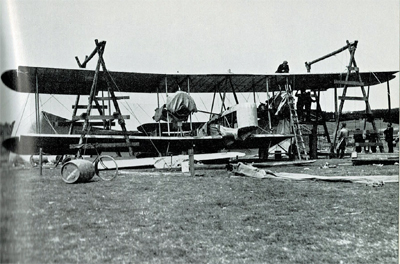
Maritime transport was used to carry the Vickers-Vimy biplane to Newfoundland on May 4th. It was assembled in Newfoundland. « The reporters representing the Daily Mail, the New York Times, and the New York World were often of assistance when extra manpower was required. » (p.61).
While the aircraft was being built, there were more and more visiters coming to the site. Brown says : « Although we remained unworried so long as the crowd contented itself with just watching, we had to guard against petty damage. The testing of the fabric’s firmness with the point of an umbrella was a favourite pastime of the spectators […]. » (p.61)
The Vickers-Vimy is being reassembled at Quidi Vidi in Newfoundland.
It was difficult to find a field that could be improvised into an aerodrome : « Newfoundland is a hospitable place, but its best friends cannot claim that it is ideal for aviation. The whole of the island has no ground that might be made into a first-class aerodrome. The district around St.John’s is especially difficult. Some of the country is wooded, but for the most part it shows a rolling, switchback surface, across which aeroplanes cannot taxi with any degree of smoothness. The soil is soft and dotted with boulders, as only a light layer covers the rock stratum. Another handicap is the prevalence of thick fogs, which roll westward from the sea. » (p.59)
They flight tested the airplane on June 9th at Quidi Vidi. During the short flight, the crew could see icebergs near the coast. They did a second trial on June 12th and found that the transmitter constantly caused problems. But, at least, the engines seemed to be reliable…
The departure
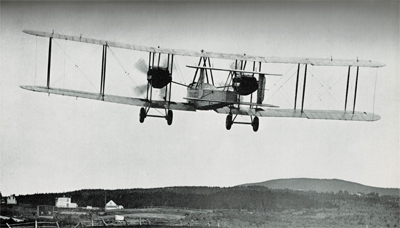
The two men left Newfoundland on June 14th 1919. In order to fight the cold air in flight, they wore electrically heated clothing. A battery located between two seats provided for the necessary energy.
The Vickers-Vimy departs from Newfoundland in 1919
The short take-off was very difficult due to the wind and the rough surface of the aerodrome. Brown writes : « Several times I held my breath, from fear that our under-carriage would hit a roof or a tree-top. I am convinced that only Alcock’s clever piloting saved us from such an early disaster. » (p.73)
It took them 8 minutes to reach 1000 ft. Barely one hour after departure and once over the ocean, the generator broke and the flight crew was cut off from all means of communication.
As the airplane consumed petrol, the centre of gravity changed and since there was no trim on the machine, the pilot had to exert a permanent backward pressure on the joystick.
Flying in clouds, fog and turbulence.
During the flight with much clouds and fog, Brown, having almost no navigation aid, had real problems to estimate the aircraft’s position and limit the flying errors. He had to wait for a higher altitude and for the night to come to improve his calculations : « I waited impatiently for the first sight of the moon, the Pole Star and other old friends of every navigator. » (p.84). The fog and clouds were so thick that at times they « cut off from view parts of the Vickers-Vimy. » (p.95)
Without proper instruments to fly in clouds, they were relying on a « revolution-counter » to establish the climbing or the falling rate. That is pretty scary. « A sudden increase in revolutions would indicate that the plane was diving; a sudden loss of revs would show that she was climbing dangerously steeply. » (p.176)
But that was not enough. They also had to deal with turbulence that rocked the plane while they could not see anything outside. They became desoriented : « The airspeed indicator failed to register, and bad bumps prevented me from holding to our course. From side to side rocked the machine, and it was hard to know in what position we really were. A spin was the inevitable result. From an altitude of 4,000 feet we twirled rapidly downward.[…]. « Apart from the changing levels marked by aneroid, only the fact that our bodies were pressed tightly against the seats indicated that we were falling. How and at what angle we were falling, we knew not. Alcock tried to centralise the controls, but failed because we had lost all sense of what was central. I searched in every direction for an external sign, and saw nothing but opaque nebulousness. » (p.88)
« It was a tense moment for us, and when at last we emerged from the fog we were close down over the water at an extremely dangerous angle. The white-capped waves were rolling along too close to be comfortable, but a quick glimpse of the horizon enabled me to regain control of the machine. » (p.40).
De-icing a gauge installed outside of the cockpit.
Snow and sleet were falling. They didn’t realize how lucky they were to continue flying in such a weather. Nowadays, there are many ways to dislodge ice from a wing while the aircraft is in flight. Here is what Brown says about their situation : « […] The top sides of the plane were covered completely by a crusting of frozen sleet. The sleet imbedded itself in the hinges of the ailerons and jammed them, so that for about an hour the machine had scarcely any lateral control. Fortunately, the Vickers-Vimy possesses plenty of inherent lateral stability; and, as the rudder controls were never clogged by sleet, we were able to hold to the right direction. » (p.95)
After twelve hours of flying, the glass of a gauge outside the cockpit became obscured by clotted snow. Brown had to deal with it, while Alcock was flying. « The only way to reach it was by climbing out of the cockpit and kneeling on top of the fuselage, while holding a strut for the maintenance of balance. […] The violent rush of air, which tended to push me backward, was another discomfort. […] Until the storm ended, a repetition of this performance, at fairly frequent intervals, continued to be necessary. » (p.94)
In order to save themselves, they executed a descent from 11,000 to 1000 feet and in the warmer air the ailerons started to operate again. As they continued their descent below 1000 feet over the ocean, they were still surrounded by fog. They had to do some serious low altitude flying : « Alcock was feeling his way downward gently and alertly, not knowing whether the cloud extended to the ocean, nor at what moment the machine’s undercarriage might touch the waves. He had loosened his safety belt, and was ready to abandon ship if we hit the water […]. » (p.96)
The arrival.
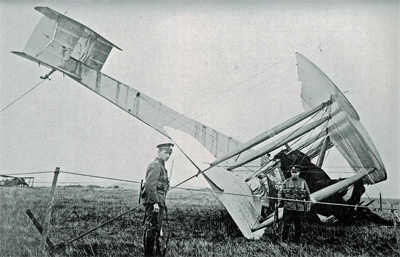
They saw Ireland at 8.15 am on June 15th and crossed the coast ten minutes later. They did not expect a very challenging landing as the field looked solid enough to support an aircraft. They landed at 8 :40 am at Clifden on top of what happened to be a bog; the aircraft rolled on its nose and suffered serious material damages. The first non-stop transatlantic flight ended in a crash. Both both crewmen were alive and well, although they were dealing with fatigue…
The transatlantic flight ends up in Ireland in a soft field
Initially, nobody in Ireland believed that the plane arrived from North America. But when they saw mail-bags from Newfoundland, there were « cheers and painful hand-shakes » (p.102).
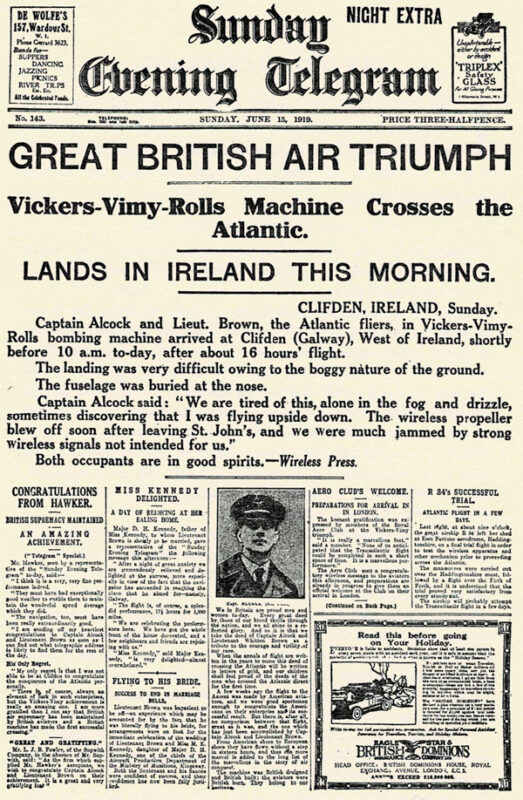
First page of the Sunday Evening Telegraph in 1919.
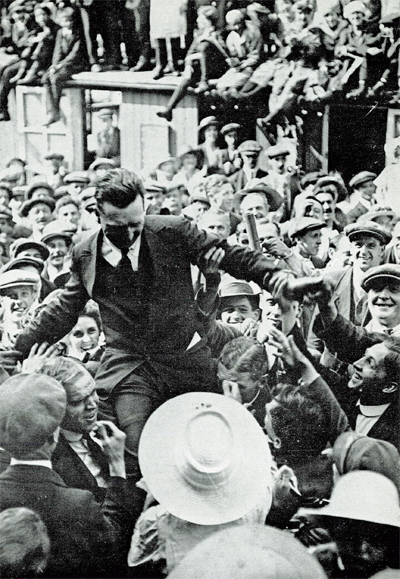
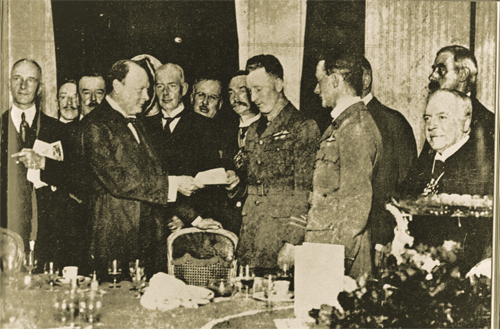
They were cheered by the crowds in Ireland and England and received their prize from Winston Churchill.
John Alcock chaired by the crowd
Winston Churchill is presenting the Daily Mail Check to the two pilots.
Their record stood unchallenged for eight years until Lindbergh’s flight in 1927.
The future of transatlantic flight.
Towards the end of the book, the authors risk a prediction on the future of transatlantic flight. But aviation made such a progress in a very short time that, inevitably, their thoughts on the subject was obsolete in a matter of a few years. Here are some examples :
« Nothwithstanding that the first two flights across the Atlantic were made respectively by a flying boat and an aeroplane, it is evident that the future of transatlantic flight belongs to the airship. » (p.121)
« […] The heavy type of aeroplane necessary to carry an economical load for long distances would not be capable of much more than 85 to 90 miles an hour. The difference between this and the present airship speed of 60 miles an hour would be reduced by the fact that an aeroplane must land at intermediate stations for fuel replenishment. » (p.123)
« It is undesirable to fly at great heights owing to the low temperature; but with suitable provision for heating there is no reason why flying at 10,000 feet should not be common. » (p.136)
The Air Age.
There is a short section in the book on the « Air Age ». I chose two small excerpts on Germany and Canada :
On Germany’s excellent Zeppelins : « The new type of Zeppelin – the Bodensee – is so efficient that no weather conditions, except a strong cross-hangar wind, prevents it from making its daily flight of 390 miles between Friedrichshafen and Staalsen, thirteen miles from Berlin. » (p.140)
On Canada’s use of aeroplanes : « Canada has found a highly successful use for aeroplanes in prospecting the Labrador timber country. A group of machines returned from an exploration with valuable photographs and maps of hundreds of thousands of pound’s worth of forest land. Aerial fire patrols, also, are sent out over forests.» (p.142) and « Already, the Canadian Northwest Mounted Police [today the RCMP] have captured criminals by means of aeroplane patrols. » (p.146)
Conclusion
The Manchester Guardian stated, on June 16th 1919 : « […] As far as can be foreseen, the future of air transport over the Atlantic is not for the aeroplane. It may be used many times for personal feats of daring. But to make the aeroplane safe enough for business use on such sea routes we should have to have all the cyclones of the Atlantic marked on the chart, and their progress marked in from hour to hour. »(p.169)
Title : Our Transatlantic Flight
Authors : Sir John Alcock and Sir Arthur Whitten Brown
Front cover of the book “The Man and His Art” by R.G. Smith
« We had no television in those days, so my evenings were spent reading history or drawing, mostly airplanes”.
“[Lieutenant Commander Beaumont] influenced my life as an artist. […] He participated in Operation Deep Freeze in Antarctica. Where others saw only white and blue in this frigid area, Beaumont found wonderful color and conveyed same in his art. He added alcohol to his paints to prevent them from freezing as he worked in sub-zero temperatures for 30 minute intervals, retreating to a warmer area before going out again”.
“It was Beaumont who taught me composition, color balance, and how to look at a subject and translate the visual image to paper or canvas”.
“Beaumont emphasized it wasn’t necessary to reproduce an exact replica of a scene as long as the end result achieved dramatic impact”.
“Bob Poole taught me […] how to grey down vivid colors. He also taught me that by blending colors, I could add motion to aircrafts and add subtlety to harsh lines”.
“Understanding light and its effects is obviously critical to an artist […]. For instance, as the descending sun caught the side of a rusty tanker, it created a starkly bright copper tone. We learned that if we didn’t try to emulate that color on paper within 30 minutes, the light would be lost, and the rich copper tone would quickly change to a dingy, lifeless brown”.
“Aspiring artists want to know how to draw and paint, but very few want to take the time to learn”.
“Refrain from ever being satisfied with your work. Never stop rehearsing you craft. Every painting is another step in an endless learning curve. Achievement comes from hard work, discipline, and a constant program of practice and learning”.
“Accuracy requires study and thorough knowledge of your subject. […] Generally, more than 50 percent of the time invested in a painting went into research”.
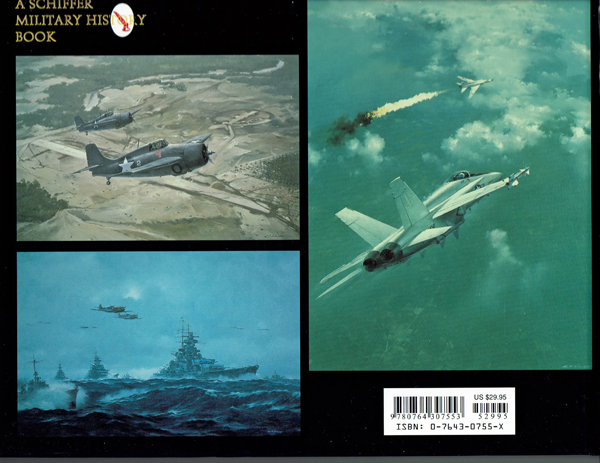
Back cover of the book “The Man and His Art” by R.G. Smith
“As to planning a picture, my approach usually entailed making several sketches of ideas for the scene I wanted to create before deciding on the final composition”.
“Create the background first, knowing beforehand where you intend to place the aircraft, which should be the last phase of your painting”.
“My criticism of much of aviation art today is that many artists feel they must paint every rivet on an aircraft, or every line on a ship. It often appears as though some artists cut their aircraft from a photograph and paste it on the background”.
“[…] the eye and the brain do most of the work, connecting the dots and lines. In other words, you don’t have to include every detail, just a suggestion of detail”.
“Study the works of artists you admire, or whose style you want to emulate”.
“Some artists only see an airplane as a mechanical object. As a result, their depiction of them is mechanical, stilted portraits of aircraft rather than a picture with character, motion, or some measure of dramatic quality”.
“I’m not a complicated man and it has never taken much in the way of material things to make me happy. Most of my pleasures have come from my family, my career, my hobby, my books, and my friends. The wonderful experiences and opportunities that came my way were frosting on the cake”.
Title: The Man and His Art. R.G. Smith / an Autobiography (with Rosario “Zip” Rausa) Author: R.G. Smith with Rosario “Zip” Rausa Copyright: 1999 by R.G. Smith Edition: Schiffer Publishing Limited ISBN: 0-7643-0755-X
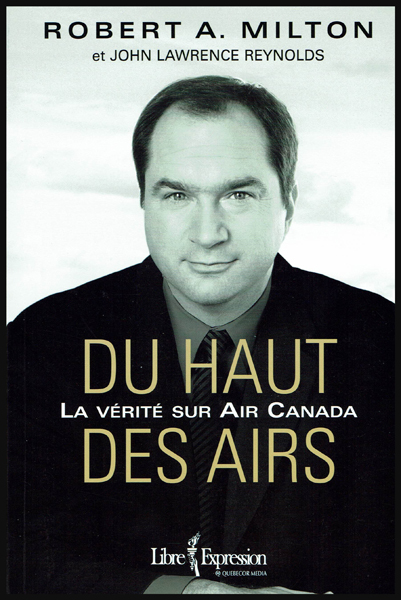
Robert A. Milton managed Air Canada during the most tempestuous period of the history of air transport.
I translated the quotes from the French version of the book.
“It is all right to say to a Crown corporation to operate, starting tomorrow, like a private enterprise, but it’s like saying to a dog to walk on its hind legs from now on. The dog can succeed, but it will need time to adjust to this new idea”.
“Rod Eddington, the British Airways CEO, made everybody laugh when talking about the resistance to change of middle managers. He said: “As it is said for staff reductions, turkeys have never voted in favor of Christmas”.
“The most efficient system in the world can only work properly if the people who apply it want it to work”.
“No air transport society has ever succeeded in reducing its activities, except in the context of a restructuration under judiciary supervision”.
“One day, as I was walking through the department of technical operations, I looked around and noticed that some people were working in a cubicle fitted out along an outside wall. There were many windows in the wall, but they were all covered with brown paper. I was curious to know why. Was the outside view so terrible that nobody wanted to look through the windows? Or was it so beautiful that it could distract the employees? I checked and the view had nothing really special. It was not more beautiful nor uglier than the other views from the building.
When I asked for explanations, I was told that the employees working along that wall belonged to a group where the salary level did not allow access to a window. But, for different reasons, it had been necessary to position them near a wall with windows. A bureaucrat of the organization had been afraid, I suppose, that making an exception to the rule would lead to anarchy, and he ordered that the windows be covered to correct this unacceptable situation. Useless to say that the brown paper disappeared a few minutes after I received the explanation”.
“Quite often, people who progress slowly in their career without having to take decisions inevitably end up by having to take one. At that moment, they freeze like a deer being blinded by a car headlights, and they get knocked out”.
“If someone puts one finger in my eye, I react by putting two fingers in both of his eyes”
“The VISA Aerogold card is nothing else than a money making machine for the CIBC. It represents 20 to 25 % of the market capitalization of the bank”.
“It is necessary to respect the rules of the game, but to play in all seriousness by using all the tools that are available to you”
Here, Robert Milton quotes a former Minister of Transport of Canada: “He raised the governance problems and the airports inability to control costs, to show interest in customers and to build only the needed infrastructure, instead of the luxurious installations that are now appearing all across the country”.
“In the future, I see Air Canada recognized as one of the six best airline companies of the world, with connections in all regions of the globe and with an interior service representing a smaller, but all the same important part of its total income”.
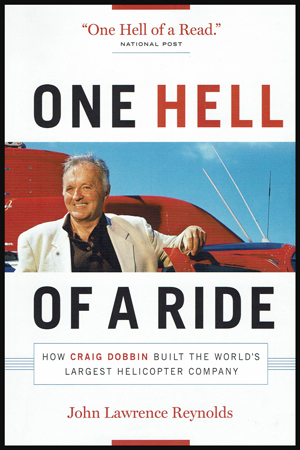
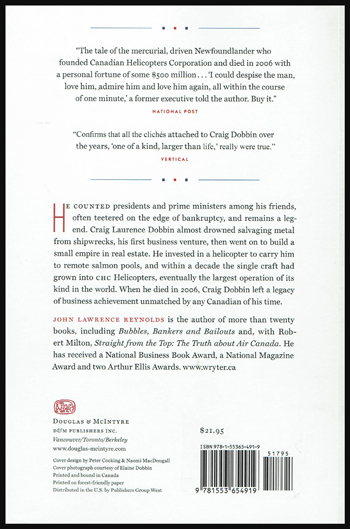
The Canadian Craig Dobbin built the world’s largest helicopter company
“One hell of a ride” book cover about Craig Dobbin and the world’s largest helicopter company: CHC Helicopters
His view on management
“I’m not an expert on anything” he explained. “Whatever the job, whatever the challenge, somebody can do it better than I can. True entrepreneurs surround themselves with professional managers who share their vision and put form around it. Not only can you not do it all yourself, it’s not necessary, and it does not make sense. I believe in being a good casting director of people who work together and share together”.
Handling pressure
“It’s been a good week” Craig Dobbin might comment to his personal secretary late on a Friday afternoon. Then his face would cloud over and he’d say, “Get Keith Stanford on the phone and ask him for my financial summary. That’ll fuck up my weekend”.
A capacity to take huge financial risks
“The hell with the contract”, he grinned. “Let’s buy the buggers out and we’ll get the contract that way! We’ll start with Toronto [Helicopters].”
“One morning, shortly after the deal to purchase Toronto Helicopters was completed, Craig Dobbin strolled into Robert Foster’s Toronto office. “Robert” he said “I want you to get on a plane, fly to Calgary and buy Okanagan Helicopters for me.” “But Craig,” Foster replied, “you don’t have any money.” Dobbin shrugged and said “That’s your problem.””
On the importance of relaxing and have fun
“Over time, Dobbin introduced initiation rites for first-time visitors [to his fishing lodge]. Steve Hudson’s [a pilot] initial visit to Adlatuk involved a helicopter flight over the ocean in search of an iceberg drifting down from the Arctic. When a suitable iceberg was located, the initiate was given his instructions. “They handed me a hammer and an ice bucket,” Hudson explains. “My job was to jump out of the helicopter onto the iceberg and fill the bucket with chipped ice for our drinks back at the fishing lodge”.
Icebergs, Hudson discovered, are very unstable and riding one in the North Atlantic with a Super Puma hovering a few feet over your head is like trying to keep your balance while walking across a trampoline. “It was a lot of fun for the guys in the helicopter,” he says, “but not so much fun for me, trying to knock enough million-year-old ice of the berg to fill the bucket.” Back in the camp, the ice chilled several glasses of Jameson raised in a toast to the new crew member.””
“One hell of a ride”, from John Lawrence Reynolds
A genuine interest in people
“When he talked with you in social situations,” one business acquaintance recalls, “he was focused totally on you. He wasn’t looking over your shoulder or around the room, searching for someone more important. He was really interested in what you were saying. Everyone sensed this about the man and was drawn to him”.
Dobbin’s humanity
“Dobbin’s business acumen rarely overrode his humanity. On a flight to his fishing lodge in Long Harbour with a group of friends, Dobbin asked the helicopter pilot to set the craft down for a washroom break. The pilot chose an open area adjacent to a shack and tower where a provincial wildlife officer was spending the summer on fire-watch duty. The officer, a grizzled veteran of wildlife work, kept the group laughing for some time with his stories and anecdotes, and the short rest break extended into an hour’s impromptu entertainment.
“How long have you been here?” Dobbin asked the old timer as the group was about to board the helicopter and resume their journey. “Ten weeks,” the officer answered, with about another ten weeks to go before returning home. “Anything you need?” Dobbin inquired, and the man said he was out of sugar; it would be nice to have something to sweeten his tea, but he would get by.
An hour later, when everyone had disembarked at Long Harbour, Dobbin instructed the helicopter pilot not to shut down the aircraft yet. He entered the cookhouse and emerged with a two-kilo bag of sugar, ordering the pilot to fly it back to the wildlife officer they had met.
“Are you kidding?” the young pilot said. “I’ll spend about two thousand bucks in fuel alone to fly it there.”
Dobbin gripped the pilot’s arm. “Son,” he said, “that sugar will mean more to that old fellow than two thousand bucks will ever mean to me. Now get going.””
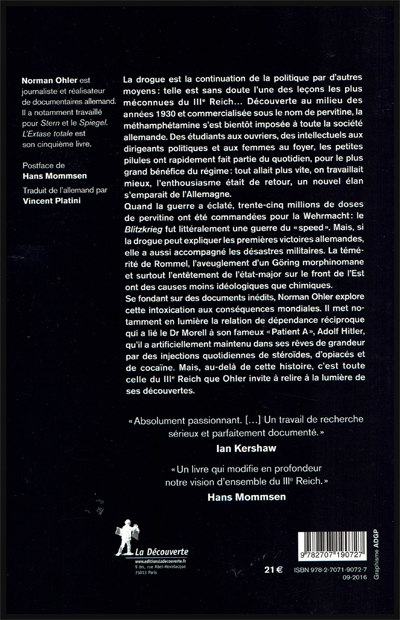
Translated from German to French, this book is titled : « L’extase totale – Le troisième Reich, les Allemands et la drogue ». The original title was : « Der totale Rausch. Drogen im Dritten Reich ». The author is a German journalist and documentarist who worked for Stern and Der Spiegel. He has also written four other books. I tried to translate the quotes to the best of my ability.
The research made by the author shows that in the years preceding the Second World War, the German population regularly used drugs to better support the defeat resulting of the First World War. Drug consumption was a standard phenomenon. It became necessary to curtail this habit.
Front cover of the book “L’extase totale” by Normand Ohler
Hitler is thus presented as a « pure role model […], an ascetic, the enemy of drugs who disregards his own needs » (p.25). But if there is somebody in Germany who is becoming a regular user of drugs and who even has access to his own pusher, namely the well-known Dr Morell, it is Hitler.
In the documents presented by the author, Hitler is also described as thePatient A : « Hitler is getting used to repetitive shots and to those mysterious substances flowing in his veins to supposedly invigorate him » (p.37).
In 1937, the Temmler factories create the first German methylamphetamine, also known as « pervitin ». There is a widespread use in the German population as well as in the army. Pervitin is the artificial booster that lasts more than twelve hours, « solves problems » and keeps the German soldier awake for several days : « Use of pervitin becomes as natural as drinking a cup of coffee » (p.44).
The German troops, who sleep every two or three days now, rush through Europe. It is the famous Blitzkrieg. The armour do not stop anymore. While the Allied soldiers must sleep on a rotating basis, the German soldiers charge without taking any breaks, energized with methamphetamine.
Poland is the first surprised. « […] provided with a huge amount of drugs, but without dosage indications, the Wehrmacht attacks the Polish neighbour who is not doped and has no idea of what to expect. » (p.63).
Thirty five million doses are ordered for the army and the Luftwaffe. « The Wehrmacht becomes the first army in the world to widely use chemical drugs […]. A new form of war has appeared » . (p.76)
Peter Steinkamp, a medical historian, states that « the Blitzkrieg was led through the use of methamphetamine, not to say that it was planned with methamphetamine in mind » (p.85).
The German officers do not obey orders anymore, exhilarated by the quick victories : « Guderian […] continues his offensive while he has formally received the order to stop » (p.86). It is the same thing for Rommel who does not obey General Hoth’s orders : « He has lost all senses of danger, [which is] a typical symptom of an excessive consumption of methamphetamine. He maintains his offensive both day and night ». (p.88). Hitler does not control the generals of the armoured divisions who now act in an autonomous mode.
Decided to regain control of his officers, Hitler takes a decision that ignores any military strategy. He orders all his troops to stop during ten days, at a moment when they have almost surrounded the Allied. The German officers impress upon Hitler to complete the military campaign but « Hitler wants to show his ground troops that it is him and nobody else who leads this war » (p.95). At Dunkirk, « more than 340,000 French, Belgian and British soldiers escaped by the sea » (p.95).
Backcover of the book ” L’extase totale ” by Normand Ohler
The author refers to numerous research documents pertaining to extensive drug consumption among soldiers and officers. This habit was present up to the highest military ranks. The German population was also keen to use drugs on an extensive basis : « It does not take long before the number of doses that find themselves in the stomach or blood of Germans exceed the million doses » (p.114)
The melting pot of drugs used on a daily basis by Hitler has an important effect on his judgment. He makes a serious strategic mistake concerning the war raging with Russia. He forbids any retreat of the German troops without his official authorization. The Wehrmacht undergoes heavy losses to the elite Russian divisions « freshly arrived from Siberia » (p.135).
Another important strategic mistake happens in December 1941 when Germany decides to declare war to the United States : « Germany is already exhausted by the fights it wages on multiple fronts, while overseas, the industrial giant is ready for the battle » (p.139).
Hitler’s stubbornness « to refuse to give up an inch of the conquered territory has a more profound reason : that the chimneys continue to work as long as possible in the East, in the extermination camps in Auschwitz, Treblinka, Sobidor, Chelmno, Majdanek and Belzec. Hold all positions until all the Jews are killed. Distancing himself from the human laws, [Hitler] continues his war against the weakest» (p.140).
The author enumerates other military strategical mistakes made by Hitler. He also details the close relation that existed between Hitler and his personal doctor, Dr Morell. The reader learns about the content of Hitler’s daily drug cocktails, among which Eucodal, cocaine and morphine. Benefiting from his close personal relation with Patient A, Dr Morell also increases his personal influence and fortune.
The reader witnesses the Führer’s progressive decline and the consequences of his desperate decisions. It is quite surprising that among all Hitler biographies, his heavy consumption of drugs and their consequences are barely noted.
The end of the book deals with the harsh experiments made on prisoners in the concentration camps.
The book « L’extase totale » allows a different understanding of the Second World War and of the psychology of the German population at the time. The reader realizes the very strong impact of the chemical drugs before and during the war. Even the way the Blitzkrieg is traditionnally presented has to be reviewed.
The advanced technology combined with military strategy and extensive use of chemical drugs initially gave the advantage to the German forces. However, with time, a lack of control on pervitin and other drugs had irreversible negative consequences on a huge number of soldiers and officers. It was the cause of crucial military strategical mistakes. An exclusive identity-based nationalism was also responsible for the loss of millions of human lives.
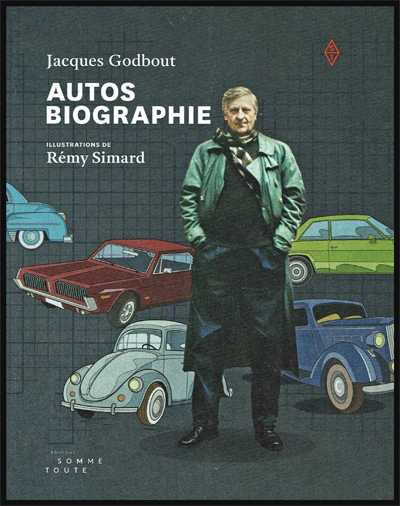
Front cover of the book Autos Biographie by Jacques Godbout
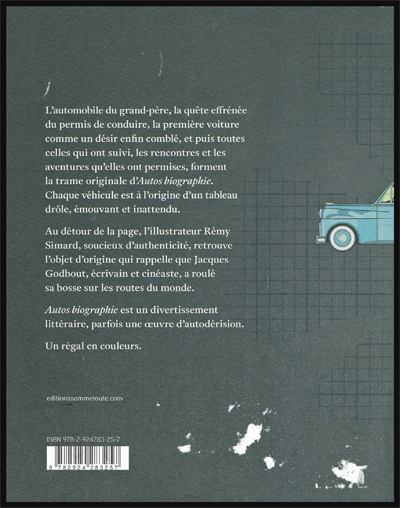
Jacques Godbout has found a very interesting way to present his autobiography. The cars that he once owned or rented , even those who he attempted to drive without success, become the link that the reader follows to travel around the world, always learning something new about the author’s life.
This is a refreshing book, filled with humor, where the author presents his family and many other people with whom he studied or worked, including Robert Bourassa, a former Prime Minister of Quebec.
Back cover of the book Autos Biographie by Jacques Godbout
As a citizen of Quebec City, I was surprised to learn that it is the rounded shape of the St-Laurent bar, inside Château Frontenac, that inspired Jacques Godbout and three of his friends (Paul Buissonneau, Gilles Carle and Jacques Languirand) when they were asked to sketch the beautiful Montreal Expo 67’s pavillion “L’homme dans la cité” (Man in the Community).
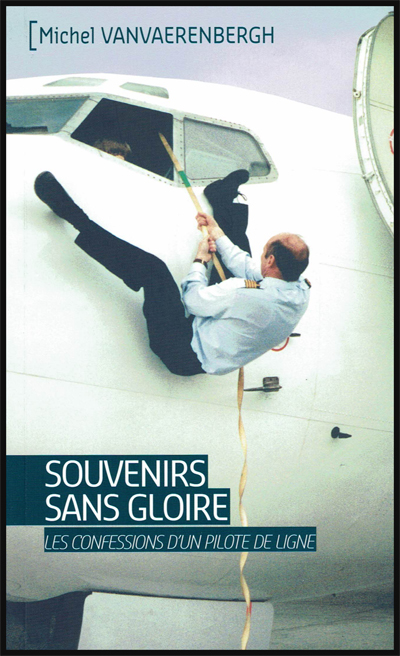
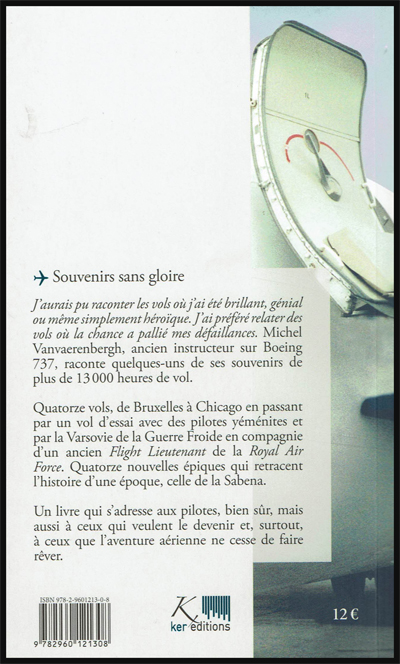
The title of this French book could be translated as: “Memories without glory: the confessions of an airline pilot”. A bit of modesty was certainly required in order to publicly expose one’s own flying mistakes, especially when that person is an airliner captain.
Front cover of the book: “Souvenirs sans gloire – Les confessions d’un pilote de ligne”
However, the book does not relate only some of the errors made by the author, Michel Vanvaerenbergh, but also those of the crew members working at the time for the Sabena airline company.
Generally, flying errors are discussed in private and corrective actions are published by each airline company for their staff in order to limit the risk of repeating the same mistakes. But to actually publish a book on one’s own mistakes is quite original and also very useful. Beginners or experienced pilots will certainly profit from the author’s past experiences.
Some of the stories are quite scary: on several occasions, the reader realizes that the pilots and passengers were lucky to survive a flight. Once, the pilots had to decide if a runway was long enough for take-off. They did not have the appropriate documents on board to calculate what was needed and the Sabena office was closed. They estimated that they could do it but realised too late that is was not the case, seeing the end of the runway approaching quickly. They forced the Boeing off the ground before it had reached the appropriate speed. The aircraft refused to climb for seven minutes. That meant that the aircraft was close to stalling and that everyone on board nearly escaped death.
Back cover of the French book: “Souvenirs sans gloire”
The author tells the story of crew members under the influence of alcohol with whom he had to deal with. There is also the unbelievable account of a test flight with Yemeni pilots who never used the appropriate charts to adjust the parameters of the aircraft. To make it easier, they preferred assuming the aircraft was always at its maximum weight.
On a few occasions, too much assertiveness from pilots and crew members almost resulted in an airliner crash.
The literary style has only one objective: go straight to the point. So forget any fanciful writing. Moreover, there are no paragraphs in this small book, something to which I was not used. But those are only details and the reader can easily deal with them.
Considering the intensity of real life stories, “Souvenirs sans gloire” is certainly a book not to be missed, especially for the aviation enthusiast.
Click on the link for other books relating specifically to human behaviour on my blog.