Categories
Real life stories as a flight service specialist (FSS): Quebec FSS

Quebec FSS and the September 11th 2001 events

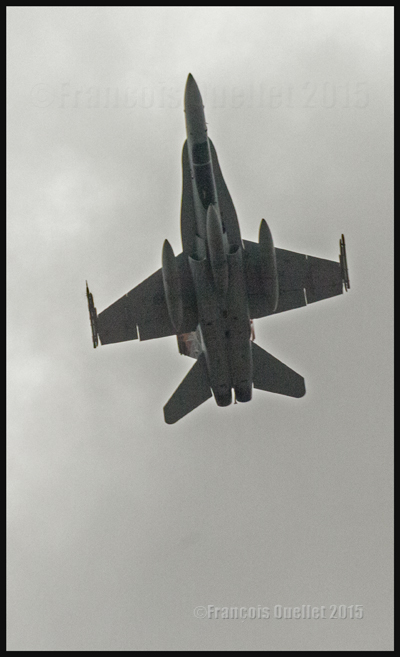
One of four F-18s over the National War Memorial in Ottawa on October 22nd 2015

During the September 11th 2001 crisis, the Canadian sky belonged, for a short period, to the military. The latter had taken the decision that every aircraft that had not taken-off yet had to stay on the ground, and those which were airborne had to expedite the landing.

There were a few exceptions for medical evacuations, but those flights were tightly monitored. All air traffic services units communicated with aircrafts in flight and agencies on the ground to advise them of the new rules now in place.

Generally speaking, regardless of the initial surprise, all pilots with whom the Transport Canada flight service specialists (FSS) in Quebec City had talked, through their multiple frequencies, offered no resistance.

But I remember the case of a pilot flying a twin-engine aircraft over the Laurentides region to whom the order of landing as soon as possible had been given. He refused to obey since it was out of the question for him to lose money on already booked charter flights, especially on a beautiful day.

The flight service specialists could understand his frustration. Nonetheless, it was not a good time to debate. It was, for all air traffic services units involved, a particularly busy day and nobody had extra time to argue at length about a request.

The message was repeated one more time. In view of his refusal to obey, NORAD (North American Aerospace Defense Command) was contacted. The reply came back quickly and the pilot was given two choices: either he landed or an CF-18 fighter jet would be launched to take care of the situation.

No need to add anything else. The pilot complied immediately.

For more real life stories about being a FSS in Quebec City, click on the following link: Flight service specialist (FSS) in Quebec City

Categories
Real life stories as a flight service specialist (FSS): Quebec FSS

FSS and pilots with different styles

Pilots regularly refer to flight service specialists (FSS) when preparing for a flight. They can either phone or visit a flight service station. The FSS progressively know an increasing number of pilots who differ a lot in experience.

As with any profession, competence and a professional attitude vary for the same license. Pilots are no exception and I could divide them in three categories: 85% meet the requirements on a continual basis, 10% constantly exceed the expectations and the last 5% deals with more or less important shortcomings.

Here are two small stories involving pilots of very different style and some flight service specialists. Those events happened in the ‘80s and ‘90s:

The pilot with a gigantic ego

One day, a pilot called the Transport Canada flight service station in Quebec City (CYQB) on the local radio frequency and said: “I’ll be landing in twenty minutes at Lac St-Augustin. Call my wife and tell her to pick me up”.

That was not a polite way to request a favor. He obviously had decided that those types of private phone calls were part of our responsibilities. As the flight service specialist was working higher priorities, he told the pilot that this was something he would have to do himself.

Losing his temper, the pilot started to reel off his CV and all the contacts with whom he would communicate to set this employee’s case. His long monologue forced us to lower the air radio frequency’s volume. His ramblings blocked an important frequency and were a nuisance to the other pilots. Eventually, he ran out of ideas and the radio frequency was finally available for essential communications.

A few hours later, the same pilot made a spectacular entry in the flight service station, shouting and blasting the employees. He then left the place by slamming what could be slammed of the swinging doors we had at the time.

Luckily, special cases like that are rare. They so differ from what we are used to that it’s impossible to forget them, even decades later.

An exceptionally cold blooded pilot

I remember of a very experienced pilot who used to visit us regularly at the Transport Canada flight service station in Rouyn-Noranda (CYUY). One day, he entered the station, leaned on the briefing counter, and started to talk about different subjects before finally asking us if we had any documents in our library that were dealing with an airplane crash…

We replied by the affirmative. Considering his calm and the tone in his voice, we figured that he was just curious. He then told us that he had just crashed less than an hour ago and that the machine he was flying was totally wrecked. He was the only person on board and managed to get out with scratches only.

I must admit that I had never met somebody that could be so detached from an event of such importance!

For more real life stories about being a FSS in Quebec City, click on the following link: Flight service specialist (FSS) in Quebec City

Categories
Real life stories as a flight service specialist (FSS): Iqaluit FSS

The Sultan of Brunei stops in Iqaluit, in the Canadian Arctic

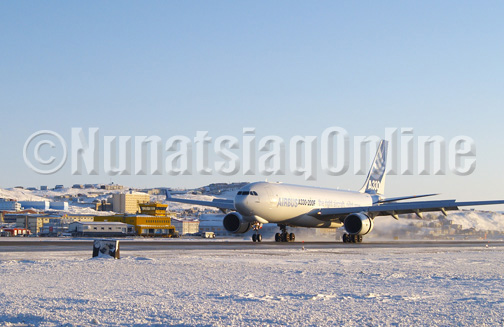
The Iqaluit airport, on Baffin Island in the Nunavut, is a popular stopover for short and mid-range aircrafts needing to refuel when overflying the Canadian Arctic. Its 8,600 feet runway can accommodate all types of aircrafts. Airbus aircrafts like the A380, the A350-XWB and the A330-200F were tested there during several days to evaluate their performance under extreme cold temperatures.

Airbus A330-200F arriving in Iqaluit for extreme cold tests. (PHOTO by CHRIS WINDEYER)

Well-known actors, princes and princesses (among them some members of the British Monarchy) and many political personalities stopped in Iqaluit throughout the years. Even Nelson Mandela stopped by Iqaluit on his return trip from United States.

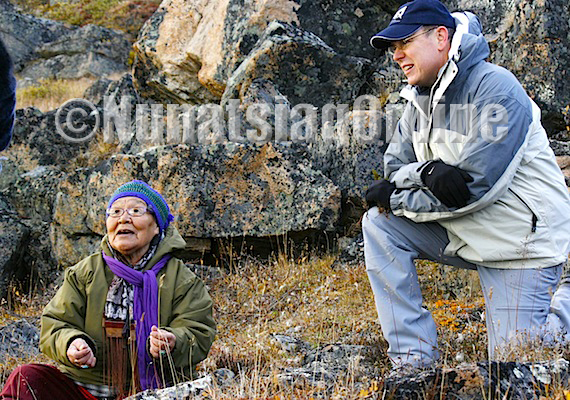
Elder Alacie Joamie and Prince Albert II of Monaco in Iqaluit in 2012

Around 1989-1990, the Sultan of Brunei and his suite also stopped in Iqaluit. The flight service specialists (FSS) were surprised to see that a Boeing 727 was not enough to accommodate the Sultan as two Gulfstream American business jets also landed few minutes before the 727.

Once the three aircrafts were parked on the apron, the Boeing 727’s front door was opened, a stairway was lowered and staff members rolled out a long red carpet. Two women got out of the airplane and started sweeping the whole carpet and, few minutes later, the Sultan stepped out for a walk and a breath of fresh air.

In less than an hour, the refueling was completed and everyone got back onboard their respective aircraft and left for Europe. It was the first time I was witnessing such a deployment of resources to carry a monarch.

But I had seen nothing yet. Few years later, I was transferred to the Transport Canada flight service station in Quebec City, which would later become the Quebec Flight Information Center (FIC) under Nav Canada. There, I could witness, with other air traffic services staff members, the frenzy surrounding the arrival of the President of the United States, Georges W. Bush, for the 2001 Summit of the Americas. That was certainly beyond measure…

For more real life stories as a FSS in Iqaluit, click on the following link: Flight service specialist (FSS) in Iqaluit

Categories
Street photography

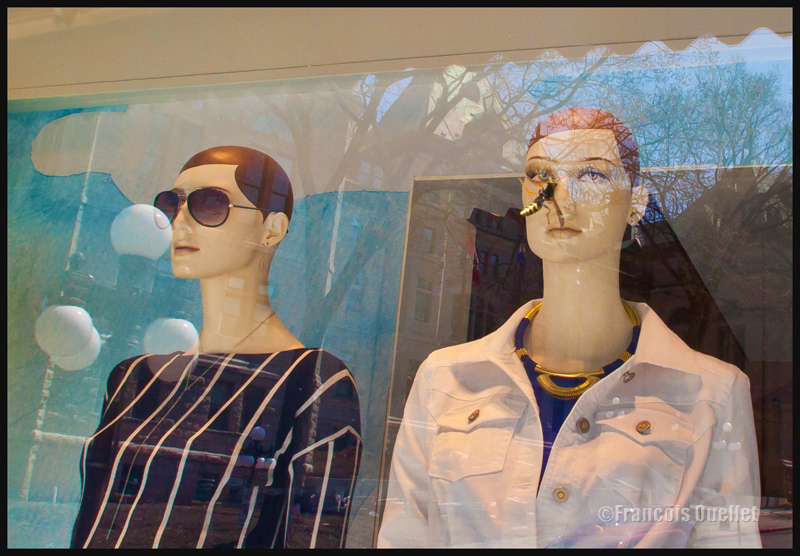
Street photography: mannequin attacked by a wasp in Quebec

In Quebec City, this mannequin seems to be attacked by a wasp moving slowly along the shopwindow. The scene looked realistic enough to deserve a photo!

Street photography: mannequin under attack

For other street photography pictures, click on the following link:

Street photography

Categories
Photos of Canada Photos of Quebec

Photography in the Province of Quebec : Tewkesbury 2015

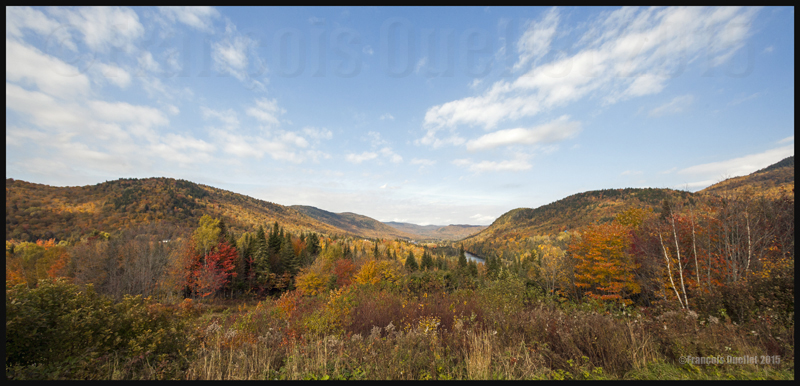
Profiting from the autumnal season to do some photography, I visited the Tewkesbury region, near Quebec City, were there are always interesting point of views. First, near the Tewkesbury church :

Tewkesbury, Québec 2015
Tewkesbury church, Québec 2015
Tewkesbury Blue Roof, Québec 2015

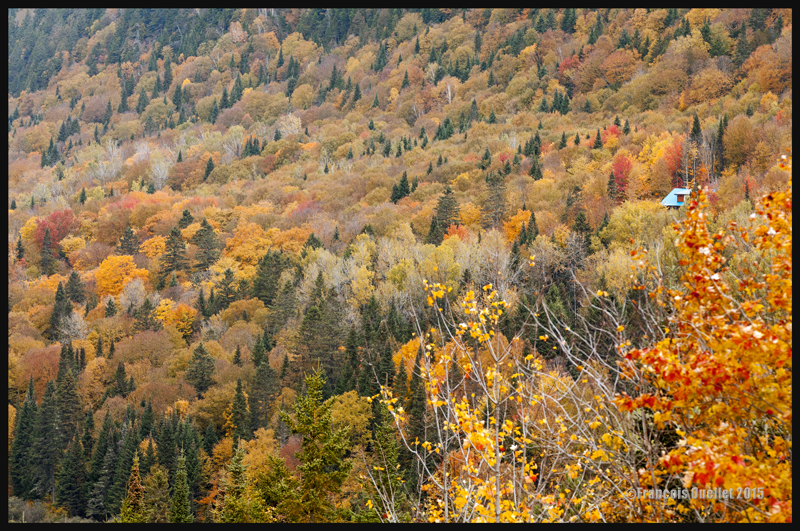
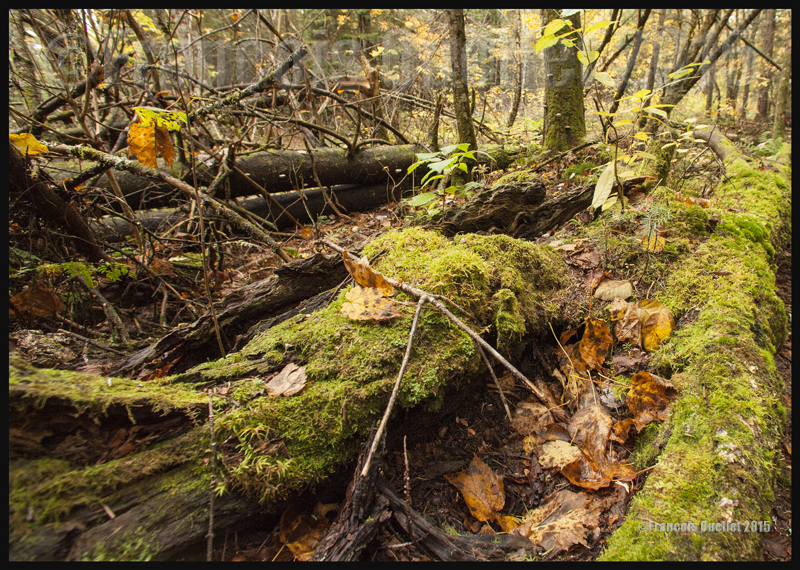
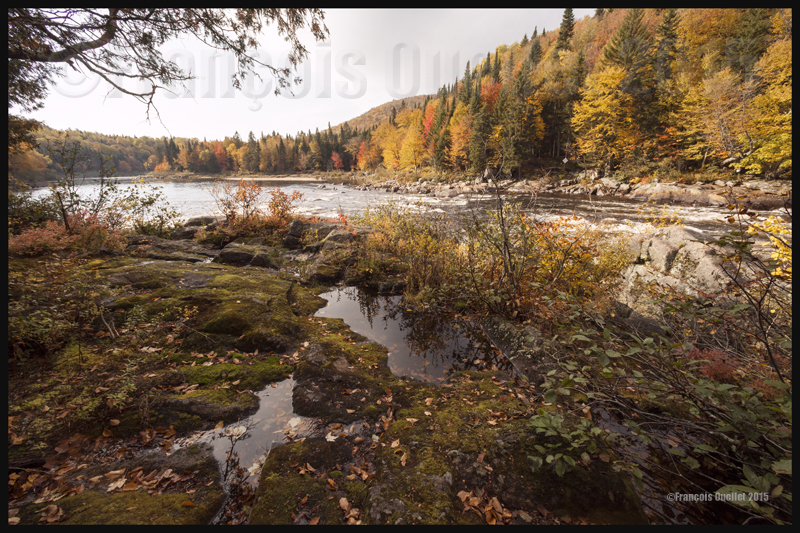
Then, following a trail heading to the Jacques-Cartier river, I was able to take few shots, sometimes under an overcast sky and, on few occasions, with the sun shining through clouds :

Autumn in Tewkesbury, Quebec 2015
Tewkesbury, Québec 2015

All the photos were taken with a Canon 5D MKII DSLR camera. I mostly used two lens : a Canon 14mm 2.8L fixed lens and a Canon 70-200 f2.8L IS II USM.

For other photos on the province of Quebec and also Quebec City, click on the following links from my blog:

Categories
Photography

Night photography: the Blood Moon Eclipse seen from Quebec

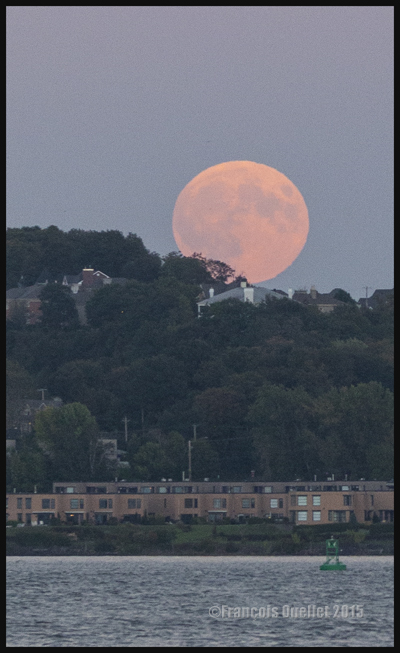
A quick look on internet provided the exact location and time where the moon would rise in the Quebec City region. On September 27th 2015, one had to look towards 089 degrees and be ready for 18:25 PM.

September 27th 2015. Blood Moon photo taken from Promenade Champlain, Quebec City, with a Canon 5D MKII.

Imagine being able to connect your camera to a modern personal telescope. That would make for fantastic shots. But since I deal with a Canon 70-200 f2.8L IS II USM coupled with an extender, I cannot expect the same results. Nonetheless, it is not a reason to stay at home…

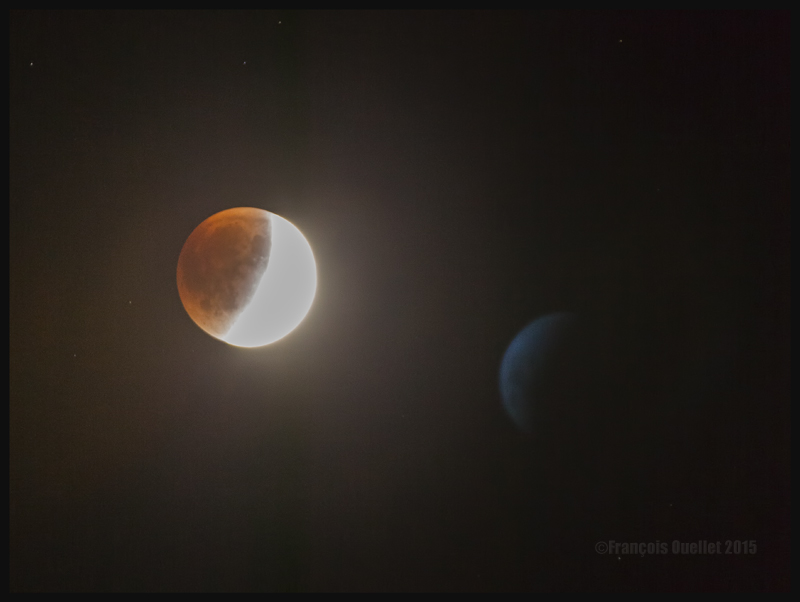
September 27th 2015 Blood Moon Eclipse. As for the blue object to the right of the screen, your explanations are welcomed.

The most interesting effect happened during late evening. I caught the above shot around 22:15. Cranking the ISO, I saw a blue planet or something that looks like it in the frame. The shot was not taken through a window so there was no glass reflection. I was kind of surprised to see this addition to the Blood Moon Eclipse. I wrote to a local astronomy club, asking them what it could be. They answered that unless I took the shot through a window, causing a reflection, they did not know what it was.

I know nothing yet about astronomy. If it is the reflection of the moon, I don’t know how it got there since I was taking the photo outside, without a polarizer. According to a recent comment sent by Mario Cloutier (see the comments) who points the reader to another blog looking at this question, it is possible that the picture of this ghost moon is the result of an overexposed shot combined with the atmosphere’s specific characteristics of temperature and moisture which would increase the reflexion and refraction. That is a logical explanation. The last shot was taken around 22:35:

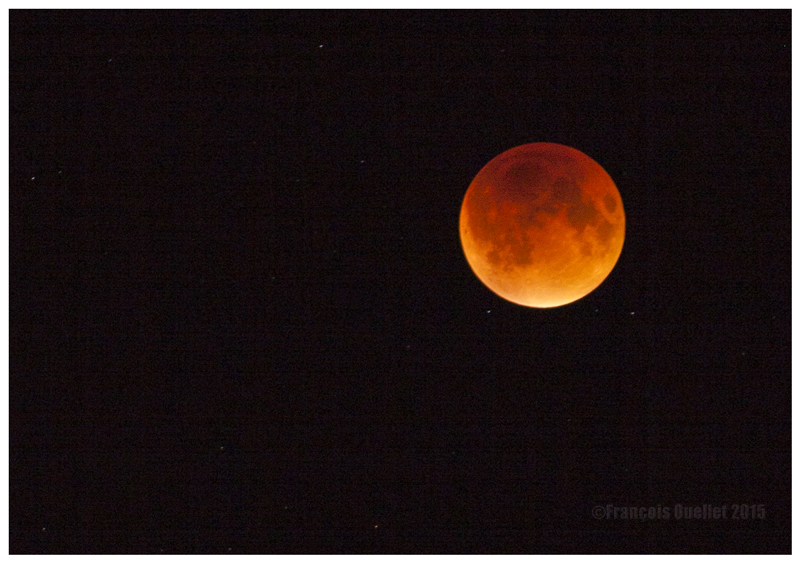
September 27th 2015 Blood Moon Eclipse. Camera adjusted on BULB priority, with ISO 100 and 2.8 aperture.
Categories
Real life stories as a flight service specialist (FSS): Iqaluit FSS

Carrying a .357 Magnum to Iqaluit

(Precedent document: Aviation photography: Rouyn-Noranda aircraft photos during 1986-1988 (Part three of three)

In 1988, I left Rouyn-Noranda for the Transport Canada flight service station, on Baffin Island. Iqaluit is Nunavut’s Capital and a designated port of entry to Canada for international air and marine transportation. Located at the crossroads of both polar and high North Atlantic air routes, Iqaluit airport can handle any type of aircraft.

I had to learn new tasks linked to ICAO responsibilities toward international air traffic crossing the Atlantic Ocean, as well as continue to act as a flight service specialist (FSS) and provide air traffic services.

The departure would be made from the Montreal Pierre-Elliott-Trudeau international airport. I decided to bring my .357 Magnum revolver with which I had been training for several years. Official papers authorized me to carry the gun from my home to the Montreal airport. Once there, I headed to a counter where an agent gave me another document allowing me to carry the revolver in the Nordair Boeing 737 leaving for Iqaluit.

There was no stipulation that the gun had to be left in the cockpit. I went through the security zone. The .357 Magnum was in a small case, in an Adidas sport bag. The bag was put on a moving strap, like any other hand luggage, in order to be checked by a security agent. The bag was not open by the agent; he looked at the screen, saw what was in the bag and that was it. I thought at the time that he might have received special instructions that I knew nothing about.

I was a bit surprised at the easiness with which I could carry a gun, but having never tried it before, since I was not a policeman, I concluded that it was the way things were done when all the papers and requests had been filed accordingly. The screening process being completed, I went outside and walked towards the Boeing 737.

A female flight attendant was greeting all the passengers. I presented her my airplane ticket just as I was ready to board the plane and she immediately asked me if the gun was in the bag I was carrying, and if it was loaded. My answers being acceptable, she invited me to go to my seat.

Once comfortably seated, I placed my Adidas bag under the front passenger’s seat instead of the elevated compartments along the aisles. I wanted to be able to see the bag at all times. The airplane took-off and it was a smooth flight to Iqaluit.

Three years passed and came the time to be transferred at the Transport Canada flight service station in Québec City (CYQB). The world had certainly changed during those three years isolated up in the Arctic. In 1989, Marc Lépine got known for the massacre, with a firearm, of fourteen women studying at the Montreal Polytechnic School.

I headed to the Iqaluit RCMP office in order to fill the appropriate documents that would allow me to carry the gun back to Québec City, a gun that would be sold few months after my arrival at destination. The police officer signed the papers and told me that the revolver would be kept in the Boeing 737’s cockpit.

I asked him, in case it was still allowed, if I had the liberty to carry it in my bag and put it under the front passenger’s seat, like I did for the inbound flight. He looked at me and clearly did not believe a word I had just said. But that did not matter. The gun would travel in the cockpit with the pilots and I would claim it once at destination.

When I think again about this story, almost thirty years later, I realize how the world has dramatically changed. There was a time where I could head to the Montreal international airport with my family to watch the landings and takeoffs from an exterior elevated walkway opened to the general public. From this same walkway, chimney smokers would negligently throw away their still smoking cigarette butts in an area where fuel trucks were operating.

The airport’s management eventually forbid the access to the outside walkway after having received too many complaints from passengers who rightfully claimed that their suitcases had been damaged by cigarette butts thrown from the walkway…

(Next story: Iqaluit and the old American military base)

For more real life stories as a FSS in Iqaluit, click on the following link: Flight service specialist (FSS) in Iqaluit
Categories
Photography Ship photography

Ship photography: Yilmar’s YM Saturn approaching Quebec in 2014

Ship photography: the YM Saturn, owned by Yilmar, is approaching Quebec City in 2014

The YM Saturn is a merchant navy ship carrying chemical products. The owner is Yilmar Shipping and Trading, from Istanbul, Turkey. It was built in 2007 and uses the Malt flag throughout its international trips. You can see it here, approaching Quebec City, in 2014. In the background, the Île d’Orléans bridge is visible.

In order to frame the vessel differently during its approach toward Quebec City, I positioned myself at the corner of Buade Street, in Old Quebec. The street and surroundings trees and branches offered a natural frame in which it became possible to position the ship. Weather conditions were constantly changing, with rain showers that allowed to get a more lively street. The ship was far away, but the compressed perspective effect created by a Canon 70-200mm 2.8 coupled with a 2X extender gives a feeling of proximity.

For other ship photos posted on my website, click on the following link:

Ship photography

Categories
Photography

HDR Photography

HDR (High Dynamic Range) Photography

Quebec Bridge, 2012.

1. A picture you would never have thought possible, because of extreme contrasts between brightness and darkness, is now accessible to you through HDR.

2. For a good HDR picture, you need at least 1) an interesting subject 2) an appropriate setting or background 3) the appropriate light and 4) a wide range in contrasts. That seems basic, but HDR will not save a picture that was not thought through.

3. You need a software like Photomatix, to transform several pictures taken at different exposures into one HDR picture. But this is only the first step. You will also need another editing software to improve the general result after Photomatix has been used.

4. A tripod is required to help Photomatix align the pictures and create the HDR effect.

5. As with your normal pictures, it is always better to try to use the lowest ISO as possible.

Gruyères, Switzerland, 2013.

6. It is safer to work with manual focus. This way, none of your shots will have been influenced by external objects without you noticing. It will always be the exact same focus throughout the HDR photo session. With automatic focus, you generally notice your blurred pictures when you’re back home and then it is too late (it will often happen under low light conditions).

7. The greater the contrast, the more exposures you need to take (up to nine) in order to match the dynamic range of your eyes.

8. The idea is to take each exposure at a different exposure setting. If you need seven exposures, an example of settings would be: -1, -2/3, -1/3, 0, +1/3, +2/3, +1. You might decide that three exposures only are necessary and go for -2, 0, +2 or -1, 0, +1. The choice is yours but you must take only the required number of exposures to avoid including too much noise in your shots.

Canon, 16-35mm, HDR format.

9. Throughout your HDR exposures of a specific scene, always keep the same aperture.

10. A scene is rarely perfectly balanced with light and shadows. If there are many shadow areas in the photo you want to take, then take more exposures over the recommended settings to ensure that you caught the whole dynamic range of the scene.

A house in Sainte-Pétronille, on Île d'Orléans, autumn 2012. HDR picture.
A house in Sainte-Pétronille, on Île d’Orléans, autumn 2012. HDR picture.

11. Inversely, if your scene has lots of highlight areas, take more exposures under the recommended settings.

12. Setting your camera to “automatic bracketing” is preferable because all the pictures are taken quickly thus avoiding to show any blurred picture in the final HDR picture. But if you want to show the movement of water in a creek, you don’t need bracketing: just take few shots with different time of exposure (in number of seconds). Just don’t overdo it otherwise it will give place to an uninteresting undefined white surface.

13. Check your LCD monitor so that none of the highlights are blown out. There would be a loss of details. For the same reason, you must avoid to block the shadows.

14. Always work with RAW files, it gives you better results. The RAW file already provides you with more f/stops then the JPEG file, and this before the transformation in HDR has even started).

15. Of all the lenses I’m using, the wide angle lens is my preferred one with it comes to HDR photography.

Spring light in the lower town of Quebec City

16. To improve the composition or enhance the general impact, crop the picture.

17. Not all pictures are appropriate for HDR transformation. If you want a dramatic silhouette as the final result, for example, HDR will not be appropriate. It will reveal too many details in the shadows and you will lose the high contrast effect that you were looking for. With practice, you will recognize where HDR is the most effective.

18. Whether you want a realistic picture or not, you can obtain surprising results with the combined effects of softwares like Photomatix, Topaz, Photoshop, Nik Software, Lightroom, Lucis Pro and so on. It’s only a matter of taking your time to experiment.

19. If you have only one picture on hand, like a shot you took years ago, and you would like to give it an HDR effect, you can use a software likeTopaz Adjust. There is an HDR effect section in that software that allows you to get a wide range of effects. But this is not going to be nearly as good as the real HDR resulting out of many pictures. The final editing step is, most of the time, done using Photoshop.

20. An unpretentious book about HDR is “Rick Sammon’s HDR Photography Secrets for Digital Photographers”. It is simple, colorful, well written and loaded with practical informations.

Eiffel Tower at night with HDR effect

Note: All the photos were taken with a Canon 5D MKII

Categories
Photography

Photography and weather

Some cloud families

Cumuliform clouds add energy to any photo. Even photos in black and white benefit from them largely, whether it is for a normal or an HDR photo.

Cumuliform clouds add dynamism to this Abbaye du Mont St-Michel scenery. France (1978)
Black and white HDR picture of lamp posts installed along the St-Lawrence, Quebec City 2012.

The stratiform clouds add to the tranquillity and the stability of a photo.

Daytona Beach under stratus clouds in 2011. The end of the afternoon allows the fresh air from the sea to move over the heated land, which helps create few cumulus fractus, visible near the buildings.

Clouds including a stratiform and cumuliform components (stratocumulus) produce an effect that is more energizing than the simple stratus, while avoiding the explosion of energy of the cumuliform clouds.

A stratocumulus adds to this otherwise peaceful scenery captured on board the Lyria train between Paris and Geneva in 2013.

The cold front

The approach of a cold front enhances the possibility of interesting photos. If it is a fast moving cold front of moist and unstable air, the photos will probably be more spectacular, as some thunderstorms will be associated with the system. A dew point of more than 15 C indicates the presence of a lot of water vapor which can be transformed into precipitation, thus releasing a lot of energy. When these conditions are combined with a really strong contrast between the new air mass which approaches and the one which goes away, the produced meteorological phenomena will certainly be intense.

In the photos below, the meteorological system approaching the Quebec Jean-Lesage international airport also had to cross a small mountain range.

A roll arcus cloud in development ahead of a thunderstorm approaching the Quebec Jean-Lesage airport in 2012.
View under a developing arcus cloud at the Quebec Jean-Lesage international airport (2012)
An arcus cloud ahead of a thunderstorm approaching the Quebec Jean-Lesage airport in 2012
A roll arcus cloud ahead of a thunderstorm heading for Quebec City in 2012

The morning fog

The morning fog offers many opportunities for interesting photos. You can choose an isolated tree and capture the combined effects of the morning sun and fog. Or you may choose a cluster of trees, for a completely different effect. Both photos below were taken in Domaine Cataraqui, Quebec City.

Trees in fog at Domaine Cataraqui, Quebec City 2009
Sun and fog provide for a special atmosphere at the Domaine Cataraqui, Quebec City 2009

A morning fog resulting from a cold cloudless night will persist for hours if there is no wind. The cold morning air, motionless over a slightly hotter stretch of water, creates a fog that will finally disappear just before noon, when the atmosphere has been heated enough. If there had been an overcast sky during the night, chances are that the air over the water would have remained at a higher temperature, preventing the formation of fog.

The opportunities for more interesting photos arise when you witness the first holes in the fog layer.

The Ocean tugboats during a dense fog in the Bassin Louise in Quebec (2012).

We can take into account the season to estimate the speed of the diurnal reheating of the lower atmosphere. A morning fog will need more time to dissipate from late autumn to early spring: that leaves more time for the photographer to prepare. The forecasts can announce the disappearance of fog while it will not be the case if, over your sector, there is an invading layer of stratocumulus preventing the morning sun from reaching the ground.

To determine if the fog is going to dissipate as expected or will remain and possibly intensify, watch the difference between the temperature and the dew point on the hourly meteorological observations issued by weather stations near your place of residence. If the temperature and dew point spread increases, the fog is going to lift. If the difference between those two decreases, the fog is going to persist and possibly intensify.

The mist

The mist can be qualified as such when the visibility is superior to ½ mile, but do not exceed 6 miles for an observer on the ground. If the visibility is of ½ mile or less, it is called fog. This photo of the Bic National Park, near Rimouski, shows the interesting effect that the mist adds to a beautiful landscape.

Mist in the Bic National Park, Province of Quebec (2009)

Hot and unstable air in winter

When there is a warm and unstable air advection (about 0 degrees) while winter has already settled, there are good opportunities for photos. A moderately developed cumulus produces significant snow showers and this snow sticks on all the surrounding objects. All that snow would have begun to melt on contact of objects if the latter had had a temperature superior to zero degree. But, the winter being already settled, the snow persists. It gives enough time to capture some souvenirs.

A Quebec City street after a snow shower

The local effects

A photographer might benefit from learning about the meteorological local effects influencing the regions he intends to visit. The local effects are often simple to understand and they repeat themselves regularly, according to wind and season changes. The knowledge of these effects allows the photographer to be ready and position himself even before the phenomenon occurs. It limits the comments like: “If I had known that it would occur, I would have settled down here one hour earlier!

The local terrain as well as large size bodies of water produce predictable meteorological phenomenon that can be used by a well prepared photographer. It can consist of persistent fog, repetitive snowstorms over a small sector, strong winds, cumuliform clouds alongside the mountain summits, etc. By being positioned at the right place, at the right time, the desired photo can be realized.

A change in the wind direction

A change in the wind direction suddenly increases the opportunities of interesting photos. It might announce the approach of a cold front, a warm front, a sea or land breeze, etc. In the photo below, a bit of fresher air suddenly began crossing the St-Lawrence seaway at the end of the day, thanks to the approach of a weak cold front. The water was still relatively warm and the moisture which was present over the surface became visible due to the cool air supply. The conditions were now ideal for a short-term thin fog, as long as the wind speed would not increase. Just in time for a photo.

The new wood pellets silos in Anse au Foulon in Quebec City en 2014

Familiarization with weather radars

It can be useful to get acquainted with weather radars which, for the needs of photography, remain simple to interpret. Multiple echoes of small dimension with a steep gradient of various colors indicate precipitation resulting from cumuliform clouds. The showers associated with these clouds are often moderated or strong and will be the result of approaching towering cumulus or cumulonimbus (thunderstorms). A towering cumulus presents a dark base and a white summit to the photographer. At sunset, their vertical development can be used to emphasize the last rays of light.

The side of a towering cumulus (TCU) is benefiting from the remaining sunlight over Quebec

Large echo areas of similar colors of low intensity indicate a relatively stable air generally producing steady light rain or drizzle. This should be understood as a possibility of increased humidity limiting the visibility through mist or fog.

Hoar frost

Hoar frost is a short-term phenomenon. It is thus necessary to capture the scene before the sun melts everything. The photo below shows some small twigs on which hoar frost has settled. It was taken at the beginning of the seventies. Although the quality of the photo is not exceptional, the meteorological phenomenon is well demonstrated.

A combination of snow and hoar frost observed on a Quebec field in 1976.

Forest fires

Wishing to make photos of western Canada during summer 2014, I came up against a season where hundreds of forest fires were raging. The smoke was covering some parts of Alberta and British Columbia. Some fires were important enough to require the closure of the sole highway connecting Lake Louise to Jasper. I thus decided to include the effects of those fires in the holiday souvenirs.

A visibility reduced in forest fire smoke allows a photographer to obtain, without special editing, sunsets with interesting colors.

Sunset and smoke from forest fires in Kamloops in 2014

The smoke also produces an effect similar as fog, but a fog which would be impossible to obtain at the end of a summer afternoon while the sun shines and there is a 38 degrees Celsius temperature.

An area near Kamloops, Canada, that was touched by forest fires in 2014

At dusk, the residual smoke is visible near tree tops while the setting sun strikes the mountain side. The effect is of two horizontal lines of complementary colors, blue and orange.

Forest fire smoke and sunset combined in Lake Louise, Alberta en 2014

Metar decode and description

Metar Decode and Description

Significant Present Weather Codes

Significant Present Weather Codes