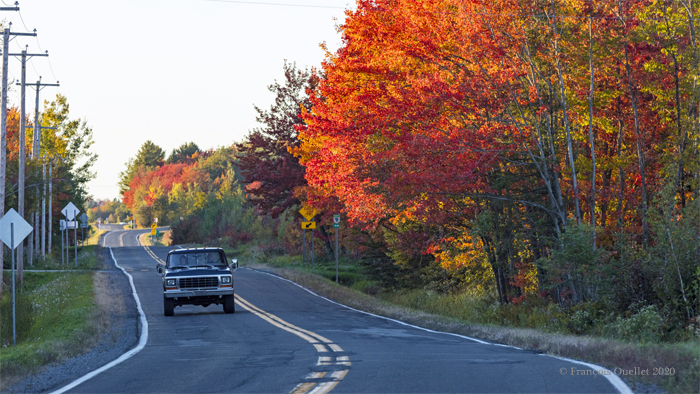
Old American Ford pick-up on the road to Lyster in Québec in 2020
This photo was taken at the end of a beautiful day in the Chaudière-Appalaches region. The sun is almost on the horizon and is hitting the sides of the trees directly, further enhancing the autumn colors .
By this time, people are home having dinner and there are hardly any vehicles on the road. Rather than photographing an empty road, which certainly would have been a logical choice, I waited for a vehicle to show up and advance into the foreground of the photo. We are in the countryside and, luckily for me, the old Ford pick-up fitted perfectly in the landscape.
In terms of the photographic composition, the ideal position to capture the scene seemed to be near the curve, so as to use the white line of the road as a guideline leading to the subject of interest. The 16×9 format also allowed for a photo large enough to include the set of transmission line poles on the left, which itself was certainly as old as the pick-up. The latter was positioned according to the rule of thirds, without any compromises being necessary.
The posts on the left allowed a better framing of the subject. In the distance, the sun shines on the road and we assume there is a field on the left that lets the sun’s rays pass through.
The picture was taken with a Canon 5DS R full frame camera.
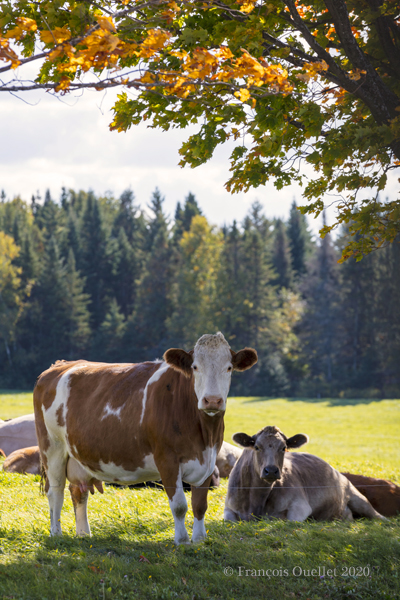
The picture above was taken from my car as I was driving on the roads of Quebec in the Chaudière-Appalaches region, looking for interesting subjects that would show the first autumn colors. The sound of the engine idling attracted the curiosity of the animals. Ears are pointed and the two cows kept their eyes on me the whole time I was adjusting the camera. Coincidentally, they stood in an ideal position for a photo taken in vertical format. The photographic composition was thus simplified. A few yellow leaves in the tree show that Autumn was only starting. The picture was taken with a Canon 5DS R full frame camera.
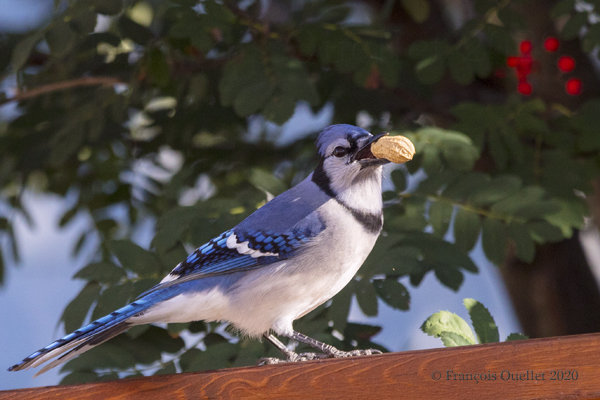
Blue jay and Russian Mountain Ash. Autumn 2020 in Quebec City.
Every Autumn, a Blue Jay lands on our patio knowing he can stock up for the winter. After hearing his calls, I quickly get the peanuts and the camera.
The pictures were taken with a Canon EOS 5DS R which allows significant cropping without loss of quality. In the photo above, the branches of the Russian Mountain Ash surround the bird and provide a natural setting.
I place the peanuts in front of the tree, just to include a few small red fruits in the photographic composition.
Blue jay with a peanut in front of a Russian Mountain Ash. Quebec City 2020.
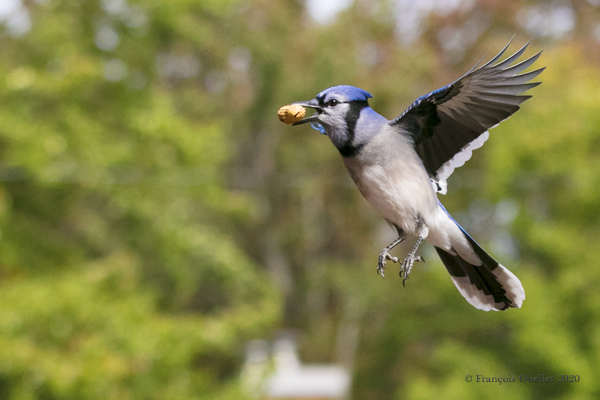
Capturing the blue jay in flight is a bit more difficult, but in the digital age and with a Canon EF 70-200mm f / 2.8L IS II USM lens, photographing birds in flight is made much easier. The photo below was taken with a shutter speed of 1/8000, an aperture of 4.0, and an ISO set at 1250.
Blue Jay in flight. Quebec City 2020.
I have yet to see a Blue Jay eat the fruits of our Russian Mountain Ash. On the other hand, the ravens of the neighborhood have no problem with them.
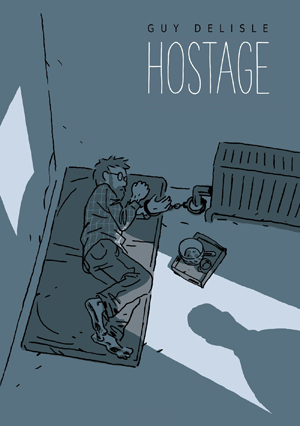
Guy Delisle took fifteen years to write this graphic novel. He tells the story of the kidnapping for ransom (K&R) in 1997 of a French citizen, Christophe André, while he was working for a medical NGO in the Caucasus region.
Faithful to his habits, this author born in Quebec City offers us a fascinating and humane narrative. A work that looks at a real life story often adds tension, when properly put together. This is what happens with the work of Guy Delisle. Hostage is a 428-page graphic novel that can be read in one sitting. As it often happens in dramatic events, humans discover an unsuspected character and strengths that enable them to cope with abuse, loneliness and stress.
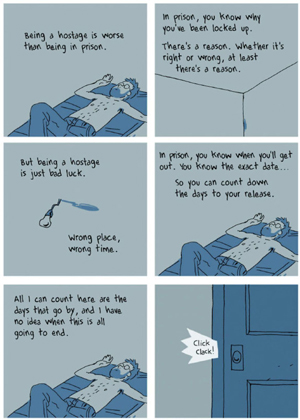
Hostage by Guy Delisle interior page
The pace and the quality of the drawings and the script make it easy for the reader to dive into the story and imagine themselves in the place of the captive. Would the decisions made by the hostage also have been made by the reader? Would he have used other means to deal with his captivity?
I discourage the reader from trying to discover the conclusion of this story before starting to read the book. Resist this temptation, the read is worth the effort!
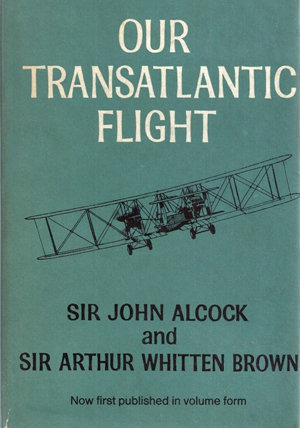
Our transatlantic flight, by Sir John Alcock and Sir Arthur Whitten Brown
Newfoundland
Before 1949, Newfoundland was called Dominion of Newfoundland and was part of the British Commonwealth . In 1949, it became a Canadian province.
The first non-stop flight eastward across the Atlantic.
The book « Our transatlantic flight » tells the story of the historic flight that was made in 1919, just after the First World War, from Newfoundland to Ireland. There was a 10,000 £ prize offered by Lord Northcliffe from Great Britain for whoever would succeed on the first non-stop flight eastward across the Atlantic.
A triumph for British aviation
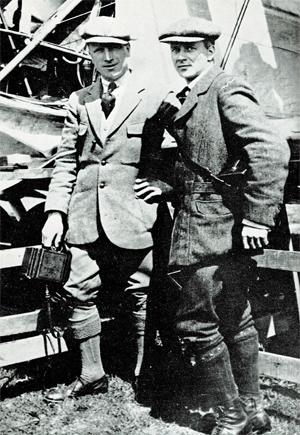
Sir John Alcock and Sir Arthur Whitten Brown , respectively pilot and navigator, wrote the story of their successful flight in this book which was published in 1969. The followings are pilot quotes from the book : « For the first time in the history of aviation the Atlantic had been crossed in direct, non-stop flight in the record time of 15 hours, 57 minutes. » (p.13) « The flight was a triumph for British aviation; the pilot and navigator were both British, the aircraft was a Vickers-Vimy and the twin engines were made by Rolls-Royce. » (p.13)
Sir John Alcock and Sir Arthur Whitten Brown
As with all great human achievements, a very good flight planning and some luck was needed to make this flight a success. If there was an engine failure during the flight, even if the planning was excellent, there was only one outcome : downward.
In order to make the flight, Alcock and Brown boarded a ship from England bound to Halifax. They then headed to Port aux Basques and finally arrived in St.John’s. There, they joined a small group of British aviators who had arrived a few days before and who were also preparing for the competition. « The evenings were mostly spent in playing cards with the other competitors at the Cochrane Hotel, or in visits to the neighbouring film theatres. St.John’s itself showed us every kindness. » (p.60)
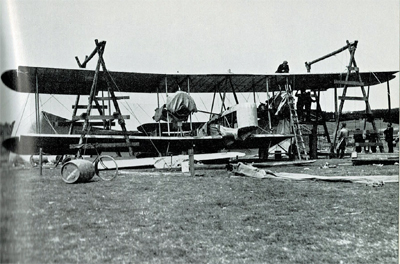
Maritime transport was used to carry the Vickers-Vimy biplane to Newfoundland on May 4th. It was assembled in Newfoundland. « The reporters representing the Daily Mail, the New York Times, and the New York World were often of assistance when extra manpower was required. » (p.61).
While the aircraft was being built, there were more and more visiters coming to the site. Brown says : « Although we remained unworried so long as the crowd contented itself with just watching, we had to guard against petty damage. The testing of the fabric’s firmness with the point of an umbrella was a favourite pastime of the spectators […]. » (p.61)
The Vickers-Vimy is being reassembled at Quidi Vidi in Newfoundland.
It was difficult to find a field that could be improvised into an aerodrome : « Newfoundland is a hospitable place, but its best friends cannot claim that it is ideal for aviation. The whole of the island has no ground that might be made into a first-class aerodrome. The district around St.John’s is especially difficult. Some of the country is wooded, but for the most part it shows a rolling, switchback surface, across which aeroplanes cannot taxi with any degree of smoothness. The soil is soft and dotted with boulders, as only a light layer covers the rock stratum. Another handicap is the prevalence of thick fogs, which roll westward from the sea. » (p.59)
They flight tested the airplane on June 9th at Quidi Vidi. During the short flight, the crew could see icebergs near the coast. They did a second trial on June 12th and found that the transmitter constantly caused problems. But, at least, the engines seemed to be reliable…
The departure
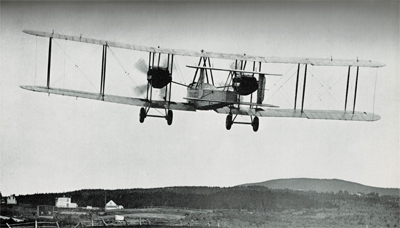
The two men left Newfoundland on June 14th 1919. In order to fight the cold air in flight, they wore electrically heated clothing. A battery located between two seats provided for the necessary energy.
The Vickers-Vimy departs from Newfoundland in 1919
The short take-off was very difficult due to the wind and the rough surface of the aerodrome. Brown writes : « Several times I held my breath, from fear that our under-carriage would hit a roof or a tree-top. I am convinced that only Alcock’s clever piloting saved us from such an early disaster. » (p.73)
It took them 8 minutes to reach 1000 ft. Barely one hour after departure and once over the ocean, the generator broke and the flight crew was cut off from all means of communication.
As the airplane consumed petrol, the centre of gravity changed and since there was no trim on the machine, the pilot had to exert a permanent backward pressure on the joystick.
Flying in clouds, fog and turbulence.
During the flight with much clouds and fog, Brown, having almost no navigation aid, had real problems to estimate the aircraft’s position and limit the flying errors. He had to wait for a higher altitude and for the night to come to improve his calculations : « I waited impatiently for the first sight of the moon, the Pole Star and other old friends of every navigator. » (p.84). The fog and clouds were so thick that at times they « cut off from view parts of the Vickers-Vimy. » (p.95)
Without proper instruments to fly in clouds, they were relying on a « revolution-counter » to establish the climbing or the falling rate. That is pretty scary. « A sudden increase in revolutions would indicate that the plane was diving; a sudden loss of revs would show that she was climbing dangerously steeply. » (p.176)
But that was not enough. They also had to deal with turbulence that rocked the plane while they could not see anything outside. They became desoriented : « The airspeed indicator failed to register, and bad bumps prevented me from holding to our course. From side to side rocked the machine, and it was hard to know in what position we really were. A spin was the inevitable result. From an altitude of 4,000 feet we twirled rapidly downward.[…]. « Apart from the changing levels marked by aneroid, only the fact that our bodies were pressed tightly against the seats indicated that we were falling. How and at what angle we were falling, we knew not. Alcock tried to centralise the controls, but failed because we had lost all sense of what was central. I searched in every direction for an external sign, and saw nothing but opaque nebulousness. » (p.88)
« It was a tense moment for us, and when at last we emerged from the fog we were close down over the water at an extremely dangerous angle. The white-capped waves were rolling along too close to be comfortable, but a quick glimpse of the horizon enabled me to regain control of the machine. » (p.40).
De-icing a gauge installed outside of the cockpit.
Snow and sleet were falling. They didn’t realize how lucky they were to continue flying in such a weather. Nowadays, there are many ways to dislodge ice from a wing while the aircraft is in flight. Here is what Brown says about their situation : « […] The top sides of the plane were covered completely by a crusting of frozen sleet. The sleet imbedded itself in the hinges of the ailerons and jammed them, so that for about an hour the machine had scarcely any lateral control. Fortunately, the Vickers-Vimy possesses plenty of inherent lateral stability; and, as the rudder controls were never clogged by sleet, we were able to hold to the right direction. » (p.95)
After twelve hours of flying, the glass of a gauge outside the cockpit became obscured by clotted snow. Brown had to deal with it, while Alcock was flying. « The only way to reach it was by climbing out of the cockpit and kneeling on top of the fuselage, while holding a strut for the maintenance of balance. […] The violent rush of air, which tended to push me backward, was another discomfort. […] Until the storm ended, a repetition of this performance, at fairly frequent intervals, continued to be necessary. » (p.94)
In order to save themselves, they executed a descent from 11,000 to 1000 feet and in the warmer air the ailerons started to operate again. As they continued their descent below 1000 feet over the ocean, they were still surrounded by fog. They had to do some serious low altitude flying : « Alcock was feeling his way downward gently and alertly, not knowing whether the cloud extended to the ocean, nor at what moment the machine’s undercarriage might touch the waves. He had loosened his safety belt, and was ready to abandon ship if we hit the water […]. » (p.96)
The arrival.
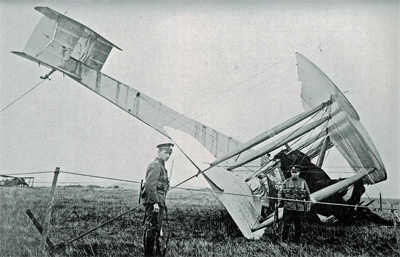
They saw Ireland at 8.15 am on June 15th and crossed the coast ten minutes later. They did not expect a very challenging landing as the field looked solid enough to support an aircraft. They landed at 8 :40 am at Clifden on top of what happened to be a bog; the aircraft rolled on its nose and suffered serious material damages. The first non-stop transatlantic flight ended in a crash. Both both crewmen were alive and well, although they were dealing with fatigue…
The transatlantic flight ends up in Ireland in a soft field
Initially, nobody in Ireland believed that the plane arrived from North America. But when they saw mail-bags from Newfoundland, there were « cheers and painful hand-shakes » (p.102).
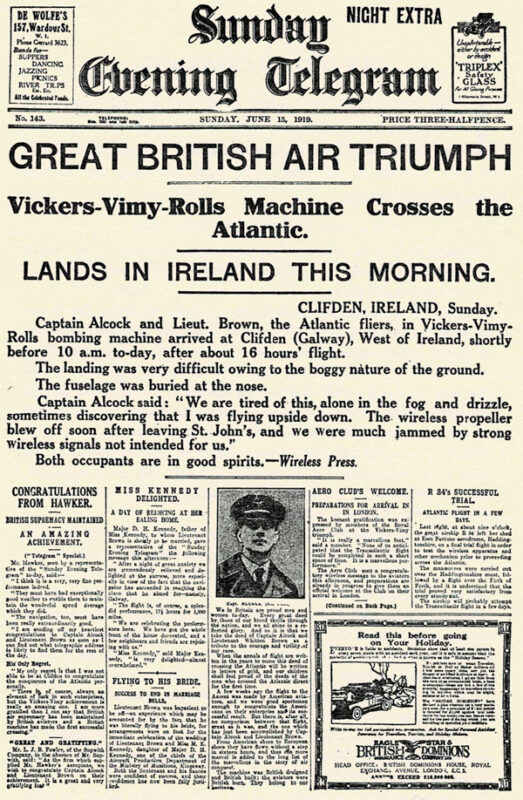
First page of the Sunday Evening Telegraph in 1919.
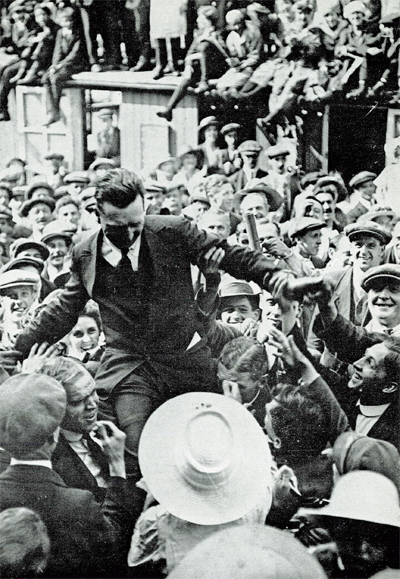
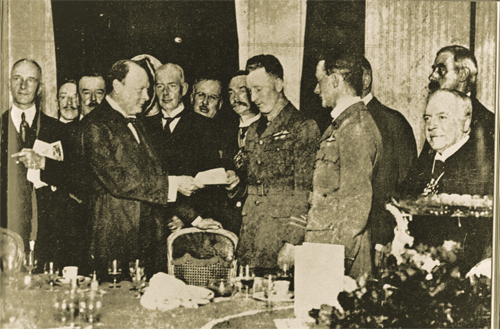
They were cheered by the crowds in Ireland and England and received their prize from Winston Churchill.
John Alcock chaired by the crowd
Winston Churchill is presenting the Daily Mail Check to the two pilots.
Their record stood unchallenged for eight years until Lindbergh’s flight in 1927.
The future of transatlantic flight.
Towards the end of the book, the authors risk a prediction on the future of transatlantic flight. But aviation made such a progress in a very short time that, inevitably, their thoughts on the subject was obsolete in a matter of a few years. Here are some examples :
« Nothwithstanding that the first two flights across the Atlantic were made respectively by a flying boat and an aeroplane, it is evident that the future of transatlantic flight belongs to the airship. » (p.121)
« […] The heavy type of aeroplane necessary to carry an economical load for long distances would not be capable of much more than 85 to 90 miles an hour. The difference between this and the present airship speed of 60 miles an hour would be reduced by the fact that an aeroplane must land at intermediate stations for fuel replenishment. » (p.123)
« It is undesirable to fly at great heights owing to the low temperature; but with suitable provision for heating there is no reason why flying at 10,000 feet should not be common. » (p.136)
The Air Age.
There is a short section in the book on the « Air Age ». I chose two small excerpts on Germany and Canada :
On Germany’s excellent Zeppelins : « The new type of Zeppelin – the Bodensee – is so efficient that no weather conditions, except a strong cross-hangar wind, prevents it from making its daily flight of 390 miles between Friedrichshafen and Staalsen, thirteen miles from Berlin. » (p.140)
On Canada’s use of aeroplanes : « Canada has found a highly successful use for aeroplanes in prospecting the Labrador timber country. A group of machines returned from an exploration with valuable photographs and maps of hundreds of thousands of pound’s worth of forest land. Aerial fire patrols, also, are sent out over forests.» (p.142) and « Already, the Canadian Northwest Mounted Police [today the RCMP] have captured criminals by means of aeroplane patrols. » (p.146)
Conclusion
The Manchester Guardian stated, on June 16th 1919 : « […] As far as can be foreseen, the future of air transport over the Atlantic is not for the aeroplane. It may be used many times for personal feats of daring. But to make the aeroplane safe enough for business use on such sea routes we should have to have all the cyclones of the Atlantic marked on the chart, and their progress marked in from hour to hour. »(p.169)
Title : Our Transatlantic Flight
Authors : Sir John Alcock and Sir Arthur Whitten Brown
Cover page of the book Black Detroit by Herb Boyd.
As the author Herb Boyd writes, « this is the first book to consider black Detroit from a long view, in a full historical tableau. » (p.14). If you are looking for a significant black person that influenced Detroit’s history, he or she is in the book.
The author covers the arrival of Blacks in Detroit through the Underground Railroad the type of work they could find, the music they created, their need to have their own church to avoid racism, the work at Ford, the influence of trade unions, the poor housing conditions, etc.
Of course, there are several paragraphs on racism, police repression and useless violence, the problems caused by the KKK and how a few individuals dealt with it, the Smith Act, the American Civil War and the desire the end slavery, the presence of Rosa Parks in the city and Nelson Mandela’s visit in Detroit in 1990.
There is not only something on the past history and development of Detroit but also thoughts on the future of the city and how it will have to deal with the fact that there are so many people choosing to live in the suburbs instead of in Detroit itself.
Since the fight for equal rights, racism, police repression and the useless deaths of so many black individuals have continued to be an important problem in United States, I have chosen a few quotes from the book on those subjects.
I also chose a paragraph on Nelson Mandela’s visit in Detroit. When Nelson Mandela left United States to fly back to South Africa, his plane had to do a stopover in Iqaluit, in Canada’s Arctic. I was working as a flight service specialist (FSS) at Iqaluit in 1990, so I could see him and Winnie attending an official ceremony in the middle of the night at the airport’s terminal. You can read the real life stories in Iqaluit on my website.
Detroit and Canada.
« In 1795, Detroit was still under British jurisdiction, and the city was a de facto part of Upper Canada. » (p.22)
« Judge Woodward stipulated in a later ruling that if black Americans were to acquire freedom in Canada, they could not be returned to slavery in the United States. “Two of Denison’s children […] took advantage of this ruling by escaping to Canada for a few years and then returning to Detroit as free citizens”. Theirs was a landmark case and would be cited as a precedent in a number of appeals for emancipation by enslaved African Americans. (p.25)
The Smith Act
“The Smith Act, was written so that labor organization and agitation for equal rights could be construed as sedition and treason, the same as actually fighting to overthrow the government by force” (p.162)
Police repression and brutality
“[…] Twenty-five blacks had been killed in Detroit while in police custody in 1925, eight times the number killed under police supervision that year in New York City, whose black population was at least twice as large” (p.112)
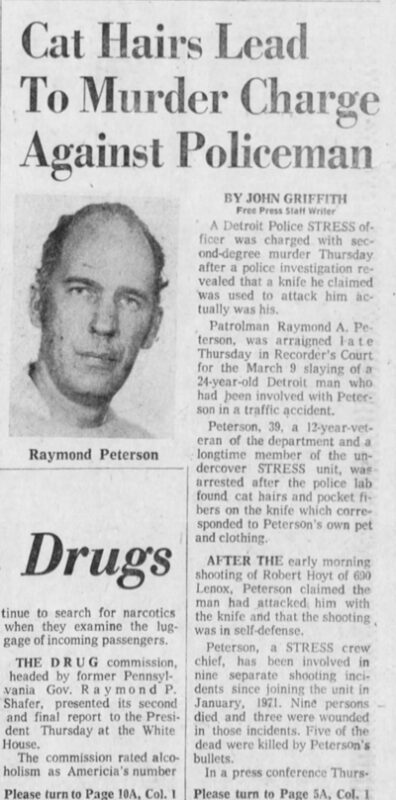
“During STRESS’s (Stop the Robberies and Enjoy Safe Streets) first year as a death squad – cum – SWAT team [near 1970], the city’s police force had the highest number of civilian killings per capita of any American police department. During its three and a half years of existence, STRESS officers shot and killed 24 men, 22 of them African American.[…] Among the STRESS officers, none was as seemingly problematic as crew chief Raymond Peterson. Before he was assigned to STRESS, he had amassed a record number of complaints. During his first two years on the squad, he took part in nine killings and three nonfatal shootings. Bullets from Peterson’s gun killed five of the victims. No charges were brought in any of these cases.” (p.226-227)
The policeman Raymond Peterson and a murder charge in Detroit in the seventies.
“[Around 1999] gentrification was one thing to worry about, but police brutality was a far more menacing immediacy for young black Detroiters. They were keenly aware there was little mercy awaiting them from the police, nor from school conselors or employment agencies, and certainly not from the drug dealers” (p.292)
“[Around 2001] Detroit, according to reports from several local papers, had the highest number of fatal shootings among the nation’s largest cities” (p.300)
“Throughout the nation over the previous decade, from 1999 to 2009, gun violence had taken the lives of thousands of young black men and women, and hundreds of them were unarmed victims of unwarranted police violence. Few of these terrible tragedies were as heart-wrenching as the killing of seven-year-old Aiyana Jones by a police officer in May 2010. It was around midnight and Aiyana was asleep on the couch with her grandmother nearby watching television. Neither of them had time to react to the thud at the door nor the flash-bang grenade tossed into the living room by the police at the start of the raid.
Officer Joseph Weekley immediately began firing his MP5 submachine gun blindly through the window into the smoke and chaos. One of the bullets entered Aiyana’s head and exited through her neck. She was killed instantly. The SWAT team had come looking for a murder suspect who lived upstairs but left with only a dead child. […]. » (p.327-328).
Education
“Ethelene Crockett, having raised three children, earned a medical degree from Howard University in 1942. She completed her internship at Detroit Receiving Hospital, and because no Detroit hospital would accept an African American woman physician, she did her residency in New York City. Finally in 1952, she was accepted at a hospital in Detroit, becoming the first black woman in her field of obstetrics and gynecology to practice in the state.” (p.163)
No middle-class for young blacks.
“With the traditional routes to middle-class success closed, young black Detroiters sought other means of survival, mainly via the underground economy.” (p.254)
Nelson Mandela in Detroit
“In the summer of 1990, Nelson Mandela toured the United States after spending twenty-seven years in prison. […] When Mandela and his wife, Winnie, emerged from the plane [in Detroit], one of the first people they recognized was Rosa Parks. Nelson Mandela stated that Parks had been his inspiration during the long years he was jailed on Robben Island and that her story had inspired South African freedom fighters’” (p.268).
Detroit’s future
“Most Detroiters live in neighborhoods, and in these areas, development is uneven. There are some flashes of improvement, but by and large, communities are still struggling with unemployment, crime, and low-achieving schools. Detroit is a city with large expanses of uninhabited land and is sprinkled with thirty-one thousand vacant and dilapidated houses. In various pockets throughout town, community-based organizations have worked tirelessly to maintain their respective areas against a tide of neglect and disinvestment. The current mayoral administration has tried to use an assortment of methods to arrest the decline of the neighborhoods, with moderate success. This gargantuan task has been assisted with massive aid from the Obama administration, but the city still has major hurdles ahead with a large poor, unskilled, and semiliterate population.” (p.342).
Click on the link for other books on the history of cities on my blog.
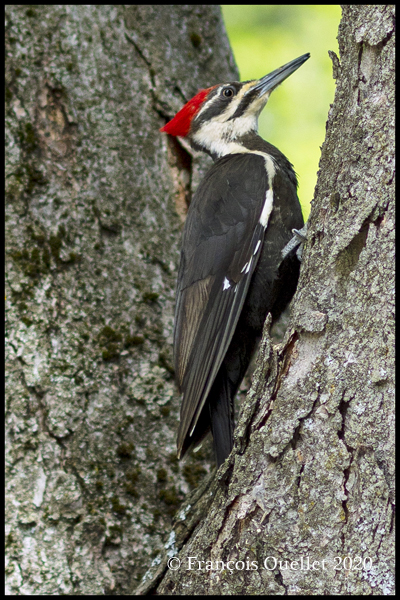
Pileated Woodpecker (female) at work on a silver maple in 2020.
Last week, a Pileated Woodpecker female landed on our silver maple. When it digs a hole in a tree to find food, the bird hits the trunk harder and at a much slower rate than the Hairy Woodpecker. This is what caught our attention.
This Woodpecker is impressive, especially when it is the first time that we have the chance to observe it at work. The Pileated Woodpecker measures between 40 and 49 cm and is found in Canada and the United States. When its work is completed, it leaves a hole of about 10 x 7 cm in the tree.
Click on the link for other articles on the environment on my blog.
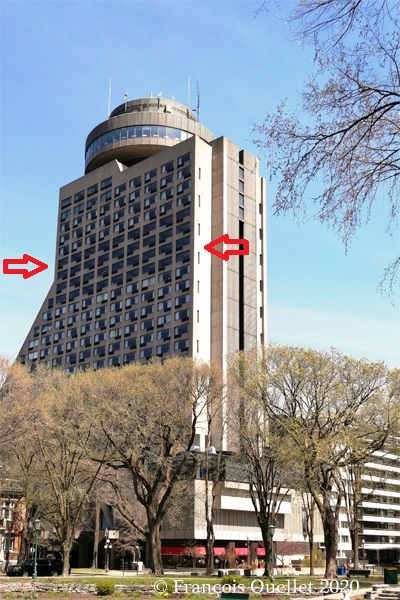
In Quebec City, a few floors of the Hôtel Le Concorde receive patients recovering from the coronavirus.
Hôtel Le Concorde and the rooms reserved for patients who had to deal with the coronavirus.
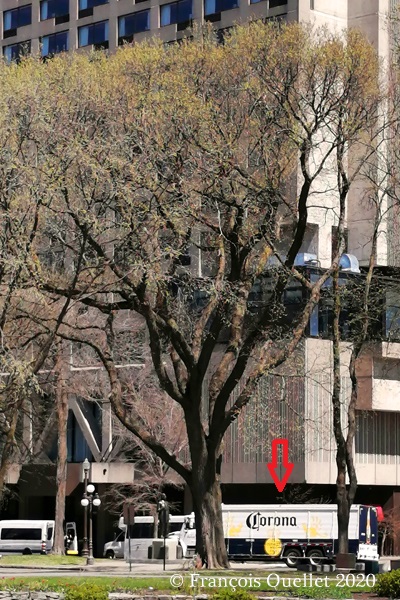
Within seconds of taking this photo of the hotel, a Corona delivery truck appeared in front of the hotel. It was just a coincidence. But somebody was in need of the Mexican serum!
Hôtel Le Concorde and the Corona delivery truck.
Speaking of coronavirus (COVID-19), I was recently at Costco and was wearing a protective mask. I heard some people near me say: “I don’t see why he’s wearing a mask, it doesn’t even protect him!” I tried to explain to them that I was wearing the mask to protect the people around me, but that did not convince anyone. It seems that taking selfless action to protect others is inconceivable. The purpose of wearing a mask is to protect the neighbors. And if the neighbors wear one too, they protect me. The more we wear the mask, the more we protect each other. We help each other. However, it seems to be a surprisingly difficult concept to grasp!
At the entrance of a huge garden store, a lady refused to rub her hands with gel. She said to the clerk: “No way am I putting liquid germicide on my hands, it’s not good for my health.” The clerk was very nice and replied: “Okay, so come in with me and wash your hands inside with soap and water.” She had no choice because she would not have been allowed to shop. This is another example of a human behavior that is hard to understand. If she was so interested in her health, taking care of her weight situation would have been more sensible than to focus on a bit of liquid germicide.
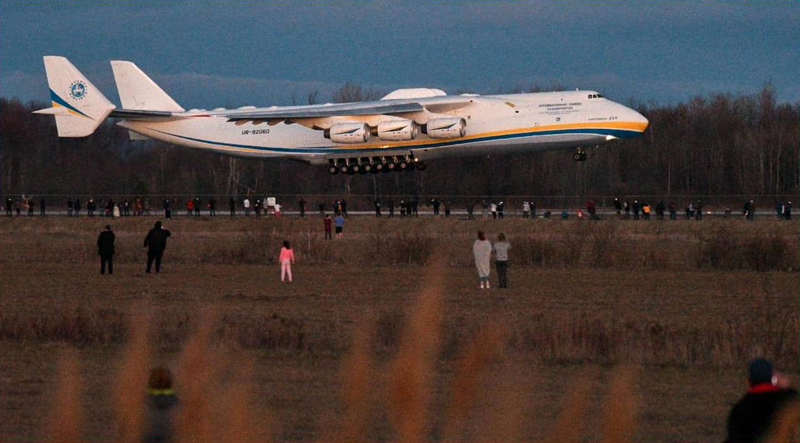
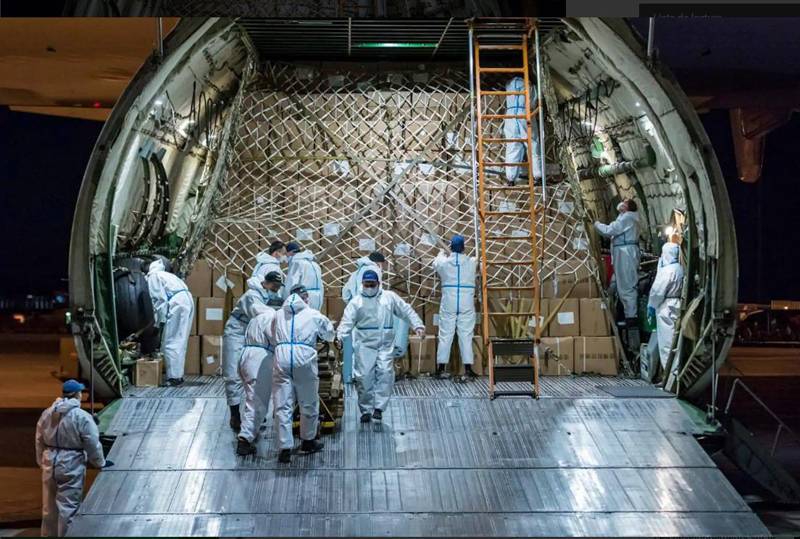
On Friday May 1st 2020, Quebec received a shipment of medical equipment destined to the people fighting COVID-19. An Antonov 225 was carrying the goods. The flight was organized thanks to a joint collaboration between Nolinor, Momentum Solutions and Antonov Airlines.
Departing from Tianjin, China, the plane made a stopover in Anchorage, Alaska, before continuing its flight over Canada towards the province of Quebec.
The Antonov 225 carrying medical supplies for Canada makes a stopover in Anchorage, Alaska.
The arrival of the Antonov 225 in Anchorage was announced in advance by the media, which allowed a large crowd to stand near the airport and monitor the approach of the aircraft. The following link allows you to view the approach and arrival: KTUU Video Antonov 225
At 5:35 on the KTUU video, we can see a Fedex MD-11F. It is worth mentioning, because this was a very impressive plane at the time of its conception, but companies are progressively getting rid of it due to the age and fuel costs associated with its operation. Today, the aircraft is only used for the transport of goods. The production of aircrafts of this size, with three engines, was stopped years ago. There is a good chance that the Antonov 225 will continue to fly long after the MD-11F has made its last flight. (Edit: The Russians destroyed the Antonov 225 during the invasion of Ukraine)
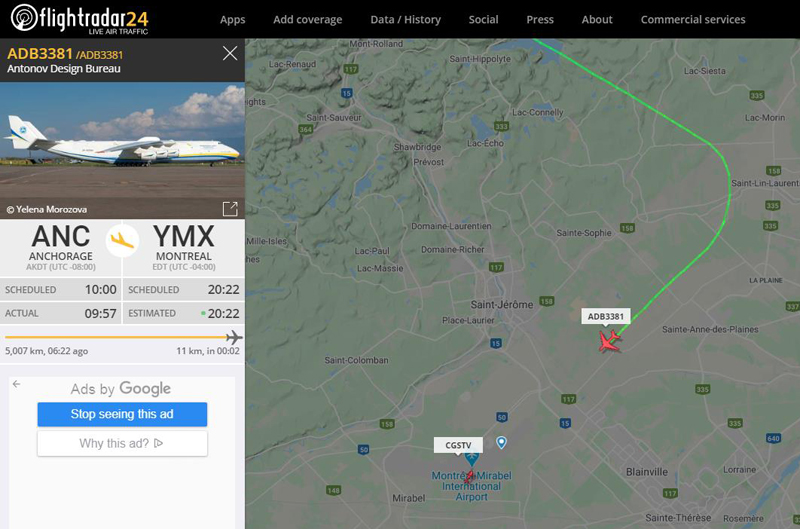
After taking off from Anchorage in the morning of May 1st, the Antonov 225 arrived in Mirabel, Quebec, in the evening of the same day at around 8:22 p.m. The aircraft’s flight path (ADB3381) could be followed on Flightradar24 at the time of its approach for Mirabel (CYMX).
The Antonov 225 ADB3381 on final for Mirabel airport in Canada on May 1st 2020.
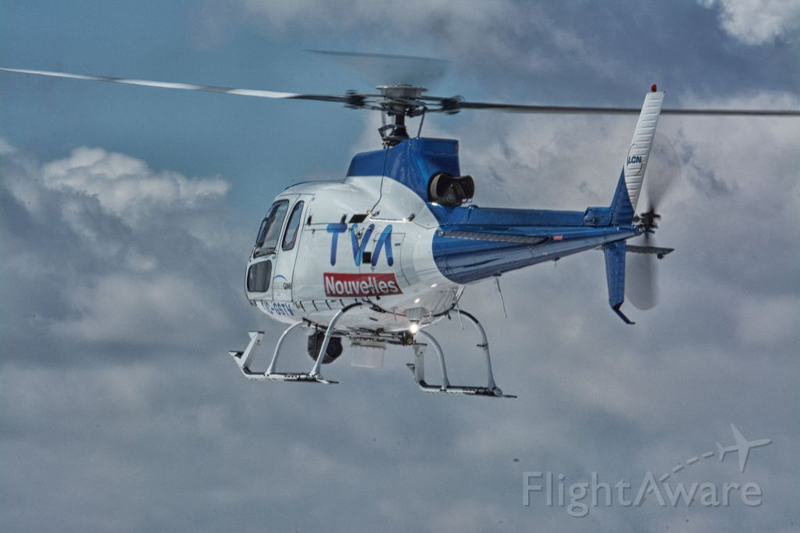
We can see on the Flightradar24 screen capture that a helicopter (C-GSTV) is positioned to film the arrival of the world’s biggest aircraft. It is an AS 350 BA from TVA, a French-language news media in Quebec.
The Québec TVA news helicopter C-GSTV.
Source : FlightAware.
The Antonov 225 arrives in Mirabel from Anchorage on May 1st 2020.
Several challenges were encountered for this flight to be a success: the language barrier, the verification of equipment quality (contaminated material is not of a big help), the airport operation’s requirements from China, customs limited hours of operation, maximum daily time in service for the Antonov 225 crew, international competition for slot times and orders, initiatives from some countries to acquire shipments not intended for them, etc. But finally, after hard work, Quebec finally received the precious cargo.
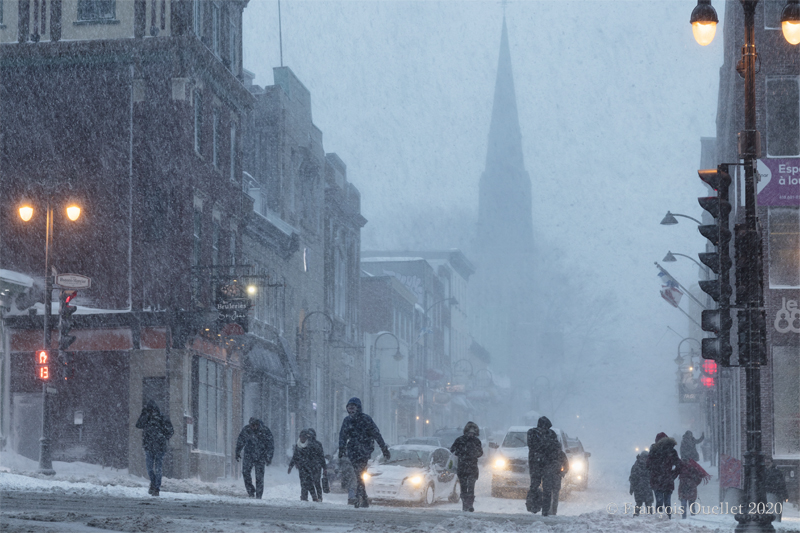
As I process these photos taken in February 2020, we are in full confinement because of COVID-19. It’s strange how life has changed in such a short time. Just a few weeks ago, I was freezing in Old Quebec and in the surrounding area while doing winter photography. There were lots of residents and tourists all around, and I could warm up in the cafes of my choice. There was no question of social distancing, masks, closed restaurants and daily press conferences of the federal and provincial governments!
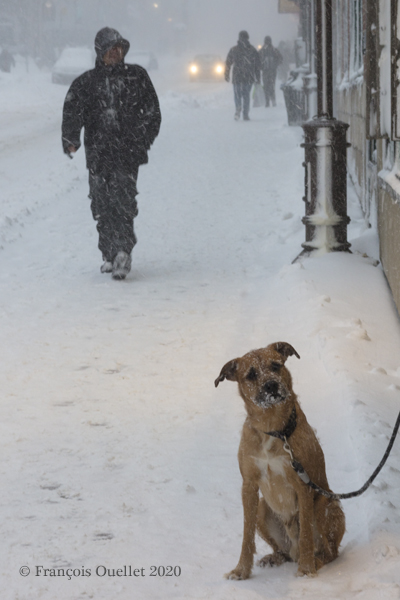
Un chien attend son maître dehors durant une tempête hivernale en 2020.
The photo above was taken on rue St-Jean, around supper time. Citizens went out to have a bite in one of the many restaurants and cafes on this popular street, while others quickly went to specialty stores to get missing ingredients for the supper to be prepared. Dogs are not allowed inside the shops, so they have to wait a few minutes outside in the snowstorm for their owners.
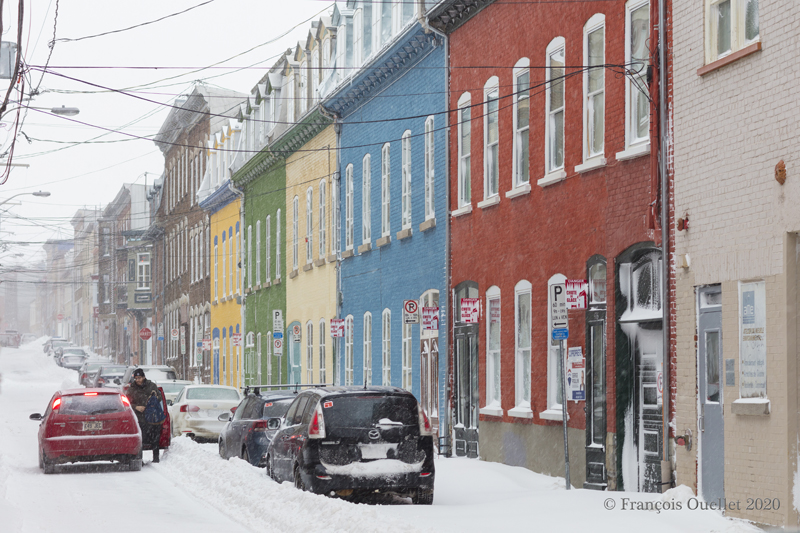
Multicolored buildings near Old Quebec winter 2020
I enjoyed the digital processing of these multicolored dwellings. Indeed, although they are interesting, the original colors of the buildings were still less vivid than what I wanted to obtain for this winter scenery near Old Quebec. The saturation was therefore slightly increased to obtain the desired effect.
Crossing the Honoré-Mercier avenue in Quebec City winter 2020
Traffic time on Honoré-Mercier avenue. Pedestrians have just enough time to cross this very busy avenue before the numerous buses and cars block the passage again. The icy and sloping roadway, the wind and the snow make it more difficult than usual, but the time allowed to cross remains the same. Hurry up!
For this photography project, I used a Canon 5DSr full-frame camera with a Canon EF 85mm f/1.2L II USM lens.