Transat Québec Saint-Malo 2024 and the Château Frontenac
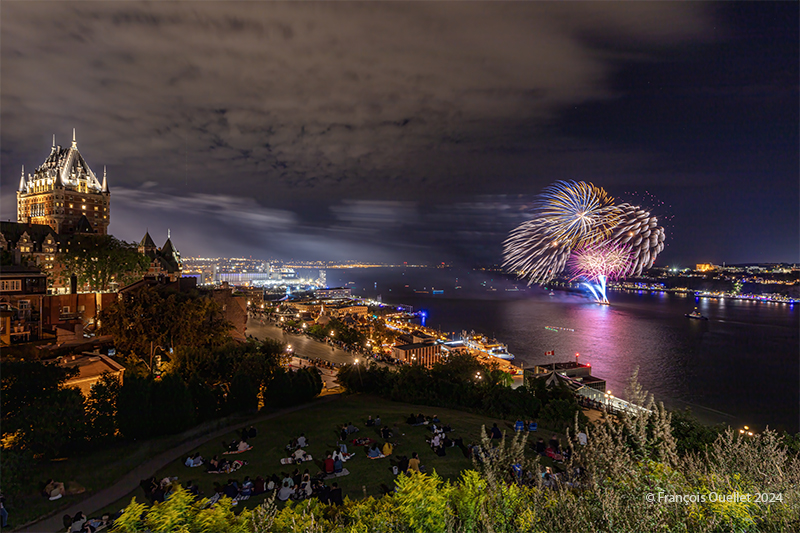
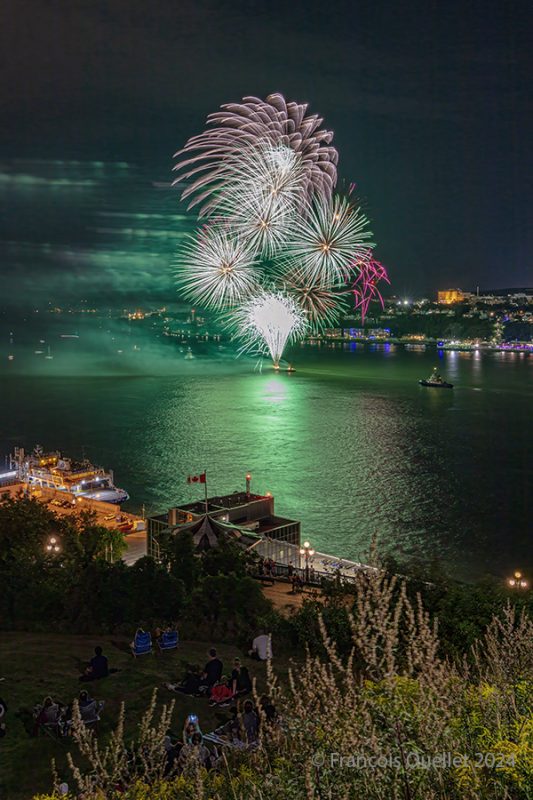
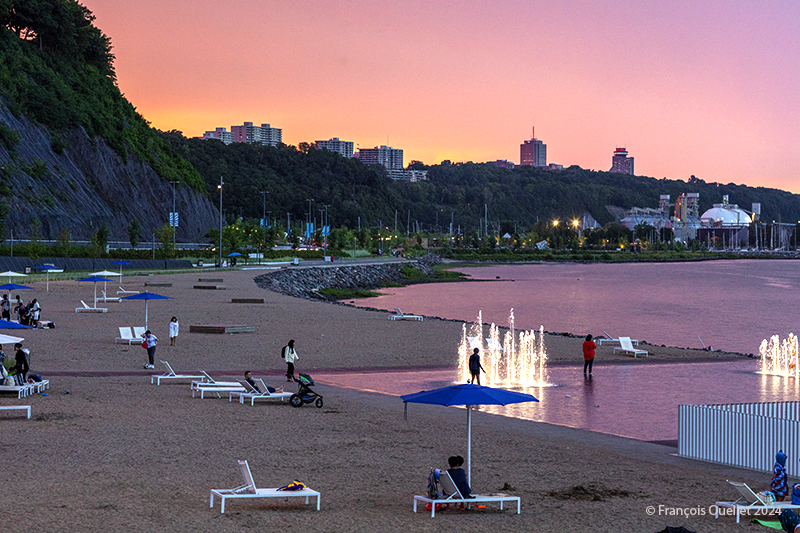
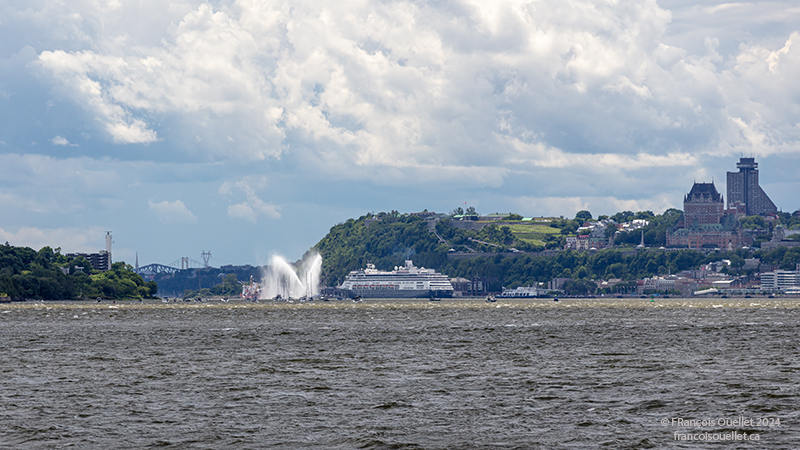
Above, a view of Cap Diamant and the Château Frontenac as the Transat Québec Saint-Malo 2024 gets underway. You can see the water jets and the Volendam, a cruise ship anchored at the Port of Quebec.
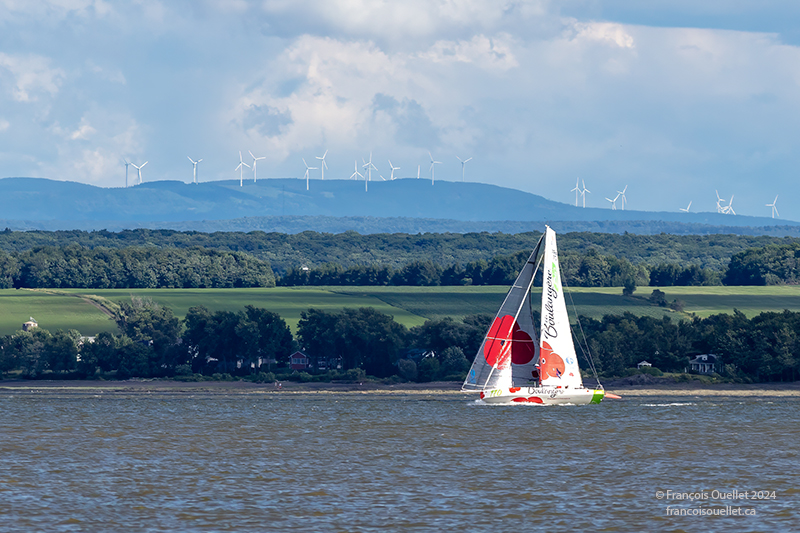
La Boulangère Bio sailboat on the St.Lawrence River during the Transat Québec St-Malo en 2024
The photo above shows the sailboat La Boulangère Bio on the St. Lawrence River off Île d’Orléans. Skipper Amélie Grassi is originally from France, more specifically La Rochelle. She achieves excellent results in most of the races she takes part in.
In the background is the 150 MW Massif du Sud wind farm, which supplies electricity to Hydro-Québec.
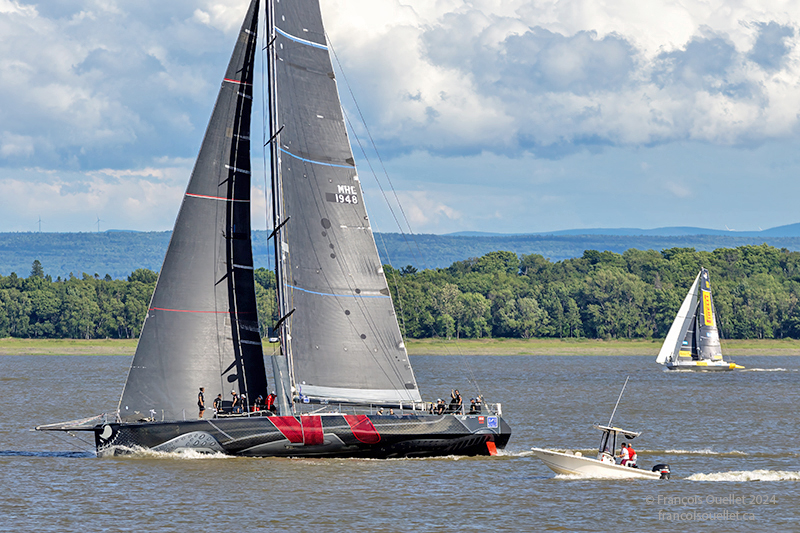
The Atlas Ocean Racing sailboat during the Transat Québec St-Malo 2024
This photo shows the Atlas Ocean Racing sailboat during the Transat Quebec Saint-Malo as it passes near Île d’Orléans near Quebec City. Skipper Gilles Barbot is a French Canadian of Breton origin who now lives in Montreal. All crew members are Canadian, from the province of Quebec.
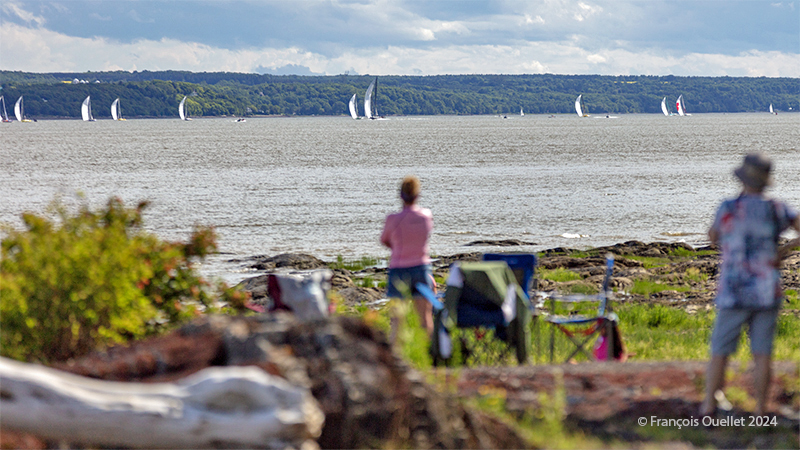
The Transat Québec Saint-Malo 2024 observed from Île d’Orléans.
Curious onlookers set up here and there along the south shore of Île d’Orléans to watch the sailboats that left Quebec City an hour ago.
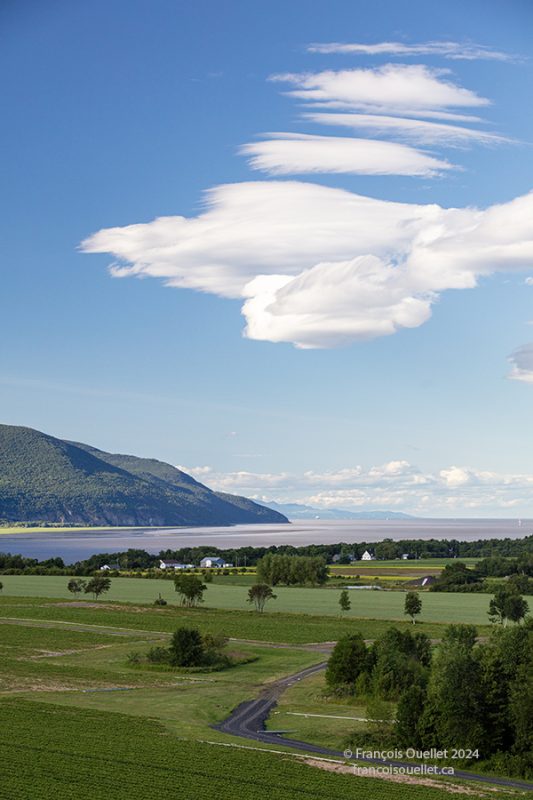
Rotor clouds and lenticular clouds over the St.Lawrence River during the Transat Québec Saint-Malo 2024.
Off Île d’Orléans, lenticular clouds and a small rotor cloud are visible. They are formed by strong wind aloft that is crossing the mountain range north of the St. Lawrence River.
P.S. After many days of racing, the results are now known. It is the Atlas Ocean Racing‘s team that arrived first in St-Malo, France.
The Martinique Tchalian sailboat and the Volendam during the Transat Québec Saint-Malo 2024
Above, the sailboat Martinique Tchalian in the Transat Québec Saint-Malo 2024. Piloted by Jean-Yves Aglae, Jean-Marie Hervé and Moane Mangattale, the boat is off Île d’Orléans as the cruise ship Volendam approaches on its way to Charlottetown, Prince Edward Island.
The Martinique Tchalian sailboat between the Alerce and the Frankopan during the Transat Québec Saint-Malo 2024.
Above, the Martinique Tchalian is in the area of Berthier-sur-Mer, near two ships, the Alerce (on the left in the photo) and the Frankopan. In this section of the St. Lawrence River, the channel is narrow, and ships must use it to sail upstream to the Great Lakes.
The Alerce is a bulk carrier heading for the Port of Quebec, from the Port of Jorf Lasfar (MA JFL) in Morocco. The Frankopan tanker left the Port of Sainte Victoire in Quebec (CA SVD) a few hours ago, and is heading for the Port of Houston in the USA (US HOU).
Sailboat and cruise ship Volendam on the St.Lawrence Seaway near Île d’Orléans during the Transat Québec St-Malo 2024.
Marine traffic off Quebec City was blocked in anticipation of the departure of the Transat Québec Saint-Malo 2024. As soon as the sailboats got a head start, cargo and cruise ships summarized their operations on the St. Lawrence River. Pictured above is the Volendam rounding Île d’Orléans near Quebec City. It is heading for Charlottetown, capital of Prince Edward Island in Canada.
Its captain appears to put a little pressure on the captain of the sailing vessel ahead, but this is in fact an optical illusion caused by compressed perspective. In fact, I took the photo when the ship was still a long way off. I brought the subject closer using a Canon 70-200 f2.8L IS II USM lens, followed by a major crop from a 50.6 megapixel photo.
Thunderstorm at the start of the Transat Québec St-Malo 2024.
The tenth Transat Québec St-Malo on June 30, 2024 got underway with very unstable weather conditions, including a thunderstorm that forced a postponement of the start. While this weather temporarily disrupted the sailors’ plans, it delighted the photographers who came to capture the event. Above, a view of Quebec City taken from Île d’Orléans.
Fishing in the Jacques-Cartier national park in Spring in Québec.
A fisherman sits quietly in the river of the Jacques-Cartier national park casting his line, while his companion watches from the shore. Here, everyone has as much space as they want to enjoy their hobby.
Some photographers use Photoshop’s “dehaze” function to keep the background sharp to infinity. I prefer to retain the natural feel of the scene. The violet-blue landscape visible at the top of the shot helps to capture the distance.
Forest in the Jacques-Cartier national park in Spring in Québec 2024.
People prepare for their outing in the huge ancestral canoe known as a rabaska. In the foreground, but no longer visible in the photo, was originally a group of vacationers launching an inflatable raft. But all these people were distracting from the main subject. Tight framing eliminated this obstacle.
Nature in the Jacques-Cartier National Park in Québec.
I use the frame-within-a-frame technique to present the multicolored reflections of the river in the photo above. There’s blue, orange and green, outlined by two vertical trunks on either side of the photo and an oblique branch at the top.
I use the same technique in the shot below, but in a less obvious way, as the frame in the foreground remains blurred. Attention is immediately drawn to the canoeists who are just finishing their trip and getting ready to dock.
Canoeing on the Jacques-Cartier river in Québec 2024
The Grand défi Pierre Lavoie returns every year to raise funds for the Fondation du Grand défi Pierre Lavoie, which supports many causes including research into orphan diseases.
Police blocking the traffic in Sillery before the arrival of the GDPL cyclists.
Cyclists pay to take part in the challenge, and the public can also make a monetary contribution to support the riders. Participants benefit from fully protected circuits where car traffic would normally cause problems. Above, police officers prohibit access to cars as cyclists arrive on Avenue des Gouverneurs in Sillery, Quebec.
Cyclists arriving in Sillery at the Grand défi Pierre Lavoie 2024.
Grand défi Pierre Lavoie (GDPL) 2024 cyclists on avenue des Gouverneurs in Quebec City.
The Grand défi Pierre Lavoie 2024 cyclists in the Sillery sector in Quebec City.
Cyclists take it in turns to cover a series of circuits totalling 1,000 kilometers in the Quebec City region over three days. Depending on the route chosen, the difference in altitude ranges from 199 metres to almost 900 metres.
Each route starts and finishes on the Université Laval grounds in Quebec City.
The first stage of the GDPL 2024 took place on June 14. It was only a 21-kilometre warm-up circuit, and I photographed the participants as they completed their journey and headed for their base camp at Université Laval. There are just 979 kilometers to go between now and the afternoon of June 16…
Group of cyclists in the Grand défi Pierre Lavoie (GDPL) 2024 in action at Québec.
GDPL 2024 cyclists wearing the Montreal Canadians hockey club jersey.
Photos were taken with a Canon EF 24-70mm f/2.8L USM lens.
Spring in the Parc National de la Jacques-Cartier in Québec.
Normally, a 3:2 or 4:3 ratio is used to display in vertical mode. But the 16:9 aspect ratio of the photo above shows both the reverberations in the water and a significant portion of the landscape. So, whatever the conventions and what makes purists happy, we use what does justice to our first impression.
What caught my eye in this scene? The very wide range of green tones, the alternation of light and shade in the landscape and the reflections, the roundness of the deciduous trees and the tips of the conifers, the atmosphere of the place and, last but not least, the human presence. All this can be seen in a fraction of a second, and the shot is taken before the canoe enters the shaded area on the left.
Historic lodge in Spring in the Jacques-Cartier national park in Québec.
The photo above shows a historic chalet in Jacques-Cartier National Park in Spring. It’s no longer available for rent, but it’s a great asset for photography enthusiasts. At this location, paddleboarding is safe thanks to a very weak current.
Tourist attraction in the Parc national de la Jacques-Cartier in Québec.
On the same day and on the same river, but a few kilometers upstream, a group of people attempt their first descent in an inflatable boat on a rougher stretch of water.
The first group takes the plunge, while the second watches, waiting its turn and trying to learn from the others’ mistakes. Occasionally, paddlers get stuck on top of a flat rock flush with the water, and have to use their initiative to free themselves and continue their journey. Sometimes canoeists find themselves in the water, and Sépaq staff have to help them out.
Click on the links for more photos and other articles about the province of Quebec.
Profiting from the strong winds at île d’Orléans 2024
A single-day visit to Île d’Orléans for a photography session was enough to capture a wide variety of cloudy conditions in April 2024. In spring, when unstable, humid air crosses the mountain range north of the St. Lawrence River, you can expect anything on the island. Above, a kitesurfing enthusiast practises his art between localized showers. All he cares about is strong winds.
Coloured houses of Île d’Orléans. Spring 2024.
A few kilometers from route du Mitan, colourful houses and a bit of blue-sky contrast with the showers elsewhere on the island. You can see that the cloud layer in the distance is not very thick.
Looking north from île d’Orléans, Spring 2024.
Above, a towering cumulus (TCU) approaches the St. Lawrence River in the late afternoon from the north. It is likely to cross the river towards the island, if it has not lost some of its strength, in the meantime, due to subsidence, the phenomenon that forces air to compress and warm as it is forced down a mountain range.
Sailboats on île d’Orléans. Spring 2024.
The shape of the clouds in the photo above gives a good indication of the strength of today’s winds. You can hear it whistling through the ropes and between the masts of the sailboats at the marina in the municipality of St-Jean, île d’Orléans. At the time of my visit, some owners were preparing their boats for the warmer periods of May.
A house on île d’Orléans, Spring 2024.
I really like the scene above, but I admit that some might find it dark, if not sinister. It was this slightly disturbing aspect that caught my attention and that I tried to capture.
A boat requires repainting on île d’Orléans, Spring 2024.
In this last photo, the sky is practically clear. It is then easier to obtain better contrasts. A pseudo-HDR treatment brings out the paintwork on a boat that has seen better years.
Hiker entering the Jacques-Cartier National Park’s forest, Winter 2024.
The province of Québec offers in 2024 a free admission to Parc national de la Jacques-Cartier a few days a week. This means more visitors than ever before head for the park. Hikers seeking absolute peace and quiet should opt for the paid days.
Even so, if you look carefully, it’s always possible to spot a lone walker, as in the photo above. Most people take the marked trails for ease, but others, like the individual above, venture out on snowshoes near the Jacques-Cartier River, which is completely covered in snow at this time of year.
Jacques-Cartier National Park’s landscape, Winter 2024.
Approximately three kilometres from the Discovery and Services Chalet is a bridge. From here, the hiker can capture some very beautiful scenes. In winter, an interesting effect can be achieved by positioning yourself close to the banks.
November in the Jacques-Cartier National Park in Quebec, 2023
This scenery relaxes me so much, yet there are no spectacular elements. Rather, all the components are in perfect harmony: reflections in the water, some bluish snow here and there, brushes and a few leaning trees lit from the side by a soft late afternoon light. As the large trunks occupy the majority of the scene, I chose a vertical format for the photographic composition.
Photo of the Jacques-Cartier national park, Winter 2024.
Above, the landscape attracts the eye with its combination of horizontal, vertical and oblique lines, as well as its alternating black and white in the foreground. I positioned myself to include in the scene a large branch that enters the photo from the top right-hand corner.
The foreground features open water, snow-covered ice, pure ice and snow-covered ice again. In the middle ground, coniferous and deciduous trees. In the background, a forest revealing the snow on the mountain floor. I’ve left only a hint of sky, as the latter offers no particular interest on this cloudy February day, other than to add some white to complete the alternation of colours.