Streets and buildings of Old Quebec. Picture by François Ouellet
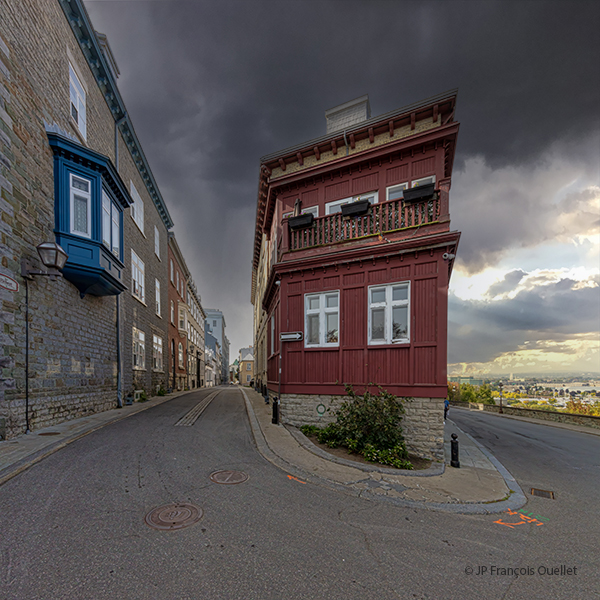
Here’s a scene from Quebec City, specifically Old Quebec, captured in autumn. I rarely use the square format to present a photo, but this time it suited the photographic composition perfectly. Digital processing enhanced the effect of the clouds and lessened the impact of the setting sun in the west.
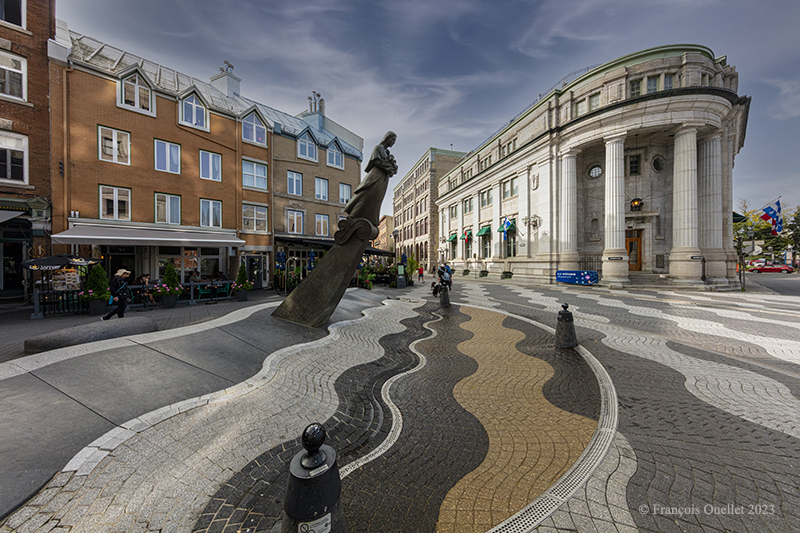
Old meets new in this photo of Old Quebec. On the right, the headquarters of the Norplex group, real estate developer. This is the former Canadian Bank of Commerce building, designed in 1914 by architect V. D. Horsburgh. The rounded shape is reminiscent of the Bank of England’s Tivoli.
In the foreground, the sculpture-fountain La Vivrière, a more modern creation inaugurated in 1995 on Place de la FAO to mark the fiftieth anniversary of the founding of the FAO in Quebec City in 1945, under the aegis of Lester B. Pearson.
In terms of photographic composition, the sculpted waves in the foreground gradually direct the viewer’s eye towards the main building at the top right of the photo. The rounded columns are only straight thanks to the use of Canon’s ultra-wide-angle EF 11-24mm F/4L lens.
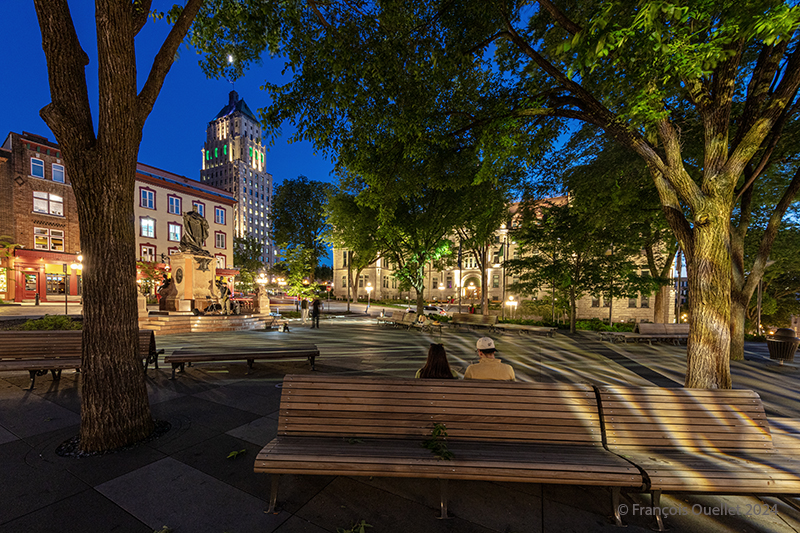
Quiet evening in Old Quebec during Summer 2024
Above, a view of the newly restored Place de l’Hôtel-de-Ville. In the distance, the tower of the Price building. Rotating spotlights create moving shadows for the couple in the foreground.
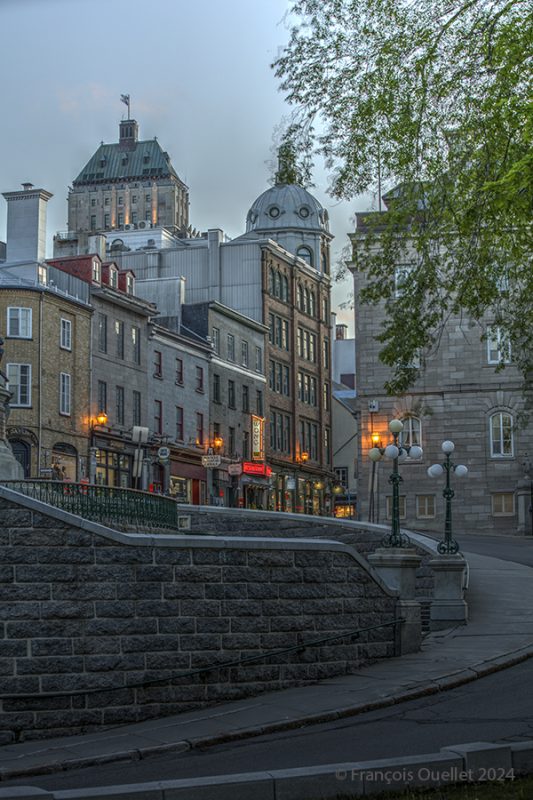
Old Quebec buildings seen from Côte de la Montagne, 2024.
Above, a five-shot HDR photo of buildings in Old Quebec. In the foreground, a wall stands at the intersection of Port Dauphin and Côte-de-la-Montagne streets. In the middle ground, we see the shops and buildings on rue De Buade. In the background, the Price Building, the only skyscraper permitted in Old Quebec.
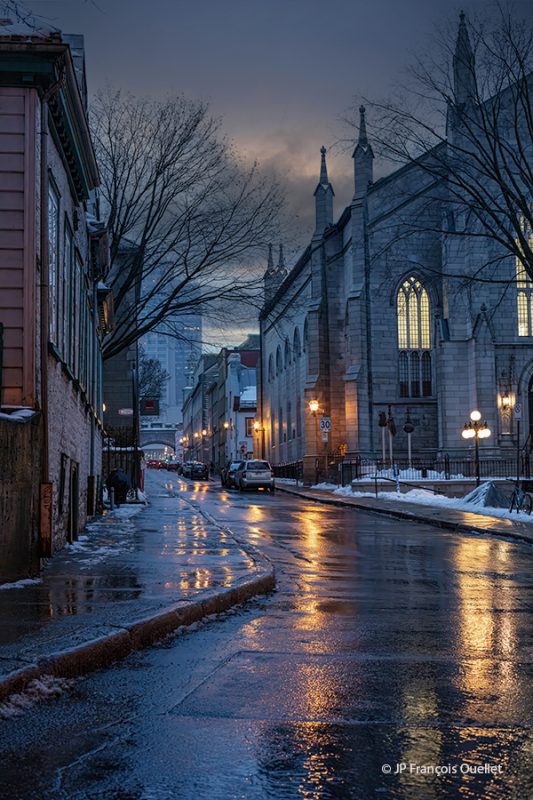
For this photo of rue Dauphine in Old Quebec, I chose a period when everything changes rapidly. The blue hour still allows us to make out the most significant details of this night photography session. Winter is just around the corner and the rain showers, momentarily halted, are trying to erase the snow that now lingers on the ground in early December.
The freshly fallen rain reflects the light from the streetlamps on rue Dauphine and from the windows of the former church, now the Maison de la littérature.
This kind of photo can only be taken with frequent visits to the old town, in all seasons and weather conditions. The photographer’s eye immediately catches sight of a scene around a bend in the road that needs to be captured.
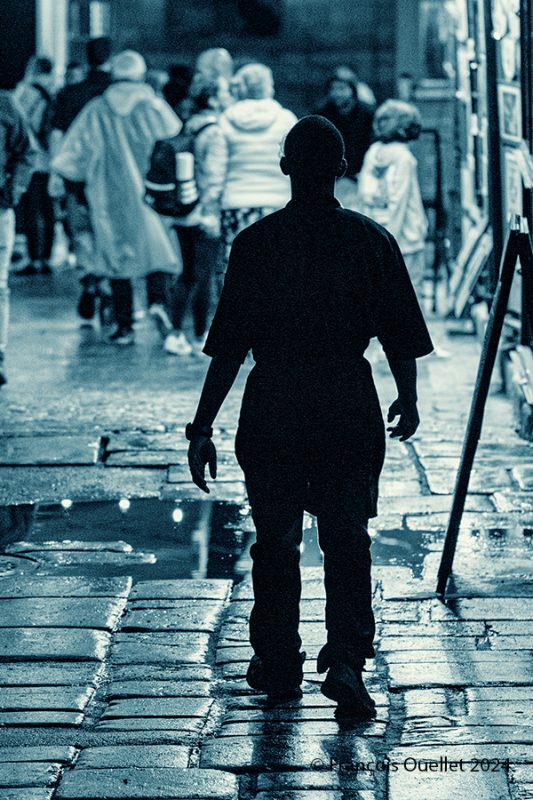
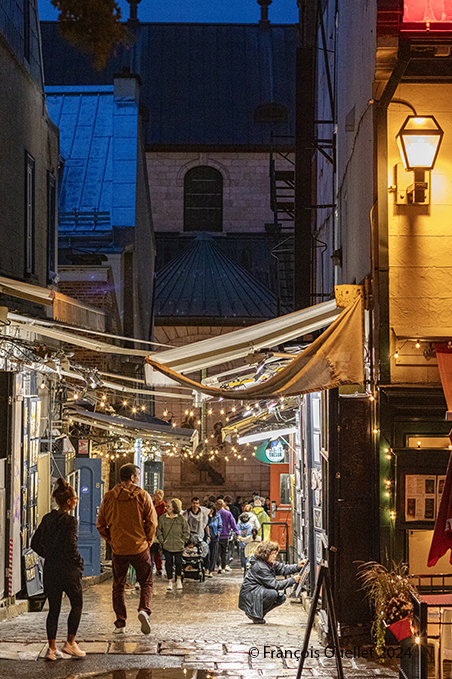
On an evening when isolated showers were continually changing the atmosphere in Quebec City, I visited the old part of the town, especially “rue du Trésor”. Today’s article features four photos of the same street captured from different angles. About three hours separates the shots.
Above, passers-by seem to be followed by an individual. I’ve maximized the effect of tension by taking advantage of a moment when the tourists in the background are in the light and the lone walker remains in shadow. To accentuate the discomfort, I opted for a cold tone and undersaturation in post-processing.
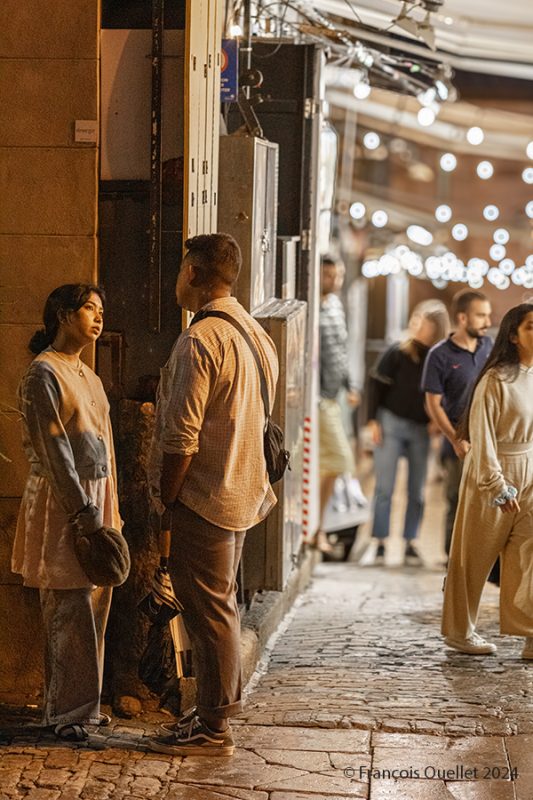
Below, two young people chat quietly at the entrance to rue du Trésor, while pedestrians go about their business. The tiles have had time to dry out a little since the last shower.
Conversation near rue du Trésor, Old Quebec 2024
The photo is legal in Quebec because it’s not just about the two persons in the foreground. There’s a street setting where other passers-by are also present. This is always a factor to consider when publishing for non-commercial use. If the couple is alone in the scene and it’s a close-up, I can capture the scene, but under Quebec law, I don’t publish. For added precaution, it is sometimes better to wait a while between the moment the photo is taken and its distribution. Finally, I make sure that people are not portrayed in such a way as to damage their reputation. So, there are always multiple factors to consider before a photo is taken and distributed.
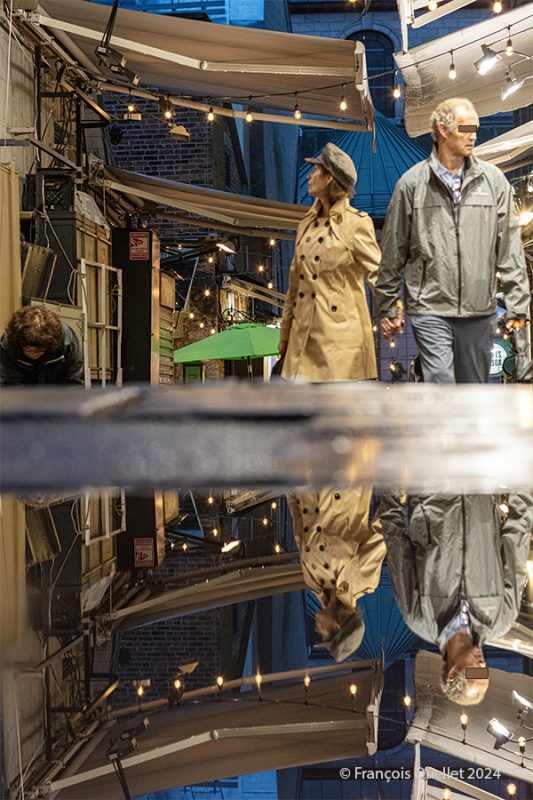
Reflections after the rain in the rue du Trésor, Old Quebec 2024
Above, a couple takes a walk immediately after a rain shower. I set up the camera a few inches off the ground, in front of a puddle to get a reflection.
The goal of the picture is the water reflection but, since I want to publish the photo, I have to think about the persons. The couple becomes possibly the main subject for some viewers. Using added precaution, I put an artificial obstacle in front of the man’s eyes to make him less recognizable. As for the woman, her head turned to one side makes identification impossible.
Below is a view of the Rue du Trésor during the “blue hour,” after the showers. The last tourists take the opportunity to choose a piece of art before the shopkeepers leave.
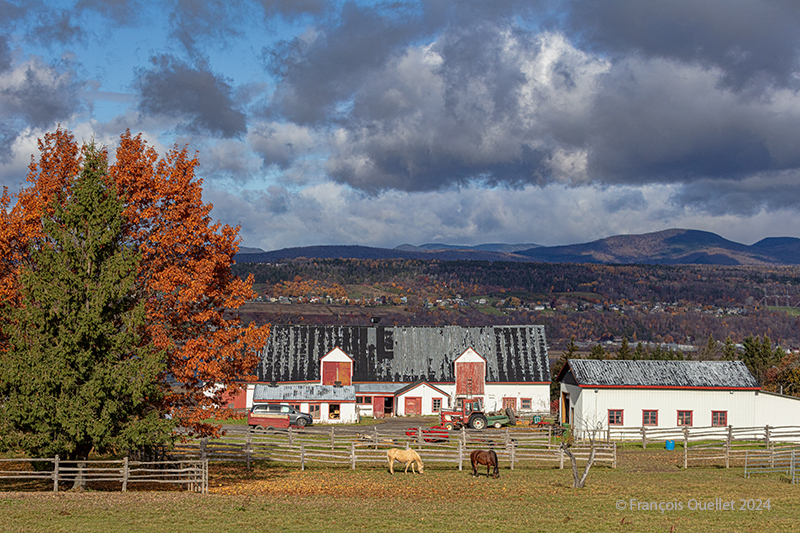
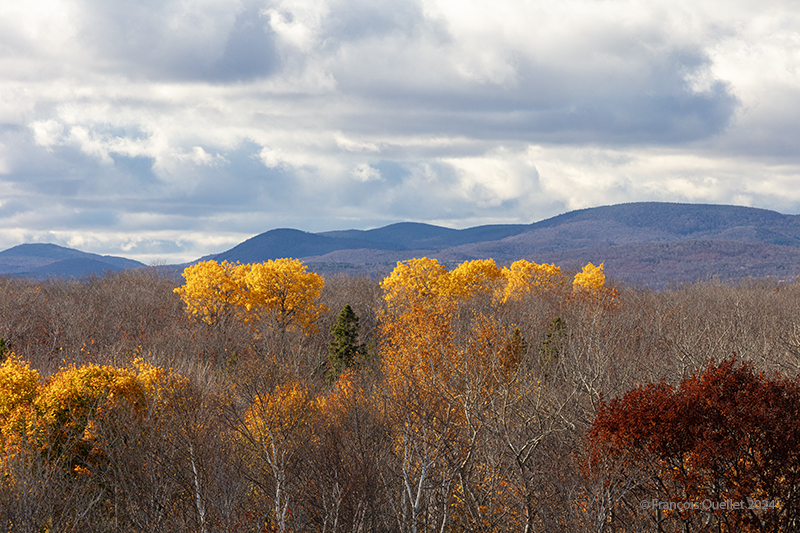
Here’s a photo taken late autumn on Île d’Orléans. The sun shines through the cumuliform clouds, helping to create interesting contrasts of light and shadow on the mountains in the background. Towards noon, the more direct sunshine dissipates these clouds, and late in the afternoon, the new-found coolness helps to form a uniform stratocumulus ceiling over the region. The photo was taken around 10 am, at a time when there is still a mixture of clear skies and clouds, making the photo more dynamic.
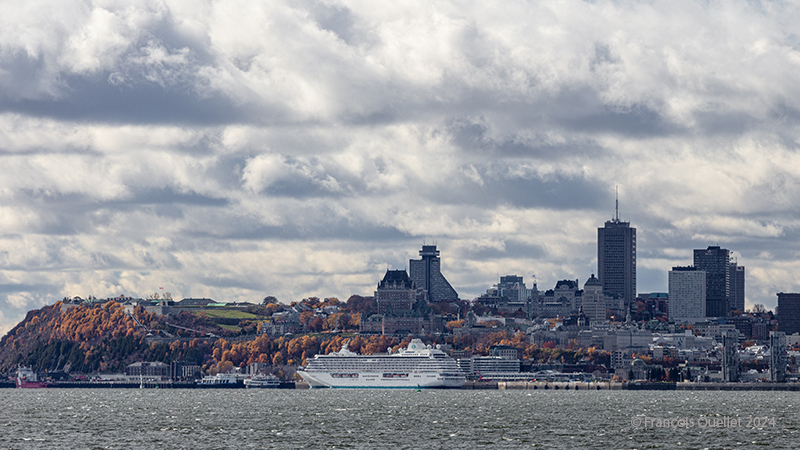
Above, a photo of the Château Frontenac in autumn with a cruise ship that has just docked at the Port of Québec. The photo was taken from Île d’Orléans. Also visible in the center of the photo is the Concorde Hotel’s revolving restaurant, “Ciel! Resto-bar”.
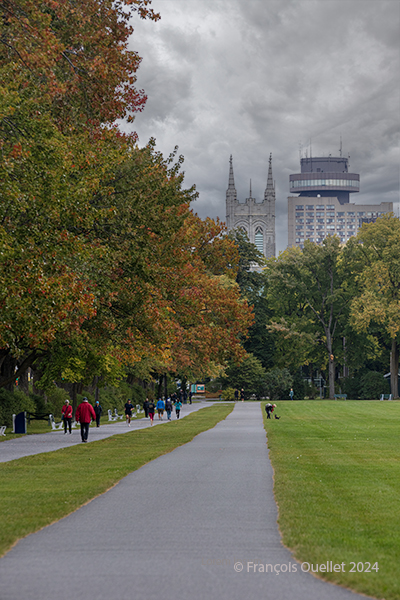
The photo shows the Battlefields Park in early autumn, as the trees begin to change color. In the distance on the right is the revolving restaurant “Ciel! Bistro-bar” and, on the left, the turret of Saint-Dominique church.
This photo was taken in autumn from the wooden tower at the eastern end of Île d’Orléans. Late in the season, there are fewer leaves left on the trees, but the sun hitting the vegetation from the side breathes new life into the landscape.
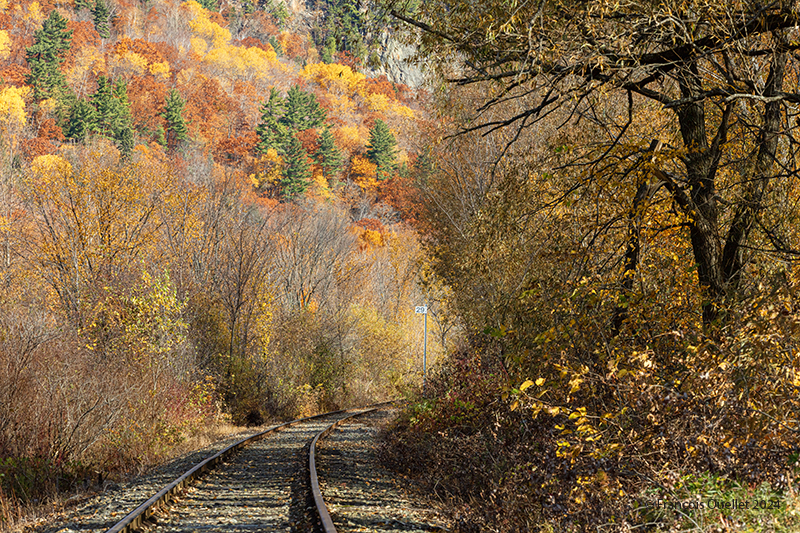
Above, a railroad track crossing the Cap-Tourmente National Wildlife Area in Quebec. Autumn is well underway and red is no longer part of the scene. However, the colors remain attractive. At the time of our visit, only 26,000 of the 600,000 geese migrating south remained.
Trees in the Montcalm dictrict in Québec City during Autumn 2024.
The Montcalm sector of Quebec City is brimming with majestic trees that change colour in autumn. Those photographed above are located right next to the Battlefields Park, owned by the Government of Canada.
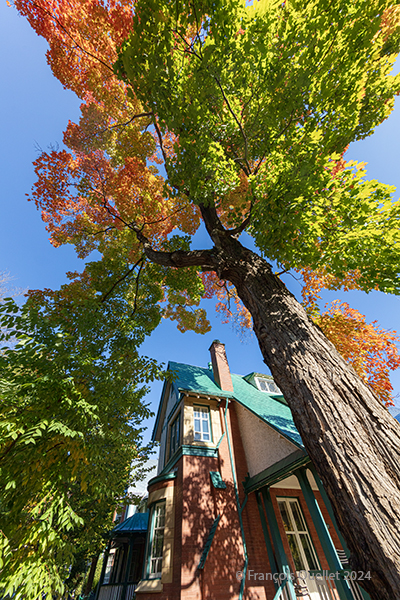
Trees of the Grande-Allée in Quebec City in Autumn.
The tree above is on Grande-Allée, in the direction of Old Quebec. I shot it using a Canon EF 11–24 mm f/4 USM wide-angle lens. All I had to do was wait until 10:00 AM for the sun to strike the foliage from the side. Earlier than that, the brightness is a little lacking, and later the sun rises too high and hits the foliage from above with a violent light that detracts from the overall effect.
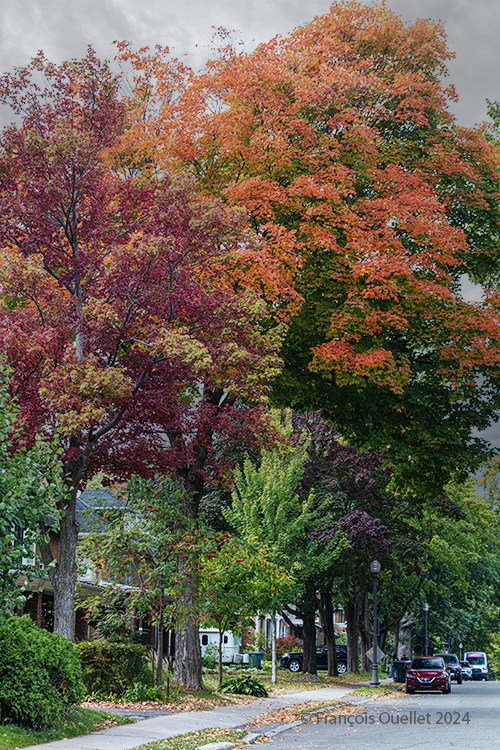
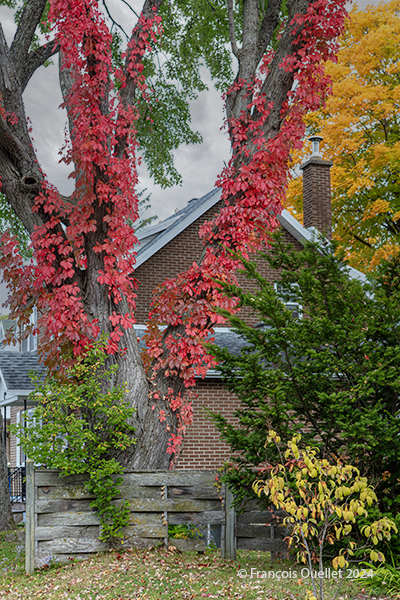
Trees in a Sillery street in Québec City during Autumn 2024.
Above are a few trees in the Sillery area of Quebec City. It’s not often that red leaves cover several tree trunks. You have to be there at the right time, because the effect doesn’t last long. We also need to be able to count on the wisdom of homeowners who have seen fit to let nature do its job, rather than cleaning everything up to make it look “nicer,” as we sometimes see.
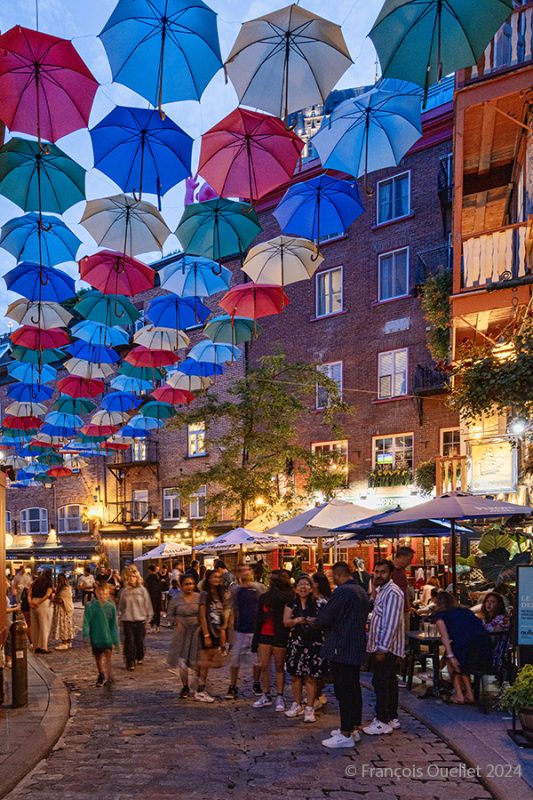
Umbrellas cover part of Rue du Cul-de-Sac in Quebec City. Most tourists are unaware of this installation when they set foot in the Petit Champlain area. Surprised, they whip out their cell phones and capture the moment as best they can. Since they’re just passing through, most don’t have the luxury of choosing the most appropriate light for their multiple shots.
The situation is different for someone who has easy and frequent access to the location. They can wait for the “blue hour” on a fine summer evening, and at the same time capture the golden hue of the lights in front of the many restaurants lining the alleyway.
The main challenge in taking the above shot, however, is the sharp contrasts in light.
For example, the tourists in the foreground are standing in the half-light, but the viewer still wants to see the details. Just above the people, the lighting contrasts sharply with the shaded area at the bottom of the photo. It’s hard for the camera to decide which brightness to prefer.
To top it all off, the soft blue light of late evening illuminates the umbrellas from above, while the restaurant lights illuminate the installation from below.
Image processing software is used to optimize the information contained in the RAW file of the photo, helping to highlight the different areas of brightness in the scene while avoiding areas that are too light or too dark.