Sailboat anchored in the Saguenay Fjord in the province of Québec
Heading up the west coast of Saguenay from Saint-Siméon, you pass through Sagard (home to the Desmarais family’s huge estate and castle) and L’Anse-Saint-Jean. In L’Anse-Saint-Jean, you can book a shuttle for a few hours’ round trip on the Saguenay. This allows you to see Cap Trinité and stop off at Sainte-Rose-du-Nord.
I took the picture above from Baie Éternité. The cliffs rise up to 400 metres. A sailboat has chosen to anchor there for a while.
The Saguenay River at low tide near La Baie, Québec 2025
Just before La Baie, you can walk on the beach at low tide. There are several interesting opportunities for landscape photography, including a lighthouse, mountains, the town at night, and even cruise ships sailing up the Saguenay River in the fall.
Downtown in La Baie, province of Québec 2025
To achieve the above effect in La Baie, I had to remove a few poles and advertisements using digital processing software. The pseudo-HDR method enhances the impact of the clouds by defining them more clearly.
Seals resting on rocks in the Saguenay fjord, Québec 2025
This last photo shows seals resting on the rocks along the Saguenay Fjord. The captain of the ferry was able to approach the cliffs safely because of the great depth of the fjord at this point.
In September 2025, another edition of Vintage Weekend took place in Quebec City. This year, more than 200 vintage cars were on display on Saint-Paul Street and on the grounds adjacent to Espace Quatre Cent in Quebec City’s Old Port.
Stéphane Lavallée’s 1959 Corvette at Quebec City’s Vintage Weekend
As usual, restaurant owners had their hands full serving the many curious visitors who came to admire the cars. In addition, they had to contend with the presence of travelers who had recently disembarked from the three cruise ships moored in the harbor. The next photo shows the energetic team at Bistro St-Malo hard at work feeding passersby.
The restaurateur of Bistro St-Malo at work on St-Paul Street at Weekend Vintage 2025
This year, musicians from Calgary entertained the crowd with songs from the 1950s. The audience was delighted by the excellent quality of the performance, both in terms of singing and music. The same can be said of the dancers, who took us back in time with a few hits from that era.
Retro dancing on St. Paul Street at the Quebec Vintage Weekend in 2025
Below, cars occupy the space surrounding La Vivrière, a fountain sculpture commemorating the founding of the Food and Agriculture Organization of the United Nations (FAO).
Gary Lynch’s Hudson Hornet Hollywood 7x at Quebec City’s Vintage Weekend
Burger Heaven Lights on for Service at the Weekend Vintage in Quebec City
Paul Forest’s 1955 Chevrolet Bel Air with modified color
1952 Oldsmobile Super 88 Holiday and Michel Savard at Quebec City’s Vintage Weekend
Above, Michel Savard poses proudly next to his 1952 Oldsmobile Super 88 Holiday. As for André Guillemette, he had original parts shipped from Great Britain to do justice to his 1962 Jaguar Mark II, which can be seen below.
André Guillemette’s 1962 Jaguar Mark II at Quebec City’s 2025 Vintage Weekend
Reflections in Michel Métivier’s 1967 Pontiac GTO at Quebec City’s Vintage Weekend
A final photo shows St. Paul Street with Charles Boisseau’s 1965 Corvette Stingray.
Charles Boisseau’s 1965 Corvette Stingray at Quebec City’s Vintage Weekend
Now that we know the winner, here are seven photos of Julian Alaphilippe, the Tudor team, Marion Rousse (the winner’s partner), Tadej Pogacar and Pavel Sivakov.
The Tudor team and Alaphilippe on côte de la Montagne at the GPC Québec 2025
The 216-kilometer race took place between https://www.quebec-cite.com/en/old-quebec-city Old Quebec, the Plains of Abraham, the Montcalm neighborhood, and Champlain Boulevard. Above, cyclists climb Côte de la Montagne, which has an average gradient of 9% over 600 meters, but with a steep section reaching 13%.
Below, a photo of the main peloton with the Château Frontenac in the background.
View of the Château Frontenac during the GPC Québec 2025
Near the Château Frontenac, I take the opportunity to snap a photo of Tadej Pogacar and Julian Alaphilippe, two of the most famous names in the race.
Pogacar and Alaphilippe the winner of the GPC Québec race 2025
The Tudor cyclist team opens the way for Alaphilippe at the GPC Québec 2025
On Rue Saint-Louis, the young Swiss Tudor team worked to save Julian Alaphilippe’s efforts. Below, Julian Alaphilippe after his victory. In the background are Tadej Pogacar and Pavel Sivakov of the UAE team. The latter finished two seconds behind Alaphilippe, while Alberto Bettiol of the XDS Astana Team took third place, four seconds behind.
Pogacar was well positioned, but at the end of the race, the group he was riding with refused to take turns at the front. So, he decided to slow down and watch someone else win.
Alaphilippe, Pogacar and Sivakov after the Grand Prix cycliste de Québec 2025
Marion Rousse, former French champion and actual director of the Women’s Tour de France, was working as an analyst at the GPC in Quebec City. She left her post for a few minutes to congratulate her partner, Julian Alaphilippe. She can be seen in the photo below walking towards the Tudor team.
Marion Rousse arrives to congratulate Julian Alaphilippe at the GP cycliste de Québec 2025
It was once again an exciting race, held for the fourteenth consecutive year under sunny skies and ideal temperatures. Every year, more and more cycling enthusiasts come to watch this UCI World Tour race. The same is true for the race in Montreal.
Here is the link for all the results of the Quebec City race.
A paddleboard enthusiast on the Jacques-Cartier River in Quebec 2025
An excellent spot for paddleboarding (SUP) in the Quebec City area is located at kilometer 25 (EKWATEK) of Jacques-Cartier National Park. There are no services as such at this location, but a large free parking lot provides easy access to the riverbank, which is only a few meters away.
The natural surroundings are breathtaking. Bring a good camera (or at least a cell phone) in a waterproof bag. There are several splendid spots for landscape photography.
As summer progresses, the water level drops. However, even in fall, the river remains deep enough to enjoy your sport in complete peace of mind. At first, paddleboarders follow the gentle current of the Jacques-Cartier River southward. So there’s no need to paddle vigorously! You can just let yourself go. You’ll know when it’s time to turn back when you see small waterfalls in the distance. To avoid damaging the board, you turn around.
On the return trip, the effort required is greater, but not excessive. In strong north winds, bring a paddle to which you can attach an oar in place of the handle, giving you the feeling of paddling like a kayaker. Sitting or kneeling on the board, you will return to your starting point more quickly.
In the event of a southerly wind, the energy required to return is minimal. This allows you to make several round trips and spend a few hours on the river without getting exhausted!
A beautiful summer day in Jacques-Cartier National Park
On your way to kilometer 25, you can admire several scenes like this. The surroundings are magnificent! Green, yellow, and orange are the colors of autumn. There is very little red in the area. The orange color is concentrated mainly at the beginning of autumn, while the yellow persists much longer. The photo above was taken at the beginning of August.
Reflections in Jacques-Cartier National Park in summer.
Photography technique
Even if the initial goal is to go paddleboarding on the Jacques-Cartier River, you can bring a camera, just in case a special scene merits a photo. It is best to shoot in RAW mode to make it easier to correct imperfections later.
Today, the complete absence of wind allows for exceptional reflections for landscape photography. But you have to choose your environment carefully: no distractions should break the effect. The goal is to create momentary confusion through a mirrored scenery.
A tight frame keeps the panorama identical in both parts of the photo. You must then ensure that the horizon is as straight as possible. Finally, you can improve the initial image by reducing the smoke haze. Indeed, the summer of 2025 in Quebec will have been the one where forest fires in Western Canada considerably impacted on visibility in Quebec.
The sun slowly sets over Jacques-Cartier National Park.
I took this photo of the Jacques-Cartier National Park Valley in the late afternoon to profit from the soft lighting. Also, in August at this time, the sun in the southwest hits the eastern slope. The light is then reflected in the middle of the valley and diffused through the smoke. Some of the haze can be removed, but it is important to keep enough of it to preserve the majestic effect of the landscape.
In the foreground, paddleboarders, barely visible, enjoy the exceptional light of the late afternoon.
Montreal city view from Mount Royal in the evening in HDR.
This photo of Montreal in the evening during the blue hour is actually three photos superimposed with different apertures (HDR photography). In the absence of a tripod, I placed the camera on the rampart at the top of Mont-Royal. This allowed me to use a very low ISO and a nice depth of field.
Mount Royal is a major tourist attraction. The many visitors crowd along the rampart and compete for a selfie. Getting through the three HDR exposures without being hit by a curious onlooker is a miracle. As soon as my camera moves the slightest bit, I have to take all three photos again. And that evening, Mount Royal was crowded! But luck eventually smiles on us.
Sculpture of a winged demon on a Montreal building.
In Montreal, you can expect many styles of sculpture to grace the facades of buildings. The red-eyed demon above has an strong effect on the pedestrian! Good thing it’s not in front of a restaurant…
Rabagliati artwork on a Montreal building.
On the Plateau Mont-Royal, there’s a space reserved for a creation by Michel Rabagliati, the Quebec author renowned for his Paul series of comic strips. He also produces graphic novels, of which “Rose à l’île” is a good example. The winter scene on the building contrasts with the warm summer day in Montreal at the time of our visit.
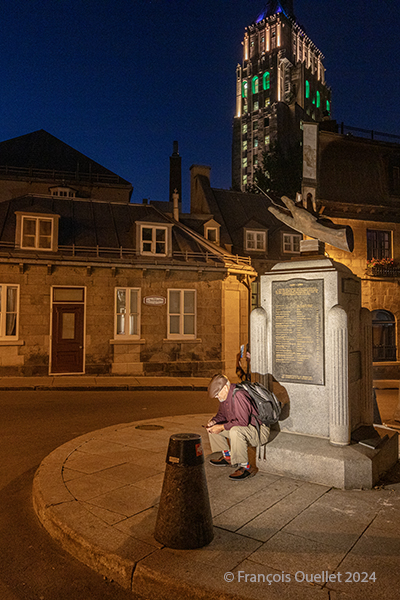
A pedestrian takes a break in Old Quebec, with the Price building in the background.
A pedestrian rests in the evening in the shadow of the Price building in Old Quebec. Many residents and tourists alike appreciate the safety of the Old Town. Accompanied or unaccompanied, even the elderly feel at ease here late in the evening.
The Price building is the only skyscraper allowed in Old Quebec. During my photography sessions in this area, I enjoy finding different vantage points and special lighting to feature this unique building. At the time I captured the scene, there was still a bit of blue in the sky. This color blends delicately with the surrounding orange-yellow.
Passing through the church parking lot for a night photography session, I took advantage of the sculpture honoring the eight Canadian martyr saints to highlight the full moon.
One of the Jesuits made the task easy for me, as he was already pointing his finger skyward. All I had to do was wait for the right moment to link religion and astronomy. Social media have popularized this kind of technique in photography, but it’s still satisfying to get such a shot.
The day ends at Berthier-sur-Mer, in the province of Quebec. The last glimmers of the setting sunilluminate this magnificent flower directly. There are only a few specimens of its kind on the beach. The flower points directly towards the horizon and the St. Lawrence River. The weak rays of the sun replace a flash to illuminate the plant from within.
Effect of inversion fog on architectural styles in Quebec City.
Photography theory
In March, a heat wave sweeps through Quebec City while there is still snow on the ground. The warm air floating above the snow favors the appearance of fog or mist in places. But if the wind picks up even a little, visibility will quickly improve.
For lovers of night photography, now is the time to get busy! I arrive on Grande-Allée just as the fog begins to lift. The scene presents several types of contrast. Visibility varies at different heights and in the presence of buildings with very different styles.
I position myself so that the old house is directly in front of the more modern building. By framing tightly, I eliminate all distractions. The light fog accentuates the impact of the tower’s numerous lights. This further enhances the chiaroscuro effect. One hour later, the fog has totally disappeared.