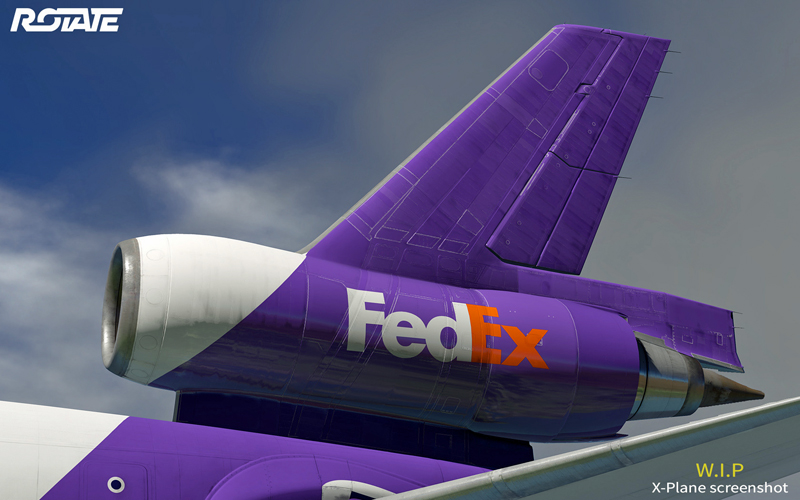
The virtual MD-11 being created by the Rotate company for the X-Plane flight simulation platform.
Good news for flight simulation enthousiasts! Those who had stopped looking for a virtual MD-11 will have an opportunity to fly this legendary aircraft.
The Rotate company, which makes virtual aircrafts for the X-Plane flight simulation platform, has decided to make a virtual MD-11. It is quite a challenge but the progress is steady.
A few years ago, another company, PMDG, created a virtual MD-11 but decided to drop the product and let down the customers who had bought their excellent aircraft. They stopped providing updates and eventually erased the MD-11 from their list of products.
Since then, many flight simmers have been wondering if they could one day learn to fly the MD-11. Numerous crashes of MD-11s have happened in real life since its creation by Mc Donnell Douglas. They were mostly due to pilots unable to master the aircraft, except in the case of Swissair 111.
The Rotate’s staff have recently published a new photo (see above) on their WEB page to show that the virtual aircraft is slowly taking shape. The graphic quality is really superb.
In an interview given to PC Pilot in the March/April edition, Rotate said that they want to achieve a high level of simulation with the MD-11, but that they still have a long way to go. They stated that the MD-11 is much bigger and much more complex than the MD-80 (that they are already offering) and that they want the MD-11 to reflect those characteristics.
Those who fly using FSX will now be able to add X-Plane as another flight simulator to their computer and thus use the MD-11 when it will be ready (probably around the end of 2019).
The beauty with X-plane is that the 64 bits platform uses all six cores of the new CPUs on the market. The FPS (frame per second) number is thus very high, which will allow users of the MD-11 to fly around huge virtual airports when the weather is complex without having to compromise.
Another positive aspect is that ORBX now offers products for X-Plane, which will greatly increase the choice of quality virtual sceneries.
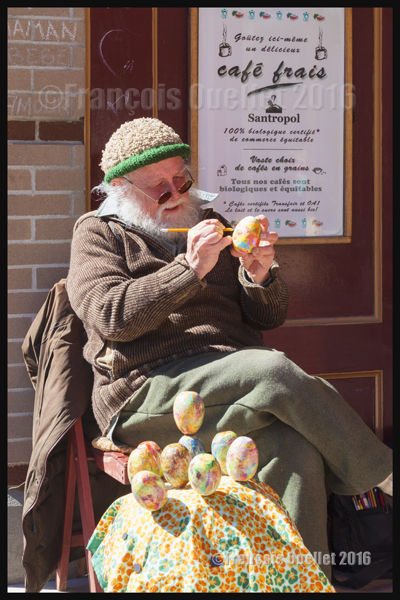
Tom White designing Easter eggs in Old Quebec (2016)
While I was walking in Old Quebec, I stopped to watch Tom White, a local artist, work on his hand-made Easter eggs. We talked for a few minutes and he agreed to let me take a picture of him at work.
For other photos on the province of Quebec and also Quebec City, click on the following links from my blog:
The pictures below were taken in Vancouver and Victoria, in British Columbia. They were all taken with a Canon 5DSR full frame camera.
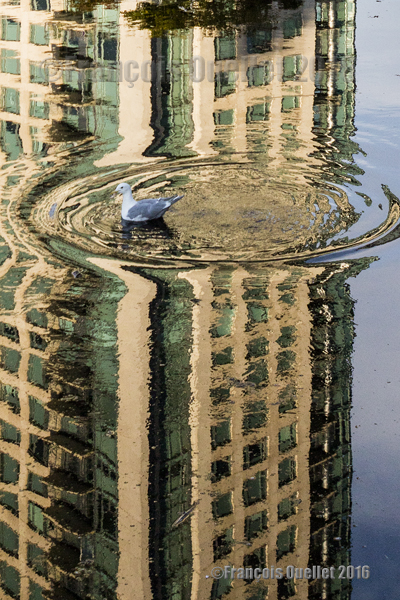
In the Vancouver harbour, several condo towers have been built in the last few years. Many condos in those towers can now be rented by travellers through Airbnb, thus entering in direct competition with the hotels located nearby. I was trying to use the water reflections in the harbor to show one of the towers when this seagull appeared in the viewfinder, adding a touch of life to the scenery.
Another way of showing the Vancouver Harbour architecture (2016)
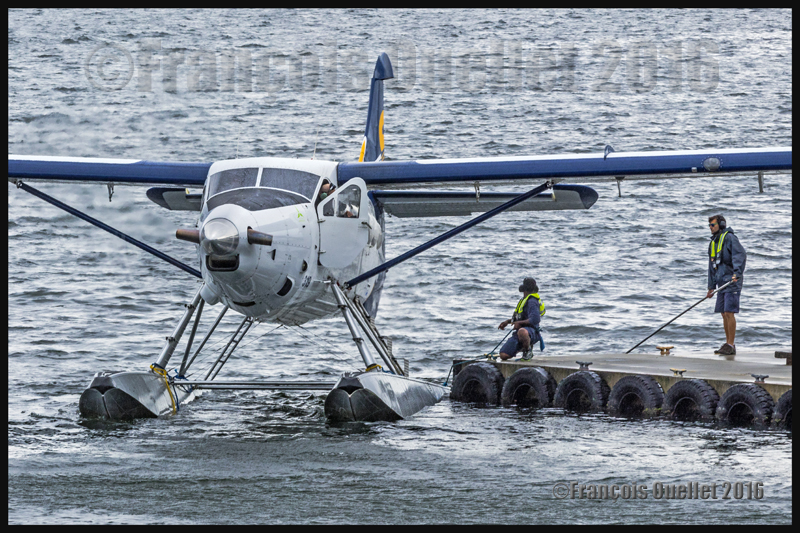
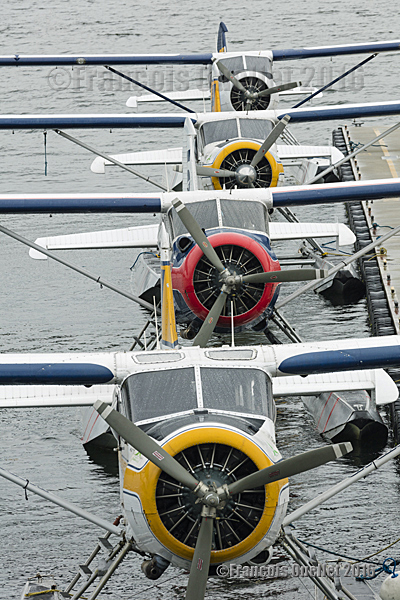
Floatplanes of all types constantly maneuver in the Vancouver harbour. The two photos below show a Saltspring Air Turbo Otter as it is being helped to park. You can also see a row of Harbour Air Beavers (DHC-2) parked after a day of uninterrupted flights.
Saltspring Air Turbo Otter C-FLAP in Vancouver Harbour 2016
Harbour Air DHC-2 Beaver floatplanes in Vancouver, British-Columbia (2016)
In the Willows Beach’s Park, in Victoria, I was able to photograph this Cooper’s Hawk using a Canon 70-200 f2.8L IS II USM telephoto lens. The full frame sensor 50 megapixels allowed for some serious cropping to bring the bird closer. The hawk clearly annoyed all the crows that considered themselves as the owners of the territory.
Cooper’s Hawk in a Victoria’s public park (2016)
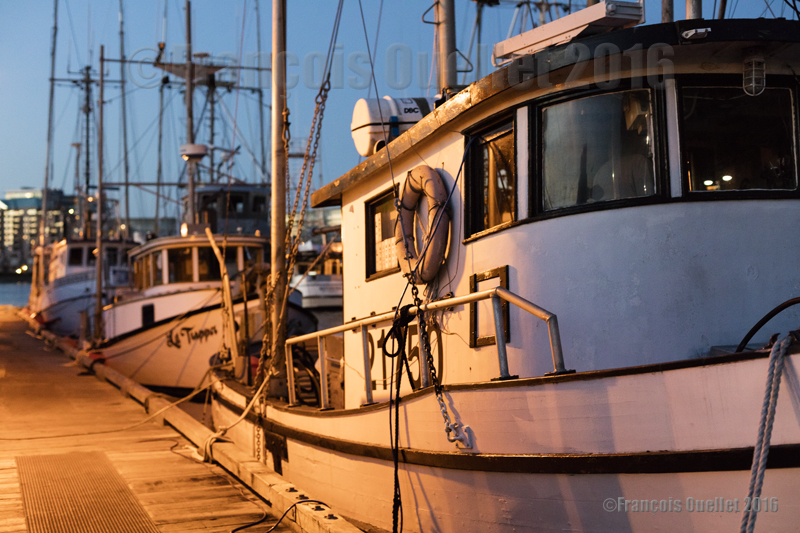
In the evening, the fishing boats come back to the Victoria Fisherman’s Wharf. Since I was standing on a moving platform, the use of a tripod would have been useless because of vibrations impossible to eliminate. The solution was to use a lens requiring little light, like the Canon EF 50mm 1.4 USM. By increasing the aperture and the ISO, the picture could be taken with a high enough shutter speed to avoid a blurred photo.
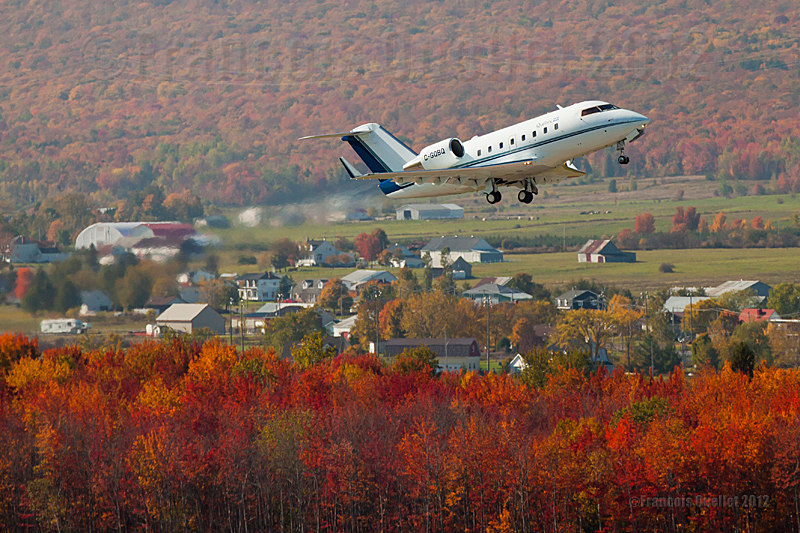
Government of Quebec Challenger CL-600 C-GQBQ airborne from the Québec Jean-Lesage international airport
I return in the past with this photo of the Governement of Quebec Challenger 600 C-GQBQ. It is seen here after the take-off from the Quebec Jean-Lesage international airport. The picture was taken during fall 2012 with a Canon 5D MKII full frame camera, from the stairway surrounding the Quebec control tower.
With regards to photographic composition, the rule of thirds can be detected in the two wooden zones in the background, one at the top and the other at the bottom of the photo. The aircraft’s position in the frame happens to also meet the same rule of thirds.
I used the spectacular colors of fall to add some interest to the scene.
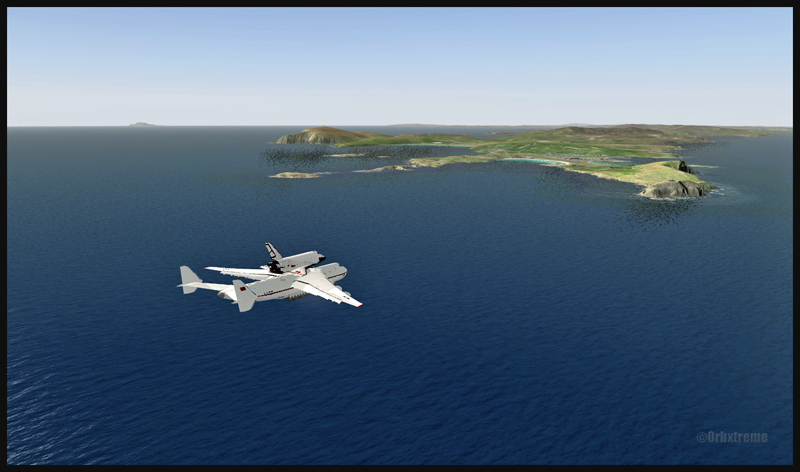
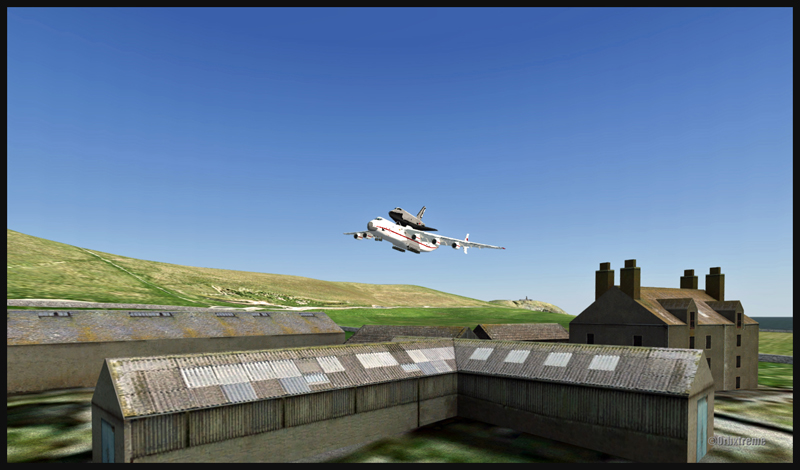
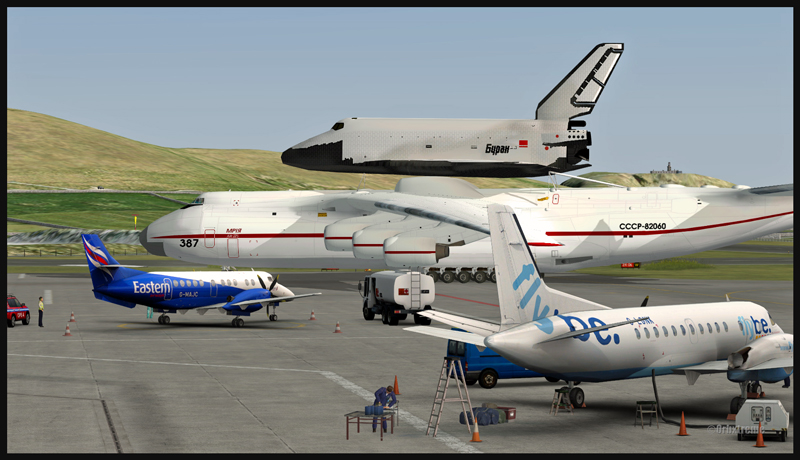
Antonov 225 with the Russian shuttle Bourane inbound for Sumburgh, Scotland (FSX)
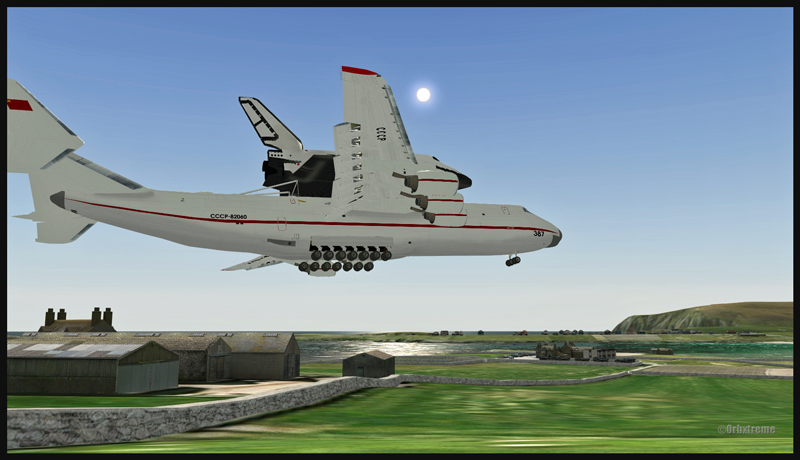
Antonov 225 with the Bourane shuttle on final approach to Sumburgh, Scotland (FSX)
I know, Sumburgh is not an airport meant to receive the Antonov 225, even less with the Russian space shuttle Buran as cargo. In fact, this aircraft and Sumburgh exclude each other mutually. But if you want to try an almost impossible virtual flight , now is the opportunity.
Antonov 225 with the Bourane shuttle on short final approach to Sumburgh, Scotland (FSX)
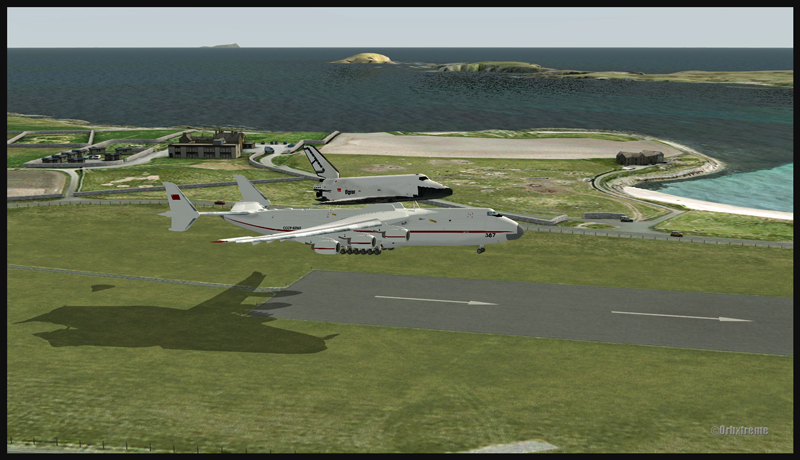
You must forget about the weight of the aircraft on the runway, the limited space to taxy and park, and the required distance for an eventual take-off. It is probable that once in Sumburgh, this aircraft will stay there forever.
Antonov 225 with the Russian shuttle Bourane over the runway in Sumburgh, Scotland (FSX)
It is interesting, though, to remember the exceptional performances of the Antonov 225. While flying over the Bourget for a demonstration, it was able to maintain a 45 degree turn with the 62 tons Russian shuttle mounted on top.
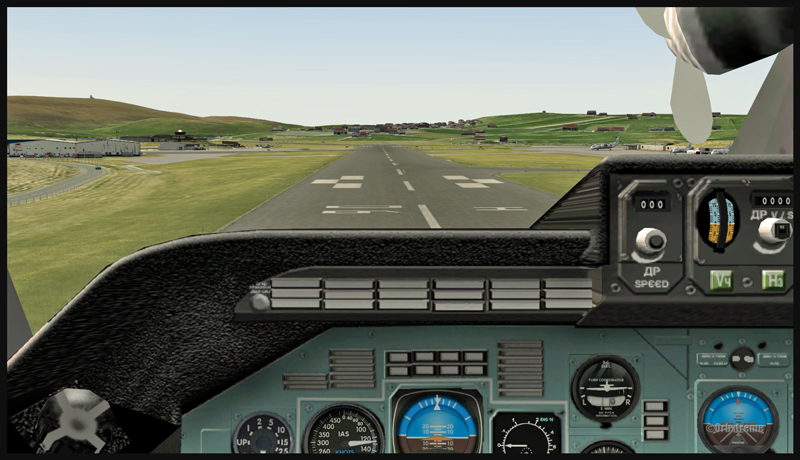
Speed 126 kts on the Sumburgh runway, Scotland, with the Antonov 225 and the Russian shuttle Bourane (FSX)
Antonov 225 taxiing in Sumburgh, Scotland (FSX)
The approach can be made at a surprisingly slow speed for an aircraft of that weight and the breaking performance is known to be excellent. In Sumburgh, you have the choice between two runways (4700 to 4900 feet). Forget about a safe final approach, you must fly it like a daredevil. It is possible to download the Antonov 225 and the shuttle for free. As for the Sumburgh airport, it is a creation of ORBX and is available for a very reasonable fee.
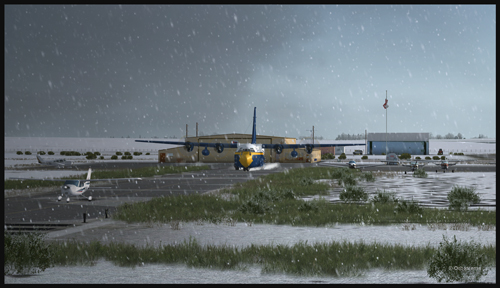
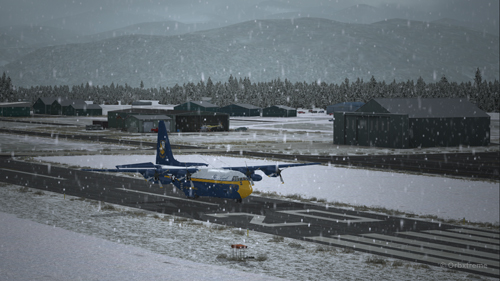
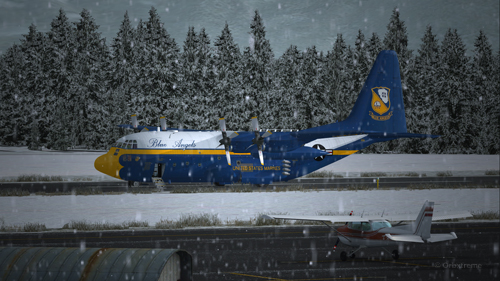
A virtual C-130 belonging to the Blue Angels is taxiing at the High River airport, in Alberta.
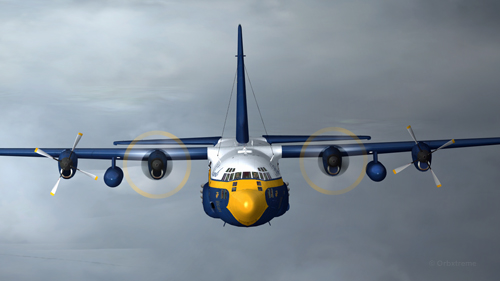
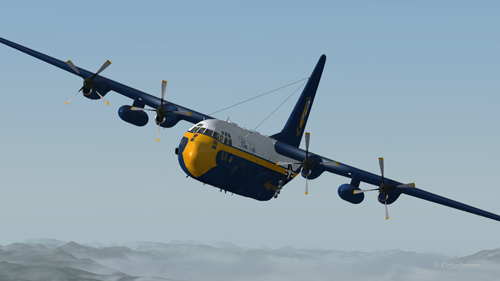
Wanting to add an almost impossible flight in the “unhinged virtual flights” section of my web site, I tried a flight with the Blue Angels C-130 Hercules (Captain Sim) where the aircraft gradually lost all of its engines.
The Blue Angels C-130 Hercules waiting in line behind a single engine aircraft at the High River airport.
I am aware that the Blue Angels mechanics are real professionals, so I assumed that the engine failures were caused by an unknown reason.
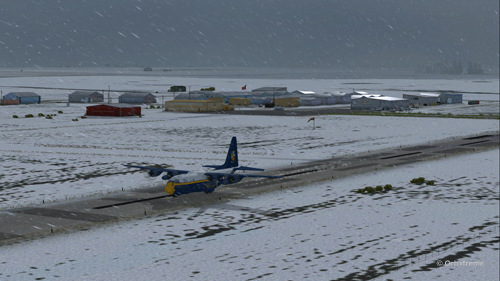
A virtual Blue Angels Lockheed C-130 Hercules takes-off from the High River (CEN4) Canadian airport in Alberta.
The take-off was made without problem from the Canadian High River (CEN4) airport. This free airport was designed by Vlad Maly and is available through ORBX. The aircraft leaves the 4150 feet runway heading to the Coeur d’Alène airport (KCOE) in United States.
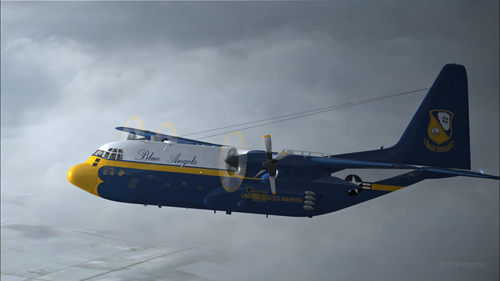
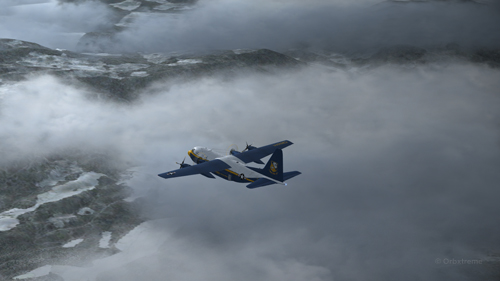
Eventually, the first engine stops. This does not cause a problem. The propeller is feathered and the gradual climbing continues.
The C-130 Hercules loses its first engine.
The second engine stops. The pilot must forget the initial destination. Bonners Ferry (65S) becomes the alternate airport since the 4000×75 feet runway is good enough for the C-130.
The second engine has just stopped on this C-130 Hercules.
Double engine failure for this virtual Blue Angles C-130 Hercules.
The third engines gives way. A slow descent starts. Bonners Ferry is not very far. The airport is at an altitude of 2337 ft asl.
The aircraft is volontarily flown at a higher altitude than what would normally be requested for a normal approach, just in case the fourth engine stops. When three engines stop after the same refueling, the pilot has the right to think that what feeds the fourth engine can also cause problems.
Three engine failures on this virtual Blue Angels C-130 Hercules.
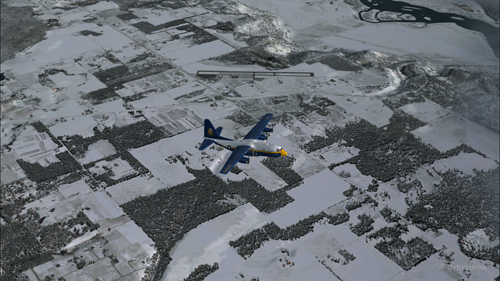
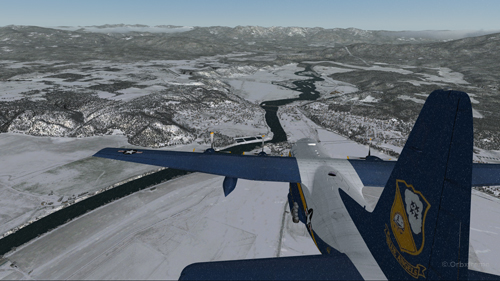
The highest mountains are now behind the aircraft.
Virtual C-130 Hercules aircraft with three engine failures enroute to the Bonners Ferry airport.
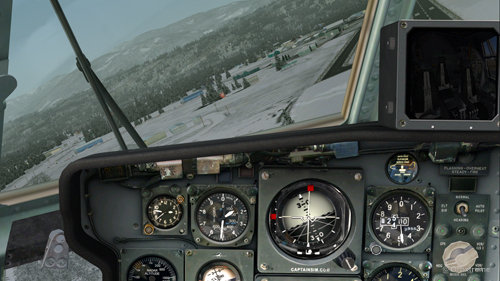
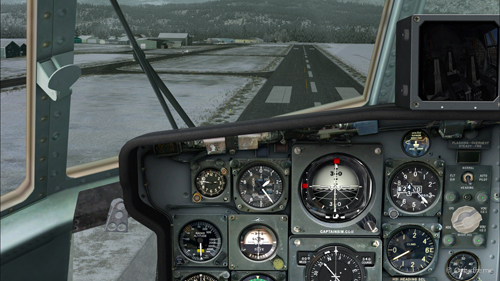
The Bonners Ferry (65S) runway is in sight.
Virtual C-130 Hercules aircraft with three engine failures, by the Bonners Ferry’s runway.
The fourth engine stops. The flaps will not be functional for the landing.
From now on, the pilot should save the virtual flight a few times since it is possible that several trials will be necessary to glide sucessfully to the airport. This is the fun of virtual flight.
The four engines have now failed on that virtual C-130 aircraft.
The C-130 Hercules has become a big glider. When the speed is maintained, the aircraft loses more 1000 feet per minute. It is easier to feel the aircraft’s inertia.
The wheels will be brought out only when necessary since the gear adds a lot of drag.
From the position indicated in the picture below, it is impossible to arrive to the airport in a straight line: the aircraft will glide over the airport. In the picture, the aircraft seems to be on a good path for landing, but it is an illusion caused by the wide-angle format chosen for the screen capture.
The aircraft is definitely too high. It is impossible to use the flaps to increase the rate of descent.
Lockheed C-130 Hercules virtual aircraft with four engine failures on the approach to the Bonners Ferry’s virtual airport (65S).
One must choose between 1) sideslips 2) a 360 degree turn to lose altitude or 3) multiple steep turns perpendicular to the runway to increase to distance to the airport.
What would you choose?
There is no universal method. The 360 degree turn is riskier but can prove efficient. An Airbus A330-200 flown by Quebecer Robert Piché that had lost all of its engines landed successfully in the Açores in 2001 after attempting a last minute 360 degree turn to lose altitude. But here, I did not believe there was enough altitude to safely complete the turn and reach the runway.
A few steep turns were made to extend to ride to the airport. Why steep turns? In order to avoid getting closer to the airport before an acceptable altitude was reached. This method helped keep an eye on the runway at all times to verify if the slope to the airport was still acceptable.
Fourty degree turn to the right on the approach to the Bonners Ferry’s airport.
Steep turn to the left to extend the distance to the Bonners Ferry airport.
I tried the three methods, always starting from the same saved flight (photo 10). After several sideslips, the aircraft was always approaching the airport too quickly. There was not enough time to lose altitude. The final speed always happened to be too high to stop a C-130 without flaps or thrust reversers.
The 360 degree turn, be it right or left, with different angles and a reasonable speed, always incurred a loss of altitude that brought the aircraft 200 to 300 feet short of the threshold.
Finally, after a few steep turns, the aircraft was positioned on final with the appropriate speed and altitude.
View of the Lockheed C-130 Hercules with four engine failures, on the approach for Bonners Ferry (65S).
A few last seconds adjustments, to reposition the aircraft in the center of the runway.
Speed 150 knots. End of the turn for the Bonners Ferry’s airport.
At 140 kts, but without any reverse thrust, the whole runway should be necessary to stop the aircraft.
Speed 140 knots, aligned with the Bonners Ferry’s runway.
The landing was smooth and the aircraft stopped short of the threshold.
For an unknown reason, the anemometer was still indicating a 10 kts airspeed, even when the aircraft had stopped.
C-130 cargo aircraft on the Bonners Ferry’s runway.
Lockheed C-130 Hercules virtual aircraft after landing at the Bonners Ferry (65S) airport.
C-130 Hercules aircraft in Bonners Ferry.
Try such a flight in the virtual mode. The worst that can happen is that you have fun!
The virtual flight below was made with the FSX flight simulation platform. The last time I flew at Limberlost Ranch, I used a Cessna C-207 ( The Cessna C-207 in Limberlost Ranch ).
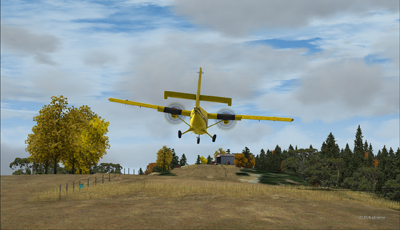
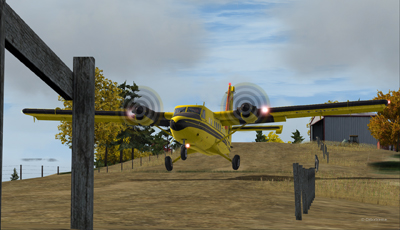
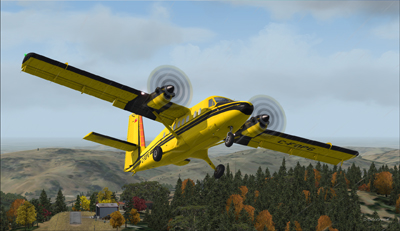
This time, I tried the sloped and laterally uneven runway with a Twin Otter. This one is painted with the real colours of the Province of Ontario Ministry of natural resources (C-FOPG). The only problem I expected was regarding the larger wings of the Twin Otter once close to the hangar.
On final for the Limberlost Ranch runway
Twin Otter C-FOPG approaching the Limberlost Ranch short runway
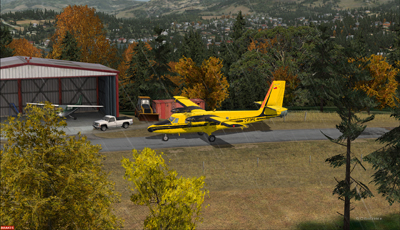
Finally, everything went well. The only difficulty was to manoeuver near the hangar to reposition the aircraft for take-off. With several ajustments to the propeller’s pitch, I was eventually able to turn around.
Arrival at Limberlost Ranch of the Twin Otter C-FOPG
Virtual aircraft belonging to the Ontario provincial government turning around on the Limberlost Ranch runway.
Since the fence is low enough, it is not a problem for the aircraft’s wings.
Virtual aircraft C-FOPG rolling on the Limberlost Ranch (CA21) runway.
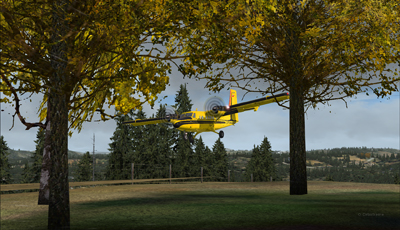
Near the grass runway’s threshold are a few tall trees that require, for safety measures, a slight banking. Just in case…
Limberlost Ranch is a fun challenge. It is part of a package called Blue-Canyon Nyack and sold by Orbx. If this is not challenging enough for the flight simulation buff, it is always possible to add strong direct crosswinds and that should do it!
Digitally modified photo of Place d’Youville in Old Quebec
This digitally modified photo shows a part of Place d’Youville, in Old Quebec.
I wanted to capture the church in the background, which seemed to be squeezed between two bigger buildings. It became the principal subject of the photo and it was positioned according to the rule of thirds. This rule is far from mandatory in photography but it often provides interesting results.
I liked the repetitive effect of the windows on each side of the picture and the fact that there were diagonal lines that lead the eye to the church. The vegetation in the foreground added a nice touch to the scenery. There was only one thing missing: a human presence.
With a little patience, three girls stopped on the sidewalk and started to talk, exactly where I wanted them to be. The wet sidewalk on which they stood helped to reflect the ambiant light and also lead the eye to the church, the principal subject in the photo.
I rarely digitally transform a photo in such a drastic way. The reason was simple: normally, when the ambiant light is not favorable, you can sometimes use the black and white setting. However, the light on that day did not offer the required contrasts to get sufficiently interesting results.
I did not want to leave Place d’Youville without having captured the energy I felt there. I opted for a radical option after having cropped the image in order to keep only the essential features.
The picture was taken with a Canon 5DSR full frame camera.
For other photos on the province of Quebec and also Quebec City, click on the following links from my blog:
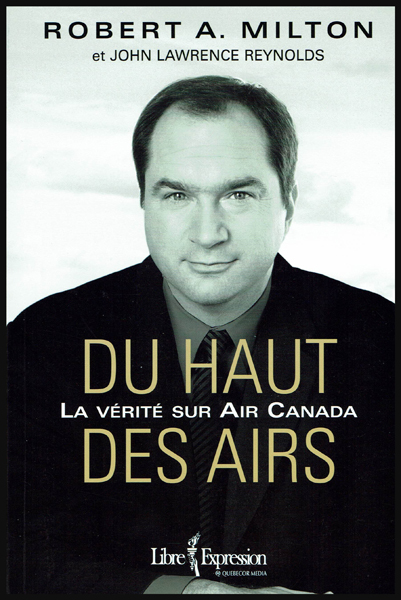
Robert A. Milton managed Air Canada during the most tempestuous period of the history of air transport.
I translated the quotes from the French version of the book.
“It is all right to say to a Crown corporation to operate, starting tomorrow, like a private enterprise, but it’s like saying to a dog to walk on its hind legs from now on. The dog can succeed, but it will need time to adjust to this new idea”.
“Rod Eddington, the British Airways CEO, made everybody laugh when talking about the resistance to change of middle managers. He said: “As it is said for staff reductions, turkeys have never voted in favor of Christmas”.
“The most efficient system in the world can only work properly if the people who apply it want it to work”.
“No air transport society has ever succeeded in reducing its activities, except in the context of a restructuration under judiciary supervision”.
“One day, as I was walking through the department of technical operations, I looked around and noticed that some people were working in a cubicle fitted out along an outside wall. There were many windows in the wall, but they were all covered with brown paper. I was curious to know why. Was the outside view so terrible that nobody wanted to look through the windows? Or was it so beautiful that it could distract the employees? I checked and the view had nothing really special. It was not more beautiful nor uglier than the other views from the building.
When I asked for explanations, I was told that the employees working along that wall belonged to a group where the salary level did not allow access to a window. But, for different reasons, it had been necessary to position them near a wall with windows. A bureaucrat of the organization had been afraid, I suppose, that making an exception to the rule would lead to anarchy, and he ordered that the windows be covered to correct this unacceptable situation. Useless to say that the brown paper disappeared a few minutes after I received the explanation”.
“Quite often, people who progress slowly in their career without having to take decisions inevitably end up by having to take one. At that moment, they freeze like a deer being blinded by a car headlights, and they get knocked out”.
“If someone puts one finger in my eye, I react by putting two fingers in both of his eyes”
“The VISA Aerogold card is nothing else than a money making machine for the CIBC. It represents 20 to 25 % of the market capitalization of the bank”.
“It is necessary to respect the rules of the game, but to play in all seriousness by using all the tools that are available to you”
Here, Robert Milton quotes a former Minister of Transport of Canada: “He raised the governance problems and the airports inability to control costs, to show interest in customers and to build only the needed infrastructure, instead of the luxurious installations that are now appearing all across the country”.
“In the future, I see Air Canada recognized as one of the six best airline companies of the world, with connections in all regions of the globe and with an interior service representing a smaller, but all the same important part of its total income”.
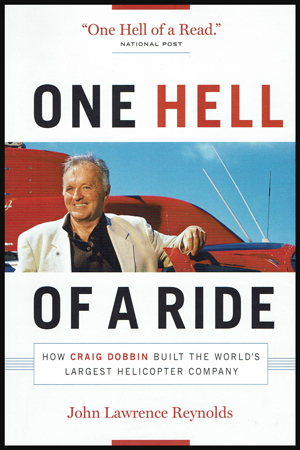
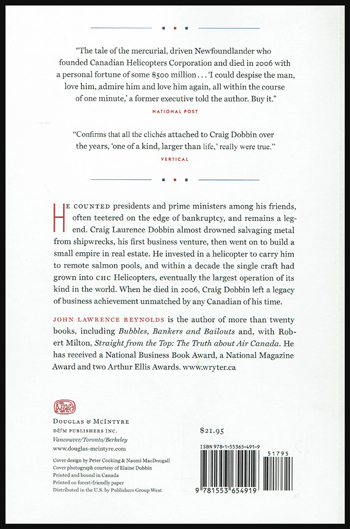
The Canadian Craig Dobbin built the world’s largest helicopter company
“One hell of a ride” book cover about Craig Dobbin and the world’s largest helicopter company: CHC Helicopters
His view on management
“I’m not an expert on anything” he explained. “Whatever the job, whatever the challenge, somebody can do it better than I can. True entrepreneurs surround themselves with professional managers who share their vision and put form around it. Not only can you not do it all yourself, it’s not necessary, and it does not make sense. I believe in being a good casting director of people who work together and share together”.
Handling pressure
“It’s been a good week” Craig Dobbin might comment to his personal secretary late on a Friday afternoon. Then his face would cloud over and he’d say, “Get Keith Stanford on the phone and ask him for my financial summary. That’ll fuck up my weekend”.
A capacity to take huge financial risks
“The hell with the contract”, he grinned. “Let’s buy the buggers out and we’ll get the contract that way! We’ll start with Toronto [Helicopters].”
“One morning, shortly after the deal to purchase Toronto Helicopters was completed, Craig Dobbin strolled into Robert Foster’s Toronto office. “Robert” he said “I want you to get on a plane, fly to Calgary and buy Okanagan Helicopters for me.” “But Craig,” Foster replied, “you don’t have any money.” Dobbin shrugged and said “That’s your problem.””
On the importance of relaxing and have fun
“Over time, Dobbin introduced initiation rites for first-time visitors [to his fishing lodge]. Steve Hudson’s [a pilot] initial visit to Adlatuk involved a helicopter flight over the ocean in search of an iceberg drifting down from the Arctic. When a suitable iceberg was located, the initiate was given his instructions. “They handed me a hammer and an ice bucket,” Hudson explains. “My job was to jump out of the helicopter onto the iceberg and fill the bucket with chipped ice for our drinks back at the fishing lodge”.
Icebergs, Hudson discovered, are very unstable and riding one in the North Atlantic with a Super Puma hovering a few feet over your head is like trying to keep your balance while walking across a trampoline. “It was a lot of fun for the guys in the helicopter,” he says, “but not so much fun for me, trying to knock enough million-year-old ice of the berg to fill the bucket.” Back in the camp, the ice chilled several glasses of Jameson raised in a toast to the new crew member.””
“One hell of a ride”, from John Lawrence Reynolds
A genuine interest in people
“When he talked with you in social situations,” one business acquaintance recalls, “he was focused totally on you. He wasn’t looking over your shoulder or around the room, searching for someone more important. He was really interested in what you were saying. Everyone sensed this about the man and was drawn to him”.
Dobbin’s humanity
“Dobbin’s business acumen rarely overrode his humanity. On a flight to his fishing lodge in Long Harbour with a group of friends, Dobbin asked the helicopter pilot to set the craft down for a washroom break. The pilot chose an open area adjacent to a shack and tower where a provincial wildlife officer was spending the summer on fire-watch duty. The officer, a grizzled veteran of wildlife work, kept the group laughing for some time with his stories and anecdotes, and the short rest break extended into an hour’s impromptu entertainment.
“How long have you been here?” Dobbin asked the old timer as the group was about to board the helicopter and resume their journey. “Ten weeks,” the officer answered, with about another ten weeks to go before returning home. “Anything you need?” Dobbin inquired, and the man said he was out of sugar; it would be nice to have something to sweeten his tea, but he would get by.
An hour later, when everyone had disembarked at Long Harbour, Dobbin instructed the helicopter pilot not to shut down the aircraft yet. He entered the cookhouse and emerged with a two-kilo bag of sugar, ordering the pilot to fly it back to the wildlife officer they had met.
“Are you kidding?” the young pilot said. “I’ll spend about two thousand bucks in fuel alone to fly it there.”
Dobbin gripped the pilot’s arm. “Son,” he said, “that sugar will mean more to that old fellow than two thousand bucks will ever mean to me. Now get going.””