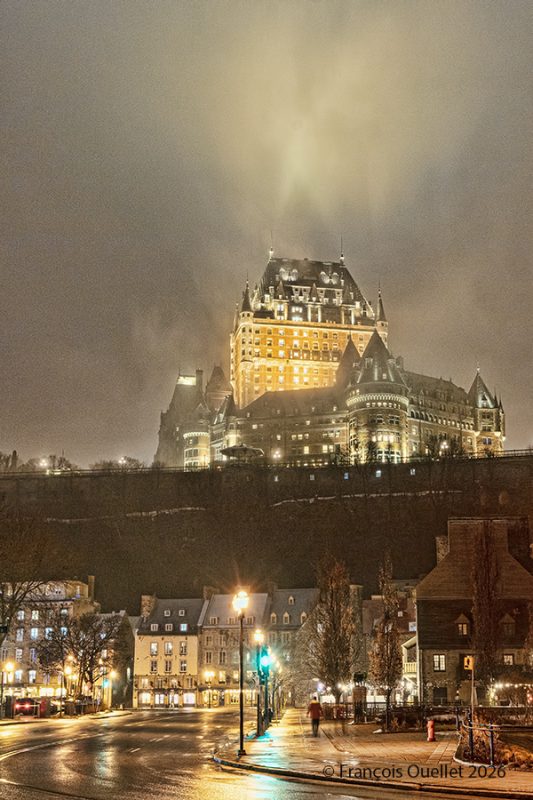
Château Frontenac during Christmas time in Quebec City
The photo above shows a section of the German Christmas market in Quebec City in front of the Château Frontenac. As usual, there was a large crowd that day in Old Quebec but I waited for the pedestrians to disperse a little before taking the picture. The blue hour is approaching…
Below, the huge Christmas tree installed at Place Royale occupies the foreground of this photo of Notre-Dame-des-Victoires Church in Old Quebec. This year, anonymous donors have made it possible for the interior of the church to be festively illuminated for the 2025 holiday season.
The Notre-Dame-des-Victoires church in Old Quebec during Christmas time in 2025.
Click on the link for more photos of Quebec City on my blog.
While visiting Old Quebec, I took the opportunity to practice my night photography. The photo above shows some Christmas decorations at the intersection of Saint-Paul Street and Saint-Pierre Street. This is HDR photography, as I stacked five photos of 50.6 megapixels each.
Christmas decorations on rue Saint-Pierre in Old Quebec
For the photo above, I am a little cramped in the old Rue Saint-Pierre. It was only with the help of a Canon EF 11-24 mm F/4L USM super wide-angle lens mounted on a tripod that I was able to take this shot. There is only one shot, because the HDR effect would not produce anything interesting, accumulating the lights on the illuminated sign to such an extent that everything would become diffuse.
The format is not standard, but that only matters to photographers who are unable to break free from the theoretical rules of photography.
On a beautiful day in December 2025, I spent a few hours in Old Quebec and its surroundings to take some pictures on the eve of the holidays.
Two pedestrians in Old Quebec during winter 2025.
At this time of year, the German market in Quebec City attracts residents from neighboring towns and tourists alike. Today, it’s -10°C and very windy, but people are still out and about.
Since photography requires the use of a tripod and often involves standing still, the priority is to dress as warmly as possible.
A stand in the Quebec German market in Old Quebec 2025
I challenged myself to work only with a 300mm telephoto lens for part of the evening, in order to isolate scenes that my eye would not automatically see. This method sometimes leads to beautiful visual discoveries, such as the close-up of the kiosk above.
The Christmas German market of Quebec City and the Glühwein Bar 2025
In contrast to the previous photo, the above result cannot be achieved without the help of a wide-angle lens. A cell phone solved the problem of low light and captured this winter scene from the German market. It even allowed the “Glühwein Bar” to be included in the shot.
This year, the Alsace pavilion at the German market is still offering hot food and drinks, but like many businesses, it is ignoring official inflation and significantly exceeding it. Be sure to read the menu and associated costs carefully before ordering, or you may be in for a big surprise.
The Grande-Allée and some Christmas decorations in Quebec City 2025.
A final nighttime photograph shows a small section of Grande-Allée with some Christmas decorations, with the Le Concorde hotel highlighted in blue in the background. This part of Quebec City has received a lot of attention from retailers.
I will explore the city again in a few days to bring back more memories of this Christmas atmosphere before it’s too late.
The graphic novel “Tsar Bomba” recounts, through the testimony of Andrei Sakharov, the competition between the major powers to create the most devastating atomic weapon.
The author Fabien Grolleau states that he does not wish to use his book for propaganda purposes, and I must say that I quite agree. Although the book focuses mainly on the USSR’s nuclear tests, it also provides information about France and the United States. When recounting the various stories that unfolded throughout the development of “Tsar Bomba,” it is essential to at least provide the reader with the context of the USSR at the time. We are dealing with a totalitarian regime that eliminates its own citizens, even if they have done nothing wrong. I saw the results of Stalin’s purges in the book “Les alpinistes de Staline.”
The graphic novel Tsar Bomba (in French)
Soviet scientists worked in what was known as “the Facility.” They did not know exactly where it was located, due to military secrecy. They did also ignore for how long they would work in these nuclear research laboratories. And it is clear that, given the context of the time, no scientist dared to openly criticize the Kremlin. But Sakharov was an exception.
Realizing the significance of his research, Andrei Sakharov began to “denounce Stalin’s crimes, the dangers of thermonuclear war, current and future ecological threats, and above all, the lack of democracy in his country! This was unheard of in the Soviet Union.” He had now become a dissident.
Below is a graph showing the difference in intensity between an atomic bomb created in 1945 and the Tsar Bomba of 1961.
Comparison of the strength of nuclear bombs
The Germany-Japan alliance during World War II upset the balance of power and pushed the United States to invent an unthinkable weapon to end the hostilities. The nuclear age began with the Manhattan Project and Hiroshima. The major powers recognized the devastating effect of atomic weapons and embarked on an arms race to establish a policy of nuclear deterrence. No single country could be allowed to possess the bomb! Humanity now had to come to terms with the idea that the balance of terror-maintained peace.
The author highlights the impact of radiation on residents living in areas surrounding nuclear test sites. Whether due to shifting winds, stronger-than-expected nuclear reactions, or a lack of transparency towards villagers, many citizens die as a result of these supposedly “controlled” tests. National security and territorial sovereignty take precedence over all other considerations.
On a Personal Note
A new race is now consuming all the energy of researchers working for the major powers: artificial intelligence. We hear about the ethical use of these technological advances, but this is more smoke and mirrors than anything else.
All that matters now for a major power is to ensure that it is ahead of the others. An article from the January/February edition of Foreign Affairs magazine mentioned that the country that has a real lead over its competitors in artificial intelligence will control the world. In this context, I do not believe that a major power will agree to limit itself and slow down its research because of an ethical issue.
In conclusion, here is a quote from Albert Einstein that appears in the graphic novel: “I don’t know how World War III will be fought, but I know how World War IV will be fought: with sticks and stones.”
Leaving Tadoussac, the road continues along the Côte-Nord (North Shore) and we pass through Forestville to reach Baie-Comeau and take the ferry to Matane, on the south shore of the St. Lawrence River.
We arrive in Matane at dusk, just in time to set up the camera equipment on the beach. There’s no way I can take the photo above from the ferry, because a long exposure requires absolute stillness. I want to capture this beautiful September moon rising above the houses.
I miss a few shots by relying on autofocus. I quickly change my photography technique. Liveview (Live View) mode and manual focus will improve the sharpness.
Fishing boat at dusk in Matane, Quebec 2025
The next day, a boat leaves Matane just before nightfall for a fishing expedition off the St. Lawrence River. The relative calm of the waters offers interesting reflections. The low light and distance of the boat require the use of a high-quality lens, in this case the Canon EF 300mm f/2.8L IS II USM.
On the way back from Matane to Quebec City, a stop at Bic National Park allows us to take a few photos, including this fishing boat returning to port. The sailors’ departure time varies constantly depending on the river tides.
Fishing boat in the Parc national du Bic, Québec 2025
Another location well known for its beauty is the municipality of Sainte-Luce-sur-Mer. Below, the colorful houses along the beach attract the attention of tourists and contribute to the area’s reputation. I preferred to capture an overall effect by including vegetation in the foreground. The few small low cumulus clouds also add to the dynamic of the scene.
The village of Sainte-Luce-sur-Mer and its colorful houses.
One last photo shows the sunset in Berthier-sur-Mer. This area, along with the Kamouraska and Notre-Dame-du-Portage regions, regularly offers exceptional panoramas when the sun sets. So much so that some photos can look like they’ve been retouched.
I saw reds and purples so pronounced that it became obvious that the photographer would have been accused of oversaturating his shots.
Sunset at Berthier-sur-Mer en 2024.
After an excellent meal at the beach restaurant in Berthier-sur-Mer, we finally reach our final destination, the beautiful city of Quebec City.
Ferry Baie Sainte-Catherine Tadoussac in the province of Québec, 2025
The ideal time to visit Tadoussac, the fjord, and the surrounding area is in May and June until Saint-Jean-Baptiste Day, then immediately after Labor Day.
If travellers decide to go there during the summer anyway, they will see tourists everywhere.
View from Hotel Tadoussac in the province of Québec, 2025
If you can, book one or two nights at the Tadoussac Hotel, preferably with a room overlooking the river. In the morning, the space will be much brighter than a room facing the backyard. The hotel has undergone extensive renovations, which will continue discreetly in 2025.
The hotel is close to everything, and you can explore many local attractions without having to use your car. The docks are also a ten-minute walk away when it’s time to take a whale-watching cruise.
Beluga whale sculpture in front of the interpretation center in Tadoussac, Quebec 2025
Numerous chairs on the grounds in front of the hotel Tadoussac allow guests to enjoy magnificent views of the surrounding landscape and the St. Lawrence River. The hotel restaurant is decent and features a beautiful glass roof. However, don’t expect the same level of culinary experience as Chez Truchon in La Malbaie.
As for the tourist attraction of booking a cruise on the St. Lawrence River to watch humpback whales and beluga whales on the AML Grand Fleuve, I would advise you to pay the extra fee that gives you exclusive access to the upper deck of the boat. You will be much more comfortable there and able to take pictures of the marine mammals than if you find yourself crammed in with dozens of other curious people on the main deck.
Fin whale in the St. Lawrence river near Tadoussac, Québec 2025
However, I don’t think it’s worth paying extra to sit in the VIP lounge and have a glass of wine. If alcohol is your priority, skip the cruise and stop at one of the bars along the beach instead. You’ll save a lot of money.
Another tip: a cell phone won’t be very userul for taking pictures. In general, belugas and whales are not close enough to the ships for cell phones to capture them clearly. If you want to bring back a high-quality digital souvenir, bring a decent camera with a telephoto lens that can crop images without too much degradation.
Cloud formations near Tadoussac and the Saguenay River 2025
I can’t stress this enough: even if it’s warm or cool in Tadoussac when you set out on the river, the temperature will drop significantly once you’re out on the open water, sometimes by as much as 10 degrees Celsius. A hat and several layers of clothing will allow you to truly enjoy the experience and stay outside the cabin throughout the trip. Those who are less well-dressed focus on protecting themselves from the cold, stay inside the cabin, and see practically nothing.
KLM MD-11 airborne from Rotterdam The Hague virtual airport in Microsoft Flight Simulation
After Holland, France is stage 22 of the flight simulation tour of the world. The first airport of interest will be Paris-Le Bourget (LFPB), more specifically the Musée de l’Air et de l’Espace du Bourget. Since this is a historical visit, we choose the aircraft accordingly.
So, departing from Rotterdam, passengers board an MD-11 in KLM colors. The last flight of KLM’s MD-11 passenger aircraft in the real world took place in 2014, departing from Montreal to Amsterdam.
Today, several MD-11s are still flying, but only in cargo versions. Airlines are progressively replacing them by more modern aircrafts.
TFDI produced this high-quality virtual aircraft. An updated version has further improved the aircraft. It can be seen below flying at 13,000 feet.
A KLM MD-11 climbs for FL210 towards Paris-Le Bourget (LFPB) with MSFS
Below, the MD-11 reaches flight level FL210. The virtual weather based on METAR reports from Rotterdam and Paris indicates no serious problems for the approach and landing.
Virtual TFDI KLM MD-11 about to reach FL210 enroute to (LFPB) Paris Le Bourget airport
For this flight, the MD-11 is carrying only about 100 passengers. The runway at Le Bourget offers plenty of room for maneuvering when landing such an aircraft. Thirty-five degrees of flaps will therefore be sufficient for the final approach to runway 25.
The approach axis is unusual in that it is offset by 26 degrees from the center of the runway. As Jean-Pierre Otelli so aptly puts it in his book, ” Piloter en sécurité ” : “If the localizer were in line with the runway, the final approaches at Le Bourget would pass 1,000 feet above Terminal 1 at Roissy” […]. Aircraft landing on 25 must make a final 26-degree turn after following the localizer.”
Le Bourget is not the only airport where a serious turn is necessary on final approach. We obviously remember the Hong Kong Checker Board Approach for runway 13 at the former Kai Tak Airport in Hong Kong. At that airport, the final turn was not 26 degrees, but 47 degrees.
Finally, we can also mention Ronald Reagan Airport, where the approach for runway 19 requires a final turn of 36 degrees to avoid the area surrounding the White House.
KLM MD-11 on final for the virtual airport Paris Le Bourget (LFPB) with Microsoft Flight Simulator
The MD-11 taxis down the runway after a smooth landing. After switching off the autopilot for the final approach, an alarm sounds in the cockpit. Even after the plane has touched down, no matter what I do to silence the alarm, nothing works. I still have several hours of study ahead of me to master this aircraft.
Virtual KLM MD-11 taxiing on rwy 27 Paris Le Bourget airport after landing with MSFS
The MD-11 taxis to a makeshift parking area near the museum after crossing the disused runway.
A KLM MD-11 de KLM arrives at the Paris Le Bourget (LFPB) airport with Microsoft Flight Simulator
Le Musée de l’Air et de l’Espace du Bourget (The Air and Space Museum in Le Bourget).
Virtual Musée de l’Air et de l’Espace du Bourget with Microsoft Flight Simulator MSFS
The next stage of our flight around the world with Microsoft Flight Simulator will also take place in France. The current weather conditions will once again dictate the choice of aircraft and destination.
After visiting the La Malbaie region, the Saguenay Fjord, Bagotville, and La Baie, all of which were featured in my previous blog post, we continue our journey to Saint-Gédéon, along the Lac-Saint-Jean, Alma, and then back to La Baie at nightfall.
Lac-Saint-Jean, September 2025
Lac-Saint-Jean has a circumference of 263 kilometers and covers an area of 1,003 square kilometers. When we were there, the wind was blowing moderately, and it’s easy to imagine the swells that boaters must face in the middle of this immense expanse of water. Some sources cite waves up to 4 meters high during extreme weather conditions.
Hay bales near St-Gédéon, Lac Saint-Jean 2025
In September, farmers store hay bales. Around 6 p.m. in the Saint-Gédéon region near Lac-Saint-Jean, the sun hits the field from the side, beautifully illuminating the hay still outside. An excellent opportunity for landscape photography.
Just before nightfall and our departure for Alma, we take a few shots of the wind turbines near the lake. The photographic composition requires a vertical frame.
Wind turbines at dusk in Lac-Saint-Jean, Quebec 2025
In Alma, we take the opportunity to eat at the restaurant owned by Mario Tremblay, a star hockey player for the Montreal Canadiens who is now retired. It was well worth the stop! I took a photo of the restaurant entrance where you can see the hockey player in action!
Entrance to Mario Tremblay’s restaurant in Alma
The journey continues in the next article, where we stop in Tadoussac for a whale watching cruise.
Sailboat anchored in the Saguenay Fjord in the province of Québec
Heading up the west coast of Saguenay from Saint-Siméon, you pass through Sagard (home to the Desmarais family’s huge estate and castle) and L’Anse-Saint-Jean. In L’Anse-Saint-Jean, you can book a shuttle for a few hours’ round trip on the Saguenay. This allows you to see Cap Trinité and stop off at Sainte-Rose-du-Nord.
I took the picture above from Baie Éternité. The cliffs rise up to 400 metres. A sailboat has chosen to anchor there for a while.
The Saguenay River at low tide near La Baie, Québec 2025
Just before La Baie, you can walk on the beach at low tide. There are several interesting opportunities for landscape photography, including a lighthouse, mountains, the town at night, and even cruise ships sailing up the Saguenay River in the fall.
Downtown in La Baie, province of Québec 2025
To achieve the above effect in La Baie, I had to remove a few poles and advertisements using digital processing software. The pseudo-HDR method enhances the impact of the clouds by defining them more clearly.
Seals resting on rocks in the Saguenay fjord, Québec 2025
This last photo shows seals resting on the rocks along the Saguenay Fjord. The captain of the ferry was able to approach the cliffs safely because of the great depth of the fjord at this point.
The Quebec comic book “Les derniers corsaires” tells what appears to be true stories, although it is difficult for me to verify every detail in the book. There may also be some inventions on the part of the authors.
The events are said to have taken place during World War II aboard various British submarines, including the Thorn. Their officers learn on the job and sometimes narrowly avoid making critical mistakes.
For example, Lieutenant Woolf of the Royal Navy wants to quickly defeat the Germans, despite his relative inexperience and flawed strategies. His desire to rack up trophies and earn the rank of captain puts the submarine in danger. In a naval battle, haste is a poor advisor.
This officer redeems himself in a big way as he learns to use all the tools at his disposal to improve his risk management and make brilliant and courageous decisions. Sailors who were previously hesitant to follow him now support him to the death if necessary.
The story is surprising in its intensity and the amount of information it contains. It gives a better understanding of some of the qualities and knowledge required to gain an advantage over an opponent while avoiding costly mistakes. The comic book is a page-turner. You want to know everything, even though that’s obviously not possible.
The content of the correspondence between Captain Woolf and his brother provides a powerful conclusion to this comic book. While researching the content of the comic book, the authors discovered a website (www.walterwoolf.letters.org) which was blocked three days later. The correspondence downloaded during this short period of time reveals interesting information.
Thus, as the war was about to end in favour of the Allies, the SS based in the North Atlantic intended to launch a bacteriological war. They transported Hagen’s bacillus (possibly Hansen’s bacillus) to France by sea on the sailing ship Göteborg.
Although the mission failed and the bacillus did not reach its destination, its discovery on the sailboat raises several questions that have yet to be answered. The crew set off for a desolate spot in Greenland to await nature’s verdict. Were those who discovered the bacillus infected? Where did the entire crew disappear?
The authors write: “In 2001, Denmark declared part of Greenland’s west coast and hinterland a military exclusion zone, which remained in place until 2009. It can be assumed that intensive research is being carried out there.”
This is a well-crafted comic book that will leave no one indifferent.