Cover of the book: “L’heure des prédateurs” from Giuliano Da Empoli
In his book “L’heure des prédateurs (The Hour of the Predator ),” Giuliano Da Empoli writes, “Three months before the invasion of Ukraine, Surkov, who had been dismissed by Putin some time before, published an article in which everything was already said. Every society, he wrote, is subject to the physical law of entropy. No matter how stable it may be, in the absence of external intervention, it eventually produces chaos within. Up to a certain point, it is possible to manage this, but the only way to solve the problem definitively is to export it. According to Surkov, the great empires of history regenerate themselves by shifting the chaos they produce beyond their borders. This was the case with the Romans in ancient times, and, according to the author, with the Americans in the 20th century. It is also the case with Russia, “for which constant expansion is not just an idea, but the very raison d’être of our history.”
And when exporting turmoil fails to reestablish stability to the country, the country’s leader is sent into retirement, one way or another. The writer adds: “When chaos exceeds a certain stage, the only way to restore order is to identify a scapegoat. And the leader, whoever he may be, is always a scapegoat waiting in the wings. Tolstoy compares him to ‘a ram fattened for the slaughterhouse”.” (Deepl translation)
Click on the link for more articles on geopolitics in my blog.
Book “Apprivoiser son ombre” by Jean Monbourquette
“The more a nation isolates itself, the blinder it becomes to its own faults and shortcomings, and the more it will tend to project its fears, repugnance, and atavisms onto neighbouring nations. Only through regular contact with other peoples can a nation recognize its own shortcomings and flaws. Until people learn to know and appreciate foreign customs, they will harbour prejudices created by their own national shadow. Jokes about neighbouring peoples and racist nicknames are clear signs of projections of the national shadow.
In times of war, the collective shadow cast on “the enemy” is maintained and exacerbated by the media. Everything that is considered detestable and reprehensible at home is relentlessly sought out in the adversary. During the Second World War, the German people had every imaginable flaw. During the Cold War that followed, it was the Russians’ turn to be judged harshly. Black people have long been the target of projection by white people. Jews have similarly been the preferred victims of the collective shadow of several other peoples. Minorities, foreigners, and great minds always disturb others with their differences and originality. They are exposed to becoming scapegoats, bearers of all the malicious tendencies of the national shadow.
Are nations therefore condemned, as such, to constantly create enemies or scapegoats and to burden them with their collective shadow? Is it permissible to dream that one day all nations will look at each other in all truthfulness and that each will tame its shadow instead of projecting it onto another nation in an attempt to destroy it?
Cover of the book: “L’heure des prédateurs” from Giuliano Da Empoli
The following excerpt is taken from Giuliano Da Empoli‘s book “L’heure des prédateurs”.
“Today, an aircraft carrier that cost the US government ten billion dollars can be sunk by two or three Chinese hypersonic missiles costing fifteen million. Conversely, to shoot down a $200 drone launched from southern Lebanon, Israel must use a Patriot missile worth $3 million each time. Not to mention a cyberattack capable of paralyzing an entire nation, the cost of which is virtually zero.
These days, attack costs less than defense. Much less. And the price continues to fall. In the future, some claim that a single individual will be able to declare war on the entire world and win. When you consider that a DNA synthesizer capable of creating new deadly pathogens costs around $20,000, or the price of a used car, this prospect does not seem so far-fetched.
According to the company that produces it, the latest ChatGPT model launched in fall 2024 has led to a significant increase in the risk of artificial intelligence being misused to create chemical, biological, radiological, and nuclear weapons. This risk is now classified at the highest level on the company’s scale, but that did not prevent OpenAI from putting the product on the market, without any regulatory authority finding fault with it.
Click on the link for more articles on geopolitics on my blog.
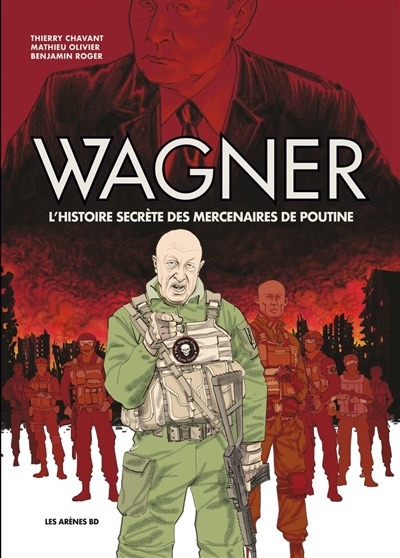
The graphic novel “Wagner”, l’histoire secrète des mercenaires de Poutine.
“Wagner” is a top-quality graphic novel, the fruit of serious research based on numerous known and confidential sources.
Thanks to the large concentration of relevant data in a single volume, readers will quickly gain a better understanding of the international role played by this mercenary group supported by Vladimir Putin, which has gradually established itself in Mali, the Central African Republic, Libya and Syria, before attacking the Ukrainians.
The book includes the names of numerous companies, corporations and foundations (Concord, IRA [Internet Research Agency], SEWA Security Services, Lobaye Invest, M-Finance, M-Invest, Meroe Gold, Midas Resources, First Industrial Company, International Global Logistic [IGL], Alpha Development, Marko Mining, Prime Security, etc.) and a host of players who played a major role in sharing control of natural resources (mines, forests, etc.) in the Central African Republic and Mali.
The book shows how the short-sightedness of certain politicians and intelligence services enabled Wagner to gain a foothold in Africa without too much difficulty. It sheds light on the hasty departure of the French in Mali and the Chinese south of Bamako.
African leaders and customs officials turn a blind eye to the transfer of gold and diamonds to Russia. But I don’t have to dig very far in my memory to point out that many great powers have enjoyed similar treatment in other places on our beautiful planet.
Scriptwriter and illustrator Thierry Chavant is careful not to over-censor the actions of Wagner’s mercenaries, who sometimes think of themselves as soldiers. The explicit drawings shed light on the crimes committed by these killers, including rape, torture and the systematic elimination of hundreds of people at a time.
Despite these radical methods, the mercenaries do not have it easy against determined opponents. Wagner lost many fighters to the jihadists in Africa, but far fewer than in Ukraine, where the group suffered a literal debacle, with tens of thousands killed and wounded.
Even Yevgeny Prigozhin and Dmitry Utkin lost their lives when the private jet they were in exploded over Russia. The question I still ask myself today: how can anyone be so stupid as to continue to fly calmly over Russia after having tried to seize power by force a few weeks earlier?
The book confirms that international geostrategy has two faces: an acceptable side, where diplomats and businessmen work hard to gain advantages for themselves or their countries. But there’s also a much more violent side, where the main principles give way to the desire to win new territories with the wealth they contain. And there, any means are good enough to achieve the goal, be it obscure financing, threats, summary executions, overthrowing governments or even modern-day slavery.