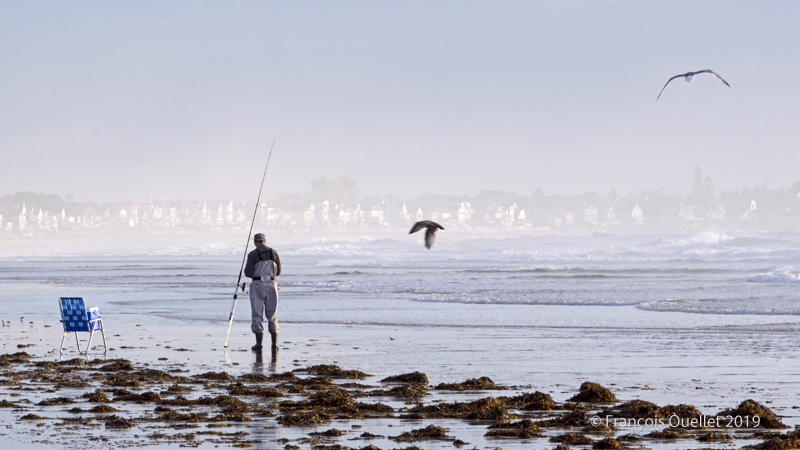
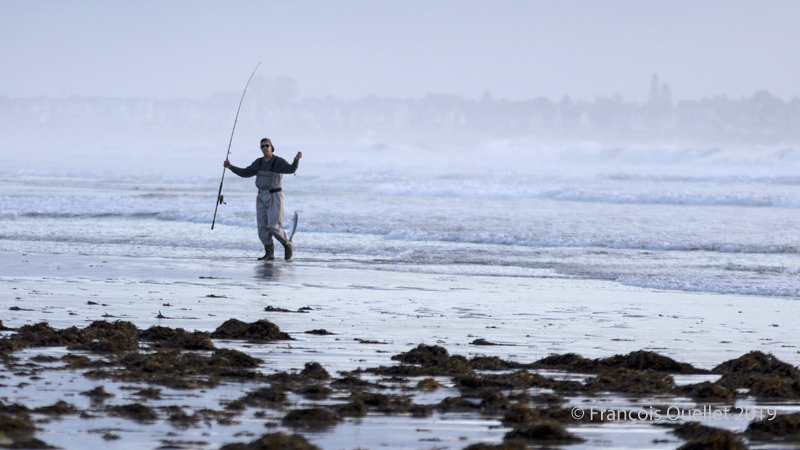
A fisherman profits from the beautiful morning to try to catch an Atlantic Striped Bass.
Since the fisherman will be on the beach for at least an hour, I have enough time to install a tripod on the beach and use the telephoto lens to bring in the man artificially. It is worth waiting for a few seagulls to fly nearby; this always add a bit of life to the scenery.
The compressed perspective offered by a telephoto lens and the significant cropping allow to increase the presence of the houses on the Ogunquit and Wells beaches, in United States.
Ogunquit fisherman with Atlantic Striped Bass web
The Atlantic Striped Bass can grow up to 1.5 meter (5 feet) in length and weight up to 35 kg (77 pounds). Fishing laws are different for each State. I believe that in Maine, a fisherman cannot keep a fish that is less than 71 cm (28 inches) in length.
Although I am quite far away from the fisherman, he has nonetheless noticed me. He turns around and proudly shows the Striped Bass that he just caught. A few seconds later, he puts the fish back in the water, knowing that the fish is still too small to be kept.
Click on the link for other photos of the United States on my blog.
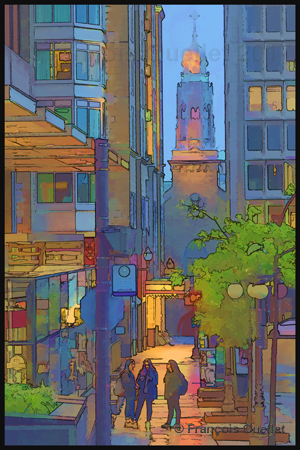
Digitally modified photo of Place d’Youville in Old Quebec
This digitally modified photo shows a part of Place d’Youville, in Old Quebec.
I wanted to capture the church in the background, which seemed to be squeezed between two bigger buildings. It became the principal subject of the photo and it was positioned according to the rule of thirds. This rule is far from mandatory in photography but it often provides interesting results.
I liked the repetitive effect of the windows on each side of the picture and the fact that there were diagonal lines that lead the eye to the church. The vegetation in the foreground added a nice touch to the scenery. There was only one thing missing: a human presence.
With a little patience, three girls stopped on the sidewalk and started to talk, exactly where I wanted them to be. The wet sidewalk on which they stood helped to reflect the ambiant light and also lead the eye to the church, the principal subject in the photo.
I rarely digitally transform a photo in such a drastic way. The reason was simple: normally, when the ambiant light is not favorable, you can sometimes use the black and white setting. However, the light on that day did not offer the required contrasts to get sufficiently interesting results.
I did not want to leave Place d’Youville without having captured the energy I felt there. I opted for a radical option after having cropped the image in order to keep only the essential features.
The picture was taken with a Canon 5DSR full frame camera.
For other photos on the province of Quebec and also Quebec City, click on the following links from my blog:
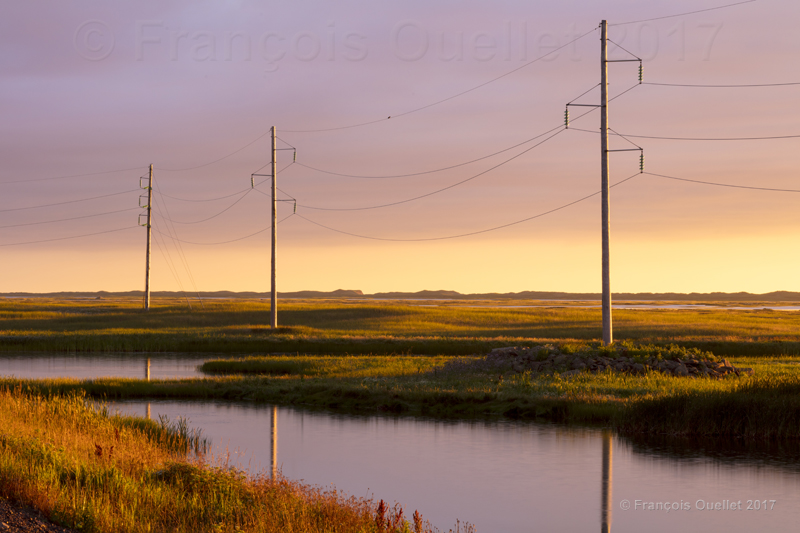
The Magdalen Islands, in the Province of Quebec, are recognized for the magnificent sunsets. The picture above was taken while I was coming back from Havre Aubert with my family during summer 2017. The ponds are located between Havre Aubert and Cap-aux-Meules, immediately alongside the main road.
The day had been cloudy and there was no indication that the evening would offer a possibility to get an interesting picture. But around 8 PM, while the sun was still relatively high above the horizon, a few sunrays were able to pierce through the cloud deck. The stratocumulus being well defined, it became obvious that when the sun would be close enough to the horizon, it would light the cloud deck from below as well as light up the ponds. It was important to act rapidly in order to capture the beautiful atmosphere.
When the winds are calm and you must stand still close to ponds in order to do photographic adjustments, one must accept to lose some blood to swarming moskitos. That night, I must have lost a pint of blood!
The absence of wind allowed for a good reflection of the electric poles in the foreground.
The picture was taken with a Canon 5DSR full frame camera equipped with a Canon 70-200 f2.8L IS II USM telephoto lens and a graduated filter used to avoid the underexposure that would be caused by the highlights in the horizon. I used aperture priority and set it at F18 to get a proper depth of field. The ISO was set at 200 and the focal length at 135 mm.
For other photos on the province of Quebec and also Quebec City, click on the following links from my blog:
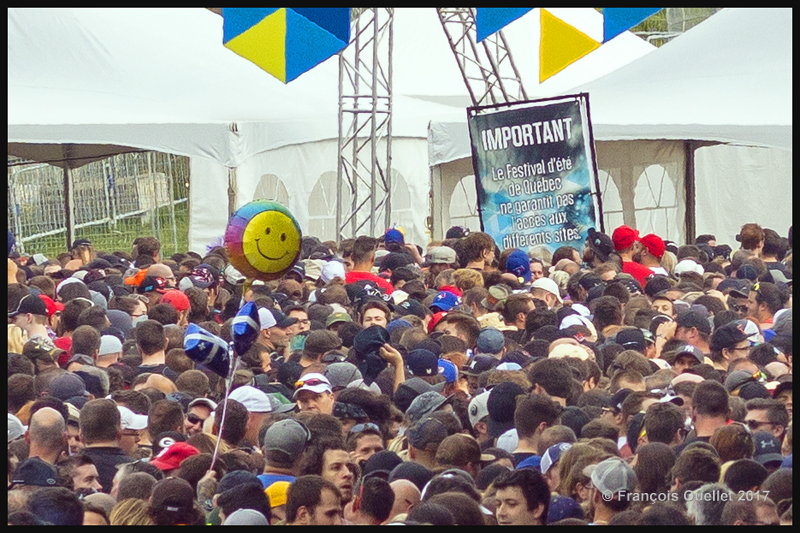
On the picture above, there is a sign indicating that the Quebec Summer Festival does not garantee an access to any sites. Under normal circumstances, this makes sense.
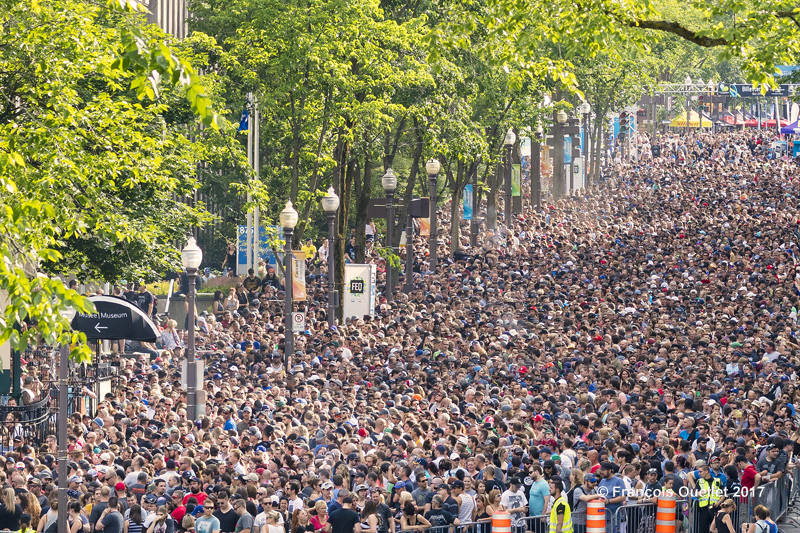
Part of the crowd waiting to enter the site for the Metallica show at the Quebec Summer Festival in 2017
But to say such a thing to the crowd who came to see Metallica would have been quite a challenge : « Ladies and gentlemen, as the person in charge of the Quebec Summer Festival, I would like to take the opportunity to remind you that the ticket you bought does not garantee an access to any specific site. A sign has been posted to that effect and the people at the beginning of the waiting line for the Metallica show can actually read it. Today happens to be such a day where you do not have access to the site. But there are other shows in town, so have a good festival and have fun! »
But all went well and the Metallica show, as well as the other shows presented at the Quebec Summer Festival were a success in 2017.
On a more technical side, the full-frame camera used to take the huge crowd was a Canon 5DSR equipped with a Canon EF 85mm f/1.2L II USM lens. The top of the St.Louis Gate, on Grande-Allée, was the perfect place to capture all those people waiting for Metallica.
For other photos on the province of Quebec and also Quebec City, click on the following links from my blog:
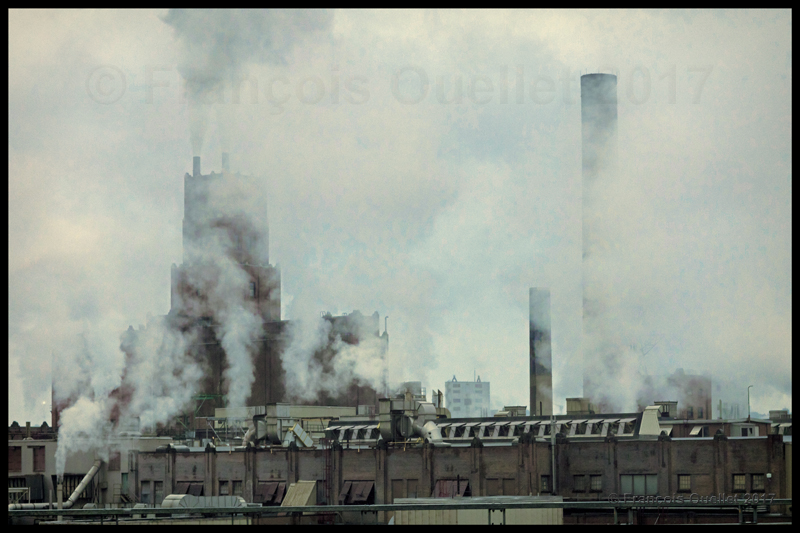
The picture above, that shows the activities of the White Birch Paper company in Quebec City, was taken on June 2017 from a moving car on a highway heading to Quebec City’s east side.
The shot was taken with a Canon 5DSR full-frame camera at 19:33 when the light was quite weak. There was also a bit of mist and an overcast sky at the time of the picture.
In order to compensate for the lack of adequate light, and also for the fact that the camera was moving, it was necessary to use a lens requiring very little light. That prevented from setting too high of an ISO (only 2500). The shutter speed was set to 1/1250 sec. The perfect lens for this picture was the Canon EF 85mm f/1.2L II USM.
Some cropping had to be done to recenter the main subject according to the rule-of-thirds.
Finally, an image editing software helped increase the cloud and smoke effects around the two chimneys.
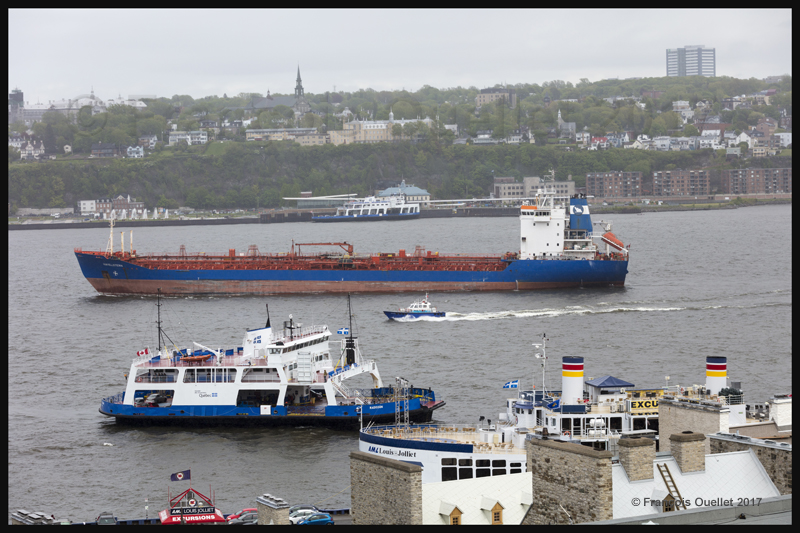
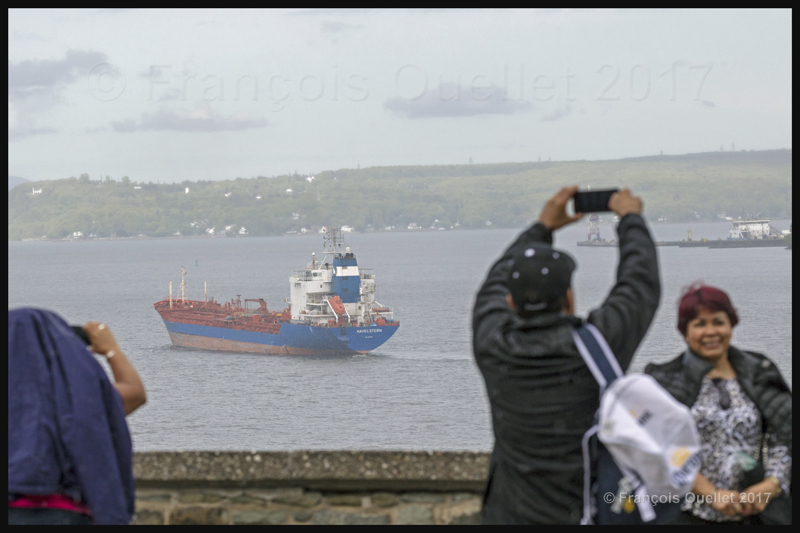
The Havelstern is a chemical tanker sailing under Canadian flag which was built in 1994. Its draught is of 8.5 meters. It is photographed here on June 3rd 2017 in front of Quebec City, with Lévis in the background, heading to Point Tupper in Nova Scotia, Canada.
The Havelstern between Quebec City and Lévis on June 3rd 2017
Several vessels are visible in the picture above. In the foreground, it is possible to see the two chimneys of the Louis Joliet, a boat essentially used for tourist excursions. Then there is one of the two ferries constantly traveling between the south and north shore of St. Lawrence Seaway between Lévis and Quebec City.
The small boat riding by the Havelstern is used to carry one of the St. Lawrence Seaway pilots. A pilot who masters the navigation specifications on this part of the seaway boards the ship and takes control until he can transfer the control to another pilot farther down the seaway ( Pilotes du St-Laurent ). In the background is the second ferry used to carry passengers and cars from one shore to the other.
The full-frame camera used to take the pictures was a Canon 5DSR equipped with a Canon EF 70-200mm f/2.8L IS II USM lens. With a 5.0 aperture and the ISO set at 200, the shutter speed allowed was 1/1000 sec.
The Havelstern ship and île d’Orléans in the background, June 2017
While the tourists are having fun in Quebec City, the picture above shows the Havelstern heading to Île d’Orléans in a rain shower.
The picture below represents the Havelstern making a wide turn to navigate around the southern portion of Île d’Orléans. The ship was quite far away and some serious cropping would have to be done in order to enlarge the image. In order to get a picture that would not be blurred, I had to increase the shutter speed a bit.
The Havelstern ship is approaching Île d’Orléans in June 2017, heading to Point Tupper in Nova-Scotia
The ISO was adjusted to 200 and the focal length was set to 200mm. The aperture was only 4.0, allowing a shutter speed of 1/2500 sec.
For other pictures of ships on my website, click on the following link : Ship photography.
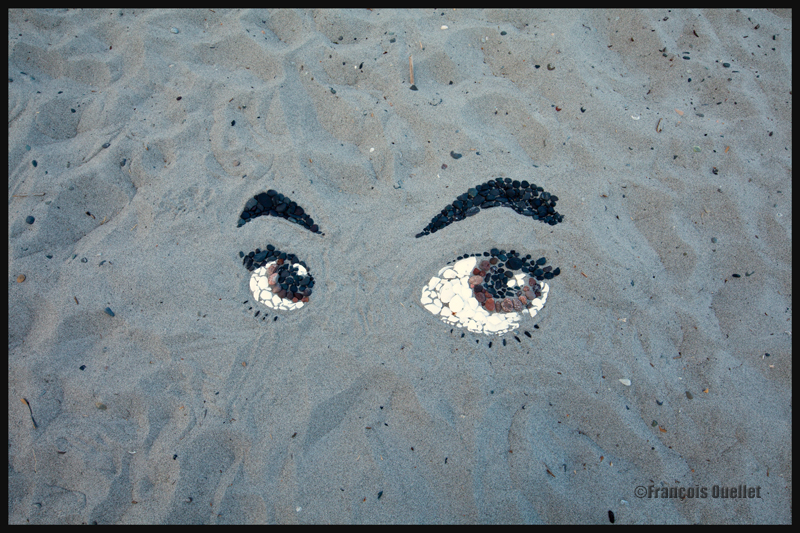
The picture above represents an improvised artwork that was done on Willows Beach in Oak Bay, a municipality in Victoria, British Columbia. The work, created during a summer afternoon in 2014, was made slightly out of the way from the main activity area of the beach and, by luck, was not damaged after its author left the beach.
However, during the evening, while taking a walk, I saw that a group of young people had installed a volleyball net on the beach, not far from where the artwork was located. The players often sent the ball very close to where the eyes where so I decided to take a picture to immortalize the work.
Shells and rocks of multiple colours had been assembled by a real artist to give the eyes an extremely realistic appearance, full of life. You may note that the artist took care of designing the eyes of different size, as it is necessery to add a three dimensional effect. Few white shells had even been added near the centre of the eyes to add the reflection appearance and bring the eyes to life. A real artist creation!
This street photography shot, taken in Paris with a Canon 5D MKII full-frame camera, works better in the French language since the word « occupé » placed on the banner plays a crucial role. In French, “occupé” can mean that there is a labour unrest and that the activity of a company is being disturbed by its employees. “Occupé” can also mean “busy”. This street photography shot uses both meanings.
In the background, some people are removing the stickers that have been placed on the wall of a store representing an international company. One can see the word “occupé” written on a banner, which here means “labour unrest”. In the mid-plane, everyone is in movement. Each person is looking somewhere except toward the foreground where a beggar without legs waits for donations.
Three levels of wealth are represented in the picture. There is the fortune associated with the owner of a very well-known international company (the name is mostly hidden for legal reasons), there is the standard financial situation associated with the citizens in the mid-plane and there is the beggar’s financial situation.
I wanted to include the word “occupé” (busy) in the photo in order to express something else: people who are walking and who seem to benefit from an acceptable financial situation do not have any time for the man who cannot walk and who certainly does not benefit from an acceptable comfort. The banner announces that everyone is “occupé” (busy).
A green apple, put down on the sidewalk in front of the beggar, and a green bag behind him seem to summarize the belongings of the disabled beggar.
For other street photography pictures posted on my site, click on the following link:
In 2017, Quebec City has opted for a decentralization of the Carnival activities which where always organized on the Plains of Abraham. Part of Grande-Allée was blocked to traffic and other activities where also held in the parc de l’Amérique-Française, the parc de la Francophonie and at Place d’Youville, in the hearth of the touristic sector.
Quebec Carnival 2017 symbols
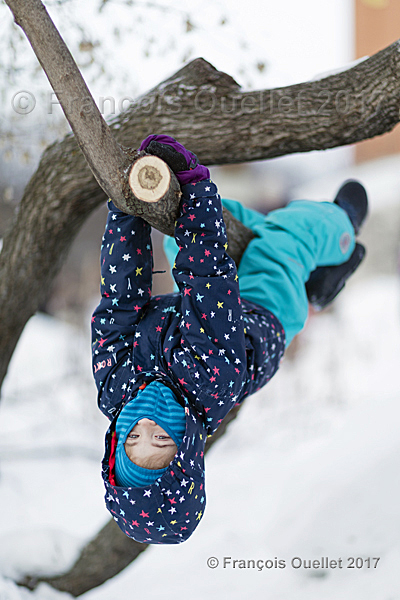
This new formula seems to be a success, according to the number of people met during my photography sessions on the different sites. Children, as usual, were not really bothered by the cold temperature et found a way to have fun. The picture below was taken while the wind chill factor was -20C.
Child playing at the parc de l’Amérique-Française during the 2017 Quebec Carnival
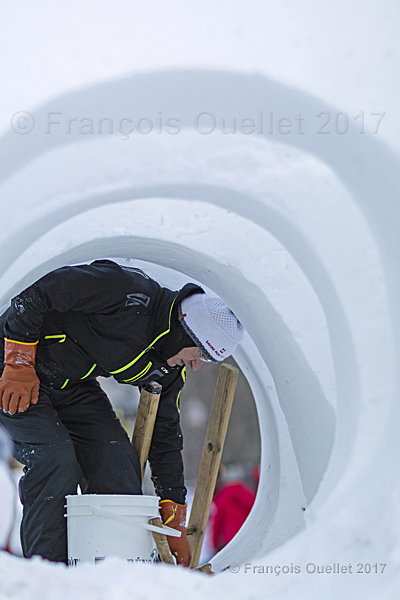
The parc de l’Amérique-Française was receiving the international snow sculpture contest. Many countries were present: Argentina, Canada, France, Germany, Italy, Mexico, Morocco, Peru and the United States. Italy won the first prize with an excellence award from the Quebec Carnival, added to an award from the public and the benevolent staff. The Italian sculptors were Pietro Germano, Samuel Bonapace and Gino Casagranda. The picture below represents one Italian sculptor at work.
An Italian sculptor at work during the 2017 Quebec Carnival.
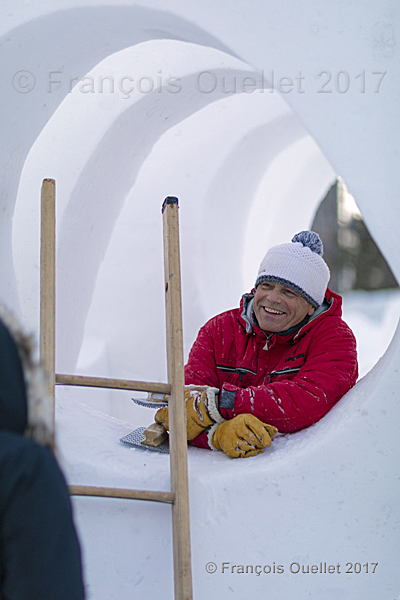
The second prize, with a Government of Quebec award, was offered to the team from France, who was composed of Pascal Veuillet, André Marastoni and Éric Margery. The pictures below show the work in progress and a French sculptor taking a few minutes to talk with a citizen. He does not seem too annoyed by the cold weather…
French sculptor at the 2017 Quebec Carnival
A French sculptor at the 2017 Quebec Carnival
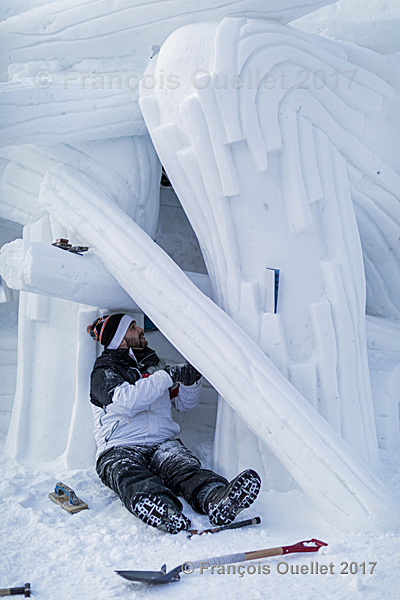
The team from Canada won the third prize, with an award from Quebec City. In the team were Jessy Armand, Michel Proulx and Mathieu Béchard. The pictures below represent two of the Canadian sculptors at work.
A Quebec sculptor at work on the Canada snow sculpture during the 2017 Quebec Carnival
French Canadian sculptor at the 2017 Quebec Carnival
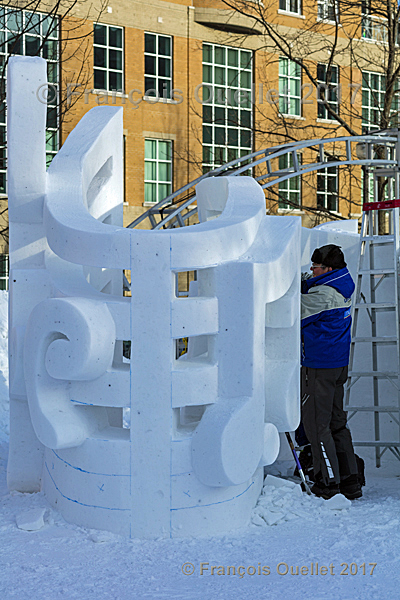
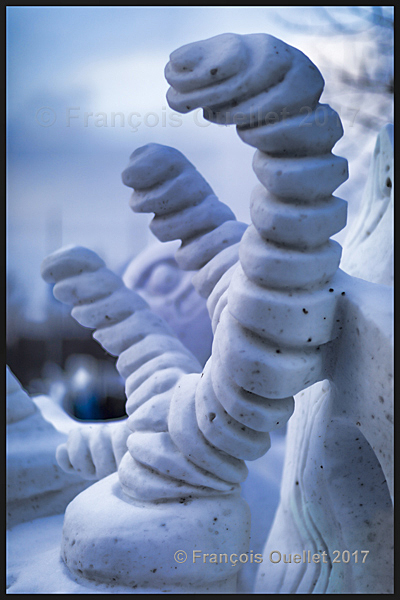
Some sculptures had a really original look. Instead of capturing the whole creation, I decided to frame a section of one of the sculpture in order to emphasize the artwork.
Section of a snow sculpture at the 2017 Quebec Carnival.
All the pictures have been taken using a Canon 5DSR full-frame camera equipped with a Canon EF 85mm f/1.2 II USM lens, with or without tripod, depending on the amount of light available. The picture above was shot using a 1.2 aperture to maximize the blurred effect in the background. It was then reworked using two different image editing softwares.
For a better idea of all the activites organized by the Quebec Carnival, head towards the following official and bilingual site: Quebec Carnival official site
For other photos on the province of Quebec and also Quebec City, click on the following links from my blog:
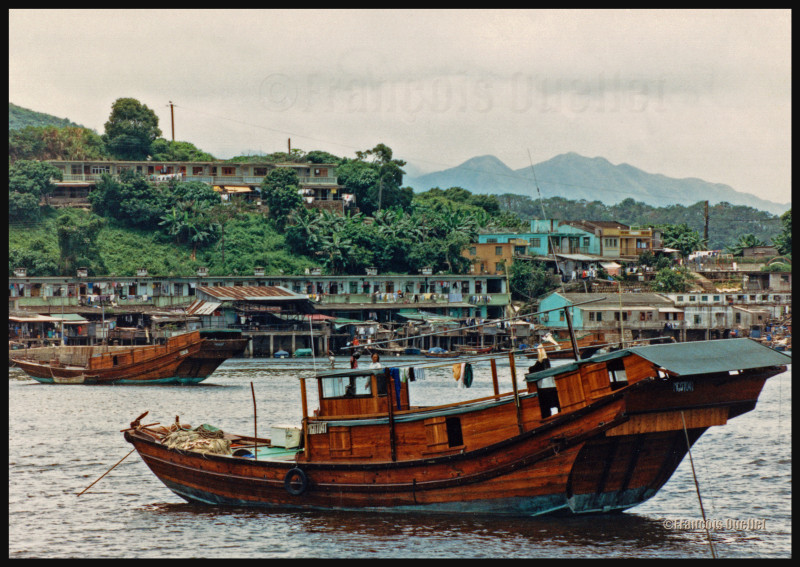
This picture was taken with a Pentax SF1 camera during a one month trip in the area of Hong-Kong. Other pictures relating to this 1990 Asian trip are available in my photo gallery sections under the title “Asia”.
The period when this picture of the Chinese junks in Tai Po was captured corresponds exactly to one year after the 1989 Tiananmen Square events. The South China Morning Post had written that about 100,000 persons had marched to commemorate the tragedy. I could even see the crowd from my seat in the Cathay Pacific Boeing 747-200 when we overflew Hong Kong for the final approach towards the Kaï Tak airport.
I used some time to travel on the South China sea and when our ferry started to navigate between islands, I saw those beautiful wooden junks and captured the scene.
For other boat or ship photos posted on my website, click on the following link: