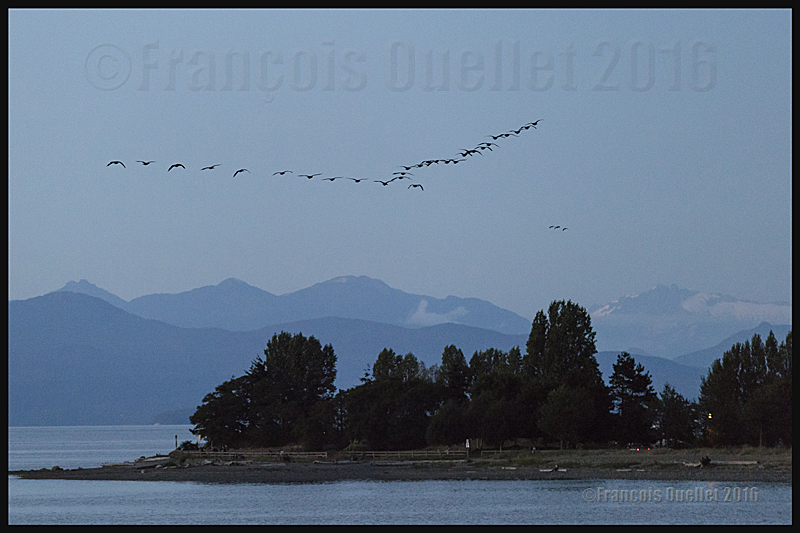
Canada Geese over the Strait of Georgia in British-Columbia, in 2016.
Night photography is not always planned and the photo above, taken late in the evening, was certainly not one I would have been able to take when I started as a photographer.
There was a superb sunset on the strait of Georgia, in British Columbia, and I had taken multiple pictures until late in the evening with my Canon 5DSR full-frame camera. The photography session was almost over.
Once I decided that it was time to pack-up for the night, I heard a flock of Canada Geese. They were flying in formation over the mountains to the west and were heading north in the darkness. In order to photograph those fast moving birds in the remaining light, drastically different settings would have to be made on the camera, and this, very rapidly.
The camera was equipped with a Canon 70-200 f2.8L IS II USM telephoto lens mounted on a tripod and facing west. It was on manual focus, the stabilizer was inactive and the ISO setting was very low. A ND graduated filter was already mounted on an adapter which was installed on the lens.
That meant dismantling the camera from the tripod, activating the automatic focus as well as the stabilizer, increasing the ISO, removing the ND graduated filter, limiting the aperture to insure sufficient shutter speed, composing the photo and taking few rapid shots before the geese were too far away.
Few seconds later, those birds and the landscape were becoming another souvenir of a beautiful summer holiday spent in British Columbia.
For more articles in the category « Photos of Canada », click on the following link : Photos of Canada
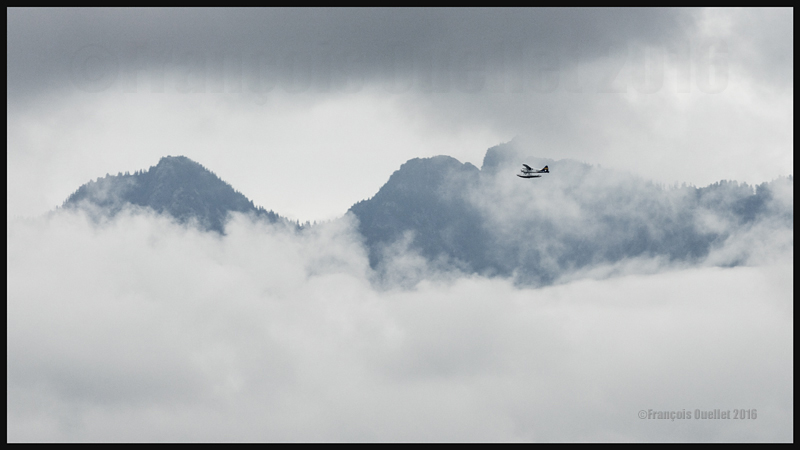
An Harbour Air DHC-2 Beaver floatplane is just airborne from Vancouver
The photo above portrays a Beaver floatplane belonging to Harbour Air. It is seen here a few minutes after its take-off from the Vancouver Harbour floatplane base in British Columbia. The picture was taken with a Canon 5DSR full-frame camera equipped with a Canon 70-200 f2.8L IS II USM telephoto lens.
The aircraft, quite small in the photo, could have been enlarged using the Canon 5DSR’ s 50 megapixel full-frame sensor. The image would still have been of excellent quality but I would have lost the effect I was initially looking for.
As opposed to what seems obvious at first sight, the scenery was not captured sitting in another plane but from the ground, while I was standing near the Harbour Air seaplane base. The morning’s constant precipitation saturated the air with moisture and helped create a low level cloud base.
An image editing software was then used to crop the scene. I used a non standard photo format to show the kind of flight the pilot was dealing with, between two cloud layers and with a mountain range on his right. It seems to me that a photographer does not have to feel obliged to follow an arbitrary format if the latter has a negative impact on the intended result.
Cliquez sur le lien pour d’autres photos d’avions sur mon blogue.
A crow in flight over the Georgia Strait in British-Columbia
This picture of a crow in flight over the Georgia Strait in British Columbia was taken with a Canon 5DSR full-frame camera. The aperture was set around 4.0. This allowed for a faster shutter speed. A reasonable ISO setting also kept the digital noise to a minimum.
In order to increase my chances of getting a precise photo of the crow, and to ensure that the background was blurred to limit distractions, I decided to follow as much as possible the exact speed of the bird with the camera. This is always risky as one can lose unique photo opportunities. But when it works, the picture is always interesting.
A significant cropping was then necessary to increase the size of the crow in the photo but this had no negative impact on the image’s quality since the initial ISO setting was quite low and I had access to the Canon 5DSR’s 50 megapixel full-frame sensor. Such a huge number of megapixels makes it easier when comes the time to enlarge pictures.
A bit of patience was necessary in order to capture an interesting subject but the wait was worth it. The specimen above landed about fifty feet from me on a Parksville beach. It started to look for small pieces of wood and, when satisfied of its finding, took-off for its nest.
For more articles in the category « Photos of Canada », click on the following link : Photos of Canada
The photography book « Full Frame », by David Noton, was written in 2010 but the content is still totally pertinent today. It’s possibly the best photography book I’ve ever read. The images are fantastic and the text is loaded with practical and accessible information.
Photography book “Full Frame” by David Noton
The author is known as one of the best landscape photographer in the world. Every page of his book is divided in three sections: before, during, after. This means that you read about everything that the author had to deal with as he travelled around the world with his wife to capture landscapes: the preparation, technique, priorities, obstacles, successes, etc.
All along the book, I had the feeling that a friend was writing me since the text is written with a light and humoristic approach in mind, and certainly without pretend. Here are some of his remarks and advices:
“Luck is where preparation and opportunity combine.” (p.38) This certainly applies to everything we do in life.
“Stick with the full frame quality and crop as when required, keeping all the [sensor’s megapixels] information in reserve”.
“Sometimes a new lens or format will serve as a catalyst for a whole new way of looking. It’s all part of the evolutionary process.” (p.64)
Sharpen all digital images. Pictures are made of square pixels and need microadjustments.
To choose among your interesting similar photos which one is the best, start with a very good one and compare it with each other photo, one at a time, throwing away the ones that are inferior. You will save a lot of time.
A bit of blinking in the highlights is not terrible since RAW files can easily be adjusted. Don’t forget that the camera’s monitor shows an histogram adjusted for JPEG files.
Use a grad filter to control the contrasts only, not to add mood or create an artificial contrast.
There is no need to always show the tops of mountains.
“The best pictures are the simplest. Composition is the art of knowing what to leave out.” (p.71)
“Be flexible and strive to extract the most from seemingly adverse conditions.” (p.77)
“For wide angle views on the world, a full-frame sensor is imperative.” (p.93)
Back cover of the photography book “Full Frame” by David Noton
“Scout the location, analyse the options in different lighting situations, previsualize the image, plan the shoot then keep returning until it’s nailed.” (p.113)
“Location finding is everything; the photography is the easy bit.” (p.125)
“Don’t be afraid of “blinkies” in the brightest part of the sky where the sun shines through […]. We don’t expect to see detail there.” (p.138)
“Using movement is an essential technique in a photographer’s repertoire.” (p.143)
“The classic, golden rule of thirds is a good starting point, but it’s only a guideline to ignore at will.” (p.149)
“A camera’s sensor is not a linear device so the right half of the histogram contains far more information than the left. Those apparently overexposed images, when processed with the brightness brought back to the desired density, will have richer tones and less noise than a frame exposed to the left.” (p.153)
“We photographers can only continue to improve if we keep pushing ourselves.” (p.187)
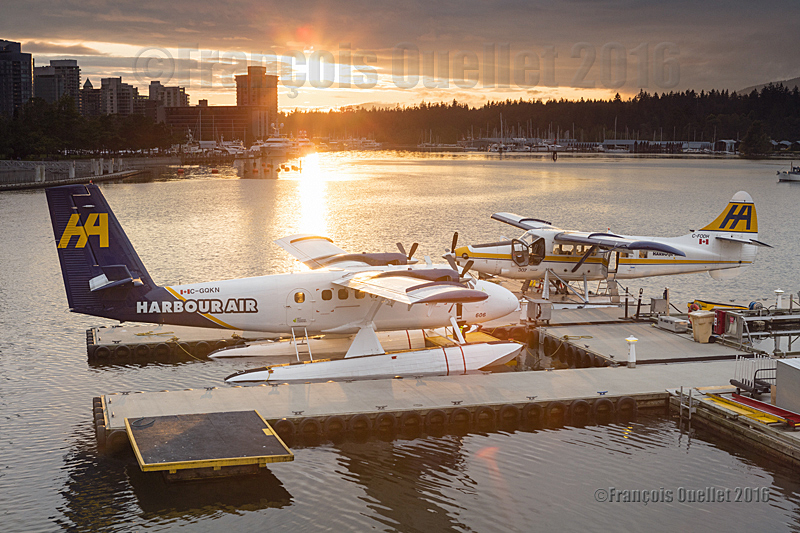
Harbour Air Twin Otter floatplane C-GQKN and Turbo Otter floatplane C-FODH in the sunset in the Port of Vancouver during summer 2016
The picture above has been taken with a Canon 5DSR full-frame camera in the Port of Vancouver, in British Columbia, during summer 2016. Following a very busy day of take-offs and landings, everything is now peaceful. The Harbour Air Twin Otter floatplane C-GQKN and Turbo Otter floatplane C-FODH are now parked for the night.
Pictures taken at dusk or dawn benefit from a unique light. Nonetheless, taking pictures of aircrafts against the light, with the last sunrays still visible, requires a special attention with regards to blown out highlights.
When contrasts are too important, it is possible to correct the situation by taking several pictures with different exposures and merging them using an image editing software like Photomatix (HDR photography). This is done in a few minutes only. Nonetheless, with floatplane aircrafts that are still slightly moving even when tied for the night, there is an increased risk of a blurred picture. The best way to proceed is to use a ND grad filter and to place it exactly where the light is the strongest. Naturally, there will still be some blown out highlights.
This being said, you still have a good margin of manoeuver, since there is no problem in showing a limited amount of over-exposed highlights in the brighter part of the sunrays, as there is not much details to lose there anyway. While purists would argue otherwise and spend hours in front of their computer trying to correct everything, you are making the best of another day of photographic exploration.
If the picture was taken using RAW files (or RAW with JPEG), it is possible to improve the scene even more by correcting some aspects like the contrasts, the brightness, the colours, the saturation and ambient light, etc. This also requires very limited time in front of the computer once you understand the basic principles of an image editing software.
Harbour Air Twin Otter floatplane C-GQKN on final for Vancouver Harbour, in British-Columbia, during Summer 2016. Photo taken with a Canon 5DSR full frame camera.
It looked like it would be an average day for a photography session at the Vancouver Harbour. The sky was quite ordinary, which means totally cloudless. But around noon, a new and more humid air mass made its way in British Columbia and rapidly the blue sky was replaced by clouds and precipitations. At the same time, the high intensity light that was prevailing around noon suddenly took more acceptable levels for photography.
Pilots of different bush floatplanes like the Twin Otter (DHC-6), Turbo Otter (DHC-3T) and Beaver (DHC-2) had to deal with the sudden weather deterioration in order to complete the daily planned flights. But one man’s loss is another man’s gain. For aviation photography, low clouds and light intensity meant that the pictures would be more interesting.
The photo above was taken with a Canon 5DSR full-frame DSLR camera equipped with a Canon 70-200 f2.8L IS II USM telephoto lens. In order to capture the moving propellers, I had to set a low shutter speed. The scene was then cropped to avoid visual distractions. The 50.6 megapixels full-frame sensor of the Canon 5DSR facilitates cropping when it is required.
In the foreground, there is a Harbour Air Twin Otter floatplane (C-GQKN) approaching to land in the Vancouver Harbour. In the background, far away and in the superior right corner of the photo, the pilot of a Turbo Otter floatplane also deals with worsening weather while ensuring that he maintains a visual contact with high ground obstacles surrounding the harbour.
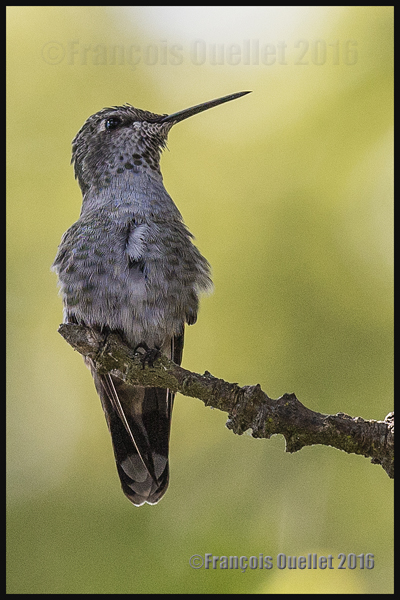
Hummingbird photographed with a Canon 5DSR DSLR camera in Victoria, British-Columbia, in 2016
The 50.6 megapixels full frame sensor in the Canon 5DSR camera is of great help when comes the time for bird photography. It allows major cropping of an image without any loss in quality.
With a little patience, it was possible to take a picture of a hummingbird in a public park in Victoria, British Columbia after the bird finally rested on a branch for a few seconds. Without cropping and a powerful 500mm telephoto lens, it would have been difficult to produce a sufficiently large and clear image of a five centimeter bird.
I used a Canon 5DSR equipped with a Canon EF 70-200 f2.8L II USM telephoto lens. The camera was adjusted on APERTURE mode. The telephoto lens stabilizer was activated. The autofocus was set on the SERVO mode to insure the image sharpness in the event that the subject started to move.
But the hummingbird was so small that the autofocus constantly whizzed between the bird and the leaves. I had to switch to manual focus and use Liveview.
Once the picture was taken and cropping was done, few contrast and luminosity corrections were necessary in order to enhance the bird’s plumage which happened to be backlighted. RAW files facilitated the edition in Photoshop.
Likewise, the background intensity of the colours was corrected to avoid distracting from the principal subject. The initial picture, in landscape format, was later changed in the portrait format, which allowed the exclusion of several branches around the bird which were imposing and diverting attention.
Naturally, the chosen depth-of-field blurred the background, helping the hummingbird to stand-out.
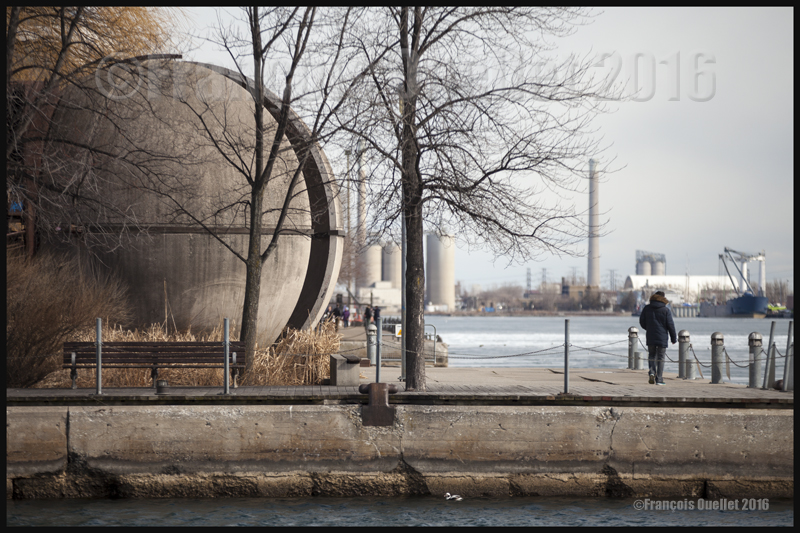
Here are some photos of Toronto that were taken in February 2016 with a Canon 5D MKII DSLR camera. The photos were all saved in RAW and JPEG files to facilitate any additional work that could have been required with an image editing software.
Architecture and photography both offering unlimited possibilities, I did not impose any limitations. The primary goal was to profit from any opportunity that would arise while profiting from the softer light offered by the winter season.
Toronto Harbourfront, Winter 2016
The first article with regards to photography in Toronto that was published on my website showed only one subject: the CN Tower. It was published during Winter 2016:
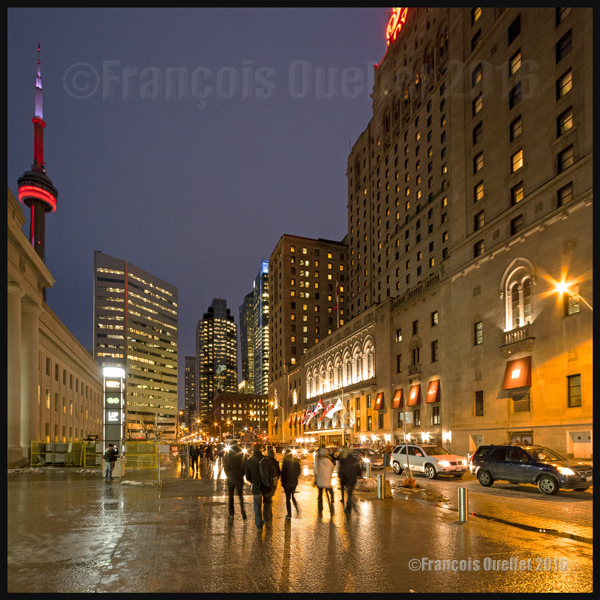
In the present article, I develop other angles of Toronto which is a city in constant evolution and where you can find multiple styles of architecture. In the picture below, a recent rain shower helped to add unexpected reflections.
Toronto and CN tower by night. Winter 2016
Some architectural subjects are naturally imposing. This is the case when all you have to do is look straight ahead, enjoy what you see and immediately try to compose an interesting photo.
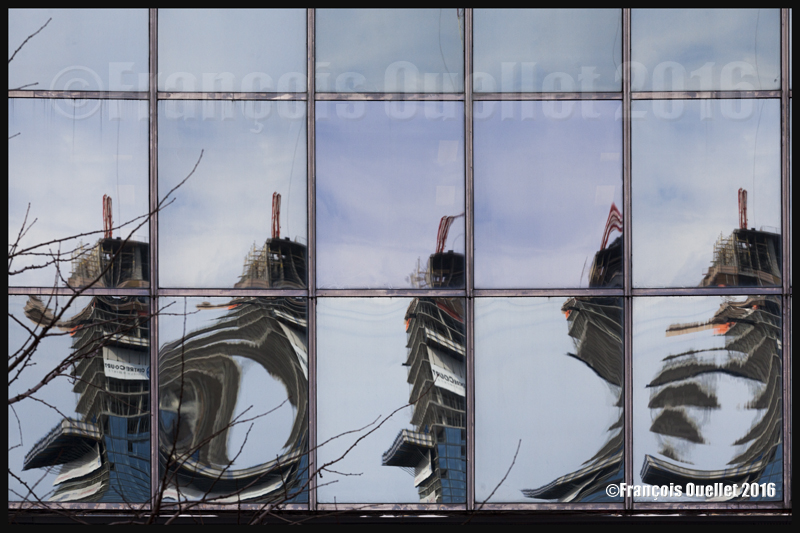
A good example is the interesting reflected shapes that can be seen on the windows of a building. I could not help to take the picture below as I was surprised that a windowed building could send back images that were so totally different from each other. I am curious why there is so much distortion between the windows…
Toronto building reflections (2016)
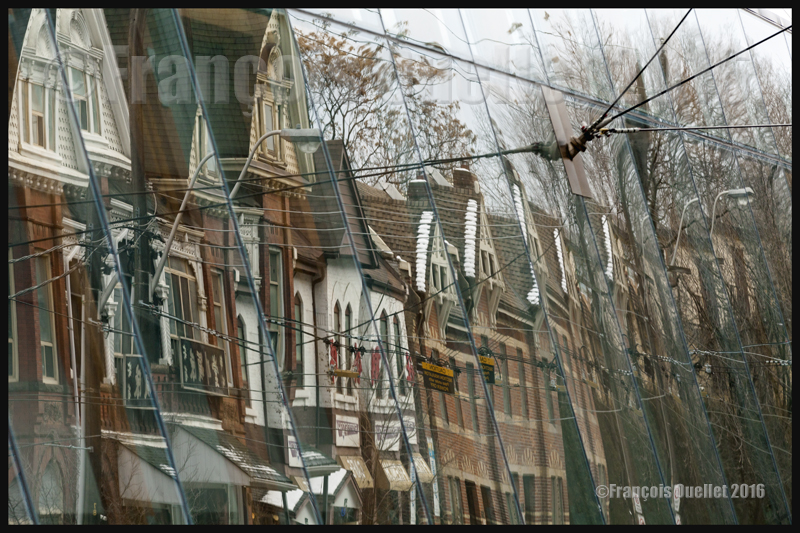
Instead of taking pictures of the newly designed Art Gallery of Ontario, I used its reflective properties to capture something a lot older, which was the design of the row of older houses on the other side of the street.
Some houses are reflecting on the Art Gallery of Ontario (2016)
It is also possible to add variety and fun to a photo session by looking for special shapes, angles or contrasts that are not already obvious.
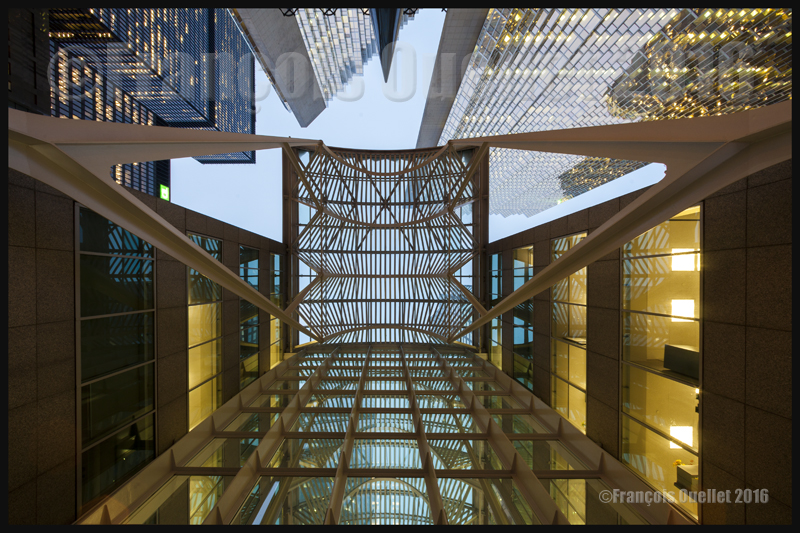
As I was walking downtown, I passed by the Brookfield head office. The architecture of this relatively new building is quite interesting. The architects were able to preserve the facades of older surrounding buildings by integrating them and assigning each one a role inside the new construction, possibly because the city required their protection in case of any new development.
But it is only once I was leaving the sky rise that I found the idea for the next photo: a vertical wide-angle shot from which all lines would be straight, all this possible by using the advantages of the Canon 5D MKII full frame sensor coupled to a Canon 14mm 2.8L wide-angle fixed lens. Image sharpness was insured through manual focus, a tripod, a remote trigger and the mirror lock-up function.
Toronto sky rise, Ontario 2016
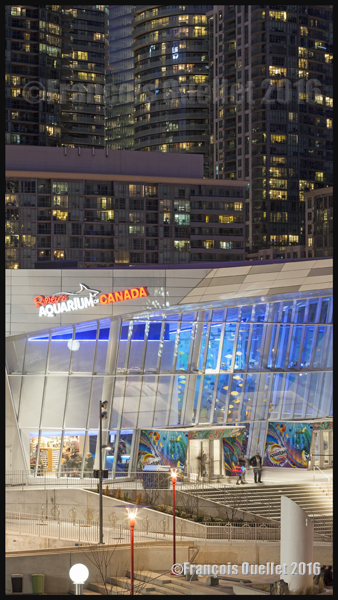
The last photo is essentially about contrasts: the colour contrasts (light and dark) and the density contrasts that one can find in different constructions of Toronto.
In the foreground, we see the aquarium, with its pale and inviting colours, as well as lots of space where only few people are visible. In the background, there is the exact opposite, with very dark high-density condo towers, very close to each other, where every inhabitant hopes to have an interesting view on the Lake Ontario. All this in a photo divided in two parts and cropped very tightly to increase the differences and eliminate any visual distractions.
Contrast between the Ripleys Aquarium of Canada and the condominiums in the background. Toronto, Ontario (2016)
For more articles in the category « Photos of Canada », click on the following link : Photos of Canada
Official opening of the Pierre Lassonde Pavilion, which is part of the Musée National des Beaux-Arts de Québec, seen from Grande Allée on June 24th 2016
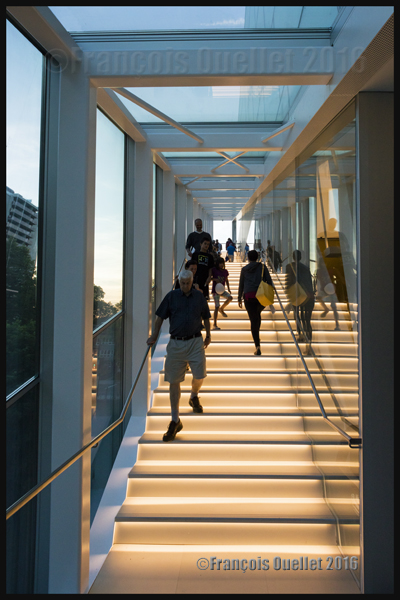
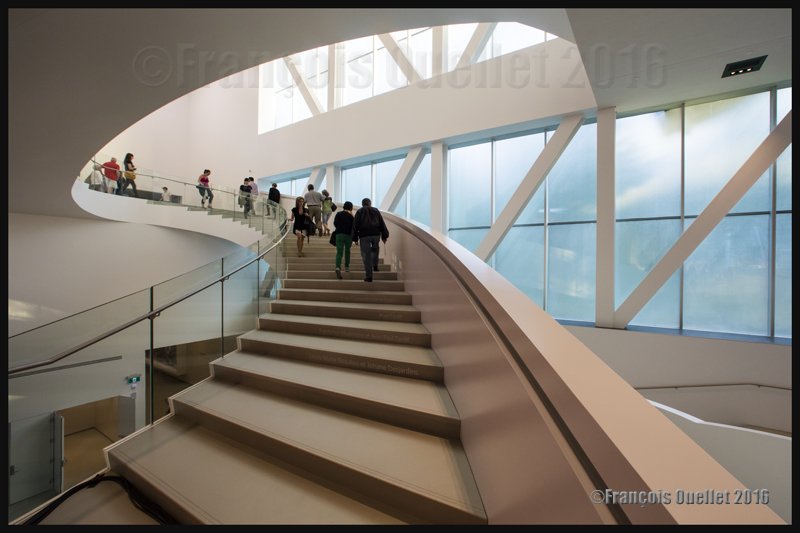
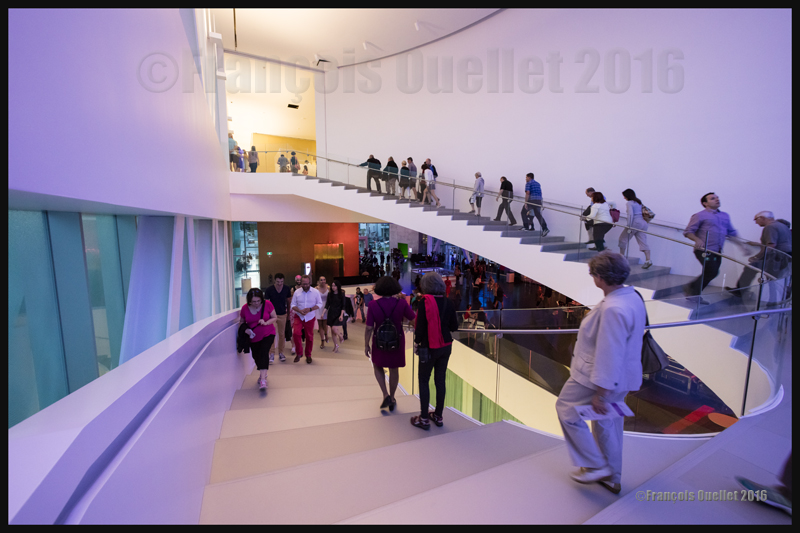
Pierre Lassonde Pavilion (Musée National des Beaux-Arts de Québec) intercommunication stairway on the day of official opening in June 2016
On June 24th 2016, during the National Holiday of Quebec, the new Pierre Lassonde pavilion of the Musée National des Beaux-Arts du Québec (MNBAQ) on Grande Allée in Quebec City was inaugurated. This pavilion, that has been expected for a very long time, will allow the Museum to expose art that had to be stored, up to now, due to lack of floor space. This new pavilion will double the exibition space.
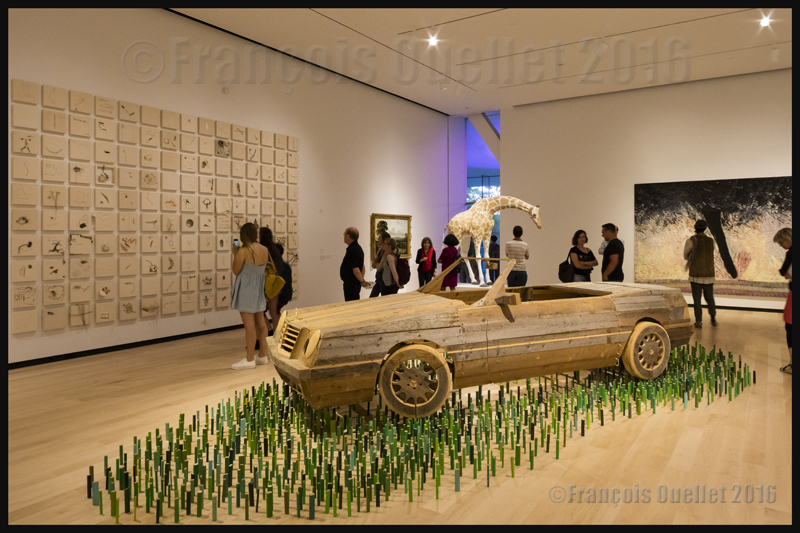
Artwork exibited in the Pavillon Pierre Lassonde du MNABQ on June 24th 2016
Many political personalities were present, among them the Prime Minister of Canada Justin Trudeau and Quebec’s Prime Minister Philippe Couillard, as well as the MNBAQ director Line Ouellet. International actuality caught up with the Canadian Prime Minister during his presence in Quebec and he had to comment on United Kingdom’s exit from the European Union (Brexit) which was voted on the precedent day.
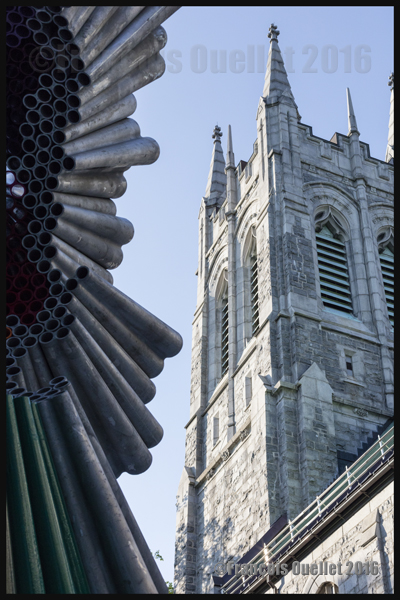
Part of a sculpture located outside of the Pierre Lassonde Pavilion at the Musée National des Beaux-Arts du Québec in 2016
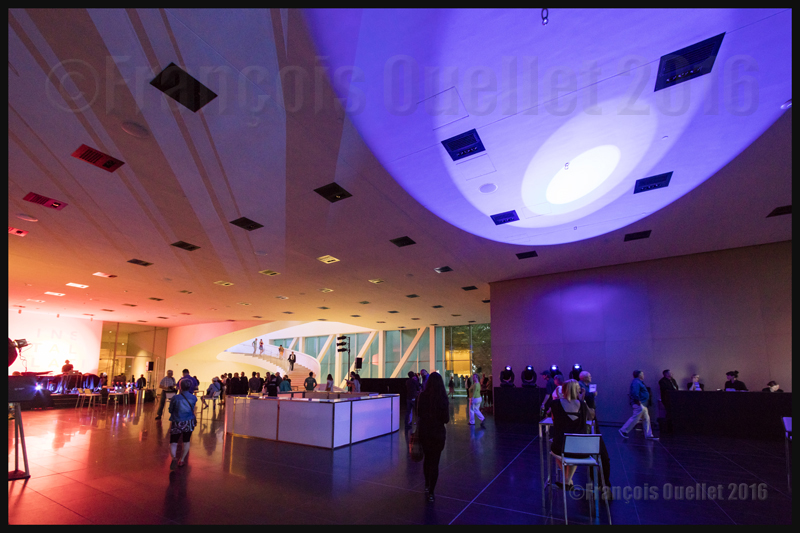
June 24th 2016 in the MNBAQ’s Pierre Lassonde Pavilion
The Pierre Lassonde pavilion architectural project, valued at about $103 millions, was the result of an international competition won by the American architectural firm OMA from New York. Fifteen thousand people were expected to show up for the inauguration. Instead, thirty thousand people visited the pavilion to get a glimpse of the creation directed by the architect Shohei Shigematsu.
Pierre Lassonde Pavilion’s intercommunication stairway on June 24th 2016. Photo taken with a Canon 5DSR equipped with a 14mm 2.8L fixed lens.
MNBAQ’s Pierre Lassonde Pavilion’s stairway on June 24th 2016
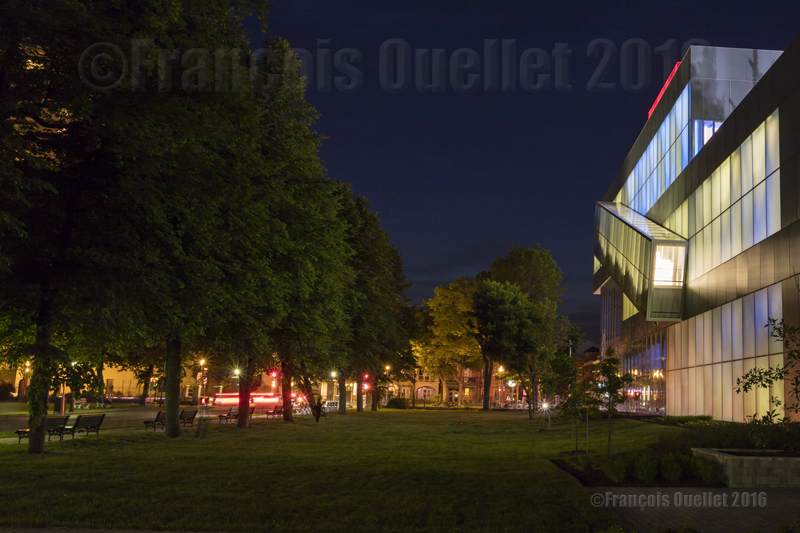
Lots of compromises to limit the expenses had to be made, like in all serious projects. Nonetheless, the pavilion is a success and I am eager to see what kind of atmosphere will be generated this coming winter when the light shines through the glass panels and colors the snow around the pavilion. This new building, with its original architecture and the light that emanates from it, already adds a new dynamic when night falls on Grande Allée.
MNBAQ’s Pierre Lassonde Pavilion on the evening of official opening. Photo taken with a Canon 5DSR on June 24th 2016
Intercommunication staircase in the Pierre Lassonde Pavilion at the MNBAQ on the day of official opening (June 24th 2016)
For those of you who are interested in photography, here are some details about the photographic equipment used for my photos : they were all taken with a DSLR Canon 5DSR camera. The Canon lenses that were used were : EF 14mm f/2.8L II USM, EF 50mm f/1.4 USM and telephoto lens EF 70-200 mm f/2.8L IS II USM. The use of a flash being forbidden inside the museum, I had to carefully adjust the ISO, speed and aperture settings, especially where the use of a tripod was not authorized. For those occasions, the EF 50 mm f/1.4 USM was of great help.
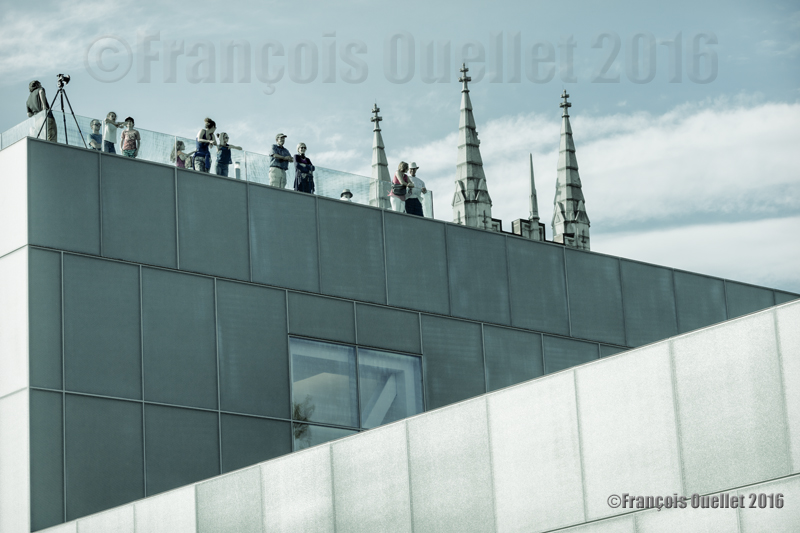
Visitors on the roof of the MNBAQ’s Pierre Lassonde Pavilion on June 24th 2016
For other photos on the province of Quebec and also Quebec City, click on the following links from my blog:
Here are a few recent photos taken during the month of May 2016 using a Canon 5DSR camera equipped with a Canon 70-200 f2.8L IS II USM telephoto lens. I was on île d’Orléans for the photo session, near the Horatio Walker promenade in Sainte-Pétronille.
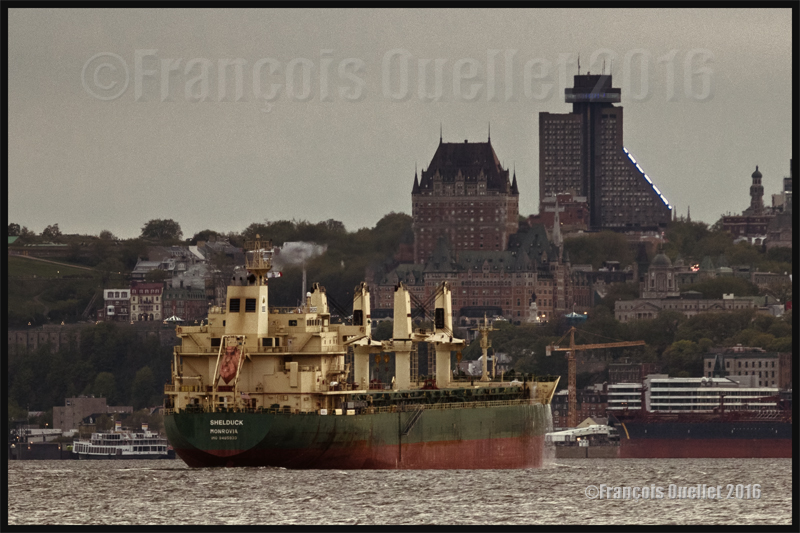
The vessel Shelduck (Monrovia) in front of Quebec City in 2016. The photo was taken with a Canon 5DSR
The picture above shows the vessel Shelduck flying the Liberian flag. It just crossed the narrow channel between île d’Orléans and Levis. This ship, built in 2012, is a bulk carrier. In the background it is possible to see Quebec City, with the Château Frontenac and the Hotel Le Concorde Quebec.
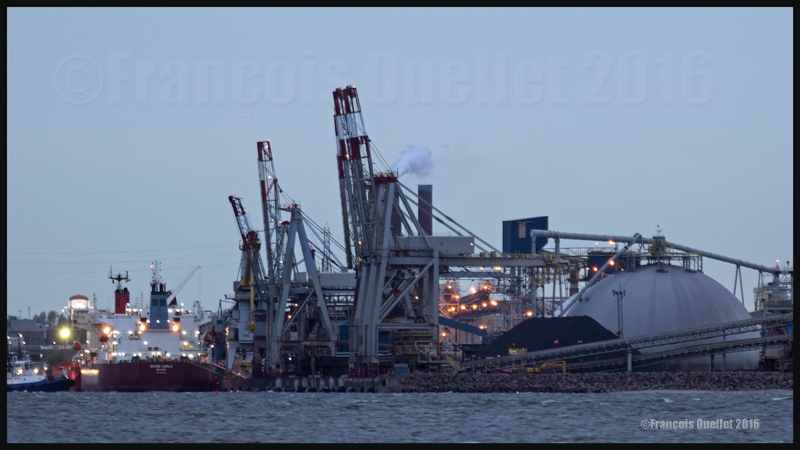
The photo below shows the Silver Carla (Majuro), a tanker used to carry oil and chemical products. It is moored at the Quebec harbour installations. The ship was built in 2014 and sails using the Marshall Islands flag of convenience.
The vessel Silver Carla (Majuro) and some of the Quebec harbour installations in May 2016
In the picture below, the tanker Cap Jean, property of Euronav, is approaching île d’Orléans. This tanker was initially supposed to be named St. Jean but the name’s religious connotation could have caused problems in some parts of world. The name Cap Jean was thus chosen.
The vessel Cap Jean, property of Euronav, in front of Quebec City in 2016
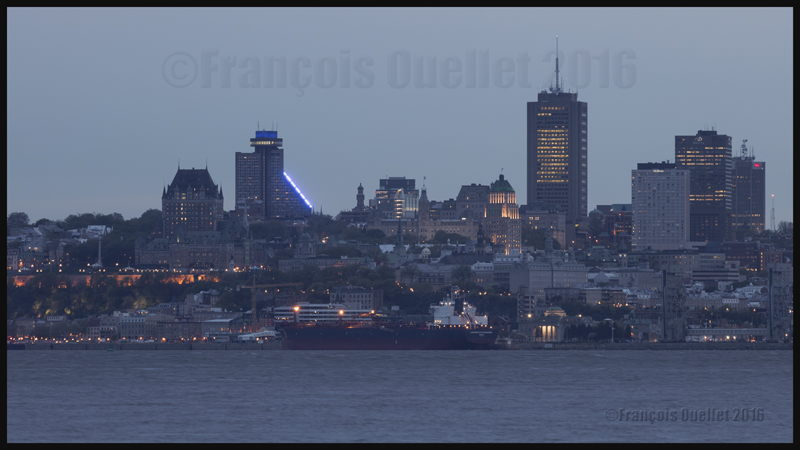
The photo below, also taken from île d’Orléans, offers an interesting view of Quebec City just before nightime. The Hotel Le Concorde Quebec’s new lighting system is visible in the distance. In the foreground, you can see the ship Laurentia Desgagnés.
The vessel Laurentia Desgagnés moored in front of Quebec City during a May 2016 evening.
Below, the ship Nilufer Sultan is heading towards Quebec harbour. Built in 2008, this oil tanker also uses the Marshall Islands flag of convenience.
The vessel Nilufer Sultan in front of Quebec City in 2016. Also visible are the Château Frontenac and the Hôtel Le Concorde Quebec.
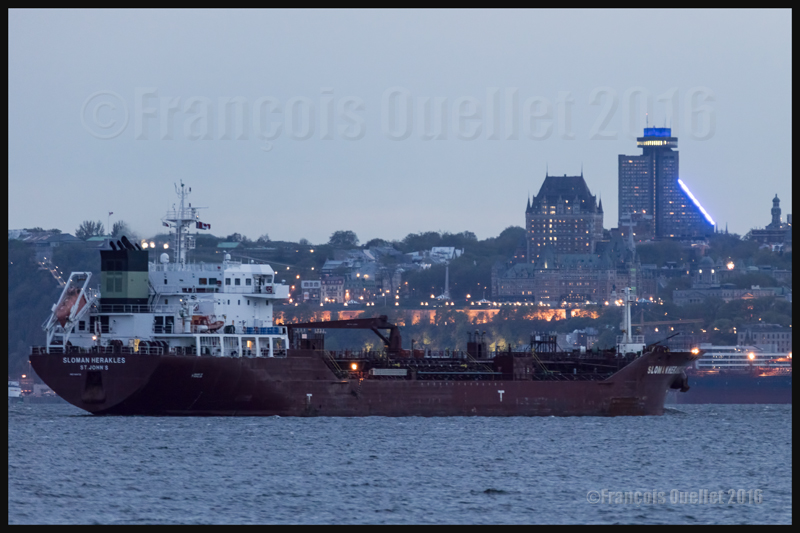
The photo below shows the tanker Sloman Herakles, normally based in St. John’s, Canada. It sails under the Antigua and Barbuda flag and is heading to Sarnia, Ontario.
The vessel Sloman Herakles (St. John’s) in front of Quebec City in 2016
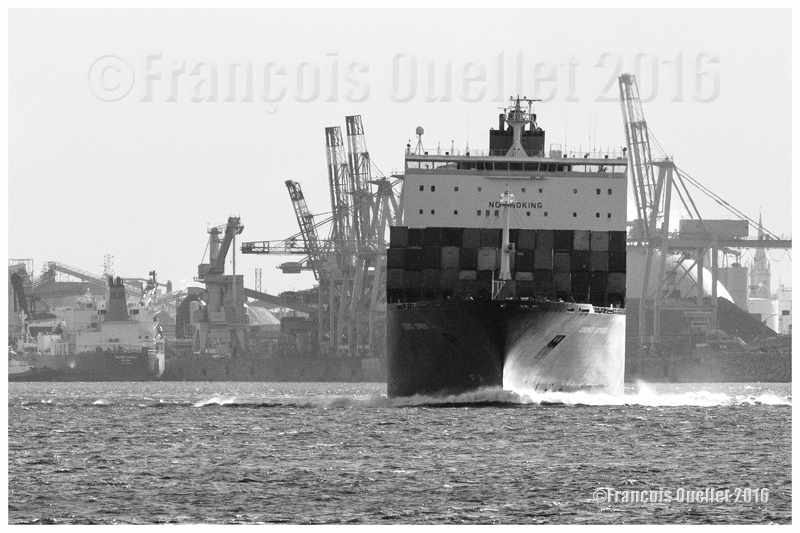
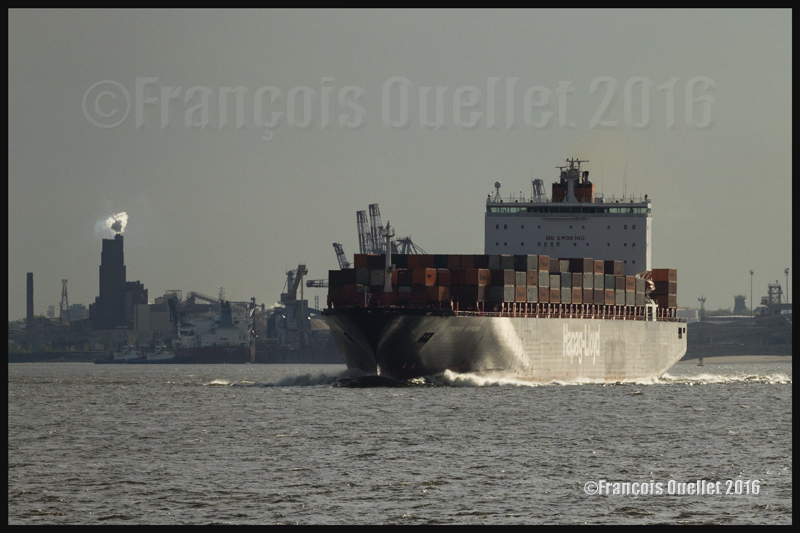
The two photos below show the container ship Toronto Express, property of the Hapag Lloyd Company. I chose to transform the first picture in black and white since the ship did not contrast enough with the background in the colored picture. It is actually slightly inclined since it is turning towards the right while approaching île d’Orléans. On the next picture, we can see in the background the smoking chimney of the Papiers White Birch Company, formerly called Daïshowa and later Stadacona.
Black and white photo of Hapag Lloyd’s Toronto Express in front of the Quebec harbour installations in May 2016
The Vessel Hapag Lloyd Toronto Express near the Quebec City Harbour in 2016. Photo taken with a Canon 5DSR full-frame camera
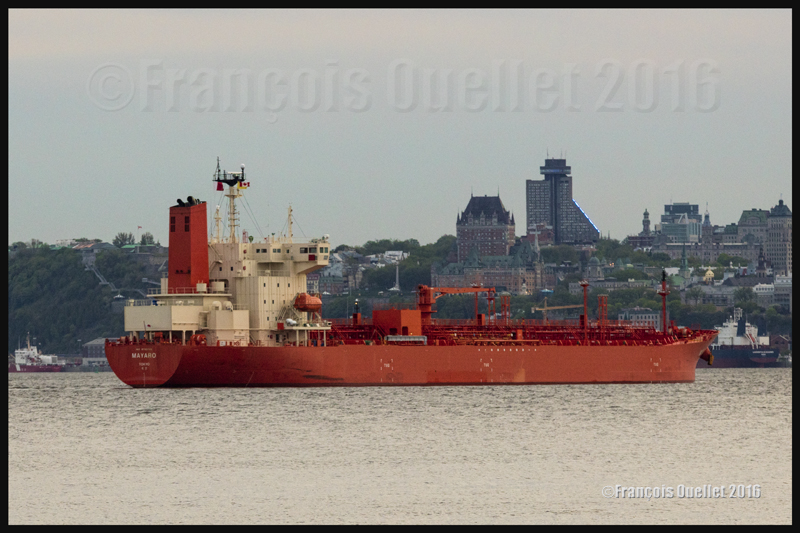
Below is the chemical tanker Mayaro (Japan) arriving near Quebec City in May 2016.
The vessel Mayaro (Tokyo) and Quebec Château Frontenac in the background. The picture was taken in 2016 with a Canon 5DSR
Taking pictures in the evening
Trying to take pictures of moving ships in the evening, using the smallest possible ISO, forces a photographer to use a tripod, a remote trigger and the camera’s mirror lock-up function to reduce vibrations. Ideally, it is best to find a spot where the tripod will be protected from the wind while ensuring that the camera’s strap is not moving at all. There is no need to use a polarizing filter at this time of the day: that would only be detrimental to the photo.
The Canon 5DSR DSLR full frame camera allows the photographer to take a picture in two steps, reducing even more the possibility of secondary vibrations. First, the mirror is lifted up. Then, two seconds later, the photo is finally taken. For a sharper image, it is best to use the Liveview function with a 16X enlargement and do a manual focus adjustment.
Risks associated with photography!
On île d’Orléans, many visitors use the surroundings banks to let their dog roam freely. This can cause a problem as the animal sometimes perceives the photographer and his photographic equipment as a potential threat to a master that it must protect… You will have been advised!
For other ship photos posted on my website, click on the following link: