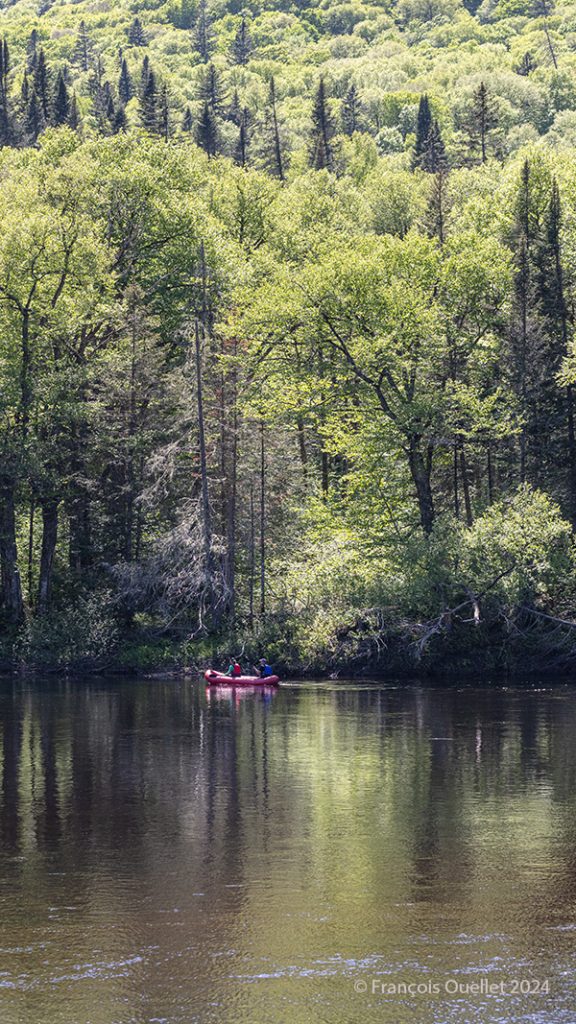
Spring in the Parc National de la Jacques-Cartier in Québec.
Normally, a 3:2 or 4:3 ratio is used to display in vertical mode. But the 16:9 aspect ratio of the photo above shows both the reverberations in the water and a significant portion of the landscape. So, whatever the conventions and what makes purists happy, we use what does justice to our first impression.
What caught my eye in this scene? The very wide range of green tones, the alternation of light and shade in the landscape and the reflections, the roundness of the deciduous trees and the tips of the conifers, the atmosphere of the place and, last but not least, the human presence. All this can be seen in a fraction of a second, and the shot is taken before the canoe enters the shaded area on the left.
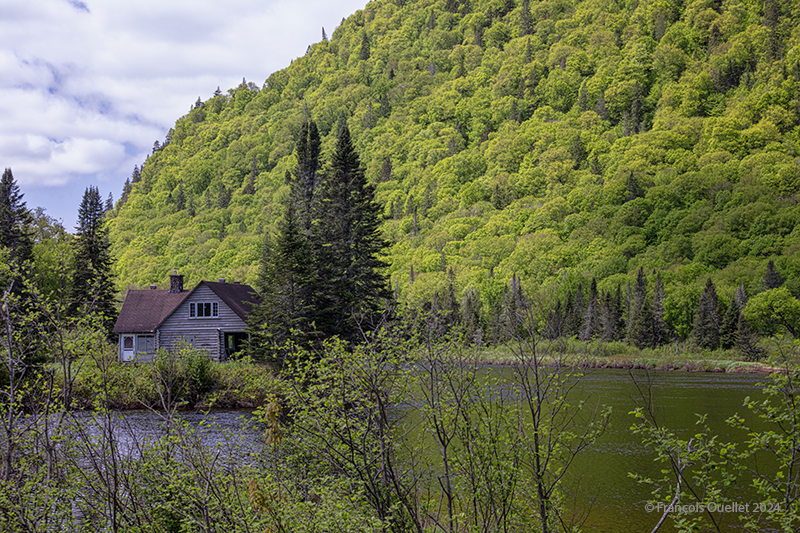
Historic lodge in Spring in the Jacques-Cartier national park in Québec.
The photo above shows a historic chalet in Jacques-Cartier National Park in Spring. It’s no longer available for rent, but it’s a great asset for photography enthusiasts. At this location, paddleboarding is safe thanks to a very weak current.
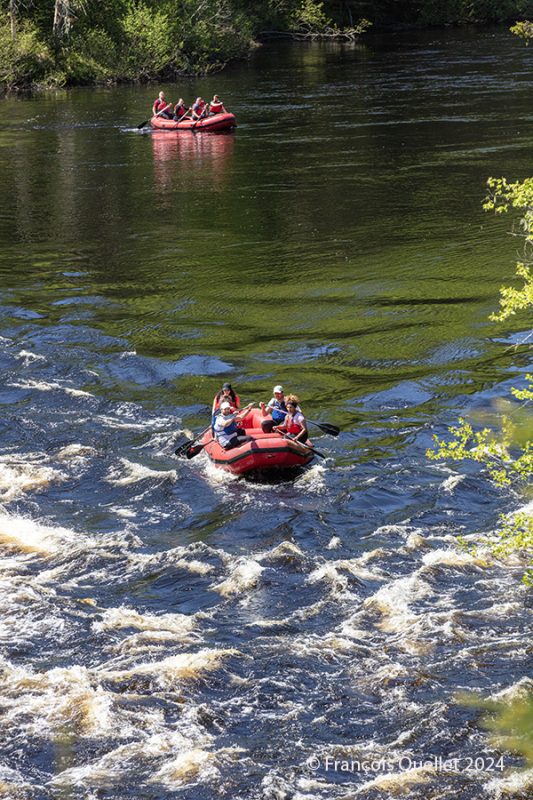
Tourist attraction in the Parc national de la Jacques-Cartier in Québec.
On the same day and on the same river, but a few kilometers upstream, a group of people attempt their first descent in an inflatable boat on a rougher stretch of water.
The first group takes the plunge, while the second watches, waiting its turn and trying to learn from the others’ mistakes. Occasionally, paddlers get stuck on top of a flat rock flush with the water, and have to use their initiative to free themselves and continue their journey. Sometimes canoeists find themselves in the water, and Sépaq staff have to help them out.
Click on the links for more photos and other articles about the province of Quebec.
After all, it’s quite possible to have the right to photograph without having the right to publish. You also need to know the nuances between editorial and commercial distribution, as well as how to obtain written authorization where applicable.
There are also nuances between the privacy laws of the following two groups: the first made up of Quebec and France, and the second made up of the rest of Canada, the United States and the majority of Western countries.
In addition, a distinction must be made between the person who is the main subject of the photo and those who are merely incidental to it. The laws also change depending on whether the photo is taken from a public or private place. Finally, there are always exceptions to each category. As you can see, nothing is simple in this area…
The author uses case law to flesh out his points. He also discusses the limits of police and security officer powers, and what is legally permissible on Facebook and other social networks when it comes to disseminating an image.
He also elaborates on the difference between patrimonial, moral, integrity and authorship rights. He even expands on the changes to copyright before and after November 7, 2012. A section of the book tells you how to detect if your images are being used illegally, and how to request corrections and compensation.
Finally, Francis Vachon uses the last sections of his book to show us how to obtain photos legitimately, and sometimes free of charge. He also shows us how to protect ourselves from a lawsuit.
In short, a book full of vital information for the amateur and professional photographer, as well as for all social media users. Many of these users are full of good intentions, but can find themselves in trouble pretty quickly for inadvertent negligence.
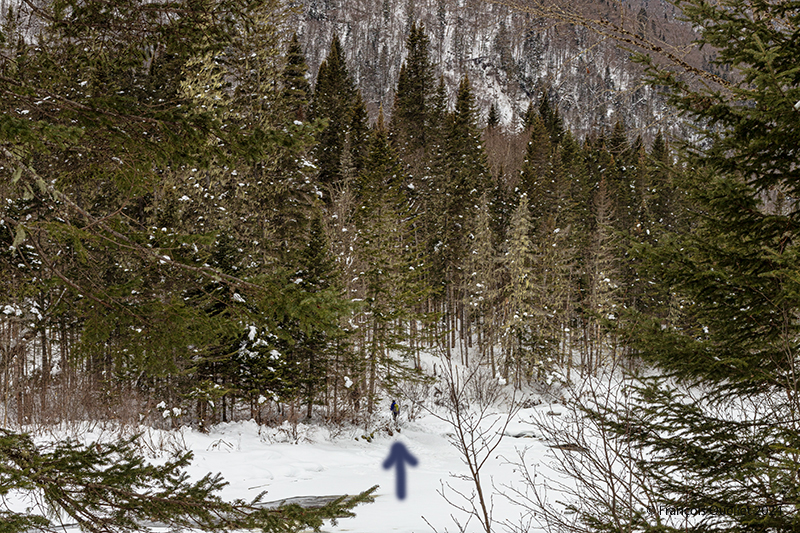
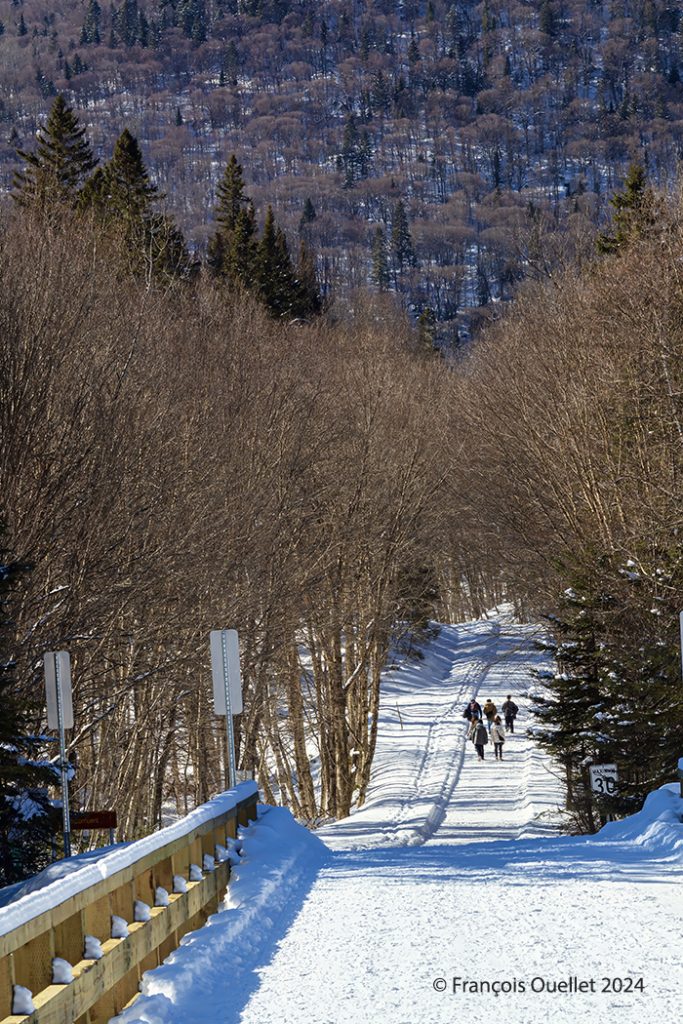
Hiker entering the Jacques-Cartier National Park’s forest, Winter 2024.
The province of Québec offers in 2024 a free admission to Parc national de la Jacques-Cartier a few days a week. This means more visitors than ever before head for the park. Hikers seeking absolute peace and quiet should opt for the paid days.
Even so, if you look carefully, it’s always possible to spot a lone walker, as in the photo above. Most people take the marked trails for ease, but others, like the individual above, venture out on snowshoes near the Jacques-Cartier River, which is completely covered in snow at this time of year.
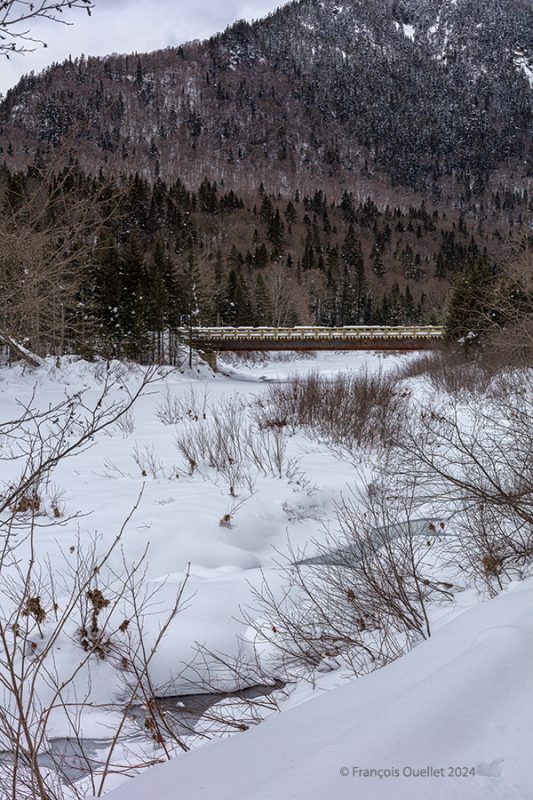
Jacques-Cartier National Park’s landscape, Winter 2024.
Approximately three kilometres from the Discovery and Services Chalet is a bridge. From here, the hiker can capture some very beautiful scenes. In winter, an interesting effect can be achieved by positioning yourself close to the banks.
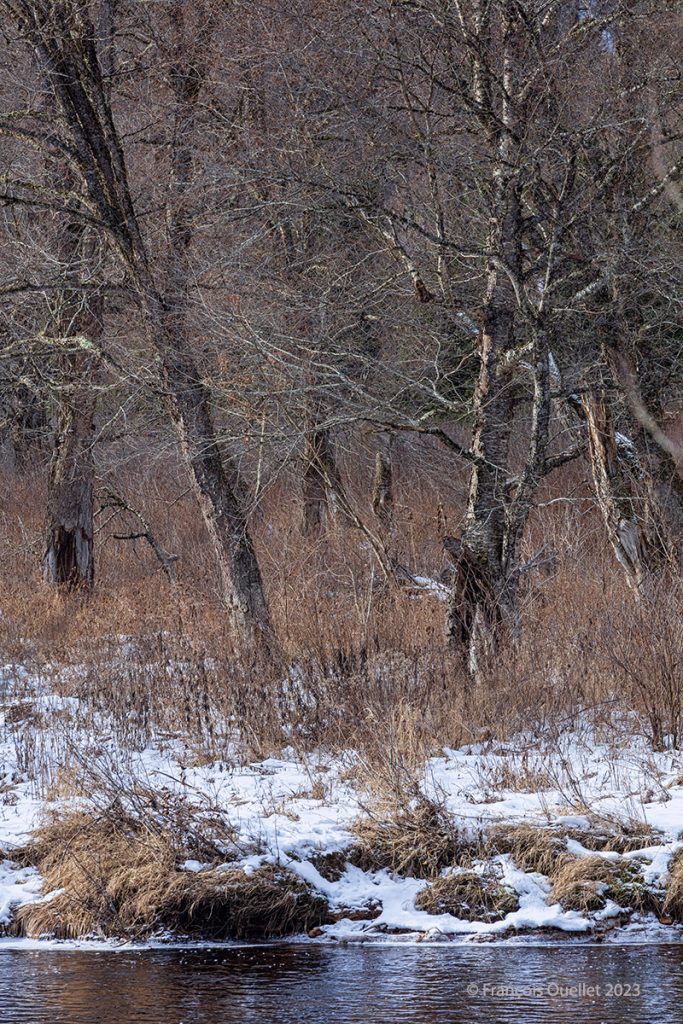
November in the Jacques-Cartier National Park in Quebec, 2023
This scenery relaxes me so much, yet there are no spectacular elements. Rather, all the components are in perfect harmony: reflections in the water, some bluish snow here and there, brushes and a few leaning trees lit from the side by a soft late afternoon light. As the large trunks occupy the majority of the scene, I chose a vertical format for the photographic composition.
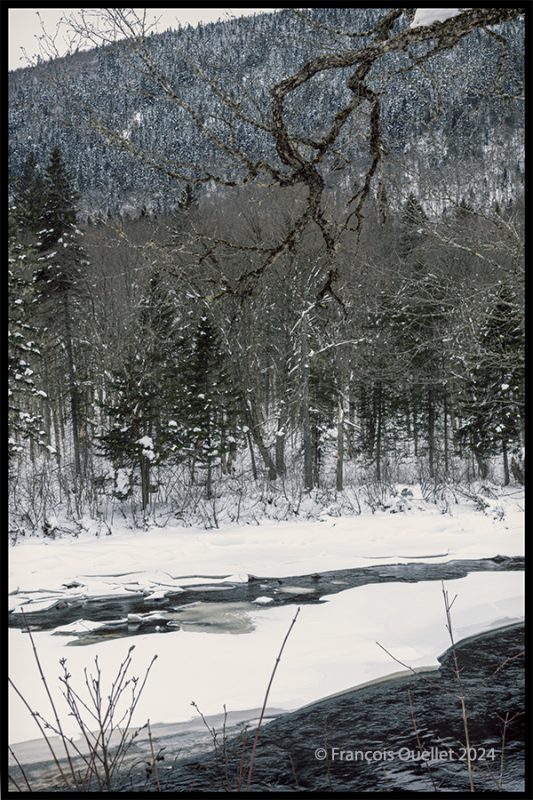
Photo of the Jacques-Cartier national park, Winter 2024.
Above, the landscape attracts the eye with its combination of horizontal, vertical and oblique lines, as well as its alternating black and white in the foreground. I positioned myself to include in the scene a large branch that enters the photo from the top right-hand corner.
The foreground features open water, snow-covered ice, pure ice and snow-covered ice again. In the middle ground, coniferous and deciduous trees. In the background, a forest revealing the snow on the mountain floor. I’ve left only a hint of sky, as the latter offers no particular interest on this cloudy February day, other than to add some white to complete the alternation of colours.
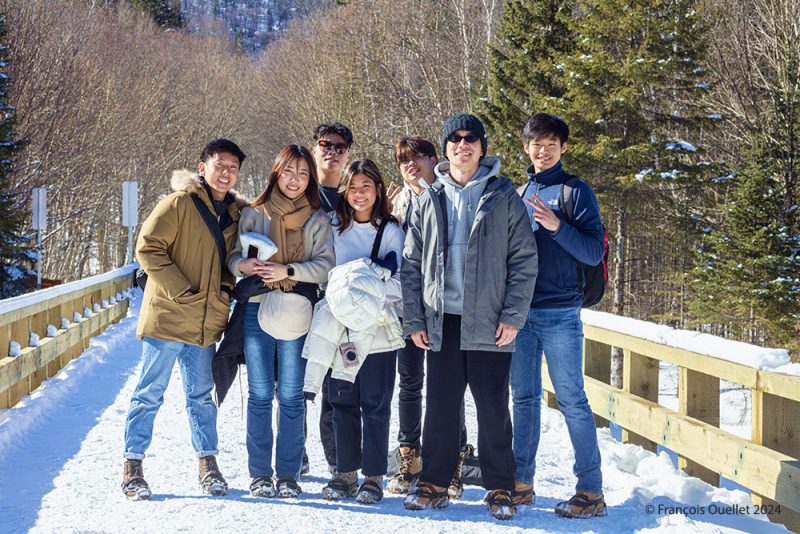
Students from Singapour visiting the Jacques-Cartier National Park during winter 2024
During my hike in the Jacques-Cartier National Park today, I met some French people, a Polish woman and seven students from Singapore. They are part of an exchange program with Canada and are currently studying at an Ontario university. They are taking advantage of their reading week to make a little trip to Quebec.
A group of students from Singapour on a trail in the Jacques-Cartier National Park winter 2024
You couldn’t ask for a better day for the long excursion they’ve planned. It was -13C early this morning, but a new air mass entered Quebec and by the time I took these photos, we’d already reached +1C with beautiful sunshine and almost no wind. But I reckon they’ll have much walking to do to complete their excursion before the park closes for the evening.
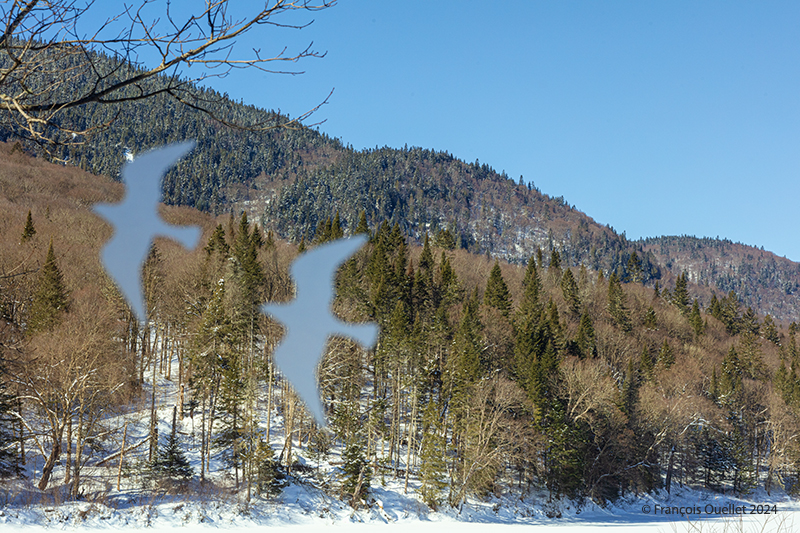
Birds on a window at the Jacques-Cartier National Park winter 2024
Bird decorations are glued to the windows of the Discovery and Service Center at KM 10. I attempted a photo from inside the building, while including the forest in the background.
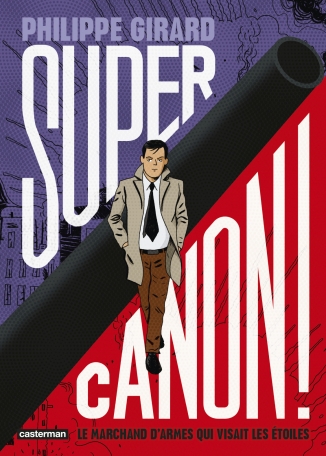
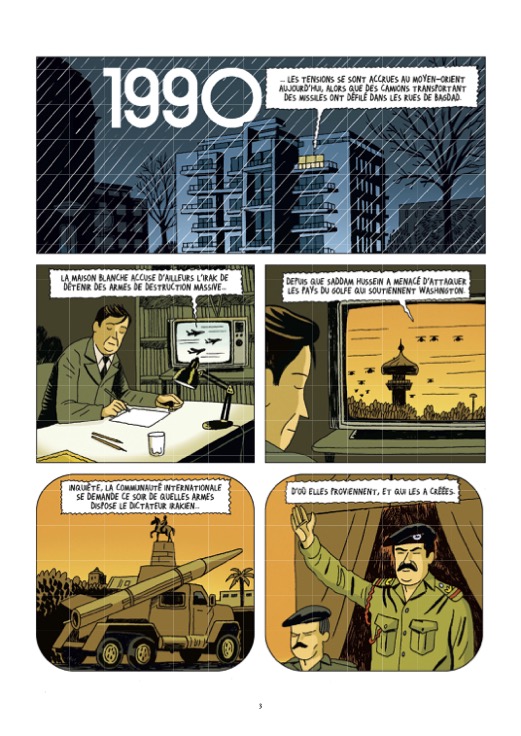
The graphic novel “Super canon” from Philippe Girard.
With “Super canon— Le marchand d’armes qui visait les étoiles”, writer Philippe Girard offers us a high quality graphic novel, as much for the scenario as for the drawings and colour choices. For this work, he benefited from an author residency in Liège. He certainly enjoyed his experience in Belgium much more than his writer’s residency in Poland, where he had to fend for himself because the hosts hadn’t respected the scheduled introductions and appointments. At the time, he used his misfortune to produce a very interesting graphic novel entitled “Le Starzec — un mois à Cracovie”.
Graphic novel “Le Starzec – Un mois à Cracovie” by Philippe Girard.
“Super Canon” is based on a true story, that of Canadian engineer Gerald Vincent Bull. Of course, it’s impossible to retrace this man’s life step by step, so the author has created a character named Doctor Gerry.
On reading the book, we realize the incredible talent of Gerald Bull, the scientist who revolutionized ballistics. We bear witness to his chequered destiny, tormented as he was between his youthful dreams and his boundless ambitions.
To balance his research budgets and keep his company afloat, he gradually transformed himself into an arms dealer. He offers his service to multiple states, including Canada, the United States, Israel, Iraq, Iran, China. In the process, he becomes the object of constant surveillance by many agencies and accumulates enemies.
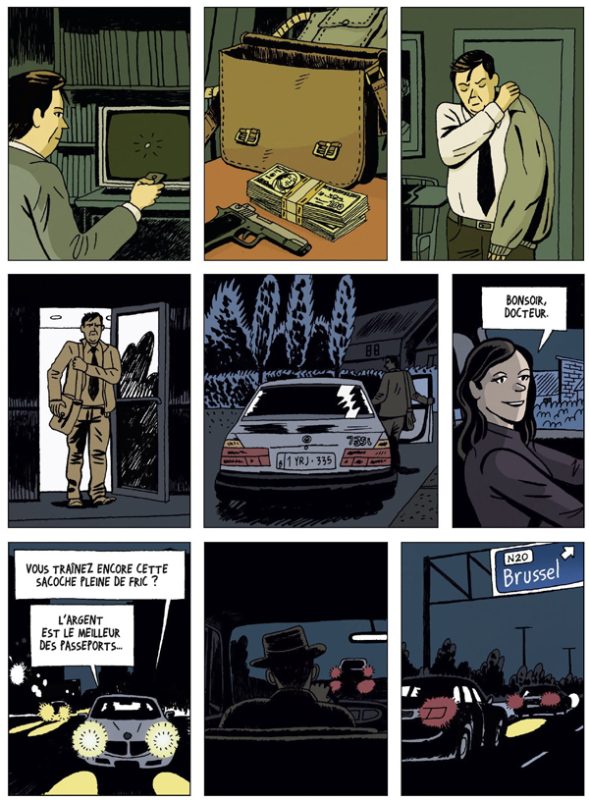
A page from the graphic novel “Super Canon” by Philippe Girard.
We’re dealing with a genius who has purposely blocked any critical thinking about his weapons of destruction. He dreams of a powerful cannon to send satellites into space, but the intelligence agencies of other countries hold very different plans for his invention.
He naively believes that he will be able to serve several masters with divergent interests, without this causing him the slightest problem. It borders on childish reasoning, on wilful blindness in the pursuit of the high life.
My only reservation regarding the content concerns the first page of the story. I find an ambiguity about Iraq and weapons of mass destruction (box 5, page 3). This was indeed the initial fear raised by the United States, but repeated follow-ups by UN inspectors had shown that Saddam Hussein had no such weapons. The invasion of Iraq couldn’t be justified on such a basis. The invasion went ahead anyway, and none of these supposed armaments were found in Iraq. I would have liked the UN’s conclusions to have been mentioned. This would have allowed to establish the book’s scenario on a basis that left no room for doubt.
A page from the graphic novel “Super canon”.
Otherwise, one thing’s for sure: you’ll enjoy this extremely well-crafted graphic novel.
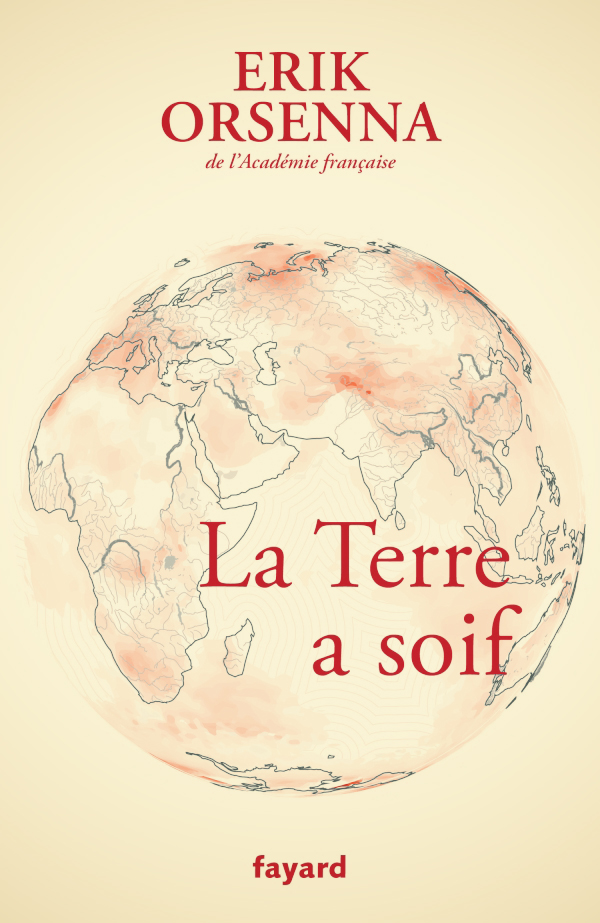
I appreciate Erik Orsenna for his erudition, his Cartesian thinking, his poetry and his ability to find the detail that will amuse the reader while informing him. In his book, the author tackles with equal comfort a wide variety of themes relating to history, religion, philosophy, the environment, climate change, renewable energy, pure science, politics and economics.
Being first and foremost a man of the field, he quickly recognized the need to develop and maintain political contacts in many countries in order to facilitate his travels in areas often considered problematic. The reader benefits from this privileged access.
In “La Terre a soif”, he presents us with portraits of thirty-three rivers around the world. The list is not exhaustive, of course, because after years of travel and observation, he was pressed by the publisher to produce his book. I know that if it were up to him, he would still be on the road accumulating information, each more interesting than the other.
Here are some of the rivers discussed in this book: Mississippi, St. Lawrence, Loire, Nil, Congo, Ganges, Mekong, Colorado and even Panama’s two rivers. The smallest of the rivers mentions in the book flows in Brittany, France and is called Trieux, while the largest is the Amazon in Brazil.
With some of the more powerful countries like China, or Israel and a few others, negotiating for the equitable administration of a river is difficult. The dams built by a powerful country reduce the flow downstream and the smaller surrounding countries make do with what is left. Water harvesting also dries up land over long distances, affecting agricultural production.
Navigation on waterways must also adapt to the reduced flow. One example is the Panama Canal: [DeepL translation]: “ The lack of water is the great fear of Panama. We remember that the heart of the canal is the great Gatún Lake. If it were to dry up, the ships would run into rocks and sand: they would no longer be able to transport their cargo from one sea to the other. Trucks would have to take over”. (p.252)
In contrast, the author shows that there are ways to administrate a major river so that it benefits the riparian countries. He cites the management of the St. Lawrence River by the United States and Canada as an example.
Contrary to what one might think when it comes to the environment and water scarcity, not everything in this book is negative. On the contrary, Erik Orsenna has understood that the reader is tired of alarmist statements. The author has therefore designed a very well-balanced book where it is possible to make the reader’s thoughts evolve without the latter feeling the need to take an antidepressant at each chapter.
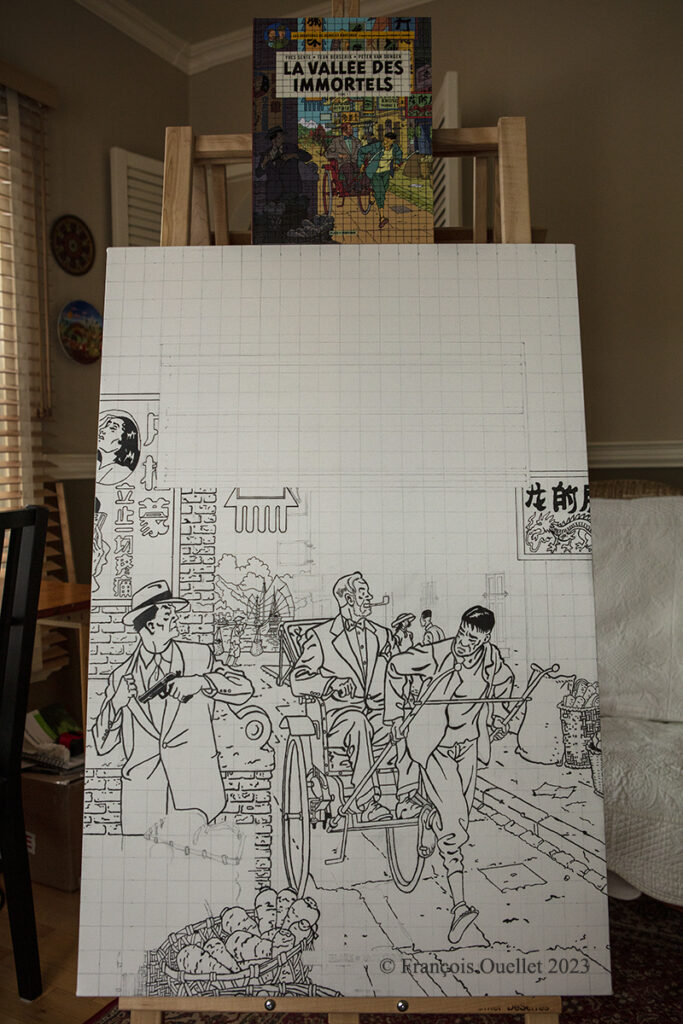
Enlarging the Blake and Mortimer album: La vallée des immortels tome 1
In February 2023, I began transferring the cover of the Blake and Mortimer album “The Valley of the Immortals – Part 1” to a 24 x 36 inch canvas.
The photo above shows the original album sitting on top of the canvas and the work in progress. There is still a lot of work to do before the drawing and lettering are finished.
Then comes the coloring stage, to get the tones as close as possible to the original album. The cover has a lot of colors, which is not the case with many other Blake and Mortimer albums.
This particular album resonates with me for several reasons. First of all, the authors use in the scenario a Cessna C-170B type plane, which brings back memories of flying. Indeed, by a happy coincidence, in 1981 I flew across Canada in this small aircraft dating from 1952. The plane was not equipped with any air navigation instruments, except for an old compass. We were not yet in the GPS era! I published the story of this flight from St-Jean to Edmonton on my blog.
Another reason that increases my interest in the album is also related to a memory. On the cover, Mortimer is in Wan Chai District, a district I visited in 1990 during a trip to Hong Kong and the New Territories. At that time, the Cathay Pacific Boeing B-747 used the legendary Kai Tak airport and flew the approach over a huge demonstration of more than 100,000 people commemorating the anniversary of the Tiananmen Square massacre.
I will be posting more photos of “The valley of the immortals” painting over the next few months, numbering the title of each article so that those interested in the subject can find their way around.
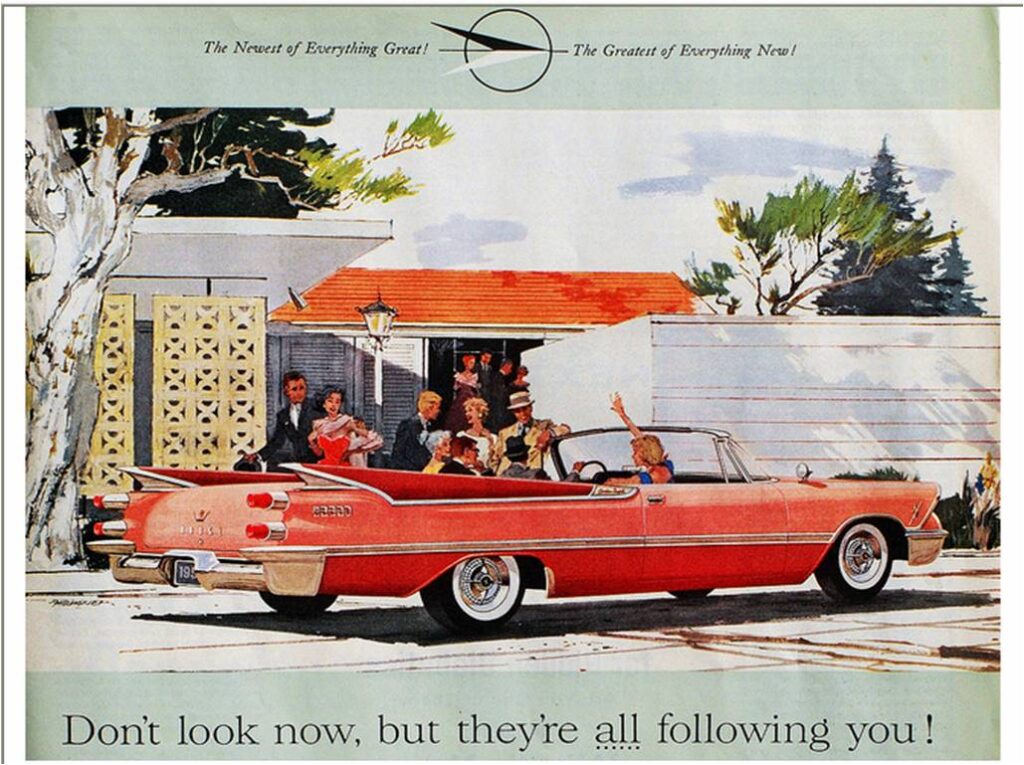
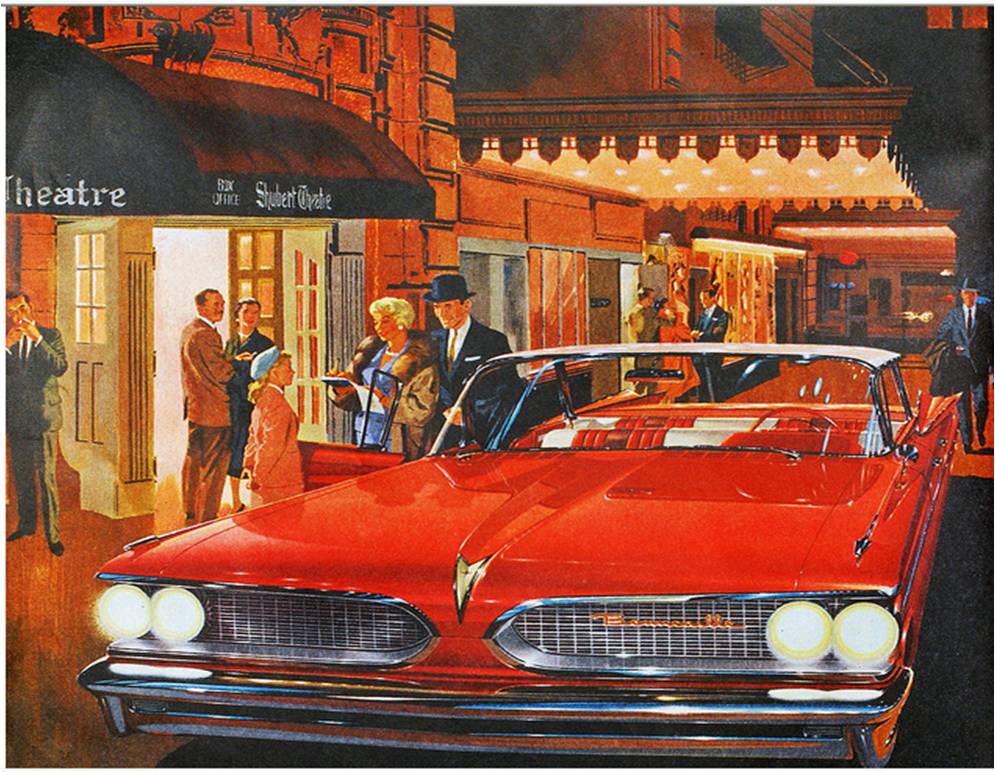
The two pictures below show advertisements for cars that were found at the time in various magazines.
Old advertisement of a big american car
Old advertisement of a Pontiac Bonneville american car.
These old representations of a new car favored very bright colors to catch the reader’s eye and increase the chances of a sale. In the two photos above, red and orange are found on cars, buildings, dresses, faces, etc.
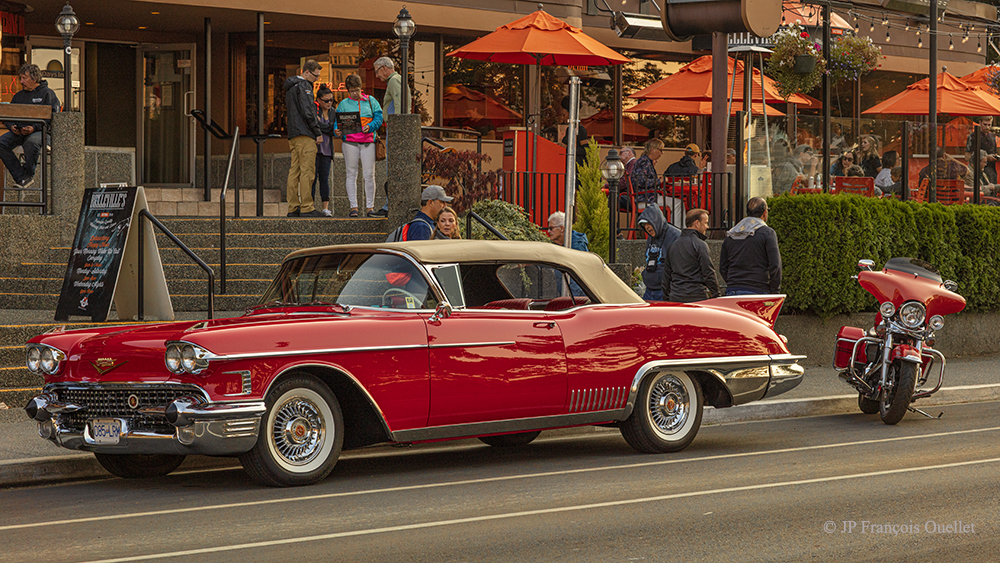
Vintage Cadillac parked in Victoria, British Columbia
When I spotted this old Cadillac in 2018 in Victoria, British Columbia, the two previous photos came to mind. Again, several elements of the same red and orange colors are found in the photographic composition: the Cadillac, the motorcycle, the umbrellas, the post office box, the chairs and tables, and even part of the menu. It almost looks like an artificial set-up for an upcoming advertisement!
Click on the link for more photos of Canada and Québec on my blog.
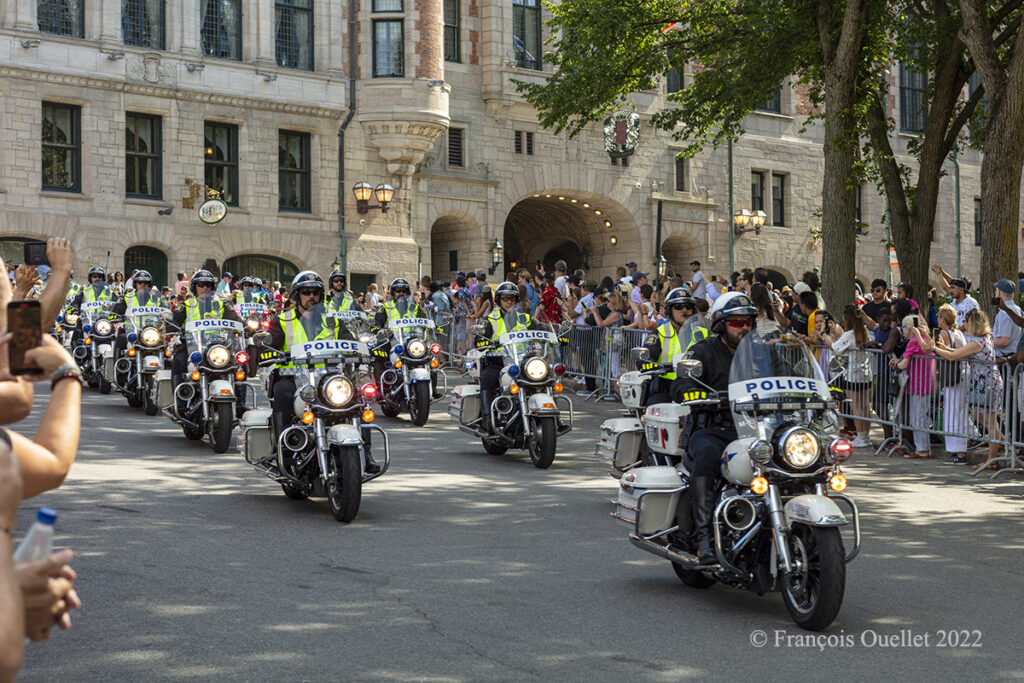
Motorcycle policemen lead the convoy bringing the Pope to Old Quebec in 2022.
If you don’t have privileged access, the main difficulty in photographing the arrival of Pope Francis in Old Quebec in 2022 lies in the vague and sometimes contradictory information offered to journalists in an obvious effort to protect the itinerary of the head of state.
You also have to deal with the strong police presence and the barriers that open and close according to the mood of the moment, blocking bicycles and pedestrians long before the Pope has crossed the Saint-Louis gate. As a photographer, you don’t want to find yourself suddenly stuck in a place of no interest.
Other aspects to consider are purely photographic, such as the ambient light and the distance from the subject at the time of the photo, which will influence the choice of equipment carried.
The official convoy arrives on Saint-Louis Street. It is important to know that in the afternoon, the sun crosses directly the axis of the Saint-Louis Street in its slow descent towards the west. If you position yourself along this street to take the picture, there is no physical obstacle, but you photograph against the light a convoy which passes at full speed. The camera sensor does not appreciate backlighting, because it has difficulty evaluating which light takes precedence. The choice of a straight line on Saint-Louis Street is therefore not very interesting.
The crowd greets Pope Francis on his arrival in Old Quebec in 2022.
The Pope’s driver sits on the left (at least in Canada). The Pope will therefore be on the right, whether forward or backward. If one stands in the Place d’Armes, one gives priority to the driver rather than to the Pontiff.
As the sun travels progressively from the axis of St. Louis Street to the west, the tall trees of the Place d’Armes will create a natural veil blocking the effects of backlighting. This will increase the chances of successful photos.
On St. Louis Street, the convoy is moving quickly in a long straight line. The chances of getting a good picture decrease. When the security cars reach the end of Saint-Louis, they have to brake because of a sharp curve near the Château Frontenac. If you position yourself immediately after the curve, the chances of getting an acceptable picture increase greatly.
As for photographic equipment, a camera lens that requires little light will help optimize shutter speed and depth of field, especially in the late afternoon. The Canon EF 85mm f/1.2L II USM lens offers more flexibility.
A camera with a full-frame sensor will also allow the cropping necessary to magnify the photo without loss of quality. For the photos included in this article, the camera used was a Canon 5DSR.
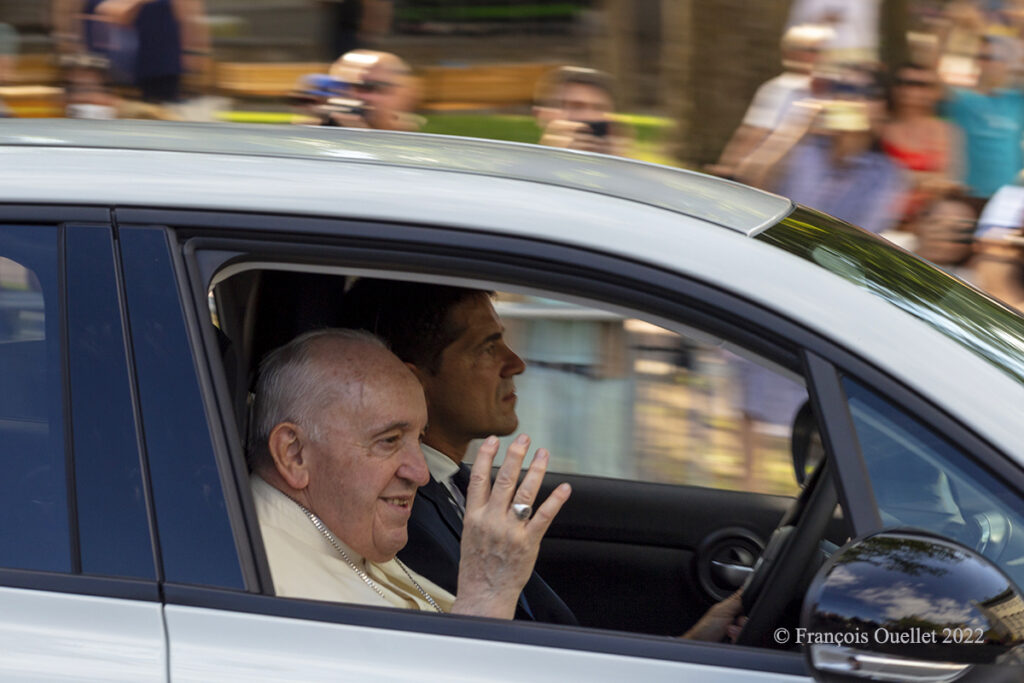
The riskiest technique which therefore requires a little more experience is to take the picture of the head of state in his car in focus while leaving the outside blurred, to show that the car is moving fast. You follow the car with the camera’s viewer. The closer it gets to you, there is an obvious feeling of acceleration. It is thus necessary to increase the rotation of your body to adjust to the car’s relative speed change. The autofocus does its job as the vehicle approaches.
There is only a fraction of a second where you get a completely clear view of the head of state. A second too early and you only see a portion of the face with a piece of the car, a second too late and you get a three-quarter rear view. A continuous shooting mode becomes absolutely necessary.
Pope Francis arrives in Old Quebec on his trip to Canada in 2022.
An adequate shutter speed captures the face of the head of state accurately and keeps the background blurred. A shutter speed that is too fast makes the whole scene clear and sharp, and the photo loses its dynamism. Too slow a speed and the face lacks definition. There is only one chance to get it right.
So, those were a few ideas to remember if you want to photograph important events in Old Quebec. A prior knowledge of the terrain and of the sun’s position at specific times remains essential if you want to increase your chances of success.
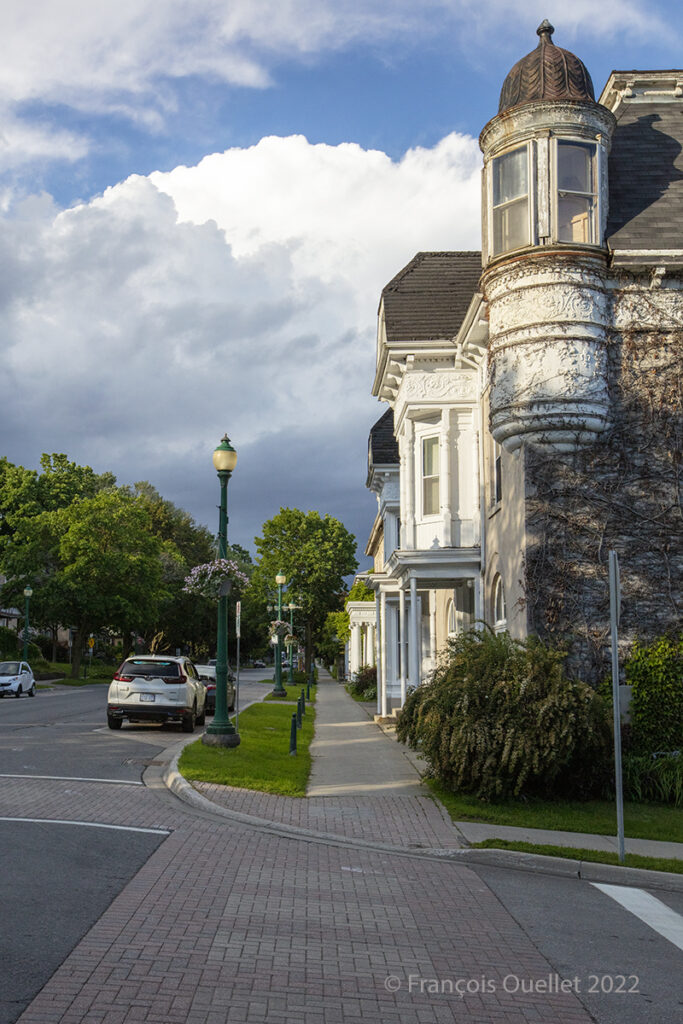
The historic area of Brockville in Ontario is surprising for its architecture, its large mature trees and the presence of a very well-planned marina. At the end of each day, many vehicles come to park along the boardwalk which provides a beautiful view of the St. Lawrence River near the Thousand Islands Archipelago.
The photo above shows one of these old buildings covered with ivy and other vines. The unstable weather on this day allowed us to capture a towering cumulus cloud (TCU) in the background, which adds to the overall atmosphere.
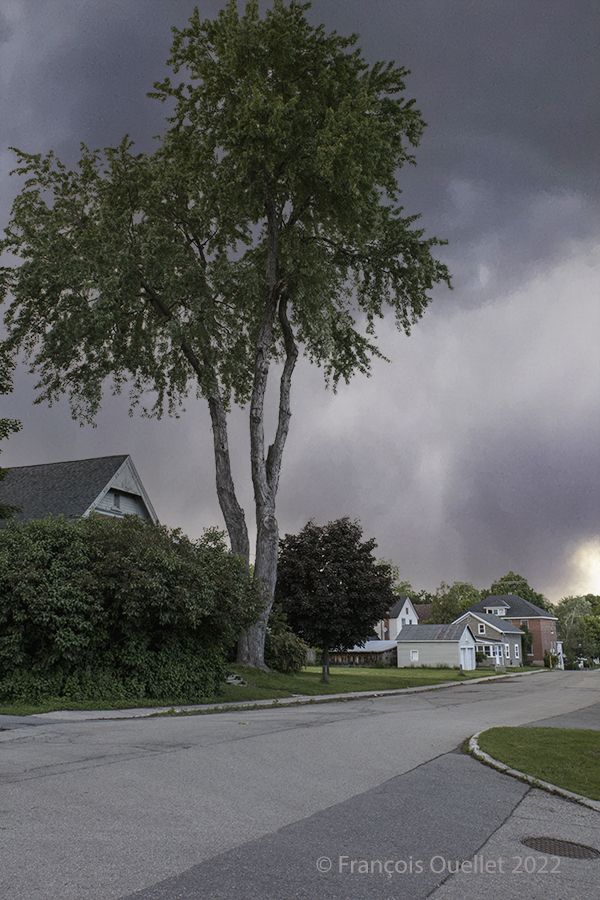
Isolated tree near the historic area of Brockville in Ontario.
While walking around the historic district of Brockville, we spotted this huge tree standing alone at the curb. Although it is not protected by other trees in the area to endure the storms and high winds over the years, it managed to survive and reach maturity without too much damage.
Both pictures were taken with a Canon 5DSr full frame camera.