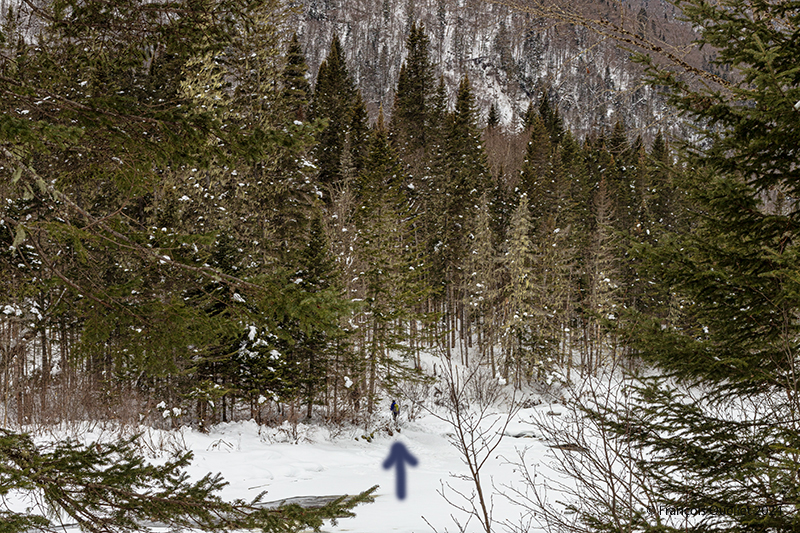
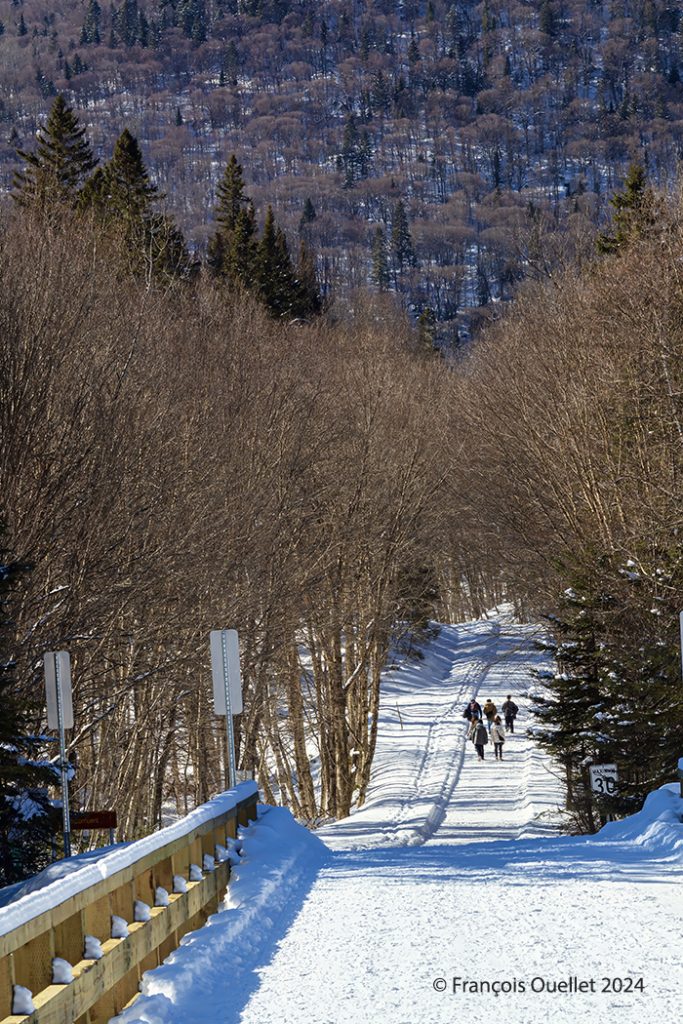
Hiker entering the Jacques-Cartier National Park’s forest, Winter 2024.
The province of Québec offers in 2024 a free admission to Parc national de la Jacques-Cartier a few days a week. This means more visitors than ever before head for the park. Hikers seeking absolute peace and quiet should opt for the paid days.
Even so, if you look carefully, it’s always possible to spot a lone walker, as in the photo above. Most people take the marked trails for ease, but others, like the individual above, venture out on snowshoes near the Jacques-Cartier River, which is completely covered in snow at this time of year.
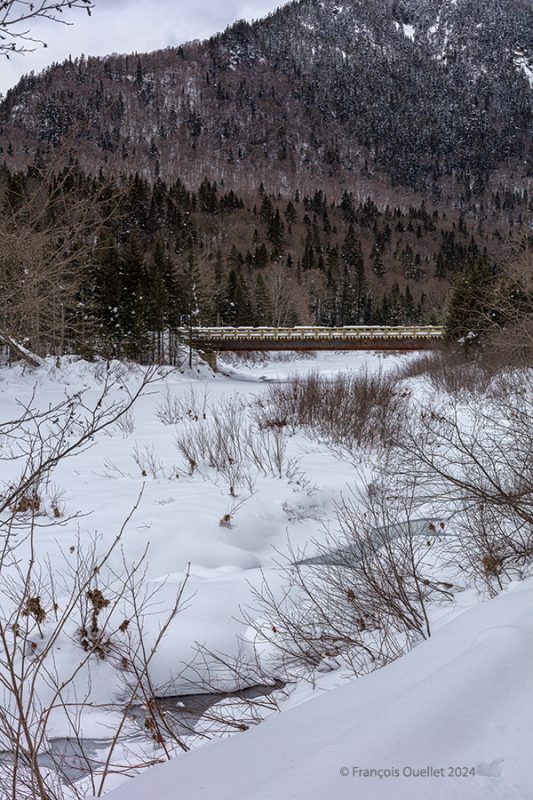
Jacques-Cartier National Park’s landscape, Winter 2024.
Approximately three kilometres from the Discovery and Services Chalet is a bridge. From here, the hiker can capture some very beautiful scenes. In winter, an interesting effect can be achieved by positioning yourself close to the banks.
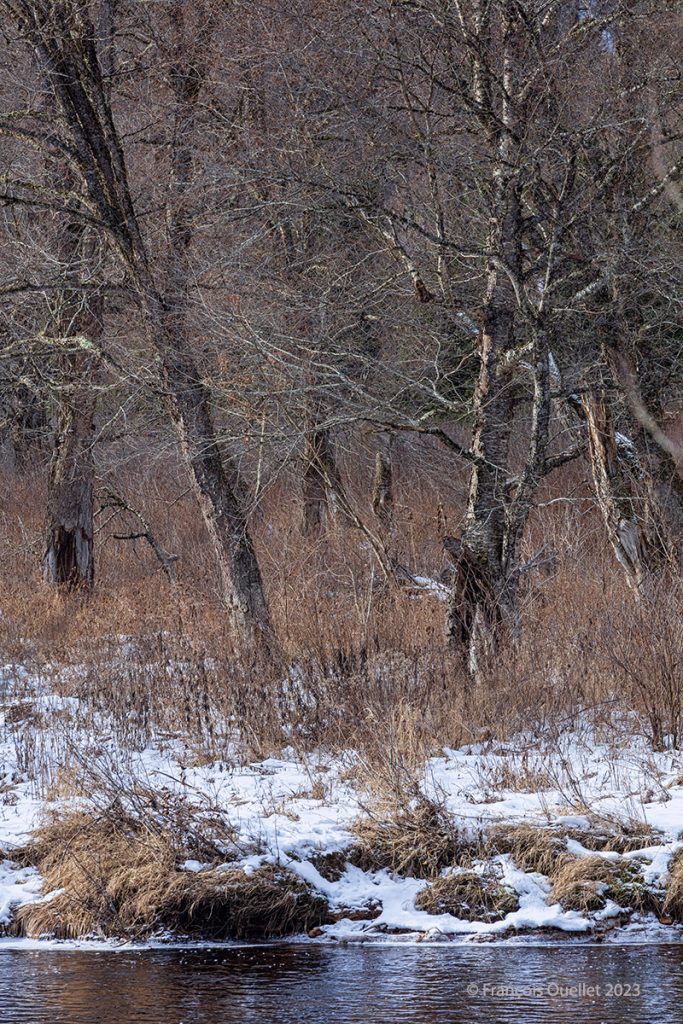
November in the Jacques-Cartier National Park in Quebec, 2023
This scenery relaxes me so much, yet there are no spectacular elements. Rather, all the components are in perfect harmony: reflections in the water, some bluish snow here and there, brushes and a few leaning trees lit from the side by a soft late afternoon light. As the large trunks occupy the majority of the scene, I chose a vertical format for the photographic composition.
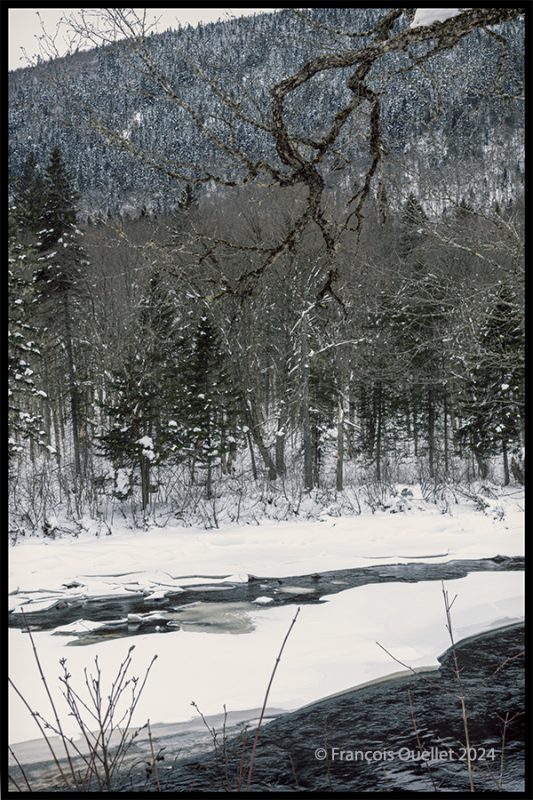
Photo of the Jacques-Cartier national park, Winter 2024.
Above, the landscape attracts the eye with its combination of horizontal, vertical and oblique lines, as well as its alternating black and white in the foreground. I positioned myself to include in the scene a large branch that enters the photo from the top right-hand corner.
The foreground features open water, snow-covered ice, pure ice and snow-covered ice again. In the middle ground, coniferous and deciduous trees. In the background, a forest revealing the snow on the mountain floor. I’ve left only a hint of sky, as the latter offers no particular interest on this cloudy February day, other than to add some white to complete the alternation of colours.
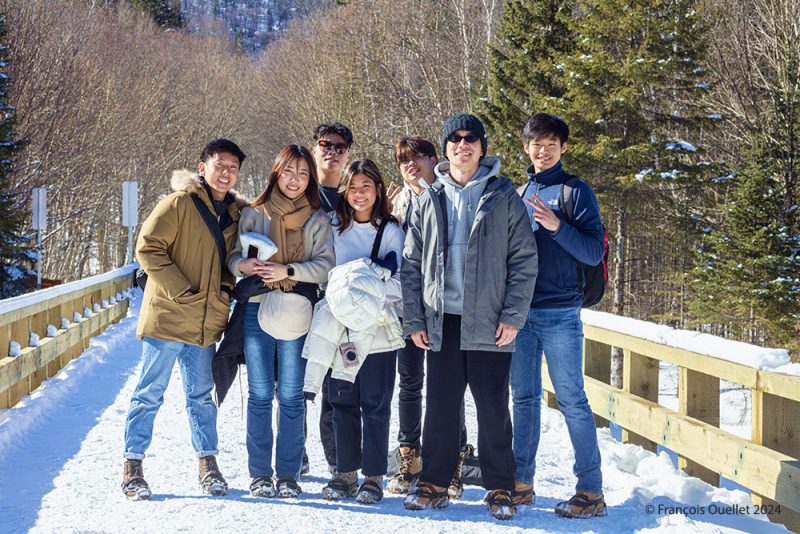
Students from Singapour visiting the Jacques-Cartier National Park during winter 2024
During my hike in the Jacques-Cartier National Park today, I met some French people, a Polish woman and seven students from Singapore. They are part of an exchange program with Canada and are currently studying at an Ontario university. They are taking advantage of their reading week to make a little trip to Quebec.
A group of students from Singapour on a trail in the Jacques-Cartier National Park winter 2024
You couldn’t ask for a better day for the long excursion they’ve planned. It was -13C early this morning, but a new air mass entered Quebec and by the time I took these photos, we’d already reached +1C with beautiful sunshine and almost no wind. But I reckon they’ll have much walking to do to complete their excursion before the park closes for the evening.
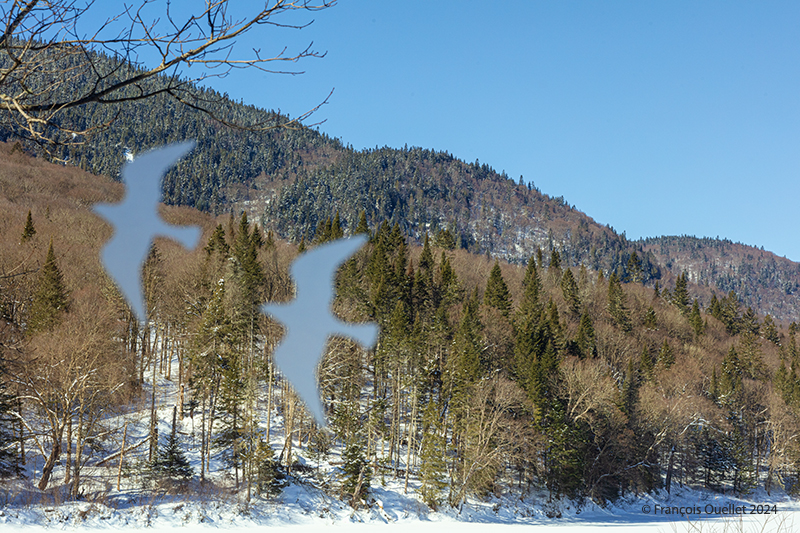
Birds on a window at the Jacques-Cartier National Park winter 2024
Bird decorations are glued to the windows of the Discovery and Service Center at KM 10. I attempted a photo from inside the building, while including the forest in the background.
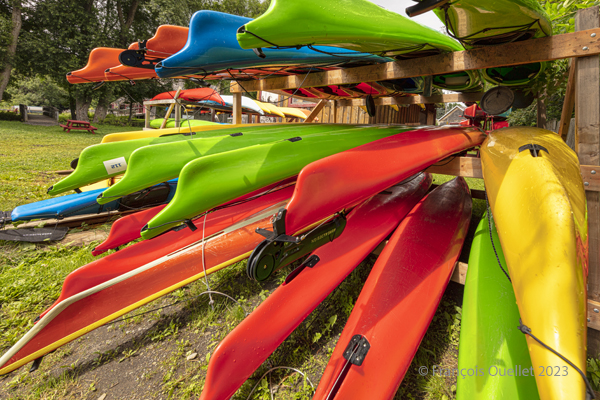
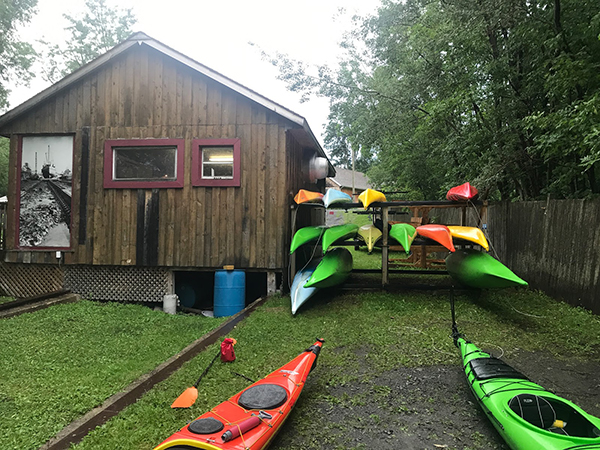
Sea kayaks at Saint-Laurent-de-l’Île d’Orléans 2023
On Sunday, September 24, 2023, the company Quatre Natures organized a certified level 1 sea kayaking course the St. Lawrence River, starting from Île d’Orléans. As registration was done well in advance, we had to be a bit lucky during the activity, as it would take place as much in good weather as in bad.
So, I take a chance. Fortunately, an incredible day awaits the six students: full sun and twenty degrees Celsius. How should we dress for the circumstances? We know that the human body temperature is 37 degrees Celsius. The kayaker adds up the water and air temperatures and compares the total to the temperature of the human body. With the river that day at 18 degrees and the air around 20 degrees, this gives a total of 38. As this figure is slightly higher than normal body temperature, we can wear normal clothing for water activities, rather than a wetsuit.
The morning is used to cover theory. No one sets foot in the water. The instructor discusses what the kayaker must have on board, the relative quality of different equipment, preparation, communications and radio frequencies, safety and hypothermia prevention, and so on.
Sea kayaking activity at l’île d’Orléans (photo Vadym Kravchenko)
After lunch, the kayaks are placed on the lawn and the vocabulary related to each part of the kayak is learned. The student then settles into the kayak and learns how to adjust the footbraces, hold the paddle, install the spray skirt, and so on. The boats are then brought to shore and kayaking begins.
First, we learn the basic maneuvers. How to embark and disembark, the trajectory the paddle should follow in the water depending on whether you want to go forward, backward or turn. We discuss the correct position of the body, arms and wrists on the paddle, and the importance of rotating the pelvis to force the paddle properly. We quickly realize the influence of side winds on the kayak, especially when it has no centerboard or rudder.
The river is considered level 2 for kayaking. The current is strong, and we have to deal with three-metre tides. The wind around the island is also stronger than in Quebec City. Level 1 kayakers are encouraged to seek out Level 1 locations to gain experience, and never to set off alone at this stage of their learning process.
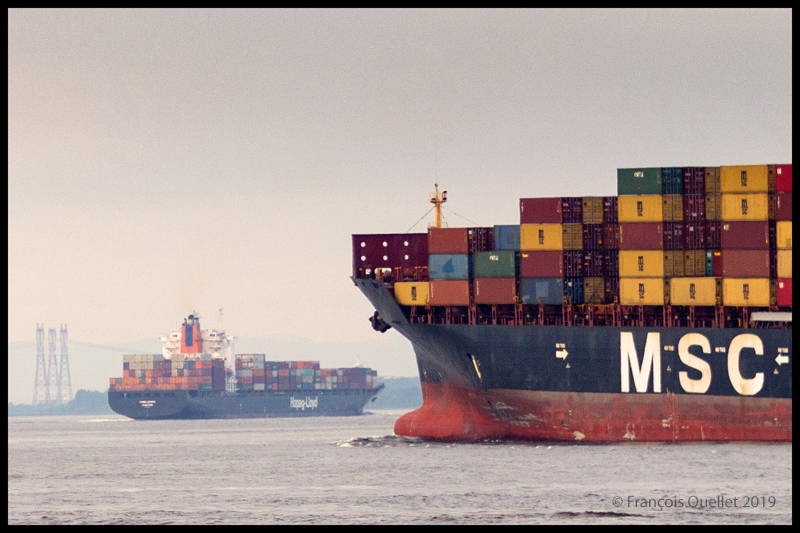
During the exercises, you can see the container ships and the various pleasure boats offshore. The larger vessels generate waves that take between five and ten minutes to reach the shore. When these approach, the instructor warns novice kayakers to turn to face the wave, so as to limit the effects on the boat.
The container ship Hapag_Lloyd Quebec Express and the container ship MSC Paola are sailing around Île d’Orléans near Quebec City.
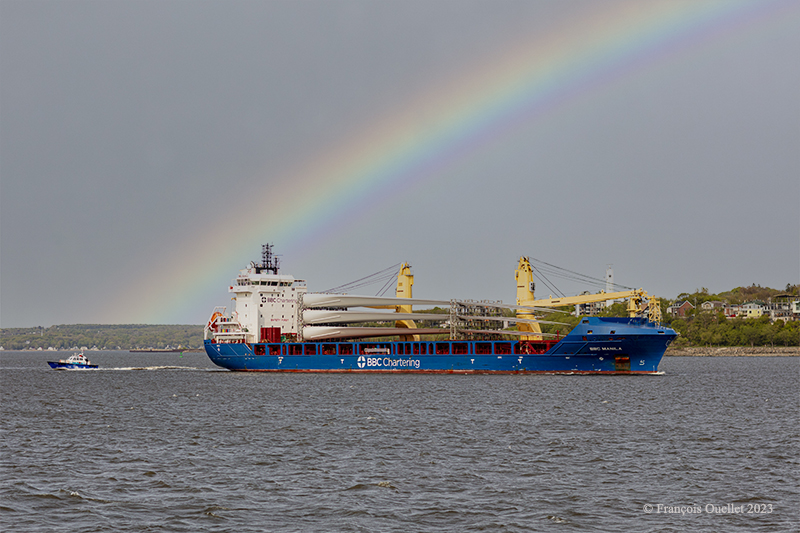
The BBC Manila carries wind turbine blades on the St.Lawrence Seaway near Quebec City.
Then come the emergency maneuvers: what’s the procedure for getting out of a kayak that’s just capsized? How do you help someone who has capsized?
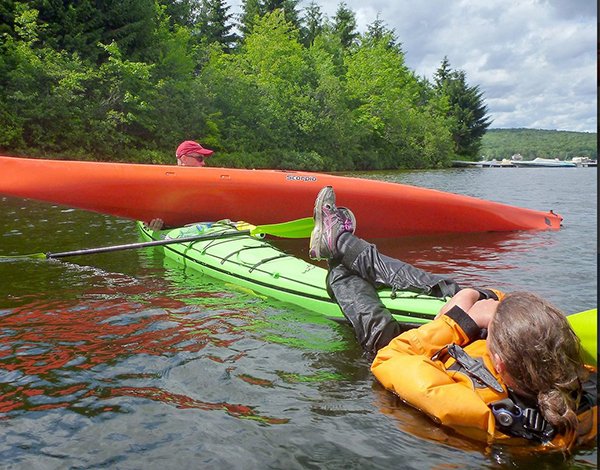
I didn’t have time to get to this stage of the course. I capsized before. I don’t remember how I managed to extricate myself from the kayak and get back to the surface, but we’re not talking about an approved method here. The brain immediately detects the danger and organizes itself so that the body gets out of the kayak and the head doesn’t stay underwater for too long.
In the minutes that follow, the instructor teaches us how to perform the classic exit from a capsized kayak. We work in pairs. At Level 1, there’s no question of using the paddle to force the kayak to turn.
To obtain KDM 1 certification, everyone must lean sideways so that the kayak tips over. Once submerged, the student leans forward, unhooks the spray skirt attached to the kayak, and slowly taps the kayak’s hull three times to signal that he is in control of what he is doing. The instructor wants to avoid unpredictable reactions. We then push ourself out of the kayak by placing our hands at hip height on the coaming. As soon as we are out of the water, it’s imperative that we hold on to our kayak, thanks to the lifeline. It only takes a few seconds. Here and there, you can hear a little coughing as the student surfaces, but nothing more. A good sip of St. Lawrence River boosts the immune system.
Next comes the recovery of the person in the water. As we work as a team, the kayaker in difficulty clings to the front of our kayak and stays there until we catch up with his or her kayak, lift it onto our boat, empty it of water, turn it over and position it correctly.
Sea kayaking course level 1 with Quatre Natures (photo Quatre Natures)
The person clinging to the kayak then releases his or her grip, and depending on the method taught, climbs back into the boat while the latter is being held securely. The important thing here is to keep the center of gravity as low as possible. If the person doesn’t hurry and proceed step by step, the operation is a success every time.
A few more exercises follow, and it’s back to the beach on Île d’Orléans a few hours later. Once all participants have dried off and put on their warm clothes, the course concludes with a few weather notions, including the need to consult weather forecasts and radars, and to return quickly to shore when storm cells are present.
We also cover tide calculation (rule of 12) and how to attach a kayak to a car roof. How many attachment points? What equipment is available to make the job easier? Where should harnesses go to avoid breaking the kayak? Etc.
The KDM 1 certificate is awarded approximately eight to nine hours after the start of the course, depending on the instructor’s assessment. I noticed that on the way home, in the heat of the car, I really didn’t feel like rushing on the road. But you quickly come back to reality when you see how fast the cars are coming up behind you.
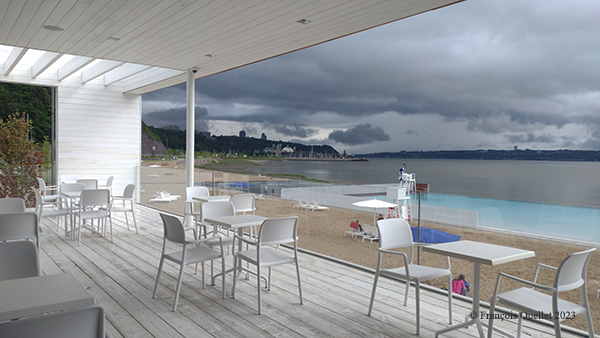
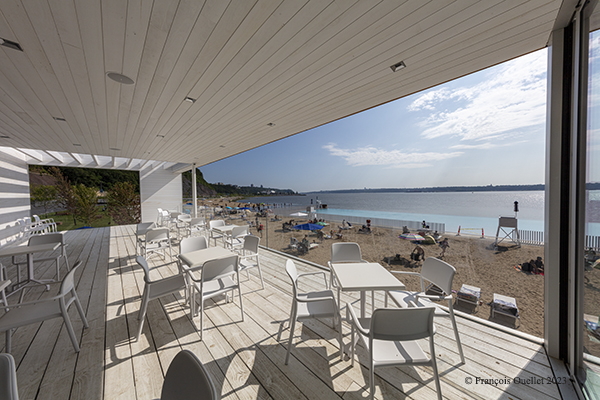
Comfortably seated on the new terrace of Quebec City’s Station de la Plage, I wrote this article sheltered from the elements.
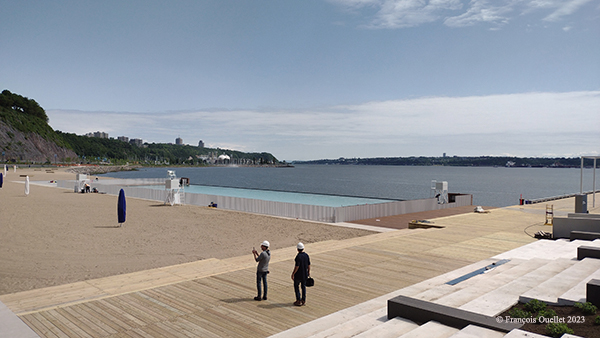
Phase 3 of the Promenade Samuel-De Champlain in Quebec City will have cost around $190 million. A site foreman confides: “The most complex part of all this was complying with the actual government requirements. We had to do a lot of digging and install infrastructure to prevent wastewater from being discharged into the St. Lawrence River. We also had to deal with the sudden increase in inflation: to avoid a $50 million overrun, we had to shorten the width of the children’s romper and cut where it had to least impact “.
While out cycling, I took the opportunity to snap a few shots of the construction progress around what will develop into the “station de la Plage”.
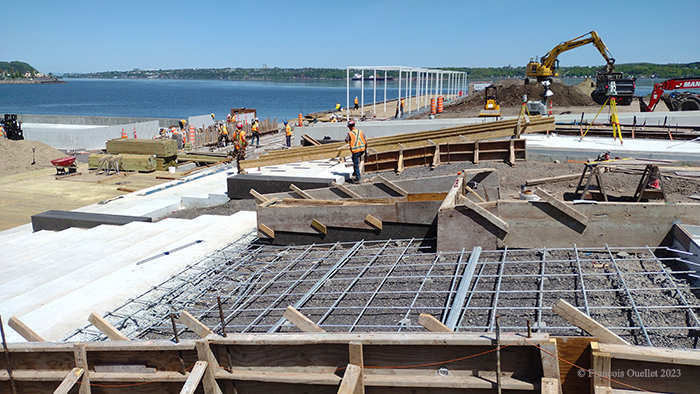
Construction of the stairs at the “station de la Plage”, Quebec City.
The picture above shows the production of the reinforced concrete for the main staircase.
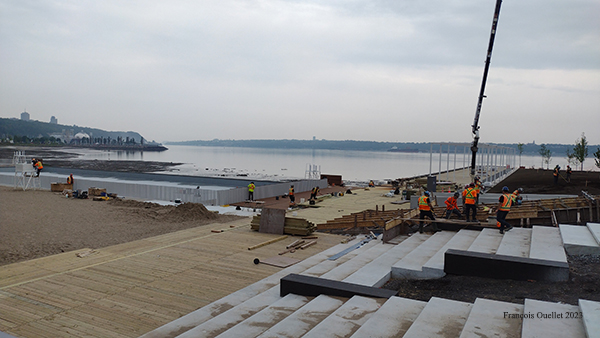
Below, the finished steps can be seen. What will become the swimming pool (on the left of the photo) receives its first coat of paint. A modification to the pool’s depth necessitated the installation of a fence.
Painting the swimming pool at the “station de la Plage” and installing the fence.
It can disappear completely into the ground as soon as swimming is allowed. However, its operation is currently causing serious problems, as with all novelties. When the motor exerts too much force to raise a section of fence, it falls back down on its own. The presence of sand in the vicinity may have been ignored, or at least its effect underestimated, when the railing was designed. Sand is inserted into the gears with each day’s activity. And there’s no question of using grease to make it easier to raise and lower the panels: the sand would stick to the lubricant and further complicate operations. A technician has been working for weeks to rectify the situation.
The “station de la Plage” is almost completed.
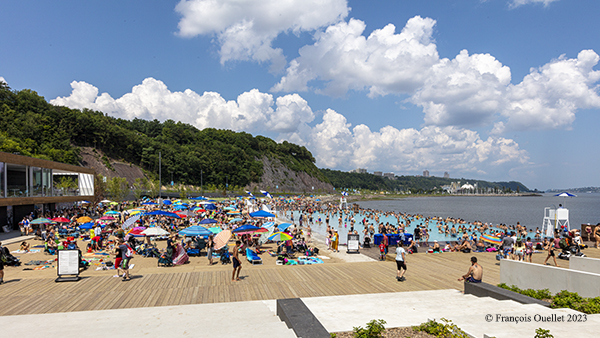
The pool has now received a coat of blue paint. This creates a clear demarcation with the color of the river water, an effect that will also benefit photographers. Only a few preparations remain before the population can officially access the site. The Commission de la capitale nationale de Québecwants people to be able to bathe just in time for the Fête nationale des Québécois, on June 24.
From now on, the incredible popularity of the site with the public will have to be managed. Indeed, in their eagerness to access the beach, few individuals bother to read the current regulations. This task will fall to the security staff, who will have to utilize their teaching skills and diplomacy to get the message across.
In fact, the “station de la Plage” and “station de la Voile” are so popular that the planners had to quickly rethink parking management. On sunny days, thousands of people come to relax on the sites. Cars arrive laden with children and beach equipment, and everyone hopes to find a space for their vehicle. But by 10 a.m., there’s nothing left.
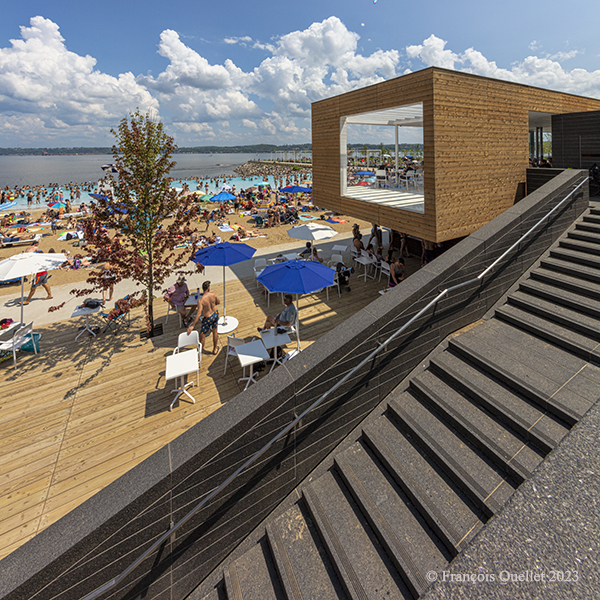
The two beach and building attendants have their hands full observing everything that moves, correcting habits and arguing with people. Because, in addition to the scarcity of parking spaces, pedestrians are not tolerated strolling alongside their bicycles, either near the beach or on the elevated terrace.
Raised deck at “station de la Plage”, Québec City.
However, the rules and regulations posted on the National Capital Commission’s website are confusing. They stipulate that you must walk on the site and that bicycle traffic is prohibited. You might think that a person walking with his bike at his side would be complying with the requirements, since he’s not straddling it, but that’s not the case.
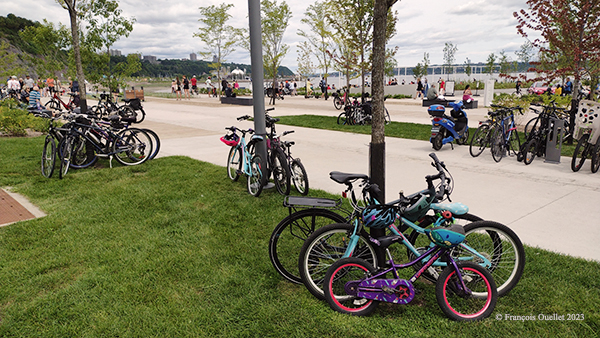
A month into the operation, a security guard tells me: “We’ve already notified over 400 visitors who were walking while holding a bike”. He wants the word to get out. But the facilities for accommodating bicycles are not keeping up with demand. The tree trunks near the main building help out, and serve as a place to put a padlock on busy days.
Trees used to lock bikes at the station de la Plage in Quebec City.
What’s more, with bicycles becoming increasingly expensive, many cyclists are reluctant to leave them unattended for a few hours, even when locked. Experienced thieves are notoriously quick. This first year of operations will therefore require some modifications to procedures and installations.
Non fiction comic book “Mégantic – Un train dans la nuit”.
We have all heard of the tragedyexperienced by the inhabitants of Lac-Mégantic in 2013, when a driverless oil train from the CP railway company pulling hundreds of cars of explosive petroleum derails in the middle of the night, explodes and kills 47 inhabitants of the city.
The comic book (or graphic novelaccording to some) “Mégantic – Un train dans la nuit ” adds to the information that we already knew about this tragedy. It also exposes several key pieces of information overlooked by the media.
Author Anne-Marie Saint-Cerny worked for years on the file and, in order to convey the content and the emotions in images, enlisted the help of Christian Quesnel. The result is extremely interesting. The formula works: the drawings are very precise, the layout leaves room for the reader to reflect on the events, the colours are appropriate.
In the train explosion in Lac-Mégantic, there are multiple factors to consider, among others:
1) Executives of the CP company making catastrophic choices.
2) As always, a desire to meet the demands of shareholders. There is a reduction in staff and the company self-assesses when it comes to safety.
3) One driver only is allowed for a train carrying hundreds of tanks of explosives.
4) Politicians agree to the new cuts proposed by the company.
5) There is some magical thinking involved: if something goes wrong with the driver, the train stops on its own thanks to a mechanism which, however, is always likely to fail eventually.
6) Dated rails.
7) The transport of dangerous goods is granted to the MMA, a company with a dubious reputation .
8) The DOT-111 tanks are too fragile for hazardous materials and targeted in more than 25 surveys.
9) There is an agreement to tamper with the oil bill of lading. Instead of indicating the code PG1 (the most dangerous, the most explosive) as it should be, it is instead PG111 (not dangerous) that is written.
10) The lead locomotive is terribly worn.
11) The driver reports a problem with his old locomotive. He is ordered to continue on his way.
12) In Lac-Mégantic, the train is heating up. The driver is ordered to apply the brakes and let the engine run. The driver is then allowed to leave the premises and go to bed. This is one of the repercussions of allowing a single driver on a train.
13) During the night, a fire starts on the lead locomotive, the one that had problems. The firefighters shut down the engine. “By turning off the engine, the air pressure in the air brakes is released. Eventually, the train will start to move on its own and descend the slope towards Lac-Mégantic.”
With just one driver gone to sleep somewhere, there are now 5,000,000 litres of explosivesstarting to move on the rails and no one will stop them.
“Firefighters believe they are fighting low flammable oil. They are unaware that the CP and World Fuel have falsified the papers, camouflaging their oil classified as the most explosive and dangerous.” There are 47 dead, including several suicides.
Now that there has been a disaster, those involved directly or indirectly are passing the buck, as is the custom in tragedies. The graphic novel mentions, at the political level, the names of Denis Lebel, Lisa Raitt, John Baird and later Marc Garneau. At CP, the author mentions Hunter Harrison. The MMA’s CEO Edward Burkhardt is also mentioned.
Changes happen, but not the ones you would think…
Naomi Klein analyzes the “shock strategy” devised by Milton Friedman. In step 1, “we take advantage of what the population while it is still dazed: they will not be able to oppose what we want to impose on them.” The zoning is being quickly changed to include the expropriation of houses that are totally outside the disaster-affected area. There are some people who are interested in these properties…
In step 2 of the “shock strategy”, we “use the excuse of mandatory decontamination to wipe out the Old World. Excluding the population from the scene of the tragedy, so that they cannot cling to it, so that there is no going back. “
Finally, step 3: “Faced with a population whose shock has been exacerbated by the destruction of its landmarks and habits, we can launch a reconstruction or reinvention which will be received with resigned acceptance“. We have the case of people living in Fatima, a remote area spared by the disaster: owners must quickly sign their expropriation or they shall lose everything. When the former owners are finally gone, a Jean Coutu pharmacy comes to settle on the vacated land.
On the legal side, the small players are targeted and the investigation is limited as much as possible. Takeovers are carried out and returns to shareholders multiplied.
The book flaunts some of the political and entrepreneurial maneuvers aimed at protecting the railway companies. Even at the dawn of 2022, eight years later, the rails still pass through downtown Lac-Mégantic.
“MMA-Canada, essentially bankrupt, has paid nothing and has not been sued.“
“Nothing has changed in rail laws in Canada since the tragedy: companies self-regulate, self-monitor and, in the event of an accident, self-investigate. Thus, it was the CP itself that investigated the deaths of three of its employees in an accident in February 2019 in British Columbia. The CP investigator, prevented from investigating, denounced his employer and called for an independent investigation by the Royal Canadian Mounted Police (RCMP) and the Transport Safety Board (TSB), an investigation immediately accepted by the chief investigator responsible for the case at the TSB. That same day, this TSB investigator was dismissed from his post. The CP investigator concluded on a CP no-fault.”
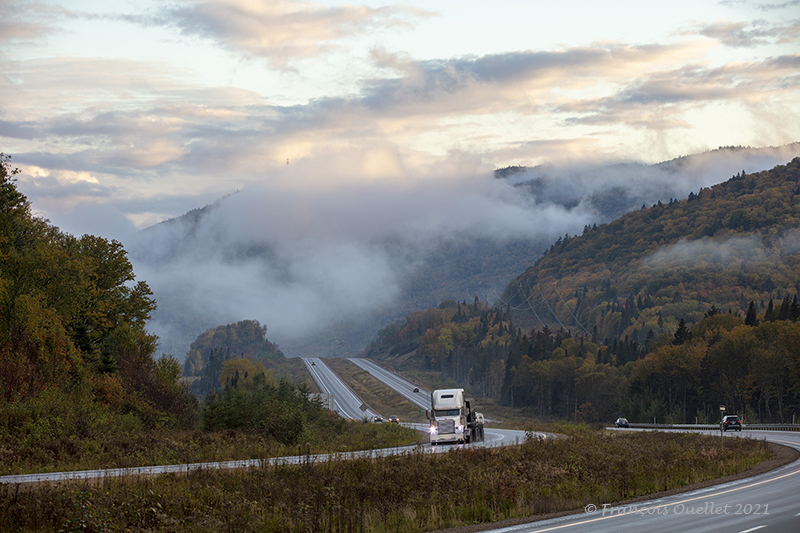
The above photo was taken while returning from a photography session in the Jacques-Cartier National Park on Route 175, near Quebec City. The rapid drop in temperatures in the early evening allowed the rapid formation of low clouds in the valley. The autumn colors and the effects of the setting sun on the clouds help bring the landscape to life. Landscape photography is often the result of careful planning; but one should not overlook unforeseen opportunities, as is the case here.
Route 175 is heavily used by semi-trailer trucks for trips between Québec and Saguenay-Lac-Saint-Jean. So I waited a bit for an eighteen wheeler to get close enough to include it in the photo.
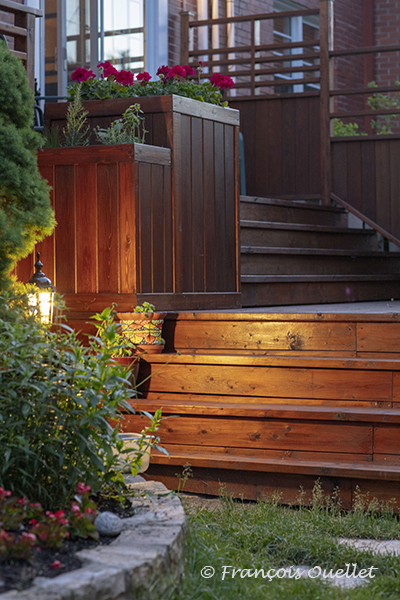
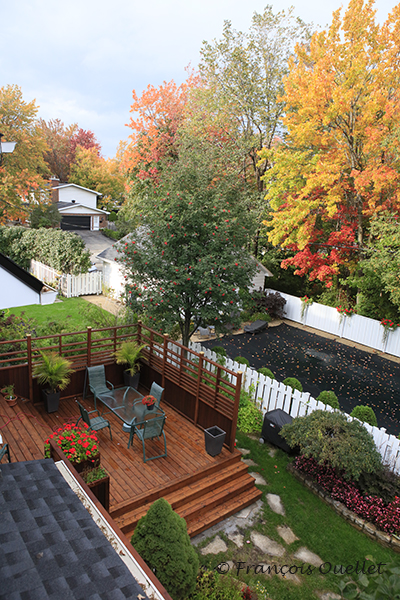
We have arrived at the last article in the “ Building a patio ” series. The photo above shows the two-tiered flower box as well as the three-step staircase that has been completely redone. The last step must be cut at an angle to follow the pronounced drop in the ground at this point, under the patio.
Black metal fence sawn and replanted.
A general view of the railing and of the black metal fence to the left of the photo which has been sawn and set back in cement.
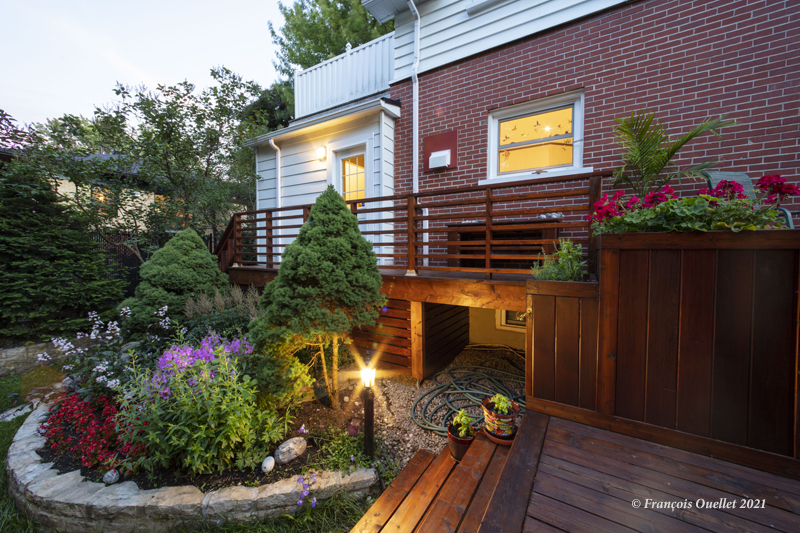
Red cedar siding under the patio and support post.
Above is a view of the red cedar siding built under the patio. I kept an access to the hose and didn’t block out all of the light entering in the basement window. Another fixture has also been reactivated.
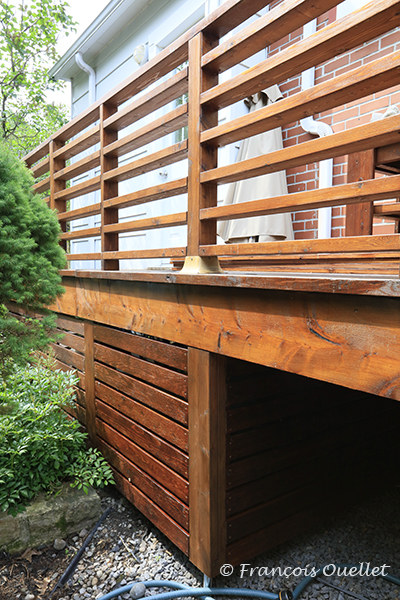
Close-up of the red cedar siding under the patio.
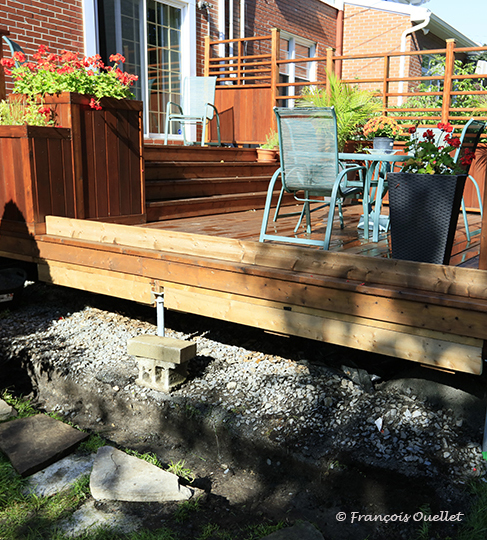
The photo above shows a close-up of the siding under the patio. We can see a metal pole near the watering can which seems to support the terrace: its practical function is null; it is only there for appearance (all the siding is firmly fixed from the top).
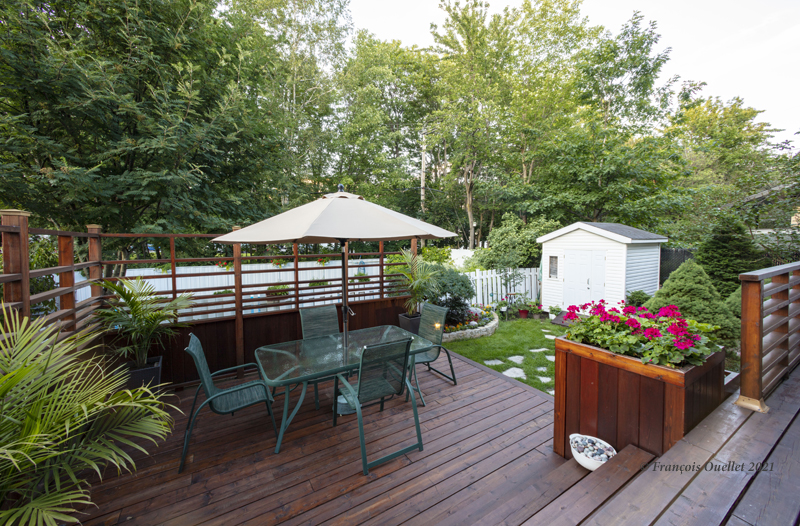
View of the completed terrace.
Overview of the terrace.
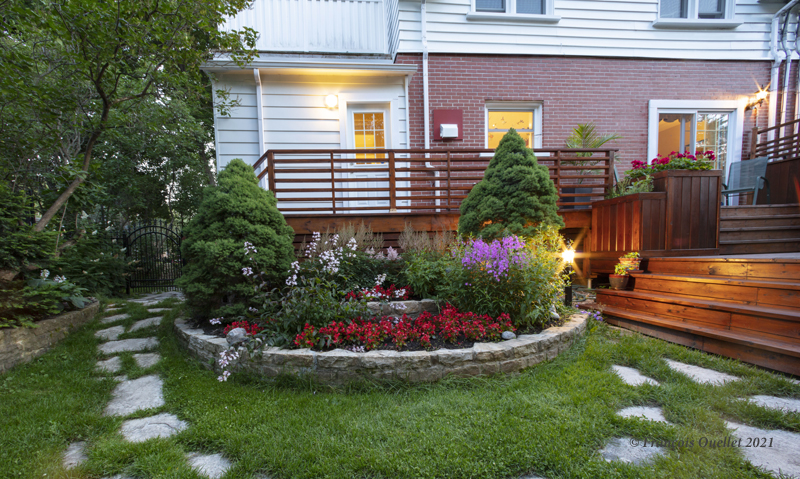
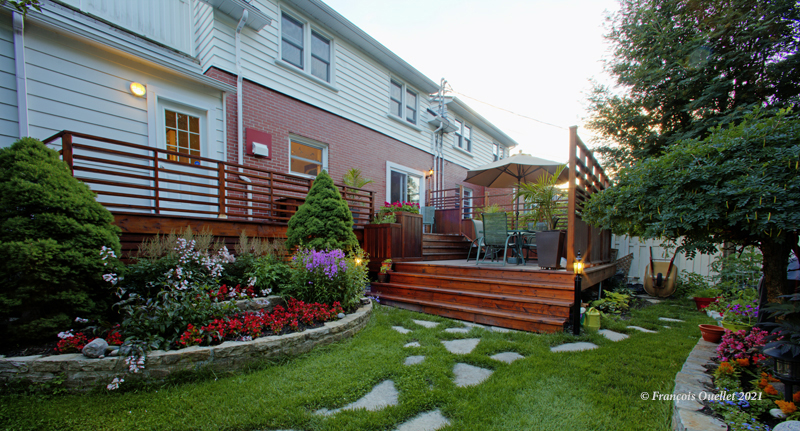
HDR Wide angle view of the wooden deck
Another overview of the patio. This time, I took the picture in HDR, meaning five pictures were taken with a different aperture and compiled on a computer to achieve a result that fights the highlights in the background. When you shoot westward with the sun going down, that’s what it looks like: you have to correct the photo in order to see something. The terrain looks larger than it actually is: this is due to the effect of the wide-angle lens.
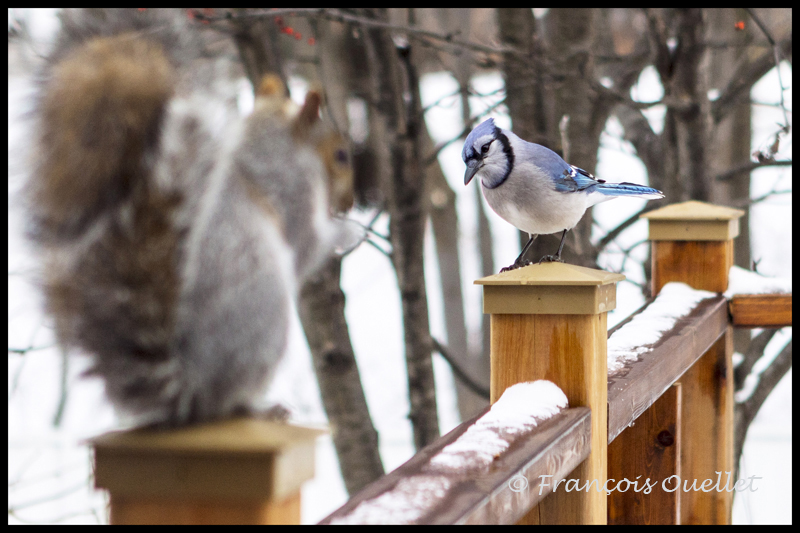
Squirrel and Blue Jay on the new patio.
The last photo is of a squirrel and a blue jay who regularly invite each other for a peanut meal on the patio. If you want to see some close-up photos of these blue jays, click on these pages of my site: Blue Jay in Autumn and Blue Jay and Russian Mountain Ash.
I hope this series on renovation and on building a patio has been helpful to you.
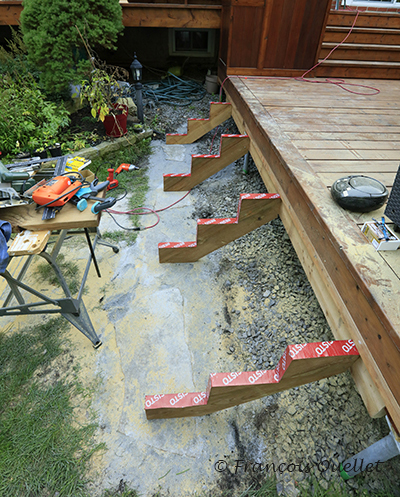
Planning and execution errors forced me to redo some work, including a staircase and the base that will receive this staircase. Renovation is also about going back (but as little as possible!). The cost of additional materials is negligible, but it will take time. It is now necessary to build a staircasewith three steps sitting on a very solid base.
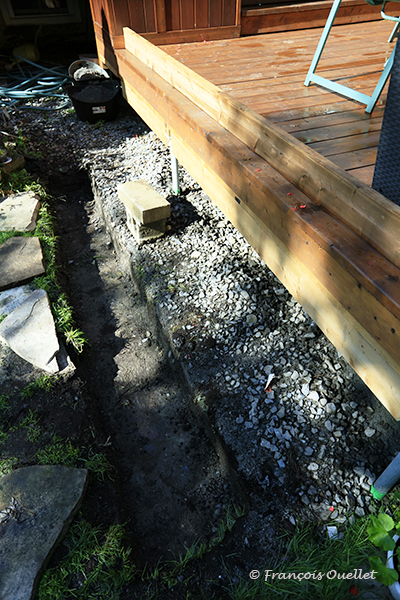
Digging to prepare the foundation of the stairs.
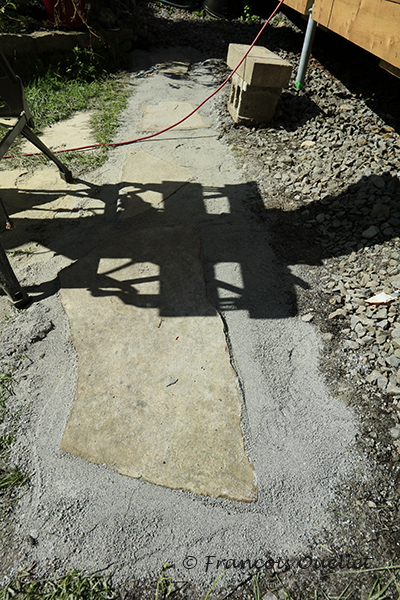
This time, I dig a foot deep, and add 0-3 / 4 rock and stone dust, followed by a few slabs that will receive the stair stringers.
Rocks and stone dust and slabs to receive the staircase.
Here is the final result. Nothing will move.
Cutting the stairs in a 2X12 piece of wood.
From 2X12 spruce boards, the four stringers are cut.
Installation of the four stairs stringers.
The four stringers rest securely on the slabs and are covered with a red Resisto waterproof membrane: this will prevent rot from settling on the stringers. An additional board is needed to accommodate the stringers and it should be placed under the contour beam.
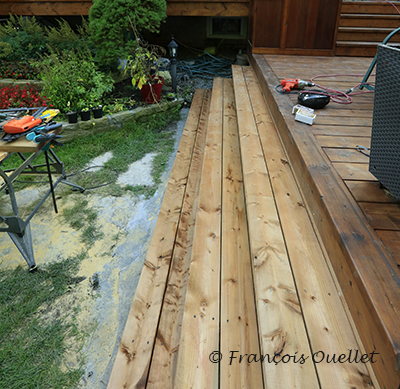
Three-step staircase redone.
The photo above shows the final result, just before the stain is applied.
General view of the first section of the wooden deck.
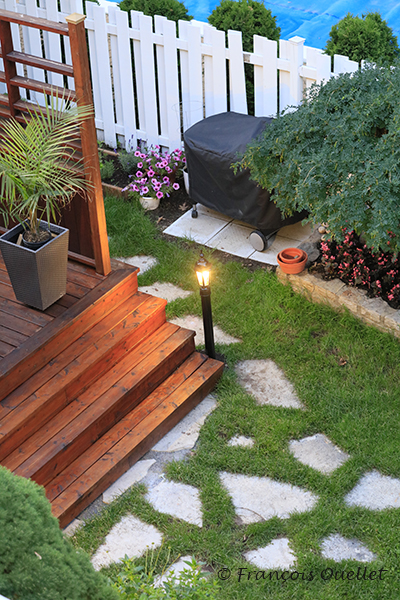
Above is an overview of part of the new terrace, with the new three-step staircase. The grass in front of the steps is badly damaged, having suffered the effects of construction for an extended period. But next spring, everything will be back to normal.
New wooden stairs.
This is the final look of the new staircase the following spring, after the wood stain has been applied and the fixtures have been reinstalled one by one around the patio. Fortunately, not all of the electrical wires were cut by the mechanical shovel, which made their reinstallation easier.
Continued in the next article: “Building a patio (7 of 7)”.
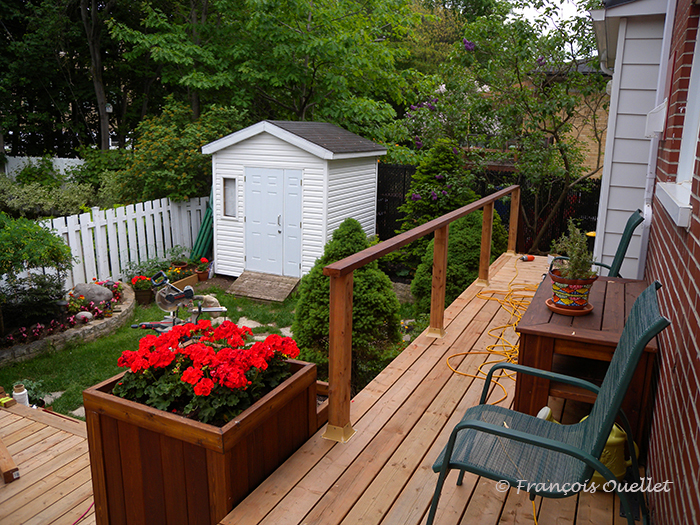
The third staircase and the ramp are under construction. The vertical posts and steps are made of spruce and the rest will be red cedar.
Handrail and staircase.
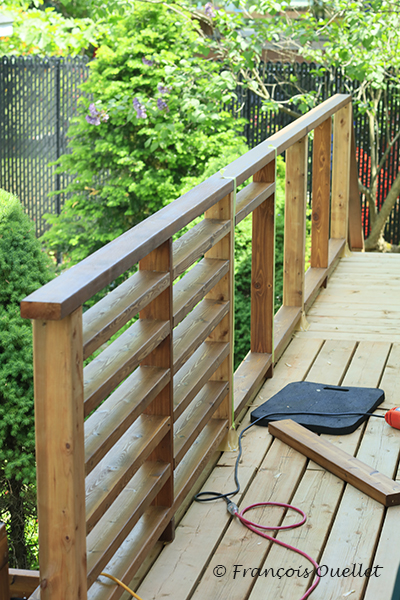
Construction of the railing has started. Initially, we thought of a metal railing with glass panels. We investigated the available models and it seemed to us that the appearance was a bit too modern for the age of the house. We thought that continuing with the same materials as the terrace would be a better idea. I drew up railing plans and had family members vote on which model to use.
Installation of horizontal red cedar posts.
One at a time, the horizontal bars of red cedar are installed between the vertical posts. Spirit level and measuring gallon ensure that the appearance will be as correct as possible. The flaws are easy to see when a railing of this length is built, with so many separate pieces inside.
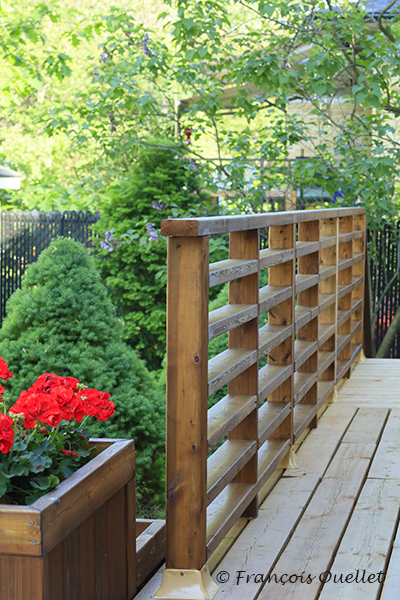
Completed red cedar ramp.
This is the final effect, when the thirty-six pieces of wood have been cut and laid.
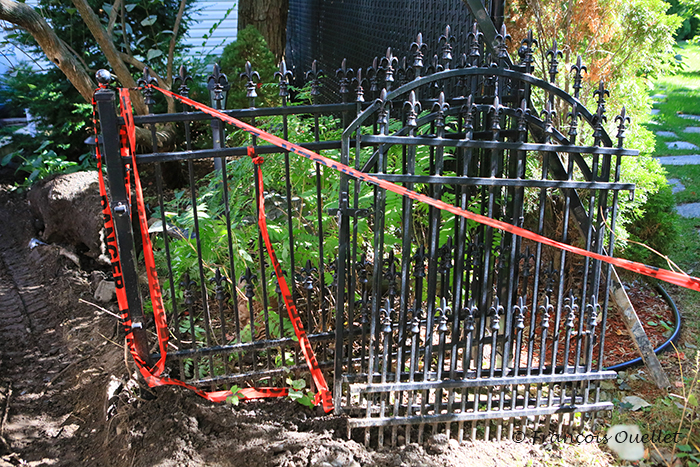
The sections of metal fence to cut and reinstall.
The black metal fence that stood right next to the patio was partially dismantled during the installation of the new French drain. The cement bases of the fence posts were damaged by machinery. It was now necessary to get this old cement out of the ground, regroove, cut off five centimeters from the fence, re-weld the parts of the fence together, recast cement and replant the metal posts.
I tried to have the work done by Clôture Provinciale, of St-Augustin, because the initial fence had been made by them, according to my drawing. After ten calls, months of waiting and no return calls, I tried to approach other companies to do the work. I was told I would have to wait until next year because all the companies had contracts for months to come. Finally, I found a company in Beauport that bid $ 2700.00 to do the work. But it was a bit expensive.
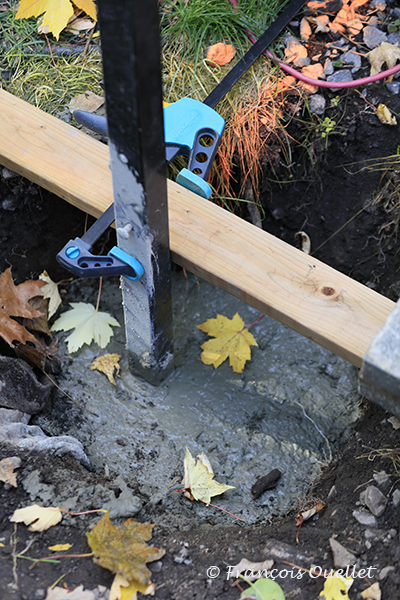
Cement is poured to secure the fence post.
So I decided to do a lot of the work myself, but still called on Clôture Nordik to pull the old cement bases out of the ground and dig two new holes at least 5 feet deep. I sawed off the metal fence and had the sections welded together. I then poured 700 pounds of cement into the two holes, laid the metal posts and reinstalled the fence. I then applied a coat of black Tremclad paint. Total expenses: $ 700 instead of the $ 2700 proposed by the Beauport company.
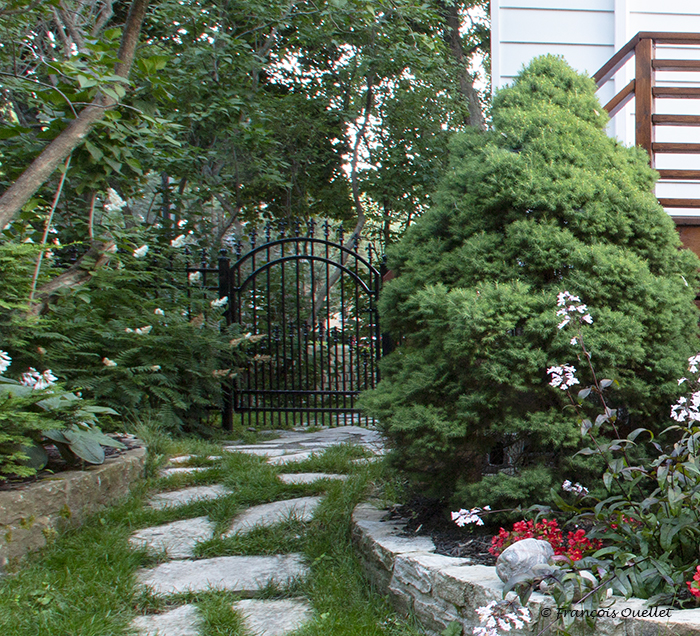
Reinstalled metal fence.
Here is the final result for the fence.
Continued in the next article: “Building a patio (6 of 7)”.