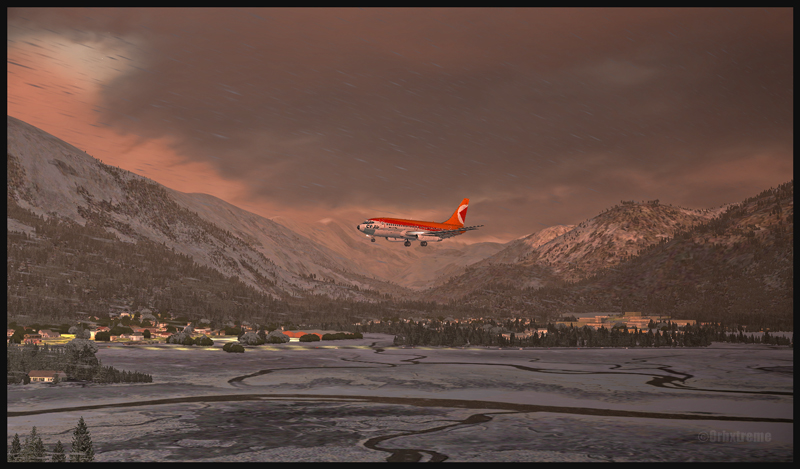
CP Air B-737 on approach for the Juneau airport in Alaska
Here is a slightly modified screen capture showing a CP Air B-737 in a virtual flight towards the Juneau runway in Alaska. The Boeing is a creation of the Captain Sim company and the scenery is the result of the hard work of the ORBX pros.The meteorological system is a combination of three elements: Cumulus X, the “Heavy snowstorm” selection in FSX and the improvements to snow appearance obtained through PrecipitFX.
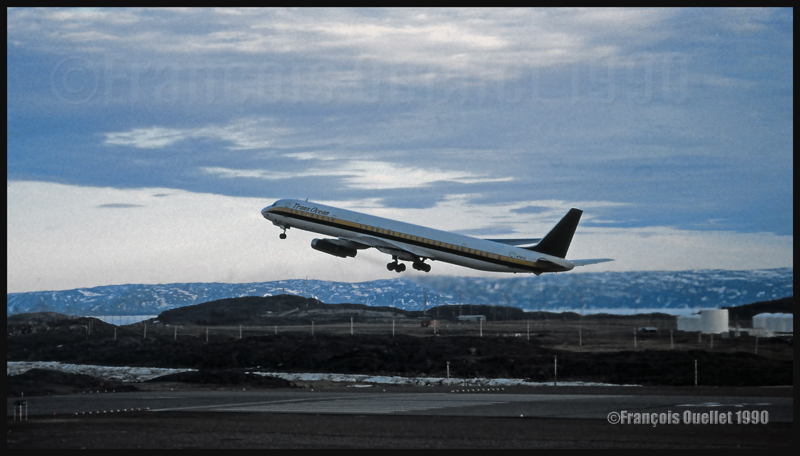
On a summer day of 1989, a DC-8-63F took-off from Iqaluit airport’s runway 36, on Baffin Island, heading towards Los Angeles. In order to do the flight without any stopovers, the tanks had been topped. The combined fuel, passengers and cargo weight required an extremely long ground run before the wheels could leave the runway.
Viewed from the Transport Canada flight service station tower, it seemed to us that the pilot had waited until the last moment to pull on the stick. Once airborne, the aircraft flew horizontally and stayed very low over the flat terrain to profit from the ground effect.
However, few kilometers from the threshold of runway 18, the terrain started to rise enough to request a positive climb rate. The pilot slightly pulled on the stick but avoided any turn to maximize lift.
Using binoculars, the flight service specialists (FSS) watched the aircraft as it should have made a left turn a long time ago. When the turn was finally attempted, the aircraft started to sink and lose much of the altitude precedently gained. We could follow the changes of altitude through the long trails of dark smoke left behind the aircraft.
Realizing the airplane was not ready to turn yet as it was going down, the pilot had started to fly it horizontally again. Moments later, the pilot tried again and the aircraft made a five to ten degree bank before starting to climb very gently. The aircraft would not have handled anything more.
It was the first time that we were considering pressing the red button used to alert airport emergency services. But this would not have been very useful since very little help could have been provided quickly enough, taking into account the position of the aircraft, its enormous amount of fuel on board and the total absence of roads in that isolated Arctic region.
N795AL DC-8-63 Trans Ocean airborne runway 18 in Iqaluit in 1990
In 1982, Air UK ceased its charter flight operation. But five years later, the company was back in that business, under the name of Air UK Leisure. It started its operation by using three Boeing 737-200s but soon realized more aircrafts would be needed. In 1988, Air UK Leisure ordered seven new 737-400s, the first of their type in Europe.
Those 737-400s, built at Boeing Field in Seattle, had to fly to Europe by passing over northern Canada. The aircrafts could not do that long trip without stopping for fuel. They landed at the Iqaluit airport, on Baffin Island, in the Nunavut.
Air UK G-UKLB Boeing B737 arriving in Iqaluit
In the unique aviation photography above, taken from the local Transport Canada flight service station (FSS), you can see one of those new Boeings, a B737-4YO, G-UKLB.
During the same period, many companies having recently acquired some B737-400s and 500s did the same trip from Seattle to Europe by stopping in Iqaluit. Among those, Aer Lingus and Hapag-Lloyd.
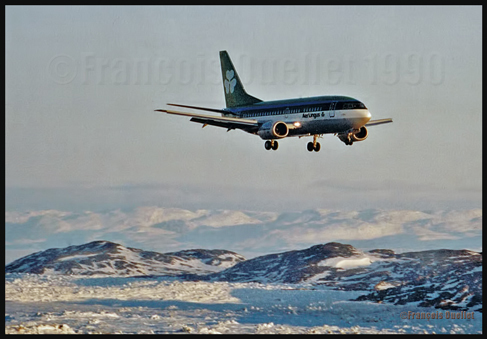
Aer Lingus B-737 on final in Iqaluit in 1990
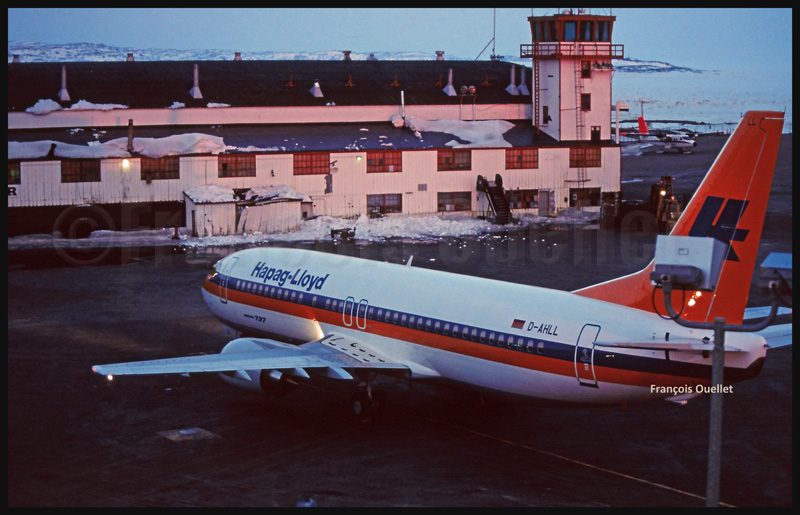
A new Hapag-LLoyd (D-AHLL) Boeing B-737 has just arrived from Boeing Field in Seattle. Next destination: Germany.
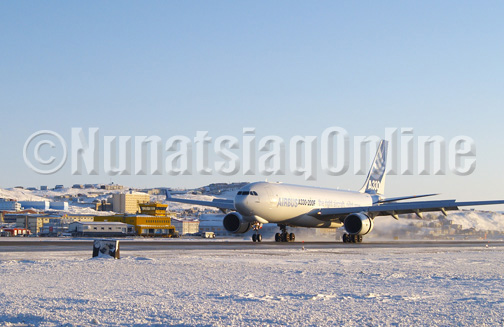
The Iqaluit airport, on Baffin Island in the Nunavut, is a popular stopover for short and mid-range aircrafts needing to refuel when overflying the Canadian Arctic. Its 8,600 feet runway can accommodate all types of aircrafts. Airbus aircrafts like the A380, the A350-XWB and the A330-200F were tested there during several days to evaluate their performance under extreme cold temperatures.
Airbus A330-200F arriving in Iqaluit for extreme cold tests. (PHOTO by CHRIS WINDEYER)
Well-known actors, princes and princesses (among them some members of the British Monarchy) and many political personalities stopped in Iqaluit throughout the years. Even Nelson Mandela stopped by Iqaluit on his return trip from United States.
Elder Alacie Joamie and Prince Albert II of Monaco in Iqaluit in 2012
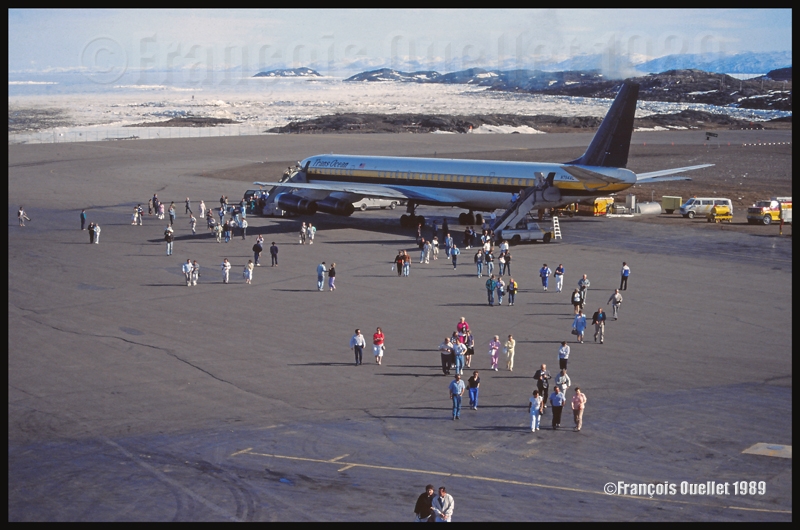
Around 1989-1990, the Sultan of Brunei and his suite also stopped in Iqaluit. The flight service specialists (FSS) were surprised to see that a Boeing 727 was not enough to accommodate the Sultan as two Gulfstream American business jets also landed few minutes before the 727.
Once the three aircrafts were parked on the apron, the Boeing 727’s front door was opened, a stairway was lowered and staff members rolled out a long red carpet. Two women got out of the airplane and started sweeping the whole carpet and, few minutes later, the Sultan stepped out for a walk and a breath of fresh air.
In less than an hour, the refueling was completed and everyone got back onboard their respective aircraft and left for Europe. It was the first time I was witnessing such a deployment of resources to carry a monarch.
But I had seen nothing yet. Few years later, I was transferred to the Transport Canada flight service station in Quebec City, which would later become the Quebec Flight Information Center (FIC) under Nav Canada. There, I could witness, with other air traffic services staff members, the frenzy surrounding the arrival of the President of the United States, Georges W. Bush, for the 2001 Summit of the Americas. That was certainly beyond measure…
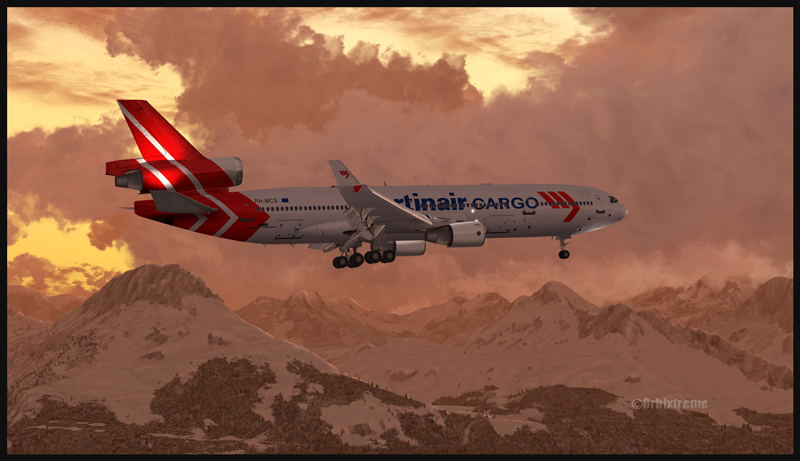
This screen capture represents the PMDG MD-11 inbound for the Valdez virtual airport in Alaska. The scenery is made by Orbx. This virtual MD-11 is a real fun to fly in manual mode since it requires a lot of attention. A 6,500 feet runway is enough for a MD-11 but it does not offer much margin of manoeuver. (Edit: This aircraft is not supported anymore by PMDG).
1989 was a problematic year for the Transport Canada flight service specialists (FSS) in Iqaluit as we had problems communicating by means of HF frequencies with airliners crossing the North Atlantic.
As usual, we tried to get position reports at 60, 70 and 80 degree west in order to ensure that the Montreal, Gander, Winnipeg and Edmonton area control centers could provide accurate air traffic services by maintaining ten minutes or eighty nautical miles between each aircraft. We had to note the route, the actual and next position of the aircrafts, the different time, speed and altitude, this while we relayed ATC clearances.
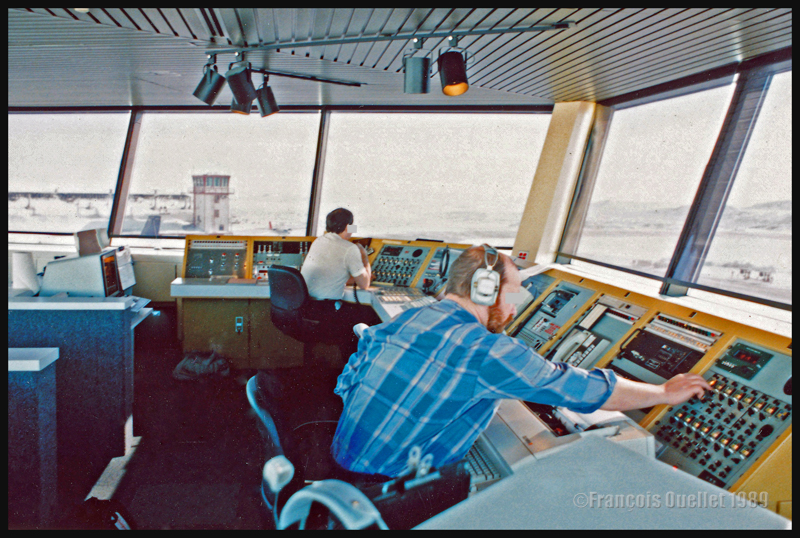
Flight service specialists at work at the Iqaluit flight service station in 1989
But for many weeks in February and March, the radio communications were blocked by a solar storm that was strong enough to cause problems to the Hydro-Québec electrical network. The entire province of Quebec suffered an electrical power blackout that lasted nine hours on March 13th.
During a major solar storm, the full spectrum of HF frequencies can become useless for frequent periods varying from ten minutes to an hour.
I remember several problematic cases, among which one where an area control center controller asked us to contact an airliner to know if the pilot could climb to 37,000 feet once at 70 degree west. The question was transmitted to the pilot and he immediately replied: “Roger, we are climbing 370”. He had not received any clearance to change his altitude but he was nonetheless starting to climb where there was no adequate separation between him and other aircrafts.
We replied multiple times: “Negative, this is a question, this is not a clearance, do not climb to flight level 370”, but the pilot never replied back due to the poor quality of HF communications. The control center was quickly called back and advised of the situation.
For the remaining period of the solar storm, the flight service specialists were asked about the actual quality of the HF communications before any punctual requests was sent on radio in order to avoid problems.
The Transport Canada flight service specialists (FSS) in Iqaluit were sometimes amazed by the type of clothing chosen by pilots who were ferrying aircrafts from Europe to America.
Small and mid-size aircrafts required a flight plan including a stopover in Iqaluit, on Baffin Island, since refueling was necessary. One would think that pilots would have prepared themselves for unexpected situations and plan according to the extreme weather conditions prevailing at some of the airports along their route to America.
The FSS staff witnessed, on numerous occasions, small jets experience serious problems while refueling under very cold temperature. While the tanks were being filled up, the tires were deflating progressively.
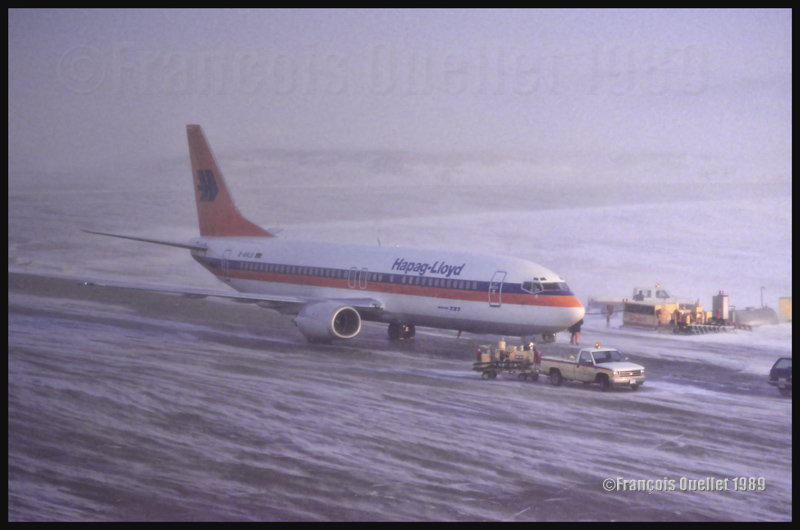
Hapag Lloyd D-AHLO B737-4K5 in its delivery flight in 1989, from Boeing Field (KBFI) to Iqaluit, and then towards Germany. It is being refueled during difficult weather conditions. This type of aircraft did not experience much problem with the cold weather, but it was not the case with smaller business jets
A small delay in the operations and the engines did not start anymore. The pilots got out of their aircraft, wearing only a thin leather jacket and summer shoes. Trying to protect themselves from the bitter cold, they gesticulated while talking with the fuel man who, himself, was wearing a thick Arctic suit that protected him from head to toes.
A thin leather jacket and summer shoes were certainly appropriate for Southern Europe but far from being useful on the apron of an airport where the wind chill factor often varied between -50C and -65C. The aircraft sometimes had to be towed in a hangar in order to be warmed up for hours, if not the night, and the transit fees grew exponentially.
I suppose that a pilot who lived such an experience remembers it today as clearly as the FSS staff, but not for the same reasons. And it is almost certain that he prepared accordingly for the next ferry flight.
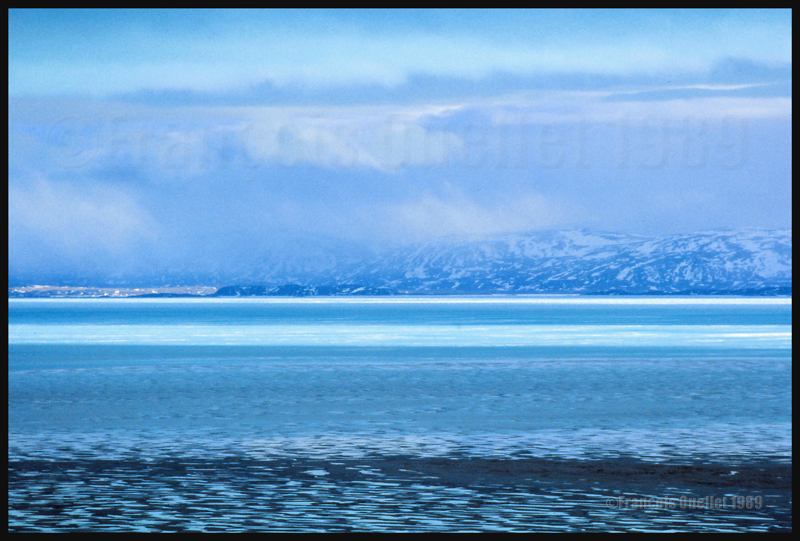
Mountains around Iqaluit, during a nice day when there is still ice in the bay. The blue tones are absolutely magnificent.
FSGRW is a weather generator and it uses downloaded data from the internet to simulate actual real weather all around the world (24,000 + airports).
The program simulates very well what is going on in the atmosphere up to FL520, including the depiction of hurricanes and tropical cyclones.
FSGRW does not come with its own cloud texture packages. Like for ASN(Active Sky Next) or OpusFSI, you must add a texture package from a third party (like REX for example). FSGRW will then use those beautiful textures to represent the downloaded weather from the internet, instead of the old cloud files that were created years ago by Microsoft.
FSGRW was not created to give you access to all kind of fancy options like automatic connections to the weather radar of big airliners. It is a simple but very efficient program that aims at representing the weather accurately.
FSGRW includes some well-known local weather effects.
Icefield in sight! A screen capture realized with the following products: FSX, FSGRW, REX, and a combination of Orbx creations. Final editing with a photo editing software (slight corrections only)
FSGRW is compatible with FS2004, FSX, ESP, P3D, Steam and X-Plane.
FSGRW gives you the possibility to use the actual weather present at one airport and transfer it to another airport. You have access to historic weather through a file-mode option. You may also choose to fly with dynamic or static weather. The weather updates are made every six minutes now that version 027 has been issued.
You can create your own flight plan and weather sequence.
FSGRW can be used through a network.
I own FSGRW and use it in combination with REX texture packages. I am very satisfied of the result. But I don’t doubt that ASN, OpusFSI or REX weather engines can provide excellent results as well. The only thing to remember is that you have to buy a weather engine AND cloud texture packages in order to improve the virtual weather’s visual aspect.
The weather engine ASN (Active Sky Next), like FSGRW, OpusFSI or REX updates the weather by downloading the latest information from the internet. There is also a possibility to use historical data (up to two years back).
ASN, FSGRW and OpusFSI use the default FSX cloud texture sets. So those weather engines can benefit from additional cloud texture sets (from REX for example) for a better visual depiction.
The cloud locations and coverage are accurate as well as realist. Thick overcast layers can be displayed. The cloud transitions are smooth, as well as the vertical variations in temperature, wind speed and wind direction.
Cloud-based effects include in-cloud reduced visibility, related turbulence (in cloud or when entering or exiting a cloud formation), accurate position of precipitation according to the type of clouds and to your position relative to the cloud formation.
Microbursts, wind shears, hail, turbulence as well as updrafts and downdrafts effects are modelled for thunderstorms. There are aural wind shear alerts when flying through a thunderstorm cell: That will nonetheless not be of great help if you attempt to cross a strong thunderstorm as, like in real life, you might not succeed…
You can use the radar to navigate through bad weather since radar and cloud positions are synchronized. The radar shows the intensity of precipitations as well as the echo tops.
Voiced warnings will be triggered when new Airmets and Sigmets are issued. They cover the world and can be viewed on a map. Associated icing and turbulence are added according to the warnings.
In flight, you can receive voiced weather updates through ATIS, FlightWatch or FSS.
ASN corrects the problems sometimes associated with low-level clouds, like inaccurate coverage and wrong position of the clouds, or layers that are really too thin.
Like with other weather engines, there is a flight planning mode. You can enter, import, or build a flight plan, as well as change the flight plan and waypoints at any time before or during a flight.
The weather, airports and navaids are displayed and can be edited, added or erased. The forecasts are available through graphics or text. If, along your route, there is no Metar issued for few hours, the engine will use the forecast to update the weather.
The thermals are modeled using the temperature and surface of terrain.
The wake turbulence trails are visible and, like in real life, are moving with the wind.
ASN does not rely only on interpolation to cover the oceanic areas and other territories where there are few weather stations.
The developers of ASN say that they have created a realistic hurricane simulation based on actual hurricane data. Their program would automatically disregard the ground data that seems incorrect. I cannot comment about the realism of that simulation since I have not tried it yet. But if it is correctly modelled, this function should interest whoever wants to experiment what it is to fly in or near a hurricane.
ASN is compatible with FSX, FSX: SE and the P3D versions up to P3DV4. It can support a multi-monitor setup.
I am not listing all the characteristics of this interesting software since there are always new options added. If you want more details, I provided the link below. Like with all the other weather engines, take the time to see what each has to offer since they have quite different features and spectrum of options.
REX offers two important elements through its different products: 1) A weather engine that downloads real weather in your computer while replicating the different weather phenomenon, through its REX Essential Plus program and 2) very realistic cloud textures (through its add-ons like Overdrive, Texture Direct, Soft Clouds).
A flight planning mode is also included, as well as numerous options to create specific weather themes that take care of the appearance of the clouds, the quality of the light in the sky, the definition of the sun effects, the different textures and colors of water.
You also have the possibility to choose different runway markings, the sounds associated with thunderstorms and the type of lightning that will illuminate your virtual sky.
REX is compatible with all platforms, including X-Plane.
Here are the REX products, which each play a very different role:
REX Essential Plus: a weather engine and a product that contains cloud textures and multiple options in order to simulate as much as possible the real outside weather for the area you have chosen. The weather engine will soon be renewed with a new addition: REX Weather Direct.
REX Overdrive: adds 12 GB of cloud textures.
REX4 Texture Direct: adds another 16 GB of cloud textures, and a possibility to create complete weather themes according to your preferences, while you still have access to other themes created by all the virtual pilots of the REX community.
REX Soft Clouds: adds volumetric clouds in the lower layer of the atmosphere for a more realistic effect.
REX4 Weather Architect: a program that allows you to create a precise weather system then position it anywhere on the planet. This is not a weather engine: It will not look for new data on internet and download it in your computer.
REX Weather Direct: a soon to be released improved weather engine that will be compatible with DX9, DX10 and DX11 as well as with FSX, FSX: SE (Steam Edition) and P3D.
On virtual flying forums, users seem to have a preference for the Active Sky Next (ASN) weather engine combined with REX cloud textures. This is a good combination, but it’s not the only one that deserves attention: FSGRW together with REX cloud textures do an excellent job (this is the duo that I am using for very precise results). There is also OpusFSI with REX, ASN with ASN2012 (ASN weather engine combined with ASN2012 cloud textures) or even a REX only set of programs (soon to be available REX Weather Direct and REX cloud textures).
This all depends on your priority: the FSGRW simplicity and absolute realism, the facility to use a cockpit camera and the dynamic head movements supported mode of OpusFSI, etc. It is best to read a lot and take the necessary time before jumping to quickly to a conclusion.
Some weather engines might need tweaking or modifications to be compatible with the most recent versions of P3D, if we believe what is written on specialized forums.