The boy tests the water temperature before running across the water jets located beside Quebec City’s City Hall.
The light in the water jets required an exposure correction of + 1/3. The shutter speed was set at 1/80 which allowed to see the boy clearly at a time when he was not moving too much. This shutter speed also allowed to visualize the water jets effects while limiting the ISO to 1250, even with such a low light. The aperture was only 6.3, just enough for what had to be photographed.
The picture was taken with a Canon 5DSR full frame camera equipped with a Canon EF70-200mm f/2.8L IS II USM lens.
The light is always interesting when a picture is taken just before the nightime or the sunrise. The scenery above was captured in Old Quebec during Summer 2018. The use of a lens requiring very little light, like the Canon EF85mm f/1.2L USM mounted on a Canon 5DSR made the task easier.
I wanted to ensure that the people were not mere shadows and that the water effects in the fountains were visible. The shutter speed was adjusted to 1/50 and the ISO set at 6400. The aperture was limited to 4.5 to respect the shutter speed. Photography is always a matter of compromise…
For other pictures of Quebec City, click on the following
links of my blog :
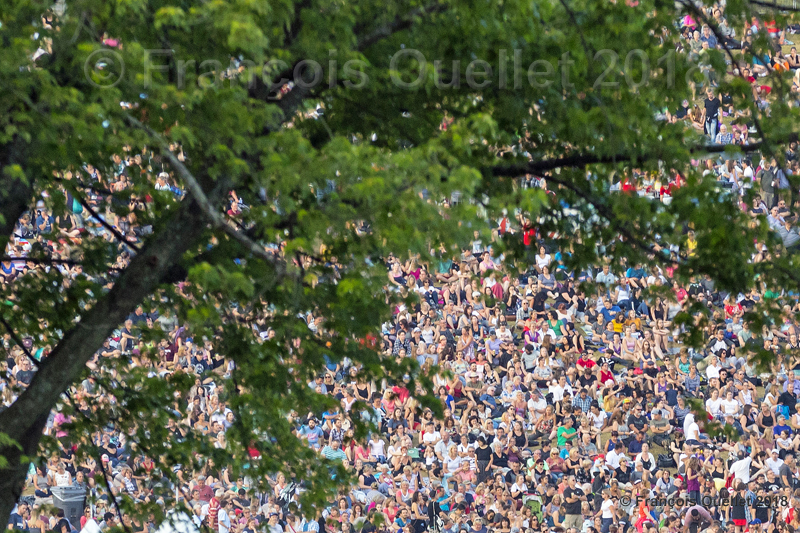
The crowd on the Plains of Abraham, in Quebec City, during the 2018 Festival d’été de Québec.
The Quebec Summer Festival draws huge crowds every year to each one of its shows. I decided to use the crowds to compose a photo in which there are only two subjects. In the foreground, one of the trees on the Plains of Abraham. I use the tree to create a diagonal that crosses the picture and, at the same time, helps balance the colours in the picture.
In the background, the crowd, without any other distraction. The people fill every available corner of the picture. They are the ones bringing the picture to life. It is also because of their presence every year that the Quebec Summer Festival is a success.
The picture was taken with a Canon 5DSR camera equipped with a Canon 70-200 f2.8L IS II USM lens. The focal length was 200mm and the shutter speed 1/250. Despite a 200mm focal, the people were still too far to be clear enough.
The goal being to crop the picture enough to enlarge the people, the ISO had to be quite low. It was set at 640. Once those priorities were established, the aperture could only be set at 5.0, which was good enough for the result I was trying to obtain. The 50.6 megapixels full frame sensor of the Canon 5DSR helped a lot.
For other pictures of Quebec City, click on the following
links of my blog :
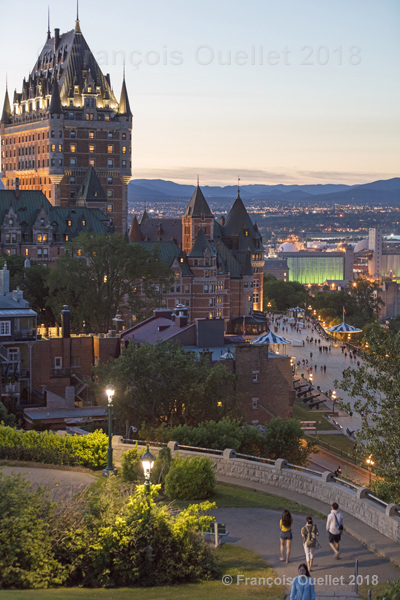
This picture of the Château Frontenac and Dufferin Terrace was taken during the Quebec Summer Festival 2018. From where I stood, near the Citadel, I could hear the crowd present on the Plains of Abraham during Patrice Michaud’s performance.
The picture was taken with a full frame Canon 5DSR camera equipped with a Canon EF70-200mm f/2.8L IS II USM. The focal length was set at 70mm. As the sun was setting, an ISO set at 200 would have caused the moving persons to be blurred. It was thus necessary to set the ISO at 4000.
Working without a graduated filter to attenuate the background light, I had to correct the exposure at +1, otherwise the middle ground would have been too dark and it was the main subject of the picture. I then slightly reduced the clear tones of the sky with Photoshop for a more balanced result.
The focus was done manually while the camera was installed on a tripod. The aperture was limited to 4.5 to limit the exposure time so that a compromise could be found between an acceptable depth of field and the moving people. This allowed for a shutter speed of only 1/15 sec, even in a relatively low light.
For other pictures of Quebec City, click on the following
links of my blog :
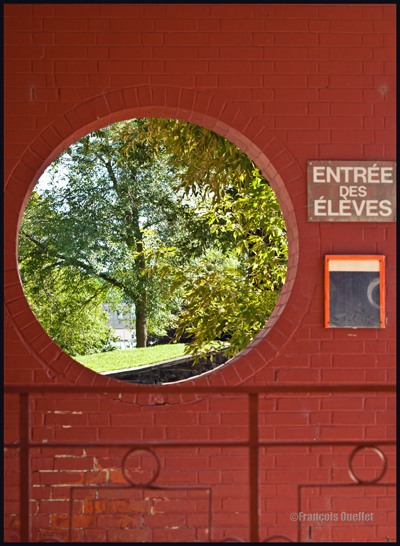
By cropping very tightly a picture of the St-Louis-de-Gonzague school’s entrance, in Quebec City, it is possible to modify the access to the school.
To the right of the hole in the wall, you can see “Entrée des élèves”, which means “Entrance for students”. With this reinterpretation, the students are invited to leave school as soon as they arrive. At a time where the society promotes an alternative education and the environment, this is an ideal opportunity for the students!
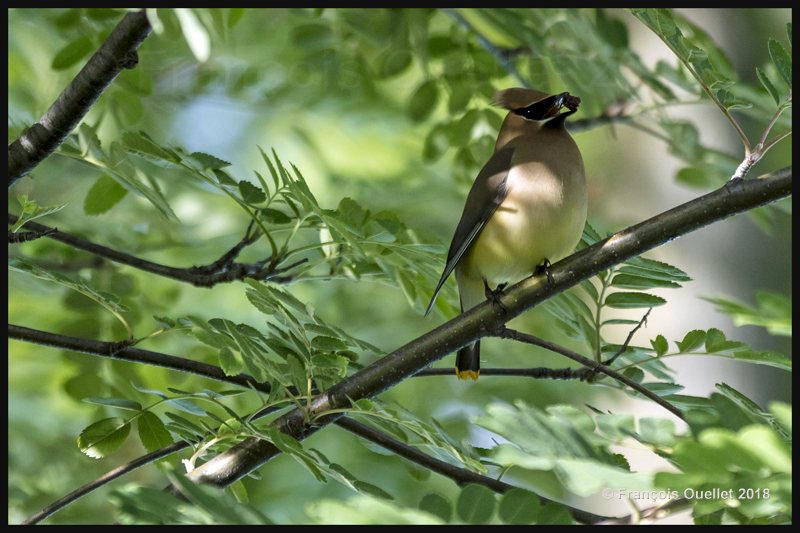
This Cedar Waxwing was photographed in June 2018 as it stopped in our Russian mountain ash. The bird had spotted a few dried out fruits left from the Autumn 2017 season.
The picture was taken with a Canon 5DSR camera in order to use the cropping facility of its full frame sensor. A Canon EF 70-200mm f/2.8L IS II USM was mounted on the camera. The aperture was set at 3.5 to ensure a blurred background.
The ISO was set at 320 since considerable cropping would be required to enlarge the bird, even with a 200mm focal length. The grain remained reasonably small through the cropping process, ensuring an acceptable image.
Click on the links for more photos of Quebec and Canada on my blog.
The pictures below were taken in Vancouver and Victoria, in British Columbia. They were all taken with a Canon 5DSR full frame camera.
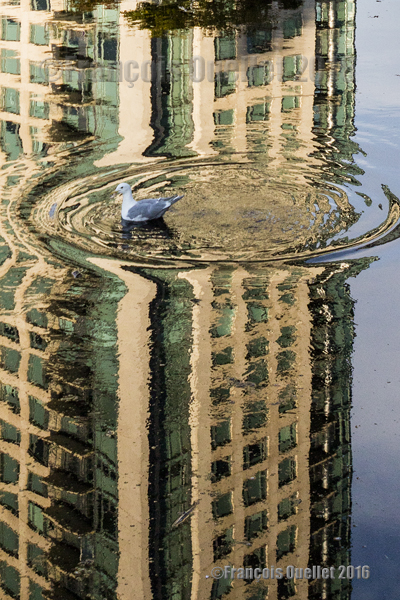
In the Vancouver harbour, several condo towers have been built in the last few years. Many condos in those towers can now be rented by travellers through Airbnb, thus entering in direct competition with the hotels located nearby. I was trying to use the water reflections in the harbor to show one of the towers when this seagull appeared in the viewfinder, adding a touch of life to the scenery.
Another way of showing the Vancouver Harbour architecture (2016)
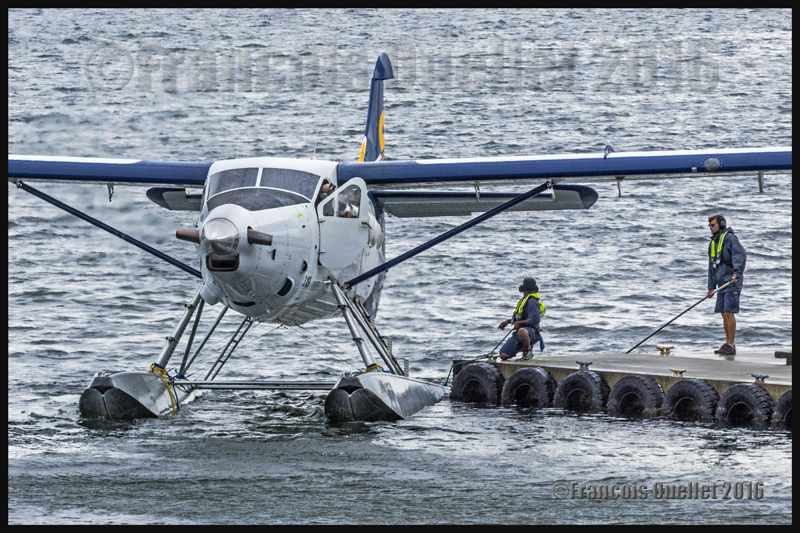
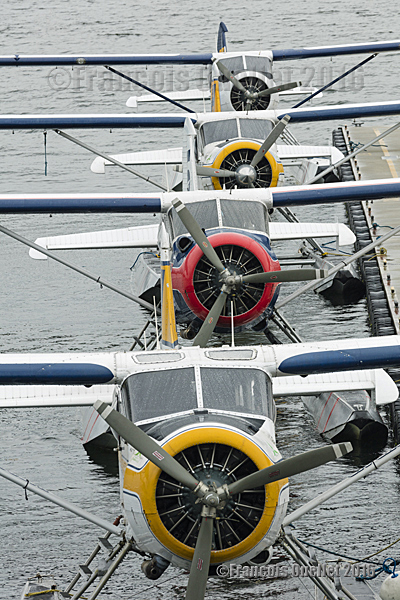
Floatplanes of all types constantly maneuver in the Vancouver harbour. The two photos below show a Saltspring Air Turbo Otter as it is being helped to park. You can also see a row of Harbour Air Beavers (DHC-2) parked after a day of uninterrupted flights.
Saltspring Air Turbo Otter C-FLAP in Vancouver Harbour 2016
Harbour Air DHC-2 Beaver floatplanes in Vancouver, British-Columbia (2016)
In the Willows Beach’s Park, in Victoria, I was able to photograph this Cooper’s Hawk using a Canon 70-200 f2.8L IS II USM telephoto lens. The full frame sensor 50 megapixels allowed for some serious cropping to bring the bird closer. The hawk clearly annoyed all the crows that considered themselves as the owners of the territory.
Cooper’s Hawk in a Victoria’s public park (2016)
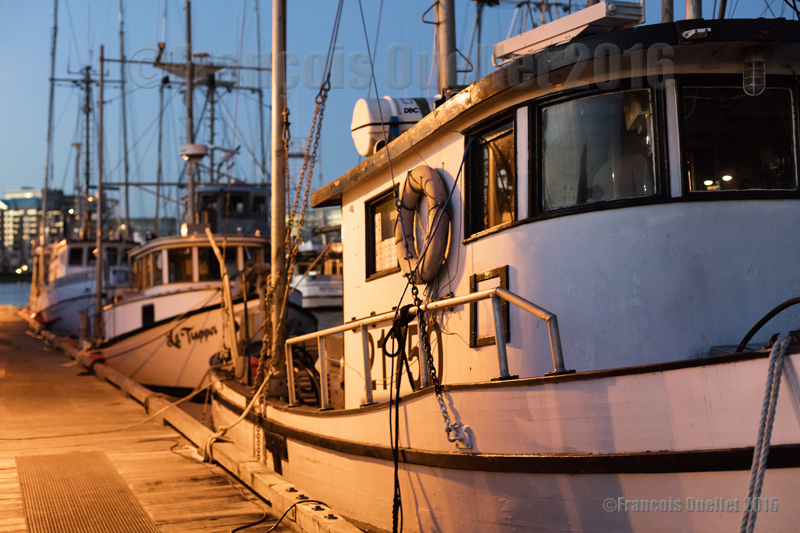
In the evening, the fishing boats come back to the Victoria Fisherman’s Wharf. Since I was standing on a moving platform, the use of a tripod would have been useless because of vibrations impossible to eliminate. The solution was to use a lens requiring little light, like the Canon EF 50mm 1.4 USM. By increasing the aperture and the ISO, the picture could be taken with a high enough shutter speed to avoid a blurred photo.
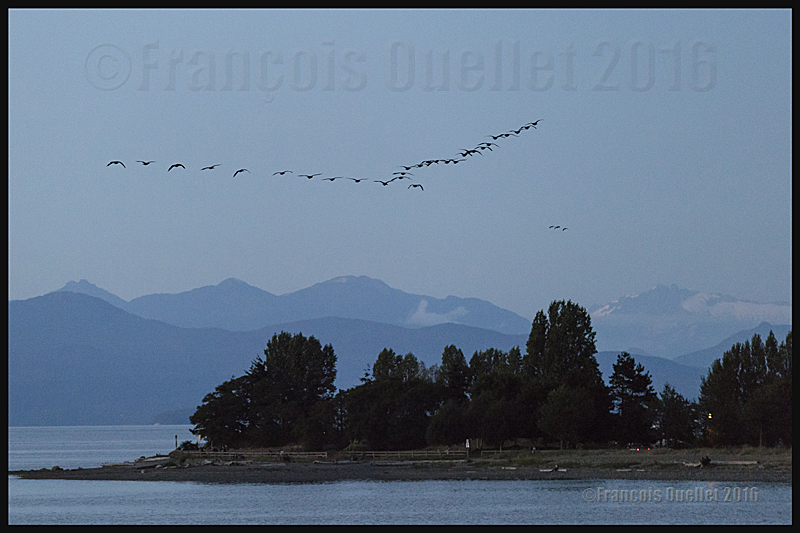
Canada Geese over the Strait of Georgia in British-Columbia, in 2016.
Night photography is not always planned and the photo above, taken late in the evening, was certainly not one I would have been able to take when I started as a photographer.
There was a superb sunset on the strait of Georgia, in British Columbia, and I had taken multiple pictures until late in the evening with my Canon 5DSR full-frame camera. The photography session was almost over.
Once I decided that it was time to pack-up for the night, I heard a flock of Canada Geese. They were flying in formation over the mountains to the west and were heading north in the darkness. In order to photograph those fast moving birds in the remaining light, drastically different settings would have to be made on the camera, and this, very rapidly.
The camera was equipped with a Canon 70-200 f2.8L IS II USM telephoto lens mounted on a tripod and facing west. It was on manual focus, the stabilizer was inactive and the ISO setting was very low. A ND graduated filter was already mounted on an adapter which was installed on the lens.
That meant dismantling the camera from the tripod, activating the automatic focus as well as the stabilizer, increasing the ISO, removing the ND graduated filter, limiting the aperture to insure sufficient shutter speed, composing the photo and taking few rapid shots before the geese were too far away.
Few seconds later, those birds and the landscape were becoming another souvenir of a beautiful summer holiday spent in British Columbia.
For more articles in the category « Photos of Canada », click on the following link : Photos of Canada
Merchant navy vessel in the Juan de Fuca Strait near Victoria (2016)
Photographers know that the most interesting hours of the day are either early in the morning or late at night, but before nighttime. These periods are ideal for subtle colors and very atmospheric shots.
The Vancouver Island coast offers absolutely everything to attract many categories of photographers: the wildlife, the mist over water bodies in the morning or late at night and the mountains that are visible almost everywhere.
Travelling through British Columbia, I noticed the great number of merchant navy vessels passing through the Juan de Fuca Strait. But to try to photograph them during daytime would only have given average pictures. Waking up early to get the right picture is never easy, but it always gives interesting results.
The only problem with regards to ship photography is that the latter often navigate quite far from the photographer, thus becoming tiny uninteresting dots on a picture. However, the Canon 5DSR camera and its 50.6 megapixels full-frame sensor solve that problem: new experiments are then possible . The scenery above was shot from a beach in Victoria, very early in the morning. It was mandatory to ensure of the total immobility of the camera since some serious cropping would be needed later on in order to significantly enlarge the ship. The slightest vibration would have been amplified through enlargment and the picture would have been useless.
Here is the method that was used: the ISO was set on 250, the tripod planted on the beach (but not in the soft sand part where the tripod could have moved a little during the photo session). Moreover, the remote trigger was used, as well as the mirror lock-up function. In order to achieve an optimal focus, the latter was done manually using Liveview with a 16X enlargment.
A Canon 70-200 f2.8L IS II USM telephoto lens was installed on the camera, with a 200mm focal setting. A ND graduated filter was installed to compensate for the rising sun’s brighter light behind the mountains. Being early on the beach also allowed for a minimal wind speed, limiting even more any tripod vibrations. I tried several shots and decided to keep the one with a bird in the scenery, so as to add a touch of life to the scenery.
For other ship photos posted on my website, click on the following link:
A crow in flight over the Georgia Strait in British-Columbia
This picture of a crow in flight over the Georgia Strait in British Columbia was taken with a Canon 5DSR full-frame camera. The aperture was set around 4.0. This allowed for a faster shutter speed. A reasonable ISO setting also kept the digital noise to a minimum.
In order to increase my chances of getting a precise photo of the crow, and to ensure that the background was blurred to limit distractions, I decided to follow as much as possible the exact speed of the bird with the camera. This is always risky as one can lose unique photo opportunities. But when it works, the picture is always interesting.
A significant cropping was then necessary to increase the size of the crow in the photo but this had no negative impact on the image’s quality since the initial ISO setting was quite low and I had access to the Canon 5DSR’s 50 megapixel full-frame sensor. Such a huge number of megapixels makes it easier when comes the time to enlarge pictures.
A bit of patience was necessary in order to capture an interesting subject but the wait was worth it. The specimen above landed about fifty feet from me on a Parksville beach. It started to look for small pieces of wood and, when satisfied of its finding, took-off for its nest.
For more articles in the category « Photos of Canada », click on the following link : Photos of Canada