Categories
Real life stories as a flight service specialist (FSS): Quebec FSS

Quebec FSS and the September 11th 2001 events

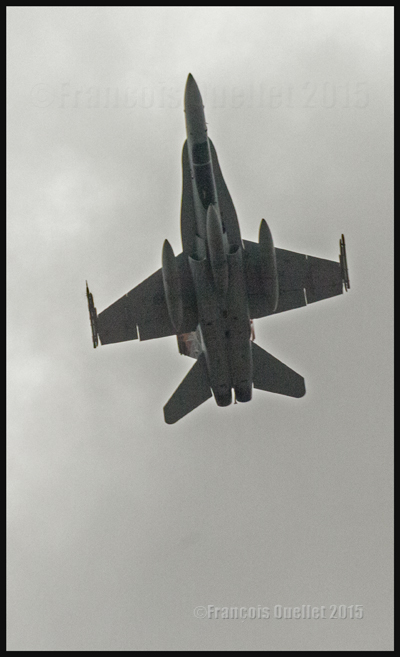
One of four F-18s over the National War Memorial in Ottawa on October 22nd 2015

During the September 11th 2001 crisis, the Canadian sky belonged, for a short period, to the military. The latter had taken the decision that every aircraft that had not taken-off yet had to stay on the ground, and those which were airborne had to expedite the landing.

There were a few exceptions for medical evacuations, but those flights were tightly monitored. All air traffic services units communicated with aircrafts in flight and agencies on the ground to advise them of the new rules now in place.

Generally speaking, regardless of the initial surprise, all pilots with whom the Transport Canada flight service specialists (FSS) in Quebec City had talked, through their multiple frequencies, offered no resistance.

But I remember the case of a pilot flying a twin-engine aircraft over the Laurentides region to whom the order of landing as soon as possible had been given. He refused to obey since it was out of the question for him to lose money on already booked charter flights, especially on a beautiful day.

The flight service specialists could understand his frustration. Nonetheless, it was not a good time to debate. It was, for all air traffic services units involved, a particularly busy day and nobody had extra time to argue at length about a request.

The message was repeated one more time. In view of his refusal to obey, NORAD (North American Aerospace Defense Command) was contacted. The reply came back quickly and the pilot was given two choices: either he landed or an CF-18 fighter jet would be launched to take care of the situation.

No need to add anything else. The pilot complied immediately.

For more real life stories about being a FSS in Quebec City, click on the following link: Flight service specialist (FSS) in Quebec City
Categories
Real life stories as a flight service specialist (FSS): Iqaluit FSS

Iqaluit FSS and the Trans Ocean Airways DC-8

In 1989, News North journalist Cam Lockerbie wrote an article about the misadventure of passengers who were forced to stay longer than expected in Iqaluit because of a stopover that went wrong.

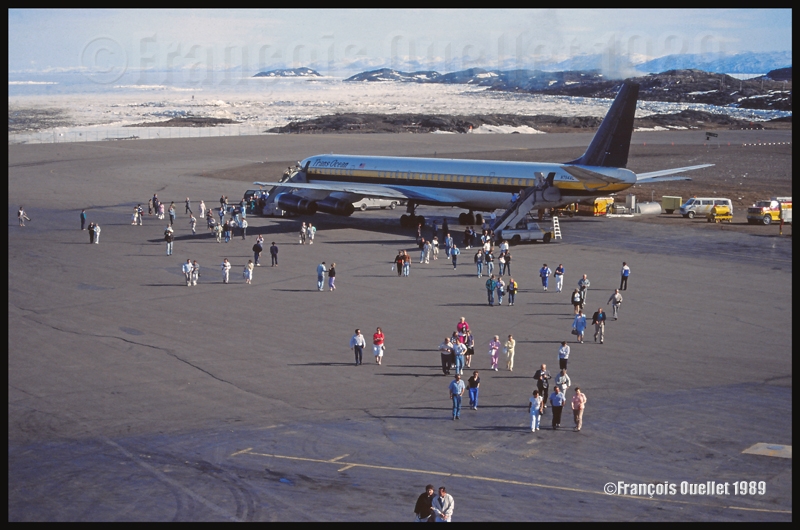
A Trans Ocean Airways DC-8 on a flight from San Francisco to Great Britain had stopped in Iqaluit, on Canada’s Baffin Island in the Nunavut, to refuel but experienced some problems during the refueling process. The aircraft would not be able to depart before the next day and 220 passengers had to find a place to sleep in Iqaluit.

Impressive efforts were deployed to help those stranded passengers since there was far from enough hotel rooms to accommodate everyone. Eventually, the passengers were dispersed throughout the town and, although there were not enough beds for everyone, there was at least a roof provided for the night.

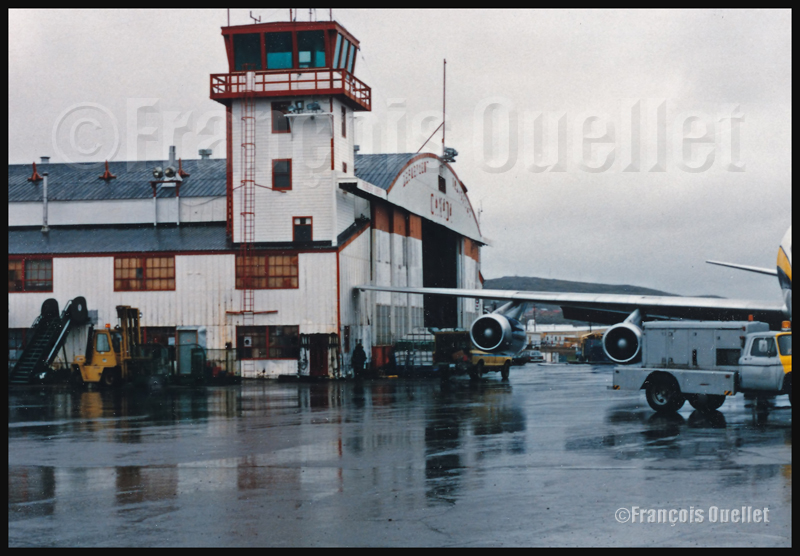
The wing of a Trans Ocean Airlines DC-8 touches a hangar in Iqaluit

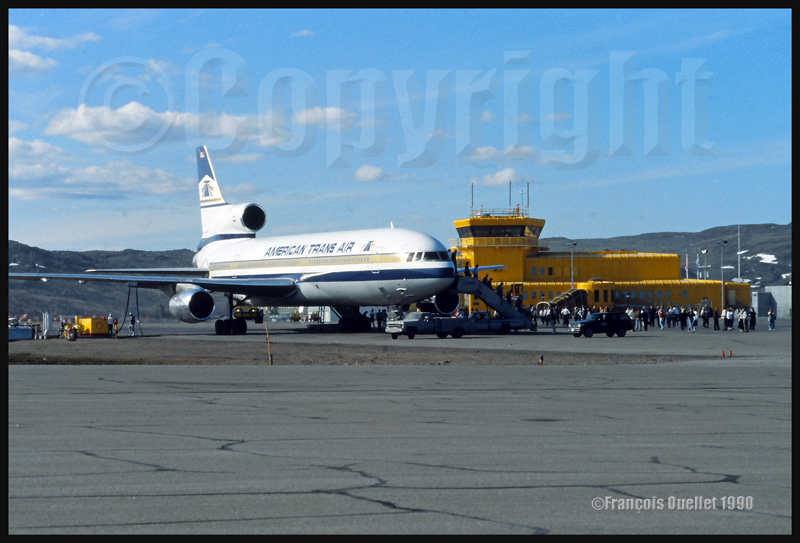
The spare parts needed for the broken DC-8 were delivered by charter jet directly from United States. After the repair was done, the DC-8 attempted to move but faced another problem. It had to find enough space to manoeuver between a hangar and an American Trans Air  Lockheed L-1011 that was refueling. An airline company employee was requested to guide the DC-8 and ensure that it would not come into contact with the L-1011 or the hangar.

The newspaper article mentioned that the aircraft was not able to move past the hangar and that part of the wing had to be dismantled. What the journalist did not write, certainly because he ignored it, is that there was a contact between the hangar door and the wing tip, in spite of the person walking in front of the DC-8, like you can see on the picture above taken by an Iqaluit flight service station FSS.

On the return flight, the same DC-8 experienced an alternator problem but the engineer’s resourcefullness prevented the passengers to spend another night in Iqaluit. In the following year, the company declared bankruptcy.

American Trans Air Lockheed L-1011 in front of the Iqaluit flight service station in 1989
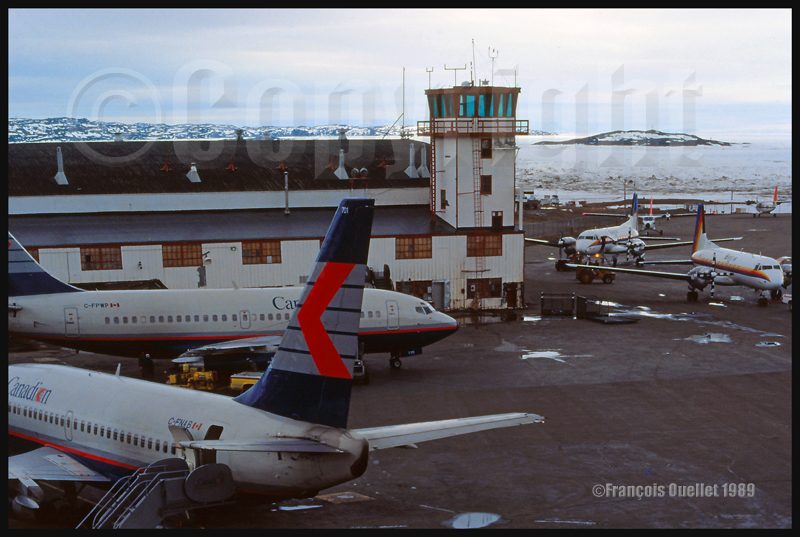
Canadian Airlines B-737 and Firstair HS-748 in Iqaluit in 1989

For more real life stories as a FSS in Iqaluit, click on the following link: Flight service specialist (FSS) in Iqaluit

Categories
Real life stories as a flight service specialist (FSS): Iqaluit FSS

Iqaluit FSS and the sleeping pilots

Airliner and cumulonimbus clouds

In the early 1990s, I was working at the Transport Canada flight service station (FSS) in Iqaluit, providing air traffic services. While I was in charge of the HF radio communications allowing the tracking of transoceanic flights, I received a call from a controller asking me to try to contact an airliner of a big European company.

Their pilots had crossed 60 degree west without communicating with Iceland radio and it was now necessary to ensure that the projected passage time for 70 degree West and the altitude of the aircraft were still valid.

I tried to communicate with the crew using all means at my disposal, among which the SELCAL system which sent an alarm signal on board the aircraft. Nothing worked. Other airliners flying nearby the aircraft were requested to help by trying some calls on VHF emergency frequencies. But again, there were no replies.

Suddenly, about one hour after the moment that the pilots should have given some sign of life, I received an answer to my repeated calls. I told the crew that all the efforts had been made to contact them but without success. I asked them an official position report and an estimate for the next mandatory point of contact. Calmly, the pilot answered that he did not know why I had not received his calls and he immediately prepared an official position report.

It was kind of strange that on a day where the HF reception was excellent, and when all other companies were communicating with Iqaluit radio without any problem, this company stayed silent for such a long period of time.

I finally received the new position report but it clearly looked like an invention. If the data provided by the crew was correct, this aircraft would successfully fly 400 nautical miles in the next ten minutes. It would mean that at this speed, the crew expected to cross most of Canada in about one hour.

I advised the pilot to redo his calculations since, visibly, he seemed to have no idea of his position. He came back with new numbers, very different this time, which match what was expected.

I guessed that during the long transatlantic flight, both pilots slowly fell asleep while the automatic pilot kept the aircraft in flight. Suddenly woken up by the multiple calls, the crew did not take into account the movement of the aircraft during the hour where everybody was asleep and, worried not to get caught, rapidly transmitted totally erroneous calculations.

Nonetheless, the story ended well since the crew, now rested, provided exact information for the following position reports, allowing for a safe flight until destination.

For more real life stories as a FSS in Iqaluit, click on the following link: Flight service specialist (FSS) in Iqaluit

Categories
Real life stories as a flight service specialist (FSS): Iqaluit FSS

Iqaluit FSS and the overloaded DC-8

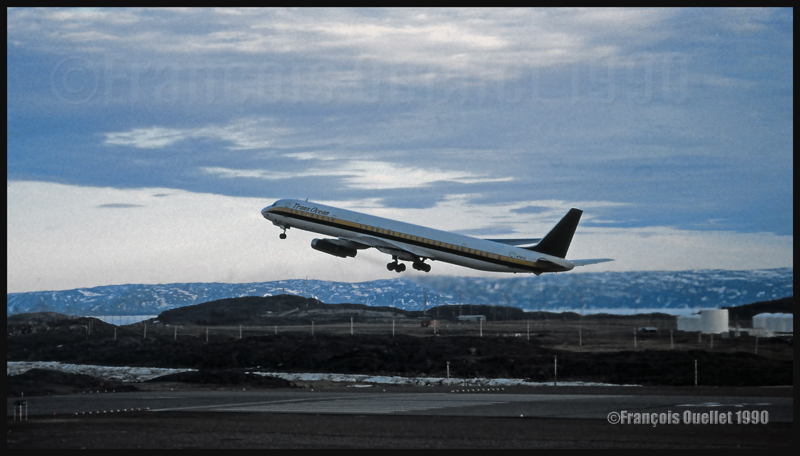
Trans Ocean DC-8-63F N794AL in Iqaluit in 1989

On a summer day of 1989, a DC-8-63F took-off from Iqaluit airport’s runway 36, on Baffin Island, heading towards Los Angeles. In order to do the flight without any stopovers, the tanks had been topped. The combined fuel, passengers and cargo weight required an extremely long ground run before the wheels could leave the runway.

Viewed from the Transport Canada flight service station tower, it seemed to us that the pilot had waited until the last moment to pull on the stick. Once airborne, the aircraft flew horizontally and stayed very low over the flat terrain to profit from the ground effect.

However, few kilometers from the threshold of runway 18, the terrain started to rise enough to request a positive climb rate. The pilot slightly pulled on the stick but avoided any turn to maximize lift.

Using binoculars, the flight service specialists (FSS) watched the aircraft as it should have made a left turn a long time ago. When the turn was finally attempted, the aircraft started to sink and lose much of the altitude precedently gained. We could follow the changes of altitude through the long trails of dark smoke left behind the aircraft.

Realizing the airplane was not ready to turn yet as it was going down, the pilot had started to fly it horizontally again. Moments later, the pilot tried again and the aircraft made a five to ten degree bank before starting to climb very gently. The aircraft would not have handled anything more.

It was the first time that we were considering pressing the red button used to alert airport emergency services. But this would not have been very useful since very little help could have been provided quickly enough, taking into account the position of the aircraft, its enormous amount of fuel on board and the total absence of roads in that isolated Arctic region.

N795AL DC-8-63 Trans Ocean airborne runway 18 in Iqaluit in 1990
Nationair C-GMXD DC-8-61 in Iqaluit in 1989

For more real life stories as a FSS in Iqaluit, click on the following link: Flight service specialist (FSS) in Iqaluit

Categories
Real life stories as a flight service specialist (FSS): Iqaluit FSS

Aviation photography: Air UK Leisure B737-4YO G-UKLB

In 1982, Air UK ceased its charter flight operation. But five years later, the company was back in that business, under the name of Air UK Leisure. It started its operation by using three Boeing 737-200s but soon realized more aircrafts would be needed. In 1988, Air UK Leisure ordered seven new 737-400s, the first of their type in Europe.

Those 737-400s, built at Boeing Field in Seattle, had to fly to Europe by passing over northern Canada. The aircrafts could not do that long trip without stopping for fuel. They landed at the Iqaluit airport, on Baffin Island, in the Nunavut.

Air UK G-UKLB Boeing B737 arriving in Iqaluit

In the unique aviation photography above, taken from the local Transport Canada flight service station (FSS), you can see one of those new Boeings, a B737-4YO, G-UKLB.

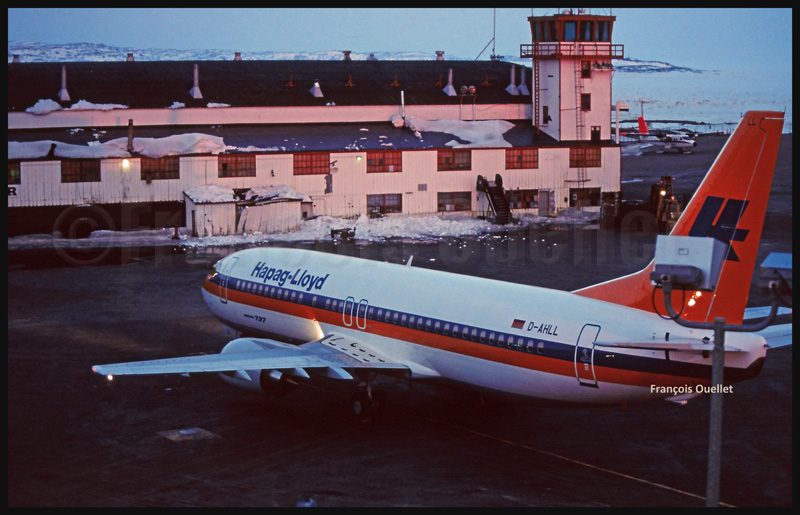
During the same period, many companies having recently acquired some B737-400s and 500s did the same trip from Seattle to Europe by stopping in Iqaluit. Among those, Aer Lingus and Hapag-Lloyd.

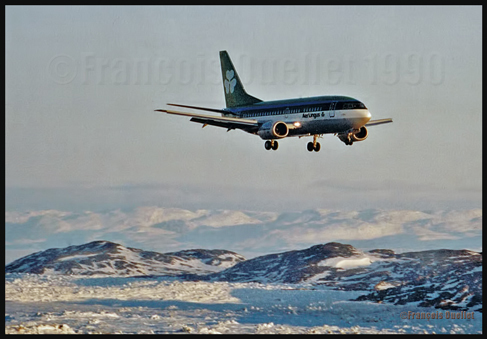
Aer Lingus B-737 on final in Iqaluit in 1990
A new Hapag-LLoyd (D-AHLL) Boeing B-737 has just arrived from Boeing Field in Seattle. Next destination: Germany.

For more real life stories as a FSS in Iqaluit, click on the following link: Flight service specialist (FSS) in Iqaluit

Categories
Real life stories as a flight service specialist (FSS): Iqaluit FSS

The Sultan of Brunei stops in Iqaluit, in the Canadian Arctic

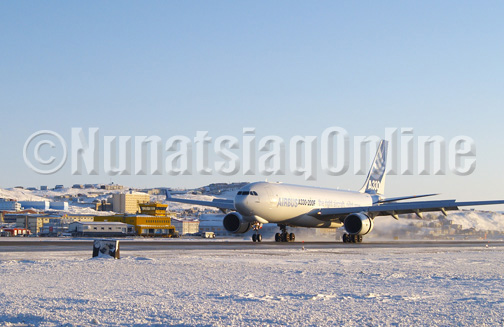
The Iqaluit airport, on Baffin Island in the Nunavut, is a popular stopover for short and mid-range aircrafts needing to refuel when overflying the Canadian Arctic. Its 8,600 feet runway can accommodate all types of aircrafts. Airbus aircrafts like the A380, the A350-XWB and the A330-200F were tested there during several days to evaluate their performance under extreme cold temperatures.

Airbus A330-200F arriving in Iqaluit for extreme cold tests. (PHOTO by CHRIS WINDEYER)

Well-known actors, princes and princesses (among them some members of the British Monarchy) and many political personalities stopped in Iqaluit throughout the years. Even Nelson Mandela stopped by Iqaluit on his return trip from United States.

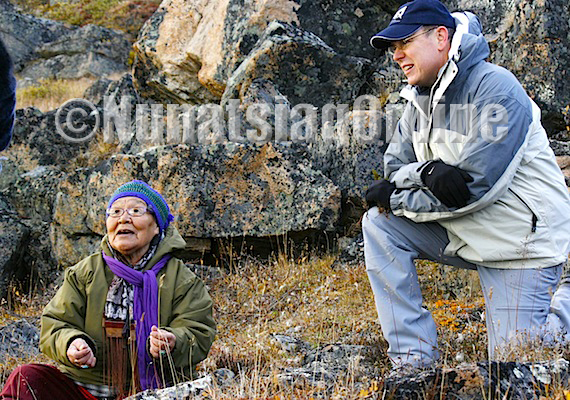
Elder Alacie Joamie and Prince Albert II of Monaco in Iqaluit in 2012

Around 1989-1990, the Sultan of Brunei and his suite also stopped in Iqaluit. The flight service specialists (FSS) were surprised to see that a Boeing 727 was not enough to accommodate the Sultan as two Gulfstream American business jets also landed few minutes before the 727.

Once the three aircrafts were parked on the apron, the Boeing 727’s front door was opened, a stairway was lowered and staff members rolled out a long red carpet. Two women got out of the airplane and started sweeping the whole carpet and, few minutes later, the Sultan stepped out for a walk and a breath of fresh air.

In less than an hour, the refueling was completed and everyone got back onboard their respective aircraft and left for Europe. It was the first time I was witnessing such a deployment of resources to carry a monarch.

But I had seen nothing yet. Few years later, I was transferred to the Transport Canada flight service station in Quebec City, which would later become the Quebec Flight Information Center (FIC) under Nav Canada. There, I could witness, with other air traffic services staff members, the frenzy surrounding the arrival of the President of the United States, Georges W. Bush, for the 2001 Summit of the Americas. That was certainly beyond measure…

For more real life stories as a FSS in Iqaluit, click on the following link: Flight service specialist (FSS) in Iqaluit

Categories
Real life stories as a flight service specialist (FSS): Iqaluit FSS

Canada: Iqaluit FSS and the 1989 solar storm

1989 was a problematic year for the Transport Canada flight service specialists (FSS) in Iqaluit as we had problems communicating by means of HF frequencies with airliners crossing the North Atlantic.

As usual, we tried to get position reports at 60, 70 and 80 degree west in order to ensure that the Montreal, Gander, Winnipeg and Edmonton area control centers could provide accurate air traffic services by maintaining ten minutes or eighty nautical miles between each aircraft. We had to note the route, the actual and next position of the aircrafts, the different time, speed and altitude, this while we relayed ATC clearances.

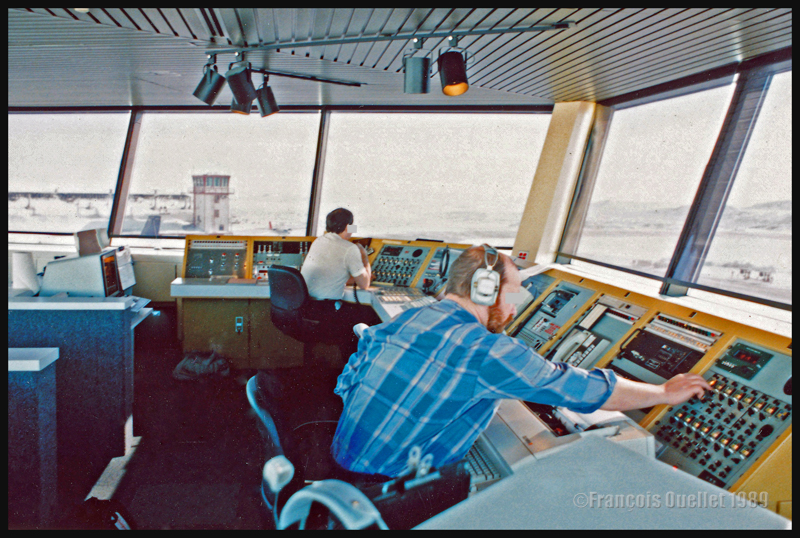
Flight service specialists at work at the Iqaluit flight service station in 1989

But for many weeks in February and March, the radio communications were blocked by a solar storm that was strong enough to cause problems to the Hydro-Québec electrical network. The entire province of Quebec suffered an electrical power blackout that lasted nine hours on March 13th.

During a major solar storm, the full spectrum of HF frequencies can become useless for frequent periods varying from ten minutes to an hour.

I remember several problematic cases, among which one where an area control center controller asked us to contact an airliner to know if the pilot could climb to 37,000 feet once at 70 degree west. The question was transmitted to the pilot and he immediately replied: “Roger, we are climbing 370”. He had not received any clearance to change his altitude but he was nonetheless starting to climb where there was no adequate separation between him and other aircrafts.

We replied multiple times: “Negative, this is a question, this is not a clearance, do not climb to flight level 370”, but the pilot never replied back due to the poor quality of HF communications. The control center was quickly called back and advised of the situation.

For the remaining period of the solar storm, the flight service specialists were asked about the actual quality of the HF communications before any punctual requests was sent on radio in order to avoid problems.

For more real life stories as a FSS in Iqaluit, click on the following link: Flight service specialist (FSS) in Iqaluit

Categories
Real life stories as a flight service specialist (FSS): Iqaluit FSS

Pilots surprised by the extreme weather prevailing in Iqaluit

The Transport Canada flight service specialists (FSS) in Iqaluit were sometimes amazed by the type of clothing chosen by pilots who were ferrying aircrafts from Europe to America.

Small and mid-size aircrafts required a flight plan including a stopover in Iqaluit, on Baffin Island, since refueling was necessary. One would think that pilots would have prepared themselves for unexpected situations and plan according to the extreme weather conditions prevailing at some of the airports along their route to America.

The FSS staff witnessed, on numerous occasions, small jets experience serious problems while refueling under very cold temperature. While the tanks were being filled up, the tires were deflating progressively.

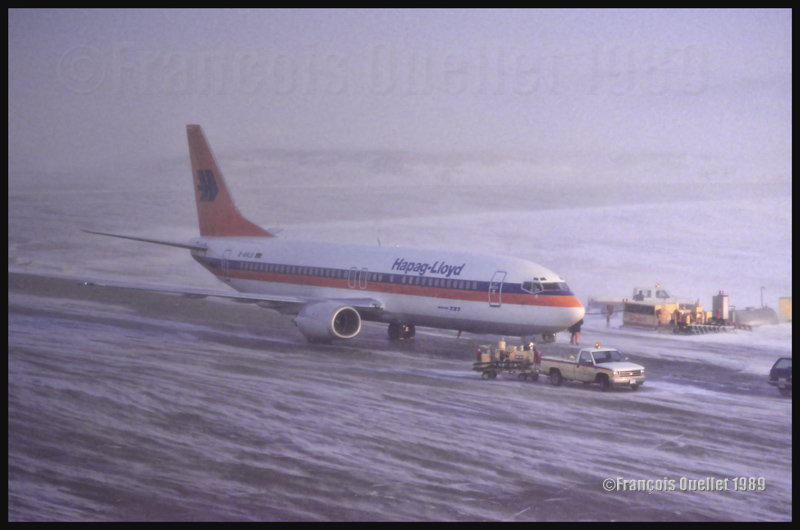
Hapag Lloyd D-AHLO B737-4K5 in its delivery flight in 1989, from Boeing Field (KBFI) to Iqaluit, and then towards Germany. It is being refueled during difficult weather conditions. This type of aircraft did not experience much problem with the cold weather, but it was not the case with smaller business jets

A small delay in the operations and the engines did not start anymore. The pilots got out of their aircraft, wearing only a thin leather jacket and summer shoes. Trying to protect themselves from the bitter cold, they gesticulated while talking with the fuel man who, himself, was wearing a thick Arctic suit that protected him from head to toes.

A thin leather jacket and summer shoes were certainly appropriate for Southern Europe but far from being useful on the apron of an airport where the wind chill factor often varied between -50C and -65C. The aircraft sometimes had to be towed in a hangar in order to be warmed up for hours, if not the night, and the transit fees grew exponentially.

I suppose that a pilot who lived such an experience remembers it today as clearly as the FSS staff, but not for the same reasons. And it is almost certain that he prepared accordingly for the next ferry flight.

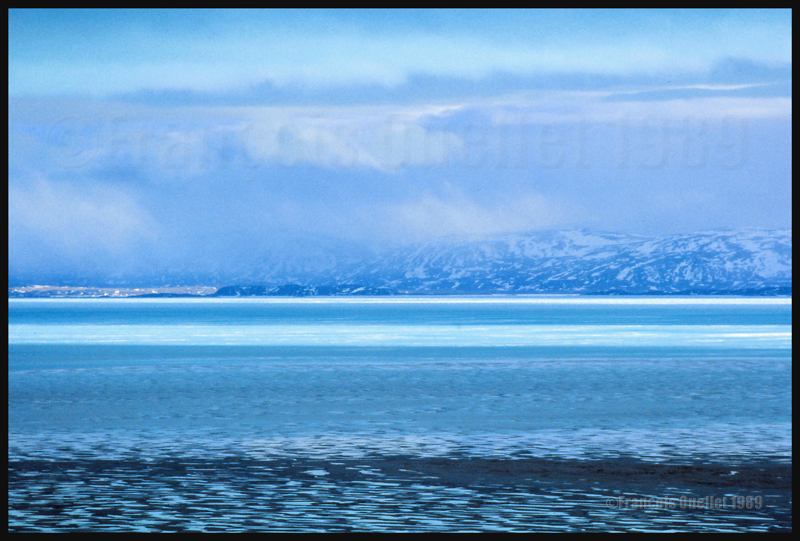
Mountains around Iqaluit, during a nice day when there is still ice in the bay. The blue tones are absolutely magnificent.

For more real life stories as a FSS in Iqaluit, click on the following link: Flight service specialist (FSS) in Iqaluit

Categories
Real life stories as a flight service specialist (FSS): Iqaluit FSS

Iqaluit FSS and the Persian Gulf War

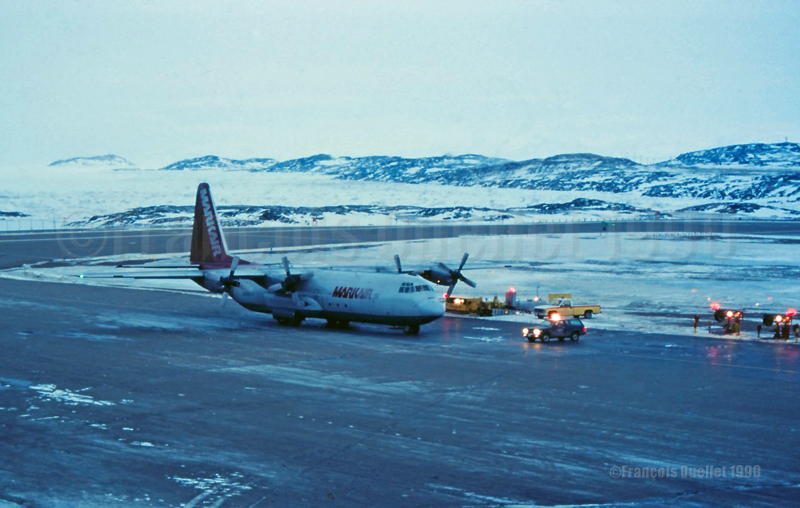
Markair L-382 on a stopover in Iqaluit in 1990

In August 1990, Iraq invaded Kuwait. This invasion was unanimously condemned, even by countries that are traditionally aligned with Iraq. The United Nations reacted by giving Iraq up to January 15th 1991 to withdraw. But Saddam Hussein’s attitude clearly showed that there would be no withdrawal and that he intended to proceed with Kuwait annexation to the Iraqi territory.

Understanding that military force would obviously be necessary, United States (representing a coalition of 34 countries) started preparing for the conflict. Aircraft movements increased and short range military aircrafts that would have to cross the Atlantic used Iqaluit, on Baffin Island, as a stopover before continuing through Greenland, Iceland, Europe and finally the Middle East.

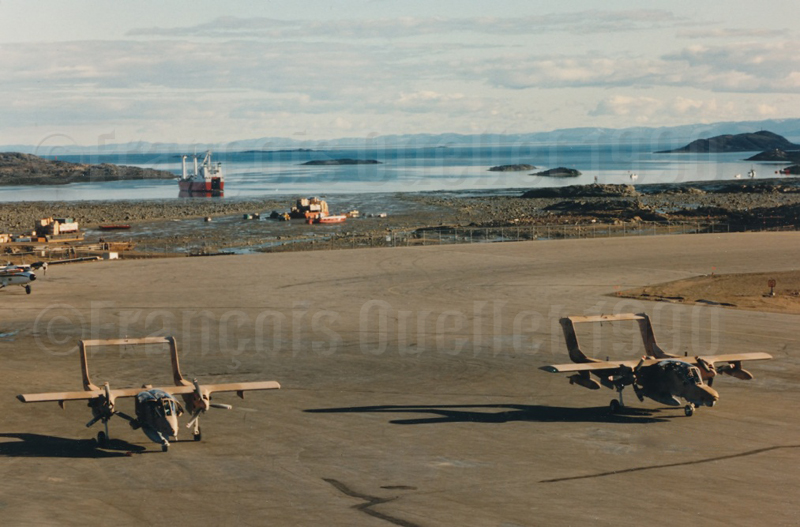
OV-10 Broncos transiting through Iqaluit in 1990 and heading for the Persian Gulf

Starting summer 1990, the Iqaluit airport then became one of the mandatory stopovers towards Middle East for some military aircrafts. Soon we could see L-382s carrying large size items and some OV-10 Broncos painted with desert colors landing in Iqaluit. Later on during autumn, other specially equipped aircrafts like the U.S.Army RU-21 Guardrail Common Sensor also made stopovers in Iqaluit.

RU-21 Guardrail Common Sensor on a stopover in Iqaluit in 1990 and heading for the Persian Gulf

A Southern Air Transport L-382 also landed in Iqaluit. That company was sometimes used by the CIA for its operations.

Southern Air Transport L-382 N908SJ transiting through Iqaluit in 1990

As soon as a flight service specialist (FSS) was not busy with radio communications, he would head toward the briefing counter to receive the military pilots who had come to obtain the mandatory weather and flight planning information that would be used to safely cross the Atlantic.

HF frequencies used for international communications at the local Transport Canada flight service station were really busy. On top of the regular air traffic services normally associated with commercial aircrafts crossing the Atlantic, we were now dealing with the radio communications associated with numerous military cargo aircrafts like the C-5s Galaxy and others.

In the two weeks preceding the United Nations ultimatum, between January 1st and 15th 1991, the Iqaluit flight service station recorded a 266 % increase against the same period in 1990 in oceanic traffic transiting through its airport. Flights were mostly related with private or chartered business jets linked to international banks, petroleum companies and military organizations preparing for the events to come. We received, among others, aircraft types like the G1, G2, G3, G4, HS25, DA50, DA90, CL60, C550, LR25 and B-727.

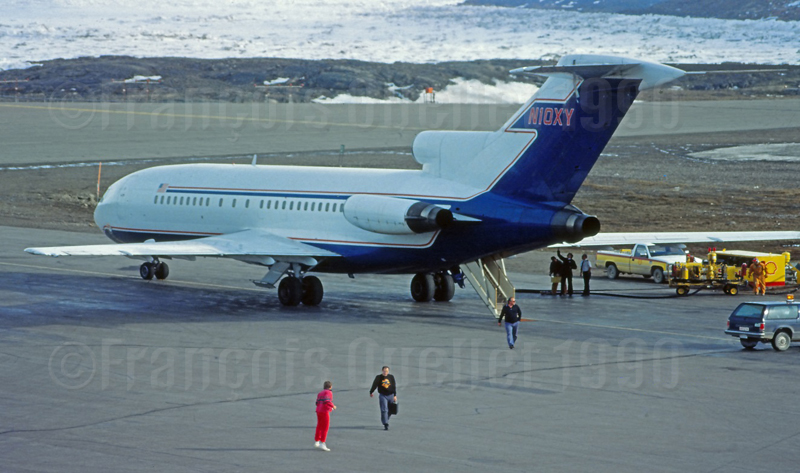
Occidental Petroleum B-727 N10XY on a stopover in Iqaluit in 1990

One night of January 1991, while we were at work, one member of the staff took-off his headphones and calmly told me: “Son, the war has started”.

I will remember that special period since we did not receive a military training but, nonetheless, we witnessed and dealt with the preparation and aircraft movements associated with a major military conflict.

Moreover, for a short period, the Iqaluit airport reverted to the use it had initially been planned and built for in 1942, during the Second World War, which was a base created for short-range military aircrafts heading to Europe.

For more real life stories as a FSS in Iqaluit, click on the following link: Flight service specialist (FSS) in Iqaluit

Categories
Real life stories as a flight service specialist (FSS): Iqaluit FSS

Two Polish asylum seekers in Iqaluit

(Precedent story: the lady who was robbed before my eyes)

A Trans Ocean Airways DC-8-71 and a Sterling Boeing B-727 in Iqaluit (1989). View from the Iqaluit flight service station.

On a 1989 autumn night in Iqaluit, on Baffin Island, Sterling’s Boeing 727 arrived from Europe and parked near the fuel tanks. From the Transport Canada flight service station tower (FSS), we could see the Canadian Customs and RCMP vehicles parked near the airplane, which was unusual. There was something going on as there were many people standing by the rear door of the plane, moving from one vehicle to the other. That was sure a lengthy stopover.

Few days later, on October 2nd 1989, the Journal de Montréal (one of the Montreal newspaper) published the following article: “[my translation] Two Polish citizen who had planned to request asylum in Newfoundland during the technical stopover of their plane on a flight from Gdansk to Vancouver were told on Saturday, by Canadian authorities, that the plane had landed in Canada’s far North”.

The article continues: “[my translation] The two men, whose identity was kept secret, still requested political asylum, said a RCMP police officer from Iqaluit, on Baffin Island in the Arctic. The Polish citizens, who were on a trip to relieve some fishermen on the west coast of Canada, thought they were in St John’s, Newfoundland capital, indicated the policeman in charge, Corporal Gary Asels”.

“The custom officer, using a map, showed them where Iqaluit [in the Nunavut] was located (2100 kilometers north of Montreal). They could not care less, as long as they were in Canada. They were very happy to be here, commented corporal Asels”.

I was told that in order to succeed with their escape from the plane, they had chosen a seat close to the rear stairway of the Boeing 727. They made sure to look like they were sleeping. When the stairway was lowered and the surveillance suspended for a quick moment, the two men just escaped through the stairway and were immediately on Canadian soil.

I am unfortunately unable to confirm today if they have been received as Canadian citizen or if they have been sent back in their country of origin.

(Next story: Iqaluit and the Persian Gulf War)

For more real life stories as a FSS in Iqaluit, click on the following link: Flight service specialist (FSS) in Iqaluit